warning JEEP WRANGLER 2006 TJ / 2.G Owner's Manual
[x] Cancel search | Manufacturer: JEEP, Model Year: 2006, Model line: WRANGLER, Model: JEEP WRANGLER 2006 TJ / 2.GPages: 368, PDF Size: 14.3 MB
Page 36 of 368

The child seat is held in the vehicle by the lap belt,
lap/shoulder belt, or the LATCH child restraint an-
chorage system.
•The belt-positioning booster seat is for children weigh-
ing more than 40 lbs (18 kg), but who are still too small
to fit in the vehicle’s seat belts properly. If the child
cannot sit with knees bent over the seat cushion while
the child’s back is against the seat back, they should
use a belt-positioning booster seat. The child and
booster seat are held in the vehicle by lap/shoulder
belt. (Some booster seats are equipped with a front
shield and are held in the vehicle by the lap portion or
lap belt.)
•For additional information refer to www.seatcheck.org
or call 1-866-SEATCHECK.
WARNING!
•Improper installation can lead to failure of an
infant or child restraint. It could come loose in a
collision. The child could be badly injured or
killed. Follow the manufacturer’s directions ex-
actly when installing an infant or child restraint.
•A rearward facing infant restraint should only be
used in a rear seat unless the passenger frontal
airbag is turned off. If the airbag is left on, a
rearward facing infant restraint in the front seat
may be struck by a deploying passenger airbag
which may cause severe or fatal injury to the
infant.
36 THINGS TO KNOW BEFORE STARTING YOUR VEHICLE
Page 41 of 368

Many, but not all restraint systems will be equipped with
separate straps on each side, with each having a hook or
connector for attachment to the lower anchorage and a
means of adjusting the tension in the strap. Forward-
facing toddler restraints and some rear-facing infant
restraints will also be equipped with a tether strap, a
hook for attachment to the tether strap anchorage and a
means of adjusting the tension of the strap.
You will first loosen the adjusters on the lower straps and
on the tether strap so that you can more easily attach the
hooks or connectors to the vehicle anchorages. Next
attach the lower hooks or connectors over the top of the
anchorage bars, pushing aside the seat cover material.
Then, attach the tether strap to the rear tether anchorage,
being careful to route the tether strap to provide the most
direct path between the anchor and the child restraint. If
the Add-A-Trunk™ option is present in the vehicle, the
lid should be opened and positioned against the back of
the rear seat prior to attaching and adjusting the strap. Finally, tighten all three straps as you push the child
restraint rearward and downward into the seat, remov-
ing slack in the straps according to the child restraint
manufacturer’s instructions.
WARNING!
Improper installation of a child restraint to the
LATCH anchorages can lead to failure of an infant or
child restraint. The child could be badly injured or
killed. Follow the manufacturer’s directions exactly
when installing an infant or child restraint.
THINGS TO KNOW BEFORE STARTING YOUR VEHICLE 41
2
Page 43 of 368
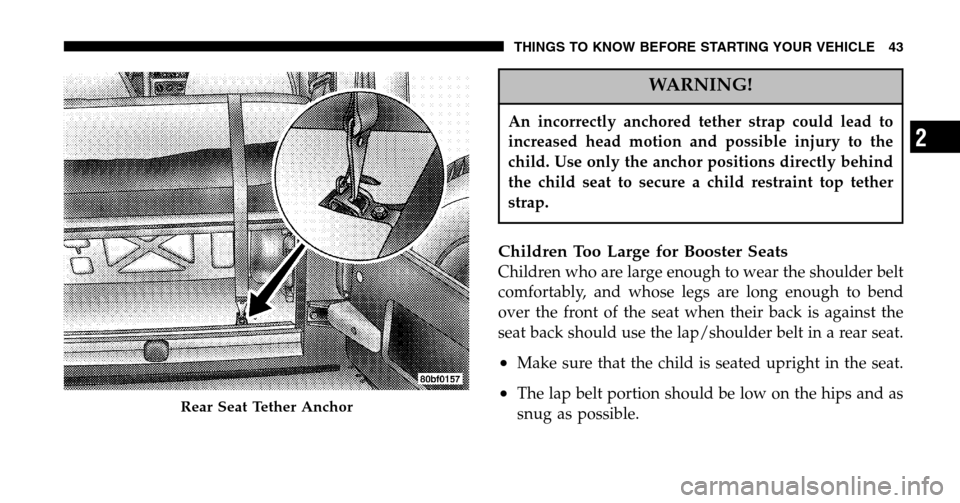
WARNING!
An incorrectly anchored tether strap could lead to
increased head motion and possible injury to the
child. Use only the anchor positions directly behind
the child seat to secure a child restraint top tether
strap.
Children Too Large for Booster Seats
Children who are large enough to wear the shoulder belt
comfortably, and whose legs are long enough to bend
over the front of the seat when their back is against the
seat back should use the lap/shoulder belt in a rear seat.
•Make sure that the child is seated upright in the seat.
•The lap belt portion should be low on the hips and as
snug as possible.Rear Seat Tether Anchor
THINGS TO KNOW BEFORE STARTING YOUR VEHICLE 43
2
Page 45 of 368

A new engine may consume some oil during its first few
thousand miles (kilometers) of operation. This should be
considered as a normal part of the break-in and not
interpreted as an indication of difficulty.
SAFETY TIPS
Exhaust Gas
WARNING!
Exhaust gases can injure or kill. They contain carbon
monoxide (CO) which is colorless and odorless.
Breathing it can make you unconscious and can
eventually poison you. To avoid breathing (CO)
follow the safety tips below.
•Do not inhale exhaust gases. They contain carbon
monoxide, a colorless and odorless gas which can kill.
Never run the engine in a closed area, such as a garage, and never sit in a parked vehicle with the
engine running for a extended period. If the vehicle is
stopped in an open area with engine running for more
than a short period, adjust the ventilation system to
force fresh, outside air into the vehicle.
•Guard against carbon monoxide with proper mainte-
nance. Have the exhaust system inspected every time
the vehicle is raised. Have any abnormal conditions
repaired promptly. Until repaired, drive with all side
windows fully open.
•Always run the climate control in panel or floor mode
when driving with any windows open, even if only
slightly, to help keep fresh air circulating inside ve-
hicle. Otherwise poisonous gases could be drawn into
the vehicle.
THINGS TO KNOW BEFORE STARTING YOUR VEHICLE 45
2
Page 46 of 368

•On hardtop models, keep the tailgate window closed
when driving your vehicle. On fabric top models, do
not drive with the rear window curtain up unless the
side curtains are also open. This will prevent carbon
monoxide and other poisonous exhaust gases from
entering the vehicle.
Safety Checks You Should Make Inside The
Vehicle
Seat Belts
Inspect the belt system periodically, checking for cuts,
frays and loose parts. Damaged parts must be replaced
immediately. Do not disassemble or modify the system.
Seat belt assemblies must be replaced after an accident if
they have been damaged (bent retractor, torn webbing,
etc.). If there is any question regarding belt or retractor
condition, replace the belt.
Airbag Warning Light
The light should come on and remain on for 6 to 8
seconds as a indicator check when the ignition switch is
first turned on. If the indicator is not lit during starting,
have it serviced. If the light stays on or comes on while
driving, have the system checked by an authorized
dealer.
Defrosters
Check operation by selecting the defrost mode and place
the blower control on high speed. You should feel the air
directed against the windshield.
46 THINGS TO KNOW BEFORE STARTING YOUR VEHICLE
Page 57 of 368
WARNING!
•Vehicles and other objects seen in the right side
convex mirror will look smaller and farther away
than they really are. Relying too much on your
right side mirror could cause you to collide with
another vehicle or other object.
•Use your inside mirror when judging the size or
distance of a vehicle seen in the right side mirror.
SEATS
WARNING!
Adjusting a seat while the vehicle is moving is
dangerous. The sudden movement of the seat could
cause you to lose control. The seat belt might not be
properly adjusted and you could be injured. Adjust
any seat only while the vehicle is parked.
UNDERSTANDING THE FEATURES OF YOUR VEHICLE 57
3
Page 59 of 368
WARNING!
Do not ride with the seatback reclined so that the
shoulder belt is no longer resting against your chest.
In a collision you could slide under the seat belt and
be seriously or even fatally injured. Use the recliner
only when the vehicle is parked.
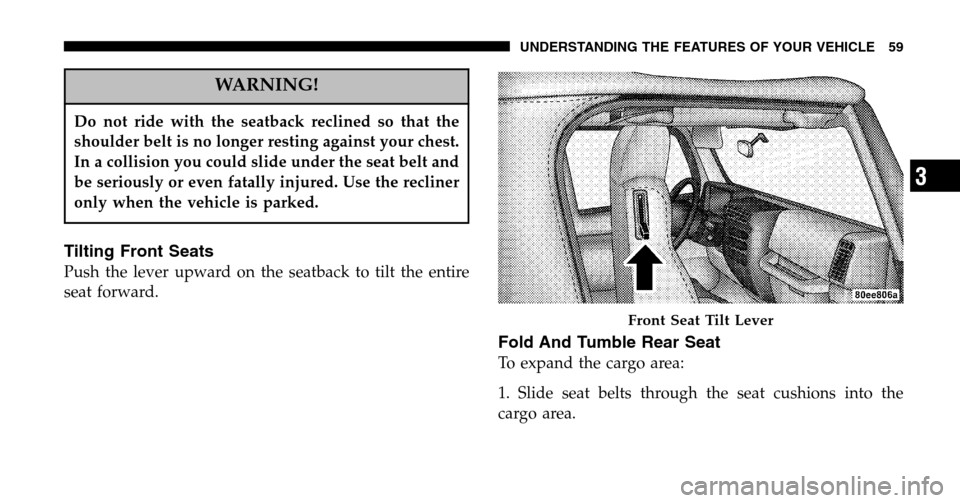
Tilting Front Seats
Push the lever upward on the seatback to tilt the entire
seat forward.
Fold And Tumble Rear Seat
To expand the cargo area:
1. Slide seat belts through the seat cushions into the
cargo area.
Front Seat Tilt Lever
UNDERSTANDING THE FEATURES OF YOUR VEHICLE 59
3
Page 61 of 368
Removing the Rear Seat
WARNING!
•It is extremely dangerous to ride in a cargo area,
inside or outside of a vehicle. In a collision people
riding in these areas are more likely to be seri-
ously injured or killed.
•Do not allow people to ride in any area of your
vehicle that is not equipped with seats and seat
belts.
•Be sure everyone in your vehicle is in a seat and
using a seat belt properly.
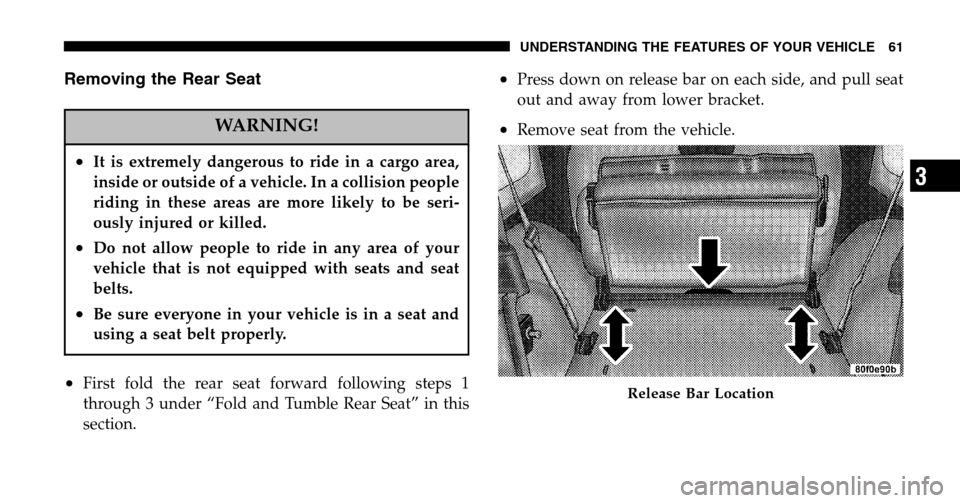
•First fold the rear seat forward following steps 1
through 3 under “Fold and Tumble Rear Seat” in this
section.
•Press down on release bar on each side, and pull seat
out and away from lower bracket.
•Remove seat from the vehicle.
Release Bar Location
UNDERSTANDING THE FEATURES OF YOUR VEHICLE 61
3
Page 62 of 368

Replacing the Rear Seat
Reverse steps for removing the seat. Be certain to pull the
seat belts between the seat cushion and seatback. Position
them for passenger use.
WARNING!
•To help protect against personal injury, passen-
gers should not be seated in the rear cargo area
with the rear seat folded down or removed from
the vehicle.
•The rear cargo space is intended for load carrying
purposes only, not for passengers, who should sit
in seats and use seat belts.
TO OPEN AND CLOSE THE HOOD
To open hood, first release both hood latches.
Hood Latch Location
62 UNDERSTANDING THE FEATURES OF YOUR VEHICLE
Page 63 of 368

Next, locate handle in middle of the front end of the
hood. Insert hand into gap between hood and radiator
support and lift up on handle to raise hood. You may
have to push down slightly on hood before lifting up on
handle. Insert the support rod into the slot in the radiator
support. To close the hood, remove the support rod from the
radiator support and place it in the retaining clip. Lower
the hood slowly, then let it drop the last few inches.
Secure both of the hood latches.
WARNING!
If the hood is not fully latched, it could fly up when
the vehicle is moving and block your forward vision.
Be sure all hood latches are latched fully before
driving.
Hood Latch
UNDERSTANDING THE FEATURES OF YOUR VEHICLE 63
3