ignition JEEP WRANGLER 2008 JK / 3.G Repair Manual
[x] Cancel search | Manufacturer: JEEP, Model Year: 2008, Model line: WRANGLER, Model: JEEP WRANGLER 2008 JK / 3.GPages: 466, PDF Size: 8.97 MB
Page 282 of 466
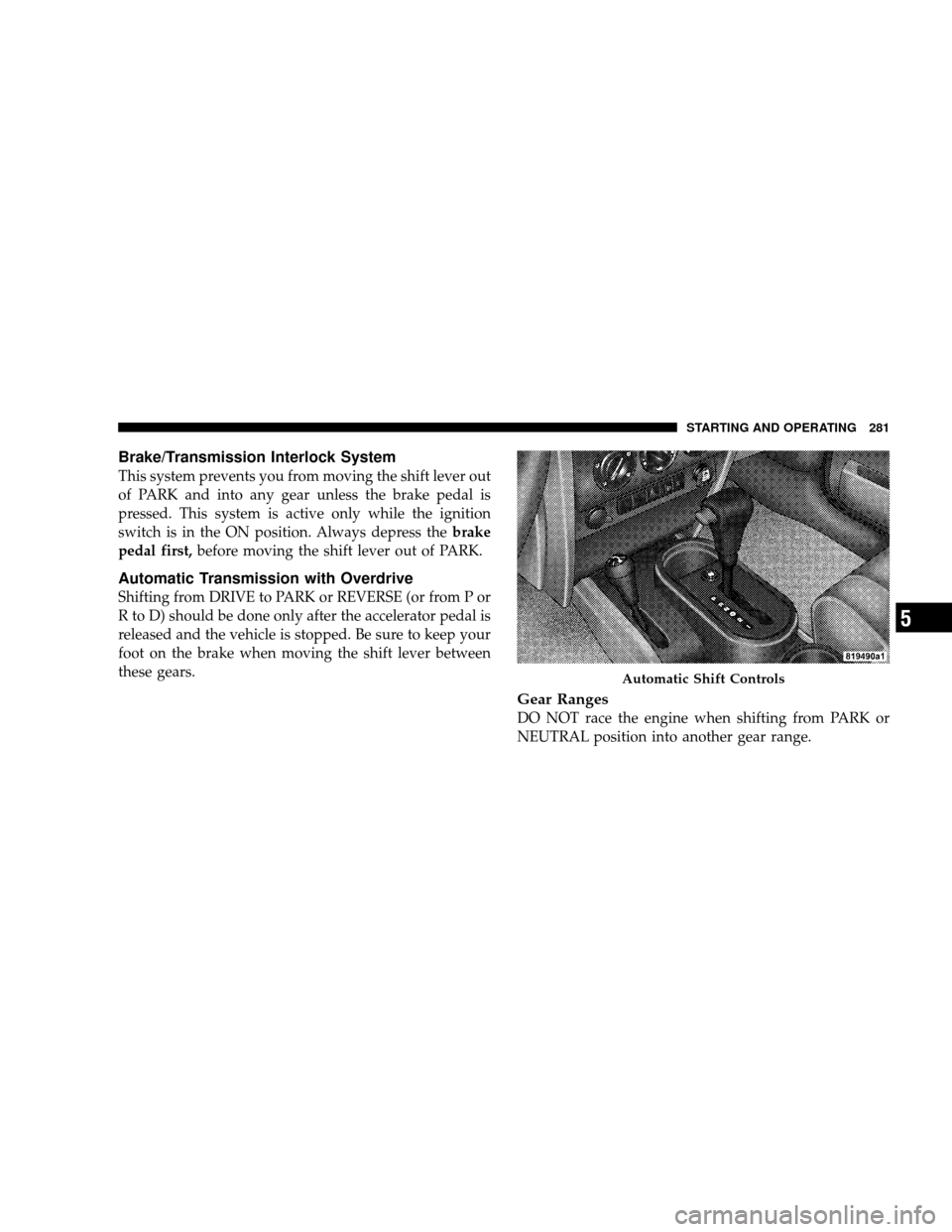
Brake/Transmission Interlock System
This system prevents you from moving the shift lever out
of PARK and into any gear unless the brake pedal is
pressed. This system is active only while the ignition
switch is in the ON position. Always depress thebrake
pedal first, before moving the shift lever out of PARK.
Automatic Transmission with Overdrive
Shifting from DRIVE to PARK or REVERSE (or from P or
R to D) should be done only after the accelerator pedal is
released and the vehicle is stopped. Be sure to keep your
foot on the brake when moving the shift lever between
these gears.
Gear Ranges
DO NOT race the engine when shifting from PARK or
NEUTRAL position into another gear range.
Automatic Shift Controls
STARTING AND OPERATING 281
5
Page 285 of 466
Overdrive can be locked out by pressing the O/D OFF
switch located on the center console. The O/D OFF
indicator light (on the switch) will illuminate to show
that the switch has been activated. When the indicator
light is on, Overdrive is locked out. Pressing the switch a
second time restores the Overdrive function. The lockout
feature is useful when towing a trailer or carrying a
heavy load.
2 (Second)
For moderate grades and to assist braking on dry pave-
ment or in mud and snow. Begins from a stop in low gear
with automatic upshift to 2nd gear. Will not shift to 3rd.
1 (First)
For hard pulling at low speeds in mud, sand, snow, or on
steep grades. Begins and stays in low gear with no
upshift. Provides engine compression braking at low
speeds.CAUTION!
•Before moving the shift lever out of PARK, you
must turn the ignition from LOCK so the steering
wheel and shift lever are released. Otherwise,
damage to steering column or shift lever could
result.
•Never race the engine with the brakes on and the
vehicle in gear, and never hold the vehicle on an
incline without applying the brakes. These prac-
tices can overheat and damage the transmission.
•When “rocking” a stuck vehicle by moving be-
tween DRIVE and REVERSE, do not spin the
wheels faster than 15 mph (24 km/h), or drivetrain
damage may result.
284 STARTING AND OPERATING
Page 291 of 466
Trac-Lok™ is especially helpful during slippery driving
conditions. With both rear wheels on a slippery surface, a
slight application of the accelerator will supply maxi-
mum traction.
WARNING!
On vehicles equipped with a limited-slip differen-
tial, never run the engine with one rear wheel off the
ground. The vehicle may drive through the rear
wheel remaining on the ground and cause you to lose
control of your vehicle.
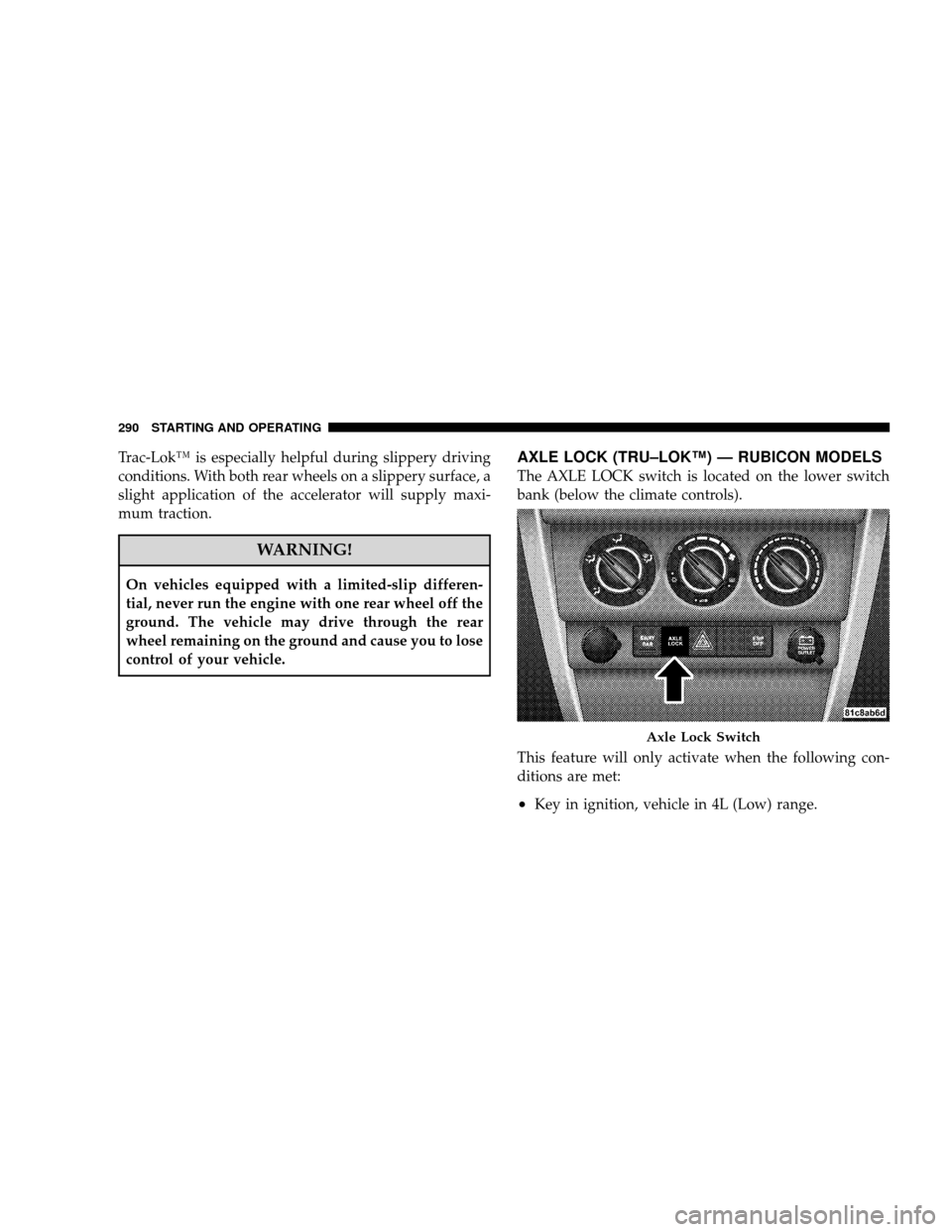
AXLE LOCK (TRU–LOK™) — RUBICON MODELS
The AXLE LOCK switch is located on the lower switch
bank (below the climate controls).
This feature will only activate when the following con-
ditions are met:
•Key in ignition, vehicle in 4L (Low) range.
Axle Lock Switch
290 STARTING AND OPERATING
Page 292 of 466
•Vehicle speed should be 10 mph (16 km/h) or less.
To activate the system, press the bottom of the AXLE
LOCK switch once to lock the rear axle only (the Rear
Axle Lock Indicator Light will illuminate), press the
bottom of the switch again to lock the front axle (the
Front Axle Lock Indicator Light will illuminate). When
the rear axle is locked, pressing the switch again will lock
or unlock the front axle.
NOTE: The indicator lights will flash until the axles are
fully locked or unlocked.
To unlock the axles, press the top of the AXLE LOCK
switch.
Axle lock will disengage if the vehicle is taken out of 4L
(Low) range, or the ignition switch is turned to the OFF
position.REAR AXLE LOCK — 4WD NON-RUBICON
MODELS (IF EQUIPPED)
The REAR AXLE LOCK switch is located on the lower
switch bank (below the climate controls).
This feature will only activate when the following con-
ditions are met:
•Key in ignition, vehicle in 4L (Low) range.
•Vehicle speed should be 10 mph (16 km/h) or less.
To activate the system, press the REAR AXLE LOCK
switch down to lock the rear axle (the Rear Axle Lock
Indicator Light will illuminate), press the switch up to
unlock the rear axle.
NOTE: The indicator lights will flash until the axle is
fully locked or unlocked.
STARTING AND OPERATING 291
5
Page 293 of 466
The rear axle lock will disengage if the vehicle is taken
out of 4L (Low) range, or the ignition switch is turned to
the OFF position.
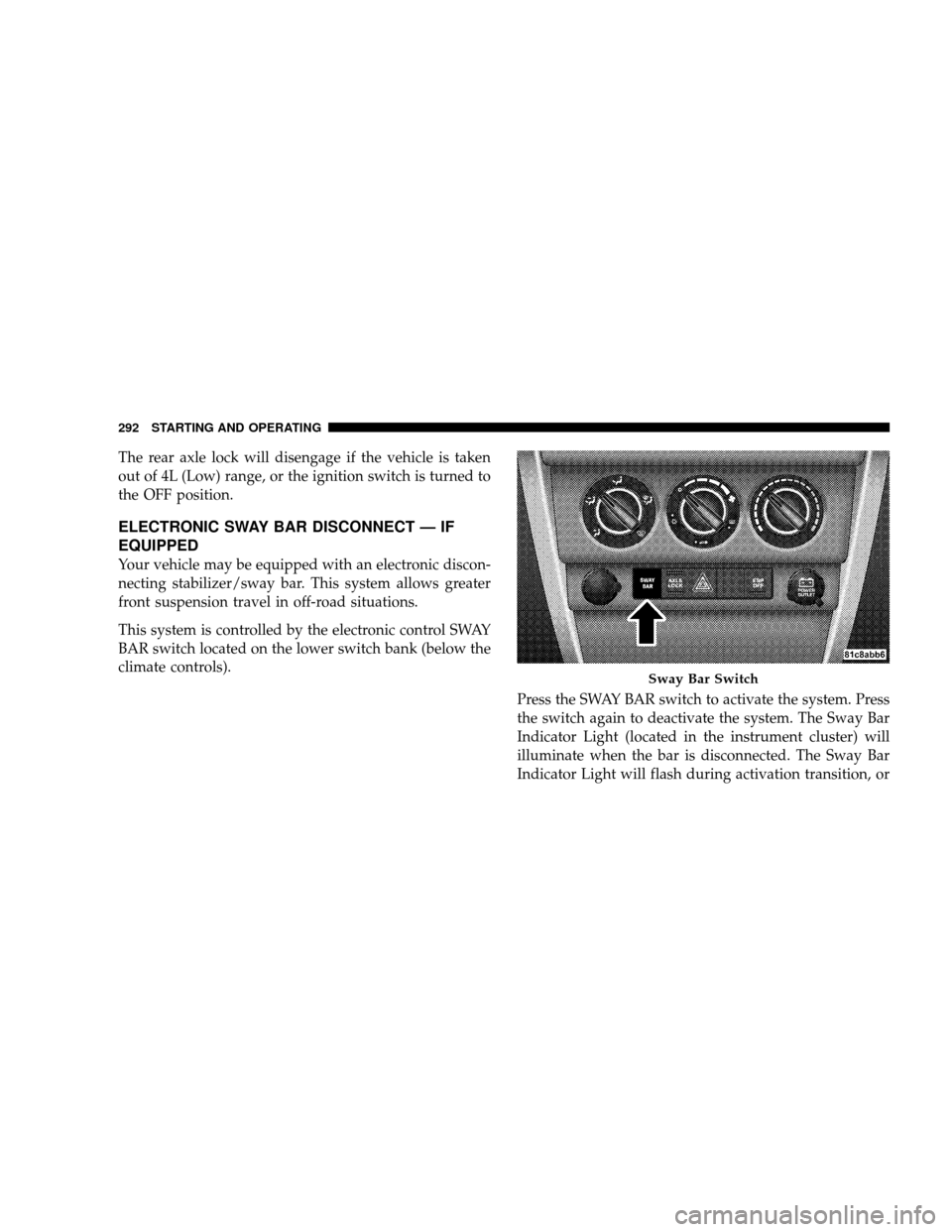
ELECTRONIC SWAY BAR DISCONNECT — IF
EQUIPPED
Your vehicle may be equipped with an electronic discon-
necting stabilizer/sway bar. This system allows greater
front suspension travel in off-road situations.
This system is controlled by the electronic control SWAY
BAR switch located on the lower switch bank (below the
climate controls).Press the SWAY BAR switch to activate the system. Press
the switch again to deactivate the system. The Sway Bar
Indicator Light (located in the instrument cluster) will
illuminate when the bar is disconnected. The Sway Bar
Indicator Light will flash during activation transition, or
Sway Bar Switch
292 STARTING AND OPERATING
Page 309 of 466
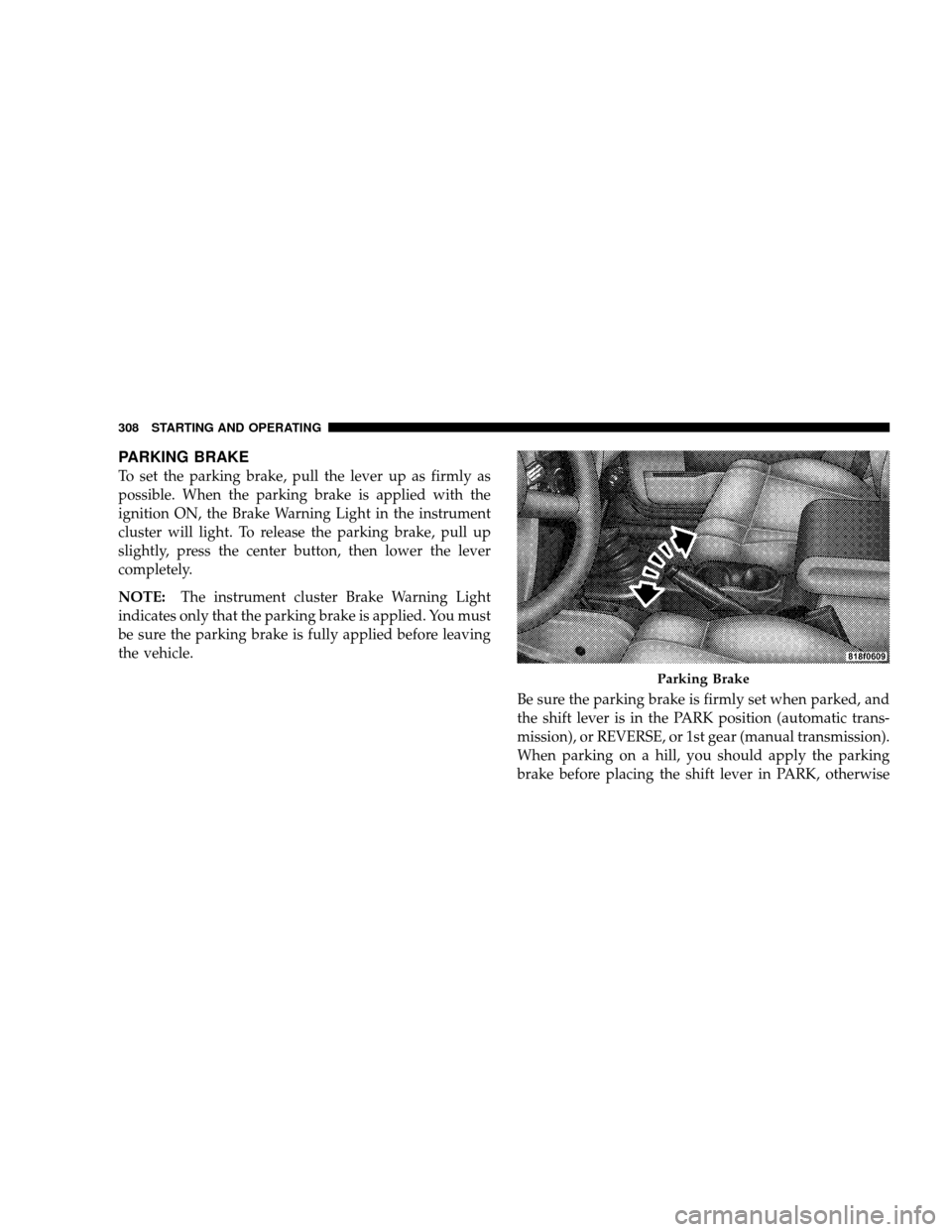
PARKING BRAKE
To set the parking brake, pull the lever up as firmly as
possible. When the parking brake is applied with the
ignition ON, the Brake Warning Light in the instrument
cluster will light. To release the parking brake, pull up
slightly, press the center button, then lower the lever
completely.
NOTE:The instrument cluster Brake Warning Light
indicates only that the parking brake is applied. You must
be sure the parking brake is fully applied before leaving
the vehicle.
Be sure the parking brake is firmly set when parked, and
the shift lever is in the PARK position (automatic trans-
mission), or REVERSE, or 1st gear (manual transmission).
When parking on a hill, you should apply the parking
brake before placing the shift lever in PARK, otherwise
Parking Brake
308 STARTING AND OPERATING
Page 310 of 466
the load on the transmission locking mechanism may
make it difficult to move the shifter out of PARK.
WARNING!
•Always fully apply the parking brake when leav-
ing your vehicle, or it may roll and cause damage
or injury. Also, be certain to leave an automatic
transmission in PARK, a manual transmission in
REVERSE or 1st gear. Failure to do so may allow
the vehicle to roll and cause damage or injury.
•Never leave children alone in a vehicle. Leaving
unattended children in a vehicle is dangerous for a
number of reasons. A child or others could be
seriously or fatally injured. Do not leave the key in
the ignition. A child could operate power win-
dows, other controls, or move the vehicle.When parking on a hill, turn the front wheels toward the
curb on a downhill grade and away from the curb on an
uphill grade.
The parking brake should always be applied whenever
the driver is not in the vehicle.
ANTI-LOCK BRAKE SYSTEM
The Anti-Lock Brake System (ABS) is designed to aid the
driver in maintaining vehicle control under adverse
braking conditions. The system operates with a separate
computer to modulate hydraulic pressure to prevent
wheel lock-up and help avoid skidding on slippery
surfaces.
All vehicle wheels and tires must be the same size and
type and tires must be properly inflated to produce
accurate signals for the computer.
STARTING AND OPERATING 309
5
Page 311 of 466
WARNING!
Significant over or under-inflation of tires, or mixing
sizes of tires or wheels on the vehicle can lead to loss
of braking effectiveness.
The Anti-Lock Brake System conducts a low speed self-
test at about 12 mph (20 km/h). If for any reason, your
foot is on the brake when the vehicle reaches 12 mph (20
km/h), this check will be delayed until 25 mph (40
km/h).
The Anti-Lock Brake System pump motor runs during
the self-test, and during an ABS stop, to provide the
regulated hydraulic pressure. The motor pump makes a
low humming noise during operation, this is normal. During off-road use, loss of traction can temporarily
defeat the system and cause the warning light to illumi-
nate. Turn the ignition OFF and ON again to restore
Anti-Lock Brake System function.
WARNING!
Pumping of the Anti-Lock Brakes will diminish their
effectiveness and may lead to an accident. Pumping
makes the stopping distance longer. Just press firmly
on your brake pedal when you need to slow down or
stop.
310 STARTING AND OPERATING
Page 335 of 466
inflation pressure of each tire on your vehicle, and inflate
each tire to the vehicle’s recommended cold placard
pressure value. The system will automatically update
and the Tire Pressure Monitoring Telltale Light will
extinguish once the updated tire pressures have been
received. The vehicle may need to be driven for up to 10
minutes above 15 mph (25 km/h) to receive this infor-
mation.
The Tire Pressure Monitoring Telltale Light will flash on
and off for 75 seconds, and will remain on solid when a
system fault is detected. The system fault will also sound
a chime. If the ignition key is cycled, this sequence will
repeat, providing the system fault still exists. A system
fault can occur by any of the following scenarios:
1. Jamming due to electronic devices or driving next to
facilities emitting the same Radio Frequencies as the TPM
sensors.
2. Installing some form of aftermarket window tinting
that affects radio wave signals.3. Lots of snow or ice around the wheels or wheel
housings.
4. Using tire chains on the vehicle.
5. Using wheels/tires not equipped with TPM sensors.
NOTE:
If your vehicle is equipped with a matching
full-size spare wheel and tire assembly, it has a tire
pressure monitoring sensor, and can be monitored by the
Tire Pressure Monitoring System (TPMS). In the event
that the matching full-size spare tire is swapped with a
low pressure road tire, the next ignition key cycle will
still show the Tire Pressure Monitoring Telltale Light to
be ON, and a chime to sound. Driving the vehicle for up
to 10 minutes above 15 mph (25 km/h) will turn OFF the
Tire Pressure Monitoring Telltale Light as long as none of
the road tires are below the low pressure warning thresh-
old.
334 STARTING AND OPERATING
Page 336 of 466
NOTE:If your vehicle is not equipped with a matching
full-size spare wheel and tire assembly, it does not have a
tire pressure monitoring sensor in the spare tire. The
TPMS will not be able to monitor the tire pressure. If you
install the spare tire in place of a road tire that has a
pressure below the low-pressure warning limit, upon the
next ignition key cycle, a chime will sound and the Tire
Pressure Monitoring Telltale Light will turn ON. After
driving the vehicle for up to 10 minutes above 15 mph (25
km/h), the Tire Pressure Monitoring Telltale Light will
flash on and off for 75 seconds and then remain on solid.
For each subsequent ignition key cycle, a chime will
sound and the Tire Pressure Monitoring Telltale Light
will flash on and off for 75 seconds and then remain on
solid. Once you repair or replace the original road tire,
and reinstall it on the vehicle in place of the spare tire, the
TPMS will update automatically and the Tire Pressure
Monitoring Telltale Light will turn OFF, as long as no tire
pressure is below the low-pressure warning limit in any of the four active road tires. The vehicle may need to be
driven for up to 10 minutes above 15 mph (25 km/h) in
order for the TPMS to receive this information.
General Information
This device complies with part 15 of the FCC rules and
RSS 210 of Industry Canada. Operation is subject to the
following conditions:
•This device may not cause harmful interference.
•This device must accept any interference received,
including interference that may cause undesired op-
eration.
The tire pressure sensors are covered under one of the
following licenses:
United States ..................... KR5S120123
Canada ........................ 2671-S120123
STARTING AND OPERATING 335
5