belt JEEP WRANGLER 2008 User Guide
[x] Cancel search | Manufacturer: JEEP, Model Year: 2008, Model line: WRANGLER, Model: JEEP WRANGLER 2008Pages: 466, PDF Size: 8.61 MB
Page 63 of 466
•Airbag deployment level (if applicable)
•Impact acceleration and angle
•Seat belt status
•Brake status (service and parking brakes)
•Accelerator status (including vehicle speed)
•Engine control status (including engine speed)
•Transmission gear selection
•Cruise control status
•Traction/stability control status
•Tire pressure monitoring system (TPMS) status
Child Restraint
Everyone in your vehicle needs to be buckled up at all
times — babies and children, too. Every state in the
United States and all Canadian provinces require that
small children ride in proper restraint systems. This is the
law, and you can be prosecuted for ignoring it.
Children 12 years and under should ride properly buck-
led up in a rear seat, if available. According to crash
statistics, children are safer when properly restrained in
the rear seats, rather than in the front.
There are different sizes and types of restraints for
children from newborn size to the child almost large
enough for an adult safety belt. Always check the child
seat owner’s manual to ensure you have the correct seat
for your child. Use the restraint that is correct for your
child.
62 THINGS TO KNOW BEFORE STARTING YOUR VEHICLE
Page 65 of 466
WARNING!
•Improper installation can lead to failure of an
infant or child restraint. It could come loose in a
collision. The child could be badly injured or
killed. Follow the manufacturer’s directions ex-
actly when installing an infant or child restraint.
•A rearward facing infant restraint should only be
used in a rear seat. A rearward facing infant
restraint in the front seat may be struck by a
deploying passenger airbag which may cause se-
vere or fatal injury to the infant.
Here are some tips for getting the most out of your child
restraint:
•Before buying any restraint system, make sure that it
has a label certifying that it meets all applicable Safety Standards. The manufacturer also recommends that
you try a child restraint in the vehicle seats where you
will use it before you buy it.
•The restraint must be appropriate for your child’s
weight and height. Check the label on the restraint for
weight and height limits.
•Carefully follow the instructions that come with the
restraint. If you install the restraint improperly, it may
not work when you need it.
•All seating positions (except for driver) have a auto-
matic locking retractor identified by a distinctive label.
The seat belts are designed to keep the lap portion
tight around the child restraint so that it is not
necessary to use a locking clip. For the seat belt with
the automatic locking retractor, pull the belt from the
retractor until there is enough to allow you to pass
through the child restraint and slide the latch plate
into the buckle. Then, pull the belt until it is fully
64 THINGS TO KNOW BEFORE STARTING YOUR VEHICLE
Page 67 of 466
vehicle by the lap/shoulder belt or the LATCH child
restraint anchorage system (Refer to LATCH — Child
Seat Anchorage System in this section).
The belt-positioning booster seat is for children weighing
more than 40 lbs (18 kg), but who are still too small to fit
the vehicle’s seat belts properly. If the child cannot sit
with knees bent over the vehicle’s seat cushion while the
child’s back is against the seatback, they should use a
belt-positioning booster seat. The child and belt-
positioning booster seat are held in the vehicle by the
lap/shoulder belt.
Children Too Large for Booster Seats
Children who are large enough to wear the shoulder belt
comfortably, and whose legs are long enough to bend
over the front of the seat when their back is against the
seatback, should use the lap/shoulder belt in a rear seat.
•Make sure that the child is upright in the seat.
•The lap portion should be low on the hips and as snug
as possible.
•Check belt fit periodically. A child’s squirming or
slouching can move the belt out of position.
•If the shoulder belt contacts the face or neck, move the
child closer to the center of the vehicle. Never allow a
child to put the shoulder belt under an arm or behind
the back.
Automatic-Locking Retractor (ALR)
To operate the switchable retractor, pull the belt from the
retractor until there is enough to allow you to pass
through the child restraint and slide the latch plate into
the buckle. Then pull on the belt until it is fully extended
from the retractor. Allow the belt to return into the
retractor, pulling on the excess webbing to tighten the lap
portion about the child restraint. Follow the instructions
of the child restraint manufacture.
66 THINGS TO KNOW BEFORE STARTING YOUR VEHICLE
Page 77 of 466
•Do not inhale exhaust gases. They contain carbon
monoxide, a colorless and odorless gas which can kill.
Never run the engine in a closed area, such as a
garage, and never sit in a parked vehicle with the
engine running for an extended period. If the vehicle is
stopped in an open area with the engine running for
more than a short time, adjust the ventilation system
to force fresh, outside air into the vehicle.
•Guard against carbon monoxide with proper mainte-
nance. Have the exhaust system inspected every time
the vehicle is raised. Have any abnormal conditions
repaired promptly. Until repaired, drive with all side
windows fully open.
•Always run the climate control in panel or floor mode
when driving with any windows open, even if only
slightly, to help keep fresh air circulating inside the
vehicle. Otherwise poisonous gases could be drawn
into the vehicle.
•On hardtop models, keep the tailgate window closed
when driving your vehicle. On fabric top models, do
not drive with the rear window curtain up unless the
side curtains are also open. This will prevent carbon
monoxide and other poisonous exhaust gases from
entering the vehicle.
Safety Checks You Should Make Inside The
Vehicle
Seat Belts
Inspect the seat belt system periodically, checking for
cuts, frays and loose parts. Damaged parts must be
replaced immediately. Do not disassemble or modify the
system.
Seat belt assemblies must be replaced after an accident if
they have been damaged (bent retractor, torn webbing,
etc.). If there is any question regarding seat belt or
retractor condition, replace the seat belt.
76 THINGS TO KNOW BEFORE STARTING YOUR VEHICLE
Page 95 of 466
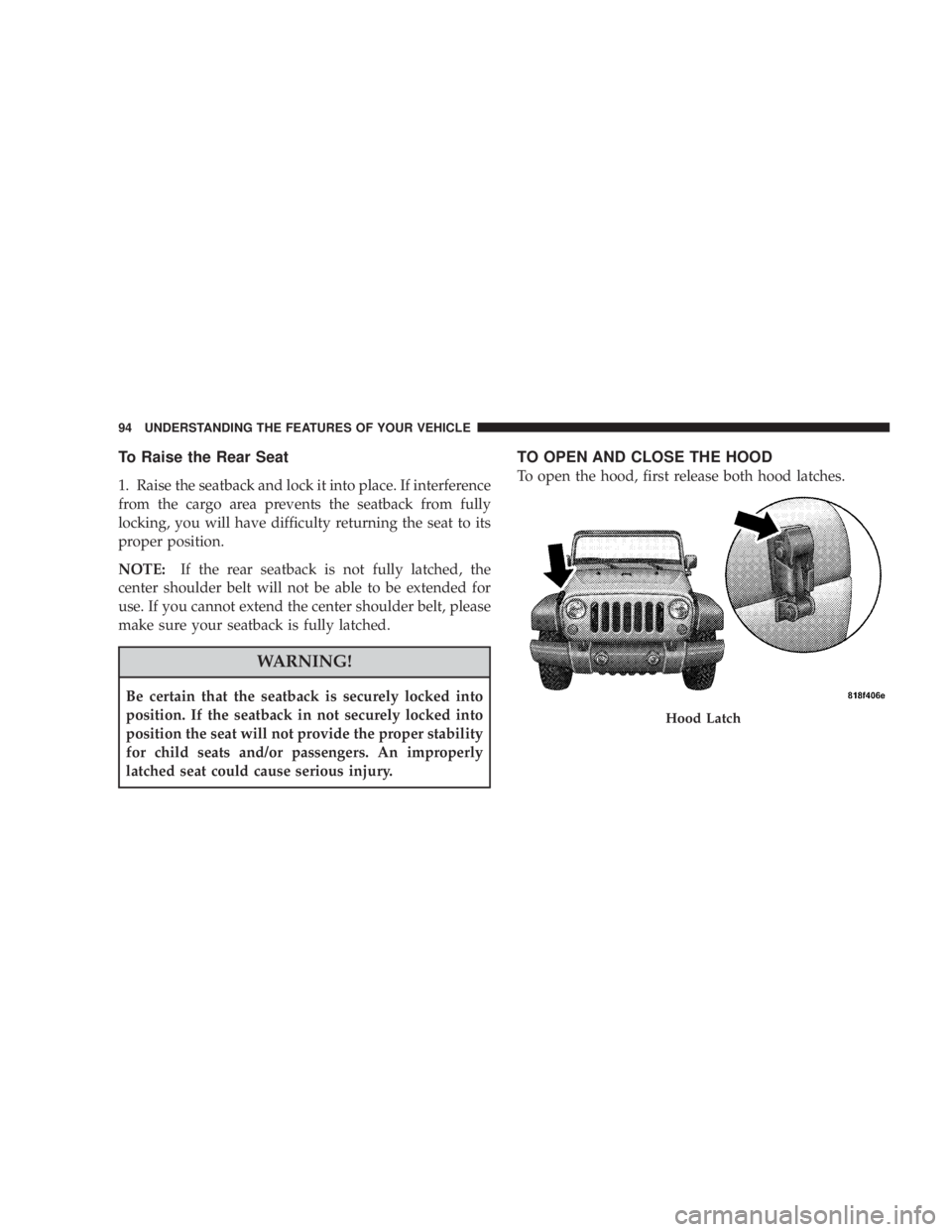
To Raise the Rear Seat
1. Raise the seatback and lock it into place. If interference
from the cargo area prevents the seatback from fully
locking, you will have difficulty returning the seat to its
proper position.
NOTE:If the rear seatback is not fully latched, the
center shoulder belt will not be able to be extended for
use. If you cannot extend the center shoulder belt, please
make sure your seatback is fully latched.
Page 127 of 466
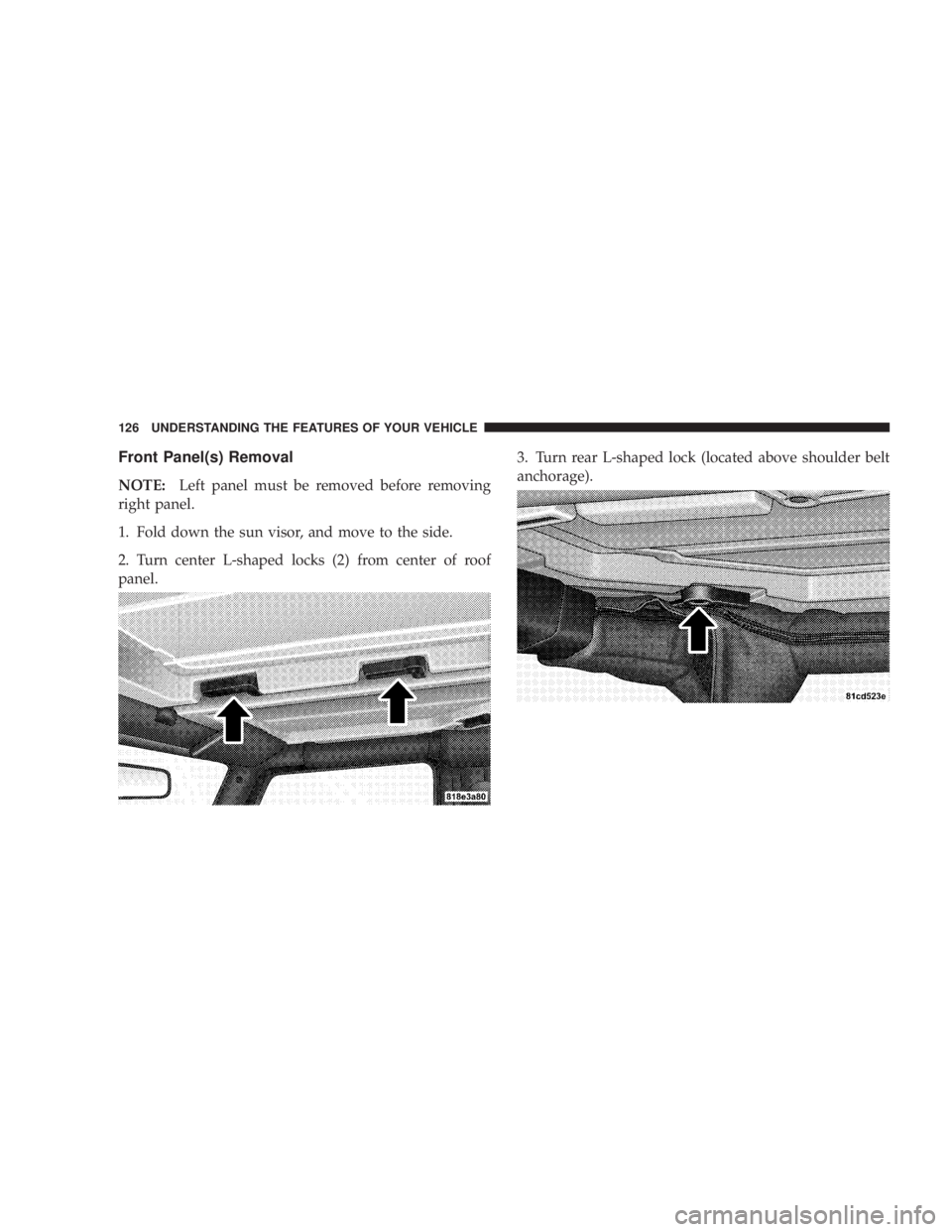
Front Panel(s) Removal
NOTE:Left panel must be removed before removing
right panel.
1. Fold down the sun visor, and move to the side.
2. Turn center L-shaped locks (2) from center of roof
panel. 3. Turn rear L-shaped lock (located above shoulder belt
anchorage).
Page 193 of 466
Raise the windshield and reinstall the side bars as soon as
the task that required their removal is completed and
before you return to on-road driving. Both you and your
passenger should wear seat belts at all times, on-road and
off-road, regardless of whether the windshield is raised
or folded down.
Outside rearview mirrors are mounted on the doors. If
you choose to remove the doors, see your authorized
dealer for a replacement cowl-mounted outside mirror.
Federal law requires outside mirrors on vehicles for
on-road use.
Page 387 of 466
Drive Belts — Check Condition and Tension
Belt tension is controlled by means of an automatic
tensioner. No belt tension adjustments are required.
However, belt and belt tensioner condition should be
inspected at the specified intervals, and replaced if re-
quired. See your authorized dealer for service
At the mileage indicated in the Maintenance Schedule,
the condition of all the belts and tensioner should be
checked. Refer to Section 8 of this manual. Improper belt
tension can cause belt slippage and failure.
Belts should be inspected for evidence of cuts, cracks,
glazing, or frayed cords and replaced if there is indication
of damage, which could result in belt failure. Low
generator belt tension can cause battery failure.
Also, check belt routing to make sure there is no inter-
ference between the belts and other engine components.
Spark Plugs
Spark plugs must fire properly to assure engine perfor-
mance and emission control. New plugs should be in-
stalled at the mileage specified in the Maintenance Sched-
ule. Refer to Section 8 of this manual. The entire set
should be replaced if there is any malfunction due to a
faulty spark plug. Refer to Fluids, Lubricants, and Genu-
ine Parts in this section for spark plug information.
Catalytic Converter
The catalytic converter requires the use of unleaded fuel
only. Leaded gasoline will destroy the effectiveness of the
converter as an emission control device.
Under normal operating conditions, the catalytic con-
verter will not require maintenance. However, it is im-
portant to keep the engine properly tuned to assure
proper catalyst operation and prevent possible catalyst
damage.
386 MAINTAINING YOUR VEHICLE
Page 391 of 466
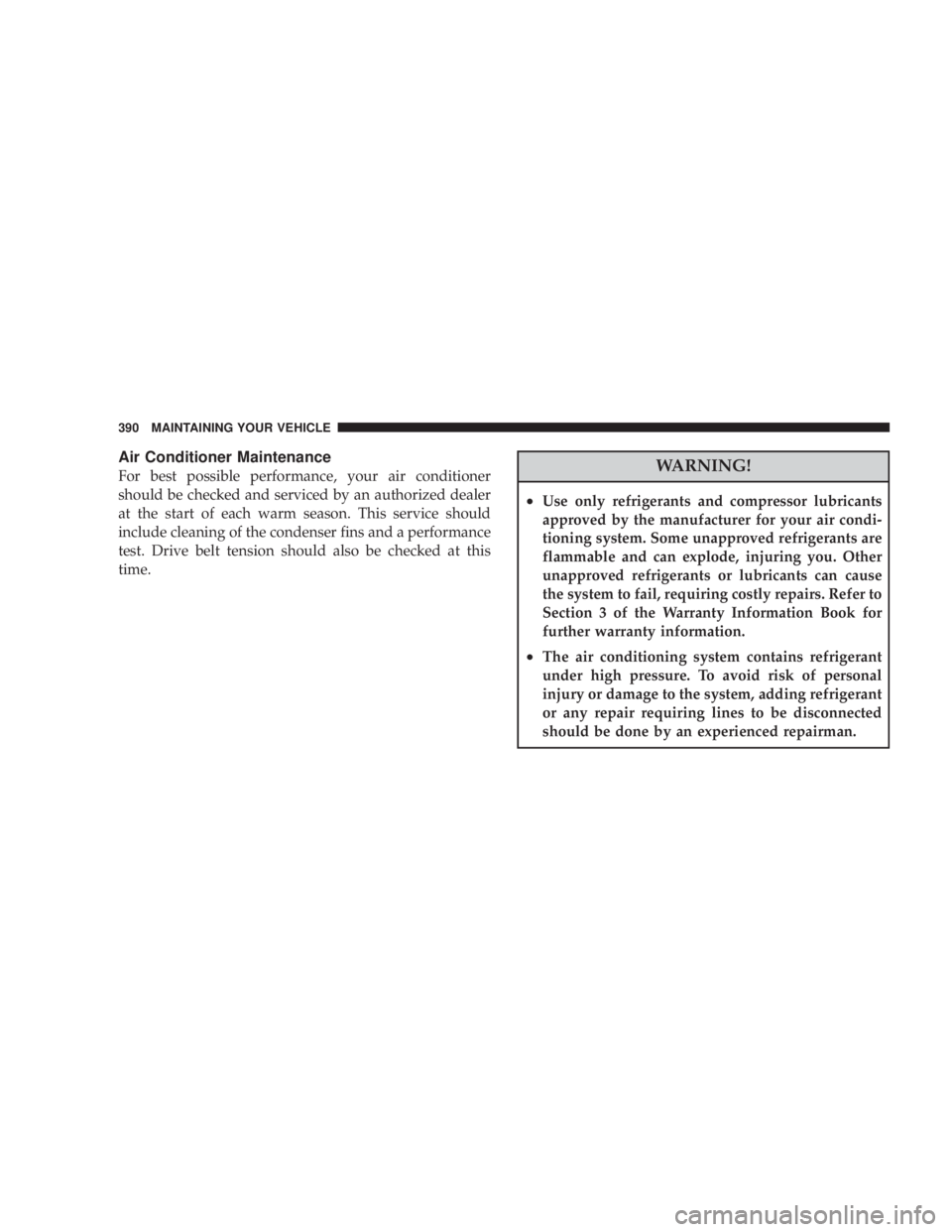
Air Conditioner Maintenance
For best possible performance, your air conditioner
should be checked and serviced by an authorized dealer
at the start of each warm season. This service should
include cleaning of the condenser fins and a performance
test. Drive belt tension should also be checked at this
time.
Page 451 of 466
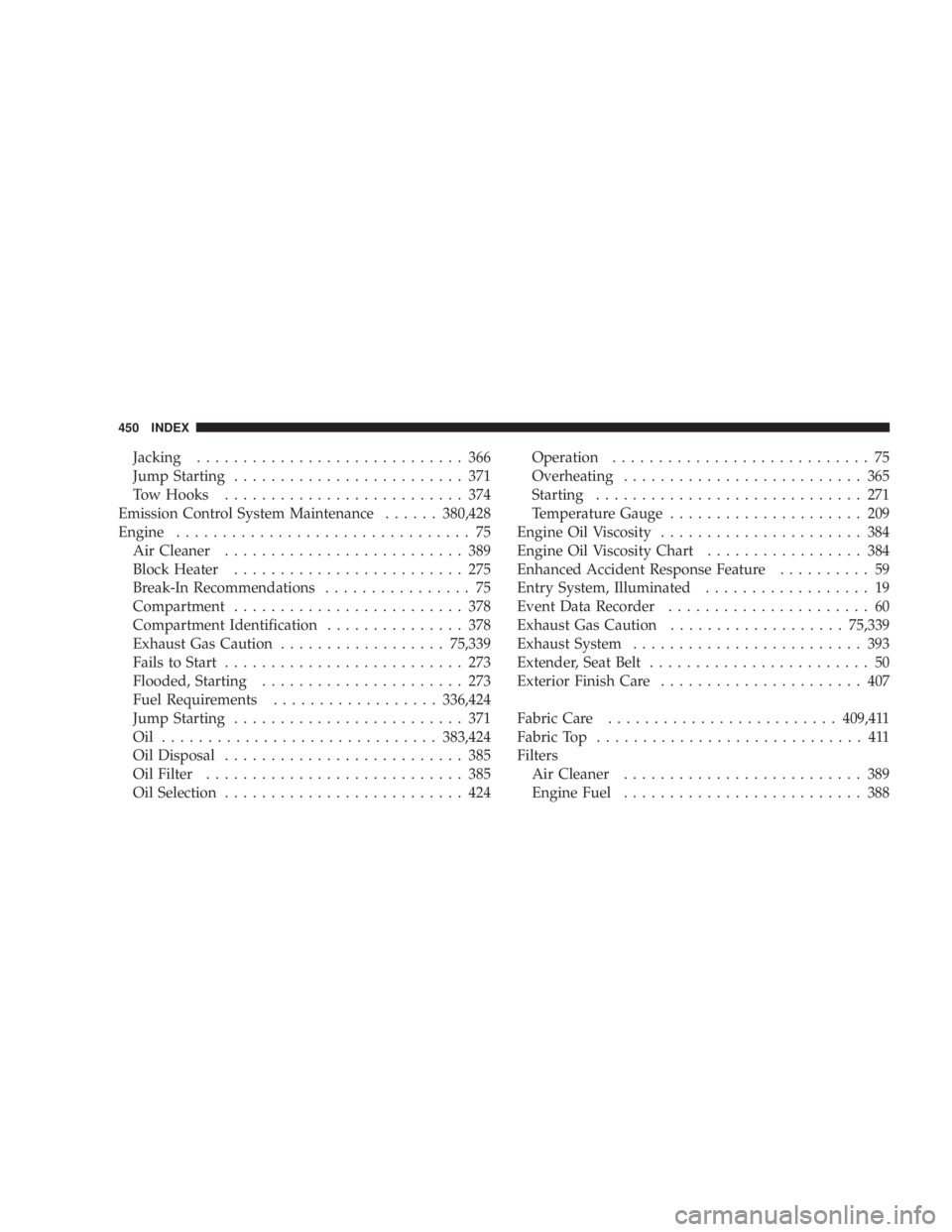
Jacking............................. 366
Jump Starting ......................... 371
Tow Hooks .......................... 374
Emission Control System Maintenance ......380,428
Engine ................................ 75
Air Cleaner .......................... 389
Block Heater ......................... 275
Break-In Recommendations ................ 75
Compartment ......................... 378
Compartment Identification ............... 378
Exhaust Gas Caution .................. 75,339
Fails to Start .......................... 273
Flooded, Starting ...................... 273
Fuel Requirements .................. 336,424
Jump Starting ......................... 371
Oil .............................. 383,424
Oil Disposal .......................... 385
Oil Filter ............................ 385
Oil Selection .......................... 424 Operation
............................ 75
Overheating .......................... 365
Starting ............................. 271
Temperature Gauge ..................... 209
Engine Oil Viscosity ...................... 384
Engine Oil Viscosity Chart ................. 384
Enhanced Accident Response Feature .......... 59
Entry System, Illuminated .................. 19
Event Data Recorder ...................... 60
Exhaust Gas Caution ................... 75,339
Exhaust System ......................... 393
Extender, Seat Belt ........................ 50
Exterior Finish Care ...................... 407
Fabric Care ......................... 409,411
Fabric Top ............................. 411
Filters Air Cleaner .......................... 389
Engine Fuel .......................... 388
450 INDEX