tire pressure JEEP WRANGLER 2008 Owners Manual
[x] Cancel search | Manufacturer: JEEP, Model Year: 2008, Model line: WRANGLER, Model: JEEP WRANGLER 2008Pages: 466, PDF Size: 8.61 MB
Page 63 of 466
•Airbag deployment level (if applicable)
•Impact acceleration and angle
•Seat belt status
•Brake status (service and parking brakes)
•Accelerator status (including vehicle speed)
•Engine control status (including engine speed)
•Transmission gear selection
•Cruise control status
•Traction/stability control status
•Tire pressure monitoring system (TPMS) status
Child Restraint
Everyone in your vehicle needs to be buckled up at all
times — babies and children, too. Every state in the
United States and all Canadian provinces require that
small children ride in proper restraint systems. This is the
law, and you can be prosecuted for ignoring it.
Children 12 years and under should ride properly buck-
led up in a rear seat, if available. According to crash
statistics, children are safer when properly restrained in
the rear seats, rather than in the front.
There are different sizes and types of restraints for
children from newborn size to the child almost large
enough for an adult safety belt. Always check the child
seat owner’s manual to ensure you have the correct seat
for your child. Use the restraint that is correct for your
child.
62 THINGS TO KNOW BEFORE STARTING YOUR VEHICLE
Page 211 of 466
21. Odometer/Trip Odometer Reset Button
Press this button to change the display from odometer to
either of two trip odometer settings. Trip A or Trip B will
appear when in the trip odometer mode. Press and hold
the button for two seconds to reset the trip odometer to 0
miles or kilometers. The odometer must be in trip mode
to reset.
22. Transmission Range Indicator
This display indicator shows the automatic transmission
gear selection.
23. Tire Pressure Monitoring Telltale LightEach tire, including the spare (if provided),
should be checked monthly when cold and
inflated to the inflation pressure recommended
by the vehicle manufacturer on the vehicle
placard or tire inflation pressure label. (If your vehicle
has tires of a different size than the size indicated on the vehicle placard or tire inflation pressure label, you should
determine the proper tire inflation pressure for those
tires.)
As an added safety feature, your vehicle has been
equipped with a tire pressure monitoring system (TPMS)
that illuminates a low tire pressure telltale when one or
more of your tires is significantly under-inflated. Accord-
ingly, when the low tire pressure telltale illuminates, you
should stop and check your tires as soon as possible, and
inflate them to the proper pressure. Driving on a signifi-
cantly under-inflated tire causes the tire to overheat and
can lead to tire failure. Under-inflation also reduces fuel
efficiency and tire tread life, and may affect the vehicle’s
handling and stopping ability.
Please note that the TPMS is not a substitute for proper
tire maintenance, and it is the driver ’s responsibility to
maintain correct tire pressure, even if under-inflation has
not reached the level to trigger illumination of the TPMS
low tire pressure telltale.
Page 299 of 466
Mud
Deep mud creates a great deal of suction around the tires
and is very difficult to get through. You should use 2nd
gear (manual transmission), or DRIVE (automatic trans-
mission), with the transfer case in the 4L (Low) position
to maintain your momentum. If you start to slow to a
stop, try turning your steering wheel no more than a 1/4
turn quickly back and forth for additional traction. Mud
holes pose an increased threat of vehicle damage and
getting stuck. They are normally full of debris from
previous vehicles getting stuck. As a good practice before
entering any mud hole, get out and determine how deep
it is, if there are any hidden obstacles and if the vehicle
can be safely recovered if stuck.
Sand
Soft sand is very difficult to travel through with full tire
pressure. When crossing soft sandy spots in a trail
maintain your vehicle’s momentum and do not stop. The
key to driving in soft sand is using the appropriate tirepressure, accelerating slowly, avoiding abrupt maneu-
vers and maintaining the vehicle’s momentum. If you are
going to be driving on large soft sandy areas or dunes,
reduce your tire pressure to a minimum of 15 psi (103
kPa) to allow for a greater tire surface area. Reduced tire
pressure will drastically improve your traction and han-
dling, while driving on the soft sand, but you must return
the tires to normal air pressure before driving on pave-
ment or other hard surfaces. Be sure you have a way to
reinflate the tires prior to reducing the pressure.
Page 311 of 466
WARNING!
Significant over or under-inflation of tires, or mixing
sizes of tires or wheels on the vehicle can lead to loss
of braking effectiveness.
The Anti-Lock Brake System conducts a low speed self-
test at about 12 mph (20 km/h). If for any reason, your
foot is on the brake when the vehicle reaches 12 mph (20
km/h), this check will be delayed until 25 mph (40
km/h).
The Anti-Lock Brake System pump motor runs during
the self-test, and during an ABS stop, to provide the
regulated hydraulic pressure. The motor pump makes a
low humming noise during operation, this is normal. During off-road use, loss of traction can temporarily
defeat the system and cause the warning light to illumi-
nate. Turn the ignition OFF and ON again to restore
Anti-Lock Brake System function.
Page 319 of 466
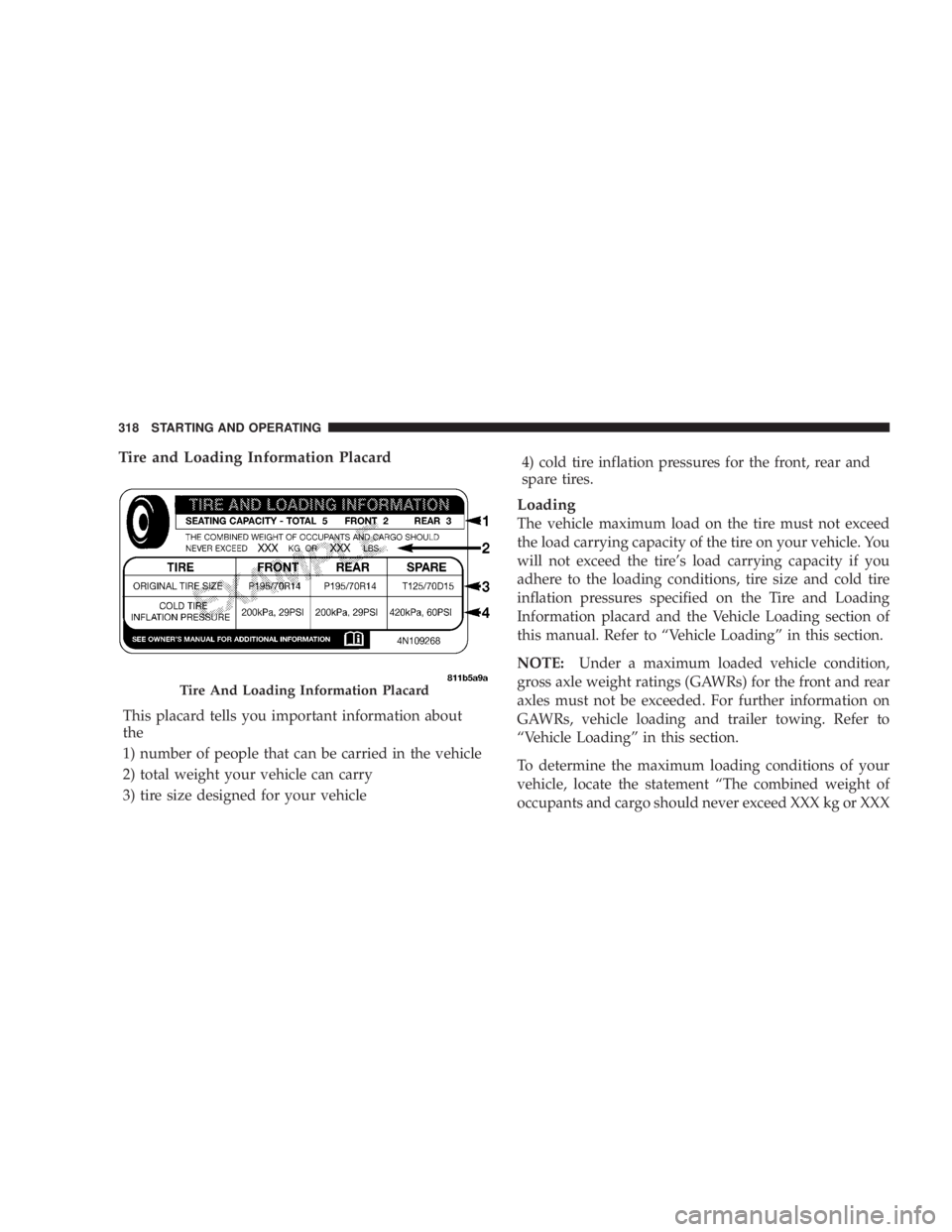
Tire and Loading Information Placard
This placard tells you important information about
the
1) number of people that can be carried in the vehicle
2) total weight your vehicle can carry
3) tire size designed for your vehicle4) cold tire inflation pressures for the front, rear and
spare tires.
Loading
The vehicle maximum load on the tire must not exceed
the load carrying capacity of the tire on your vehicle. You
will not exceed the tire’s load carrying capacity if you
adhere to the loading conditions, tire size and cold tire
inflation pressures specified on the Tire and Loading
Information placard and the Vehicle Loading section of
this manual. Refer to “Vehicle Loading” in this section.
NOTE:
Under a maximum loaded vehicle condition,
gross axle weight ratings (GAWRs) for the front and rear
axles must not be exceeded. For further information on
GAWRs, vehicle loading and trailer towing. Refer to
“Vehicle Loading” in this section.
To determine the maximum loading conditions of your
vehicle, locate the statement “The combined weight of
occupants and cargo should never exceed XXX kg or XXX
Page 323 of 466
Economy
Improper inflation pressures can cause uneven wear
patterns to develop across the tire tread. These abnormal
wear patterns will reduce tread life resulting in a need for
earlier tire replacement. Under-inflation also increases
tire rolling resistance and results in higher fuel consump-
tion.
Ride Comfort and Vehicle Stability
Proper tire inflation contributes to a comfortable ride.
Over-inflation produces a jarring and uncomfortable
ride.
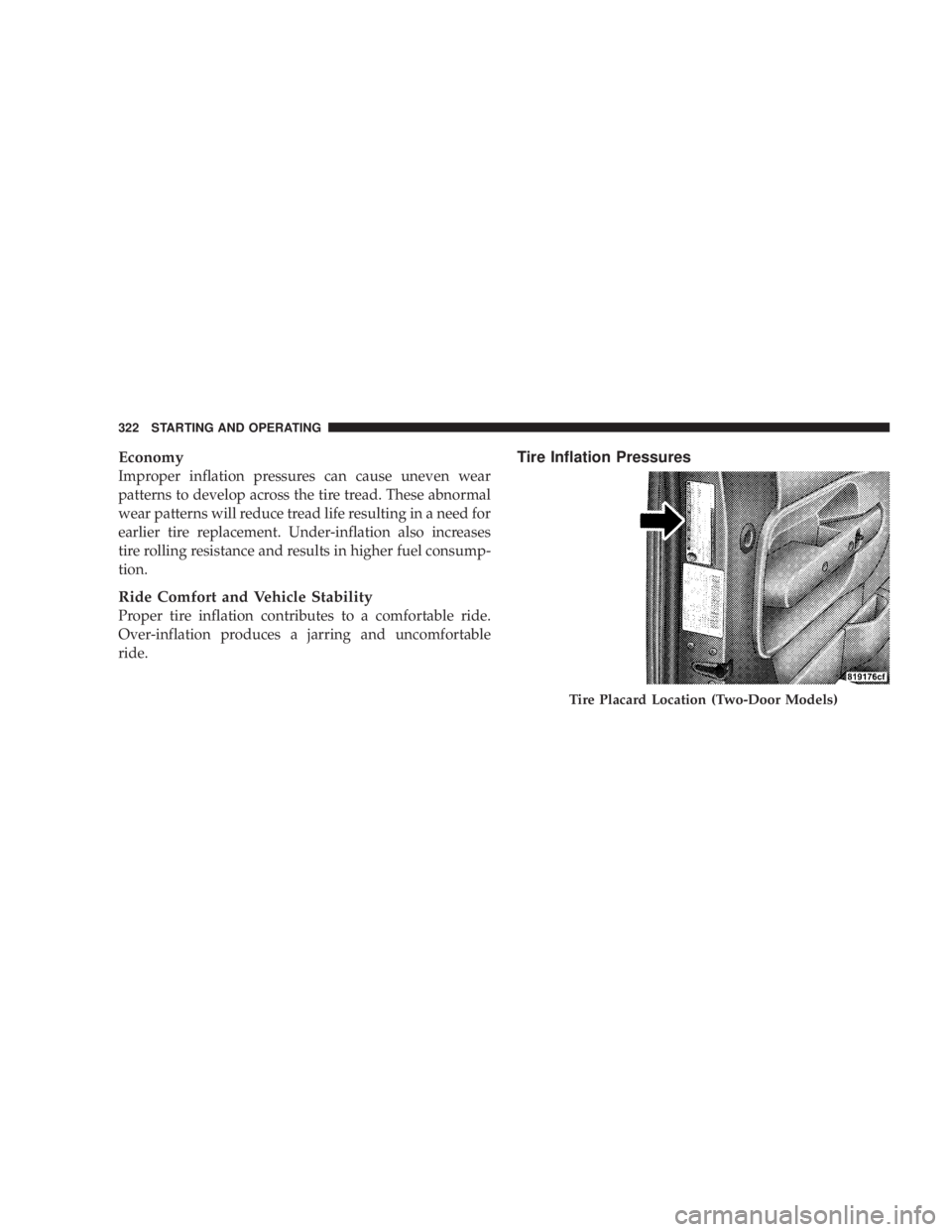
Tire Inflation Pressures
Page 325 of 466
Tire pressures change by approximately 1 psi (7 kPa) per
12° F (7° C) of air temperature change. Keep this in mind
when checking tire pressure inside a garage especially in
the winter.
Example: If garage temperature = 68° F (20° C) and the
outside temperature = 32° F (0° C) then the cold tire
inflation pressure should be increased by 3 psi (21 kPa),
which equals 1 psi (7 kPa) for every 12° F (7° C) for this
outside temperature condition.
Tire pressure may increase from 2 to 6 psi (13 to 40 kPa)
during operation. DO NOT reduce this normal pressure
buildup or your tire pressure will be too low.
Tire Pressures for High-Speed Operation
The manufacturer advocates driving at safe speeds
within posted speed limits. Where speed limits or condi-
tions are such that the vehicle can be driven at high
speeds, maintaining correct tire inflation pressure is very
important. Increased tire pressure and reduced vehicleloading may be required for high-speed vehicle opera-
tion. Refer to original equipment or an authorized tire
dealer for recommended safe operating speeds, loading
and cold tire inflation pressures.
Page 327 of 466
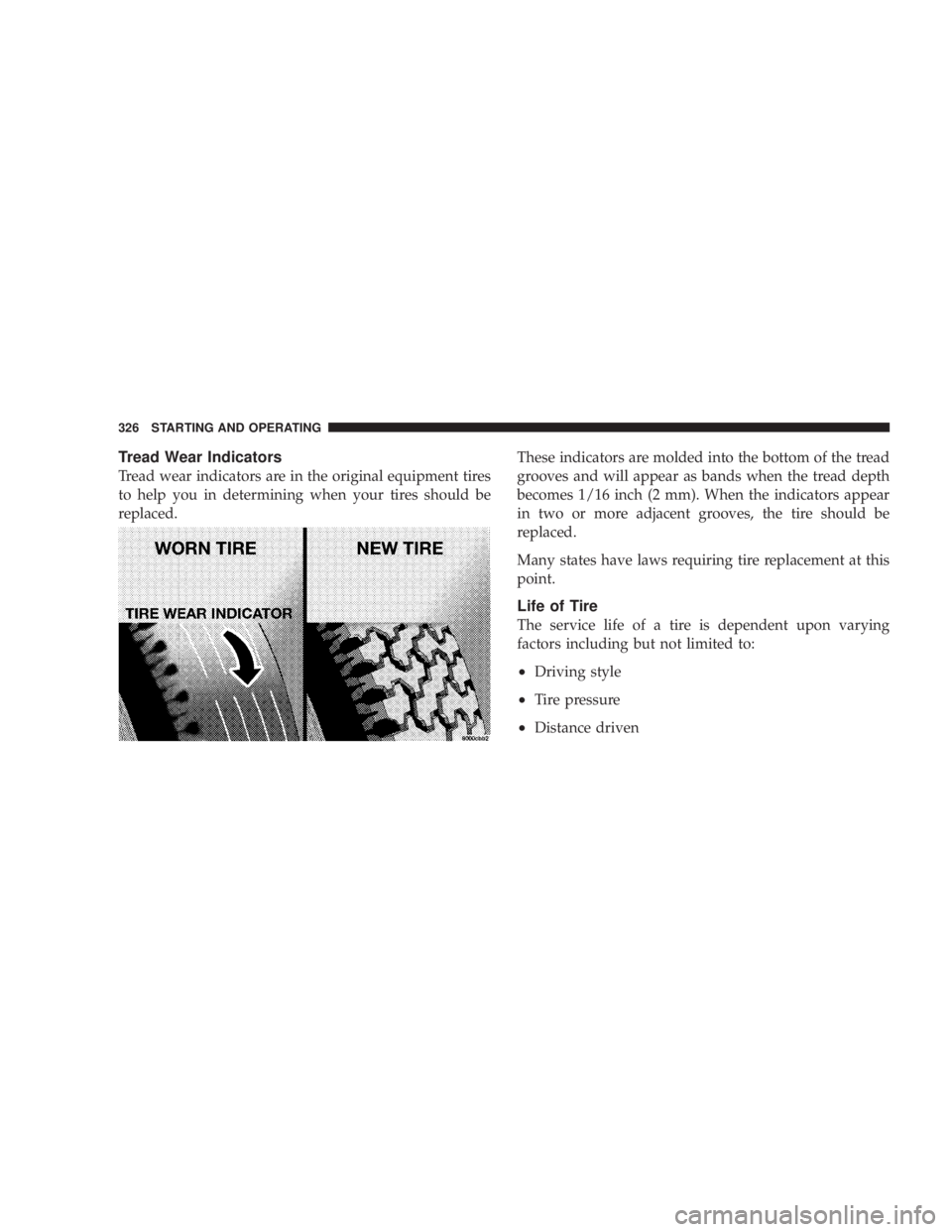
Tread Wear Indicators
Tread wear indicators are in the original equipment tires
to help you in determining when your tires should be
replaced.These indicators are molded into the bottom of the tread
grooves and will appear as bands when the tread depth
becomes 1/16 inch (2 mm). When the indicators appear
in two or more adjacent grooves, the tire should be
replaced.
Many states have laws requiring tire replacement at this
point.
Life of Tire
The service life of a tire is dependent upon varying
factors including but not limited to:
•Driving style
•Tire pressure
•Distance driven
Page 331 of 466
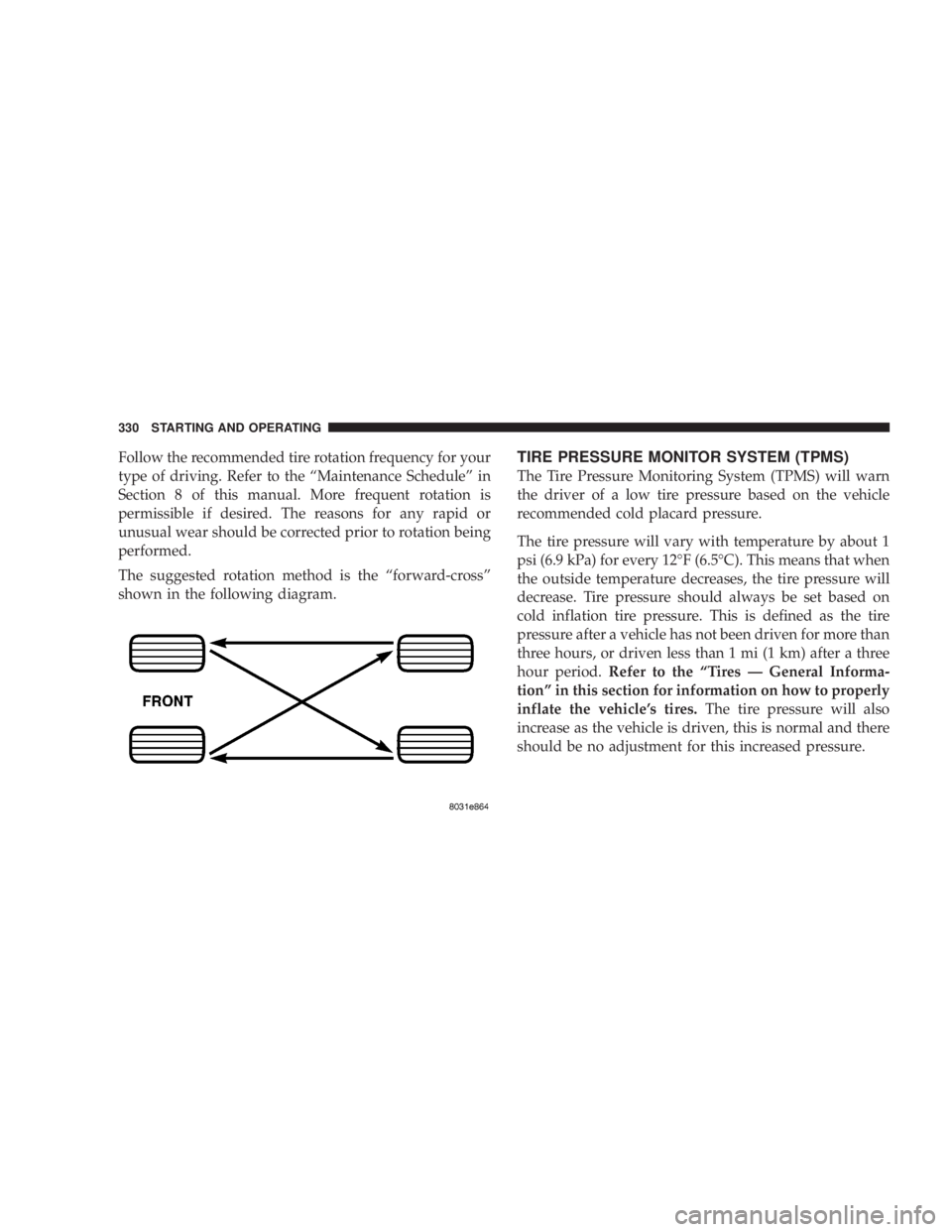
Follow the recommended tire rotation frequency for your
type of driving. Refer to the “Maintenance Schedule” in
Section 8 of this manual. More frequent rotation is
permissible if desired. The reasons for any rapid or
unusual wear should be corrected prior to rotation being
performed.
The suggested rotation method is the “forward-cross”
shown in the following diagram.TIRE PRESSURE MONITOR SYSTEM (TPMS)
The Tire Pressure Monitoring System (TPMS) will warn
the driver of a low tire pressure based on the vehicle
recommended cold placard pressure.
The tire pressure will vary with temperature by about 1
psi (6.9 kPa) for every 12°F (6.5°C). This means that when
the outside temperature decreases, the tire pressure will
decrease. Tire pressure should always be set based on
cold inflation tire pressure. This is defined as the tire
pressure after a vehicle has not been driven for more than
three hours, or driven less than 1 mi (1 km) after a three
hour period.Refer to the “Tires — General Informa-
tion” in this section for information on how to properly
inflate the vehicle’s tires. The tire pressure will also
increase as the vehicle is driven, this is normal and there
should be no adjustment for this increased pressure.
Page 333 of 466
CAUTION!
The TPMS has been optimized for the original
equipment tires and wheels. TPMS pressures have
been established for the tire size equipped on your
vehicle. Undesirable system operation or sensor
damage may result when using replacement equip-
ment that is not of the same size, type, and/or style.
Aftermarket wheels can cause sensor damage. Do not
use aftermarket tire sealants or balance beads if your
vehicle is equipped with a TPMS, as damage to the
sensors may result.