ECU JEEP WRANGLER 2009 JK / 3.G User Guide
[x] Cancel search | Manufacturer: JEEP, Model Year: 2009, Model line: WRANGLER, Model: JEEP WRANGLER 2009 JK / 3.GPages: 502, PDF Size: 14.47 MB
Page 28 of 502
To Exit Remote Start Mode and Drive the Vehicle
Before the end of the 15-minute cycle, press and release
the UNLOCK button on the RKE transmitter to unlock
the doors and disarm the Vehicle Security Alarm (if
equipped). Then, prior to the end of the 15-minute cycle,
insert the key into the ignition switch and turn the switch
to the ON position.
NOTE:The ignition switch must be in the ON position
in order to drive the vehicle.
DOORS
CAUTION!
Careless handling and storage of the removable door
panels may damage the seals, causing water to leak
into the vehicles interior.
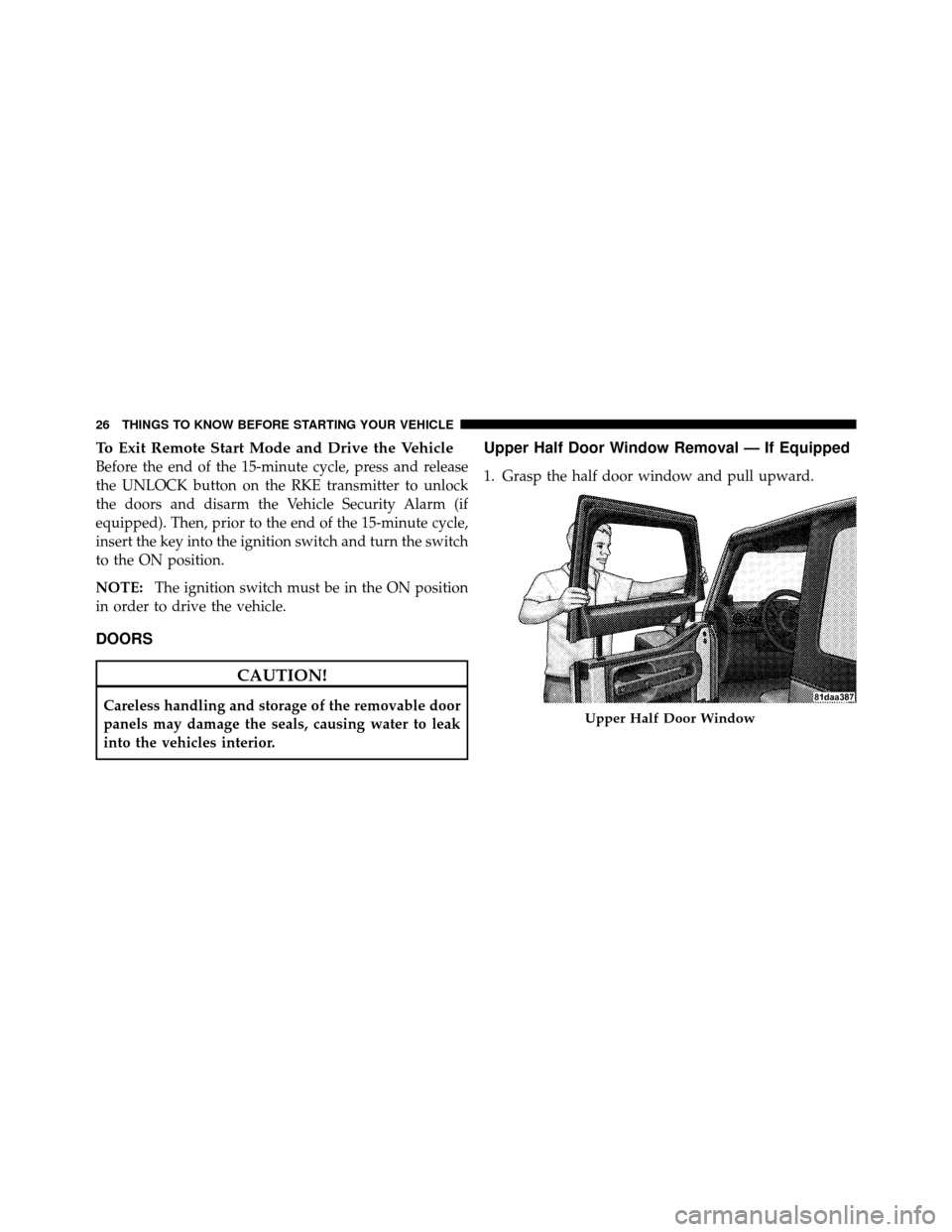
Upper Half Door Window Removal — If Equipped
1. Grasp the half door window and pull upward.
Upper Half Door Window
26 THINGS TO KNOW BEFORE STARTING YOUR VEHICLE
Page 33 of 502
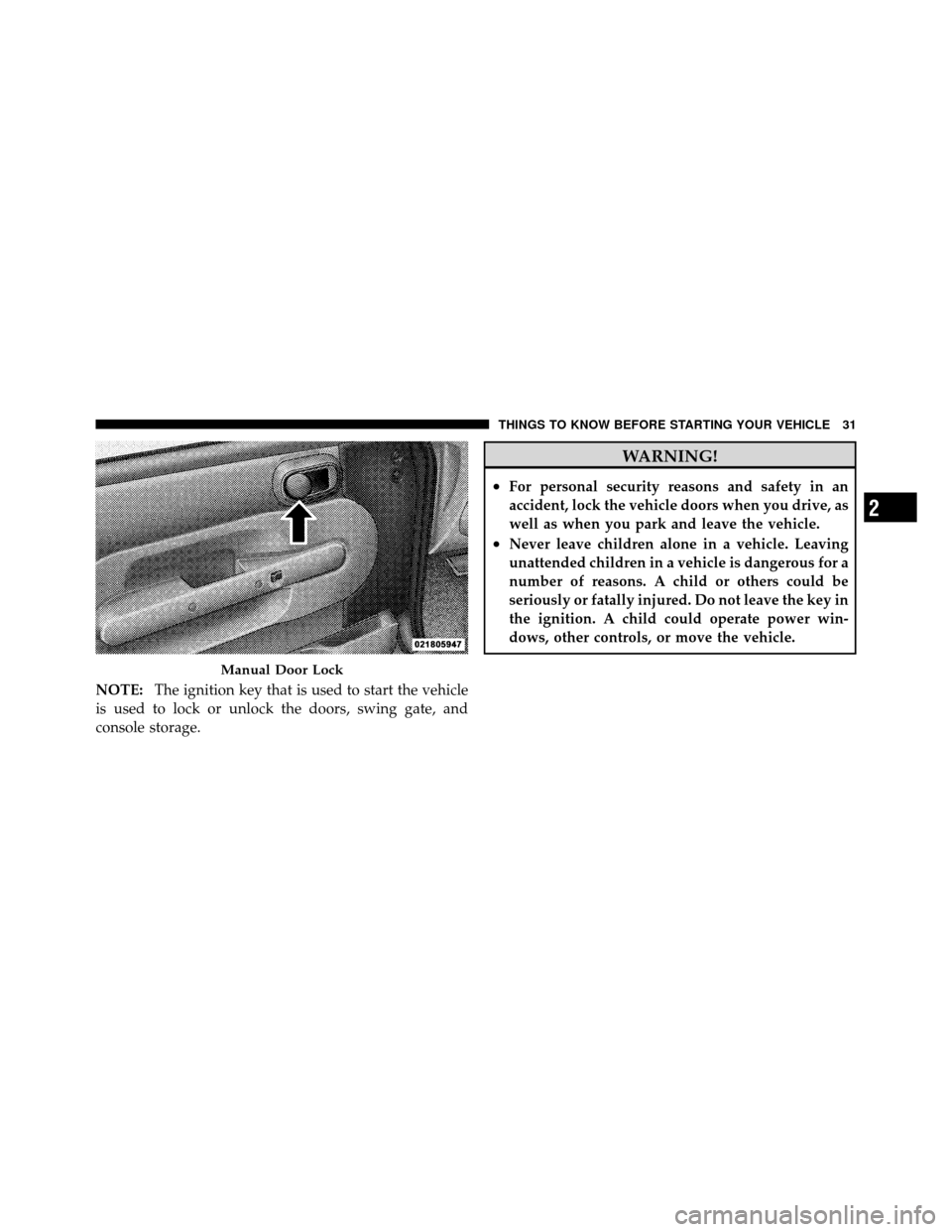
NOTE:The ignition key that is used to start the vehicle
is used to lock or unlock the doors, swing gate, and
console storage.
WARNING!
•For personal security reasons and safety in an
accident, lock the vehicle doors when you drive, as
well as when you park and leave the vehicle.
•Never leave children alone in a vehicle. Leaving
unattended children in a vehicle is dangerous for a
number of reasons. A child or others could be
seriously or fatally injured. Do not leave the key in
the ignition. A child could operate power win-
dows, other controls, or move the vehicle.
Manual Door Lock
2
THINGS TO KNOW BEFORE STARTING YOUR VEHICLE 31
Page 34 of 502
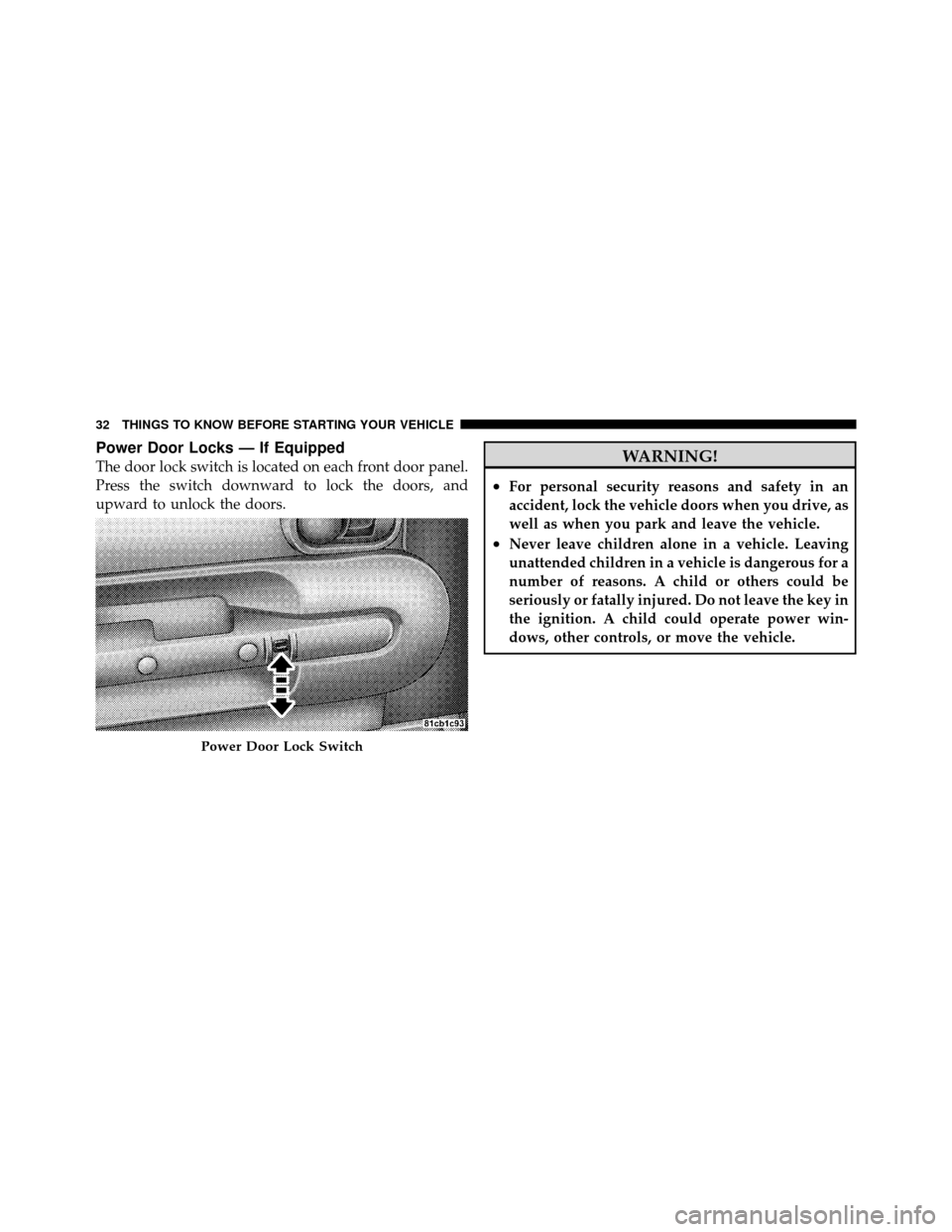
Power Door Locks — If Equipped
The door lock switch is located on each front door panel.
Press the switch downward to lock the doors, and
upward to unlock the doors.WARNING!
•For personal security reasons and safety in an
accident, lock the vehicle doors when you drive, as
well as when you park and leave the vehicle.
•Never leave children alone in a vehicle. Leaving
unattended children in a vehicle is dangerous for a
number of reasons. A child or others could be
seriously or fatally injured. Do not leave the key in
the ignition. A child could operate power win-
dows, other controls, or move the vehicle.
Power Door Lock Switch
32 THINGS TO KNOW BEFORE STARTING YOUR VEHICLE
Page 53 of 502
WARNING! (Continued)
•If your vehicle is equipped with side airbags, do not
attach cupholders or any other objects on or around
the door. The inflating side airbag could drive the
objects into occupants, causing serious injury.
•Do not cover or place items on the airbag covers.
These items may cause serious injury during infla-
tion.
•Do not store or place items under the front seats.
You may damage the airbag wiring harnesses.
The Advanced Front Airbags have a multistage inflator
design. This allows the airbag to have different rates of
inflation that are based on severity and type of collision.
Along with the seat belts, Advanced Front Airbags work
with the instrument panel knee bolsters to provide
improved protection for the driver and front passenger.
Side airbags also work with seat belts to improve occu-
pant protection.Here are some simple steps you can take to minimize the
risk of harm from a deploying airbag:
1. Children 12 years and under should always ride
buckled up in a rear seat.
Infants in rear facing child restraints should
NEVERride
in the front seat of a vehicle with a passenger airbag. An
airbag deployment could cause severe injury or death to
infants in that position.
Children that are not big enough to properly wear the
vehicle seat belt should be secured in the rear seat, in a
child restraint or belt-positioning booster seat. Older
children who do not use child restraints or belt-
positioning booster seats should ride properly buckled
up in the rear seat. Never allow children to slide the
shoulder belt behind them or under their arm.
2
THINGS TO KNOW BEFORE STARTING YOUR VEHICLE 51
Page 54 of 502
If a child from 1 to 12 years old (not in a rear facing child
seat) must ride in the front passenger seat, move the seat
as far back as possible and use the proper child restraint.
(Refer to information on Child Restraints in this section.)
You should read the instructions provided with your
child restraint to make sure that you are using it properly.
2. All occupants should ALWAYS use their lap and
shoulder belts properly.
3. The driver and front passenger seats should be moved
back as far as practical to allow the Advanced Front
Airbags room to inflate.
4. Do not lean against the door. If your vehicle has side
airbags, and deployment occurs, the side airbags will
inflate forcefully into the space between you and the
door.
5. If the airbag system in this vehicle needs to be
modified to accommodate a disabled person, contact theCustomer Center. Phone numbers are provided under “If
You Need Assistance” in Section 9 of this manual.
WARNING!
•Relying on the airbags alone could lead to more
severe injuries in a collision. The airbags work
with your seat belt to restrain you properly. In
some collisions, the airbags won’t deploy at all.
Always wear your seat belts even though you have
airbags.
•Being too close to the steering wheel or instrument
panel during airbag deployment could cause seri-
ous injury, including death. Airbags need room to
inflate. Sit back, comfortably extending your arms
to reach the steering wheel or instrument panel.
•If the vehicle has side airbags, they also need room
to inflate. Do not lean against the door. Sit upright
in the center of the seat.
52 THINGS TO KNOW BEFORE STARTING YOUR VEHICLE
Page 63 of 502
•Traction/stability control status
•Tire Pressure Monitoring System status
Child Restraint
Everyone in your vehicle needs to be buckled up at all
times, including babies and children. Every state in the
United States and all Canadian provinces require that
small children ride in proper restraint systems. This is the
law, and you can be prosecuted for ignoring it.
Children 12 years and under should ride properly buck-
led up in a rear seat, if available. According to crash
statistics, children are safer when properly restrained in
the rear seats, rather than in the front.
There are different sizes and types of restraints for chil-
dren from newborn size to the child almost large enough
for an adult safety belt. Always check the child seat
owner’s manual to ensure you have the correct seat for
your child. Use the restraint that is correct for your child.
WARNING!
In a collision, an unrestrained child, even a tiny baby,
can become a projectile inside the vehicle. The force
required to hold even an infant on your lap could
become so great that you could not hold the child, no
matter how strong you are. The child and others
could be badly injured. Any child riding in your
vehicle should be in a proper restraint for the child’s
size.
Infants and Child Restraints
•
Safety experts recommend that children ride
rearward-facing in the vehicle until they are at least
one-year oldandweigh at least 20 lbs (9 kg). Two
types of child restraints can be used rearward-facing:
infant carriers and “convertible” child seats.
2
THINGS TO KNOW BEFORE STARTING YOUR VEHICLE 61
Page 65 of 502
Here are some tips for getting the most out of your child
restraint:
•Before buying any restraint system, make sure that it
has a label certifying that it meets all applicable Safety
Standards. The manufacturer also recommends that
you try a child restraint in the vehicle seats where you
will use it before you buy it.
•The restraint must be appropriate for your child’s
weight and height. Check the label on the restraint for
weight and height limits.
•Carefully follow the instructions that come with the
restraint. If you install the restraint improperly, it may
not work when you need it.
•The seat belts in the passenger seating positions are
equipped with either an Automatic Locking Retractor
(ALR) or a cinching latch plate or both. Both types of
seat belts are designed to keep the lap portion of theseat belt tight around the child restraint so that it is not
necessary to use a locking clip. The ALR will make a
ratcheting noise if you extract the entire belt from the
retractor and then allow the belt to retract into the
retractor. For additional information on ALR, refer to
“Automatic Locking Mode” in this section.
•In the rear seat, you may have trouble tightening the
lap/shoulder belt on the child restraint because the
buckle or latch plate is too close to the belt path
opening on the restraint. Disconnect the latch plate
from the buckle and twist the short buckle-end belt
several times to shorten it. Insert the latch plate into
the buckle with the release button facing out.
•If the belt still cannot be tightened, or if pulling and
pushing on the restraint loosens the belt, disconnect
the latch plate from the buckle, turn the buckle
around, and insert the latch plate into the buckle
again. If you still cannot make the child restraint
secure, try a different seating position.
2
THINGS TO KNOW BEFORE STARTING YOUR VEHICLE 63
Page 66 of 502
•Buckle the child into the restraint exactly as the
manufacturer’s instructions tell you.
•When your child restraint is not in use, secure it in the
vehicle with the seat belt or remove it from the vehicle.
Do not leave it loose in the vehicle. In a sudden stop or
collision, it could strike the occupants or seatbacks and
cause serious personal injury.
Older Children and Child Restraints
Children who weigh more than 20 lbs (9 kg) and who are
older than one year can ride forward-facing in the
vehicle. Forward-facing child seats and convertible child
seats used in the forward-facing direction are for children
who weigh 20 to 40 lbs (9 to 18 kg), and who are older
than one year. These child seats are also held in the
vehicle by the lap/shoulder belt or the LATCH child
restraint anchorage system (Refer to LATCH — Child
Seat Anchorage System in this section).The belt-positioning booster seat is for children weighing
more than 40 lbs (18 kg), but who are still too small to fit
the vehicle’s seat belts properly. If the child cannot sit
with knees bent over the vehicle’s seat cushion while the
child’s back is against the seatback, they should use a
belt-positioning booster seat. The child and belt-
positioning booster seat are held in the vehicle by the
lap/shoulder belt.Children Too Large for Booster Seats
Children who are large enough to wear the shoulder belt
comfortably, and whose legs are long enough to bend
over the front of the seat when their back is against the
seatback, should use the lap/shoulder belt in a rear seat.
•Make sure that the child is upright in the seat.
•The lap portion should be low on the hips and as snug
as possible.
64 THINGS TO KNOW BEFORE STARTING YOUR VEHICLE
Page 68 of 502
NOTE:If your child restraint seat is not LATCH-
compatible, install the restraint using the vehicle seat
belts.
WARNING!
An incorrectly anchored tether strap could lead to
increased head motion and possible injury to the
child. Use only the anchor position directly behind
the child seat to secure a child restraint top tether
strap.
LATCH — Child Seat Anchorage System (Lower
Anchors and Tether for CHildren)
Your vehicle’s rear seat is equipped with the child
restraint anchorage system called LATCH. The LATCH
system provides for the installation of the child restraint
without using the vehicle’s seat belts, instead securing the child restraint using lower anchorages and upper
tether straps from the child restraint to the vehicle
structure.
LATCH-compatible child restraint systems are now avail-
able. However, because the lower anchorages are to be
introduced over a period of years, child restraint systems
having attachments for those anchorages will continue to
also have features for installation using the vehicle’s seat
belts. Child restraints having tether straps and hooks for
connection to the top tether anchorages, have been
available for some time. For some older child restraints,
many child restraint manufacturers offer add-on tether
strap kits or retro-fit kits. You are urged to take advantage
of all the available attachments provided with your child
restraint in any vehicle.
66 THINGS TO KNOW BEFORE STARTING YOUR VEHICLE
Page 73 of 502
WARNING!
Improper installation of a child restraint to the
LATCH anchorages can lead to failure of an infant or
child restraint. The child could be badly injured or
killed. Follow the manufacturer’s directions exactly
when installing an infant or child restraint.
Installing Child Restraints Using the Vehicle Seat
Belt
In the rear seat, you may have trouble tightening the
lap/shoulder belt on the child restraint because the
buckle or latch plate is too close to the belt path opening
on the restraint. Disconnect the latch plate from the
buckle and twist the short buckle-end belt several times
to shorten it. Insert the latch plate into the buckle with the
release button facing out.If the belt still can’t be tightened, or if pulling and
pushing on the restraint loosens the belt, you may need
to do something more. Disconnect the latch plate from
the buckle, turn the buckle around, and insert the latch
plate into the buckle again. If you still can’t make the
child restraint secure, try a different seating position.
2
THINGS TO KNOW BEFORE STARTING YOUR VEHICLE 71