transmission JEEP WRANGLER 2010 User Guide
[x] Cancel search | Manufacturer: JEEP, Model Year: 2010, Model line: WRANGLER, Model: JEEP WRANGLER 2010Pages: 554, PDF Size: 10.16 MB
Page 343 of 554
Gear Ranges
NOTE:Under extreme cold temperatures (-10°F (-23°C)
and when in DRIVE, transmission operation may be
briefly limited to only second gear operation. Normal
operation will resume once the transmission temperature
has risen to a suitable level.
DO NOT race the engine when shifting from PARK or
NEUTRAL position into another gear range.
PARK
This range supplements the parking brake by locking the
transmission. The engine can be started in this range.
Never use PARK while the vehicle is in motion. Apply
the parking brake when leaving the vehicle in this range.
Always apply the parking brake first, then place the shift
lever in the PARK position.
Page 365 of 554
your vehicle’s abilities and be able to recover it if
something goes wrong. You should never stop or shut a
vehicle off when crossing deep water unless you ingested
water into the engine air intake. If the engine stalls, do
not attempt to restart it. Determine if it has ingested
water first. The key to any crossing is low and slow. Shift
into first gear (manual transmission), or DRIVE (auto-
matic transmission), with the transfer case in the 4L
(Low) position and proceed very slowly with a constant
slow speed {3 to 5 mph (5 to 8 km/h) maximum} and
light throttle. Keep the vehicle moving; do not try to
accelerate through the crossing. After crossing any water
higher than the bottom of the axle differentials, you
should inspect all of the vehicle fluids for signs of water
ingestion.
Page 371 of 554
NOTE:
•When the parking brake is applied and the automatic
transmission is placed in gear, the “Brake Warning
Light” will flash. If vehicle speed is detected, a chime
will sound to alert the driver. Fully release the parking
brake before attempting to move the vehicle.
•This light only shows that the parking brake is ap-
plied. It does not show the degree of brake application.
When parking on a hill, it is important to turn the front
wheels toward the curb on a downhill grade and away
from the curb on an uphill grade. For vehicles equipped
with an automatic transmission, apply the parking brake
before placing the shift lever in PARK, otherwise the load
on the transmission locking mechanism may make it
difficult to move the shift lever out of PARK. The parking
brake should always be applied whenever the driver is
not in the vehicle.
Page 377 of 554
HSA Activation Criteria
The following criteria must be met in order for HSA to
activate:
•Vehicle must be stopped
•Vehicle must be on an 8% or greater incline (3% for
manual transmission equipped vehicles)
•Gear selection matches vehicle uphill direction (i.e.,
vehicle facing uphill is in forward gear; vehicle back-
ing uphill is in REVERSE gear).
Page 379 of 554
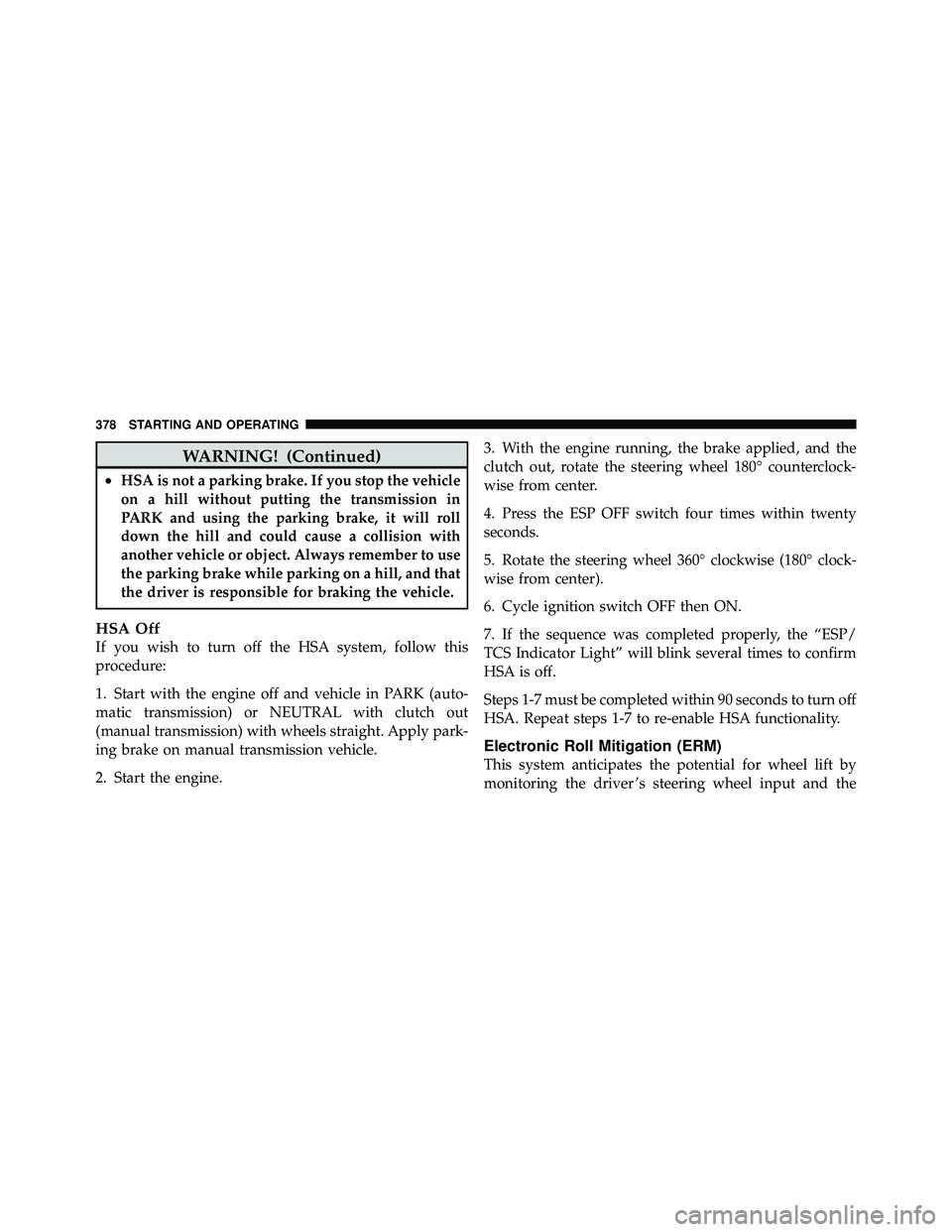
WARNING! (Continued)
•HSA is not a parking brake. If you stop the vehicle
on a hill without putting the transmission in
PARK and using the parking brake, it will roll
down the hill and could cause a collision with
another vehicle or object. Always remember to use
the parking brake while parking on a hill, and that
the driver is responsible for braking the vehicle.
HSA Off
If you wish to turn off the HSA system, follow this
procedure:
1. Start with the engine off and vehicle in PARK (auto-
matic transmission) or NEUTRAL with clutch out
(manual transmission) with wheels straight. Apply park-
ing brake on manual transmission vehicle.
2. Start the engine.3. With the engine running, the brake applied, and the
clutch out, rotate the steering wheel 180° counterclock-
wise from center.
4. Press the ESP OFF switch four times within twenty
seconds.
5. Rotate the steering wheel 360° clockwise (180° clock-
wise from center).
6. Cycle ignition switch OFF then ON.
7. If the sequence was completed properly, the “ESP/
TCS Indicator Light” will blink several times to confirm
HSA is off.
Steps 1-7 must be completed within 90 seconds to turn off
HSA. Repeat steps 1-7 to re-enable HSA functionality.
Electronic Roll Mitigation (ERM)
This system anticipates the potential for wheel lift by
monitoring the driver ’s steering wheel input and the
378 STARTING AND OPERATING
Page 427 of 554
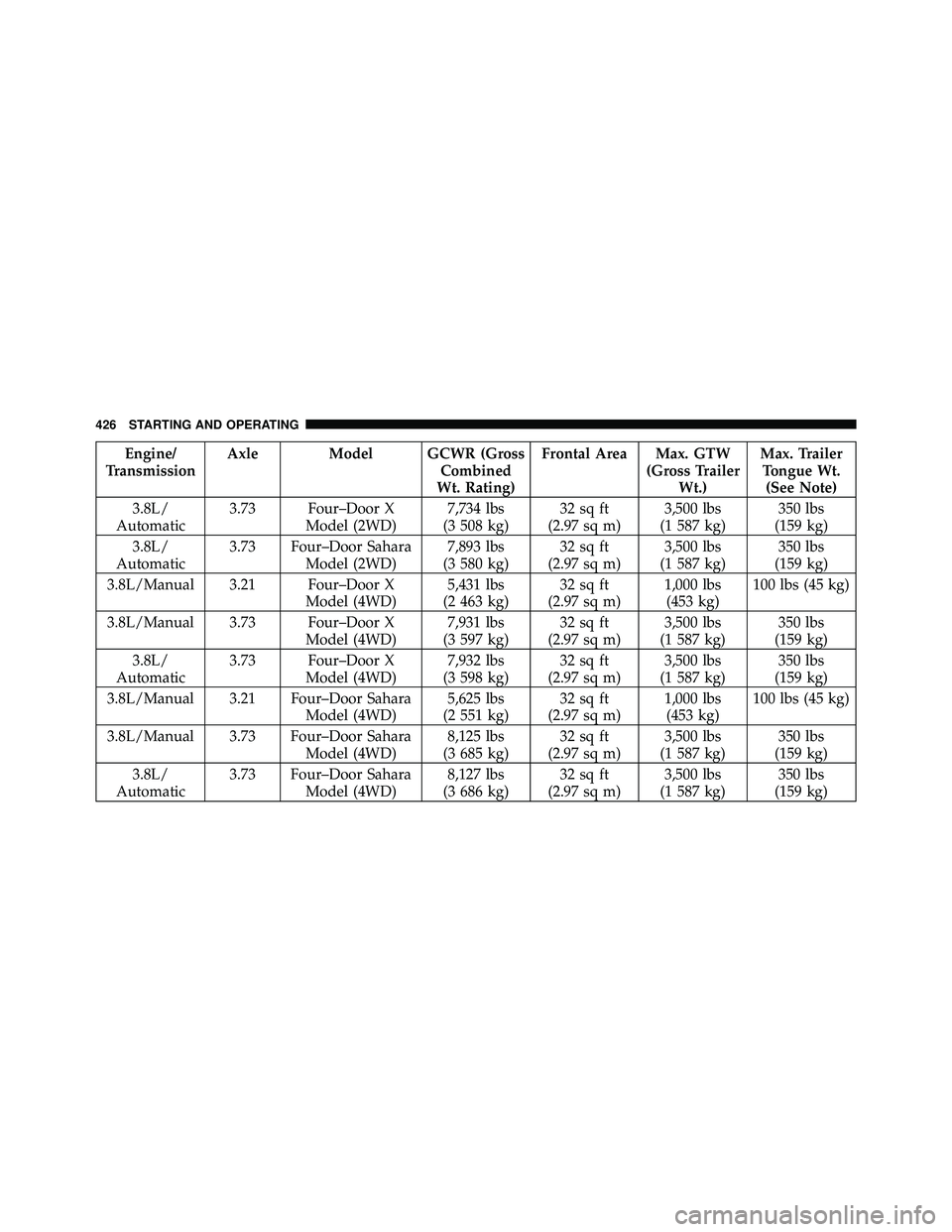
Engine/
Transmission Axle Model GCWR (Gross
Combined
Wt. Rating) Frontal Area Max. GTW
(Gross TrailerWt.) Max. Trailer
Tongue Wt. (See Note)
3.8L/
Automatic 3.73 Four–Door X
Model (2WD) 7,734 lbs
(3 508 kg) 32 sq ft
(2.97 sq m) 3,500 lbs
(1 587 kg) 350 lbs
(159 kg)
3.8L/
Automatic 3.73 Four–Door Sahara
Model (2WD) 7,893 lbs
(3 580 kg) 32 sq ft
(2.97 sq m) 3,500 lbs
(1 587 kg) 350 lbs
(159 kg)
3.8L/Manual 3.21 Four–Door X Model (4WD)5,431 lbs
(2 463 kg) 32 sq ft
(2.97 sq m) 1,000 lbs
(453 kg) 100 lbs (45 kg)
3.8L/Manual 3.73 Four–Door X Model (4WD)7,931 lbs
(3 597 kg) 32 sq ft
(2.97 sq m) 3,500 lbs
(1 587 kg) 350 lbs
(159 kg)
3.8L/
Automatic 3.73 Four–Door X
Model (4WD) 7,932 lbs
(3 598 kg) 32 sq ft
(2.97 sq m) 3,500 lbs
(1 587 kg) 350 lbs
(159 kg)
3.8L/Manual 3.21 Four–Door Sahara Model (4WD)5,625 lbs
(2 551 kg) 32 sq ft
(2.97 sq m) 1,000 lbs
(453 kg) 100 lbs (45 kg)
3.8L/Manual 3.73 Four–Door Sahara Model (4WD)8,125 lbs
(3 685 kg) 32 sq ft
(2.97 sq m) 3,500 lbs
(1 587 kg) 350 lbs
(159 kg)
3.8L/
Automatic 3.73 Four–Door Sahara
Model (4WD) 8,127 lbs
(3 686 kg) 32 sq ft
(2.97 sq m) 3,500 lbs
(1 587 kg) 350 lbs
(159 kg)
426 STARTING AND OPERATING
Page 431 of 554
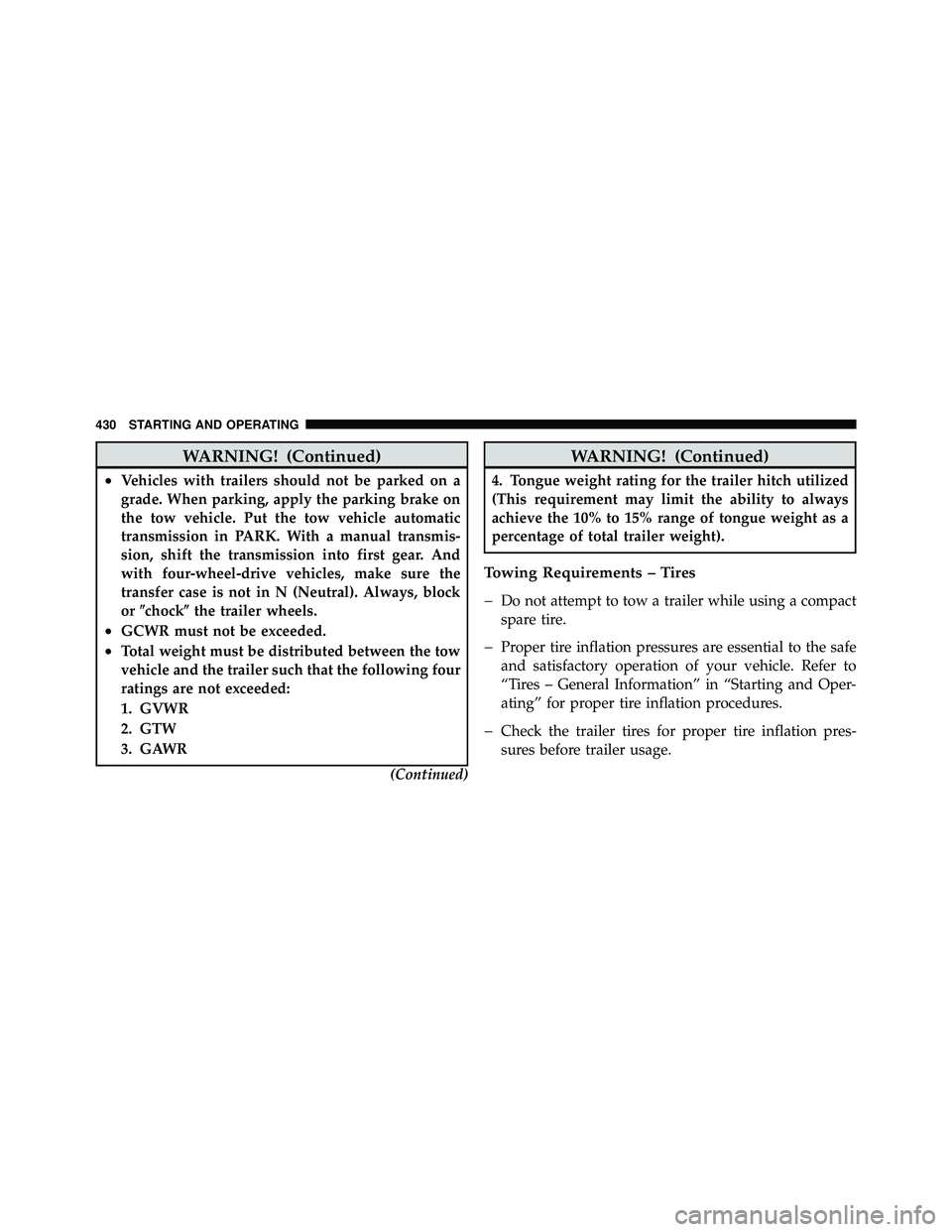
WARNING! (Continued)
•Vehicles with trailers should not be parked on a
grade. When parking, apply the parking brake on
the tow vehicle. Put the tow vehicle automatic
transmission in PARK. With a manual transmis-
sion, shift the transmission into first gear. And
with four-wheel-drive vehicles, make sure the
transfer case is not in N (Neutral). Always, block
or\bchock\b the trailer wheels.
•GCWR must not be exceeded.
•Total weight must be distributed between the tow
vehicle and the trailer such that the following four
ratings are not exceeded:
1. GVWR
2. GTW
3. GAWR
(Continued)
Page 435 of 554
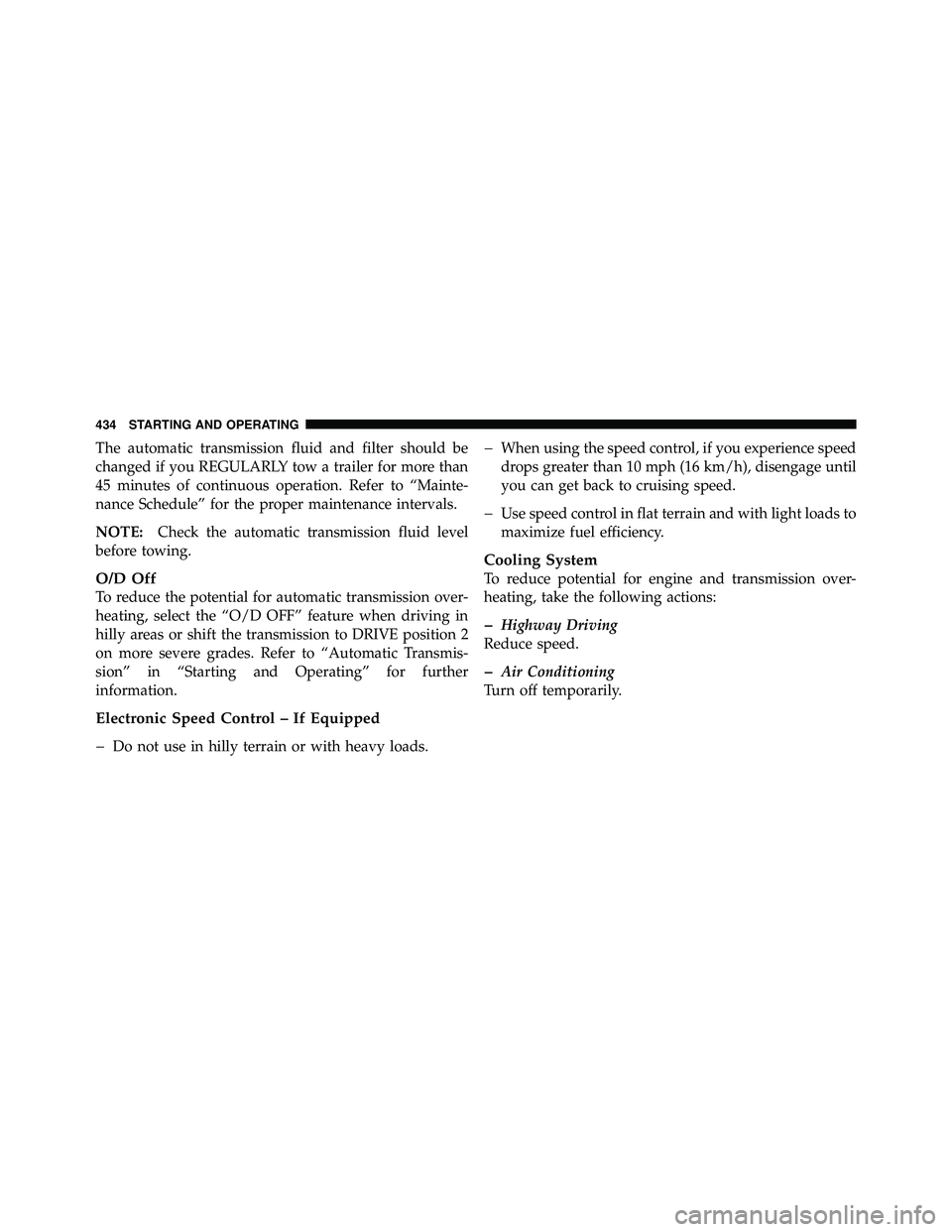
The automatic transmission fluid and filter should be
changed if you REGULARLY tow a trailer for more than
45 minutes of continuous operation. Refer to “Mainte-
nance Schedule” for the proper maintenance intervals.
NOTE:Check the automatic transmission fluid level
before towing.
O/D Off
To reduce the potential for automatic transmission over-
heating, select the “O/D OFF” feature when driving in
hilly areas or shift the transmission to DRIVE position 2
on more severe grades. Refer to “Automatic Transmis-
sion” in “Starting and Operating” for further
information.
Electronic Speed Control – If Equipped
Do not use in hilly terrain or with heavy loads.
When using the speed control, if you experience speed
drops greater than 10 mph (16 km/h), disengage until
you can get back to cruising speed.
Use speed control in flat terrain and with light loads to
maximize fuel efficiency.
Cooling System
To reduce potential for engine and transmission over-
heating, take the following actions:
Highway Driving
Reduce speed.
Air Conditioning
Turn off temporarily.
434 STARTING AND OPERATING
Page 437 of 554
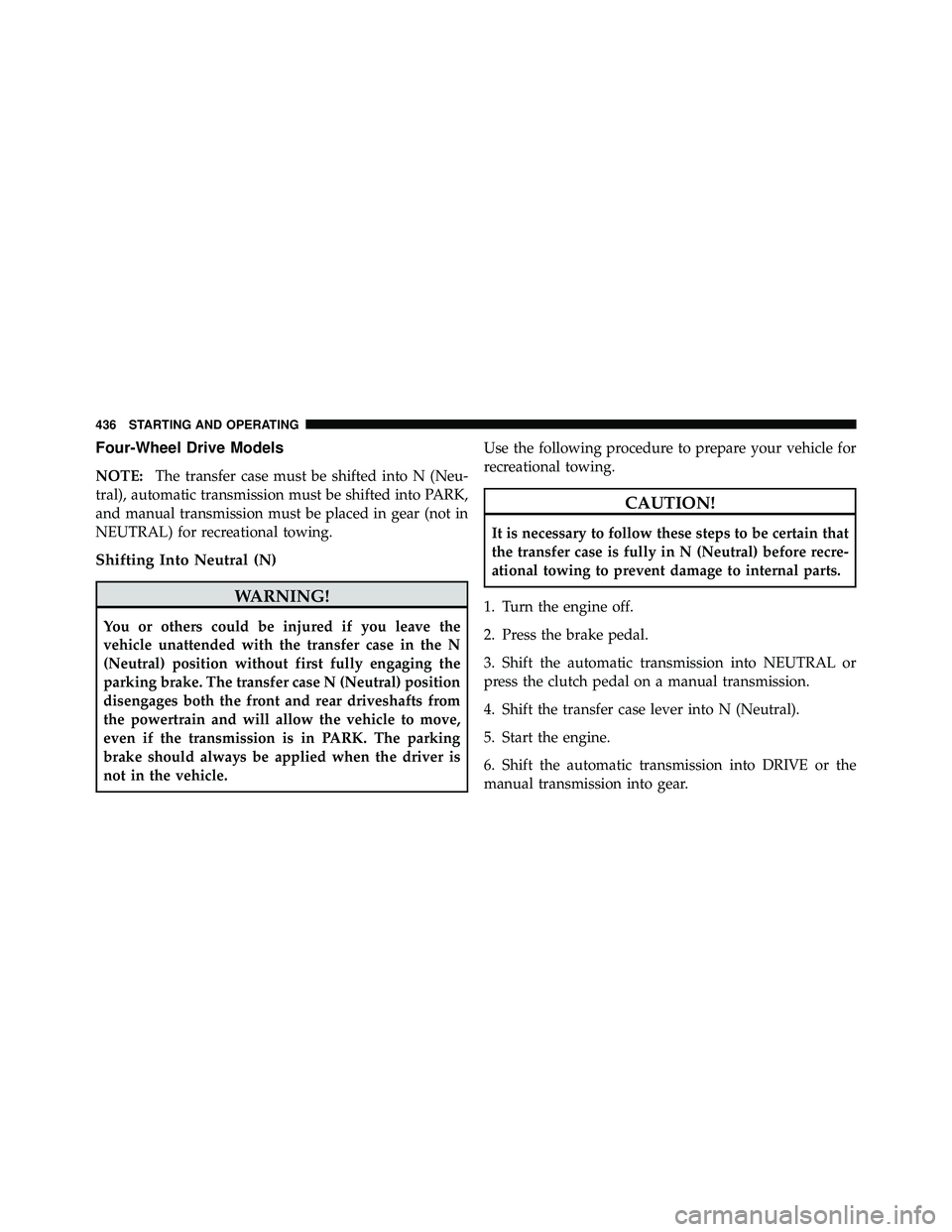
Four-Wheel Drive Models
NOTE:The transfer case must be shifted into N (Neu-
tral), automatic transmission must be shifted into PARK,
and manual transmission must be placed in gear (not in
NEUTRAL) for recreational towing.
Shifting Into Neutral (N)
Page 439 of 554
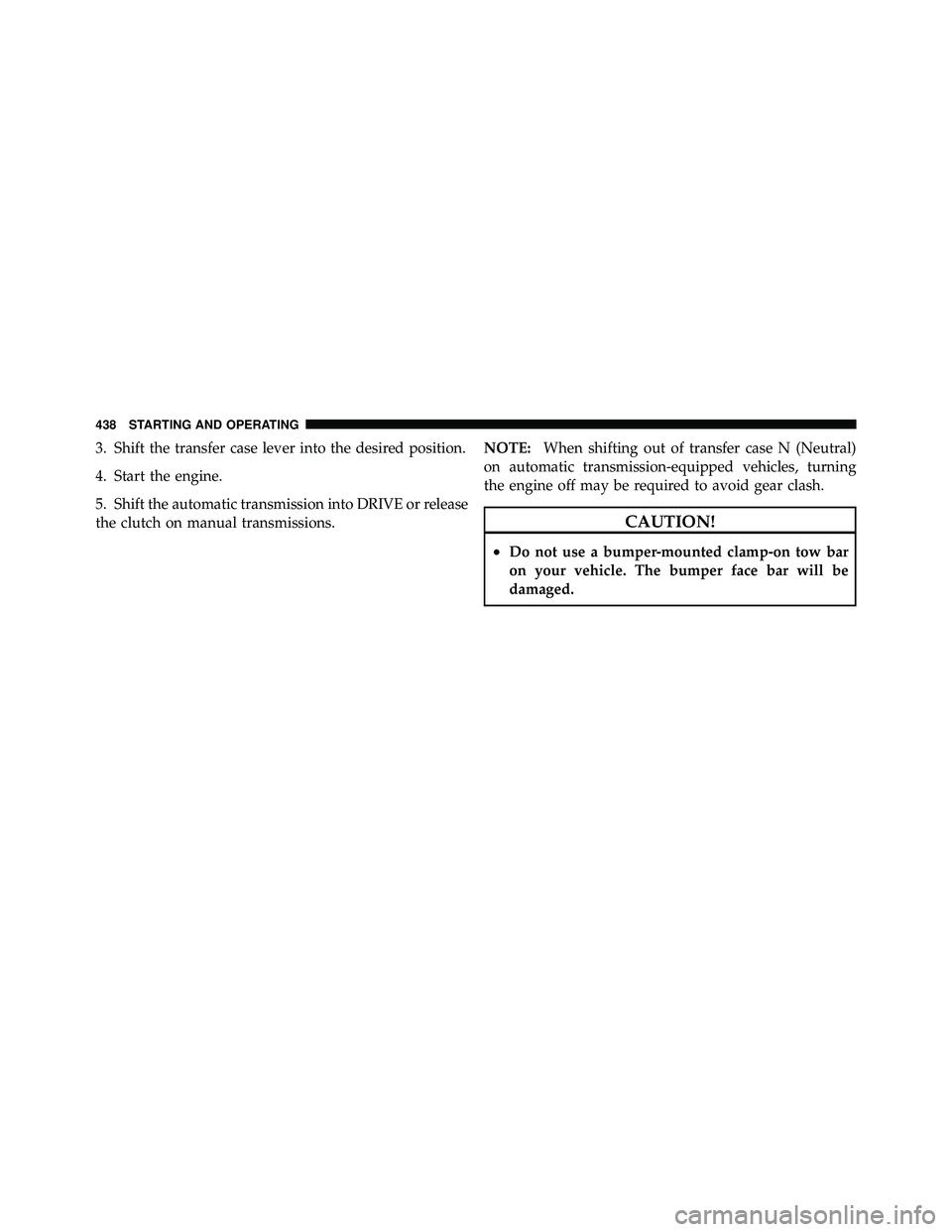
3. Shift the transfer case lever into the desired position.
4. Start the engine.
5. Shift the automatic transmission into DRIVE or release
the clutch on manual transmissions.NOTE:
When shifting out of transfer case N (Neutral)
on automatic transmission-equipped vehicles, turning
the engine off may be required to avoid gear clash.