warning light JEEP WRANGLER 2010 User Guide
[x] Cancel search | Manufacturer: JEEP, Model Year: 2010, Model line: WRANGLER, Model: JEEP WRANGLER 2010Pages: 554, PDF Size: 10.16 MB
Page 387 of 554
If the “ESP/BAS Warning Light” comes on continuously
with the engine running, a malfunction has been detected
in either the ESP or the BAS system, or both. If this light
remains on after several ignition cycles, and the vehicle
has been driven several miles/kilometers at speeds
greater than 30 mph (48 km/h), see your authorized
dealer as soon as possible to have the problem diagnosed
and corrected.
NOTE:
•The “ESP/BAS Warning Light” comes on momentarily
each time the ignition switch is turned ON.
•Each time the ignition is turned ON, the ESP System
will be ON even if it was previously turned off.
•The ESP Control System will make buzzing or clicking
sounds when it is active. This is normal; the sounds
will stop when ESP becomes inactive following the
maneuver that caused the ESP activation.
Trailer Sway Control (TSC)
TSC uses sensors in the vehicle to recognize an exces-
sively swaying trailer and will take the appropriate
actions to attempt to stop the sway. The system may
reduce engine power and apply the brake of the appro-
priate wheel(s) to counteract the sway of the trailer. TSC
will become active automatically once an excessively
swaying trailer is recognized. No driver action is re-
quired. Note that TSC cannot stop all trailers from
swaying. Always use caution when towing a trailer and
follow the tongue weight recommendations. Refer to
“Trailer Towing” in “Starting and Operating” for further
information. When TSC is functioning, the “ESP/TCS
Indicator Light” will flash, the engine power may be
reduced and you may feel the brakes being applied to
individual wheels to attempt to stop the trailer from
swaying. TSC is disabled when the ESP system is in the
“Partial Off” or “Full Off” modes.
386 STARTING AND OPERATING
Page 407 of 554
TIRE PRESSURE MONITOR SYSTEM (TPMS)
The Tire Pressure Monitoring System (TPMS) will warn
the driver of a low tire pressure based on the vehicle
recommended cold placard pressure.
The tire pressure will vary with temperature by about
1 psi (6.9 kPa) for every 12°F (6.5°C). This means that
when the outside temperature decreases, the tire pressure
will decrease. Tire pressure should always be set based
on cold inflation tire pressure. This is defined as the tire
pressure after a vehicle has not been driven for more than
three hours, or driven less than 1 mile (1.6 km) after a
three-hour period.Refer to “Tires – General Informa-
tion” in “Starting and Operating” for information on
how to properly inflate the vehicle’s tires. The tire
pressure will also increase as the vehicle is driven; this is
normal and there should be no adjustment for this
increased pressure. The TPMS will warn the driver of a low tire pressure if
the tire pressure falls below the low pressure warning
threshold for any reason, including low temperature
effects, or natural pressure loss through the tire.
The TPMS will continue to warn the driver of low tire
pressure as long as the condition exists, and will not turn
off until the tire pressure is at or above recommended
cold placard pressure. Once the “Tire Pressure Monitor-
ing Telltale Light” has been illuminated, the tire pressure
must be increased to the recommended cold placard
pressure in order for the “Tire Pressure Monitoring
Telltale Light” to be turned OFF. The system will auto-
matically update and the “Tire Pressure Monitoring
Telltale Light” will extinguish once the updated tire
pressures have been received. The vehicle may need to be
driven for up to 20 minutes above 15 mph (25 km/h) to
receive this information.
406 STARTING AND OPERATING
Page 409 of 554
NOTE:
•The TPMS is not intended to replace normal tire care
and maintenance, nor to provide warning of a tire
failure or condition.
•The TPMS should not be used as a tire pressure gauge
while adjusting your tire pressure.
•Driving on a significantly under-inflated tire causes
the tire to overheat and can lead to tire failure.
Under-inflation also reduces fuel efficiency and tire
tread life, and may affect the vehicle’s handling and
stopping ability.
•The TPMS is not a substitute for proper tire mainte-
nance, and it is the driver ’s responsibility to maintain
correct tire pressure, even if under-inflation has not
reached the level to trigger illumination of the “Tire
Pressure Monitoring Telltale Light.”
•Seasonal temperature changes will affect tire pressure,
and the TPMS will monitor the actual tire pressure in
the tire.
Base System
The Tire Pressure Monitor System (TPMS) uses wireless
technology with wheel rim-mounted electronic sensors to
monitor tire pressure levels. Sensors, mounted to each
wheel as part of the valve stem, transmit tire pressure
readings to the Receiver Module.
NOTE:It is particularly important for you to check the
tire pressure in all of your tires regularly and to maintain
the proper pressure.
The Tire Pressure Monitor System (TPMS) consists of the
following components:
•Receiver Module
•Four Tire Pressure Monitoring Sensors
408 STARTING AND OPERATING
Page 411 of 554
5. Using wheels/tires not equipped with TPM sensors.
NOTE:
•If your vehicle is equipped with a matching full-size
spare wheel and tire assembly, it has a tire pressure
monitoring sensor, and can be monitored by the Tire
Pressure Monitoring System (TPMS). In the event that
the matching full-size spare tire is swapped with a low
pressure road tire, the next ignition key cycle will still
show the “Tire Pressure Monitoring Telltale Light” to
be ON, and a chime to sound. Driving the vehicle for
up to 20 minutes above 15 mph (25 km/h) will turn
OFF the “Tire Pressure Monitoring Telltale Light” as
long as none of the road tires are below the low
pressure warning threshold.
•If your vehicle is not equipped with a matching
full-size spare wheel and tire assembly, it does not
have a tire pressure monitoring sensor in the spare tire.
The TPMS will not be able to monitor the tire pressure.If you install the spare tire in place of a road tire that
has a pressure below the low-pressure warning limit,
upon the next ignition key cycle, a chime will sound
and the “Tire Pressure Monitoring Telltale Light” will
turn ON. After driving the vehicle for up to 20 minutes
above 15 mph (25 km/h), the “Tire Pressure Monitor-
ing Telltale Light” will flash on and off for 75 seconds
and then remain on solid. For each subsequent ignition
key cycle, a chime will sound and the “Tire Pressure
Monitoring Telltale Light” will flash on and off for
75 seconds and then remain on solid. Once you repair
or replace the original road tire, and reinstall it on the
vehicle in place of the spare tire, the TPMS will update
automatically and the “Tire Pressure Monitoring Tell-
tale Light” will turn OFF, as long as no tire pressure is
below the low-pressure warning limit in any of the
four active road tires. The vehicle may need to be
driven for up to 20 minutes above 15 mph (25 km/h)
in order for the TPMS to receive this information.
410 STARTING AND OPERATING
Page 433 of 554
WARNING!
•Do not connect trailer brakes to your vehicle’s
hydraulic brake lines. It can overload your brake
system and cause it to fail. You might not have
brakes when you need them and could have an
accident.
•Towing any trailer will increase your stopping
distance. When towing, you should allow for ad-
ditional space between your vehicle and the ve-
hicle in front of you. Failure to do so could result
in an accident.
Towing Requirements – Trailer Lights and Wiring
Whenever you pull a trailer, regardless of the trailer size,
stop lights and turn signals on the trailer are required for
motoring safety.The Trailer Tow Package will include a four–pin wiring
harness. Use a factory-approved trailer harness and
connector.
NOTE:
Do not cut or splice wiring into the vehicles
wiring harness.
The electrical connections are all complete to the vehicle
but you must mate the harness to a trailer connector.
Refer to the following illustration.
432 STARTING AND OPERATING
Page 447 of 554
WARNING!
Raising the vehicle higher than necessary can make
the vehicle less stable and cause an accident. It could
slip off the jack and hurt someone near it. Raise the
vehicle only enough to remove the tire.
6. Remove the lug nuts and wheel.
7. Position the spare wheel/tire on the vehicle and install
the lug nuts with the cone-shaped end toward the wheel.
Lightly tighten the lug nuts clockwise. To avoid the risk
of forcing the vehicle off the jack, do not tighten the nuts
fully until the vehicle has been lowered.
8. Lower the vehicle by turning the jack screw to the left,
and remove the jack and wheel blocks.
9. Finish tightening the lug nuts. Push down on the
wrench while tightening for increased leverage. Alternate
nuts until each nut has been tightened twice. The correct wheel nut tightness is 95 ft lbs (130 N·m). If in doubt
about the correct tightness, have them checked with a
torque wrench by your authorized dealer or at a service
station.
10. Remove the jack assembly and wheel blocks.
11. Secure the tire, jack, and tools in their proper
locations.
Page 537 of 554
ABS (Anti-Lock Brake System)............249,371
Adding Engine Coolant (Antifreeze) .......... 472
Adding Fuel ........................... 416
Air Cleaner, Engine (Engine Air Cleaner Filter) . . . 463
Air Conditioner Maintenance ............... 465
Air Conditioning ..................... 319,323
Air Conditioning Controls ................. 323
Air Conditioning, Operating Tips ............ 324
Air Conditioning Refrigerant ............... 466
Air Conditioning System .................. 323
Air Filter .............................. 463
Air Pressure, Tires ....................... 398
Airbag ................................ 50
Airbag Deployment ....................... 58
Airbag Light ....................... 60,77,250
Airbag Maintenance ....................... 60
Airbag, Side ............................ 57
Alarm Light ........................... 250
Alarm (Security Alarm) .................... 17 Alterations/Modifications, Vehicle
............. 8
Antenna, Satellite Radio ................308,313
Antifreeze (Engine Coolant) ................ 501
Anti-Lock Brake System (ABS) ............371,373
Anti-Lock Warning Light .................. 249
Appearance Care ........................ 482
Arming Theft System (Security Alarm) ......... 18
Assistance Towing ....................... 103
Auto Down Power Windows ................ 35
Automatic Transmission ................... 478
Fluid and Filter Changes ................. 478
Fluid Level Check ..................... 478
Fluid Type ........................... 478
Gear Ranges ......................... 342
Shifting ............................. 341
Special Additives ...................... 480
Torque Converter ...................... 345
Auxiliary Electrical Outlet (Power Outlet) ...... 150
Auxiliary Power Outlet ................... 150
536 INDEX
Page 541 of 554
Flooded, Starting...................... 332
Fuel Requirements .................. 41 1,501
Jump Starting ......................... 446
Oil .............................. 460,501
Oil Disposal .......................... 462
Oil Filter ............................ 462
Oil Selection .......................... 501
Overheating .......................... 440
Starting ............................. 331
Temperature Gauge .................... 251
Engine Oil Viscosity ...................... 462
Engine Oil Viscosity Chart ................. 462
Enhanced Accident Response Feature .......... 58
Entry System, Illuminated .................. 19
Event Data Recorder ...................... 60
Exhaust Gas Caution ................... 76,415
Exhaust System ....................... 76,468
Extender, Seat Belt ........................ 49
Exterior Finish Care ...................... 483 Exterior Lights
.......................... 79
Fabric Care ......................... 485,487
Fabric Top ............................. 487
Filters Air Cleaner .......................... 463
Engine Oil ........................... 462
Finish Care ............................ 483
Flashers Hazard Warning ....................... 440
Turn Signal ................... 79,247,499,500
Flooded Engine Starting ................... 332
Fluid Capacities ......................... 501
Fluid Leaks ............................. 79
Fluid Level Checks ...................... 482
Automatic Transmission ................. 478
Engine Oil ........................... 460
Manual Transmission ................... 481
Power Steering ........................ 368
540 INDEX
Page 543 of 554
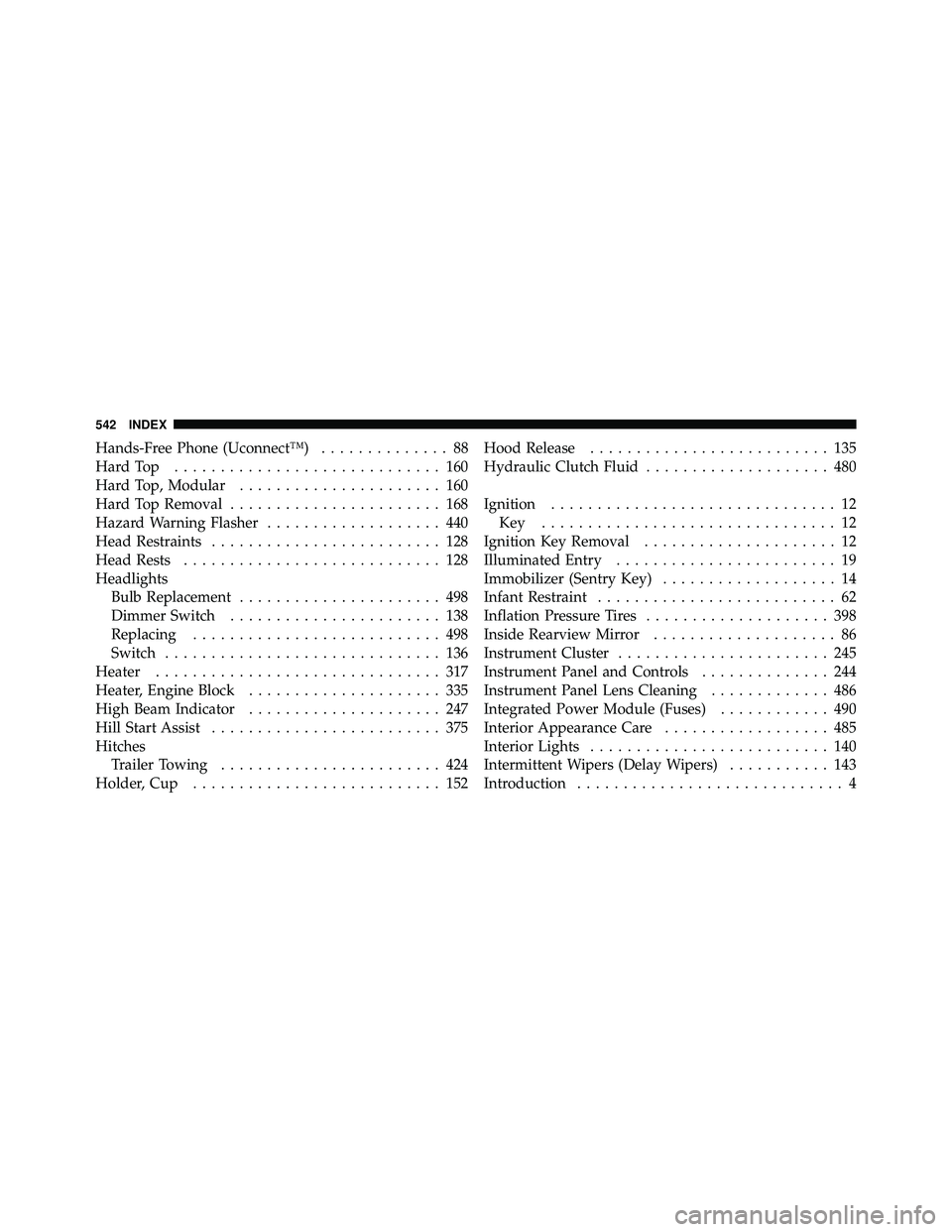
Hands-Free Phone (Uconnect™).............. 88
HardTop ............................. 160
Hard Top, Modular ...................... 160
Hard Top Removal ....................... 168
Hazard Warning Flasher ................... 440
Head Restraints ......................... 128
Head Rests ............................ 128
Headlights Bulb Replacement ...................... 498
Dimmer Switch ....................... 138
Replacing ........................... 498
Switch .............................. 136
Heater ............................... 317
Heater, Engine Block ..................... 335
High Beam Indicator ..................... 247
Hill Start Assist ......................... 375
Hitches Trailer Towing ........................ 424
Holder, Cup ........................... 152 Hood Release
.......................... 135
Hydraulic Clutch Fluid .................... 480
Ignition ............................... 12
Key ................................ 12
Ignition Key Removal ..................... 12
Illuminated Entry ........................ 19
Immobilizer (Sentry Key) ................... 14
Infant Restraint .......................... 62
Inflation Pressure Tires .................... 398
Inside Rearview Mirror .................... 86
Instrument Cluster ....................... 245
Instrument Panel and Controls .............. 244
Instrument Panel Lens Cleaning ............. 486
Integrated Power Module (Fuses) ............ 490
Interior Appearance Care .................. 485
Interior Lights .......................... 140
Intermittent Wipers (Delay Wipers) ........... 143
Introduction ............................. 4
542 INDEX
Page 545 of 554
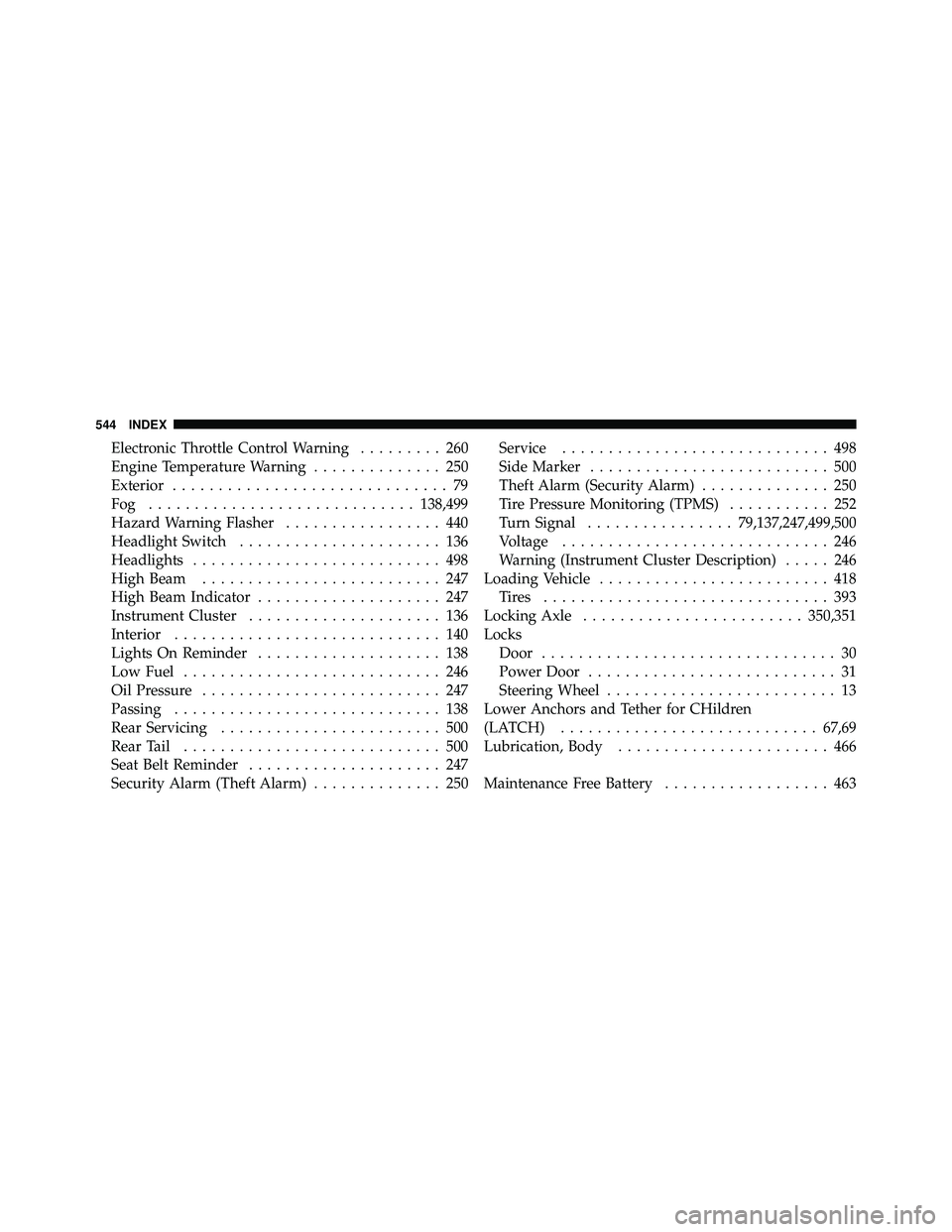
Electronic Throttle Control Warning......... 260
Engine Temperature Warning .............. 250
Exterior .............................. 79
Fog ............................. 138,499
Hazard Warning Flasher ................. 440
Headlight Switch ...................... 136
Headlights ........................... 498
High Beam .......................... 247
High Beam Indicator .................... 247
Instrument Cluster ..................... 136
Interior ............................. 140
Lights On Reminder .................... 138
Low Fuel ............................ 246
Oil Pressure .......................... 247
Passing ............................. 138
Rear Servicing ........................ 500
Rear Tail ............................ 500
Seat Belt Reminder ..................... 247
Security Alarm (Theft Alarm) .............. 250Service
............................. 498
Side Marker .......................... 500
Theft Alarm (Security Alarm) .............. 250
Tire Pressure Monitoring (TPMS) ........... 252
Turn Signal ................ 79,137,247,499,500
Voltage ............................. 246
Warning (Instrument Cluster Description) ..... 246
Loading Vehicle ......................... 418
Tires ............................... 393
Locking Axle ........................ 350,351
Locks Door ................................ 30
Power Door ........................... 31
Steering Wheel ......................... 13
Lower Anchors and Tether for CHildren
(LATCH) ............................ 67,69
Lubrication, Body ....................... 466
Maintenance Free Battery .................. 463
544 INDEX