wheel JEEP WRANGLER 2010 Owner's Manual
[x] Cancel search | Manufacturer: JEEP, Model Year: 2010, Model line: WRANGLER, Model: JEEP WRANGLER 2010Pages: 554, PDF Size: 10.16 MB
Page 409 of 554
NOTE:
•The TPMS is not intended to replace normal tire care
and maintenance, nor to provide warning of a tire
failure or condition.
•The TPMS should not be used as a tire pressure gauge
while adjusting your tire pressure.
•Driving on a significantly under-inflated tire causes
the tire to overheat and can lead to tire failure.
Under-inflation also reduces fuel efficiency and tire
tread life, and may affect the vehicle’s handling and
stopping ability.
•The TPMS is not a substitute for proper tire mainte-
nance, and it is the driver ’s responsibility to maintain
correct tire pressure, even if under-inflation has not
reached the level to trigger illumination of the “Tire
Pressure Monitoring Telltale Light.”
•Seasonal temperature changes will affect tire pressure,
and the TPMS will monitor the actual tire pressure in
the tire.
Base System
The Tire Pressure Monitor System (TPMS) uses wireless
technology with wheel rim-mounted electronic sensors to
monitor tire pressure levels. Sensors, mounted to each
wheel as part of the valve stem, transmit tire pressure
readings to the Receiver Module.
NOTE:It is particularly important for you to check the
tire pressure in all of your tires regularly and to maintain
the proper pressure.
The Tire Pressure Monitor System (TPMS) consists of the
following components:
•Receiver Module
•Four Tire Pressure Monitoring Sensors
408 STARTING AND OPERATING
Page 411 of 554
5. Using wheels/tires not equipped with TPM sensors.
NOTE:
•If your vehicle is equipped with a matching full-size
spare wheel and tire assembly, it has a tire pressure
monitoring sensor, and can be monitored by the Tire
Pressure Monitoring System (TPMS). In the event that
the matching full-size spare tire is swapped with a low
pressure road tire, the next ignition key cycle will still
show the “Tire Pressure Monitoring Telltale Light” to
be ON, and a chime to sound. Driving the vehicle for
up to 20 minutes above 15 mph (25 km/h) will turn
OFF the “Tire Pressure Monitoring Telltale Light” as
long as none of the road tires are below the low
pressure warning threshold.
•If your vehicle is not equipped with a matching
full-size spare wheel and tire assembly, it does not
have a tire pressure monitoring sensor in the spare tire.
The TPMS will not be able to monitor the tire pressure.If you install the spare tire in place of a road tire that
has a pressure below the low-pressure warning limit,
upon the next ignition key cycle, a chime will sound
and the “Tire Pressure Monitoring Telltale Light” will
turn ON. After driving the vehicle for up to 20 minutes
above 15 mph (25 km/h), the “Tire Pressure Monitor-
ing Telltale Light” will flash on and off for 75 seconds
and then remain on solid. For each subsequent ignition
key cycle, a chime will sound and the “Tire Pressure
Monitoring Telltale Light” will flash on and off for
75 seconds and then remain on solid. Once you repair
or replace the original road tire, and reinstall it on the
vehicle in place of the spare tire, the TPMS will update
automatically and the “Tire Pressure Monitoring Tell-
tale Light” will turn OFF, as long as no tire pressure is
below the low-pressure warning limit in any of the
four active road tires. The vehicle may need to be
driven for up to 20 minutes above 15 mph (25 km/h)
in order for the TPMS to receive this information.
410 STARTING AND OPERATING
Page 431 of 554
WARNING! (Continued)
•Vehicles with trailers should not be parked on a
grade. When parking, apply the parking brake on
the tow vehicle. Put the tow vehicle automatic
transmission in PARK. With a manual transmis-
sion, shift the transmission into first gear. And
with four-wheel-drive vehicles, make sure the
transfer case is not in N (Neutral). Always, block
or\bchock\b the trailer wheels.
•GCWR must not be exceeded.
•Total weight must be distributed between the tow
vehicle and the trailer such that the following four
ratings are not exceeded:
1. GVWR
2. GTW
3. GAWR
(Continued)
Page 437 of 554
Four-Wheel Drive Models
NOTE:The transfer case must be shifted into N (Neu-
tral), automatic transmission must be shifted into PARK,
and manual transmission must be placed in gear (not in
NEUTRAL) for recreational towing.
Shifting Into Neutral (N)
Page 446 of 554
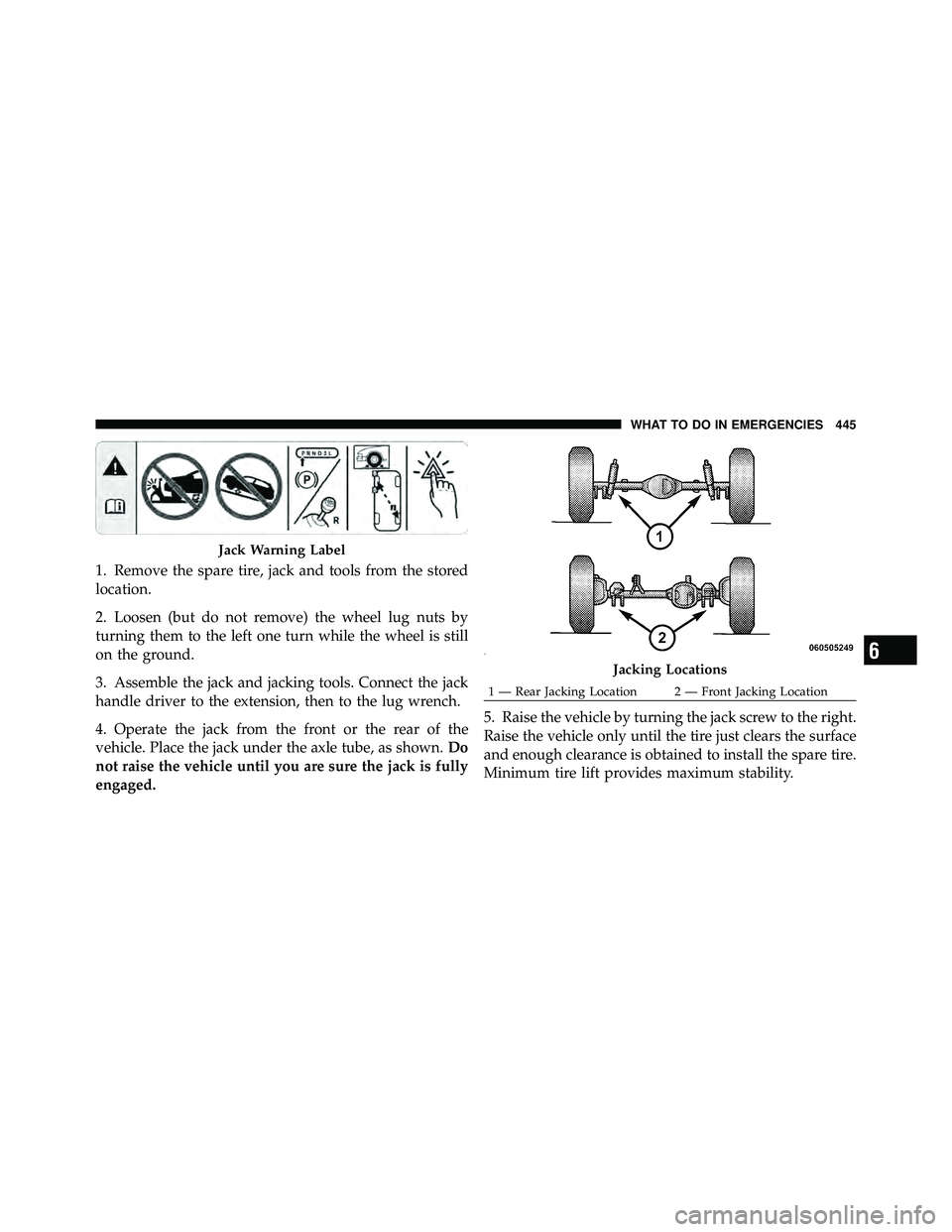
1. Remove the spare tire, jack and tools from the stored
location.
2. Loosen (but do not remove) the wheel lug nuts by
turning them to the left one turn while the wheel is still
on the ground.
3. Assemble the jack and jacking tools. Connect the jack
handle driver to the extension, then to the lug wrench.
4. Operate the jack from the front or the rear of the
vehicle. Place the jack under the axle tube, as shown.Do
not raise the vehicle until you are sure the jack is fully
engaged. 5. Raise the vehicle by turning the jack screw to the right.
Raise the vehicle only until the tire just clears the surface
and enough clearance is obtained to install the spare tire.
Minimum tire lift provides maximum stability.
Page 447 of 554
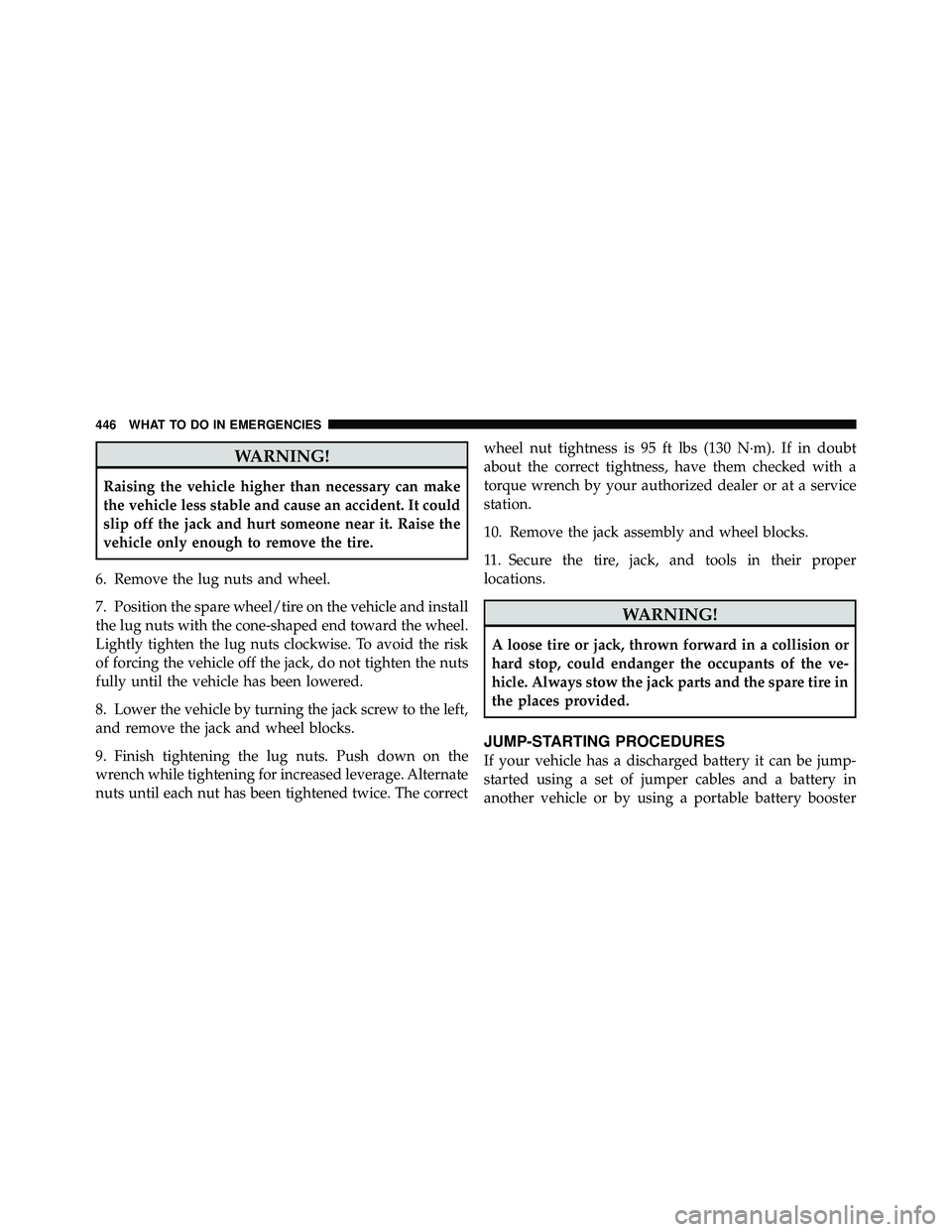
WARNING!
Raising the vehicle higher than necessary can make
the vehicle less stable and cause an accident. It could
slip off the jack and hurt someone near it. Raise the
vehicle only enough to remove the tire.
6. Remove the lug nuts and wheel.
7. Position the spare wheel/tire on the vehicle and install
the lug nuts with the cone-shaped end toward the wheel.
Lightly tighten the lug nuts clockwise. To avoid the risk
of forcing the vehicle off the jack, do not tighten the nuts
fully until the vehicle has been lowered.
8. Lower the vehicle by turning the jack screw to the left,
and remove the jack and wheel blocks.
9. Finish tightening the lug nuts. Push down on the
wrench while tightening for increased leverage. Alternate
nuts until each nut has been tightened twice. The correct wheel nut tightness is 95 ft lbs (130 N·m). If in doubt
about the correct tightness, have them checked with a
torque wrench by your authorized dealer or at a service
station.
10. Remove the jack assembly and wheel blocks.
11. Secure the tire, jack, and tools in their proper
locations.
Page 452 of 554
CAUTION!
Tow hooks are for emergency use only, to rescue a
vehicle stranded off road. Do not use tow hooks for
tow truck hookup or highway towing. You could
damage your vehicle. Tow straps are recommended
when towing the vehicle, chains may cause vehicle
damage.
TOWING A DISABLED VEHICLE
The manufacturer requires towing your vehicle with all
four wheelsOFFthe ground using a flatbed.
Page 535 of 554
WARNING!
The traction grade assigned to this tire is based on
straight-ahead braking traction tests, and does not
include acceleration, cornering, hydroplaning, or
peak traction characteristics.
Temperature Grades
The temperature grades are A (the highest), B, and C,
representing the tire’s resistance to the generation of heat
and its ability to dissipate heat, when tested under
controlled conditions on a specified indoor laboratory
test wheel. Sustained high temperature can cause the
material of the tire to degenerate and reduce tire life, and
excessive temperature can lead to sudden tire failure. The
grade C corresponds to a level of performance, which all
passenger car tires must meet under the Federal MotorVehicle Safety Standard No. 109. Grades B and A repre-
sent higher levels of performance on the laboratory test
wheel, than the minimum required by law.
Page 545 of 554
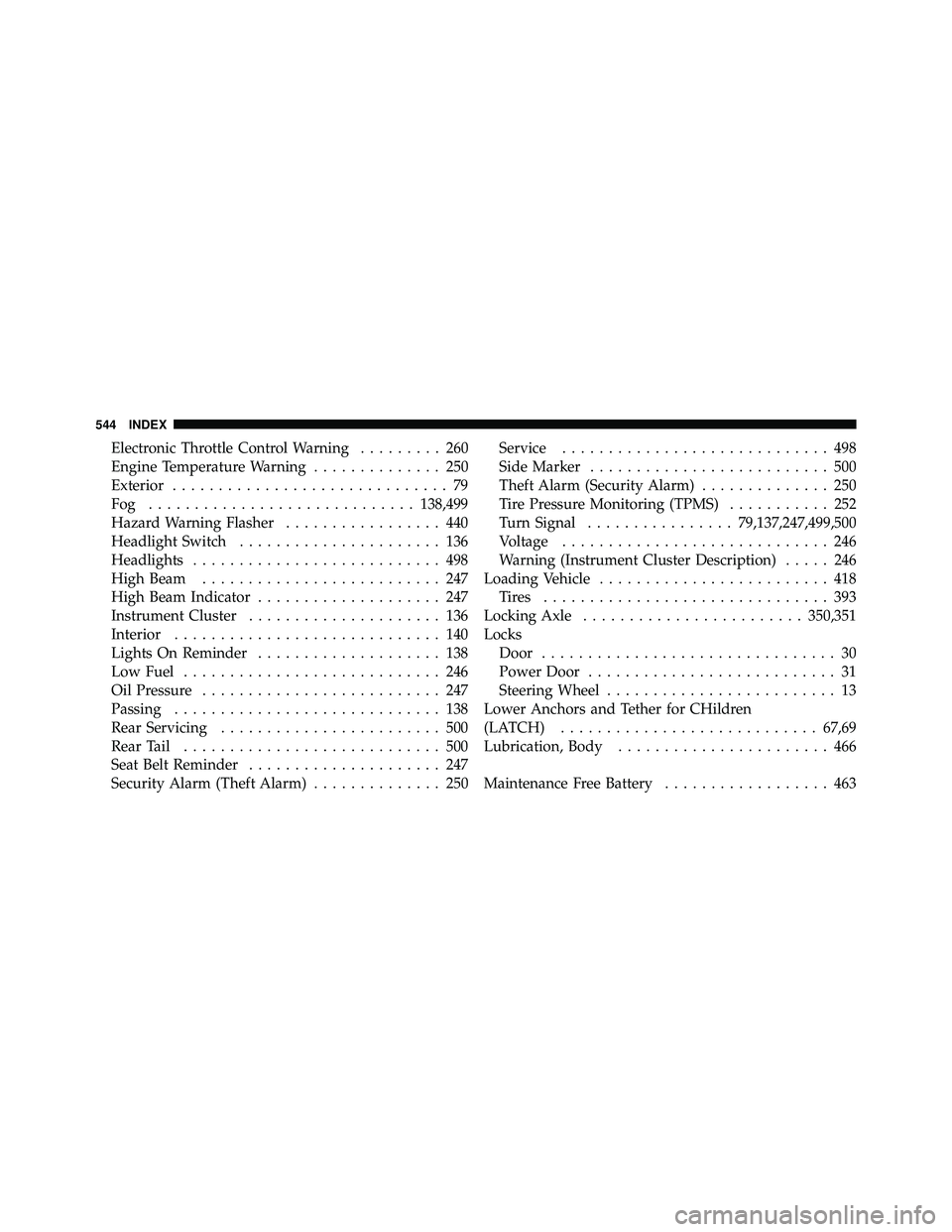
Electronic Throttle Control Warning......... 260
Engine Temperature Warning .............. 250
Exterior .............................. 79
Fog ............................. 138,499
Hazard Warning Flasher ................. 440
Headlight Switch ...................... 136
Headlights ........................... 498
High Beam .......................... 247
High Beam Indicator .................... 247
Instrument Cluster ..................... 136
Interior ............................. 140
Lights On Reminder .................... 138
Low Fuel ............................ 246
Oil Pressure .......................... 247
Passing ............................. 138
Rear Servicing ........................ 500
Rear Tail ............................ 500
Seat Belt Reminder ..................... 247
Security Alarm (Theft Alarm) .............. 250Service
............................. 498
Side Marker .......................... 500
Theft Alarm (Security Alarm) .............. 250
Tire Pressure Monitoring (TPMS) ........... 252
Turn Signal ................ 79,137,247,499,500
Voltage ............................. 246
Warning (Instrument Cluster Description) ..... 246
Loading Vehicle ......................... 418
Tires ............................... 393
Locking Axle ........................ 350,351
Locks Door ................................ 30
Power Door ........................... 31
Steering Wheel ......................... 13
Lower Anchors and Tether for CHildren
(LATCH) ............................ 67,69
Lubrication, Body ....................... 466
Maintenance Free Battery .................. 463
544 INDEX
Page 551 of 554
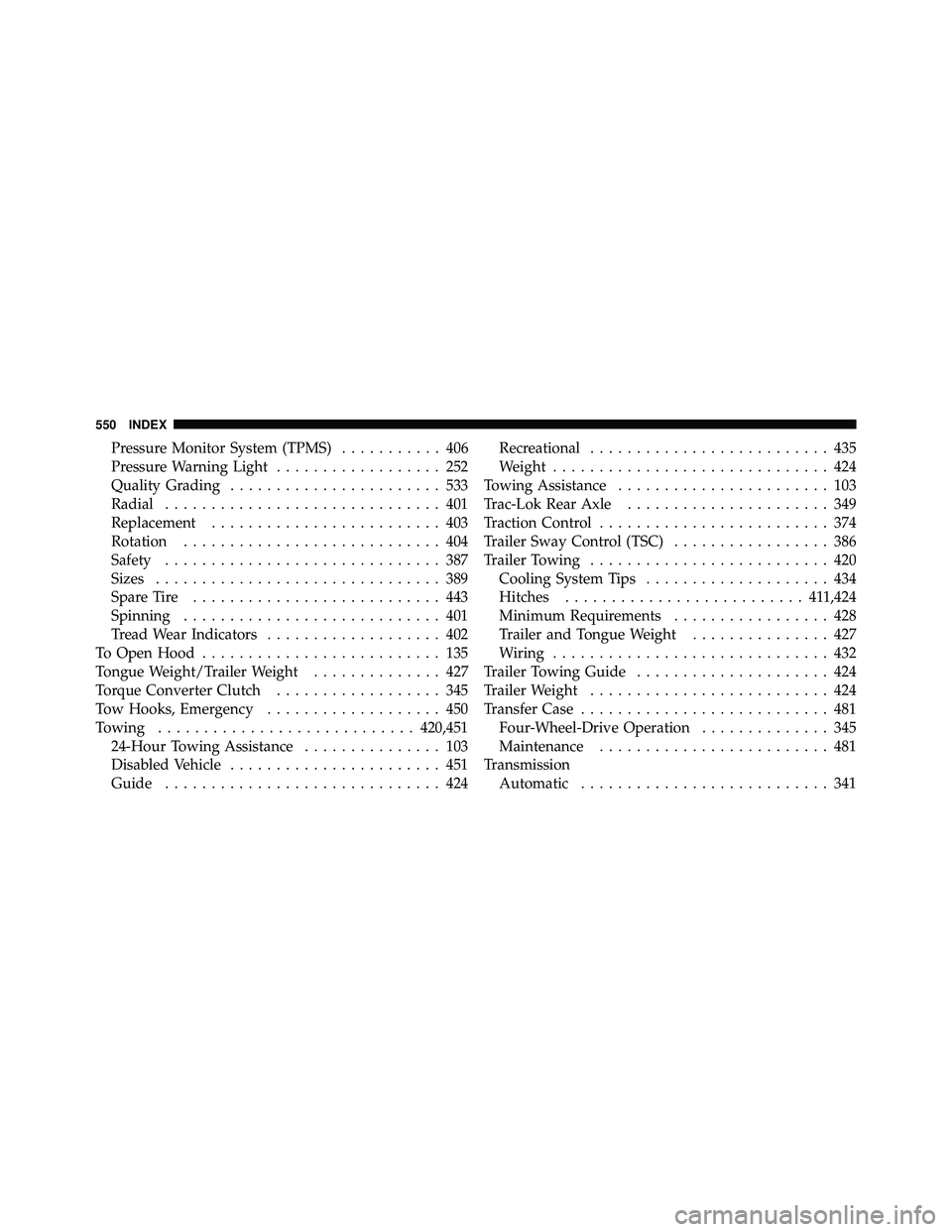
Pressure Monitor System (TPMS)........... 406
Pressure Warning Light .................. 252
Quality Grading ....................... 533
Radial .............................. 401
Replacement ......................... 403
Rotation ............................ 404
Safety .............................. 387
Sizes ............................... 389
Spare Tire ........................... 443
Spinning ............................ 401
Tread Wear Indicators ................... 402
To Open Hood .......................... 135
Tongue Weight/Trailer Weight .............. 427
Torque Converter Clutch .................. 345
Tow Hooks, Emergency ................... 450
Towing ............................ 420,451
24-Hour Towing Assistance ............... 103
Disabled Vehicle ....................... 451
Guide .............................. 424 Recreational
.......................... 435
Weight .............................. 424
Towing Assistance ....................... 103
Trac-Lok Rear Axle ...................... 349
Traction Control ......................... 374
Trailer Sway Control (TSC) ................. 386
Trailer Towing .......................... 420
Cooling System Tips .................... 434
Hitches .......................... 41 1,424
Minimum Requirements ................. 428
Trailer and Tongue Weight ............... 427
Wiring .............................. 432
Trailer Towing Guide ..................... 424
Trailer Weight .......................... 424
Transfer Case ........................... 481
Four-Wheel-Drive Operation .............. 345
Maintenance ......................... 481
Transmission Automatic ........................... 341
550 INDEX