radiator JEEP WRANGLER 2010 Owners Manual
[x] Cancel search | Manufacturer: JEEP, Model Year: 2010, Model line: WRANGLER, Model: JEEP WRANGLER 2010Pages: 554, PDF Size: 10.16 MB
Page 323 of 554
NOTE:If your air conditioning performance seems
lower than expected, check the front of the A/C con-
denser: located in front of the radiator, for an accumula-
tion of dirt or insects. Clean with a gentle water spray
from behind the radiator and through the condenser.
Fabric front fascia protectors may reduce air flow to the
condenser, reducing air conditioning performance.
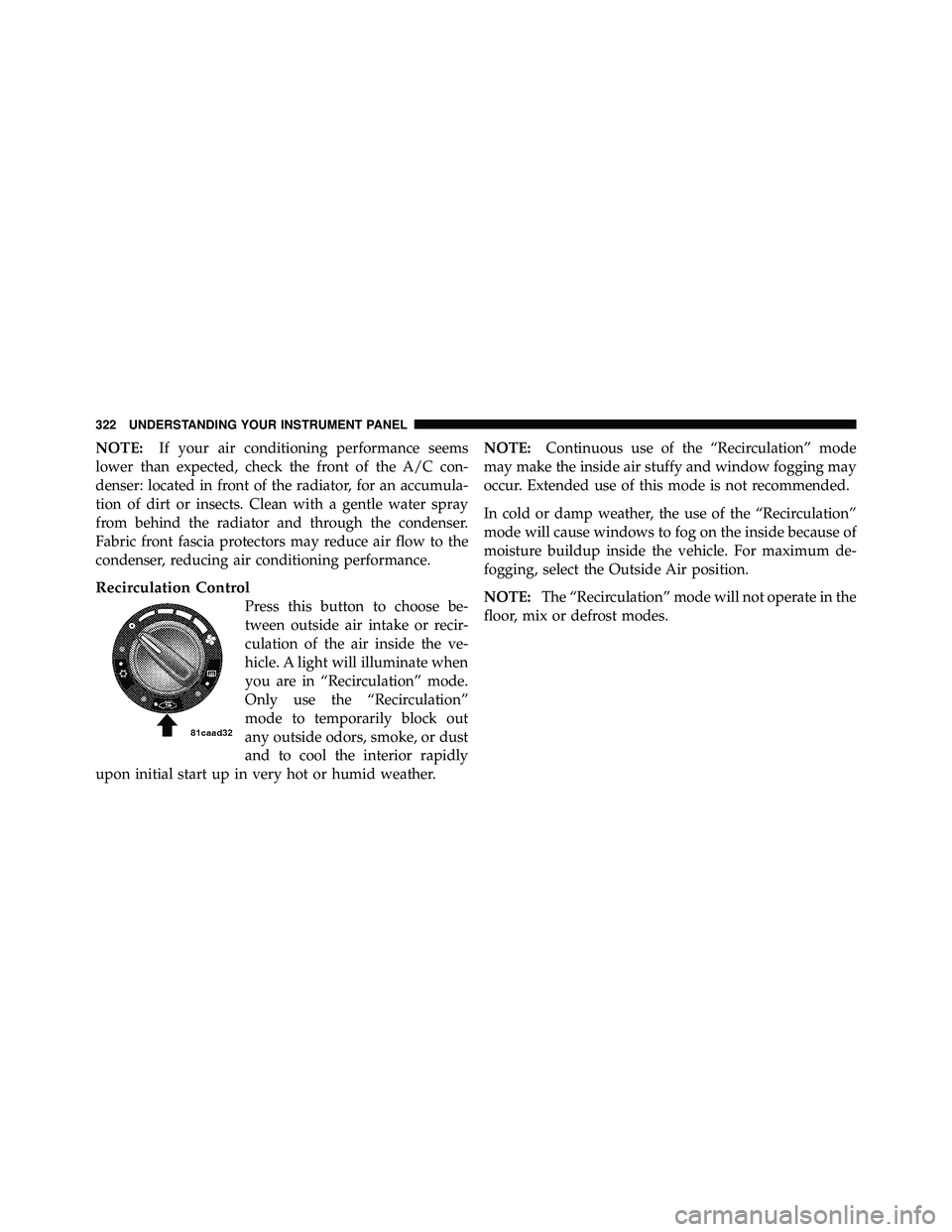
Recirculation Control
Press this button to choose be-
tween outside air intake or recir-
culation of the air inside the ve-
hicle. A light will illuminate when
you are in “Recirculation” mode.
Only use the “Recirculation”
mode to temporarily block out
any outside odors, smoke, or dust
and to cool the interior rapidly
upon initial start up in very hot or humid weather. NOTE:
Continuous use of the “Recirculation” mode
may make the inside air stuffy and window fogging may
occur. Extended use of this mode is not recommended.
In cold or damp weather, the use of the “Recirculation”
mode will cause windows to fog on the inside because of
moisture buildup inside the vehicle. For maximum de-
fogging, select the Outside Air position.
NOTE: The “Recirculation” mode will not operate in the
floor, mix or defrost modes.
Page 442 of 554
NOTE:There are steps that you can take to slow down
an impending overheat condition:
•If your air conditioner (A/C) is on, turn it off. The A/C
system adds heat to the engine cooling system and
turning the A/C off can help remove this heat.
•You can also turn the temperature control to maximum
heat, the mode control to floor and the blower control
to high. This allows the heater core to act as a
supplement to the radiator and aids in removing heat
from the engine cooling system.
Page 449 of 554
WARNING!
•Take care to avoid the radiator cooling fan when-
ever the hood is raised. It can start anytime the
ignition switch is on. You can be injured by
moving fan blades.
•Remove any metal jewelry such as watch bands or
bracelets that might make an inadvertent electrical
contact. You could be seriously injured.
•Batteries contain sulfuric acid that can burn your
skin or eyes and generate hydrogen gas which is
flammable and explosive. Keep open flames or
sparks away from the battery.
1. Set the parking brake, shift the automatic transmission
into PARK and turn the ignition to LOCK.
2. Turn off the heater, radio, and all unnecessary electri-
cal accessories. 3. If using another vehicle to jump-start the battery, park
the vehicle within the jumper cables reach, set the
parking brake and make sure the ignition is OFF.
Page 473 of 554
CAUTION!
•Mixing of engine coolant (antifreeze) other than
the specified HOAT engine coolant (antifreeze)
may result in engine damage and may decrease
corrosion protection. If a non-HOAT engine cool-
ant (antifreeze) is introduced into the cooling
system in an emergency, it should be replaced with
the specified engine coolant (antifreeze) as soon as
possible.
•Do not use water alone or alcohol-based engine
coolant (antifreeze) products. Do not use addi-
tional rust inhibitors or antirust products, as they
may not be compatible with the antifreeze/engine
coolant (antifreeze) and may plug the radiator.(Continued)
Page 475 of 554
WARNING!
The warning words DO NOT OPEN HOT on the
cooling system pressure cap are a safety precaution.
Never add engine coolant (antifreeze) when the en-
gine is overheated. Do not loosen or remove the cap
to cool an overheated engine. Heat causes pressure to
build up in the cooling system. To prevent scalding
or injury, do not remove the pressure cap while the
system is hot or under pressure.
Disposal of Used Engine Coolant
Used ethylene glycol based engine coolant (antifreeze) is
a regulated substance requiring proper disposal. Check
with your local authorities to determine the disposal
rules for your community. To prevent ingestion by ani-
mals or children, do not store ethylene glycol based
engine coolant (antifreeze) in open containers or allow itto remain in puddles on the ground. If ingested by a child
or pet, seek emergency assistance immediately. Clean up
any ground spills immediately.
Engine Coolant Level
The coolant bottle provides a quick visual method for
determining that the coolant level is adequate. With the
engine idling, and warm to normal operating tempera-
ture, the level of the engine coolant (antifreeze) in the
bottle should be between the ranges indicated on the
bottle.
The radiator normally remains completely full, so there is
no need to remove the radiator cap unless checking for
engine coolant (antifreeze) freeze point or replacing en-
gine coolant (antifreeze). Advise your service attendant
of this. As long as the engine operating temperature is
satisfactory, the coolant bottle need only be checked once
a month.
474 MAINTAINING YOUR VEHICLE