warning light JEEP WRANGLER 2013 JK / 3.G Owner's Guide
[x] Cancel search | Manufacturer: JEEP, Model Year: 2013, Model line: WRANGLER, Model: JEEP WRANGLER 2013 JK / 3.GPages: 666, PDF Size: 5.16 MB
Page 452 of 666
WARNING!
Do not descend a steep grade in NEUTRAL. Use
vehicle brakes in conjunction with engine braking.
Descending a grade too fast could cause you to lose
control and be seriously injured or killed.
Driving Across An Incline
If at all possible, avoid driving across an incline. If it is
necessary, know your vehicle’s abilities. Driving across an
incline places more weight on the downhill wheels, which
increases the possibilities of a downhill slide or rollover.
Make sure the surface has good traction with firm and stable
soils. If possible, transverse the incline at an angle heading
slightly up or down.
WARNING!
Driving across an incline increases the risk of a
rollover , which may result in severe injury.
If You Stall Or Begin To Lose Headway
If you stall or begin to lose headway while climbing a
steep hill, allow your vehicle to come to a stop and
immediately apply the brake. Restart the engine and shift
into REVERSE. Back slowly down the hill allowing
engine braking to control the descent and apply your
brakes, if necessary, but do not allow the tires to lock.
WARNING!
If the engine stalls or you lose headway or cannot
make it to the top of a steep hill or grade, never attempt
to turn around. To do so may result in tipping and
rolling the vehicle, which may result in severe injury.
Always back carefully straight down a hill in RE-
VERSE. Never back down a hill in NEUTRAL using
only the vehicle brakes. Never drive diagonally across
a hill, always drive straight up or down.
450 STARTING AND OPERATING
Page 455 of 666
Crossing Ditches, Streams, Shallow Rivers Or
Other Flowing Water
Flowing water can be extremely dangerous. Never attempt
to cross a fast running stream or river even in shallow water.
Fast moving water can easily push your vehicle down-
stream, sweeping it out of control. Even in very shallow
water, a high current can still wash the dirt out from around
your tires putting you and your vehicle in jeopardy. There is
still a high risk of personal injury and vehicle damage with
slower water currents in depths greater than the vehicle’s
running ground clearance. You should never attempt to
cross flowing water which is deeper than the vehicle’s
running ground clearance. Even the slowest current can
push the heaviest vehicle downstream and out of control if
the water is deep enough to push on the large surface area of
the vehicle’s body. Before you proceed, determine the speed
of the current, the water’s depth, approach angle, bottom
condition and if there are any obstacles. Then cross at an
angle heading slightly upstream using the low and slow
technique.
WARNING!
Never drive through fast moving deep water. It can
push your vehicle downstream, sweeping it out of
control. This could put you and your passengers at
risk of injury or drowning.
After Driving Off-Road
Off-road operation puts more stress on your vehicle than
does most on-road driving. After going off-road, it is
always a good idea to check for damage. That way you
can get any problems taken care of right away and have
your vehicle ready when you need it.
•Completely inspect the underbody of your vehicle.
Check tires, body structure, steering, suspension, and
exhaust system for damage.
• Inspect the radiator for mud and debris and clean as
required.5
STARTING AND OPERATING 453
Page 459 of 666
The parking brake lever is located in the center console.
To apply the parking brake, pull the lever up as firmly as
possible. To release the parking brake, pull the lever up
slightly, press the center button, then lower the lever
completely.When the parking brake is applied with the ignition
switch ON, the “Brake Warning Light” in the instrument
cluster will illuminate.
NOTE:
•
When the parking brake is applied and the automatic
transmission is placed in gear, the “Brake Warning
Light” will flash. If vehicle speed is detected, a chime
will sound to alert the driver. Fully release the parking
brake before attempting to move the vehicle.
•
This light only shows that the parking brake is applied.
It does not show the degree of brake application.
When parking on a hill, it is important to turn the front
wheels toward the curb on a downhill grade and away
from the curb on an uphill grade. For vehicles equipped
with an automatic transmission, apply the parking brake
before placing the shift lever in PARK, otherwise the load
on the transmission locking mechanism may make it
Parking Brake
5
STARTING AND OPERATING 457
Page 461 of 666
CAUTION!
If the “Brake Warning Light” remains on with the
parking brake released, a brake system malfunction
is indicated. Have the brake system serviced by an
authorized dealer immediately.
ANTI-LOCK BRAKE SYSTEM
The Anti-Lock Brake System (ABS) is designed to aid the
driver in maintaining vehicle control under adverse
braking conditions. The system operates with a separate
computer to modulate hydraulic pressure to prevent
wheel lock-up and help avoid skidding on slippery
surfaces.
All vehicle wheels and tires must be the same size and
type, and tires must be properly inflated to produce
accurate signals for the computer.
WARNING!
Significant over or under-inflation of tires, or mixing
sizes of tires or wheels on the vehicle can lead to loss
of braking effectiveness.
The Anti-Lock Brake System conducts a low speed self-
test at about 12 mph (20 km/h). If for any reason your
foot is on the brake when the vehicle reaches 12 mph
(20 km/h), this check will be delayed until 25 mph
(40 km/h).
The Anti-Lock Brake System pump motor runs during
the self-test, and during an ABS stop, to provide the
regulated hydraulic pressure. The motor pump makes a
low humming noise during operation; this is normal.
5
STARTING AND OPERATING 459
Page 466 of 666
WARNING!
There may be situations on minor hills (i.e., less than
8%), with a loaded vehicle, or while pulling a trailer
where the system will not activate and slight rolling
may occur, which could cause a collision with an-
other vehicle or object. Always remember the driver
is responsible for braking the vehicle.
The system will only work if the intended direction of the
vehicle and vehicle gear match. For example, if the
intended direction is forward up a hill and the vehicle is
in DRIVE (automatic transmission equipped vehicle),
and the activation criteria are met, HSA will activate.
HSA On Automatic Transmission Vehicles
The system will work in REVERSE, and all forward gears
on vehicles equipped with an automatic transmission.
The system will not activate if the vehicle is placed in
NEUTRAL.
HSA On Manual Transmission Vehicles
The system will work in REVERSE, forward gears, and
NEUTRAL on manual transmission equipped vehicles.
The system does not recognize NEUTRAL on manual
vehicles, thus it will hold the vehicle on an incline for a
short period while in NEUTRAL, regardless of clutch
position. To prevent this, do not attempt to roll down a
hill simply by putting the transmission in NEUTRAL and
letting gravity act on the vehicle, as the HSA will prevent
the vehicle from rolling. Instead, use the appropriate gear
for moving in the desired direction.
464 STARTING AND OPERATING
Page 470 of 666
ESC uses sensors in the vehicle to determine the vehicle
path intended by the driver and compares it to the actual
path of the vehicle. When the actual path does not match
the intended path, ESC applies the brake of the appro-
priate wheel to assist in counteracting the oversteer or
understeer condition.
•Oversteer - when the vehicle is turning more than
appropriate for the steering wheel position.
• Understeer - when the vehicle is turning less than
appropriate for the steering wheel position.
The “ESC Activation/Malfunction Indicator Light” (located
in the instrument cluster), starts to flash as soon as the tires
lose traction and the ESC system becomes active. The “ESC
Activation/Malfunction Indicator Light” also flashes when
TCS is active. If the “ESC Activation/Malfunction Indicator
Light” begins to flash during acceleration, ease up on the
accelerator and apply as little throttle as possible. Be sure to
adapt your speed and driving to the prevailing road condi-
tions.
WARNING!
Electronic Stability Control (ESC) cannot prevent the
natural laws of physics from acting on the vehicle,
nor can it increase the traction afforded by prevailing
road conditions. ESC cannot prevent accidents, in-
cluding those resulting from excessive speed in
turns, driving on very slippery surfaces, or hydro-
planing. ESC also cannot prevent accidents resulting
from loss of vehicle control due to inappropriate
driver input for the conditions. Only a safe, attentive,
and skillful driver can prevent accidents. The capa-
bilities of an ESC equipped vehicle must never be
exploited in a reckless or dangerous manner which
could jeopardize the user ’s safety or the safety of
others.
468 STARTING AND OPERATING
Page 473 of 666
4L Range (4WD Models)
ESC Off
This is the normal operating mode for ESC in 4L range.
Whenever the vehicle is started in 4L range, or the transfer
case (if equipped) is shifted from 4H range or NEUTRAL to
4L range, the ESC system will be in this mode. In 4L range,
ESC and TCS, except for the “limited slip” feature described
in the TCS section, are turned off until the vehicle reaches a
speed of 40 mph (64 km/h). At 40 mph (64 km/h), the
normal ESC stability function returns but TCS remains off.
When the vehicle speed drops below 35 mph (56 km/h), the
ESC system shuts off. The ESC is off at low vehicle speeds in
4L range so that it will not interfere with off-road driving,
but the ESC function returns to provide the stability feature
at speeds above 40 mph (64 km/h). The “ESC Activation/
Malfunction Indicator Light” will always be illuminated in
4L range when ESC is off.
NOTE:The “ESC OFF” message will display and the
audible chime will sound when the shift lever is placed in
the PARK position from any position other than PARK,
and then moved out of the PARK position. This will
occur even if the message was previously cleared.
WARNING!
With the ESC switched off in 4L, the enhanced
vehicle stability offered by ESC and ERM are un-
available.
2H Range (4WD Models) Or 2WD Models
On
This is the normal operating mode for ESC in 2H range
and on 2WD vehicles.
5
STARTING AND OPERATING 471
Page 476 of 666
WARNING!
If TSC activates while driving, slow the vehicle
down, stop at the nearest safe location, and adjust the
trailer load to eliminate trailer sway.
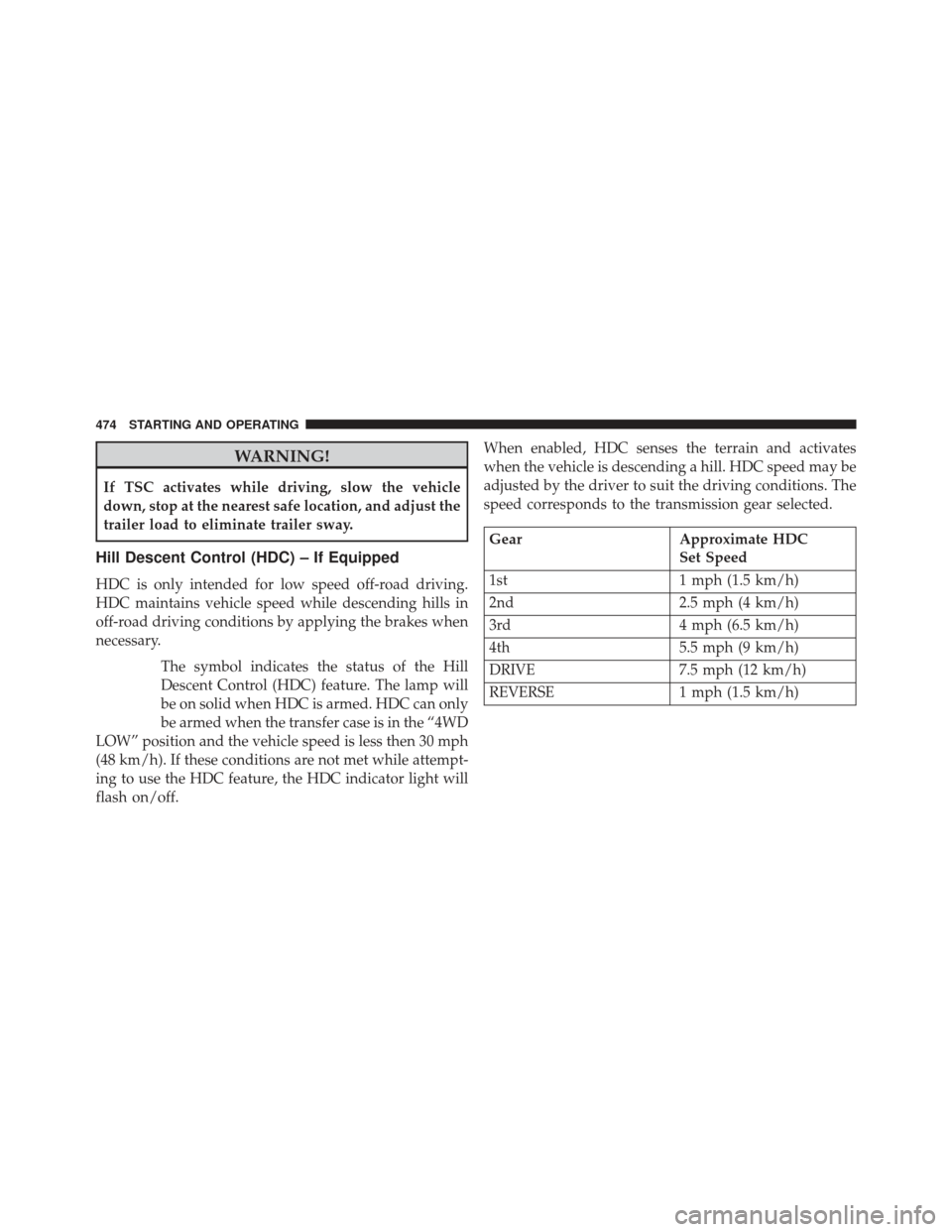
Hill Descent Control (HDC) – If Equipped
HDC is only intended for low speed off-road driving.
HDC maintains vehicle speed while descending hills in
off-road driving conditions by applying the brakes when
necessary.The symbol indicates the status of the Hill
Descent Control (HDC) feature. The lamp will
be on solid when HDC is armed. HDC can only
be armed when the transfer case is in the “4WD
LOW” position and the vehicle speed is less then 30 mph
(48 km/h). If these conditions are not met while attempt-
ing to use the HDC feature, the HDC indicator light will
flash on/off. When enabled, HDC senses the terrain and activates
when the vehicle is descending a hill. HDC speed may be
adjusted by the driver to suit the driving conditions. The
speed corresponds to the transmission gear selected.
Gear
Approximate HDC
Set Speed
1st 1 mph (1.5 km/h)
2nd 2.5 mph (4 km/h)
3rd 4 mph (6.5 km/h)
4th 5.5 mph (9 km/h)
DRIVE 7.5 mph (12 km/h)
REVERSE 1 mph (1.5 km/h)
474 STARTING AND OPERATING
Page 499 of 666
WARNING!
Tires and the spare tire should be replaced after six
years, regardless of the remaining tread. Failure to
follow this warning can result in sudden tire failure.
You could lose control and have a collision resulting
in serious injury or death.
Keep dismounted tires in a cool, dry place with as little
exposure to light as possible. Protect tires from contact
with oil, grease, and gasoline.
Replacement Tires
The tires on your new vehicle provide a balance of many
characteristics. They should be inspected regularly for
wear and correct cold tire inflation pressure. The manu-
facturer strongly recommends that you use tires equiva-
lent to the originals in size, quality and performance
when replacement is needed. Refer to the paragraph on “Tread Wear Indicators”. Refer to the Tire and Loading
Information placard or the Vehicle Certification Label for
the size designation of your tire. The Load Index and
Speed Symbol for your tire will be found on the original
equipment tire sidewall. See the Tire Sizing Chart ex-
ample found in the Tire Safety Information section of this
manual for more information relating to the Load Index
and Speed Symbol of a tire.
It is recommended to replace the two front tires or two
rear tires as a pair. Replacing just one tire can seriously
affect your vehicle’s handling. If you ever replace a
wheel, make sure that the wheel’s specifications match
those of the original wheels.
It is recommended you contact your authorized tire or
original equipment dealer with any questions you may
have on tire specifications or capability. Failure to use
equivalent replacement tires may adversely affect the
safety, handling, and ride of your vehicle.
5
STARTING AND OPERATING 497
Page 504 of 666
on cold inflation tire pressure. This is defined as the tire
pressure after a vehicle has not been driven for more than
three hours, or driven less than 1 mile (1.6 km) after a
three-hour period.Refer to “Tires – General Informa-
tion” in “Starting and Operating” for information on
how to properly inflate the vehicle’s tires. The tire
pressure will also increase as the vehicle is driven; this is
normal and there should be no adjustment for this
increased pressure.
The TPMS will warn the driver of a low tire pressure if
the tire pressure falls below the low pressure warning
threshold for any reason, including low temperature
effects, or natural pressure loss through the tire. The TPMS will continue to warn the driver of low tire
pressure as long as the condition exists, and will not turn
off until the tire pressure is at or above recommended
cold placard pressure. Once the “Tire Pressure Monitor-
ing Telltale Light” has been illuminated, the tire pressure
must be increased to the recommended cold placard
pressure in order for the “Tire Pressure Monitoring
Telltale Light” to be turned OFF. The system will auto-
matically update and the “Tire Pressure Monitoring
Telltale Light” will extinguish once the updated tire
pressures have been received. The vehicle may need to be
driven for up to 20 minutes above 15 mph (24 km/h) to
receive this information.
502 STARTING AND OPERATING