reset JEEP WRANGLER 2015 JK / 3.G Owner's Guide
[x] Cancel search | Manufacturer: JEEP, Model Year: 2015, Model line: WRANGLER, Model: JEEP WRANGLER 2015 JK / 3.GPages: 695, PDF Size: 20.64 MB
Page 440 of 695
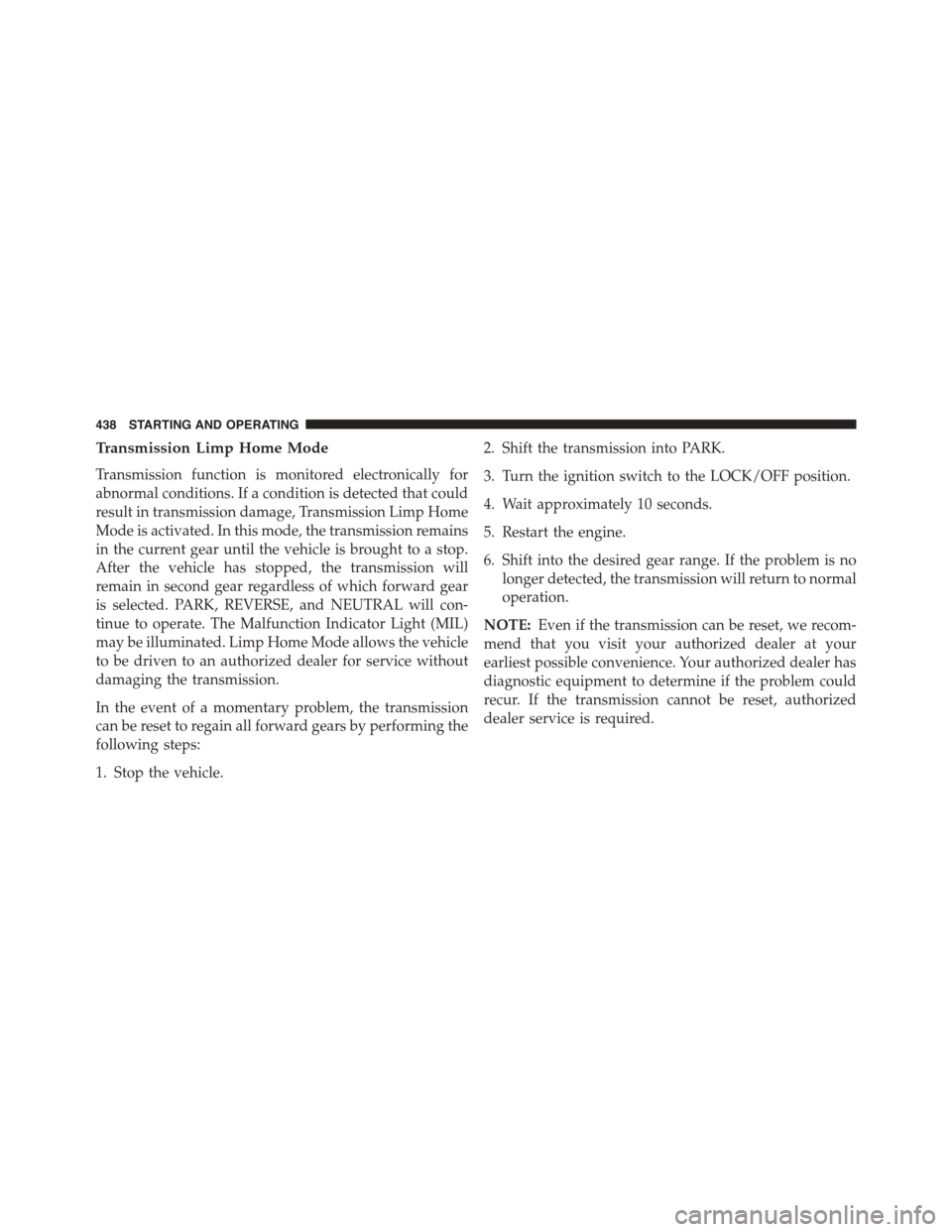
Transmission Limp Home Mode
Transmission function is monitored electronically for
abnormal conditions. If a condition is detected that could
result in transmission damage, Transmission Limp Home
Mode is activated. In this mode, the transmission remains
in the current gear until the vehicle is brought to a stop.
After the vehicle has stopped, the transmission will
remain in second gear regardless of which forward gear
is selected. PARK, REVERSE, and NEUTRAL will con-
tinue to operate. The Malfunction Indicator Light (MIL)
may be illuminated. Limp Home Mode allows the vehicle
to be driven to an authorized dealer for service without
damaging the transmission.
In the event of a momentary problem, the transmission
can be reset to regain all forward gears by performing the
following steps:
1. Stop the vehicle.
2. Shift the transmission into PARK.
3. Turn the ignition switch to the LOCK/OFF position.
4. Wait approximately 10 seconds.
5. Restart the engine.
6. Shift into the desired gear range. If the problem is no
longer detected, the transmission will return to normal
operation.
NOTE:Even if the transmission can be reset, we recom-
mend that you visit your authorized dealer at your
earliest possible convenience. Your authorized dealer has
diagnostic equipment to determine if the problem could
recur. If the transmission cannot be reset, authorized
dealer service is required.
438 STARTING AND OPERATING
Page 529 of 695
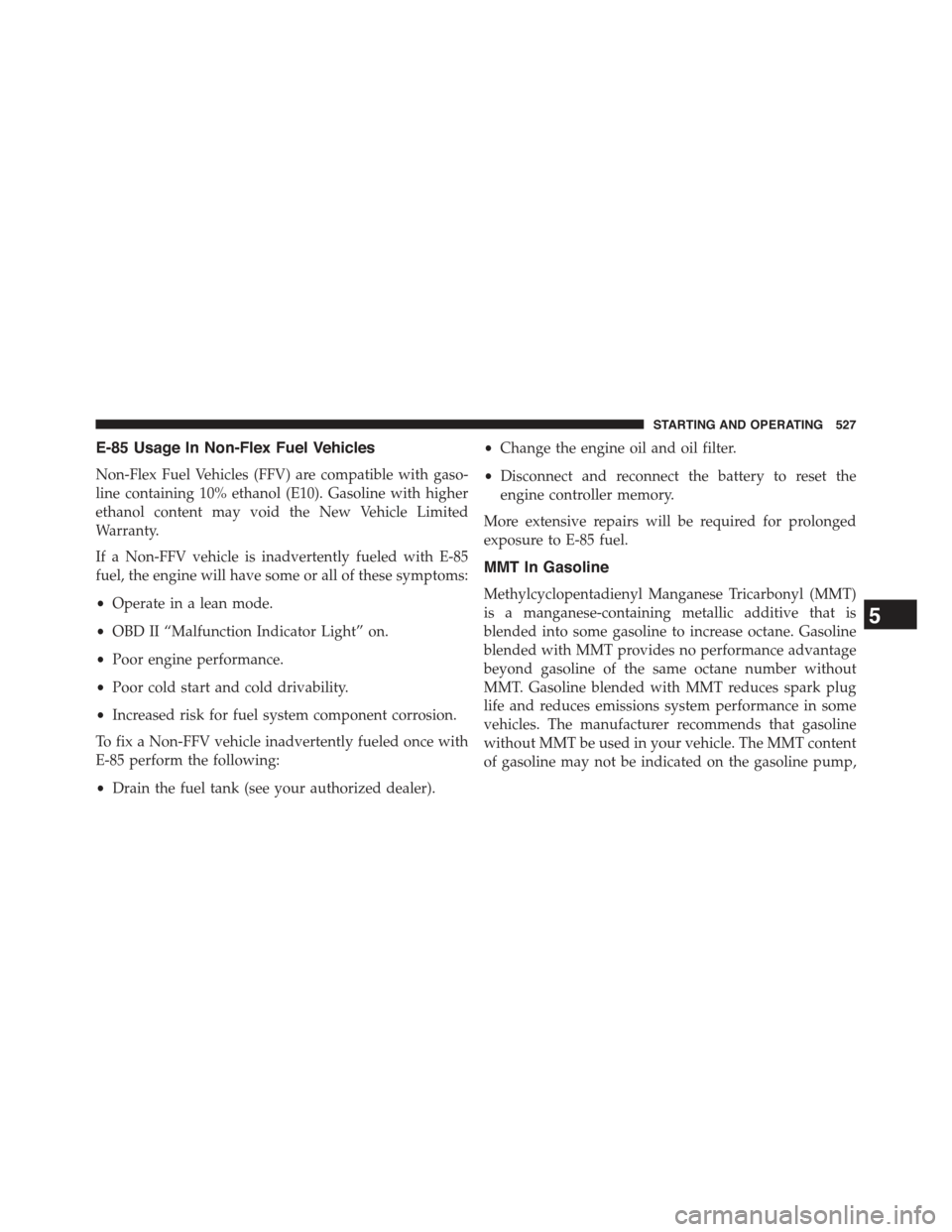
E-85 Usage In Non-Flex Fuel Vehicles
Non-Flex Fuel Vehicles (FFV) are compatible with gaso-
line containing 10% ethanol (E10). Gasoline with higher
ethanol content may void the New Vehicle Limited
Warranty.
If a Non-FFV vehicle is inadvertently fueled with E-85
fuel, the engine will have some or all of these symptoms:
•Operate in a lean mode.
•OBD II “Malfunction Indicator Light” on.
•Poor engine performance.
•Poor cold start and cold drivability.
•Increased risk for fuel system component corrosion.
To fix a Non-FFV vehicle inadvertently fueled once with
E-85 perform the following:
•Drain the fuel tank (see your authorized dealer).
•Change the engine oil and oil filter.
•Disconnect and reconnect the battery to reset the
engine controller memory.
More extensive repairs will be required for prolonged
exposure to E-85 fuel.
MMT In Gasoline
Methylcyclopentadienyl Manganese Tricarbonyl (MMT)
is a manganese-containing metallic additive that is
blended into some gasoline to increase octane. Gasoline
blended with MMT provides no performance advantage
beyond gasoline of the same octane number without
MMT. Gasoline blended with MMT reduces spark plug
life and reduces emissions system performance in some
vehicles. The manufacturer recommends that gasoline
without MMT be used in your vehicle. The MMT content
of gasoline may not be indicated on the gasoline pump,
5
STARTING AND OPERATING 527
Page 533 of 695
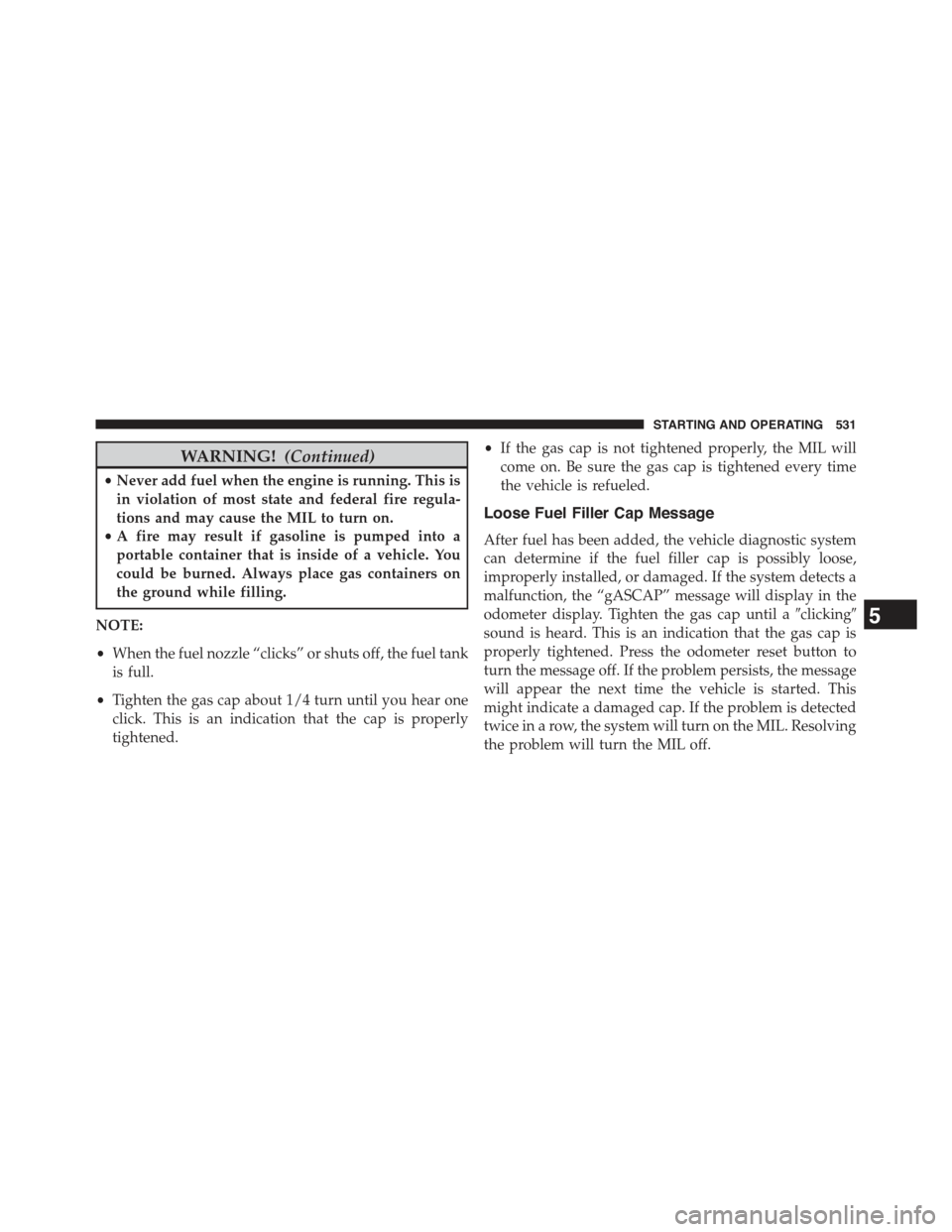
WARNING!(Continued)
•Never add fuel when the engine is running. This is
in violation of most state and federal fire regula-
tions and may cause the MIL to turn on.
•A fire may result if gasoline is pumped into a
portable container that is inside of a vehicle. You
could be burned. Always place gas containers on
the ground while filling.
NOTE:
•When the fuel nozzle “clicks” or shuts off, the fuel tank
is full.
•Tighten the gas cap about 1/4 turn until you hear one
click. This is an indication that the cap is properly
tightened.
•If the gas cap is not tightened properly, the MIL will
come on. Be sure the gas cap is tightened every time
the vehicle is refueled.
Loose Fuel Filler Cap Message
After fuel has been added, the vehicle diagnostic system
can determine if the fuel filler cap is possibly loose,
improperly installed, or damaged. If the system detects a
malfunction, the “gASCAP” message will display in the
odometer display. Tighten the gas cap until a#clicking#
sound is heard. This is an indication that the gas cap is
properly tightened. Press the odometer reset button to
turn the message off. If the problem persists, the message
will appear the next time the vehicle is started. This
might indicate a damaged cap. If the problem is detected
twice in a row, the system will turn on the MIL. Resolving
the problem will turn the MIL off.
5
STARTING AND OPERATING 531
Page 586 of 695
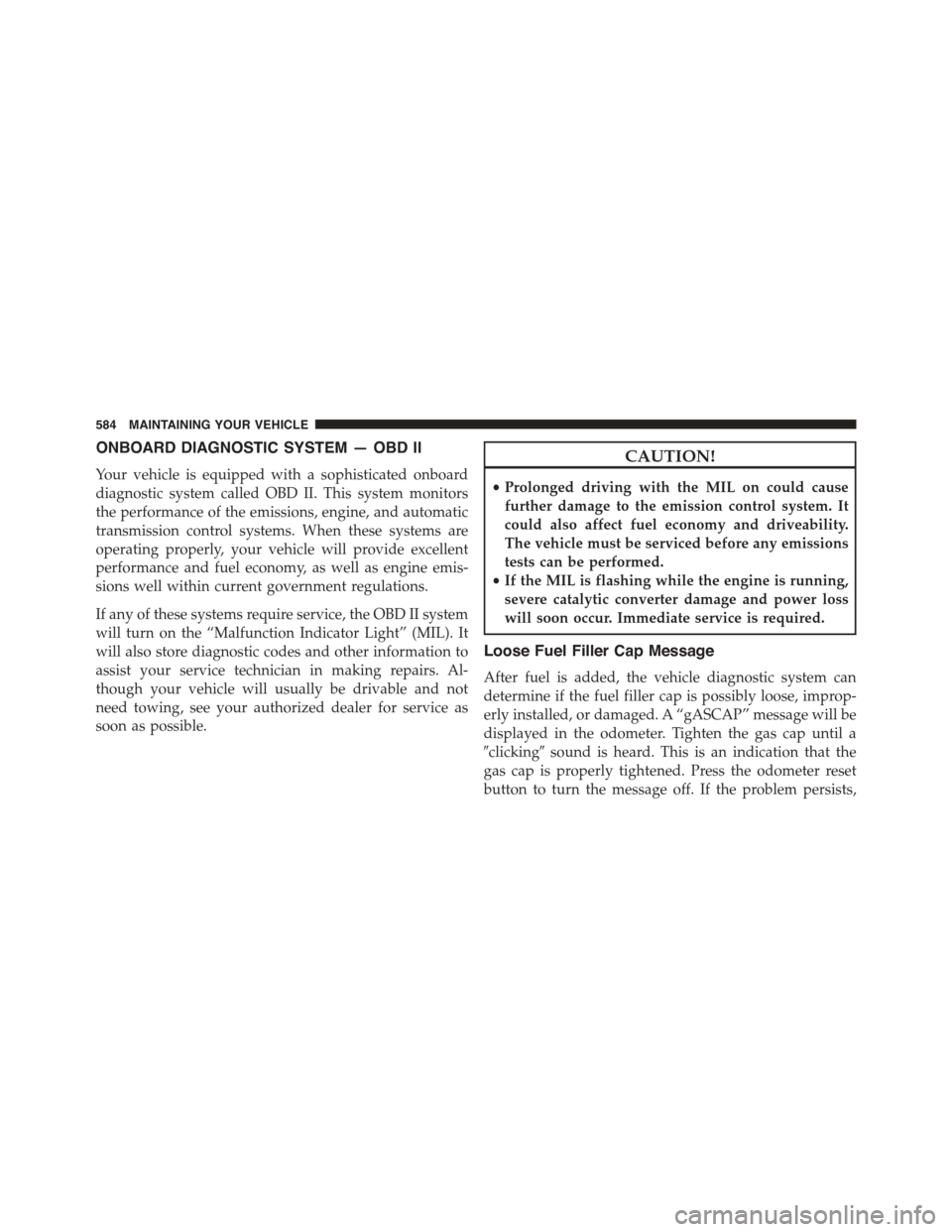
ONBOARD DIAGNOSTIC SYSTEM — OBD II
Your vehicle is equipped with a sophisticated onboard
diagnostic system called OBD II. This system monitors
the performance of the emissions, engine, and automatic
transmission control systems. When these systems are
operating properly, your vehicle will provide excellent
performance and fuel economy, as well as engine emis-
sions well within current government regulations.
If any of these systems require service, the OBD II system
will turn on the “Malfunction Indicator Light” (MIL). It
will also store diagnostic codes and other information to
assist your service technician in making repairs. Al-
though your vehicle will usually be drivable and not
need towing, see your authorized dealer for service as
soon as possible.
CAUTION!
•Prolonged driving with the MIL on could cause
further damage to the emission control system. It
could also affect fuel economy and driveability.
The vehicle must be serviced before any emissions
tests can be performed.
•If the MIL is flashing while the engine is running,
severe catalytic converter damage and power loss
will soon occur. Immediate service is required.
Loose Fuel Filler Cap Message
After fuel is added, the vehicle diagnostic system can
determine if the fuel filler cap is possibly loose, improp-
erly installed, or damaged. A “gASCAP” message will be
displayed in the odometer. Tighten the gas cap until a
#clicking#sound is heard. This is an indication that the
gas cap is properly tightened. Press the odometer reset
button to turn the message off. If the problem persists,
584 MAINTAINING YOUR VEHICLE
Page 654 of 695
MAINTENANCE SCHEDULE
Your vehicle is equipped with an automatic oil change
indicator system. The oil change indicator system will
remind you that it is time to take your vehicle in for
scheduled maintenance.
Based on engine operation conditions, the oil change
indicator message will illuminate. This means that service
is required for your vehicle. Operating conditions such as
frequent short-trips, trailer tow, extremely hot or cold
ambient temperatures, and E85 fuel usage will influence
when the “Change Oil” or “Oil Change Required” message
is displayed. Severe Operating Conditions can cause the
change oil message to illuminate as early as 3,500 miles
(5,600 km) since last reset. Have your vehicle serviced as
soon as possible, within the next 500 miles (805 km).
On Electronic Vehicle Information Center (EVIC) equipped
vehicles, “Oil Change Required” will be displayed in the
EVIC and a single chime will sound, indicating that an oil
change is necessary.
On Non-EVIC equipped vehicles, “Change Oil” will flash
in the instrument cluster odometer and a single chime
will sound, indicating that an oil change is necessary.
Your authorized dealer will reset the oil change indicator
message after completing the scheduled oil change. If a
scheduled oil change is performed by someone other
than your authorized dealer, the message can be reset by
referring to the steps described under “Instrument Clus-
ter Descriptions” or “Electronic Vehicle Information Cen-
ter (EVIC)” in “Understanding Your Instrument Panel”
for further information.
NOTE:Under no circumstances should oil change inter-
vals exceed 10,000 miles (16,000 km) or twelve months,
whichever comes first.
Severe Duty All Models
Change Engine Oil at 4000 miles (6,500 km) if the vehicle
is operated in a dusty and off road environment. This
type of vehicle use is considered Severe Duty
8
MAINTENANCE
SCHEDULES
652 MAINTENANCE SCHEDULES
Page 685 of 695
Automatic Dimming.....................112
Electric Powered........................113
Electric Remote.........................113
Heated...............................114
Outside..............................112
Rearview.............................111
Vanity...............................114
Modifications/Alterations, Vehicle...............9
Modular Hard Top........................203
Monitor, Tire Pressure System................513
MOPAR® Parts...........................586
MTBE/ETBE............................526
New Vehicle Break-In Period..................98
Occupant Restraints........................48
Octane Rating, Gasoline (Fuel)................525
Odometer...............................314
Tr i p . . . . . . . . . . . . . . . . . . . . . . . . . . . . . . . ..313
Oil Change Indicator.......................317
Oil Change Indicator, Reset..................317
Oil, Engine..............................588
Capacity.............................646
Change Interval........................331
Dipstick..............................588
Disposal..............................590
Filter................................591
Filter Disposal.........................590
Identification Logo......................589
Materials Added to......................590
Pressure Warning Light...................307
Recommendation.......................589
Synthetic.............................590
Viscosity.............................590
Oil Filter, Selection........................591
Oil Pressure Light.........................307
Onboard Diagnostic System..................584
Operating Precautions......................58410
INDEX 683
Page 687 of 695
Rear Window Features.....................297
Rear Wiper/Washer........................297
Recorder, Event Data.......................75
Recreational Towing.......................553
Shifting into Transfer Case Neutral (N)........555
Shifting out of Transfer Case Neutral (N)......556
Reformulated Gasoline.....................526
Refrigerant..............................599
Release, Hood............................165
Reminder, Seat Belt.........................50
Remote Control
Door Locks............................22
Starting System.........................29
Remote Keyless Entry (RKE)..................22
FCC General Information..................28
Remote Sound System (Radio) Controls.........396
Remote Starting System......................29
Replacement Bulbs........................641
Replacement Keys.........................17
Replacement Parts.........................586
Replacement Tires.........................509
Reporting Safety Defects....................667
Resetting Oil Change Indicator................331
Restraint, Head...........................159
Restraints, Child...........................76
Restraints, Occupant........................48
Rotation, Tires...........................512
Safety Checks Inside Vehicle.................101
Safety Checks Outside Vehicle................103
Safety Defects, Reporting....................667
Safety, Exhaust Gas........................100
Safety Information, Tire.....................487
Safety Tips...............................99
Satellite Radio Antenna.....................359
Schedule, Maintenance.....................652
Seat Belt
Adjustable Upper Shoulder Belt Anchorage......5810
INDEX 685
Page 692 of 695
Transaxle
Autostick.............................439
Transfer Case............................624
Fluid................................649
Four-Wheel-Drive Operation...............441
Maintenance...........................624
Transmission............................619
Automatic............................431
Fluid................................649
Manual..............................424
Range Indicator........................313
Shifting..............................429
Transmitter Battery Service (Remote Keyless Entry) . .27
Tread Wear Indicators......................507
Trip Computer...........................321
Trip Odometer...........................314
Trip Odometer Reset Button..................313
Turn Signals.............................169
UCI Connector...........................389
Uconnect®
Advanced Phone Connectivity..............133
Phone Call Features.....................125
Phone Features.........................128
Uconnect® 130
Operating Instructions Auxiliary Mode........371
Operating Instructions Radio Mode..........362
Uconnect® 130 With Satellite Radio
Multimedia Satellite Radio.................358
Operating Instructions CD Mode............378
Operating Instructions Radio Mode..........372
Playing MP3 Files.......................380
Uconnect® (Hands-Free Phone)...............115
Uniform Tire Quality Grades.................669
Universal Consumer Interface (UCI) Connector . . . .389
Unleaded Gasoline........................525
Untwisting Procedure, Seat Belt................57
690 INDEX