cooling JEEP WRANGLER 2017 JK / 3.G User Guide
[x] Cancel search | Manufacturer: JEEP, Model Year: 2017, Model line: WRANGLER, Model: JEEP WRANGLER 2017 JK / 3.GPages: 527, PDF Size: 5.34 MB
Page 397 of 527
CAUTION!(Continued)
•Damage to the catalytic converter can result if your
vehicle is not kept in proper operating condition. In
the event of engine malfunction, particularly involv-
ing engine misfire or other apparent loss of perfor-
mance, have your vehicle serviced promptly. Contin-
ued operation of your vehicle with a severe
malfunction could cause the converter to overheat,
resulting in possible damage to the converter and
vehicle.
Under normal operating conditions, the catalytic converter
will not require maintenance. However, it is important to
keep the engine properly tuned to assure proper catalyst
operation and prevent possible catalyst damage.
NOTE: Intentional tampering with emissions control sys-
tems can result in civil penalties being assessed against
you.
In unusual situations involving grossly malfunctioning
engine operation, a scorching odor may suggest severe and
abnormal catalyst overheating. If this occurs, stop the
vehicle, turn off the engine and allow it to cool. Service,
including a tune-up to manufacturer’s specifications,
should be obtained immediately. To minimize the possibility of catalytic converter damage:
•
Do not shut off the engine or interrupt the ignition,
when the transmission is in gear and the vehicle is in
motion.
• Do not try to start the engine by pushing or towing the
vehicle.
• Do not idle the engine with any spark plug wires
disconnected or removed, such as when diagnostic
testing, or for prolonged periods during very rough idle
or malfunctioning operating conditions.
Cooling System
WARNING!
You or others can be badly burned by hot engine
coolant (antifreeze) or steam from your radiator. If you
see or hear steam coming from under the hood, do not
open the hood until the radiator has had time to cool.
Never try to open a cooling system pressure cap when
the radiator or coolant bottle is hot.
8
SERVICING AND MAINTENANCE 395
Page 398 of 527
Engine Coolant Checks
Check the engine coolant (antifreeze) protection every 12
months (before the onset of freezing weather, where appli-
cable). If the engine coolant (antifreeze) is dirty or rusty in
appearance, the system should be drained, flushed and
refilled with fresh engine coolant (antifreeze). Check the
front of the A/C condenser (if equipped) or radiator for
any accumulation of bugs, leaves, etc. If dirty, clean by
gently spraying water from a garden hose vertically down
the face of the A/C condenser (if equipped) or the back of
the radiator core.
Check the engine cooling system hoses for brittle rubber,
cracking, tears, cuts, and tightness of the connection at the
coolant recovery bottle and radiator. Inspect the entire
system for leaks. DO NOT REMOVE THE COOLANT
PRESSURE CAP WHEN THE COOLING SYSTEM IS HOT.
Cooling System — Drain, Flush And Refill
NOTE:Some vehicles require special tools to add coolant
properly. Failure to fill these systems properly could lead to
severe internal engine damage. If any coolant is needed to
be added to the system please contact your local autho-
rized dealer. If the engine coolant (antifreeze) is dirty or contains visible
sediment, have an authorized dealer clean and flush with
OAT coolant (antifreeze) (conforming to MS.90032).
Refer to the “Maintenance Plan” in this section for the
proper maintenance intervals.
Selection Of Coolant
Refer to “Fluids And Lubricants” in “Technical Specifica-
tions” for further information.
CAUTION!
•Mixing of engine coolant (antifreeze) other than speci-
fied Organic Additive Technology (OAT) engine cool-
ant (antifreeze), may result in engine damage and may
decrease corrosion protection. Organic Additive Tech-
nology (OAT) engine coolant is different and should
not be mixed with Hybrid Organic Additive Technol-
ogy (HOAT) engine coolant (antifreeze) or any “glob-
ally compatible” coolant (antifreeze). If a non-OAT
engine coolant (antifreeze) is introduced into the cool-
ing system in an emergency, the cooling system will
need to be drained, flushed, and refilled with fresh
(Continued)
396 SERVICING AND MAINTENANCE
Page 399 of 527
CAUTION!(Continued)
OAT coolant (conforming to MS.90032), by an autho-
rized dealer as soon as possible.
•Do not use water alone or alcohol-based engine
coolant (antifreeze) products. Do not use additional
rust inhibitors or antirust products, as they may not
be compatible with the radiator engine coolant and
may plug the radiator.
• This vehicle has not been designed for use with
propylene glycol-based engine coolant (antifreeze).
Use of propylene glycol-based engine coolant (anti-
freeze) is not recommended.
Adding Coolant
Your vehicle has been built with an improved engine
coolant (OAT coolant conforming to MS.90032) that allows
extended maintenance intervals. This engine coolant (anti-
freeze) can be used up to ten years or 150,000 miles
(240,000 km) before replacement. To prevent reducing this
extended maintenance period, it is important that you use
the same engine coolant (OAT coolant conforming to
MS.90032) throughout the life of your vehicle. Please review these recommendations for using Organic
Additive Technology (OAT) engine coolant (antifreeze)
that meets the requirements of FCA Material Standard
MS.90032. When adding engine coolant (antifreeze):
•
We recommend using MOPAR Antifreeze/Coolant 10
Year/150,000 Mile (240,000 km) Formula OAT (Organic
Additive Technology) that meets the requirements of
FCA Material Standard MS.90032.
• Mix a minimum solution of 50% OAT engine coolant
that meets the requirements of FCA Material Standard
MS.90032 and distilled water. Use higher concentrations
(not to exceed 70%) if temperatures below 34°F (37°C)
are anticipated.
• Use only high purity water such as distilled or deionized
water when mixing the water/engine coolant (anti-
freeze) solution. The use of lower quality water will
reduce the amount of corrosion protection in the engine
cooling system.
Please note that it is the owner’s responsibility to maintain
the proper level of protection against freezing according to
the temperatures occurring in the area where the vehicle is
operated.
8
SERVICING AND MAINTENANCE 397
Page 400 of 527
NOTE:
•Some vehicles require special tools to add coolant prop-
erly. Failure to fill these systems properly could lead to
severe internal engine damage. If any coolant is needed
to be added to the system, please contact your local
authorized dealer.
• Mixing engine coolant (antifreeze) types is not recom-
mended and can result in cooling system damage. If
HOAT and OAT coolant are mixed in an emergency,
have a authorized dealer drain, flush, and refill with
OAT coolant (conforming to MS.90032) as soon as pos-
sible.
Cooling System Pressure Cap
The cap must be fully tightened to prevent loss of engine
coolant (antifreeze), and to ensure that engine coolant
(antifreeze) will return to the radiator from the coolant
recovery tank.
The cap should be inspected and cleaned if there is any
accumulation of foreign material on the sealing surfaces.
WARNING!
• Do not open hot engine cooling system. Never add
engine coolant (antifreeze) when the engine is over-
heated. Do not loosen or remove the cap to cool an
overheated engine. Heat causes pressure to build up
in the cooling system. To prevent scalding or injury,
do not remove the pressure cap while the system is
hot or under pressure.
• Do not use a pressure cap other than the one speci-
fied for your vehicle. Personal injury or engine
damage may result.
Disposal Of Used Engine Coolant
Used ethylene glycol-based engine coolant (antifreeze) is a
regulated substance requiring proper disposal. Check with
your local authorities to determine the disposal rules for
your community. To prevent ingestion by animals or
children, do not store ethylene glycol-based engine coolant
in open containers or allow it to remain in puddles on the
ground. If ingested by a child or pet, seek emergency
assistance immediately. Clean up any ground spills imme-
diately.
398 SERVICING AND MAINTENANCE
Page 401 of 527
Coolant Level
The coolant bottle provides a quick visual method for
determining that the coolant level is adequate. With the
engine OFF and cold, the level of the engine coolant
(antifreeze) in the bottle should be between the ranges
indicated on the bottle.
The radiator normally remains completely full, so there is
no need to remove the radiator/coolant pressure cap
unless checking for engine coolant (antifreeze) freeze point
or replacing coolant. Advise your service attendant of this.
As long as the engine operating temperature is satisfactory,
the coolant bottle need only be checked once a month.
When additional engine coolant (antifreeze) is needed to
maintain the proper level, only OAT coolant that meets the
requirements of FCA Material Standard MS.90032 should
be added to the coolant bottle. Do not overfill.
Points To Remember
NOTE:When the vehicle is stopped after a few miles/
kilometers of operation, you may observe vapor coming
from the front of the engine compartment. This is normally
a result of moisture from rain, snow, or high humidity
accumulating on the radiator and being vaporized when
the thermostat opens, allowing hot engine coolant (anti-
freeze) to enter the radiator.
If an examination of your engine compartment shows no
evidence of radiator or hose leaks, the vehicle may be
safely driven. The vapor will soon dissipate.
• Do not overfill the coolant expansion bottle.
• Check the coolant freeze point in the radiator and in the
coolant expansion bottle. If engine coolant (antifreeze)
needs to be added, the contents of the coolant expansion
bottle must also be protected against freezing.
• If frequent engine coolant (antifreeze) additions are
required, the cooling system should be pressure tested
for leaks.
• M
aintain engine coolant (antifreeze) concentration at a
minimum of 50% OAT coolant (conforming to MS.90032)
and distilled water for proper corrosion protection of your
engine which contains aluminum components.
8
SERVICING AND MAINTENANCE 399
Page 429 of 527
•Disconnect the negative (-) terminal from the battery
post and be sure that the battery is fully charged. During
storage check battery charge quarterly.
• If you do not disconnect the battery from the electrical
system, check the battery charge every thirty days, also
we recommend you use storage mode for more infor-
mation refer to (“Instrument Cluster Display Menu
Items” in “Getting To Know Your Instrument Panel”).
• Clean and protect the painted parts by applying protec-
tive waxes.
• Clean and protect polished metal parts by applying
protective waxes.
• Apply talcum powder to the front and rear wiper blades
and leave raised from the glass.
• Cover the vehicle with an appropriate cover taking care
not to damage the painted surface by dragging across
dirty surfaces. Do not use plastic sheeting which will not
allow the evaporation of moisture present on the surface
of the vehicle.
• Inflate the tires at a pressure of +7.25 psi (+0.5 bar)
higher than recommended on the tire placard and check
it periodically. •
Do not drain the engine cooling system.
• Whenever you leave the vehicle is stationary for two
weeks or more, run idle the engine for approximately
five minutes, with the air conditioning system on and
high fan speed. This will ensure a proper lubrication of
the system, thus minimizing the possibility of damage to
the compressor when the vehicle is put back into opera-
tion.
CAUTION!
Before removal of the positive and negative terminals
to the battery, wait at least a minute with ignition
switch in the OFF position and close the driver ’s door.
When reconnecting the positive and negative terminals
to the battery be sure the ignition switch is in the OFF
position and the driver ’s door is closed.
BODYWORK
Protection From Atmospheric Agents
Vehicle body care requirements vary according to geo-
graphic locations and usage. Chemicals that make roads
passable in snow and ice and those that are sprayed on
trees and road surfaces during other seasons are highly
8
SERVICING AND MAINTENANCE 427
Page 444 of 527
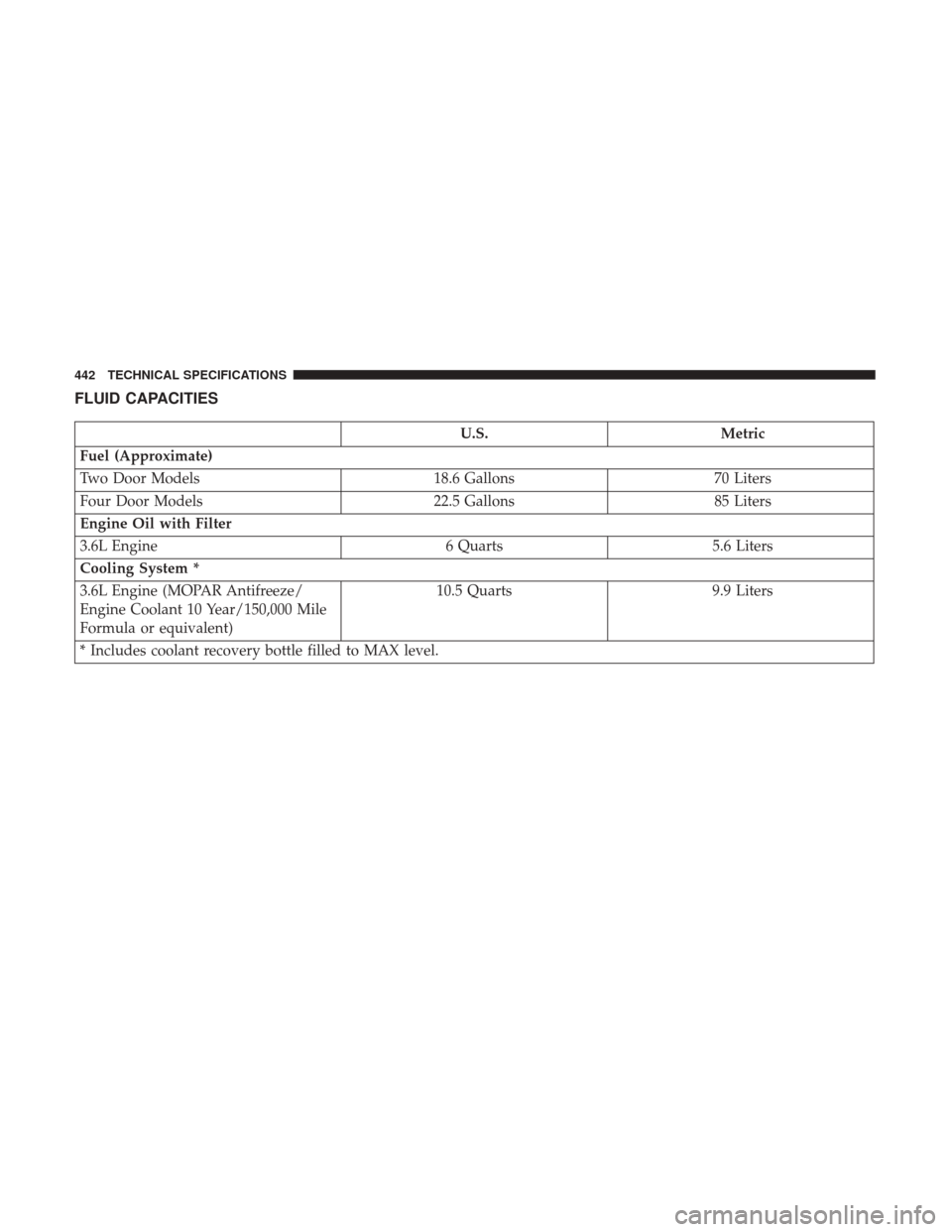
FLUID CAPACITIES
U.S.Metric
Fuel (Approximate)
Two Door Models 18.6 Gallons70 Liters
Four Door Models 22.5 Gallons85 Liters
Engine Oil with Filter
3.6L Engine 6 Quarts5.6 Liters
Cooling System *
3.6L Engine (MOPAR Antifreeze/
Engine Coolant 10 Year/150,000 Mile
Formula or equivalent) 10.5 Quarts
9.9 Liters
* Includes coolant recovery bottle filled to MAX level.
442 TECHNICAL SPECIFICATIONS
Page 446 of 527
CAUTION!
•Mixing of engine coolant (antifreeze) other than
specified Organic Additive Technology (OAT) en-
gine coolant (antifreeze), may result in engine dam-
age and may decrease corrosion protection. Organic
Additive Technology (OAT) engine coolant is differ-
ent and should not be mixed with Hybrid Organic
Additive Technology (HOAT) engine coolant (anti-
freeze) or any “globally compatible” coolant (anti-
freeze). If a non-OAT engine coolant (antifreeze) is
introduced into the cooling system in an emergency,
the cooling system will need to be drained, flushed,
and refilled with fresh OAT coolant (conforming to
MS.90032), by an authorized dealer as soon as pos-
sible.
• Do not use water alone or alcohol-based engine
coolant (antifreeze) products. Do not use additional
rust inhibitors or antirust products, as they may not
be compatible with the radiator engine coolant and
may plug the radiator.
• This vehicle has not been designed for use with
propylene glycol-based engine coolant (antifreeze).
Use of propylene glycol-based engine coolant (anti-
freeze) is not recommended.
444 TECHNICAL SPECIFICATIONS
Page 514 of 527
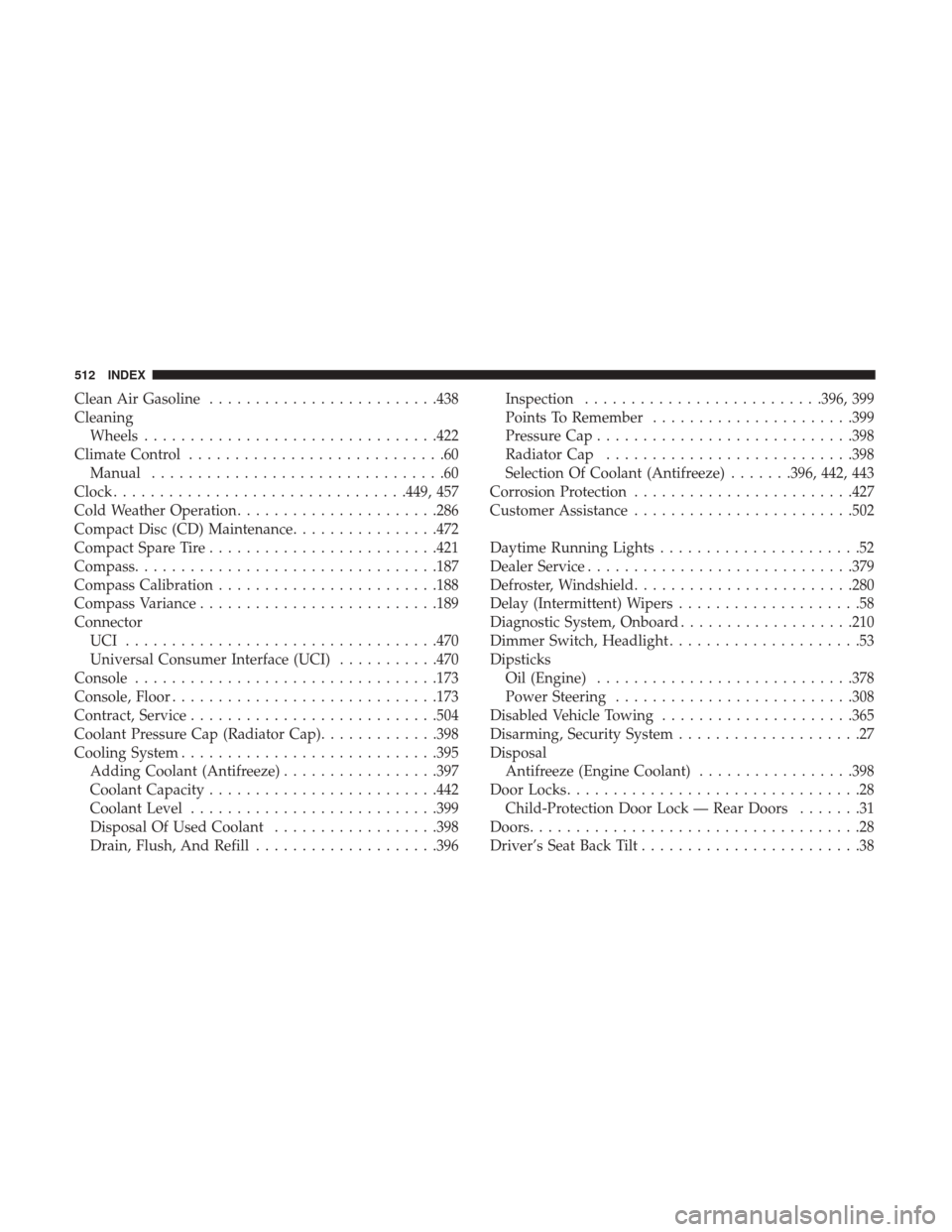
Clean Air Gasoline........................ .438
Cleaning Wheels ............................... .422
Climate Control ............................60
Manual ................................60
Clock ............................... .449, 457
Cold Weather Operation ..................... .286
Compact Disc (CD) Maintenance ................472
Compact Spare Tire ........................ .421
Compass ................................ .187
Compass Calibration ....................... .188
Compass Variance ......................... .189
Connector UCI ................................. .470
Universal Consumer Interface (UCI) ...........470
Console ................................ .173
Console, Floor ............................ .173
Contract, Service .......................... .504
Coolant Pressure Cap (Radiator Cap) .............398
Cooling System ........................... .395
Adding Coolant (Antifreeze) .................397
Coolant Capacity ........................ .442
Coolant Level .......................... .399
Disposal Of Used Coolant ..................398
Drain, Flush, And Refill ....................396 Inspection
......................... .396, 399
Points To Remember ..................... .399
Pressure Cap ........................... .398
Radiator Cap .......................... .398
Selection Of Coolant (Antifreeze) .......396, 442, 443
Corrosion Protection ....................... .427
Customer Assistance ....................... .502
Daytime Running Lights ......................52
Dealer Service ............................ .379
Defroster, Windshield ....................... .280
Delay (Intermittent) Wipers ....................58
Diagnostic System, Onboard ...................210
Dimmer
Switch, Headlight .....................53
Dipsticks Oil (Engine) ........................... .378
Power Steering ......................... .308
Disabled Vehicle Towing .....................365
Disarming, Security System ....................27
Disposal Antifreeze (Engine Coolant) .................398
Door Locks ................................28
Child-Protection Door Lock — Rear Doors .......31
Doors ....................................28
Driver’s Seat Back Tilt ........................38
512 INDEX
Page 515 of 527
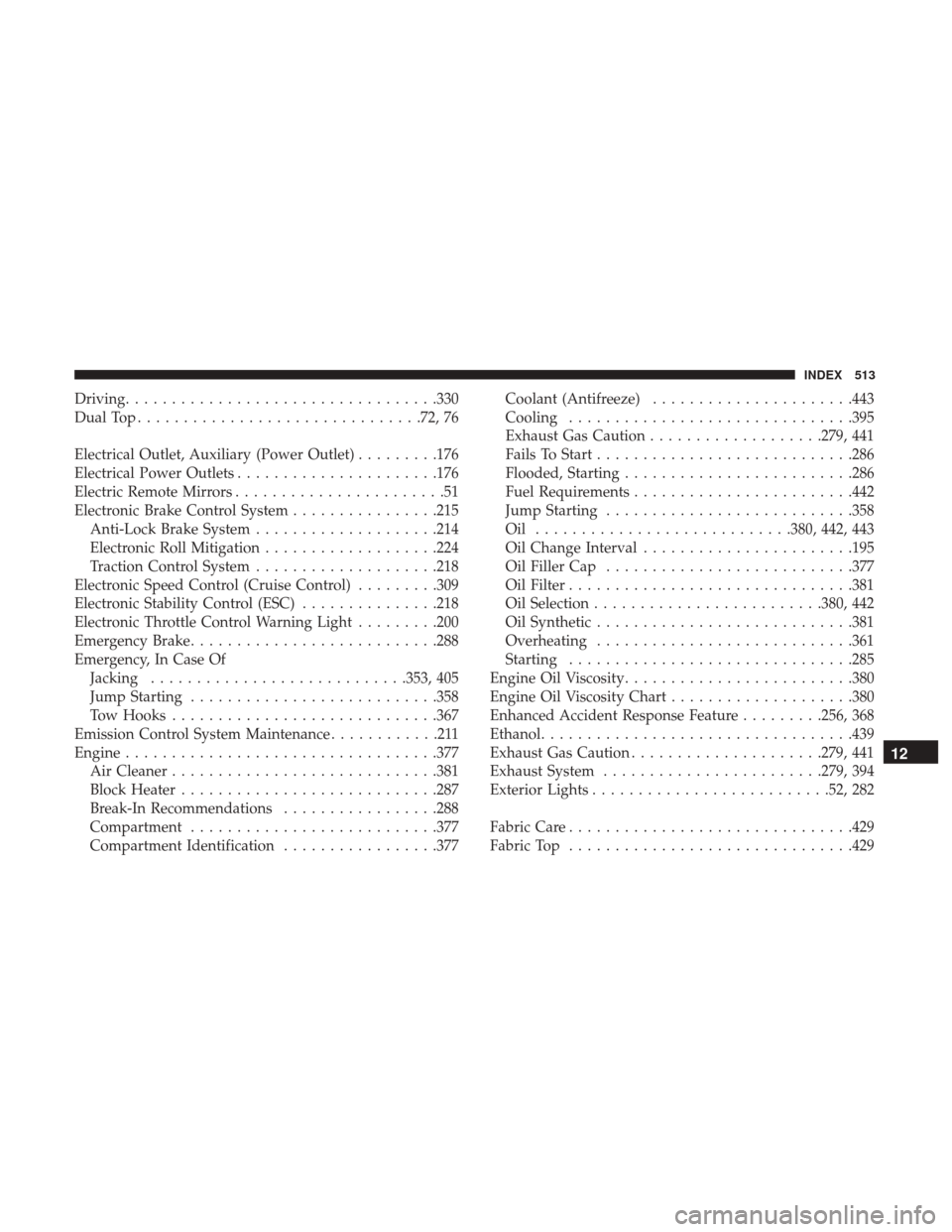
Driving................................. .330
Dual Top .............................. .72, 76
Electrical Outlet, Auxiliary (Power Outlet) .........176
Electrical Power Outlets ..................... .176
Electric Remote Mirrors .......................51
Electronic Brake Control System ................215
Anti-Lock Brake System ....................214
Electronic Roll Mitigation ...................224
Traction Control System ....................218
Electronic Speed Control (Cruise Control) .........309
Electronic Stability Control (ESC) ...............218
Electronic Throttle Control Warning Light .........200
Emergency Brake .......................... .288
Emergency, In Case Of Jacking ........................... .353, 405
Jump Starting .......................... .358
Tow Hooks ............................ .367
Emission Control System Maintenance ............211
Engine ................................. .377
Air Cleaner ............................ .381
Block Heater ........................... .287
Break-In Recommendations .................288
Compartment .......................... .377
Compartment Identification .................377 Coolant (Antifreeze)
..................... .443
Cooling .............................. .395
Exhaust Gas Caution ...................279, 441
Fails To Start ........................... .286
Flooded, Starting ........................ .286
Fuel Requirements ....................... .442
Jump Starting .......................... .358
Oil ........................... .380, 442, 443
Oil Change Interval ...................... .195
Oil Filler Cap .......................... .377
Oil Filter .............................. .381
Oil Selection ........................ .380,
442
Oil Synthetic ........................... .381
Overheating ........................... .361
Starting .............................. .285
Engine Oil Viscosity ........................ .380
Engine Oil Viscosity Chart ....................380
Enhanced Accident Response Feature .........256, 368
Ethanol ................................. .439
Exhaust Gas Caution .....................279, 441
Exhaust System ....................... .279, 394
Exterior Lights ......................... .52, 282
Fabric Care .............................. .429
Fabric Top .............................. .429
12
INDEX 513