four wheel drive JEEP WRANGLER 2DOORS 2021 Owner handbook (in English)
[x] Cancel search | Manufacturer: JEEP, Model Year: 2021, Model line: WRANGLER 2DOORS, Model: JEEP WRANGLER 2DOORS 2021Pages: 330, PDF Size: 9.16 MB
Page 8 of 330
6
STARTING AND OPERATING
STARTING THE ENGINE ........................ 138
Normal Starting —
Gasoline Engine ........................... 138
Normal Starting — Diesel Engine ......... 141
Diesel Engine Warm-Up ................ 141
Diesel Engine Idling —
In Cold Weather ........................... 142 Stopping the Engine ..................... 142
ENGINE BREAK-IN RECOMMENDATIONS .... 143
AUTOMATIC TRANSMISSION................. 143
Ignition Park Interlock................... 144
Brake/Transmission Shift Interlock
System ....................................... 144 Eight–Speed Automatic
Transmission................................ 145
FOUR–WHEEL DRIVE OPERATION .......... 146
Four-Position Transfer Case ........... 146
Five-Position Transfer Case ........... 148
Trac-Lok Rear Axle —
If Equipped ................................. 151 Axle Lock (Tru-Lok) —
Rubicon Models ........................... 151 Electronic Sway Bar Disconnect —
If Equipped ................................. 152
STOP/START SYSTEM — AUTOMATIC
TRANSMISSION (IF EQUIPPED) .............153
Automatic Mode ........................... 154
Possible Reasons The Engine Does
Not Autostop ............................... 154 To Start The Engine While In
Autostop Mode ............................. 155 To Manually Turn Off The
Stop/Start System ........................ 155 To Manually Turn On The
Stop/Start System ........................ 155 System Malfunction...................... 155
ACTIVE SPEED LIMITER —
IF EQUIPPED .......................................156
Activation .................................... 156
Exceeding The Set Speed.............. 156
Deactivation ................................ 156
SPEED CONTROL ..................................157
To Activate .................................. 157
To Set A Desired Speed ................ 158
To Resume Speed ....................... 158
To Deactivate .............................. 158
ADAPTIVE CRUISE CONTROL (ACC) —
IF EQUIPPED .......................................158
To Activate/Deactivate .................. 158
To Set A Desired ACC Speed ......... 159
To Resume .................................. 159
To Vary The Speed Setting ........... 159
Setting The Following Distance
In ACC ........................................ 160
PARKSENSE REAR PARK ASSIST —
IF EQUIPPED ........................................161
ParkSense Sensors ........................161
Enabling And Disabling
ParkSense ....................................161 ParkSense System Usage
Precautions ..................................162
PARKSENSE FRONT AND
REAR PARK ASSIST — IF EQUIPPED ......163
ParkSense Sensors ........................163
ParkSense Warning Display ............163
ParkSense Display ........................163
Enabling And Disabling
ParkSense ....................................165 Service The ParkSense Park Assist
System ........................................166 Cleaning The ParkSense System .....166
ParkSense System Usage
Precautions ..................................166
PARKVIEW REAR BACK UP CAMERA —
IF EQUIPPED ........................................167
REFUELING THE VEHICLE .....................169
Fuel Filler Cap ..............................169
Loose Fuel Filler Cap Message ......170
REFUELING THE VEHICLE — DIESEL ......170
AdBlue® (UREA) — If Equipped ....171
VEHICLE LOADING ...............................174
Weights Label...............................174
2020_JEEP_JL_WRANGLER_UG_RHD_UK.book Page 6
Page 9 of 330
7
TRAILER TOWING ................................ 175
Trailer Towing Weights
(Maximum Trailer Weight Ratings)..... 175
RECREATIONAL TOWING (BEHIND
MOTORHOME, ETC.) ............................. 176
Towing This Vehicle Behind
Another Vehicle ............................ 176 Recreational Towing — Four-Wheel
Drive Models ................................ 176
IN CASE OF EMERGENCY
HAZARD WARNING FLASHERS............... 179
BULB REPLACEMENT............................ 179
Replacement Bulbs ...................... 179
Bulb Replacement ........................ 181
FUSES ............................................... 183
General Information ...................... 183
Power Distribution Center (PDC) .... 184
JACKING AND TIRE CHANGING .............. 192
Jack Location .............................. 193
Spare Tire Removal ...................... 193
Preparations For Jacking .............. 194
Jacking Instructions ...................... 195
Road Tire Installation.................... 197
Declaration Of Conformance .......... 198
Jack Usage Precautions................. 200
JUMP STARTING .................................. 201
Preparations For Jump Start .......... 201
Jump Starting Procedure ............... 202
IF YOUR ENGINE OVERHEATS ...............204
MANUAL PARK RELEASE .....................204
FREEING A STUCK VEHICLE ..................206
TOWING A DISABLED VEHICLE ..............207
Four–Wheel Drive Models .............. 208
Without The Key Fob .................... 208
Tow Eye Usage............................. 208
ENHANCED ACCIDENT RESPONSE
SYSTEM (EARS) ..................................209
EVENT DATA RECORDER (EDR) ..............209
SERVICING AND MAINTENANCE
SCHEDULED SERVICING .......................210
Scheduled Servicing —
Gasoline Engine ........................... 210 Scheduled Servicing —
Diesel Engine............................... 216
ENGINE COMPARTMENT .......................221
2.0L Gasoline Engine .................. 221
3.6L Gasoline Engine .................. 222
2.2L Diesel Engine ....................... 223
Checking Oil Level —
Gasoline Engine .......................... 224 Adding Washer Fluid .................... 224
Maintenance-Free Battery ............ 225
Pressure Washing ......................... 225
DEALER SERVICE .................................226
Windshield Wiper Blades ...............226
Exhaust System ...........................228
Cooling System .............................229
Brake System ..............................230
Automatic Transmission ................231
RAISING THE VEHICLE ..........................232 TIRES .................................................232
Tires — General Information .........232
Tire Types ....................................237
Spare Tires — If Equipped ............237
Wheel And Wheel Trim Care ..........239
Tire Chains And Traction Devices ..... 240
Tire Rotation Recommendations ....241
STORING THE VEHICLE .........................241
BODYWORK .........................................242
Body And Underbody
Maintenance ................................242 Preserving The Bodywork ...............243
INTERIORS ..........................................245
Seats And Fabric Parts ..................245
Plastic And Coated Parts ...............246
Leather Parts ................................246
Glass Surfaces .............................246
2020_JEEP_JL_WRANGLER_UG_RHD_UK.book Page 7
Page 74 of 330
GETTING TO KNOW YOUR INSTRUMENT PANEL
72
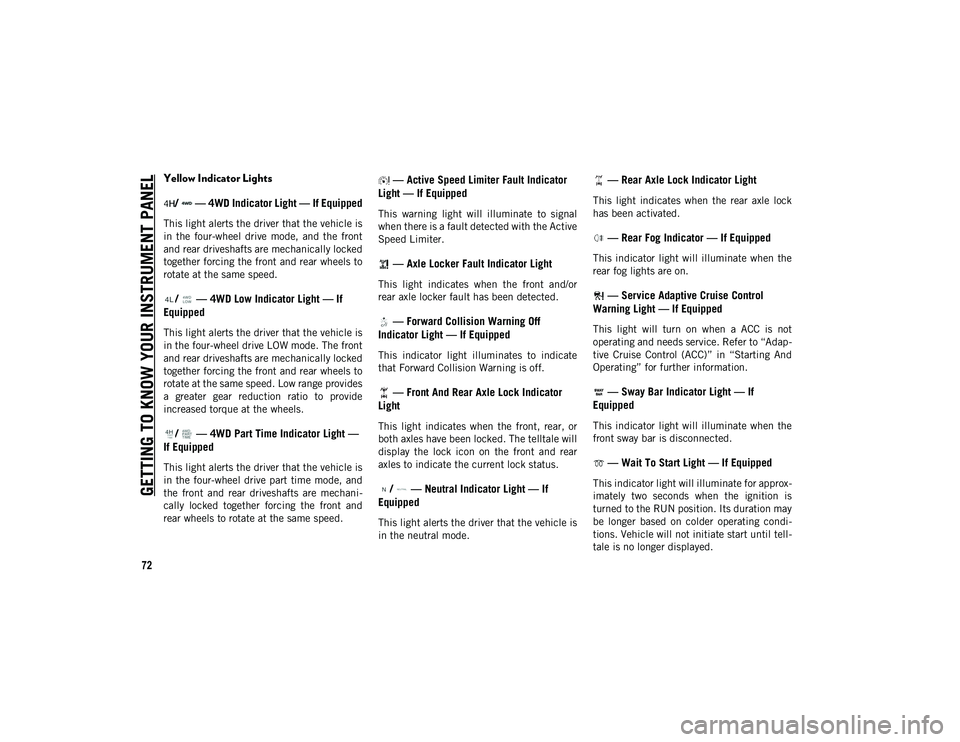
Yellow Indicator Lights/ — 4WD Indicator Light — If Equipped
This light alerts the driver that the vehicle is
in the four-wheel drive mode, and the front
and rear driveshafts are mechanically locked
together forcing the front and rear wheels to
rotate at the same speed.
/ — 4WD Low Indicator Light — If
Equipped
This light alerts the driver that the vehicle is
in the four-wheel drive LOW mode. The front
and rear driveshafts are mechanically locked
together forcing the front and rear wheels to
rotate at the same speed. Low range provides
a greater gear reduction ratio to provide
increased torque at the wheels.
/ — 4WD Part Time Indicator Light —
If Equipped
This light alerts the driver that the vehicle is
in the four-wheel drive part time mode, and
the front and rear driveshafts are mechani -
cally locked together forcing the front and
rear wheels to rotate at the same speed.
— Active Speed Limiter Fault Indicator
Light — If Equipped
This warning light will illuminate to signal
when there is a fault detected with the Active
Speed Limiter.
— Axle Locker Fault Indicator Light
This light indicates when the front and/or
rear axle locker fault has been detected.
— Forward Collision Warning Off
Indicator Light — If Equipped
This indicator light illuminates to indicate
that Forward Collision Warning is off.
— Front And Rear Axle Lock Indicator
Light
This light indicates when the front, rear, or
both axles have been locked. The telltale will
display the lock icon on the front and rear
axles to indicate the current lock status.
/ — Neutral Indicator Light — If
Equipped
This light alerts the driver that the vehicle is
in the neutral mode.
— Rear Axle Lock Indicator Light
This light indicates when the rear axle lock
has been activated.
— Rear Fog Indicator — If Equipped
This indicator light will illuminate when the
rear fog lights are on.
— Service Adaptive Cruise Control
Warning Light — If Equipped
This light will turn on when a ACC is not
operating and needs service. Refer to “Adap -
tive Cruise Control (ACC)” in “Starting And
Operating” for further information.
— Sway Bar Indicator Light — If
Equipped
This indicator light will illuminate when the
front sway bar is disconnected.
— Wait To Start Light — If Equipped
This indicator light will illuminate for approx -
imately two seconds when the ignition is
turned to the RUN position. Its duration may
be longer based on colder operating condi -
tions. Vehicle will not initiate start until tell -
tale is no longer displayed.
2020_JEEP_JL_WRANGLER_UG_RHD_UK.book Page 72
Page 75 of 330
73
Refer to “Starting The Engine” in “Starting
And Operating” for further information.
NOTE:
The “Wait To Start” telltale may not illumi-
nate if the intake manifold temperature is
warm enough.
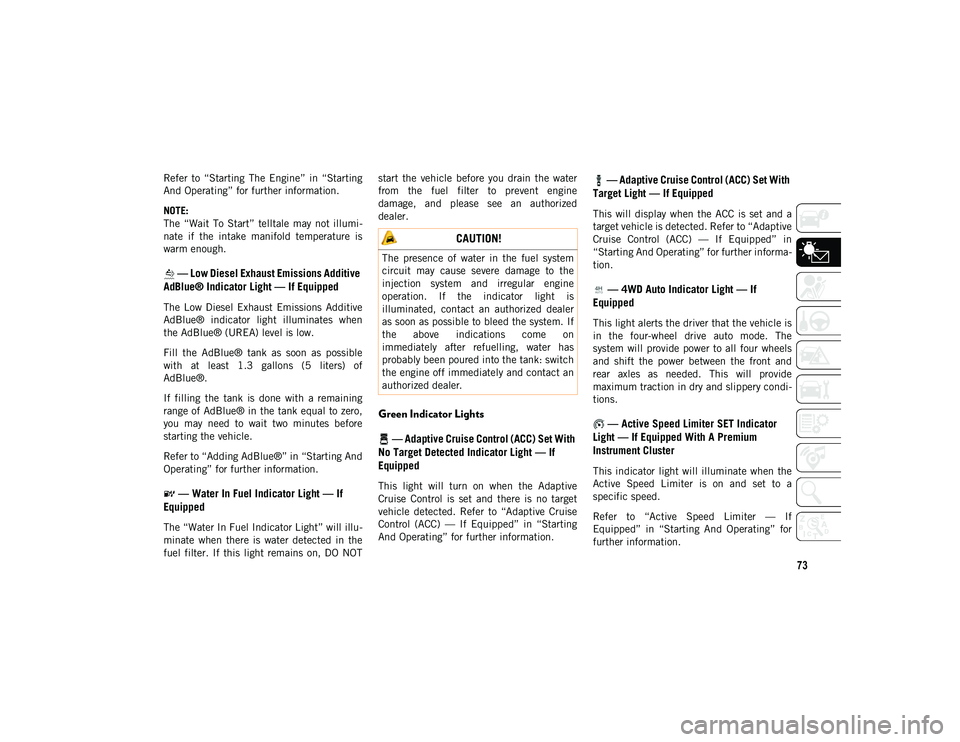
— Low Diesel Exhaust Emissions Additive
AdBlue® Indicator Light — If Equipped
The Low Diesel Exhaust Emissions Additive
AdBlue® indicator light illuminates when
the AdBlue® (UREA) level is low.
Fill the AdBlue® tank as soon as possible
with at least 1.3 gallons (5 liters) of
AdBlue®.
If filling the tank is done with a remaining
range of AdBlue® in the tank equal to zero,
you may need to wait two minutes before
starting the vehicle.
Refer to “Adding AdBlue®” in “Starting And
Operating” for further information.
— Water In Fuel Indicator Light — If
Equipped
The “Water In Fuel Indicator Light” will illu -
minate when there is water detected in the
fuel filter. If this light remains on, DO NOT start the vehicle before you drain the water
from the fuel filter to prevent engine
damage, and please see an authorized
dealer.
Green Indicator Lights
— Adaptive Cruise Control (ACC) Set With
No Target Detected Indicator Light — If
Equipped
This light will turn on when the Adaptive
Cruise Control is set and there is no target
vehicle detected. Refer to “Adaptive Cruise
Control (ACC) — If Equipped” in “Starting
And Operating” for further information.
— Adaptive Cruise Control (ACC) Set With
Target Light — If Equipped
This will display when the ACC is set and a
target vehicle is detected. Refer to “Adaptive
Cruise Control (ACC) — If Equipped” in
“Starting And Operating” for further informa -
tion.
— 4WD Auto Indicator Light — If
Equipped
This light alerts the driver that the vehicle is
in the four-wheel drive auto mode. The
system will provide power to all four wheels
and shift the power between the front and
rear axles as needed. This will provide
maximum traction in dry and slippery condi -
tions.
— Active Speed Limiter SET Indicator
Light — If Equipped With A Premium
Instrument Cluster
This indicator light will illuminate when the
Active Speed Limiter is on and set to a
specific speed.
Refer to “Active Speed Limiter — If
Equipped” in “Starting And Operating” for
further information.
CAUTION!
The presence of water in the fuel system
circuit may cause severe damage to the
injection system and irregular engine
operation. If the indicator light is
illuminated, contact an authorized dealer
as soon as possible to bleed the system. If
the above indications come on
immediately after refuelling, water has
probably been poured into the tank: switch
the engine off immediately and contact an
authorized dealer.
2020_JEEP_JL_WRANGLER_UG_RHD_UK.book Page 73
Page 80 of 330
78
(Continued)
SAFETY
SAFETY FEATURES
Anti-Lock Brake System (ABS)
The Anti-Lock Brake System (ABS) provides
increased vehicle stability and brake perfor-
mance under most braking conditions. The
system automatically prevents wheel lock,
and enhances vehicle control during braking.
The ABS performs a self-check cycle to
ensure that the ABS is working properly each
time the vehicle is started and driven. During
this self-check, you may hear a slight
clicking sound as well as some related motor
noises.
ABS is activated during braking when the
system detects one or more wheels begin to
lock. Road conditions such as ice, snow,
gravel, bumps, railroad tracks, loose debris,
or panic stops may increase the likelihood of
ABS activation(s). You also may experience the following when
ABS activates:
The ABS motor noise (it may continue to
run for a short time after the stop)
The clicking sound of solenoid valves
Brake pedal pulsations
A slight drop of the brake pedal at the end
of the stop
These are all normal characteristics of ABS.
ABS is designed to function with the Original
Equipment Manufacturer (OEM) tires. Modi-
fication may result in degraded ABS perfor -
mance.
Anti-Lock Brake Warning Light
The yellow “Anti-Lock Brake Warning Light”
will turn on when the ignition is placed in the
ON/RUN mode and may stay on for as long
as four seconds.
WARNING!
The ABS contains sophisticated electronic
equipment that may be susceptible to inter -
ference caused by improperly installed or
high output radio transmitting equipment.
This interference can cause possible loss of
anti-lock braking capability. Installation of
such equipment should be performed by
qualified professionals.
Pumping of the Anti-Lock Brakes will
diminish their effectiveness and may
lead to a collision. Pumping makes the
stopping distance longer. Just press
firmly on your brake pedal when you
need to slow down or stop.
The ABS cannot prevent the natural laws
of physics from acting on the vehicle, nor
can it increase braking or steering effi -
ciency beyond that afforded by the
condition of the vehicle brakes and tires
or the traction afforded.
The ABS cannot prevent collisions,
including those resulting from excessive
speed in turns, following another vehicle
too closely, or hydroplaning.
The capabilities of an ABS equipped
vehicle must never be exploited in a
reckless or dangerous manner that could
jeopardize the user’s safety or the safety
of others.
WARNING! (Continued)
2020_JEEP_JL_WRANGLER_UG_RHD_UK.book Page 78
Page 96 of 330
SAFETY
94
NOTE:
The TPMS is not intended to replace normal
tire care and maintenance, or to provide
warning of a tire failure or condition.
The TPMS should not be used as a tire
pressure gauge while adjusting your tire
pressure.
Driving on a significantly underinflated
tire causes the tire to overheat and can
lead to tire failure. Underinflation also
reduces fuel efficiency and tire tread life,
and may affect the vehicle’s handling and
stopping ability.
The TPMS is not a substitute for proper
tire maintenance, and it is the driver’s
responsibility to maintain correct tire pres-
sure using an accurate tire pressure
gauge, even if underinflation has not
reached the level to trigger illumination of
the TPMS Warning Light.
Seasonal temperature changes will affect
tire pressure, and the TPMS will monitor
the actual tire pressure in the tire.
System Operation
The Tire Pressure Monitoring System (TPMS)
uses wireless technology with wheel rim
mounted electronic sensors to monitor tire
pressure levels. Sensors, mounted to each
wheel as part of the valve stem, transmit tire
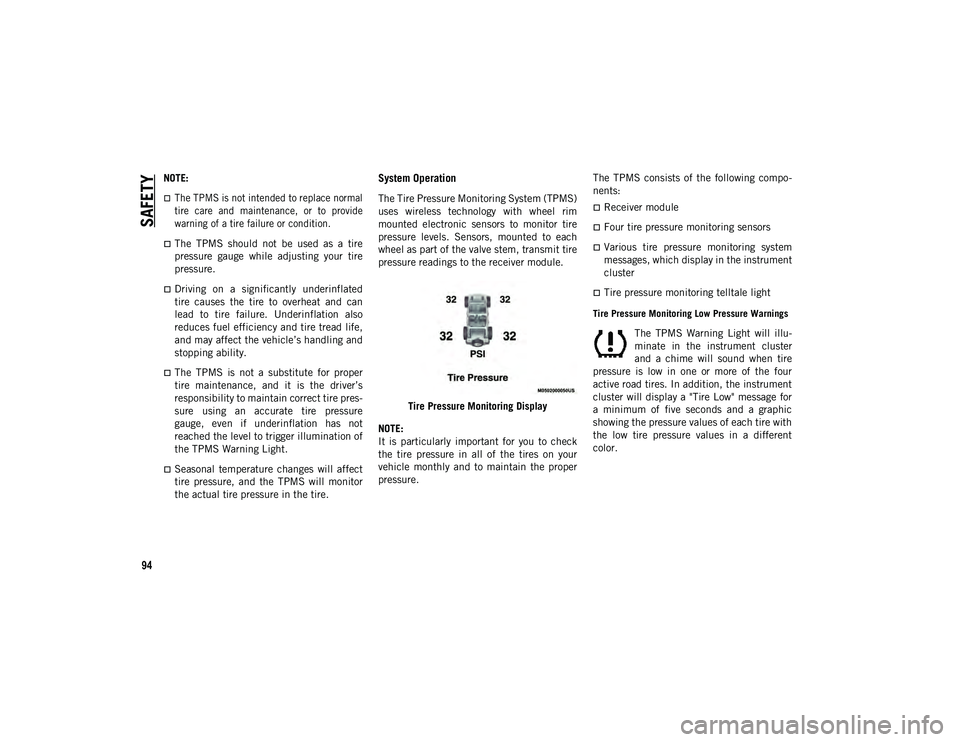
pressure readings to the receiver module.Tire Pressure Monitoring Display
NOTE:
It is particularly important for you to check
the tire pressure in all of the tires on your
vehicle monthly and to maintain the proper
pressure. The TPMS consists of the following compo
-
nents:Receiver module
Four tire pressure monitoring sensors
Various tire pressure monitoring system
messages, which display in the instrument
cluster
Tire pressure monitoring telltale light
Tire Pressure Monitoring Low Pressure Warnings
The TPMS Warning Light will illu -
minate in the instrument cluster
and a chime will sound when tire
pressure is low in one or more of the four
active road tires. In addition, the instrument
cluster will display a "Tire Low" message for
a minimum of five seconds and a graphic
showing the pressure values of each tire with
the low tire pressure values in a different
color.
2020_JEEP_JL_WRANGLER_UG_RHD_UK.book Page 94
Page 98 of 330
SAFETY
96
Vehicles With Compact Spare or Non-Matching
Full Size Spare
1. The compact spare tire or non-matching full size does not have a tire pressure
monitoring sensor. Therefore, the TPMS
will not monitor the pressure in the
compact spare tire.
2. If you install the compact or non-matching full size spare tire in place
of a road tire that has a pressure below
the low-pressure warning limit, upon the
next ignition cycle, the TPMS Warning
Light will remain on and a chime will
sound. In addition, the graphic in the
instrument cluster will still display a
different color pressure value.
3. After driving the vehicle for up to 10 minutes above 15 mph (24 km/h),
the TPMS Warning Light will flash on and
off for 75 seconds and then remain on
solid. In addition, the instrument cluster
will display a “Service Tire Pressure
System” message for five seconds and
then display dashes (--) in place of the
pressure value. 4. For each subsequent ignition cycle, a
chime will sound, the TPMS Warning
Light will flash on and off for 75 seconds
and then remain on solid, and the instru -
ment cluster will display a “SERVICE
TIRE PRESSURE SYSTEM” message for
five seconds and then display dashes (--)
in place of the pressure value.
5. Once you repair or replace the original road tire and reinstall it on the vehicle in
place of the compact spare or
non-matching full size, the TPMS will
update automatically. In addition, the
TPMS Warning Light will turn off and the
graphic in the instrument cluster will
display a new pressure value instead of
dashes (--), as long as no tire pressure is
below the low-pressure warning limit in
any of the four active road tires. The
vehicle may need to be driven for up to
10 minutes above 15 mph (24 km/h) in
order for the TPMS to receive this
information. Vehicles With a Full Size Matching Spare
1. If your vehicle is equipped with a
matching full-size spare wheel and tire
assembly, it has a tire pressure moni -
toring sensor, and can be monitored by
the Tire Pressure Monitoring System
(TPMS) when swapped with a low pres -
sure road tire.
2. In the event that the matching full-size spare tire is swapped with a low pressure
road tire, the next ignition switch cycle
will still show the TPMS Warning Light to
be on, a chime to sound, and the graphic
display will still show the low tire pres -
sure value in a different color.
3. Driving the vehicle for up to 10 minutes above 15 mph (24 km/h) will turn off theTPMS Warning Light as long as none of
road tires are below the low pressure
warning threshold.
TPMS Deactivation — If Equipped
The TPMS can be deactivated if replacing all
four wheel and tire assemblies (road tires)
with wheel and tire assemblies that do not
have TPMS sensors, such as when installing
winter wheel and tire assemblies on your
vehicle.
2020_JEEP_JL_WRANGLER_UG_RHD_UK.book Page 96
Page 99 of 330
97
To deactivate the TPMS, first replace all four
wheel and tire assemblies (road tires) with tires
not equipped with Tire Pressure Monitoring (TPM)
sensors. Then, drive the vehicle for 10 minutes
above 15 mph (24 km/h). The TPMS will chime,
the TPMS Warning Light will flash on and off for
75 seconds and then remain on. The instrument
cluster will display the “SERVICE TIRE PRES-
SURE SYSTEM” message and then display
dashes (--) in place of the pressure values.
Beginning with the next ignition cycle, the TPMS
will no longer chime or display the “SERVICE
TIRE PRESSURE SYSTEM” message in the
instrument cluster but dashes (--) will remain in
place of the pressure values.
To reactivate the TPMS, replace all four
wheel and tire assemblies (road tires) with
tires equipped with TPMS sensors. Then,
drive the vehicle for up to 10 minutes above
15 mph (24 km/h). The TPMS will chime,
the TPMS Warning Light will flash on and off
for 75 seconds and then turn off. The instru -
ment cluster will display the “SERVICE TIRE
PRESSURE SYSTEM” message and then
display pressure values in place of the
dashes. On the next ignition cycle the
"SERVICE TIRE PRESSURE SYSTEM"
message will no longer be displayed as long
as no system fault exists.OCCUPANT RESTRAINT
SYSTEMS
Some of the most important safety features
in your vehicle are the restraint systems:
Occupant Restraint Systems Features
Seat Belt Systems
Supplemental Restraint Systems (SRS)
Air Bags
Child Restraints
Some of the safety features described in this
section may be standard equipment on some
models, or may be optional equipment on
others. If you are not sure, ask an authorized
dealer.
Important Safety Precautions
Please pay close attention to the information
in this section. It tells you how to use your
restraint system properly, to keep you and
your passengers as safe as possible. Here are some simple steps you can take to
minimize the risk of harm from a deploying
air bag:
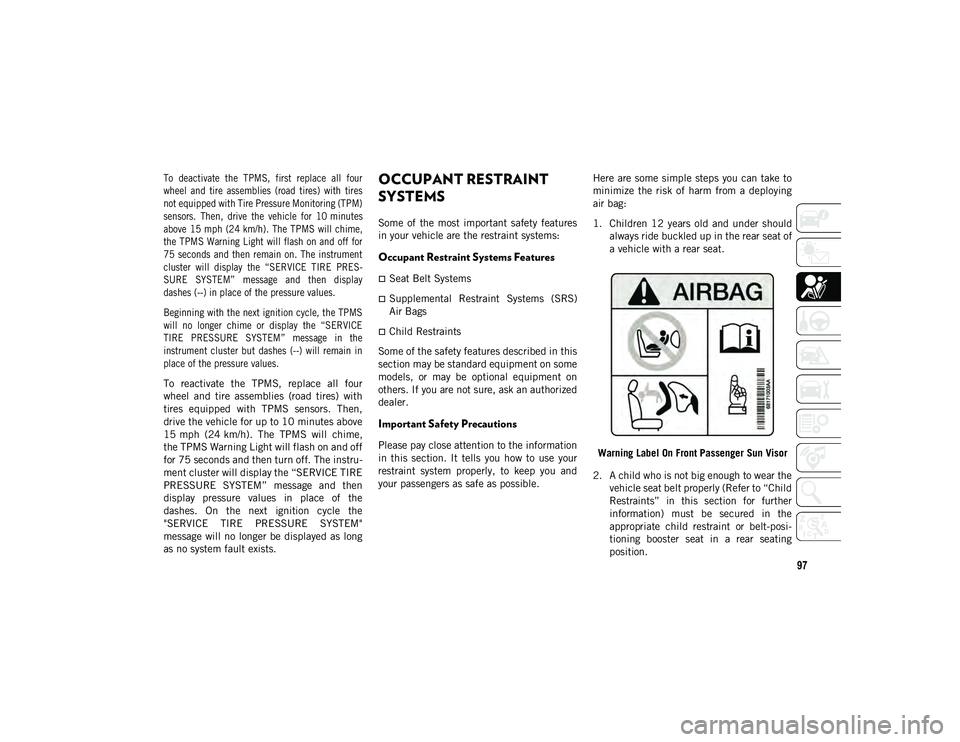
1. Children 12 years old and under should
always ride buckled up in the rear seat of
a vehicle with a rear seat.
Warning Label On Front Passenger Sun Visor
2. A child who is not big enough to wear the vehicle seat belt properly (Refer to “Child
Restraints” in this section for further
information) must be secured in the
appropriate child restraint or belt-posi -
tioning booster seat in a rear seating
position.
2020_JEEP_JL_WRANGLER_UG_RHD_UK.book Page 97
Page 148 of 330
STARTING AND OPERATING
146
The transmission will automatically down-
shift to FIRST gear when coming to a stop.
After a stop, the driver should manually
upshift (+) the transmission as the vehicle
is accelerated.
You can start out, from a stop, in FIRST or
SECOND gear (or THIRD gear, in 4L
range). Tapping (+) (at a stop) will allow
starting in SECOND gear. Starting out in
SECOND or THIRD gear can be helpful in
snowy or icy conditions.
If a requested downshift would cause the
engine to over-speed, that shift will not
occur.
The system will ignore attempts to upshift
at too low of a vehicle speed.
Holding the gear selector in the (-) posi -
tion will downshift the transmission to the
lowest gear possible at the current speed.
Transmission shifting will be more notice-
able when AutoStick is enabled.
The system may revert to automatic shift
mode if a fault or overheat condition is
detected. NOTE:
When Hill Descent Control is enabled, Auto
-
Stick is not active.
To disengage AutoStick mode, return the
gear selector to the DRIVE position. You can
shift in or out of the AutoStick position at any
time without taking your foot off the acceler -
ator pedal.
FOUR–WHEEL DRIVE
OPERATION
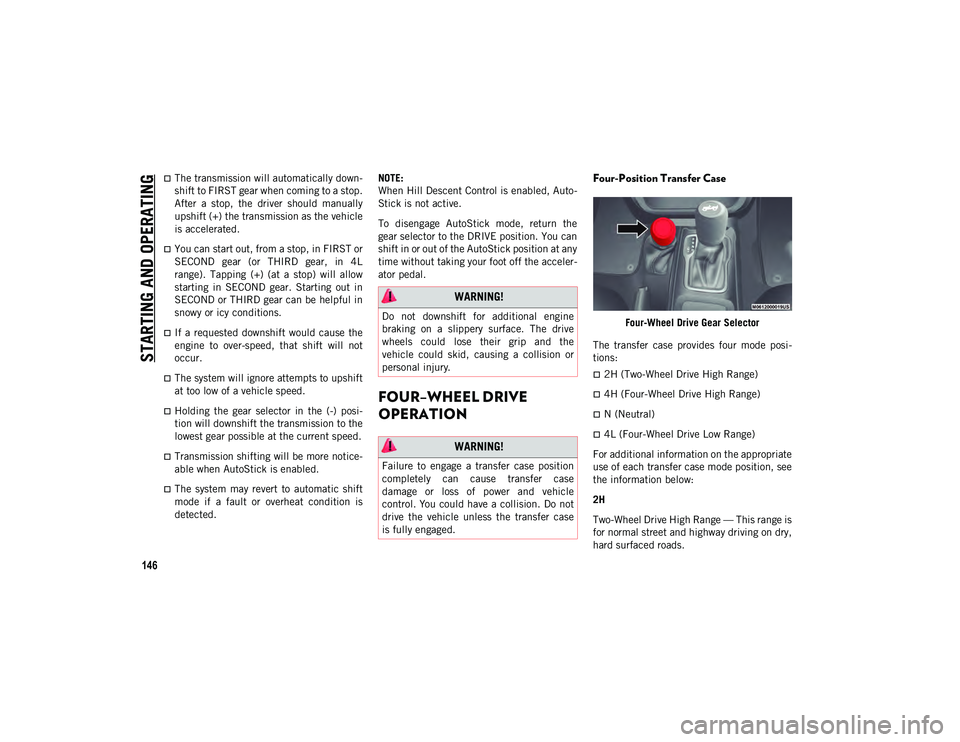
Four-Position Transfer Case
Four-Wheel Drive Gear Selector
The transfer case provides four mode posi -
tions:
2H (Two-Wheel Drive High Range)
4H (Four-Wheel Drive High Range)
N (Neutral)
4L (Four-Wheel Drive Low Range)
For additional information on the appropriate
use of each transfer case mode position, see
the information below:
2H
Two-Wheel Drive High Range — This range is
for normal street and highway driving on dry,
hard surfaced roads.
WARNING!
Do not downshift for additional engine
braking on a slippery surface. The drive
wheels could lose their grip and the
vehicle could skid, causing a collision or
personal injury.
WARNING!
Failure to engage a transfer case position
completely can cause transfer case
damage or loss of power and vehicle
control. You could have a collision. Do not
drive the vehicle unless the transfer case
is fully engaged.
2020_JEEP_JL_WRANGLER_UG_RHD_UK.book Page 146
Page 149 of 330
147
4H
Four-Wheel Drive High Range — This range
maximizes torque to the front driveshaft,
forcing the front and rear wheels to rotate at
the same speed. This range provides addi-
tional traction for loose, slippery road
surfaces only.
NEUTRAL (N)
Neutral — This range disengages both the
front and rear driveshafts from the power -
train. To be used for flat towing behind
another vehicle.
Refer to “Recreational Towing” in this
chapter for further information. 4L
Four-Wheel Drive Low Range — This range
provides low speed four-wheel drive. It maxi
-
mizes torque to the front driveshaft, forcing
the front and rear wheels to rotate at the
same speed. This range provides additional
traction and maximum pulling power for
loose, slippery road surfaces only. Do not
exceed 25 mph (40 km/h).
The transfer case is intended to be driven in
the 2H position for normal street and
highway conditions, such as hard-surfaced
roads.
In the event that additional traction is
required, the transfer case 4H and 4L posi -
tions can be used to lock the front and rear
driveshafts together, forcing the front and
rear wheels to rotate at the same speed. The
4H and 4L positions are intended for loose,
slippery road surfaces only and not intended
for normal driving. Driving in the 4H and 4L
positions on hard-surfaced roads will cause
increased tire wear and damage to the drive -
line components. Refer to “Shifting Proce -
dures” in this section for further information
on shifting into 4H or 4L. The instrument cluster alerts the driver that
the vehicle is in four-wheel drive, and the
front and rear driveshafts are locked
together. The light will illuminate when the
transfer case is shifted into the 4H position.
When operating your vehicle in 4L, the
engine speed will be approximately three
times (four times for Rubicon models) that of
the 2H or 4H positions at a given road speed.
Take care not to overspeed the engine.
Proper operation of four-wheel drive vehicles
depends on tires of equal size, type, and
circumference on each wheel. Any difference
will adversely affect shifting and cause
damage to the transfer case.
Because four-wheel drive provides improved
traction, there is a tendency to exceed safe
turning and stopping speeds. Do not go
faster than road conditions permit.
Shifting Procedures
2H To 4H Or 4H To 2H
Shifting between 2H and 4H can be made
with the vehicle stopped or in motion. The
preferred shifting speed would be 0 to
45 mph (72 km/h). With the vehicle in
motion, the transfer case will engage/disen
-
WARNING!
You or others could be injured or killed if
you leave the vehicle unattended with the
transfer case in the NEUTRAL (N) position
without first fully engaging the parking
brake. The transfer case NEUTRAL (N)
position disengages both the front and rear
driveshafts from the powertrain, and will
allow the vehicle to roll, even if the
automatic transmission is in PARK. The
parking brake should always be applied
when the driver is not in the vehicle.
2020_JEEP_JL_WRANGLER_UG_RHD_UK.book Page 147