four wheel drive JEEP WRANGLER 2DOORS 2021 Owner handbook (in English)
[x] Cancel search | Manufacturer: JEEP, Model Year: 2021, Model line: WRANGLER 2DOORS, Model: JEEP WRANGLER 2DOORS 2021Pages: 330, PDF Size: 9.16 MB
Page 150 of 330
STARTING AND OPERATING
148
gage faster if you momentarily release the
accelerator pedal after completing the shift.
Do not accelerate while shifting the transfer
case. Apply a constant force when shifting
the transfer case lever.
NOTE:
Do not attempt to make a shift while only the
front or rear wheels are spinning. The front
and rear driveshaft speeds must be equal for
the shift to take place. Shifting while only
the front or rear wheels are spinning can
cause damage to the transfer case.
Delayed shifts out of four-wheel drive may
be experienced due to uneven tire wear,
low or uneven tire pressures, excessive
vehicle loading, or cold temperatures.
Shifting effort will increase with speed,
this is normal.
During cold weather, you may experience
increased effort in shifting until the transfer
case fluid warms up. This is normal.
4H To 4L Or 4L To 4H
With the vehicle rolling at 2 to 3 mph (3 to
5 km/h), shift the transmission into
NEUTRAL (N). While the vehicle is coasting
at 2 to 3 mph (3 to 5 km/h), shift the
transfer case lever firmly to the desired posi -
tion. Do not pause with the transfer case in
N (Neutral). Once the shift is completed,
place the transmission into DRIVE.
NOTE:
Shifting into or out of 4L is possible with the
vehicle completely stopped; however, diffi -
culty may occur due to the mating teeth not
being properly aligned. Several attempts may
be required for clutch teeth alignment and
shift completion to occur. The preferred
method is with the vehicle rolling at 2 to
3 mph (3 to 5 km/h). Avoid attempting to
engage or disengage 4L with the vehicle
moving faster than 2 to 3 mph (3 to 5 km/h).
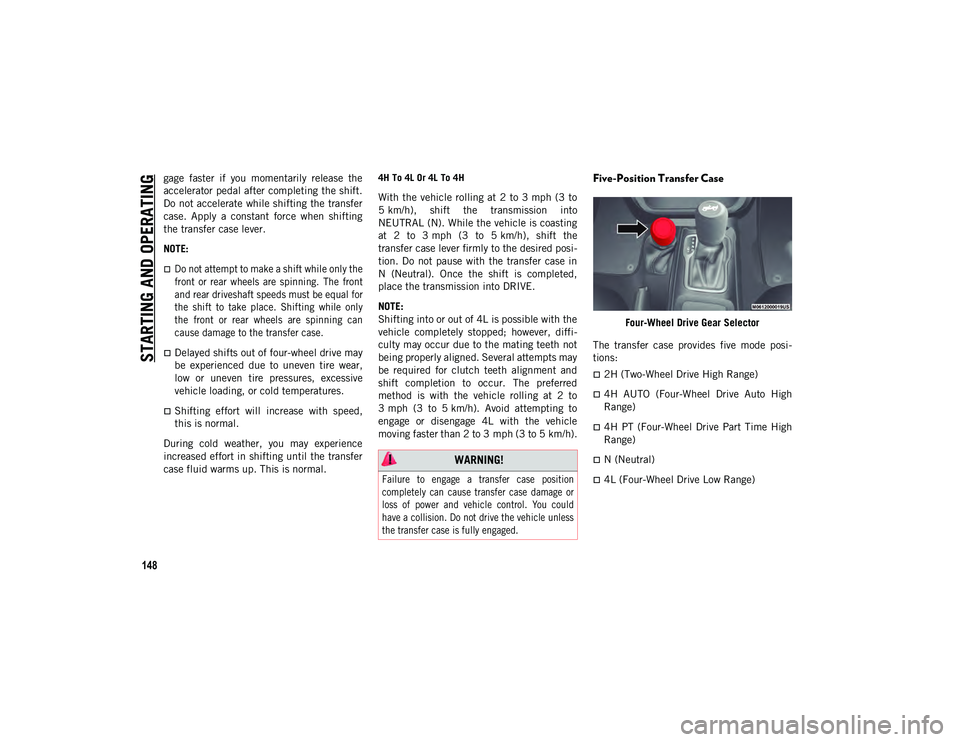
Five-Position Transfer Case
Four-Wheel Drive Gear Selector
The transfer case provides five mode posi -
tions:
2H (Two-Wheel Drive High Range)
4H AUTO (Four-Wheel Drive Auto High
Range)
4H PT (Four-Wheel Drive Part Time High
Range)
N (Neutral)
4L (Four-Wheel Drive Low Range)
WARNING!
Failure to engage a transfer case position
completely can cause transfer case damage or
loss of power and vehicle control. You could
have a collision. Do not drive the vehicle unless
the transfer case is fully engaged.
2020_JEEP_JL_WRANGLER_UG_RHD_UK.book Page 148
Page 151 of 330
149
For additional information on the appropriate
use of each transfer case mode position, see
the information below:
2H
Two-Wheel Drive High Range — This range is
for normal street and highway driving on dry,
hard surfaced roads.
4H AUTO
Four-Wheel Drive Auto High Range — This
range sends power to the front wheels. The
four-wheel drive system will be automatically
engaged when the vehicle senses a loss of
traction. Additional traction for varying road
conditions.
4H PT
Four-Wheel Drive Part Time High Range —
This range maximizes torque to the front
driveshaft, forcing the front and rear wheels
to rotate at the same speed. This range
provides additional traction for loose, slip-
pery road surfaces only. NEUTRAL (N)
Neutral — This range disengages both the
front and rear driveshafts from the power
-
train. To be used for flat towing behind
another vehicle.
Refer to “Recreational Towing” in this
chapter for further information. 4L
Four-Wheel Drive Low Range — This range
provides low speed four-wheel drive. It maxi
-
mizes torque to the front driveshaft, forcing
the front and rear wheels to rotate at the
same speed. This range provides additional
traction and maximum pulling power for
loose, slippery road surfaces only. Do not
exceed 25 mph (40 km/h).
This transfer case is designed to be driven in
the 2H mode or 4H AUTO mode for normal
street and highway conditions on dry hard
surfaced roads. Driving the vehicle in 2H will
have greater fuel economy benefits as the
front axle is not engaged in 2H.
For variable driving conditions, the 4H AUTO
mode can be used. In this mode, the front
axle is engaged, but the vehicle's power is
sent to the rear wheels. Four-wheel drive will
be automatically engaged when the vehicle
senses a loss of traction. Because the front
axle is engaged, this mode will result in lower
fuel economy than the 2H mode.
WARNING!
You or others could be injured or killed if
you leave the vehicle unattended with the
transfer case in the NEUTRAL (N) position
without first fully engaging the parking
brake. The transfer case NEUTRAL (N)
position disengages both the front and rear
driveshafts from the powertrain, and will
allow the vehicle to roll, even if the
automatic transmission is in PARK. The
parking brake should always be applied
when the driver is not in the vehicle.
2020_JEEP_JL_WRANGLER_UG_RHD_UK.book Page 149
Page 152 of 330
STARTING AND OPERATING
150
In the event that additional traction is
required, the transfer case 4H and 4L posi-
tions can be used to lock the front and rear
driveshafts together, forcing the front and
rear wheels to rotate at the same speed. The
4H and 4L positions are intended for loose,
slippery road surfaces only and not intended
for normal driving. Driving in the 4H and 4L
positions on hard-surfaced roads will cause
increased tire wear and damage to the drive -
line components. Refer to “Shifting Proce -
dures” in this section for further information
on shifting into 4H or 4L.
The instrument cluster alerts the driver that
the vehicle is in four-wheel drive, and the
front and rear driveshafts are locked
together. The light will illuminate when the
transfer case is shifted into the 4H position.
When operating your vehicle in 4L, the
engine speed will be approximately three
times (four times for Rubicon models) that of
the 2H or 4H positions at a given road speed.
Take care not to overspeed the engine.
Proper operation of four-wheel drive vehicles
depends on tires of equal size, type, and
circumference on each wheel. Any difference
will adversely affect shifting and cause
damage to the transfer case. Because four-wheel drive provides improved
traction, there is a tendency to exceed safe
turning and stopping speeds. Do not go
faster than road conditions permit.
Shifting Procedures
2H To 4H Auto Or 4H Auto To 2H
Shifting between 2H and 4H Auto can be
made with the vehicle stopped or in motion.
The preferred shifting speed would be 0 to
45 mph (72 km/h). With the vehicle in
motion, the transfer case will engage/disen
-
gage faster if you momentarily release the
accelerator pedal after completing the shift.
Do not accelerate while shifting the transfer
case. Apply a constant force when shifting
the transfer case lever.
2H/4H Auto To 4H Part Time Or 4H Part Time To
2H/4H Auto
Shifting between 2H/4H AUTO to 4H PART
TIME can be made with the vehicle stopped
or in motion. The preferred shifting speed
would be 0 to 45 mph (72 km/h). With the
vehicle in motion, the transfer case will
engage/disengage faster if you momentarily
release the accelerator pedal after
completing the shift. Do not accelerate while shifting the transfer case. Apply a constant
force when shifting the transfer case lever.
NOTE:
Do not attempt to make a shift while only
the front or rear wheels are spinning. The
front and rear driveshaft speeds must be
equal for the shift to take place. Shifting
while only the front or rear wheels are
spinning can cause damage to the transfer
case.
Delayed shifts out of four-wheel drive may
be experienced due to uneven tire wear,
low or uneven tire pressures, excessive
vehicle loading, or cold temperatures.
Shifting effort will increase with speed,
this is normal.
During cold weather, you may experience
increased effort in shifting until the transfer
case fluid warms up. This is normal.
4H Part Time/4H Auto To 4L Or 4L To 4H Part Time/
4H Auto
With the vehicle rolling at 2 to 3 mph (3 to
5 km/h), shift the transmission into
NEUTRAL (N). While the vehicle is coasting
at 2 to 3 mph (3 to 5 km/h), shift the
transfer case lever firmly to the desired posi -
2020_JEEP_JL_WRANGLER_UG_RHD_UK.book Page 150
Page 154 of 330
STARTING AND OPERATING
152
(the “FRONT + REAR” will illuminate).
When the rear axle is locked, pushing the
bottom of switch again will lock or unlock the
front axle.
NOTE:
The indicator lights will flash until the axles
are fully locked or unlocked.
To unlock the axles, push the AXLE LOCK
OFF button.
Axle lock will disengage if the vehicle is
taken out of 4L (Low) range, or the ignition
switch is turned to the OFF position.
The axle lock disengages at speeds above
30 mph (48 km/h), and will automaticallyre-lock once vehicle speed is less than
10 mph (16 km/h).
Electronic Sway Bar Disconnect — If
Equipped
Your vehicle may be equipped with an elec -
tronic disconnecting stabilizer/sway bar. This
system allows greater front suspension travel
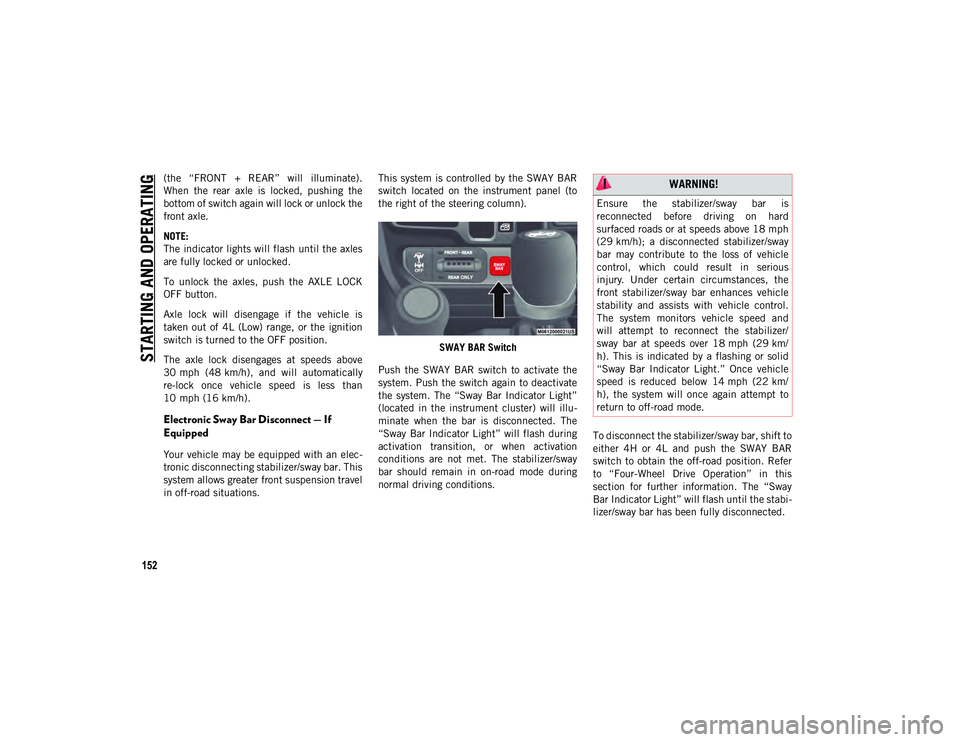
in off-road situations. This system is controlled by the SWAY BAR
switch located on the instrument panel (to
the right of the steering column).
SWAY BAR Switch
Push the SWAY BAR switch to activate the
system. Push the switch again to deactivate
the system. The “Sway Bar Indicator Light”
(located in the instrument cluster) will illu -
minate when the bar is disconnected. The
“Sway Bar Indicator Light” will flash during
activation transition, or when activation
conditions are not met. The stabilizer/sway
bar should remain in on-road mode during
normal driving conditions. To disconnect the stabilizer/sway bar, shift to
either 4H or 4L and push the SWAY BAR
switch to obtain the off-road position. Refer
to “Four-Wheel Drive Operation” in this
section for further information. The “Sway
Bar Indicator Light” will flash until the stabi
-
lizer/sway bar has been fully disconnected.
WARNING!
Ensure the stabilizer/sway bar is
reconnected before driving on hard
surfaced roads or at speeds above 18 mph
(29 km/h); a disconnected stabilizer/sway
bar may contribute to the loss of vehicle
control, which could result in serious
injury. Under certain circumstances, the
front stabilizer/sway bar enhances vehicle
stability and assists with vehicle control.
The system monitors vehicle speed and
will attempt to reconnect the stabilizer/
sway bar at speeds over 18 mph (29 km/
h). This is indicated by a flashing or solid
“Sway Bar Indicator Light.” Once vehicle
speed is reduced below 14 mph (22 km/
h), the system will once again attempt to
return to off-road mode.
2020_JEEP_JL_WRANGLER_UG_RHD_UK.book Page 152
Page 178 of 330
STARTING AND OPERATING
176
(Continued)
(Continued)
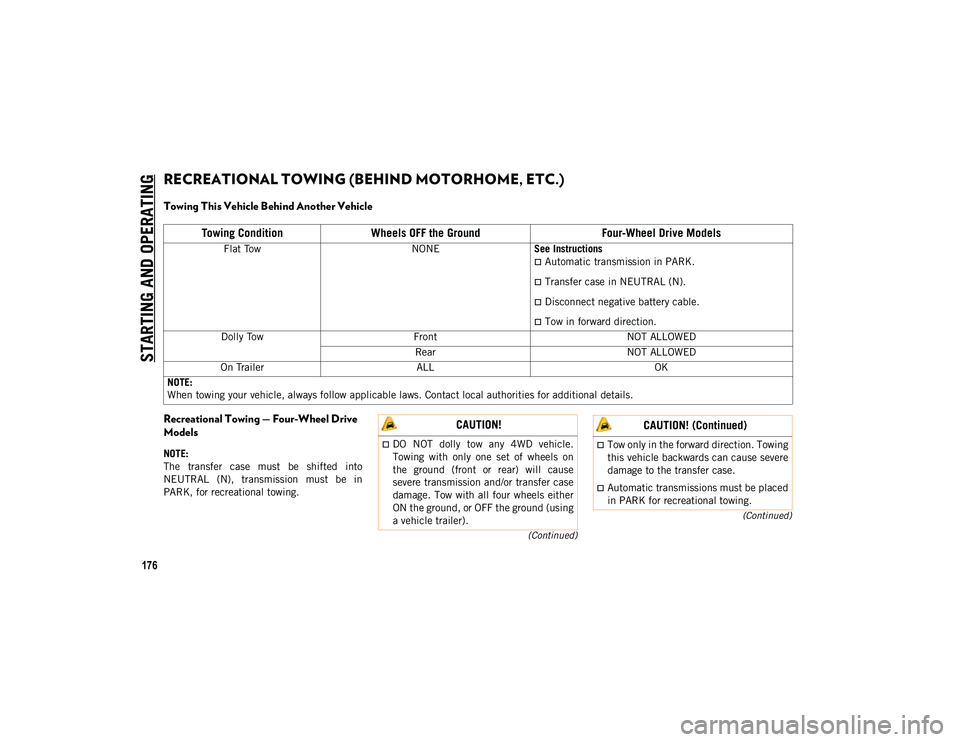
RECREATIONAL TOWING (BEHIND MOTORHOME, ETC.)
Towing This Vehicle Behind Another Vehicle
Recreational Towing — Four-Wheel Drive
Models
NOTE:
The transfer case must be shifted into
NEUTRAL (N), transmission must be in
PARK, for recreational towing.
Towing Condition Wheels OFF the Ground Four-Wheel Drive Models
Flat TowNONESee Instructions
Automatic transmission in PARK.
Transfer case in NEUTRAL (N).
Disconnect negative battery cable.
Tow in forward direction.
Dolly Tow Front NOT ALLOWED
Rear NOT ALLOWED
On Trailer ALL OK
NOTE:
When towing your vehicle, always follow applicable laws. Contact local authorities for additional details.
CAUTION!
DO NOT dolly tow any 4WD vehicle.
Towing with only one set of wheels on
the ground (front or rear) will cause
severe transmission and/or transfer case
damage. Tow with all four wheels either
ON the ground, or OFF the ground (using
a vehicle trailer).Tow only in the forward direction. Towing
this vehicle backwards can cause severe
damage to the transfer case.
Automatic transmissions must be placed
in PARK for recreational towing.
CAUTION! (Continued)
2020_JEEP_JL_WRANGLER_UG_RHD_UK.book Page 176
Page 210 of 330
IN CASE OF EMERGENCY
208
(Continued)
Four–Wheel Drive Models
The manufacturer recommends towing with
all wheels OFF the ground. Acceptable
methods are to tow the vehicle on a flatbed
or with one end of the vehicle raised and the
opposite end on a towing dolly.
If flatbed equipment is not available and the
transfer case is operable, the vehicle may be
towed (in the forward direction, with ALL
wheels on the ground), IF the transfer case is
in NEUTRAL (N) and the transmission is in
PARK (P). Refer to “Recreational Towing” in
“Starting And Operating” for detailed
instructions.
Without The Key Fob
Special care must be taken when the vehicle
is towed with the ignition in the OFF mode.
The only approved method of towing without
the key fob is with a flatbed truck. Proper
towing equipment is necessary to prevent
damage to the vehicle.
Tow Eye Usage
Your vehicle is equipped with a tow eye that
can be used to move a disabled vehicle.
When using a tow eye be sure to follow the
“Tow Eye Usage Precautions” and the
“Towing A Disabled Vehicle” instructions in
this section.
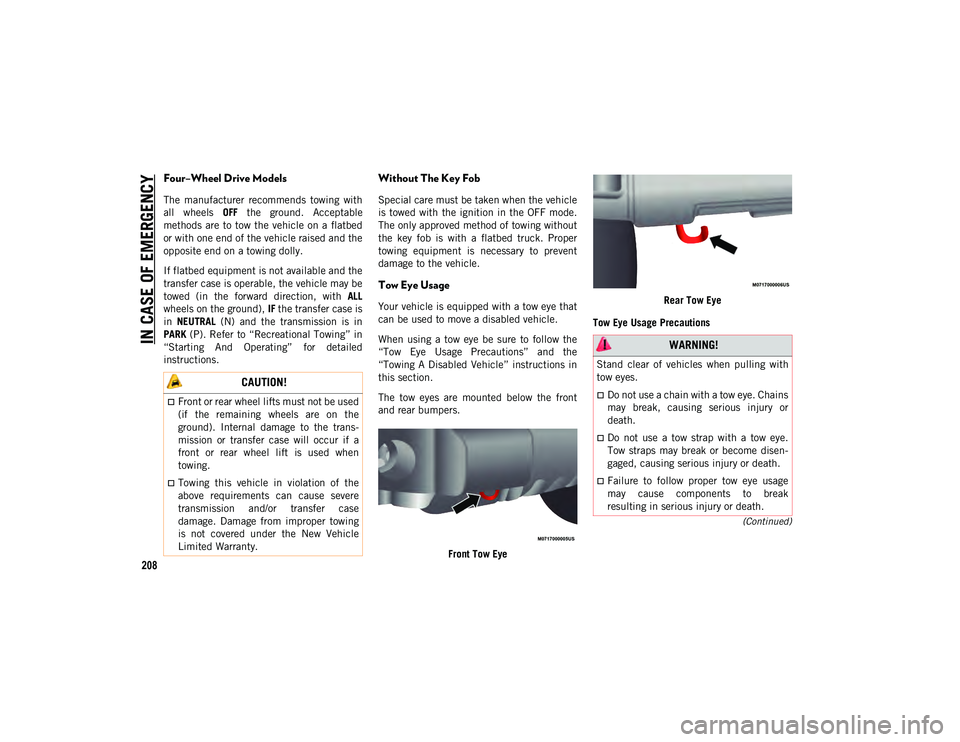
The tow eyes are mounted below the front
and rear bumpers.
Front Tow Eye Rear Tow Eye
Tow Eye Usage Precautions
CAUTION!
Front or rear wheel lifts must not be used
(if the remaining wheels are on the
ground). Internal damage to the trans-
mission or transfer case will occur if a
front or rear wheel lift is used when
towing.
Towing this vehicle in violation of the
above requirements can cause severe
transmission and/or transfer case
damage. Damage from improper towing
is not covered under the New Vehicle
Limited Warranty.
WARNING!
Stand clear of vehicles when pulling with
tow eyes.
Do not use a chain with a tow eye. Chains
may break, causing serious injury or
death.
Do not use a tow strap with a tow eye.
Tow straps may break or become disen -
gaged, causing serious injury or death.
Failure to follow proper tow eye usage
may cause components to break
resulting in serious injury or death.
2020_JEEP_JL_WRANGLER_UG_RHD_UK.book Page 208
Page 243 of 330
241
Tire Rotation Recommendations
The tires on the front and rear of your vehicle
operate at different loads and perform
different steering, handling, and braking
functions. For these reasons, they wear at
unequal rates.
These effects can be reduced by timely rota-
tion of tires. The benefits of rotation are
especially worthwhile with aggressive tread
designs such as those on On/Off Road type
tires. Rotation will increase tread life, help to
maintain mud, snow, and wet traction levels,
and contribute to a smooth, quiet ride. Refer to the “Maintenance Plan” for the
proper maintenance intervals. The reasons
for any rapid or unusual wear should be
corrected prior to rotation being performed.
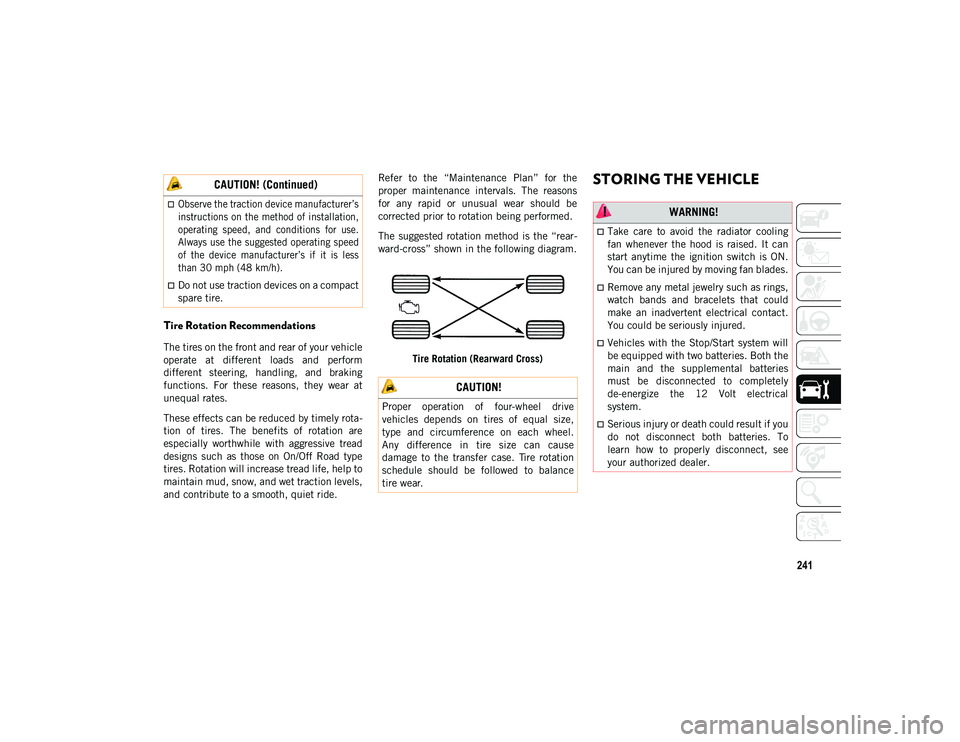
The suggested rotation method is the “rear
-
ward-cross” shown in the following diagram.
Tire Rotation (Rearward Cross)
STORING THE VEHICLE
Observe the traction device manufacturer’s
instructions on the method of installation,
operating speed, and conditions for use.
Always use the suggested operating speed
of the device manufacturer’s if it is less
than 30 mph (48 km/h).
Do not use traction devices on a compact
spare tire.
CAUTION! (Continued)
CAUTION!
Proper operation of four-wheel drive
vehicles depends on tires of equal size,
type and circumference on each wheel.
Any difference in tire size can cause
damage to the transfer case. Tire rotation
schedule should be followed to balance
tire wear.
WARNING!
Take care to avoid the radiator cooling
fan whenever the hood is raised. It can
start anytime the ignition switch is ON.
You can be injured by moving fan blades.
Remove any metal jewelry such as rings,
watch bands and bracelets that could
make an inadvertent electrical contact.
You could be seriously injured.
Vehicles with the Stop/Start system will
be equipped with two batteries. Both the
main and the supplemental batteries
must be disconnected to completely
de-energize the 12 Volt electrical
system.
Serious injury or death could result if you
do not disconnect both batteries. To
learn how to properly disconnect, see
your authorized dealer.
2020_JEEP_JL_WRANGLER_UG_RHD_UK.book Page 241
Page 323 of 330
321
Enhanced Accident Response
Feature ..................................... 115, 209
Exhaust Gas Caution .......................... 135
Exhaust System ......................... 135 , 228
Exterior Lights ............................. 32 , 137
F
Fabric Care ....................................... 244
Fabric Top ........................................ 244
Filters Air Conditioning ............................... 46
Engine Oil ..................................... 254
Flashers Hazard Warning ............................. 179Turn Signal.................................... 137
Turn Signals .....................74 , 181 , 182
Flash-To-Pass ...................................... 33
Flat Tire Changing ..................... 232 , 237
Flat Tire Stowage ....................... 232 , 237
Fluid Capacities................................. 253
Fluid Leaks ....................................... 137
Fluid Level Checks Brake ............................................ 230
Engine Oil ..................................... 224
Fluid, Brake ...................................... 257
Fluids And Lubricants ........................ 254
Fog Lights ..............................33 , 72 , 182
Fog Lights, Rear .................................. 33 Fog Lights, Service ............................ 182
Fold And Tumble Rear Seat .................. 27
Fold-Flat Seats .................................... 24
Folding Rear Seats .............................. 26
Forward Collision Warning .................... 89
Four Wheel Drive ............................... 146
Operation ...................................... 146
Shifting......................................... 146
System ......................................... 146
Four Wheel Drive Operation ................ 148
Four-Way Hazard Flasher.................... 179
Freedom Panels .................................. 51
Freeing A Stuck Vehicle ..................... 206
Fuel ................................................. 248 Adding .......................................... 169
Additives ....................................... 249
Consumption ................................. 258
Filler Cap (Gas Cap) ................169 , 170
Gasoline........................................ 248
Materials Added............................. 249
Octane Rating.........................248 , 254
Requirements ................................ 253
Specifications................................ 254
Tank Capacity................................ 253
Fueling ............................................. 169
Fuses ............................................... 183 G
Gas Cap (Fuel Filler Cap) ............ 169
, 170
Gasoline Particulate Filter (GPF)............59
Gasoline, (Fuel) .................................248
Glass Cleaning ...................................246
GVWR ...............................................174
H
Hard Top .............................................51
Hazard Warning Flashers ....................179
Head Restraints ...................................28
Headlights Automatic ........................................33
Bulb Replacement ..........................181
Cleaning ........................................242
High Beam/Low Beam Select Switch .........................................32
Leveling...........................................34 Lights On Reminder ..........................34
Passing............................................33Replacing ......................................181
Heated Steering Wheel .........................31
High Beam/Low Beam Select
(Dimmer) Switch ..................................32
Hill Descent Control .............................83
Hill Descent Control Indicator ...............83
Hill Start Assist....................................85
Hood Prop ...........................................55
Hood Release ......................................55
2020_JEEP_JL_WRANGLER_UG_RHD_UK.book Page 321
Page 327 of 330
325
Speed ControlAccel/Decel (ACC Only) ................... 159
Cancel .......................................... 158
Resume......................................... 158
Speed Control (Cruise Control) .... 157 , 158
Speed Limiter, Active ......................... 156
Starting ............................................ 138 Button ............................................ 12
Remote ........................................... 14
Starting And Operating ....................... 138
Starting Procedures ........................... 138
Steering .............................................. 31 Tilt Column ..................................... 31
Wheel, Heated ................................. 31
Wheel, Tilt....................................... 31
Steering Wheel Audio Controls ............ 279
Steering Wheel Mounted Sound System
Controls ............................................ 279
Stop/Start ......................................... 153
Storage, Vehicle .......................... 45 , 241
Storing Your Vehicle........................... 241
Stuck, Freeing ................................... 206
Sun Roof ............................................ 53
Sway Bar Disconnect Electronic ...................................... 152
Sway Control, Trailer ............................ 86
Swing Gate, Rear ................................. 55
System, Remote Starting ...................... 14 T
Telescoping Steering Column................ 31
Temperature Control, Automatic (ATC) .. 44
Text Messages ................................... 292
Tilt Steering Column ............................ 31
Tip Start ........................................... 141
Tires ......................... 137
, 232 , 237 , 238
Aging (Life Of Tires) ....................... 235
Air Pressure................................... 232
Chains .......................................... 240
Changing................................192 , 232
Compact Spare .............................. 238
General Information ........ 232 , 237 , 238
High Speed ................................... 234
Inflation Pressure........................... 233
Jacking ......................................... 232
Life Of Tires .................................. 235
Pressure Monitoring System (TPMS) .......................70 , 92
Radial........................................... 234
Replacement ................................. 236
Rotation ........................................ 241
Safety ........................................... 232
Snow Tires .................................... 237
Spare Tires..................... 193 , 237 , 238
Spinning ....................................... 235
Tread Wear Indicators .................... 235 Wheel Nut Torque .......................... 247 To Open Hood......................................55
Top
Dual .......................................... 47 , 53
Freedom ..........................................51
Hard................................................51
Power Sliding ...................................53
Removable ........................... 47 , 51 , 53
Soft ........................................... 47 , 53
Towing ...................................... 175 , 207
Disabled Vehicle .............................207
Recreational...................................176
Weight...........................................175
Towing Behind A Motorhome ...............176
Towing Eyes ......................................208
Trac-Lok Rear Axle .......................................151
Traction Control ...................................87
Traction Control Switch ........................87
Trailer Sway Control (TSC) ....................86
Trailer Towing ....................................175 Trailer And Tongue Weight...............175
Trailer Towing Guide ..........................175
Trailer Weight ....................................175
Transfer Case Fluid .............................................257Four-Wheel-Drive-Operation ..... 146 , 148
2020_JEEP_JL_WRANGLER_UG_RHD_UK.book Page 325