tire type JEEP WRANGLER UNLIMITED 2013 User Guide
[x] Cancel search | Manufacturer: JEEP, Model Year: 2013, Model line: WRANGLER UNLIMITED, Model: JEEP WRANGLER UNLIMITED 2013Pages: 655, PDF Size: 9.04 MB
Page 495 of 655
• P225/75R16 or a P235/65R17 tire with the use of a
traction device that meets the SAE type “Class S”
specification is recommended.
WARNING!Using tires of different size and type (M+S, Snow)
between front and rear axles can cause unpredictable
handling. You could lose control and have a collision.
CAUTION!To avoid damage to your vehicle or tires, observe the
following precautions:
• Because of restricted traction device clearance be-
tween tires and other suspension components, it is
important that only traction devices in good condi-
tion are used. Broken devices can cause serious
damage. Stop the vehicle immediately if noise occurs (Continued) CAUTION! (Continued)that could indicate device breakage. Remove the
damaged parts of the device before further use.
• Install device as tightly as possible and then re-
tighten after driving about ½ mile (0.8 km).
• Do not exceed 30 mph (48 km/h).
• Drive cautiously and avoid severe turns and large
bumps, especially with a loaded vehicle.
• Do not drive for prolonged period on dry pave-
ment.
• Observe the traction device manufacturer ’s instruc-
tions on the method of installation, operating speed,
and conditions for use. Always use the suggested
operating speed of the device manufacturer ’s if it is
less than 30 mph (48 km/h).
• Do not use traction devices on a compact spare tire.
5 STARTING AND OPERATING 493
Page 496 of 655
TIRE ROTATION RECOMMENDATIONS
The tires on the front and rear of your vehicle operate at
different loads and perform different steering, handling,
and braking functions. For these reasons, they wear at
unequal rates.
These effects can be reduced by timely rotation of tires.
The benefits of rotation are especially worthwhile with
aggressive tread designs such as those on On/Off Road
type tires. Rotation will increase tread life, help to main-
tain mud, snow, and wet traction levels, and contribute to
a smooth, quiet ride.
Refer to the “Maintenance Schedule” for the proper main-
tenance intervals. The reasons for any rapid or unusual
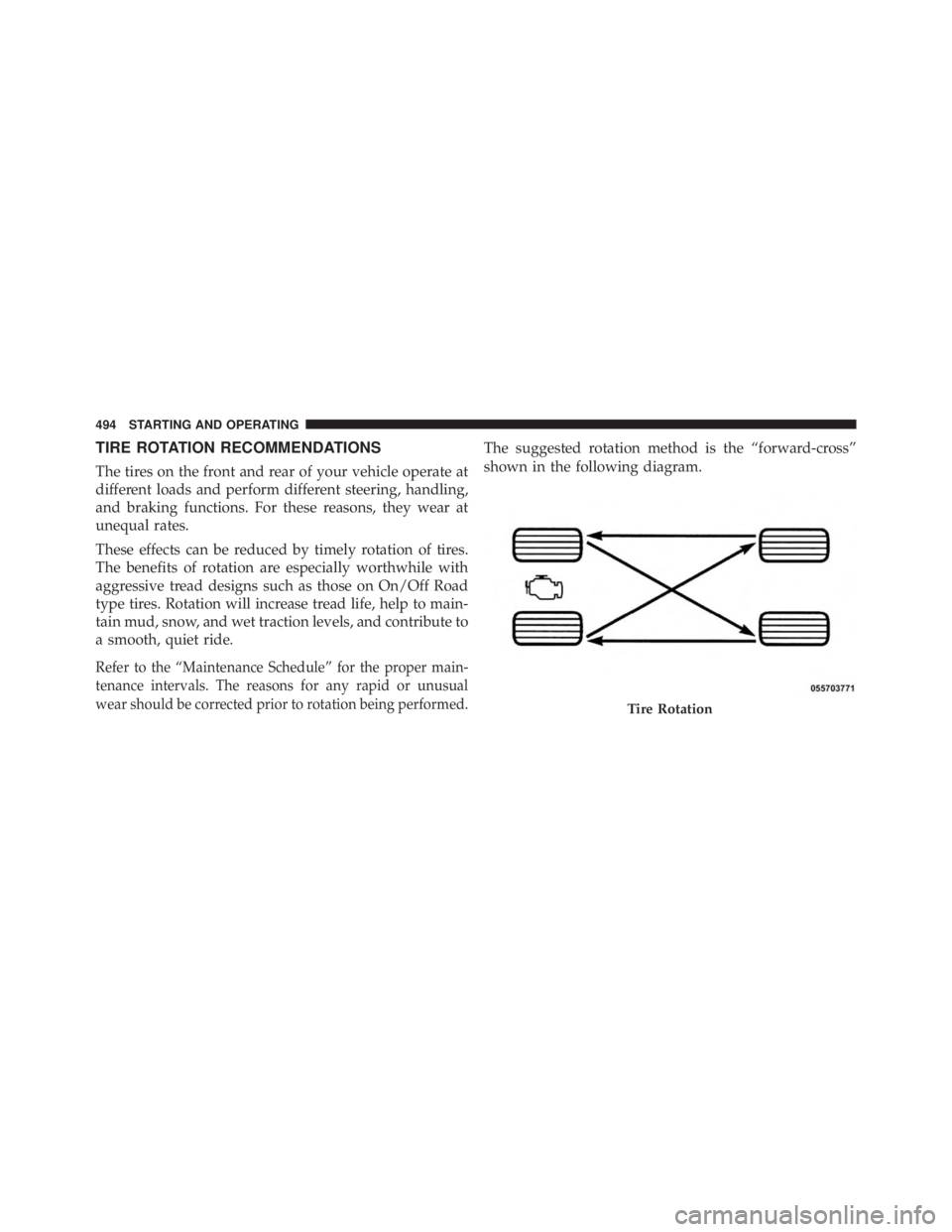
wear should be corrected prior to rotation being performed. The suggested rotation method is the “forward-cross”
shown in the following diagram.
Tire Rotation494 STARTING AND OPERATING
Page 497 of 655
CAUTION!Proper operation of four-wheel drive vehicles de-
pends on tires of equal size, type and circumference
on each wheel. Any difference in tire size can cause
damage to the transfer case. Tire rotation schedule
should be followed to balance tire wear.
TIRE PRESSURE MONITOR SYSTEM (TPMS)
The Tire Pressure Monitoring System (TPMS) will warn
the driver of a low tire pressure based on the vehicle
recommended cold placard pressure.
The tire pressure will vary with temperature by about
1 psi (6.9 kPa) for every 12°F (6.5°C). This means that
when the outside temperature decreases, the tire pressure
will decrease. Tire pressure should always be set based
on cold inflation tire pressure. This is defined as the tire pressure after a vehicle has not been driven for more than
three hours, or driven less than 1 mile (1.6 km) after a
three-hour period. Refer to “Tires – General Informa-
tion” in “Starting and Operating” for information on
how to properly inflate the vehicle’s tires. The tire
pressure will also increase as the vehicle is driven; this is
normal and there should be no adjustment for this
increased pressure.
The TPMS will warn the driver of a low tire pressure if
the tire pressure falls below the low pressure warning
threshold for any reason, including low temperature
effects, or natural pressure loss through the tire.
The TPMS will continue to warn the driver of low tire
pressure as long as the condition exists, and will not turn
off until the tire pressure is at or above recommended
cold placard pressure. Once the “Tire Pressure Monitor-
ing Telltale Light” has been illuminated, the tire pressure
5 STARTING AND OPERATING 495
Page 498 of 655
must be increased to the recommended cold placard
pressure in order for the “Tire Pressure Monitoring
Telltale Light” to be turned OFF. The system will auto-
matically update and the “Tire Pressure Monitoring
Telltale Light” will extinguish once the updated tire
pressures have been received. The vehicle may need to be
driven for up to 20 minutes above 15 mph (24 km/h) to
receive this information.
For example, your vehicle may have a recommended
cold (parked for more than three hours) air pressure of
35 psi (241 kPa). If the ambient temperature is 68°F (20°C)
and the measured tire pressure is 30 psi (207 kPa), a
temperature drop to 20°F (-7°C) will decrease the tire
pressure to approximately 26 psi (179 kPa). This tire
pressure is sufficiently low enough to turn ON the “Tire
Pressure Monitoring Telltale Light.” Driving the vehicle
may cause the tire pressure to rise to approximately
30 psi (207 kPa), but the “Tire Pressure Monitoring
Telltale Light” will still be ON. In this situation, the “Tire Pressure Monitoring Telltale Light” will turn OFF only
after the tires have been inflated to the vehicle’s recom-
mended cold placard pressure value.
CAUTION!• The TPMS has been optimized for the original
equipment tires and wheels. The TPMS pressures
have been established for the tire size equipped on
your vehicle. Undesirable system operation or sen-
sor damage may result when using replacement
equipment that is not of the same size, type, and/or
style. Aftermarket wheels can cause sensor dam-
age. Do not use aftermarket tire sealants or balance
beads if your vehicle is equipped with a TPMS, as
damage to the sensors may result. (Continued)496 STARTING AND OPERATING
Page 527 of 655
NOTE: Remember that everything put into or on the
trailer adds to the load on your vehicle. Also, additional
factory-installed options or dealer-installed options must
be considered as part of the total load on your vehicle.
Refer to the “Tire and Loading Information” placard for
the maximum combined weight of occupants and cargo
for your vehicle.
Towing Requirements
To promote proper break-in of your new vehicle drive-
train components, the following guidelines are recom-
mended:
NOTE: Trailer towing requires special rear axle lubri-
cant. Refer to “Fluids, Lubricants, and Genuine Parts” in
“Maintaining Your Vehicle” for the correct fluid type. CAUTION!• Do not tow a trailer at all during the first 500 miles
(805 km) the new vehicle is driven. The engine, axle
or other parts could be damaged.
• Then, during the first 500 miles (805 km) that a
trailer is towed, do not drive over 50 mph (80 km/h)
and do not make starts at full throttle. This helps
the engine and other parts of the vehicle wear in at
the heavier loads.
5 STARTING AND OPERATING 525
Page 637 of 655
Fluid Level Check ..................... .586
Fluid Type .......................... .585
Special Additives ...................... .585
Autostick .............................. .426
Auxiliary Electrical Outlet (Power Outlet) ....... .182
Auxiliary Power Outlet .................... .182
Axle Lock .............................. .433
Battery ................................ .570
Keyless Transmitter Replacement (RKE) ........27
Belts, Seat ...............................48
Body Mechanism Lubrication ................ .572
Brake Assist System ...................... .457
Brake Control System, Electronic ............. .456
Brake System ........................... .583
Anti-Lock (ABS) ...................... .455
Master Cylinder ....................... .583
Parking ............................. .452
Warning Light ........................ .302 Brake/Transmission Interlock ................ .419
Break-In Recommendations, New Vehicle .........98
Bulb Replacement ........................ .606
Bulbs, Light ............................ .103
Calibration, Compass ..................... .318
Capacities, Fluid ......................... .610
Caps, Filler
Fuel ............................... .510
Power Steering ....................... .451
Radiator (Coolant Pressure) .............. .580
Carbon Monoxide Warning ................. .100
Cargo Light ............................ .172
Car Washes ............................ .592
Cellular Phone ...........................114
Center High Mounted Stop Light ............. .609
Certification Label ........................ .513
Chains, Tire ............................ .492
Changing A Flat Tire ...................... .540
10 INDEX 635