flat tire JEEP WRANGLER UNLIMITED 2013 Owner's Manual
[x] Cancel search | Manufacturer: JEEP, Model Year: 2013, Model line: WRANGLER UNLIMITED, Model: JEEP WRANGLER UNLIMITED 2013Pages: 655, PDF Size: 9.04 MB
Page 500 of 655
Premium and Base TPM System
The Tire Pressure Monitor System (TPMS) uses wireless
technology with wheel rim-mounted electronic sensors to
monitor tire pressure levels. Sensors, mounted to each
wheel as part of the valve stem, transmit tire pressure
readings to the Receiver Module.
NOTE: It is particularly important for you to check the
tire pressure in all of your tires regularly and to maintain
the proper pressure.
The Tire Pressure Monitor System (TPMS) consists of the
following components:
• Receiver Module
• Four Tire Pressure Monitoring Sensors
• Tire Pressure Monitoring Telltale Light A tire pressure monitoring sensor is located in the spare
wheel if the vehicle is equipped with a matching full size
spare wheel and tire assembly. The matching full size
spare tire can be used in place of any of the four road
tires. A low spare tire will not cause the “Tire Pressure
Monitoring Telltale Light” to illuminate or the chime to
sound.
The “Tire Pressure Monitoring Telltale Light” will
illuminate in the instrument cluster, , a “LOW
TIRE PRESSURE” message will display in the EVIC, and
an audible chime will be activated when one or more of
the four active road tire pressures are low. Should this
occur, you should stop as soon as possible, check the
inflation pressure of each tire on your vehicle, and inflate
each tire to the vehicle’s recommended cold placard
pressure value. The system will automatically update
and the “Tire Pressure Monitoring Telltale Light” will
extinguish once the updated tire pressures have been498 STARTING AND OPERATING
Page 504 of 655
Tire Pressure Monitoring Low Pressure Warnings
The Tire Pressure Monitoring Telltale Light will
illuminate in the instrument cluster, and an au-
dible chime will be activated, when one or more of
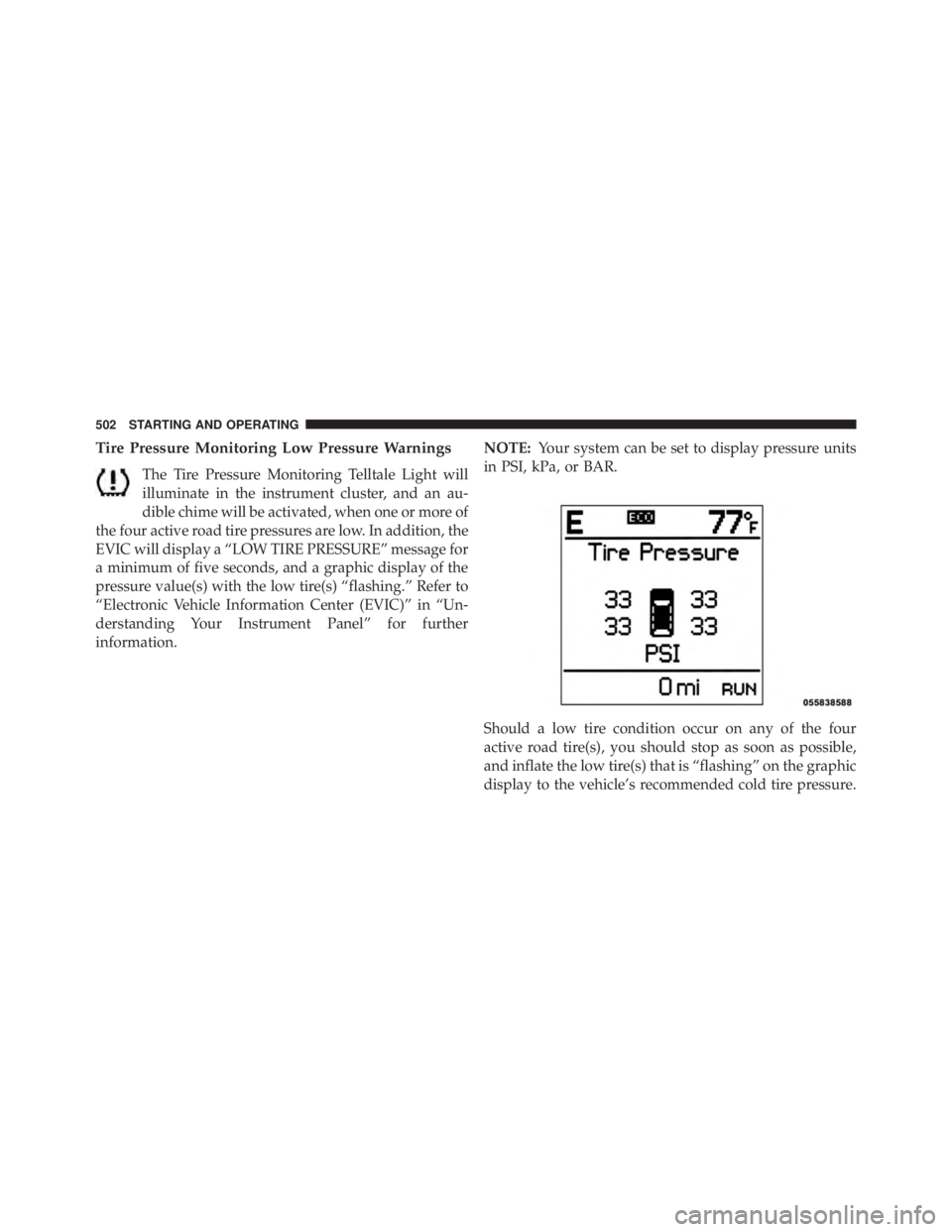
the four active road tire pressures are low. In addition, the
EVIC will display a “LOW TIRE PRESSURE” message for
a minimum of five seconds, and a graphic display of the
pressure value(s) with the low tire(s) “flashing.” Refer to
“Electronic Vehicle Information Center (EVIC)” in “Un-
derstanding Your Instrument Panel” for further
information. NOTE: Your system can be set to display pressure units
in PSI, kPa, or BAR.
Should a low tire condition occur on any of the four
active road tire(s), you should stop as soon as possible,
and inflate the low tire(s) that is “flashing” on the graphic
display to the vehicle’s recommended cold tire pressure.502 STARTING AND OPERATING
Page 516 of 655
Tire Size
The tire size on the Vehicle Certification Label represents
the actual tire size on your vehicle. Replacement tires
must be equal to the load capacity of this tire size.
Rim Size
This is the rim size that is appropriate for the tire size
listed.
Inflation Pressure
This is the cold tire inflation pressure for your vehicle for
all loading conditions up to full GAWR.
Curb Weight
The curb weight of a vehicle is defined as the total weight
of the vehicle with all fluids, including vehicle fuel, at full
capacity conditions, and with no occupants or cargo
loaded into the vehicle. The front and rear curb weight values are determined by weighing your vehicle on a
commercial scale before any occupants or cargo are
added.
Loading
The actual total weight and the weight of the front and
rear of your vehicle at the ground can best be determined
by weighing it when it is loaded and ready for operation.
The entire vehicle should first be weighed on a commer-
cial scale to insure that the GVWR has not been exceeded.
The weight on the front and rear of the vehicle should
then be determined separately to be sure that the load is
properly distributed over the front and rear axle. Weigh-
ing the vehicle may show that the GAWR of either the
front or rear axles has been exceeded but the total load is
within the specified GVWR. If so, weight must be shifted
from front to rear or rear to front as appropriate until the
specified weight limitations are met. Store the heavier514 STARTING AND OPERATING
Page 529 of 655
WARNING! (Continued)• Total weight must be distributed between the tow
vehicle and the trailer such that the following four
ratings are not exceeded:
1. GVWR
2. GTW
3. GAWR
4. Tongue weight rating for the trailer hitch utilized
(This requirement may limit the ability to always
achieve the 10% to 15% range of tongue weight as
a percentage of total trailer weight). Towing Requirements – Tires
– Proper tire inflation pressures are essential to the safe
and satisfactory operation of your vehicle. Refer to
“Tires – General Information” in “Starting and Oper-
ating” for proper tire inflation procedures.
– Check the trailer tires for proper tire inflation pressures
before trailer usage.
– Check for signs of tire wear or visible tire damage
before towing a trailer. Refer to “Tires – General
Information” in “Starting and Operating” for proper
inspection procedure.
– When replacing tires, refer to “Tires – General Infor-
mation” in “Starting and Operating” for proper tire
replacement procedures. Replacing tires with a higher
load carrying capacity will not increase the vehicle’s
GVWR and GAWR limits.
5 STARTING AND OPERATING 527
Page 545 of 655
Jacking Instructions
WARNING!Carefully follow these tire changing warnings to
help prevent personal injury or damage to your
vehicle:
• Always park on a firm, level surface as far from the
edge of the roadway as possible before raising the
vehicle.
• Turn on the Hazard Warning flasher.
• Block the wheel diagonally opposite the wheel to
be raised.
• Set the parking brake firmly and set an automatic
transmission in PARK; a manual transmission in
REVERSE.
• Never start or run the engine with the vehicle on a
jack. (Continued) WARNING! (Continued)• Do not let anyone sit in the vehicle when it is on a
jack.
• Do not get under the vehicle when it is on a jack. If
you need to get under a raised vehicle, take it to a
service center where it can be raised on a lift.
• Only use the jack in the positions indicated and for
lifting this vehicle during a tire change.
• If working on or near a roadway, be extremely
careful of motor traffic.
• To assure that spare tires, flat or inflated, are
securely stowed, spares must be stowed with the
valve stem facing the ground.
6 WHAT TO DO IN EMERGENCIES 543
Page 617 of 655
Once A Month Or Before A Long Trip:
• Check engine oil level
• Check windshield washer fluid level
• Check the tire inflation pressures and look for unusual
wear or damage
• Check the fluid levels of the coolant reservoir, brake
master cylinder, power steering and transmission as
needed
• Check function of all interior and exterior lights
Required Maintenance Intervals .
Refer to the maintenance schedules on the following
page for the required maintenance intervals. At Every Oil Change Interval As Indicated By Oil
Change Indicator System:
• Change oil and filter
• Rotate the tires. Rotate at the first sign of irregu-
lar wear, even if it occurs before the oil indicator
system turns on.
• Inspect battery and clean and tighten terminals as
required
• Inspect automatic transmission fluid if equipped
with dipstick
• Inspect brake pads, shoes, rotors, drums, hoses
and park brake
• Inspect engine cooling system protection and
hoses
• Inspect exhaust system
• Inspect engine air cleaner if using in dusty or
off-road conditions
8 M
A
I
N
T
E
N
A
N
C
E
S
C
H
E
D
U
L
E
SMAINTENANCE SCHEDULES 615
Page 634 of 655
Traction Grades
The Traction grades, from highest to lowest, are AA, A, B,
and C. These grades represent the tire’s ability to stop on
wet pavement, as measured under controlled conditions on
specified government test surfaces of asphalt and concrete.
A tire marked C may have poor traction performance.
WARNING!The traction grade assigned to this tire is based on
straight-ahead braking traction tests, and does not
include acceleration, cornering, hydroplaning, or
peak traction characteristics.
Temperature Grades
The temperature grades are A (the highest), B, and C,
representing the tire’s resistance to the generation of heat
and its ability to dissipate heat, when tested under controlled conditions on a specified indoor laboratory
test wheel. Sustained high temperature can cause the
material of the tire to degenerate and reduce tire life, and
excessive temperature can lead to sudden tire failure. The
grade C corresponds to a level of performance, which all
passenger car tires must meet under the Federal Motor
Vehicle Safety Standard No. 109. Grades B and A repre-
sent higher levels of performance on the laboratory test
wheel, than the minimum required by law.
WARNING!The temperature grade for this tire is established for
a tire that is properly inflated and not overloaded.
Excessive speed, under-inflation, or excessive load-
ing, either separately or in combination, can cause
heat buildup and possible tire failure.632 IF YOU NEED CONSUMER ASSISTANCE
Page 637 of 655
Fluid Level Check ..................... .586
Fluid Type .......................... .585
Special Additives ...................... .585
Autostick .............................. .426
Auxiliary Electrical Outlet (Power Outlet) ....... .182
Auxiliary Power Outlet .................... .182
Axle Lock .............................. .433
Battery ................................ .570
Keyless Transmitter Replacement (RKE) ........27
Belts, Seat ...............................48
Body Mechanism Lubrication ................ .572
Brake Assist System ...................... .457
Brake Control System, Electronic ............. .456
Brake System ........................... .583
Anti-Lock (ABS) ...................... .455
Master Cylinder ....................... .583
Parking ............................. .452
Warning Light ........................ .302 Brake/Transmission Interlock ................ .419
Break-In Recommendations, New Vehicle .........98
Bulb Replacement ........................ .606
Bulbs, Light ............................ .103
Calibration, Compass ..................... .318
Capacities, Fluid ......................... .610
Caps, Filler
Fuel ............................... .510
Power Steering ....................... .451
Radiator (Coolant Pressure) .............. .580
Carbon Monoxide Warning ................. .100
Cargo Light ............................ .172
Car Washes ............................ .592
Cellular Phone ...........................114
Center High Mounted Stop Light ............. .609
Certification Label ........................ .513
Chains, Tire ............................ .492
Changing A Flat Tire ...................... .540
10 INDEX 635
Page 643 of 655
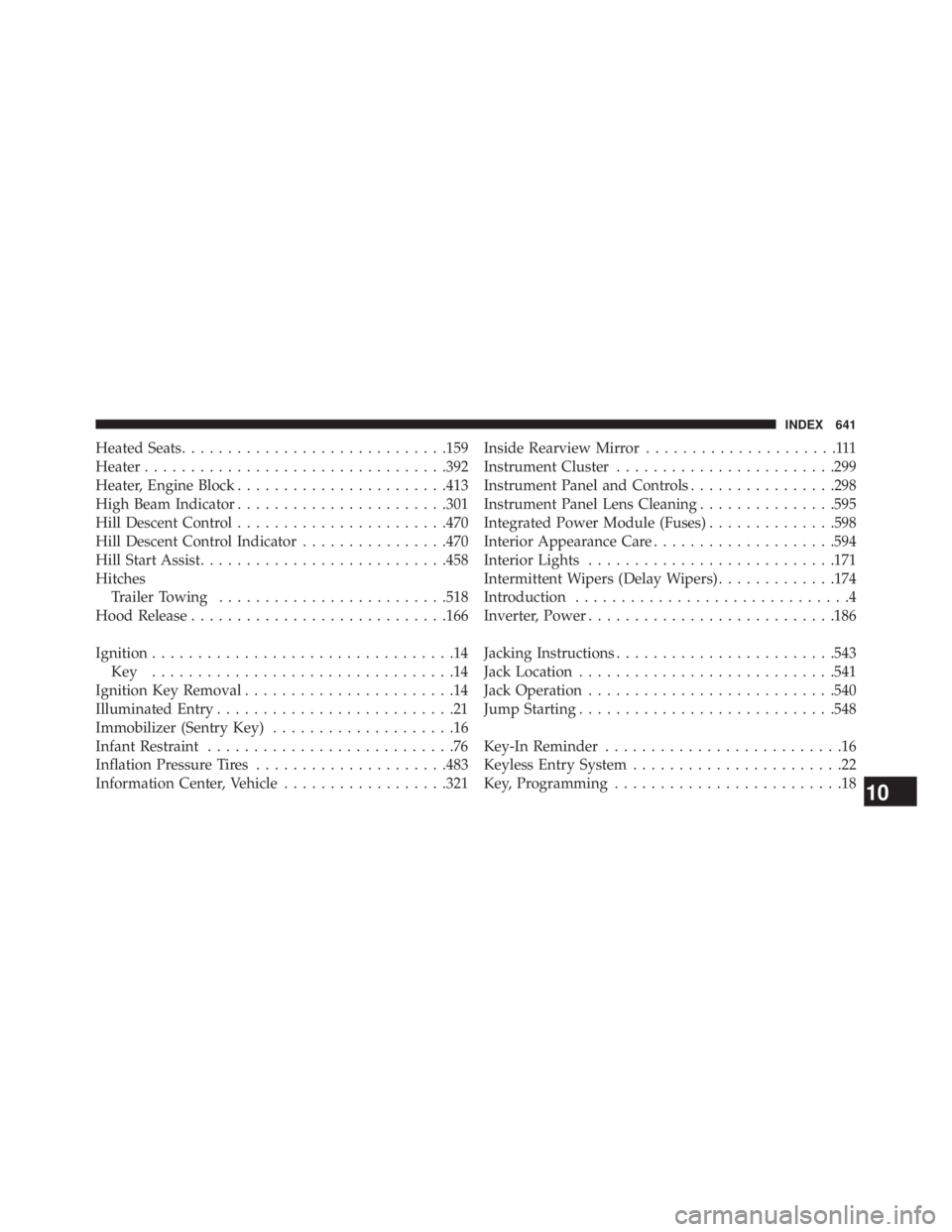
Heated Seats ............................ .159
Heater ................................ .392
Heater, Engine Block ...................... .413
High Beam Indicator ...................... .301
Hill Descent Control ...................... .470
Hill Descent Control Indicator ............... .470
Hill Start Assist .......................... .458
Hitches
Trailer Towing ........................ .518
Hood Release ........................... .166
Ignition .................................14
Key .................................14
Ignition Key Removal .......................14
Illuminated Entry ..........................21
Immobilizer (Sentry Key) ....................16
Infant Restraint ...........................76
Inflation Pressure Tires .................... .483
Information Center, Vehicle ................. .321 Inside Rearview Mirror .....................111
Instrument Cluster ....................... .299
Instrument Panel and Controls ............... .298
Instrument Panel Lens Cleaning .............. .595
Integrated Power Module (Fuses) ............. .598
Interior Appearance Care ................... .594
Interior Lights .......................... .171
Intermittent Wipers (Delay Wipers) ............ .174
Introduction ..............................4
Inverter, Power .......................... .186
Jacking Instructions ....................... .543
Jack Location ........................... .541
Jack Operation .......................... .540
Jump Starting ........................... .548
Key-In Reminder ..........................16
Keyless Entry System .......................22
Key, Programming .........................18
10 INDEX 641
Page 651 of 655
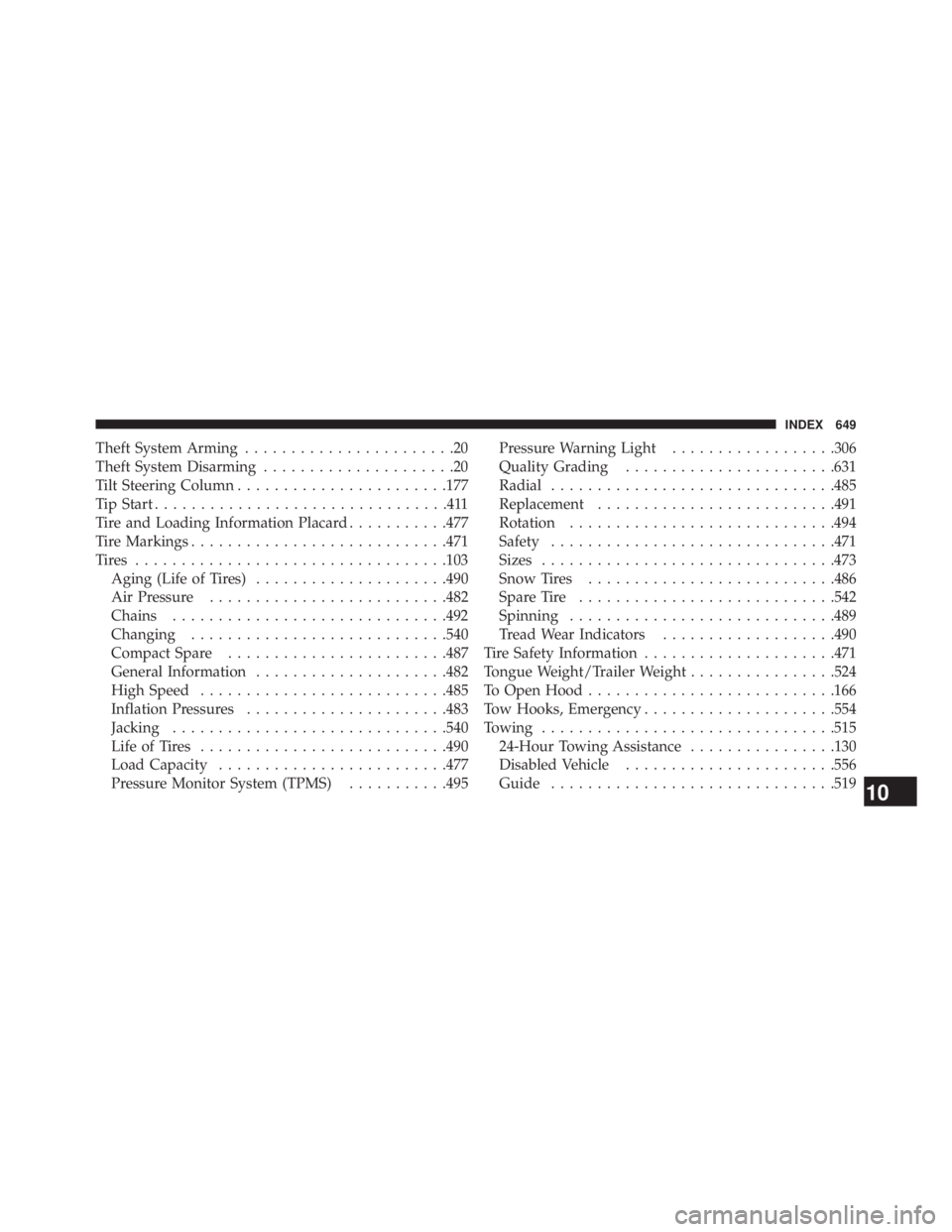
Theft System Arming .......................20
Theft System Disarming .....................20
Tilt Steering Column ...................... .177
Tip Start ................................411
Tire and Loading Information Placard .......... .477
Tire Markings ........................... .471
Tires ................................. .103
Aging (Life of Tires) .................... .490
Air Pressure ......................... .482
Chains ............................. .492
Changing ........................... .540
Compact Spare ....................... .487
General Information .................... .482
High Speed .......................... .485
Inflation Pressures ..................... .483
Jacking ............................. .540
Life of Tires .......................... .490
Load Capacity ........................ .477
Pressure Monitor System (TPMS) .......... .495 Pressure Warning Light ................. .306
Quality Grading ...................... .631
Radial .............................. .485
Replacement ......................... .491
Rotation ............................ .494
Safety .............................. .471
Sizes ............................... .473
Snow Tires .......................... .486
Spare Tire ........................... .542
Spinning ............................ .489
Tread Wear Indicators .................. .490
Tire Safety Information .................... .471
Tongue Weight/Trailer Weight ............... .524
To Open Hood .......................... .166
Tow Hooks, Emergency .................... .554
Towing ............................... .515
24-Hour Towing Assistance ............... .130
Disabled V ehicle ...................... .556
Guide .............................. .519
10 INDEX 649