warning light JEEP WRANGLER UNLIMITED 2013 Service Manual
[x] Cancel search | Manufacturer: JEEP, Model Year: 2013, Model line: WRANGLER UNLIMITED, Model: JEEP WRANGLER UNLIMITED 2013Pages: 655, PDF Size: 9.04 MB
Page 465 of 655
WARNING! (Continued)capabilities of an ERM-equipped vehicle must never
be exploited in a reckless or dangerous manner
which could jeopardize the user’s safety or the safety
of others.
Electronic Stability Control (ESC)
This system enhances directional control and stability of
the vehicle under various driving conditions. The ESC
corrects for over/under steering of the vehicle by apply-
ing the brake of the appropriate wheel to assist in
counteracting the over/under steer condition. Engine
power may also be reduced to help the vehicle maintain
the desired path.
ESC uses sensors in the vehicle to determine the vehicle
path intended by the driver and compares it to the actual
path of the vehicle. When the actual path does not match the intended path, ESC applies the brake of the appro-
priate wheel to assist in counteracting the oversteer or
understeer condition.
• Oversteer - when the vehicle is turning more than
appropriate for the steering wheel position.
• Understeer - when the vehicle is turning less than
appropriate for the steering wheel position.
The “ESC Activation/Malfunction Indicator Light” (lo-
cated in the instrument cluster), starts to flash as soon as
the tires lose traction and the ESC system becomes active.
The “ESC Activation/Malfunction Indicator Light” also
flashes when TCS is active. If the “ESC Activation/
Malfunction Indicator Light” begins to flash during ac-
celeration, ease up on the accelerator and apply as little
throttle as possible. Be sure to adapt your speed and
driving to the prevailing road conditions.
5 STARTING AND OPERATING 463
Page 468 of 655
ESC OFF switch. This will restore normal “ESC On”
mode of operation.
WARNING!With the ESC switched off, the enhanced vehicle
stability offered by ESC and ERM are unavailable.
In an emergency evasive maneuver, the ESC and
ERM systems will not engage to assist in maintaining
stability. The “Full Off” ESC mode is intended for
off-road use only.
4L Range (4WD Models)
ESC Off
This is the normal operating mode for ESC in 4L range.
Whenever the vehicle is started in 4L range, or the
transfer case (if equipped) is shifted from 4H range or
NEUTRAL to 4L range, the ESC system will be in this
mode. In 4L range, ESC and TCS, except for the “limited slip” feature described in the TCS section, are turned off
until the vehicle reaches a speed of 40 mph (64 km/h). At
40 mph (64 km/h), the normal ESC stability function
returns but TCS remains off. When the vehicle speed
drops below 35 mph (56 km/h), the ESC system shuts off.
The ESC is off at low vehicle speeds in 4L range so that it
will not interfere with off-road driving, but the ESC
function returns to provide the stability feature at speeds
above 40 mph (64 km/h). The “ESC Activation/
Malfunction Indicator Light” will always be illuminated
in 4L range when ESC is off.
NOTE: The “ESC OFF” message will display and the
audible chime will sound when the shift lever is placed in
the PARK position from any position other than PARK,
and then moved out of the PARK position. This will
occur even if the message was previously cleared.466 STARTING AND OPERATING
Page 469 of 655
WARNING!With the ESC switched off, the enhanced vehicle
stability offered by ESC and ERM are unavailable.
In an emergency evasive maneuver, the ESC and
ERM systems will not engage to assist in maintaining
stability. The “Full Off” mode is intended for off-
road use only.
2H Range (4WD Models) Or 2WD Models
On
This is the normal operating mode for ESC in 2H range
and on 2WD vehicles.
Partial Off
When in “Partial Off” mode, the TCS portion of ESC has
been disabled and the “ESC Activation/Malfunction
Indicator Light” will be illuminated. All other stability features of ESC function normally. This
mode is intended to be used if the vehicle is in deep
snow, sand, or gravel conditions and more wheel spin
than ESC would normally allow is required to gain
traction. To turn ESC on again, momentarily press the
ESC OFF switch. This will restore the normal “ESC On”
mode of operation.
NOTE: To improve the vehicle’s traction when driving with
snow chains, or starting off in deep snow, sand, or gravel, it
may be desirable to switch to the “Partial Off” mode by
pressing the ESC OFF switch. Once the situation requiring
ESC to be switched to the “Partial Off” mode is overcome,
turn ESC back on by momentarily pressing the ESC OFF
switch. This may be done while the vehicle is in motion.
5 STARTING AND OPERATING 467
Page 471 of 655
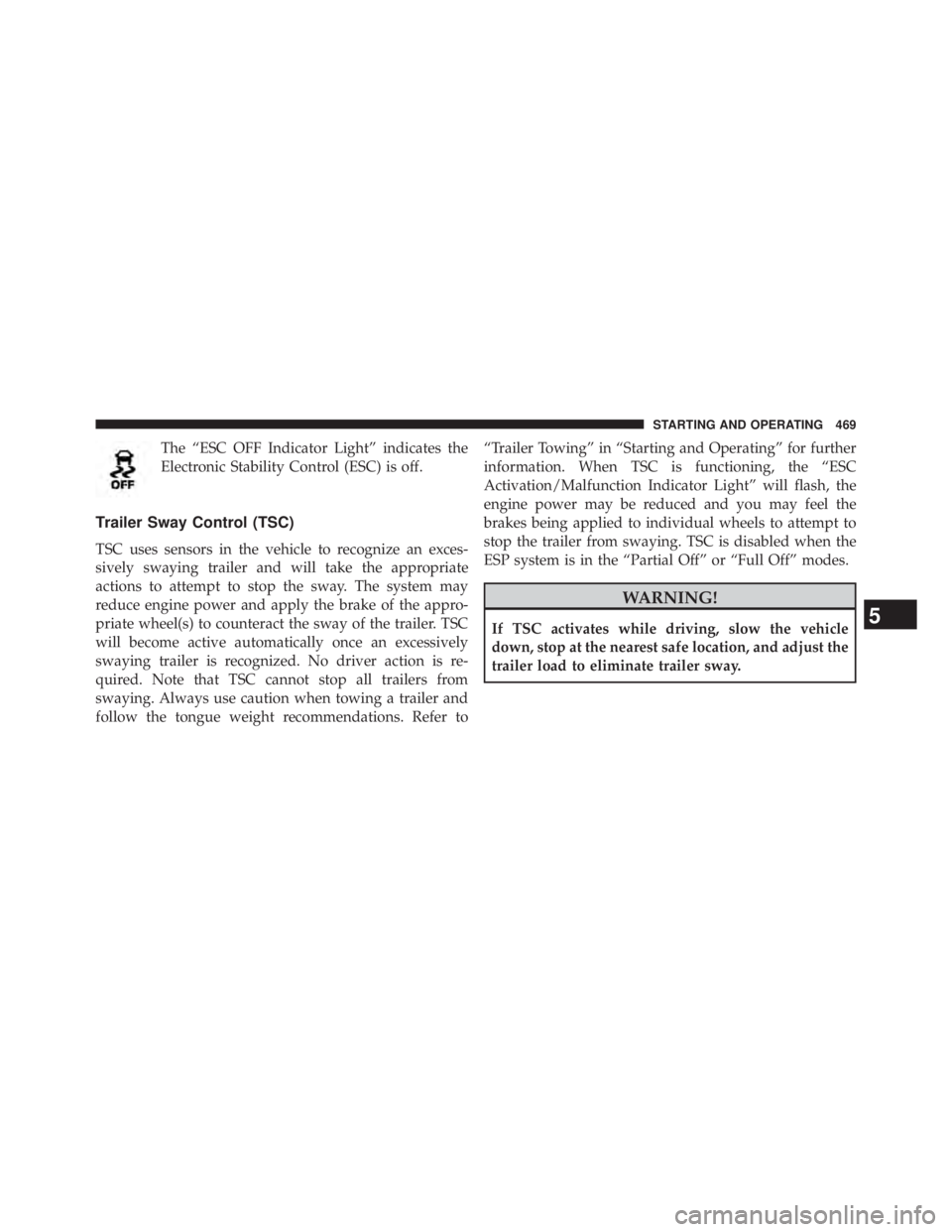
The “ESC OFF Indicator Light” indicates the
Electronic Stability Control (ESC) is off.
Trailer Sway Control (TSC)
TSC uses sensors in the vehicle to recognize an exces-
sively swaying trailer and will take the appropriate
actions to attempt to stop the sway. The system may
reduce engine power and apply the brake of the appro-
priate wheel(s) to counteract the sway of the trailer. TSC
will become active automatically once an excessively
swaying trailer is recognized. No driver action is re-
quired. Note that TSC cannot stop all trailers from
swaying. Always use caution when towing a trailer and
follow the tongue weight recommendations. Refer to “Trailer Towing” in “Starting and Operating” for further
information. When TSC is functioning, the “ESC
Activation/Malfunction Indicator Light” will flash, the
engine power may be reduced and you may feel the
brakes being applied to individual wheels to attempt to
stop the trailer from swaying. TSC is disabled when the
ESP system is in the “Partial Off” or “Full Off” modes.
WARNING!If TSC activates while driving, slow the vehicle
down, stop at the nearest safe location, and adjust the
trailer load to eliminate trailer sway.
5 STARTING AND OPERATING 469
Page 493 of 655
WARNING!Tires and the spare tire should be replaced after six
years, regardless of the remaining tread. Failure to
follow this warning can result in sudden tire failure.
You could lose control and have a collision resulting
in serious injury or death.
Keep dismounted tires in a cool, dry place with as little
exposure to light as possible. Protect tires from contact
with oil, grease, and gasoline.
Replacement Tires
The tires on your new vehicle provide a balance of many
characteristics. They should be inspected regularly for
wear and correct cold tire inflation pressure. The manu-
facturer strongly recommends that you use tires equiva-
lent to the originals in size, quality and performance
when replacement is needed. (Refer to the paragraph on “Tread Wear Indicators”). Refer to the “Tire and Loading
Information” placard for the size designation of your tire.
The Load Index and Speed Symbol for your tire will be
found on the original equipment tire sidewall. See the
Tire Sizing Chart example found in the Tire Safety
Information section of this manual for more information
relating to the Load Index and Speed Symbol of a tire.
It is recommended to replace the two front tires or two
rear tires as a pair. Replacing just one tire can seriously
affect your vehicle’s handling. If you ever replace a
wheel, make sure that the wheel’s specifications match
those of the original wheels.
It is recommended you contact your original equipment
or an authorized tire dealer with any questions you may
have on tire specifications or capability. Failure to use
equivalent replacement tires may adversely affect the
safety, handling, and ride of your vehicle.
5 STARTING AND OPERATING 491
Page 497 of 655
CAUTION!Proper operation of four-wheel drive vehicles de-
pends on tires of equal size, type and circumference
on each wheel. Any difference in tire size can cause
damage to the transfer case. Tire rotation schedule
should be followed to balance tire wear.
TIRE PRESSURE MONITOR SYSTEM (TPMS)
The Tire Pressure Monitoring System (TPMS) will warn
the driver of a low tire pressure based on the vehicle
recommended cold placard pressure.
The tire pressure will vary with temperature by about
1 psi (6.9 kPa) for every 12°F (6.5°C). This means that
when the outside temperature decreases, the tire pressure
will decrease. Tire pressure should always be set based
on cold inflation tire pressure. This is defined as the tire pressure after a vehicle has not been driven for more than
three hours, or driven less than 1 mile (1.6 km) after a
three-hour period. Refer to “Tires – General Informa-
tion” in “Starting and Operating” for information on
how to properly inflate the vehicle’s tires. The tire
pressure will also increase as the vehicle is driven; this is
normal and there should be no adjustment for this
increased pressure.
The TPMS will warn the driver of a low tire pressure if
the tire pressure falls below the low pressure warning
threshold for any reason, including low temperature
effects, or natural pressure loss through the tire.
The TPMS will continue to warn the driver of low tire
pressure as long as the condition exists, and will not turn
off until the tire pressure is at or above recommended
cold placard pressure. Once the “Tire Pressure Monitor-
ing Telltale Light” has been illuminated, the tire pressure
5 STARTING AND OPERATING 495
Page 499 of 655
CAUTION! (Continued)• After inspecting or adjusting the tire pressure,
always reinstall the valve stem cap. This will
prevent moisture and dirt from entering the valve
stem, which could damage the Tire Pressure Moni-
toring Sensor.
NOTE:
• The TPMS is not intended to replace normal tire care
and maintenance, nor to provide warning of a tire
failure or condition.
• The TPMS should not be used as a tire pressure gauge
while adjusting your tire pressure. • Driving on a significantly under-inflated tire causes
the tire to overheat and can lead to tire failure.
Under-inflation also reduces fuel efficiency and tire
tread life, and may affect the vehicle’s handling and
stopping ability.
• The TPMS is not a substitute for proper tire mainte-
nance, and it is the driver ’s responsibility to maintain
correct tire pressure, even if under-inflation has not
reached the level to trigger illumination of the “Tire
Pressure Monitoring Telltale Light.”
• Seasonal temperature changes will affect tire pressure,
and the TPMS will monitor the actual tire pressure in
the tire.
5 STARTING AND OPERATING 497
Page 502 of 655
3. Lots of snow or ice around the wheels or wheel
housings.
4. Using tire chains on the vehicle.
5. Using wheels/tires not equipped with TPM sensors.
NOTE:
• If your vehicle is equipped with a matching full-size
spare wheel and tire assembly, it has a tire pressure
monitoring sensor, and can be monitored by the Tire
Pressure Monitoring System (TPMS). In the event that
the matching full-size spare tire is swapped with a low
pressure road tire, the next ignition key cycle will still
show the “Tire Pressure Monitoring Telltale Light” to
be ON, and a chime to sound. Driving the vehicle for
up to 20 minutes above 15 mph (24 km/h) will turn
OFF the “Tire Pressure Monitoring Telltale Light” as
long as none of the road tires are below the low
pressure warning threshold. • If your vehicle is not equipped with a matching
full-size spare wheel and tire assembly, it does not
have a tire pressure monitoring sensor in the spare tire.
The TPMS will not be able to monitor the tire pressure.
If you install the spare tire in place of a road tire that
has a pressure below the low-pressure warning limit,
upon the next ignition key cycle, a chime will sound
and the “Tire Pressure Monitoring Telltale Light” will
turn ON. After driving the vehicle for up to 20 minutes
above 15 mph (24 km/h), the “Tire Pressure Monitor-
ing Telltale Light” will flash on and off for 75 seconds
and then remain on solid. For each subsequent ignition
key cycle, a chime will sound and the “Tire Pressure
Monitoring Telltale Light” will flash on and off for
75 seconds and then remain on solid. Once you repair
or replace the original road tire, and reinstall it on the
vehicle in place of the spare tire, the TPMS will update
automatically and the “Tire Pressure Monitoring Tell-
tale Light” will turn OFF, as long as no tire pressure is500 STARTING AND OPERATING
Page 503 of 655
below the low-pressure warning limit in any of the
four active road tires. The vehicle may need to be
driven for up to 20 minutes above 15 mph (24 km/h)
in order for the TPMS to receive this information.
Premium System – If Equipped
The Tire Pressure Monitor System (TPMS) uses wireless
technology with wheel rim-mounted electronic sensors to
monitor tire pressure levels. Sensors, mounted to each
wheel as part of the valve stem, transmit tire pressure
readings to the Receiver Module.
NOTE: It is particularly important, for you to regularly
check the tire pressure in all of your tires and to maintain
the proper pressure. The Tire Pressure Monitor System (TPMS) consists of the
following components:
• Receiver Module
• Four Tire Pressure Monitoring Sensors
• Various Tire Pressure Monitoring System Messages,
which display in the Electronic Vehicle Information
Center (EVIC), and a graphic displaying tire pressures
• Tire Pressure Monitoring Telltale Light
A tire pressure monitoring sensor is located in the spare
wheel, if the vehicle is equipped with a matching full-size
spare wheel and tire assembly. The matching full-size
spare tire can be used in place of any of the four road
tires.
5 STARTING AND OPERATING 501
Page 504 of 655
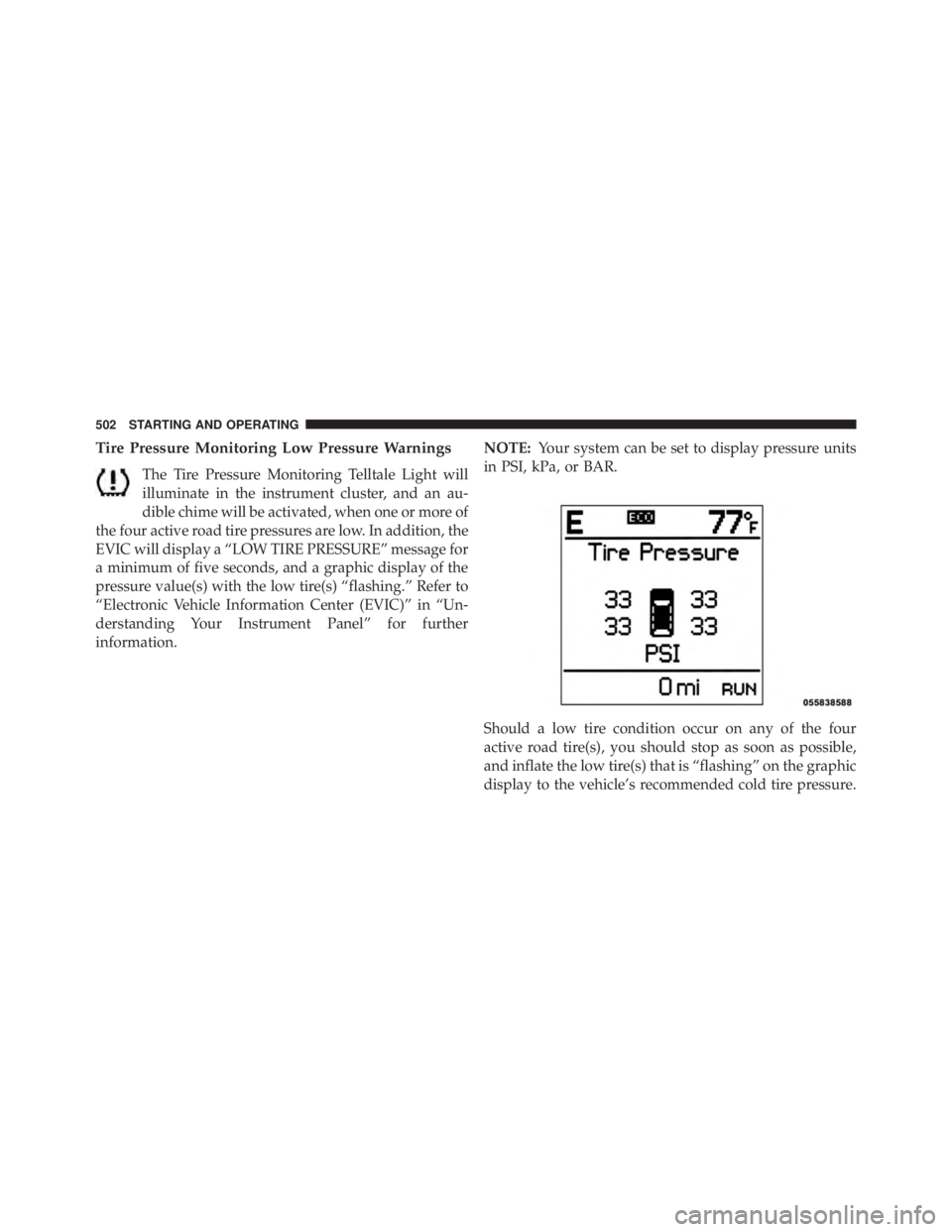
Tire Pressure Monitoring Low Pressure Warnings
The Tire Pressure Monitoring Telltale Light will
illuminate in the instrument cluster, and an au-
dible chime will be activated, when one or more of
the four active road tire pressures are low. In addition, the
EVIC will display a “LOW TIRE PRESSURE” message for
a minimum of five seconds, and a graphic display of the
pressure value(s) with the low tire(s) “flashing.” Refer to
“Electronic Vehicle Information Center (EVIC)” in “Un-
derstanding Your Instrument Panel” for further
information. NOTE: Your system can be set to display pressure units
in PSI, kPa, or BAR.
Should a low tire condition occur on any of the four
active road tire(s), you should stop as soon as possible,
and inflate the low tire(s) that is “flashing” on the graphic
display to the vehicle’s recommended cold tire pressure.502 STARTING AND OPERATING