service JEEP WRANGLER UNLIMITED 2013 Repair Manual
[x] Cancel search | Manufacturer: JEEP, Model Year: 2013, Model line: WRANGLER UNLIMITED, Model: JEEP WRANGLER UNLIMITED 2013Pages: 655, PDF Size: 9.04 MB
Page 578 of 655
Under normal operating conditions, the catalytic con-
verter will not require maintenance. However, it is im-
portant to keep the engine properly tuned to assure
proper catalyst operation and prevent possible catalyst
damage.
NOTE: Intentional tampering with emissions control
systems can result in civil penalties being assessed
against you.
In unusual situations involving grossly malfunctioning
engine operation, a scorching odor may suggest severe
and abnormal catalyst overheating. If this occurs, stop
the vehicle, turn off the engine and allow it to cool.
Service, including a tune-up to manufacturer’s specifica-
tions, should be obtained immediately. To minimize the possibility of catalytic converter dam-
age:
• Do not shut off the engine or interrupt the ignition,
when the transmission is in gear and the vehicle is in
motion.
• Do not try to start the engine by pushing or towing the
vehicle.
• Do not idle the engine with any spark plug wires
disconnected or removed, such as when diagnostic
testing, or for prolonged periods during very rough
idle or malfunctioning operating conditions.576 MAINTAINING YOUR VEHICLE
Page 583 of 655
Disposal Of Used Engine Coolant
Used ethylene glycol-based engine coolant (antifreeze) is
a regulated substance requiring proper disposal. Check
with your local authorities to determine the disposal
rules for your community. To prevent ingestion by ani-
mals or children, do not store ethylene glycol-based
engine coolant in open containers or allow it to remain in
puddles on the ground. If ingested by a child or pet, seek
emergency assistance immediately. Clean up any ground
spills immediately.
Engine Coolant Level
The coolant bottle provides a quick visual method for
determining that the coolant level is adequate. With the
engine idling, and warm to normal operating tempera-
ture, the level of the engine coolant (antifreeze) in the
bottle should be between the ranges indicated on the
bottle. The radiator normally remains completely full, so there is
no need to remove the radiator cap unless checking for
engine coolant (antifreeze) freeze point or replacing en-
gine coolant (antifreeze). Advise your service attendant
of this. As long as the engine operating temperature is
satisfactory, the coolant bottle need only be checked once
a month.
When additional engine coolant (antifreeze) is needed to
maintain the proper level, it should be added to the
coolant bottle. Do not overfill.
Points To Remember
NOTE: When the vehicle is stopped after a few miles/
kilometers of operation, you may observe vapor coming
from the front of the engine compartment. This is nor-
mally a result of moisture from rain, snow, or high
humidity accumulating on the radiator and being vapor-
ized when the thermostat opens, allowing hot engine
coolant (antifreeze) to enter the radiator.
7 MAINTAINING YOUR VEHICLE 581
Page 585 of 655
Brake System
In order to assure brake system performance, all brake
system components should be inspected periodically.
Refer to the “Maintenance Schedule” for the proper
maintenance intervals.
WARNING!Riding the brakes can lead to brake failure and
possibly a collision. Driving with your foot resting or
riding on the brake pedal can result in abnormally
high brake temperatures, excessive lining wear, and
possible brake damage. You would not have your full
braking capacity in an emergency. Power Disc Brakes
Disc brakes do not require adjustment; however, several
hard stops during the break-in period are recommended
to seat the linings and wear off any foreign material.
Brake Master Cylinder
The fluid level in the master cylinders should be checked
whenever the vehicle is serviced. If necessary, add fluid
to bring level to the full level mark on the side of the
reservoir of the brake master cylinder. With disc brakes,
fluid level can be expected to fall as the brake pads wear.
If the brake fluid level is abnormally low, check system
for leaks.
Refer to “Fluids, Lubricants, and Genuine Parts” in
“Maintaining Your Vehicle” for further information.
7 MAINTAINING YOUR VEHICLE 583
Page 592 of 655
Adding Fluid
Fluid should be added only at filler hole until fluid
begins to run out of the hole.
Drain
First remove the fill plug (B), then the drain plug (C). The
recommended tightening torque for the drain and fill
plugs is 15 to 25 ft lbs (20 to 34 N·m).
CAUTION!When replacing the plugs, do not overtighten them.
You could damage them and cause them to leak.
Selection Of Lubricant
Use only manufacturer’s recommended fluid. Refer to
“Fluids, Lubricants, and Genuine Parts” in “Maintaining
Your Vehicle” for further information. Front/Rear Axle Fluid
For normal service, periodic fluid level checks are not
required. When the vehicle is serviced for other reasons
the exterior surfaces of the axle assembly should be
inspected. If gear oil leakage is suspected inspect the
fluid level. Refer to “Fluids, Lubricants, and Genuine
Parts” in “Maintaining Your Vehicle” for further informa-
tion.
Fluid Level Check
Lubricant should be at the bottom edge of the oil fill hole.
Adding Fluid
Add lubricant only at the fill hole and only to the level
specified above.590 MAINTAINING YOUR VEHICLE
Page 607 of 655
CAUTION!• When installing the Integrated Power Module
cover, it is important to ensure the cover is properly
positioned and fully latched. Failure to do so may
allow water to get into the Integrated Power Mod-
ule, and possibly result in an electrical system
failure.
• When replacing a blown fuse, it is important to use
only a fuse having the correct amperage rating. The
use of a fuse with a rating other than indicated may
result in a dangerous electrical system overload. If
a properly rated fuse continues to blow, it indicates
a problem in the circuit that must be corrected. VEHICLE STORAGE
If you are leaving your vehicle dormant for more than
21 days, you may want to take steps to protect your
battery. You may:
• Remove Cartridge fuse #J13 in the Power Distribution
Center (PDC) labeled Ignition-Off Draw (IOD) and
store it in a safe location within the PDC.
• Or, disconnect the negative cable from the battery.
• Anytime you store your vehicle, or keep it out of
service (i.e., vacation) for two weeks or more, run the
air conditioning system at idle for about five minutes
in the fresh air and high blower setting. This will
ensure adequate system lubrication to minimize the
possibility of compressor damage when the system is
started again.
7 MAINTAINING YOUR VEHICLE 605
Page 608 of 655
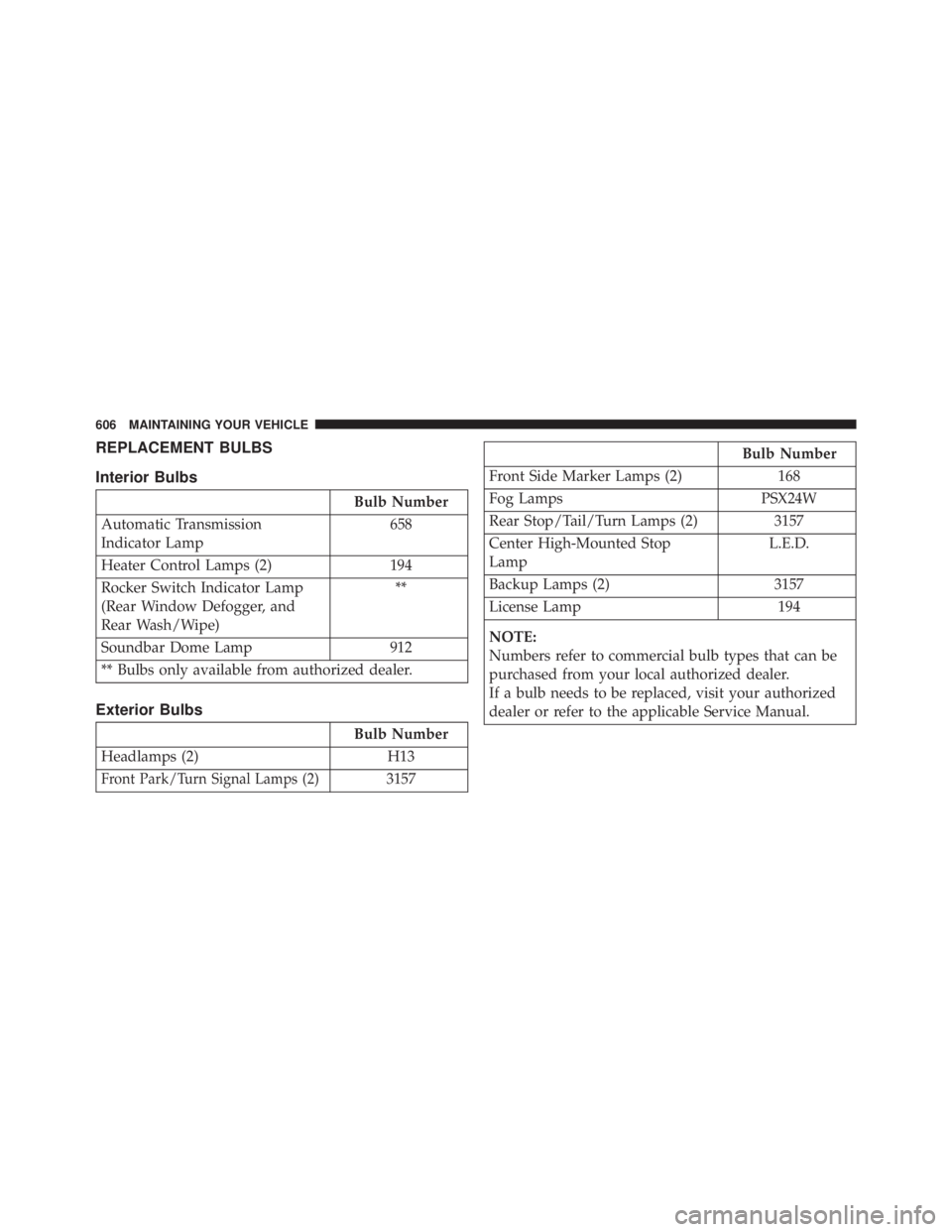
REPLACEMENT BULBS
Interior Bulbs
Bulb Number
Automatic Transmission
Indicator Lamp 658
Heater Control Lamps (2) 194
Rocker Switch Indicator Lamp
(Rear Window Defogger, and
Rear Wash/Wipe) **
Soundbar Dome Lamp 912
** Bulbs only available from authorized dealer.
Exterior Bulbs
Bulb Number
Headlamps (2) H13
Front Park/Turn Signal Lamps (2) 3157 Bulb Number
Front Side Marker Lamps (2) 168
Fog Lamps PSX24W
Rear Stop/Tail/Turn Lamps (2) 3157
Center High-Mounted Stop
Lamp L.E.D.
Backup Lamps (2) 3157
License Lamp 194
NOTE:
Numbers refer to commercial bulb types that can be
purchased from your local authorized dealer.
If a bulb needs to be replaced, visit your authorized
dealer or refer to the applicable Service Manual.606 MAINTAINING YOUR VEHICLE
Page 611 of 655
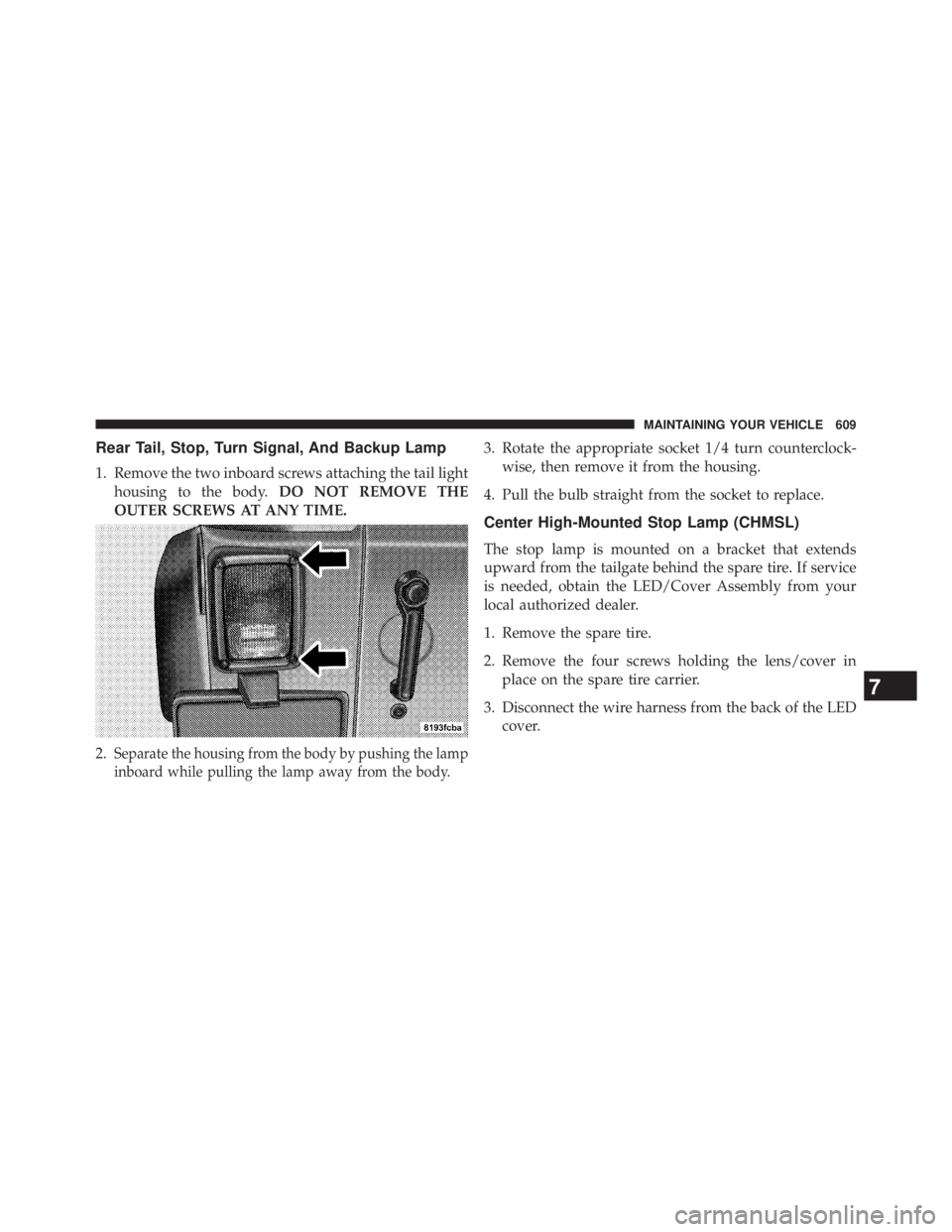
Rear Tail, Stop, Turn Signal, And Backup Lamp
1. Remove the two inboard screws attaching the tail light
housing to the body. DO NOT REMOVE THE
OUTER SCREWS AT ANY TIME.
2. Separate the housing from the body by pushing the lamp
inboard while pulling the lamp away from the body. 3. Rotate the appropriate socket 1/4 turn counterclock-
wise, then remove it from the housing.
4. Pull the bulb straight from the socket to replace.
Center High-Mounted Stop Lamp (CHMSL)
The stop lamp is mounted on a bracket that extends
upward from the tailgate behind the spare tire. If service
is needed, obtain the LED/Cover Assembly from your
local authorized dealer.
1. Remove the spare tire.
2. Remove the four screws holding the lens/cover in
place on the spare tire carrier.
3. Disconnect the wire harness from the back of the LED
cover.
7 MAINTAINING YOUR VEHICLE 609
Page 616 of 655
MAINTENANCE SCHEDULE
Your vehicle is equipped with an automatic oil change
indicator system. The oil change indicator system will
remind you that it is time to take your vehicle in for
scheduled maintenance.
Based on engine operation conditions, the oil change
indicator message will illuminate. This means that service
is required for your vehicle. Operating conditions such as
frequent short-trips, trailer tow, extremely hot or cold
ambient temperatures, and E85 fuel usage will influence
when the “Change Oil” or “Oil Change Required” message
is displayed. Severe Operating Conditions can cause the
change oil message to illuminate as early as 3,500 miles
(5,600 km) since last reset. Have your vehicle serviced as
soon as possible, within the next 500 miles (805 km).
On Electronic Vehicle Information Center (EVIC) equipped
vehicles, “Oil Change Required” will be displayed in the
EVIC and a single chime will sound, indicating that an oil
change is necessary. On Non-EVIC equipped vehicles, “Change Oil” will flash
in the instrument cluster odometer and a single chime
will sound, indicating that an oil change is necessary.
Your authorized dealer will reset the oil change indicator
message after completing the scheduled oil change. If a
scheduled oil change is performed by someone other than
your authorized dealer, the message can be reset by refer-
ring to the steps described under “Electronic Vehicle Infor-
mation Center (EVIC)/Oil Change Required” in “Under-
standing Your Instrument Panel” or under “Instrument
Cluster Description/Odometer/Trip Odometer” in “Under-
standing Your Instrument Panel” for further information.
NOTE: Under no circumstances should oil change inter-
vals exceed 10,000 miles (16,000 km) or twelve months,
whichever comes first.
8 M
A
I
N
T
E
N
A
N
C
E
S
C
H
E
D
U
L
E
S 614 MAINTENANCE SCHEDULES
Page 620 of 655
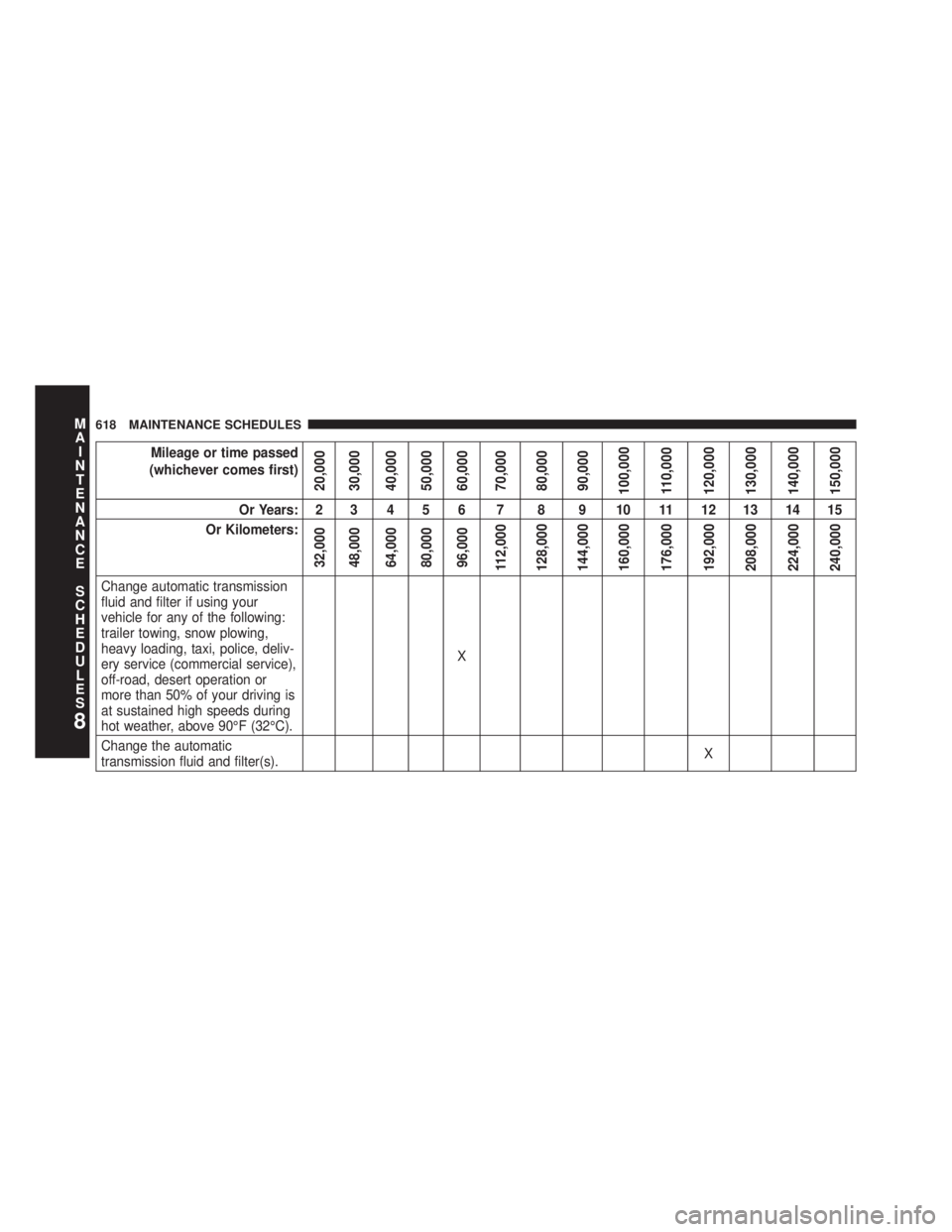
Mileage or time passed
(whichever comes first)
20,000
30,000
40,000
50,000
60,000
70,000
80,000
90,000
100,000
110,000
120,000
130,000
140,000
150,000Or Years: 2 3 4 5 6 7 8 9 10 11 12 13 14 15
Or Kilometers:
32,000
48,000
64,000
80,000
96,000
112,000
128,000
144,000
160,000
176,000
192,000
208,000
224,000
240,000Change automatic transmission
fluid and filter if using your
vehicle for any of the following:
trailer towing, snow plowing,
heavy loading, taxi, police, deliv-
ery service (commercial service),
off-road, desert operation or
more than 50% of your driving is
at sustained high speeds during
hot weather, above 90°F (32°C). X
Change the automatic
transmission fluid and filter(s). X
8 M
A
I
N
T
E
N
A
N
C
E
S
C
H
E
D
U
L
E
S 618 MAINTENANCE SCHEDULES
Page 621 of 655
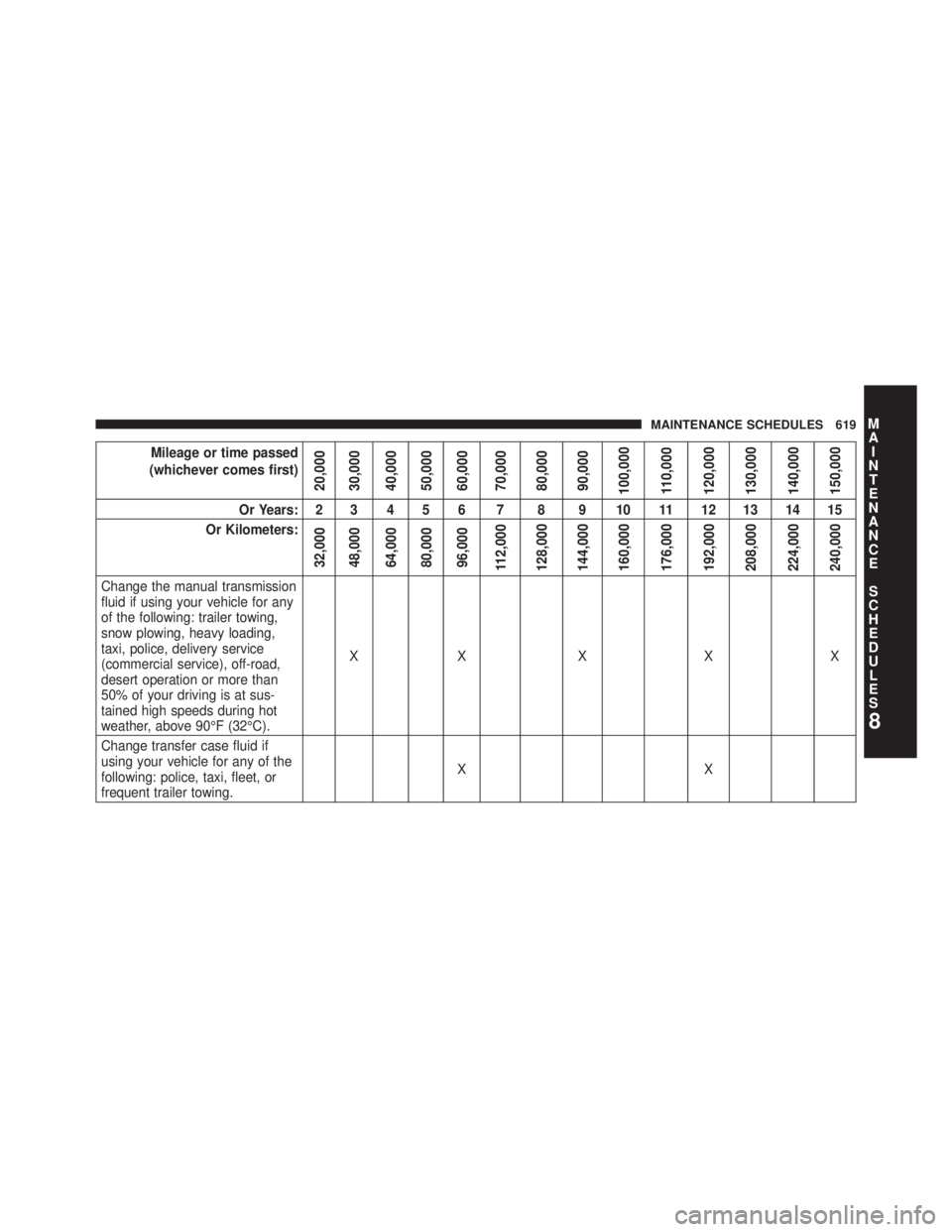
Mileage or time passed
(whichever comes first)
20,000
30,000
40,000
50,000
60,000
70,000
80,000
90,000
100,000
110,000
120,000
130,000
140,000
150,000Or Years: 2 3 4 5 6 7 8 9 10 11 12 13 14 15
Or Kilometers:
32,000
48,000
64,000
80,000
96,000
112,000
128,000
144,000
160,000
176,000
192,000
208,000
224,000
240,000Change the manual transmission
fluid if using your vehicle for any
of the following: trailer towing,
snow plowing, heavy loading,
taxi, police, delivery service
(commercial service), off-road,
desert operation or more than
50% of your driving is at sus-
tained high speeds during hot
weather, above 90°F (32°C). XX X X X
Change transfer case fluid if
using your vehicle for any of the
following: police, taxi, fleet, or
frequent trailer towing. XX
8 M
A
I
N
T
E
N
A
N
C
E
S
C
H
E
D
U
L
E
SMAINTENANCE SCHEDULES 619