towing capacity JEEP WRANGLER UNLIMITED 2013 Owners Manual
[x] Cancel search | Manufacturer: JEEP, Model Year: 2013, Model line: WRANGLER UNLIMITED, Model: JEEP WRANGLER UNLIMITED 2013Pages: 655, PDF Size: 9.04 MB
Page 480 of 655
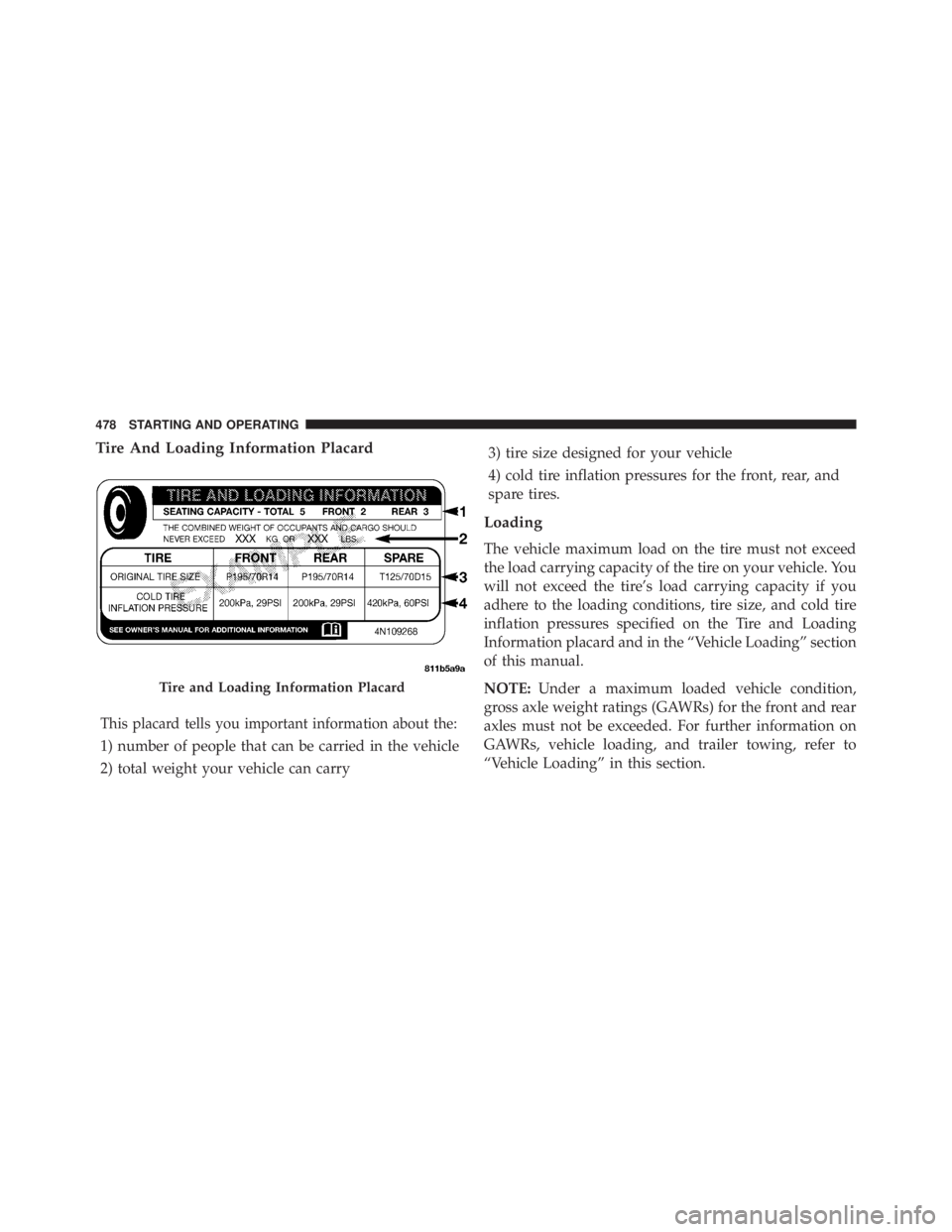
Tire And Loading Information Placard
This placard tells you important information about the:
1) number of people that can be carried in the vehicle
2) total weight your vehicle can carry 3) tire size designed for your vehicle
4) cold tire inflation pressures for the front, rear, and
spare tires.
Loading
The vehicle maximum load on the tire must not exceed
the load carrying capacity of the tire on your vehicle. You
will not exceed the tire’s load carrying capacity if you
adhere to the loading conditions, tire size, and cold tire
inflation pressures specified on the Tire and Loading
Information placard and in the “Vehicle Loading” section
of this manual.
NOTE: Under a maximum loaded vehicle condition,
gross axle weight ratings (GAWRs) for the front and rear
axles must not be exceeded. For further information on
GAWRs, vehicle loading, and trailer towing, refer to
“Vehicle Loading” in this section.Tire and Loading Information Placard478 STARTING AND OPERATING
Page 481 of 655
To determine the maximum loading conditions of your
vehicle, locate the statement “The combined weight of
occupants and cargo should never exceed XXX lbs or
XXX kg” on the Tire and Loading Information placard.
The combined weight of occupants, cargo/luggage and
trailer tongue weight (if applicable) should never exceed
the weight referenced here.
Steps For Determining Correct Load Limit
1. Locate the statement “The combined weight of occu-
pants and cargo should never exceed XXX lbs or
XXX kg” on your vehicle’s placard.
2. Determine the combined weight of the driver and
passengers that will be riding in your vehicle.
3. Subtract the combined weight of the driver and pas-
sengers from XXX lbs or XXX kg. 4. The resulting figure equals the available amount of
cargo and luggage load capacity. For example, if
“XXX” amount equals 1,400 lbs (635 kg) and there will
be five 150 lb (68 kg) passengers in your vehicle, the
amount of available cargo and luggage load capacity
is 650 lbs (295 kg) (since 5 x 150 = 750, and 1400 – 750
= 650 lbs [295 kg]).
5. Determine the combined weight of luggage and cargo
being loaded on the vehicle. That weight may not
safely exceed the available cargo and luggage load
capacity calculated in Step 4.
6. If your vehicle will be towing a trailer, load from your
trailer will be transferred to your vehicle. Consult this
manual to determine how this reduces the available
cargo and luggage load capacity of your vehicle.
5 STARTING AND OPERATING 479
Page 482 of 655

NOTE:
• The following table shows examples on how to calcu-
late total load, cargo/luggage, and towing capacities
of your vehicle with varying seating configurations
and number and size of occupants. This table is for
illustration purposes only and may not be accurate for
the seating and load carry capacity of your vehicle.
• For the following example, the combined weight of
occupants and cargo should never exceed 865 lbs
(392 kg). 480 STARTING AND OPERATING
Page 529 of 655
WARNING! (Continued)• Total weight must be distributed between the tow
vehicle and the trailer such that the following four
ratings are not exceeded:
1. GVWR
2. GTW
3. GAWR
4. Tongue weight rating for the trailer hitch utilized
(This requirement may limit the ability to always
achieve the 10% to 15% range of tongue weight as
a percentage of total trailer weight). Towing Requirements – Tires
– Proper tire inflation pressures are essential to the safe
and satisfactory operation of your vehicle. Refer to
“Tires – General Information” in “Starting and Oper-
ating” for proper tire inflation procedures.
– Check the trailer tires for proper tire inflation pressures
before trailer usage.
– Check for signs of tire wear or visible tire damage
before towing a trailer. Refer to “Tires – General
Information” in “Starting and Operating” for proper
inspection procedure.
– When replacing tires, refer to “Tires – General Infor-
mation” in “Starting and Operating” for proper tire
replacement procedures. Replacing tires with a higher
load carrying capacity will not increase the vehicle’s
GVWR and GAWR limits.
5 STARTING AND OPERATING 527
Page 530 of 655
Towing Requirements – Trailer Brakes
• Do not interconnect the hydraulic brake system or
vacuum system of your vehicle with that of the trailer.
This could cause inadequate braking and possible
personal injury.
• An electronically actuated trailer brake controller is
required when towing a trailer with electronically
actuated brakes. When towing a trailer equipped with
a hydraulic surge actuated brake system, an electronic
brake controller is not required.
• Trailer brakes are recommended for trailers over
1,000 lbs (454 kg) and required for trailers in excess of
2,000 lbs (907 kg). CAUTION!If the trailer weighs more than 1,000 lbs (454 kg)
loaded, it should have its own brakes and they should
be of adequate capacity. Failure to do this could lead to
accelerated brake lining wear, higher brake pedal
effort, and longer stopping distances.
WARNING!• Do not connect trailer brakes to your vehicle’s hy-
draulic brake lines. It can overload your brake system
and cause it to fail. You might not have brakes when
you need them and could have a collision.
• Towing any trailer will increase your stopping dis-
tance. When towing you should allow for additional
space between your vehicle and the vehicle in front
of you. Failure to do so could result in a collision.528 STARTING AND OPERATING
Page 651 of 655

Theft System Arming .......................20
Theft System Disarming .....................20
Tilt Steering Column ...................... .177
Tip Start ................................411
Tire and Loading Information Placard .......... .477
Tire Markings ........................... .471
Tires ................................. .103
Aging (Life of Tires) .................... .490
Air Pressure ......................... .482
Chains ............................. .492
Changing ........................... .540
Compact Spare ....................... .487
General Information .................... .482
High Speed .......................... .485
Inflation Pressures ..................... .483
Jacking ............................. .540
Life of Tires .......................... .490
Load Capacity ........................ .477
Pressure Monitor System (TPMS) .......... .495 Pressure Warning Light ................. .306
Quality Grading ...................... .631
Radial .............................. .485
Replacement ......................... .491
Rotation ............................ .494
Safety .............................. .471
Sizes ............................... .473
Snow Tires .......................... .486
Spare Tire ........................... .542
Spinning ............................ .489
Tread Wear Indicators .................. .490
Tire Safety Information .................... .471
Tongue Weight/Trailer Weight ............... .524
To Open Hood .......................... .166
Tow Hooks, Emergency .................... .554
Towing ............................... .515
24-Hour Towing Assistance ............... .130
Disabled V ehicle ...................... .556
Guide .............................. .519
10 INDEX 649