tow JEEP WRANGLER UNLIMITED 2014 User Guide
[x] Cancel search | Manufacturer: JEEP, Model Year: 2014, Model line: WRANGLER UNLIMITED, Model: JEEP WRANGLER UNLIMITED 2014Pages: 140, PDF Size: 12.72 MB
Page 101 of 140
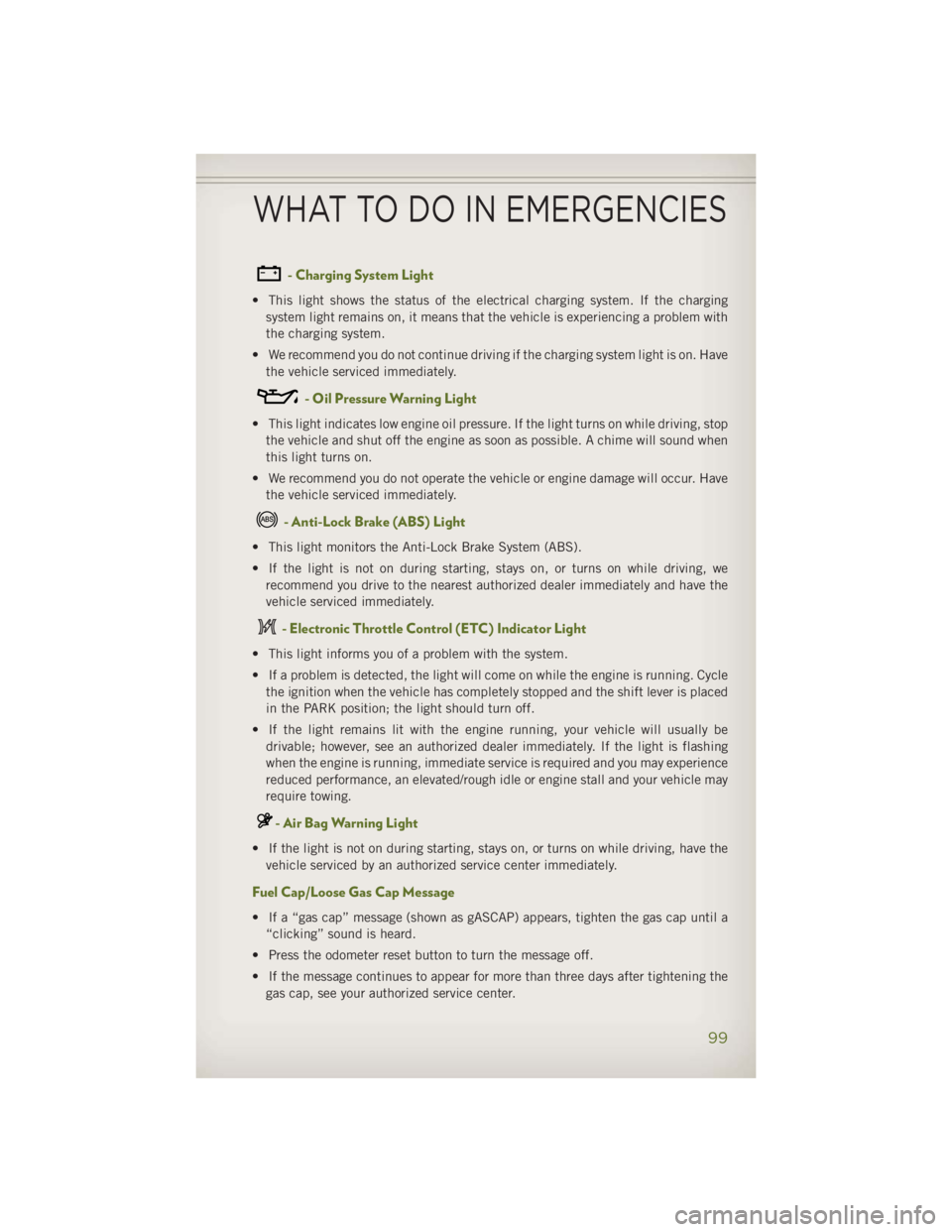
- Charging System Light• This light shows the status of the electrical charging system. If the charging
system light remains on, it means that the vehicle is experiencing a problem with
the charging system.
• We recommend you do not continue driving if the charging system light is on. Have
the vehicle serviced immediately.
- Oil Pressure Warning Light• This light indicates low engine oil pressure. If the light turns on while driving, stop
the vehicle and shut off the engine as soon as possible. A chime will sound when
this light turns on.
• We recommend you do not operate the vehicle or engine damage will occur. Have
the vehicle serviced immediately.
- Anti-Lock Brake (ABS) Light• This light monitors the Anti-Lock Brake System (ABS).
• If the light is not on during starting, stays on, or turns on while driving, we
recommend you drive to the nearest authorized dealer immediately and have the
vehicle serviced immediately.
- Electronic Throttle Control (ETC) Indicator Light• This light informs you of a problem with the system.
• If a problem is detected, the light will come on while the engine is running. Cycle
the ignition when the vehicle has completely stopped and the shift lever is placed
in the PARK position; the light should turn off.
• If the light remains lit with the engine running, your vehicle will usually be
drivable; however, see an authorized dealer immediately. If the light is flashing
when the engine is running, immediate service is required and you may experience
reduced performance, an elevated/rough idle or engine stall and your vehicle may
require towing.
- Air Bag Warning Light
• If the light is not on during starting, stays on, or turns on while driving, have the
vehicle serviced by an authorized service center immediately.
Fuel Cap/Loose Gas Cap Message
• If a “gas cap” message (shown as gASCAP) appears, tighten the gas cap until a
“clicking” sound is heard.
• Press the odometer reset button to turn the message off.
• If the message continues to appear for more than three days after tightening the
gas cap, see your authorized service center.WHAT TO DO IN EMERGENCIES
99
Page 102 of 140
OIL CHANGE EVIC INDICATOR Message
• If an “oil change” message (shown as "Change Oil Soon" and "Oil Change Needed")
appears and a single chime sounds, it is time for your next required oil change.Resetting The Light After Servicing
• Turn the ignition switch to the ON/RUN position (do not start engine).
• Fully depress the accelerator pedal three times within 10 seconds.
• Turn the ignition switch to the OFF/LOCK position.
HOTOIL – Transmission Temperature Warning Message • The HOTOIL cluster message will appear in the odometer accompanied with a
chime to indicate that there is excessive transmission fluid temperature that might
occur with severe usage such as trailer towing.
• It may also occur when operating the vehicle in a high torque converter slip condition,
such as 4-wheel-drive operation (e.g., snow plowing, off-road operation).
• If this HOTOIL message turns on, stop the vehicle and run the engine at idle or
faster, with the transmission in NEUTRAL until the message turns off.
CAUTION!Continuous driving with the Transmission Temperature HOTOIL Warning message
illuminated will eventually cause severe transmission damage and transmission
failure.
WARNING!Continued operation with the Transmission Temperature HOTOIL Warning mes-
sage illuminated could cause the fluid to boil over, come into contact with the hot
engine or exhaust components causing a fire that may result in personal injury.
WHAT TO DO IN EMERGENCIES
100
Page 104 of 140

JACKING AND TIRE CHANGING Jack Location • The jack and lug wrench are located in the rear storage compartment.
NOTE:
Turn the black plastic wing nut counter clockwise to loosen the jack from the storage bin.
Spare Tire Stowage • To remove the spare tire from the carrier, remove the tire cover, if equipped, and
remove the lug nuts with the lug wrench turning them counterclockwise.
NOTE:
If you have added aftermarket accessories to the spare tire mounted carrier, it cannot
exceed a gross weight of 69 lbs (31.3 kg) including the weight of the spare tire.
WHAT TO DO IN EMERGENCIES
102
Page 106 of 140

4. Operate the jack from the front or the rear of the vehicle. Place the jack under the
axle tube, as shown. Do not raise the vehicle until you are sure the jack is fully
engaged.
5.
Raise the vehicle by turning the jack
screw to the right. Raise the vehicle
only until the tire just clears the surface
and enough clearance is obtained to
install the spare tire. Minimum tire lift
provides maximum stability.
6. Remove the lug nuts and wheel.
7. Position the spare wheel/tire on the
vehicle and install the lug nuts with the
cone-shaped end toward the wheel.
Lightly tighten the lug nuts clockwise.
8. Lower the vehicle by turning the jack
screw to the left, and remove the jack.
9. Finish tightening the lug nuts. Push
down on the wrench while tightening
for increased leverage. Alternate nuts
until each nut has been tightened
twice. The correct wheel nut tightness
is 95 ft lbs (130 N·m). If in doubt
about the correct tightness, have
them checked with a torque wrench
by your authorized dealer or at a ser-
vice station.
10.
Remove the jack assembly and wheel
blocks.
11. Secure the tire, jack, and tools in
their proper locations.
12. Remove blocks from wheels.
WHAT TO DO IN EMERGENCIES
104
Page 107 of 140
Road Tire Installation 1. Mount the road tire on the axle.
2. Install the remaining lug nuts with the cone shaped end of the nut toward the
wheel. Lightly tighten the lug nuts.
3. Lower the vehicle to the ground by turning the jack handle counterclockwise.
4. Finish tightening the lug nuts. Push down on the wrench while at the end of the
handle for increased leverage. Tighten the lug nuts in a star pattern until each nut
has been tightened twice. The correct tightness of each lug nut is 95 ft/lbs
(130 N·m). If in doubt about the correct tightness, have them checked with a
torque wrench by your authorized dealer or service station.
5. After 25 miles (40 km) check the lug nut torque with a torque wrench to ensure
that all lug nuts are properly seated against the wheel.
CAUTION!Do not attempt to raise the vehicle by jacking on locations other than those
indicated in the Jacking Instructions for this vehicle.
WHAT TO DO IN EMERGENCIES
105
Page 108 of 140
WARNING!• Do not attempt to change a tire on the side of the vehicle close to moving
traffic. Pull far enough off the road to avoid the danger of being hit when
operating the jack or changing the wheel.
• Being under a jacked-up vehicle is dangerous. The vehicle could slip off the
jack and fall on you. You could be crushed. Never put any part of your body
under a vehicle that is on a jack. If you need to get under a raised vehicle, take
it to a service center where it can be raised on a lift.
• Never start or run the engine while the vehicle is on a jack.
• The jack is designed to be used as a tool for changing tires only. The jack
should not be used to lift the vehicle for service purposes. The vehicle should
be jacked on a firm level surface only. Avoid ice or slippery areas.
• Carefully follow these tire changing warnings to help prevent personal injury or
damage to your vehicle:
• Always park on a firm, level surface as far from the edge of the roadway
as possible before raising the vehicle.
• Turn on the Hazard Warning flasher.
• Block the wheel diagonally opposite the wheel to be raised.
• Set the parking brake firmly and set an automatic transmission in PARK;
a manual transmission in REVERSE.
• Do not let anyone sit in the vehicle when it is on a jack.
• Do not get under the vehicle when it is on a jack.
• Only use the jack in the positions indicated and for lifting this vehicle
during a tire change.
• If working on or near a roadway, be extremely careful of motor traffic.
• To assure that spare tires, flat or inflated, are securely stowed, spares
must be stowed with the valve stem facing the ground.
• Raising the vehicle higher than necessary can make the vehicle less
stable and cause a collision. It could slip off the jack and hurt someone
near it. Raise the vehicle only enough to remove the tire.
• To avoid the risk of forcing the vehicle off the jack, do not tighten the
wheel nuts fully until the vehicle has been lowered.
• A loose tire or jack, thrown forward in a collision or hard stop, could en-
danger the occupants of the vehicle. Always stow the jack parts and the
spare tire in the places provided.
• To avoid the risk of forcing the vehicle off the jack, do not tighten the lug
nuts fully until the vehicle is lowered to the ground.WHAT TO DO IN EMERGENCIES
106
Page 111 of 140
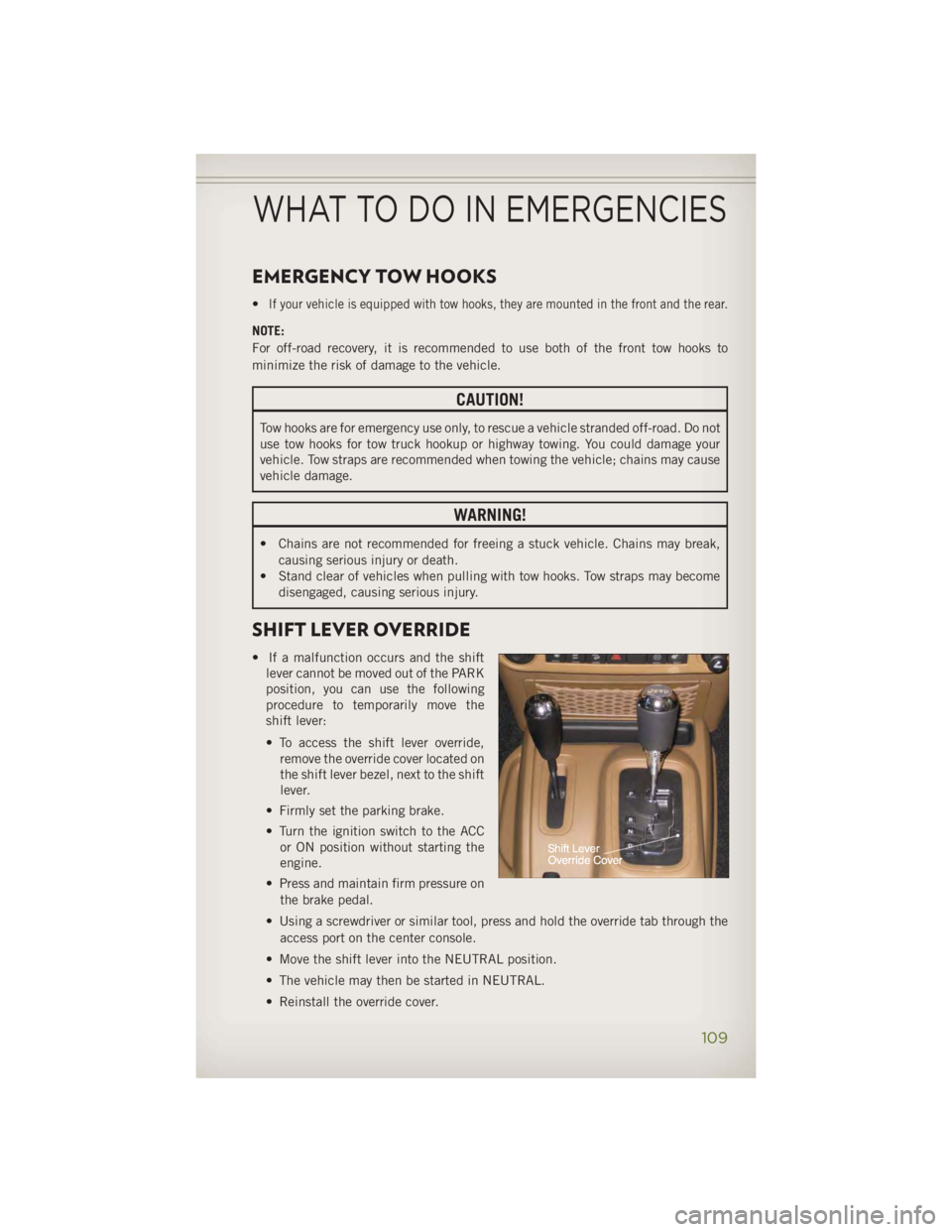
EMERGENCY TOW HOOKS • If your vehicle is equipped with tow hooks, they are mounted in the front and the rear.
NOTE:
For off-road recovery, it is recommended to use both of the front tow hooks to
minimize the risk of damage to the vehicle.
CAUTION!Tow hooks are for emergency use only, to rescue a vehicle stranded off-road. Do not
use tow hooks for tow truck hookup or highway towing. You could damage your
vehicle. Tow straps are recommended when towing the vehicle; chains may cause
vehicle damage.
WARNING!• Chains are not recommended for freeing a stuck vehicle. Chains may break,
causing serious injury or death.
• Stand clear of vehicles when pulling with tow hooks. Tow straps may become
disengaged, causing serious injury.
SHIFT LEVER OVERRIDE • If a malfunction occurs and the shift
lever cannot be moved out of the PARK
position, you can use the following
procedure to temporarily move the
shift lever:
• To access the shift lever override,
remove the override cover located on
the shift lever bezel, next to the shift
lever.
• Firmly set the parking brake.
• Turn the ignition switch to the ACC
or ON position without starting the
engine.
• Press and maintain firm pressure on
the brake pedal.
• Using a screwdriver or similar tool, press and hold the override tab through the
access port on the center console.
• Move the shift lever into the NEUTRAL position.
• The vehicle may then be started in NEUTRAL.
• Reinstall the override cover.WHAT TO DO IN EMERGENCIES
109
Page 112 of 140
TOWING A DISABLED VEHICLE • The manufacturer requires towing your vehicle with all four wheels OFF the ground
using a flatbed.
CAUTION!Towing this vehicle using any other method could result in extensive damage to the
transfer case and/or transmission.
FREEING A STUCK VEHICLE • If your vehicle becomes stuck in mud, sand or snow, it can often be moved by a
rocking motion. Turn your steering wheel right and left to clear the area around the
front wheels. Then shift back and forth between DRIVE/1st gear and REVERSE.
Using minimal accelerator pedal pressure to maintain the rocking motion, without
spinning the wheels, is most effective.
NOTE:
If your vehicle is equipped with Traction Control or Electronic Stability Control (ESC),
turn the system OFF before attempting to “rock” the vehicle.
CAUTION!• Racing the engine or spinning the wheels may lead to transmission overheating
and failure. Allow the engine to idle with the shift lever in NEUTRAL for at least
one minute after every five rocking-motion cycles. This will minimize overheat-
ing and reduce the risk of transmission failure during prolonged efforts to free
a stuck vehicle.
• When “rocking” a stuck vehicle by moving between DRIVE/1st gear and
REVERSE, do not spin the wheels faster than 15 mph (24 km/h), or drivetrain
damage may result.
• Revving the engine or spinning the wheels too fast may lead to transmission
overheating and failure. It can also damage the tires. Do not spin the wheels
above 30 mph (48 km/h) while in gear (no transmission shifting occurring).
WARNING!Fast spinning tires can be dangerous. Forces generated by excessive wheel speeds
may cause damage, or even failure, of the axle and tires. A tire could explode and
injure someone. Do not spin your vehicle's wheels faster than 30 mph (48 km/h)
or for longer than 30 seconds continuously without stopping when you are stuck
and do not let anyone near a spinning wheel, no matter what the speed.WHAT TO DO IN EMERGENCIES
110
Page 116 of 140
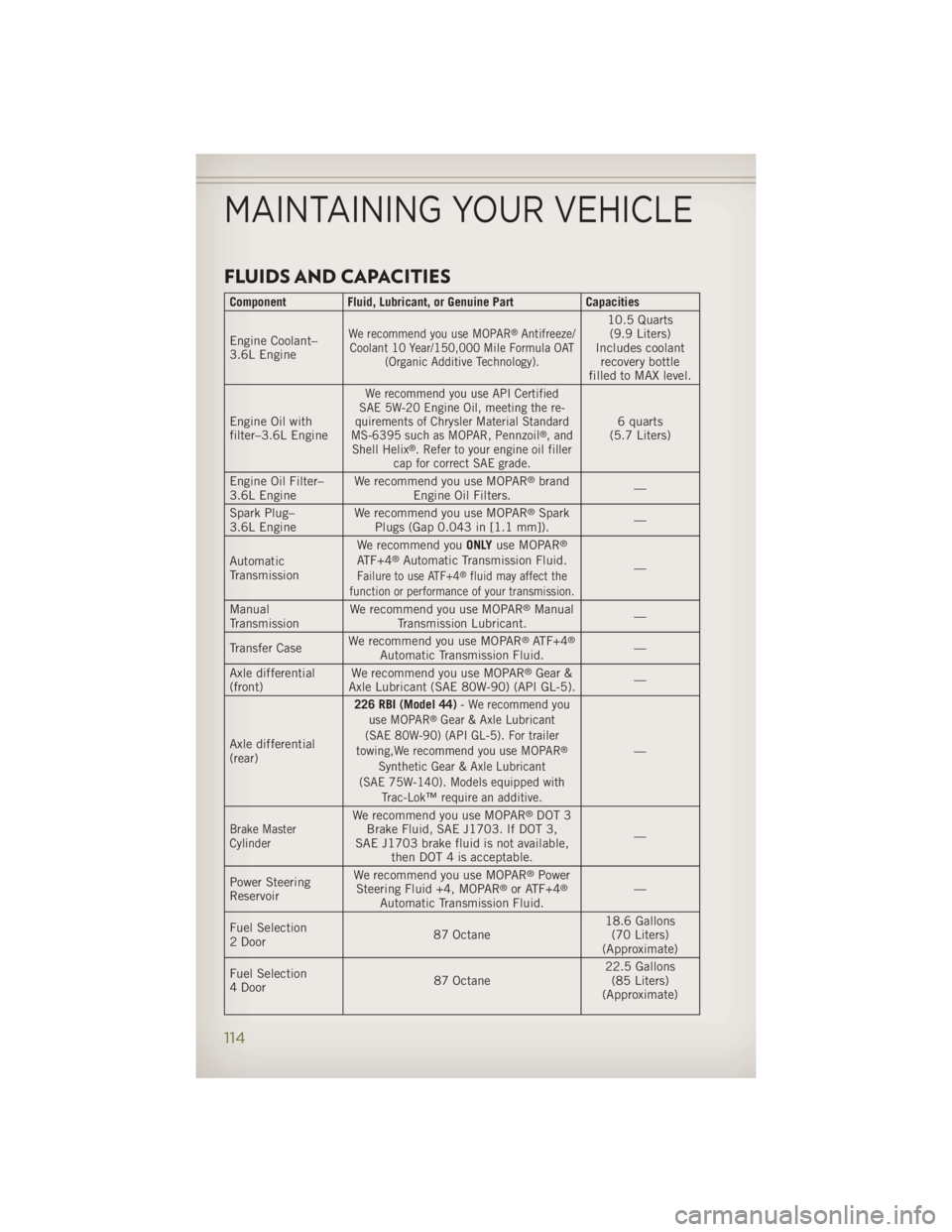
FLUIDS AND CAPACITIES Component Fluid, Lubricant, or Genuine Part Capacities
Engine Coolant–
3.6L Engine We recommend you use MOPAR ®
Antifreeze/
Coolant 10 Year/150,000 Mile Formula OAT
(Organic Additive Technology). 10.5 Quarts
(9.9 Liters)
Includes coolant
recovery bottle
filled to MAX level.
Engine Oil with
filter–3.6L Engine We recommend you use API Certified
SAE 5W-20 Engine Oil, meeting the re-
quirements of Chrysler Material Standard
MS-6395 such as MOPAR, Pennzoil ®
, and
Shell Helix ®
. Refer to your engine oil filler
cap for correct SAE grade. 6 quarts
(5.7 Liters)
Engine Oil Filter–
3.6L Engine We recommend you use MOPAR ®
brand
Engine Oil Filters. —
Spark Plug–
3.6L Engine We recommend you use MOPAR ®
Spark
Plugs (Gap 0.043 in [1.1 mm]). —
Automatic
Transmission We recommend you ONLY use MOPAR ®
ATF+4 ®
Automatic Transmission Fluid.
Failure to use ATF+4 ®
fluid may affect the
function or performance of your transmission. —
Manual
Transmission We recommend you use MOPAR ®
Manual
Transmission Lubricant. —
Transfer Case We recommend you use MOPAR ®
ATF+4 ®
Automatic Transmission Fluid. —
Axle differential
(front) We recommend you use MOPAR ®
Gear &
Axle Lubricant (SAE 80W-90) (API GL-5). —
Axle differential
(rear) 226 RBI (Model 44) - We recommend you
use MOPAR ®
Gear & Axle Lubricant
(SAE 80W-90) (API GL-5). For trailer
towing,We recommend you use MOPAR ®
Synthetic Gear & Axle Lubricant
(SAE 75W-140). Models equipped with
Trac-Lok™ require an additive. —
Brake Master
Cylinder We recommend you use MOPAR ®
DOT 3
Brake Fluid, SAE J1703. If DOT 3,
SAE J1703 brake fluid is not available,
then DOT 4 is acceptable. —
Power Steering
Reservoir We recommend you use MOPAR ®
Power
Steering Fluid +4, MOPAR ®
or ATF+4 ®
Automatic Transmission Fluid. —
Fuel Selection
2 Door 87 Octane 18.6 Gallons
(70 Liters)
(Approximate)
Fuel Selection
4 Door 87 Octane 22.5 Gallons
(85 Liters)
(Approximate)MAINTAINING YOUR VEHICLE
114
Page 117 of 140
CAUTION!• Mixing of engine coolant (antifreeze) other than specified Organic Additive
Technology (OAT) engine coolant (antifreeze), may result in engine damage and
may decrease corrosion protection. Organic Additive Technology (OAT) engine
coolant is different and should not be mixed with Hybrid Organic Additive
Technology (HOAT) engine coolant (antifreeze) or any “globally compatible”
coolant (antifreeze). If a non-OAT engine coolant (antifreeze) is introduced into
the cooling system in an emergency, the cooling system will need to be drained,
flushed, and refilled with fresh OAT coolant (conforming to MS-12106), by an
authorized dealer as soon as possible.
• Do not use water alone or alcohol-based engine coolant (antifreeze) products.
Do not use additional rust inhibitors or antirust products, as they may not be
compatible with the radiator engine coolant and may plug the radiator.
• This vehicle has not been designed for use with propylene glycol-based engine
coolant (antifreeze). Use of propylene glycol-based engine coolant (antifreeze)
is not recommended.
E85 FLEXIBLE FUEL — 3.6L ENGINE ONLY Refer to your Owner's Manual on the DVD for further details.
CAUTION!Only vehicles with the E-85 fuel filler door label or a yellow gas cap can operate
on E-85.
MAINTENANCE SCHEDULE Your vehicle is equipped with an automatic oil change indicator system. The oil change
indicator system will remind you that it is time to take your vehicle in for scheduled
maintenance.
Based on engine operation conditions, the oil change indicator message will
illuminate. This means that service is required for your vehicle. Operating conditions
such as frequent short-trips, trailer tow, extremely hot or cold ambient temperatures,
and E85 fuel usage will influence when the “Change Oil” or “Oil Change Required”
message is displayed. Severe Operating Conditions can cause the change oil
message to illuminate as early as 3,500 miles (5,600 km) since last reset. Have your
vehicle serviced as soon as possible, within the next 500 miles (805 km).MAINTAINING YOUR VEHICLE
115