warning JEEP WRANGLER UNLIMITED 2014 Owner's Guide
[x] Cancel search | Manufacturer: JEEP, Model Year: 2014, Model line: WRANGLER UNLIMITED, Model: JEEP WRANGLER UNLIMITED 2014Pages: 140, PDF Size: 12.72 MB
Page 108 of 140
WARNING!• Do not attempt to change a tire on the side of the vehicle close to moving
traffic. Pull far enough off the road to avoid the danger of being hit when
operating the jack or changing the wheel.
• Being under a jacked-up vehicle is dangerous. The vehicle could slip off the
jack and fall on you. You could be crushed. Never put any part of your body
under a vehicle that is on a jack. If you need to get under a raised vehicle, take
it to a service center where it can be raised on a lift.
• Never start or run the engine while the vehicle is on a jack.
• The jack is designed to be used as a tool for changing tires only. The jack
should not be used to lift the vehicle for service purposes. The vehicle should
be jacked on a firm level surface only. Avoid ice or slippery areas.
• Carefully follow these tire changing warnings to help prevent personal injury or
damage to your vehicle:
• Always park on a firm, level surface as far from the edge of the roadway
as possible before raising the vehicle.
• Turn on the Hazard Warning flasher.
• Block the wheel diagonally opposite the wheel to be raised.
• Set the parking brake firmly and set an automatic transmission in PARK;
a manual transmission in REVERSE.
• Do not let anyone sit in the vehicle when it is on a jack.
• Do not get under the vehicle when it is on a jack.
• Only use the jack in the positions indicated and for lifting this vehicle
during a tire change.
• If working on or near a roadway, be extremely careful of motor traffic.
• To assure that spare tires, flat or inflated, are securely stowed, spares
must be stowed with the valve stem facing the ground.
• Raising the vehicle higher than necessary can make the vehicle less
stable and cause a collision. It could slip off the jack and hurt someone
near it. Raise the vehicle only enough to remove the tire.
• To avoid the risk of forcing the vehicle off the jack, do not tighten the
wheel nuts fully until the vehicle has been lowered.
• A loose tire or jack, thrown forward in a collision or hard stop, could en-
danger the occupants of the vehicle. Always stow the jack parts and the
spare tire in the places provided.
• To avoid the risk of forcing the vehicle off the jack, do not tighten the lug
nuts fully until the vehicle is lowered to the ground.WHAT TO DO IN EMERGENCIES
106
Page 110 of 140
Once the engine is started, remove the jumper cables in the reverse sequence:
• Disconnect the negative (-) jumper cable from the engine ground of the vehicle
with the discharged battery.
• Disconnect the negative end (-) of the jumper cable from the negative (-) post of
the booster battery.
• Disconnect the opposite end of the positive (+) jumper cable from the positive (+)
post of the booster battery.
• Disconnect the positive (+) end of the jumper cable from the positive (+) post of
the discharged vehicle.
• If frequent jump-starting is required to start your vehicle you should have the
battery and charging system inspected at your authorized dealer.
CAUTION!• Do not use a portable battery booster pack or any other booster source with a
system voltage greater than 12 Volts or damage to the battery, starter motor,
alternator or electrical system may occur.
• Failure to follow these procedures could result in damage to the charging
system of the booster vehicle or the discharged vehicle.
• Accessories that can be plugged into the vehicle power outlets draw power from
the vehicle’s battery, even when not in use (i.e., cellular phones, etc.).
Eventually, if plugged in long enough, the vehicle’s battery discharges suffi-
ciently to degrade battery life and/or prevent the engine from starting.
WARNING!• When temperatures are below the freezing point, electrolyte in a discharged battery
may freeze. Do not attempt jump-starting because the battery could rupture or
explode and cause personal injury. Battery temperature must be brought above the
freezing point before attempting a jump-start.
• Take care to avoid the radiator cooling fan whenever the hood is raised. It can start
anytime the ignition switch is on. You can be injured by moving fan blades.
• Remove any metal jewelry, such as watch bands or bracelets, that might make an
inadvertent electrical contact. You could be severely injured.
• Batteries contain sulfuric acid that can burn your skin or eyes and generate
hydrogen gas which is flammable and explosive. Keep open flames or sparks away
from the battery.
• Do not allow vehicles to touch each other as this could establish a ground
connection and personal injury could result.
• Failure to follow this procedure could result in personal injury or property damage
due to battery explosion.
• Do not connect the cable to the negative post (-) of the discharged battery. The
resulting electrical spark could cause the battery to explode and could result in
personal injury.WHAT TO DO IN EMERGENCIES
108
Page 111 of 140
EMERGENCY TOW HOOKS • If your vehicle is equipped with tow hooks, they are mounted in the front and the rear.
NOTE:
For off-road recovery, it is recommended to use both of the front tow hooks to
minimize the risk of damage to the vehicle.
CAUTION!Tow hooks are for emergency use only, to rescue a vehicle stranded off-road. Do not
use tow hooks for tow truck hookup or highway towing. You could damage your
vehicle. Tow straps are recommended when towing the vehicle; chains may cause
vehicle damage.
WARNING!• Chains are not recommended for freeing a stuck vehicle. Chains may break,
causing serious injury or death.
• Stand clear of vehicles when pulling with tow hooks. Tow straps may become
disengaged, causing serious injury.
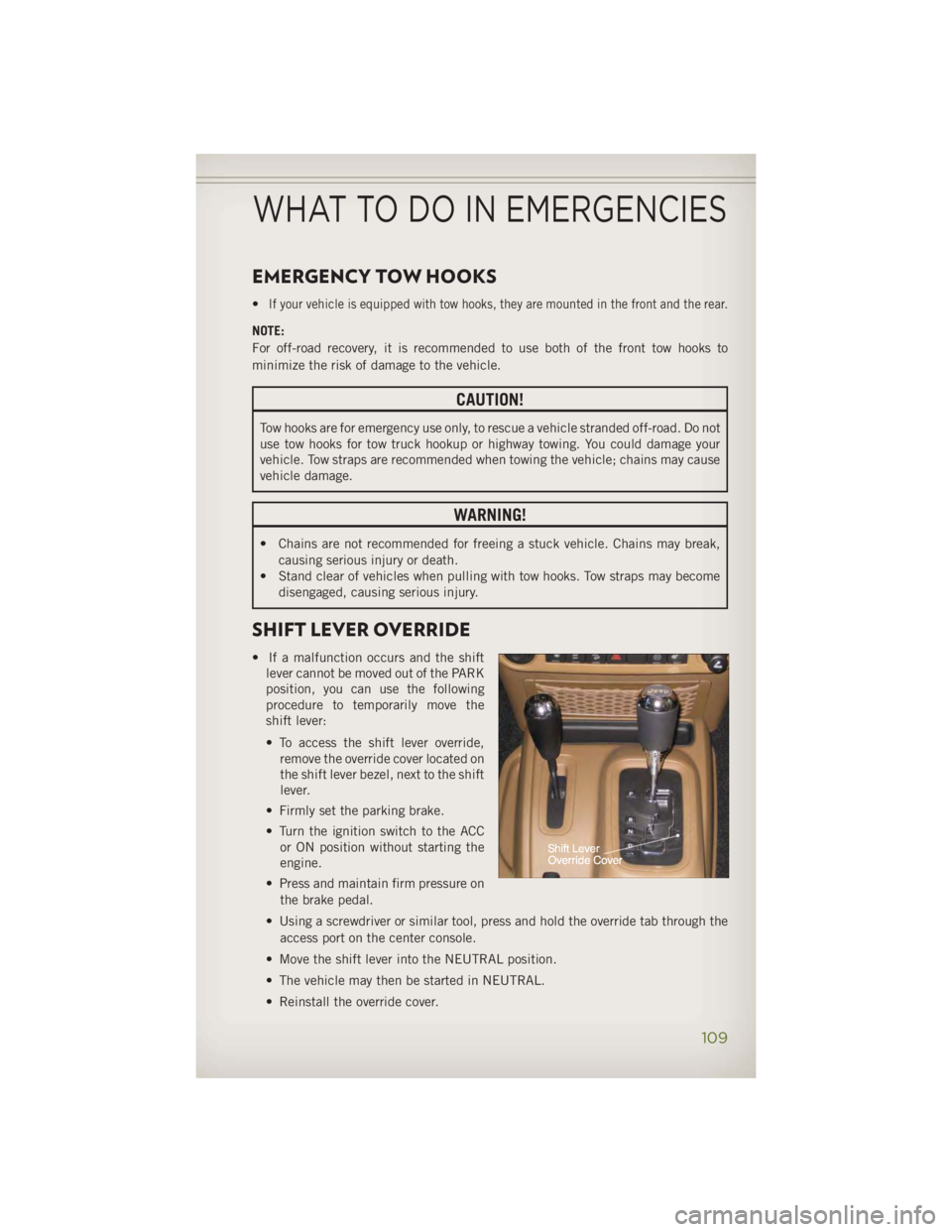
SHIFT LEVER OVERRIDE • If a malfunction occurs and the shift
lever cannot be moved out of the PARK
position, you can use the following
procedure to temporarily move the
shift lever:
• To access the shift lever override,
remove the override cover located on
the shift lever bezel, next to the shift
lever.
• Firmly set the parking brake.
• Turn the ignition switch to the ACC
or ON position without starting the
engine.
• Press and maintain firm pressure on
the brake pedal.
• Using a screwdriver or similar tool, press and hold the override tab through the
access port on the center console.
• Move the shift lever into the NEUTRAL position.
• The vehicle may then be started in NEUTRAL.
• Reinstall the override cover.WHAT TO DO IN EMERGENCIES
109
Page 112 of 140
TOWING A DISABLED VEHICLE • The manufacturer requires towing your vehicle with all four wheels OFF the ground
using a flatbed.
CAUTION!Towing this vehicle using any other method could result in extensive damage to the
transfer case and/or transmission.
FREEING A STUCK VEHICLE • If your vehicle becomes stuck in mud, sand or snow, it can often be moved by a
rocking motion. Turn your steering wheel right and left to clear the area around the
front wheels. Then shift back and forth between DRIVE/1st gear and REVERSE.
Using minimal accelerator pedal pressure to maintain the rocking motion, without
spinning the wheels, is most effective.
NOTE:
If your vehicle is equipped with Traction Control or Electronic Stability Control (ESC),
turn the system OFF before attempting to “rock” the vehicle.
CAUTION!• Racing the engine or spinning the wheels may lead to transmission overheating
and failure. Allow the engine to idle with the shift lever in NEUTRAL for at least
one minute after every five rocking-motion cycles. This will minimize overheat-
ing and reduce the risk of transmission failure during prolonged efforts to free
a stuck vehicle.
• When “rocking” a stuck vehicle by moving between DRIVE/1st gear and
REVERSE, do not spin the wheels faster than 15 mph (24 km/h), or drivetrain
damage may result.
• Revving the engine or spinning the wheels too fast may lead to transmission
overheating and failure. It can also damage the tires. Do not spin the wheels
above 30 mph (48 km/h) while in gear (no transmission shifting occurring).
WARNING!Fast spinning tires can be dangerous. Forces generated by excessive wheel speeds
may cause damage, or even failure, of the axle and tires. A tire could explode and
injure someone. Do not spin your vehicle's wheels faster than 30 mph (48 km/h)
or for longer than 30 seconds continuously without stopping when you are stuck
and do not let anyone near a spinning wheel, no matter what the speed.WHAT TO DO IN EMERGENCIES
110
Page 114 of 140
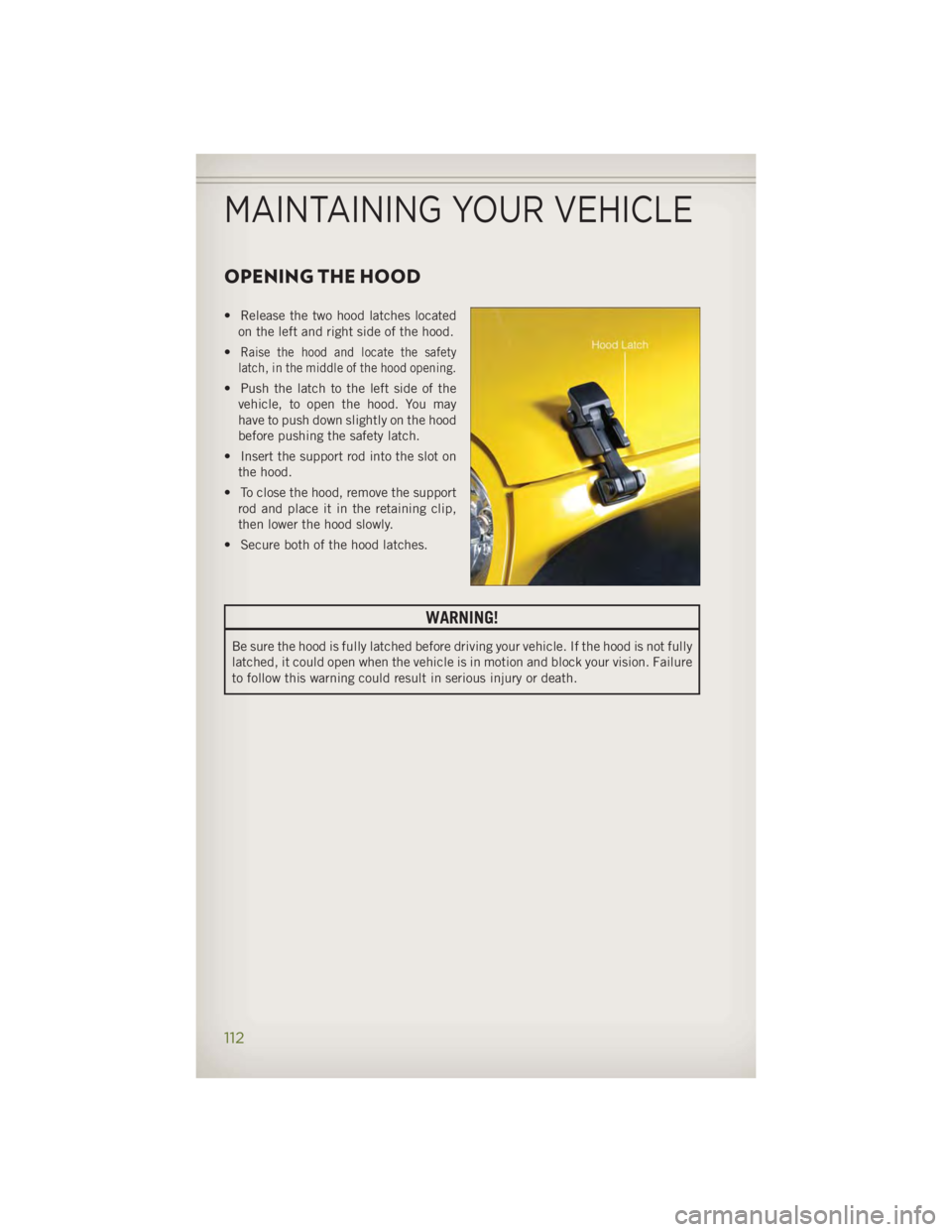
OPENING THE HOOD • Release the two hood latches located
on the left and right side of the hood.
• Raise the hood and locate the safety
latch, in the middle of the hood opening.
• Push the latch to the left side of the
vehicle, to open the hood. You may
have to push down slightly on the hood
before pushing the safety latch.
• Insert the support rod into the slot on
the hood.
• To close the hood, remove the support
rod and place it in the retaining clip,
then lower the hood slowly.
• Secure both of the hood latches.
WARNING!Be sure the hood is fully latched before driving your vehicle. If the hood is not fully
latched, it could open when the vehicle is in motion and block your vision. Failure
to follow this warning could result in serious injury or death.
MAINTAINING YOUR VEHICLE
112
Page 120 of 140
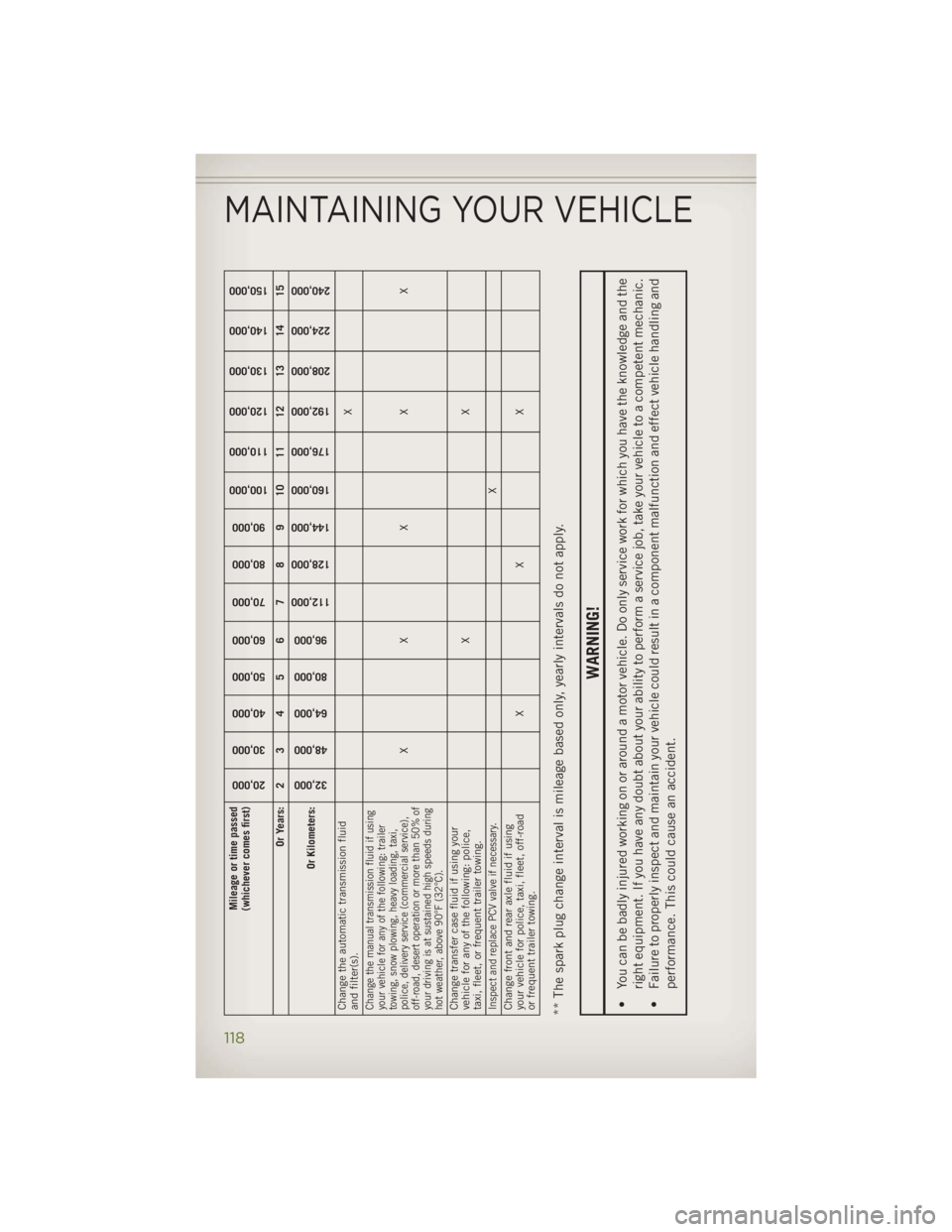
Mileage or time passed
(whichever comes first)
20,000
30,000
40,000
50,000
60,000
70,000
80,000
90,000
100,000
110,000
120,000
130,000
140,000
150,000 Or Years: 2 3 4 5 6 7 8 9 10 11 12 13 14 15
Or Kilometers:
32,000
48,000
64,000
80,000
96,000
112,000
128,000
144,000
160,000
176,000
192,000
208,000
224,000
240,000 Change the automatic transmission fluid
and filter(s). X
Change the manual transmission fluid if using
your vehicle for any of the following: trailer
towing, snow plowing, heavy loading, taxi,
police, delivery service (commercial service),
off-road, desert operation or more than 50% of
your driving is at sustained high speeds during
hot weather, above 90°F (32°C). XX X X X
Change transfer case fluid if using your
vehicle for any of the following: police,
taxi, fleet, or frequent trailer towing. XX
Inspect and replace PCV valve if necessary. X
Change front and rear axle fluid if using
your vehicle for police, taxi, fleet, off-road
or frequent trailer towing. XX X** The spark plug change interval is mileage based only, yearly intervals do not apply. WARNING!
• You can be badly injured working on or around a motor vehicle. Do only service work for which you have the knowledge and the
right equipment. If you have any doubt about your ability to perform a service job, take your vehicle to a competent mechanic.
• Failure to properly inspect and maintain your vehicle could result in a component malfunction and effect vehicle handling and
performance. This could cause an accident.MAINTAINING YOUR VEHICLE
118
Page 126 of 140
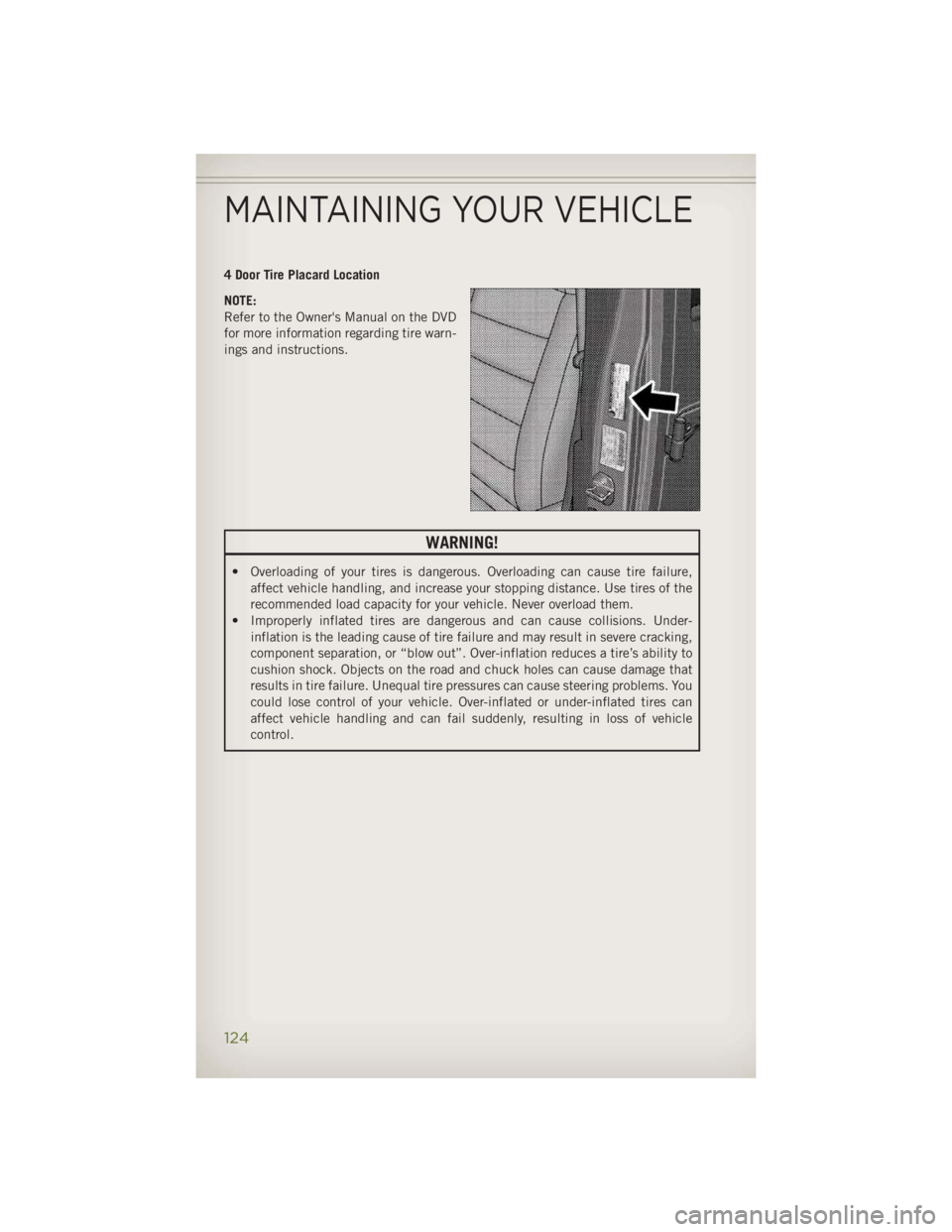
4 Door Tire Placard Location
NOTE:
Refer to the Owner's Manual on the DVD
for more information regarding tire warn-
ings and instructions.
WARNING!• Overloading of your tires is dangerous. Overloading can cause tire failure,
affect vehicle handling, and increase your stopping distance. Use tires of the
recommended load capacity for your vehicle. Never overload them.
• Improperly inflated tires are dangerous and can cause collisions. Under-
inflation is the leading cause of tire failure and may result in severe cracking,
component separation, or “blow out”. Over-inflation reduces a tire’s ability to
cushion shock. Objects on the road and chuck holes can cause damage that
results in tire failure. Unequal tire pressures can cause steering problems. You
could lose control of your vehicle. Over-inflated or under-inflated tires can
affect vehicle handling and can fail suddenly, resulting in loss of vehicle
control.
MAINTAINING YOUR VEHICLE
124
Page 128 of 140
CHRYSLER GROUP LLC CUSTOMER CENTER P.O. Box 21–8004 Auburn Hills, MI 48321–8004 Phone: 1–877–426–5337
CHRYSLER CANADA INC. CUSTOMER CENTER P.O. Box 1621 Windsor, Ontario N9A 4H6 Phone: 1–800–465–2001 (English)
Phone: 1–800–387–9983 (French)
ASSISTANCE FOR THE HEARING IMPAIRED • To assist customers who have hearing difficulties, the manufacturer has installed
special TDD (Telecommunication Devices for the Deaf) equipment at its customer
center. Any hearing or speech impaired customer, who has access to a TDD or a
conventional teletypewriter (TTY) in the United States, can communicate with the
manufacturer by dialing 1–800–380–CHRY. Canadian residents with hearing
difficulties that require assistance can use the special needs relay service offered
by Bell Canada. For TTY teletypewriter users, dial 711 and for Voice callers, dial
1–800–855–0511 to connect with a Bell Relay Service operator.
WARNING!Engine exhaust, some of its constituents, and certain vehicle components con-
tain, or emit, chemicals known to the State of California to cause cancer and birth
defects, or other reproductive harm. In addition, certain fluids contained in
vehicles and certain products of component wear contain, or emit, chemicals
known to the State of California to cause cancer and birth defects, or other
reproductive harm.
PUBLICATIONS ORDERING • If you are the first registered retail owner of your vehicle, you may obtain one free
printed copy of the Owner's Manual, Warranty Booklet or Radio Manuals on your
DVD by calling 1–877–426–5337 (U.S.) or 1–800–387–1143 (Canada) or by
contacting your dealer.
•
Replacement User Guide kits or DVDs or, if you prefer, additional printed copies of
the Owner's Manual, Warranty Booklet or Radio Manuals may be purchased by visiting
www.techauthority.com or by calling 1–877–890–4038 (U.S.) or 1–800–387–1143
(Canada). Visa, Master Card, American Express and Discover orders are accepted.
If you prefer mailing your order, please call the above numbers for an order form.CONSUMER ASSISTANCE
126
Page 131 of 140
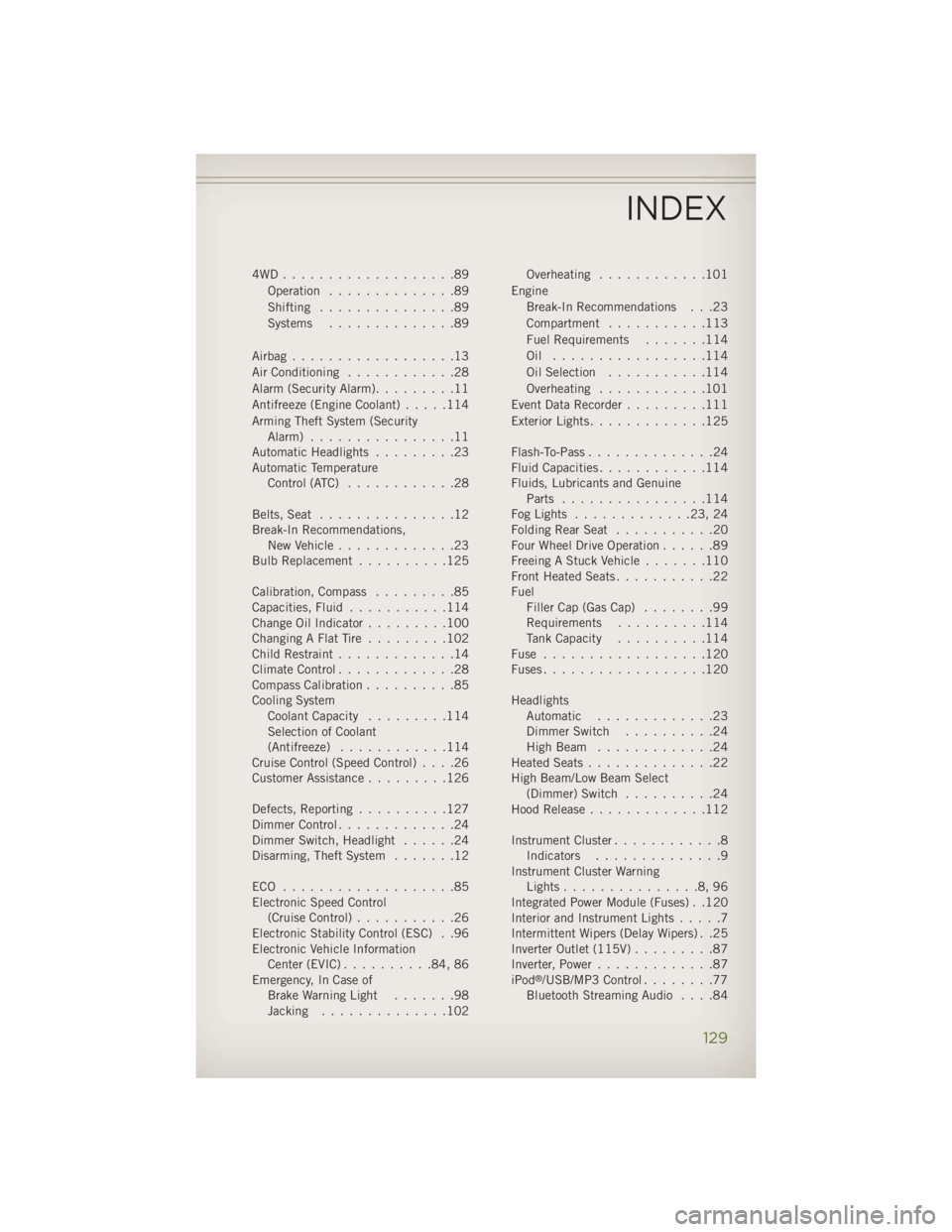
4WD...................89
Operation ..............89
Shifting ...............89
Systems ..............89
Airbag..................13
Air Conditioning ............28
Alarm (Security Alarm) .........11
Antifreeze (Engine Coolant) .....114
Arming Theft System (Security
Alarm) ................11
Automatic Headlights .........23
Automatic Temperature
Control (ATC) ............28
Belts, Seat ...............12
Break-In Recommendations,
New Vehicle .............23
BulbReplacement ..........125
Calibration,Compass .........85
Capacities, Fluid ...........114
ChangeOilIndicator.........100
ChangingAFlatTire .........102
Child Restraint .............14
Climate Control .............28
Compass Calibration ..........85
Cooling System
Coolant Capacity .........114
Selection of Coolant
(Antifreeze) ............114
Cruise Control (Speed Control) ....26
Customer Assistance .........126
Defects, Reporting ..........127
Dimmer Control .............24
Dimmer Switch, Headlight ......24
Disarming, Theft System .......12
ECO ...................85
Electronic Speed Control
(Cruise Control) ...........26
Electronic Stability Control (ESC) . .96
Electronic Vehicle Information
Center(EVIC)..........84,86
Emergency, In Case of
Brake Warning Light .......98
Jacking ..............102 Overheating ............101
Engine
Break-In Recommendations . . .23
Compartment ...........113
FuelRequirements .......114
Oil .................114
Oil Selection ...........114
Overheating ............101
Event Data Recorder .........111
Exterior Lights .............125
Flash-To-Pass ..............24
Fluid Capacities ............114
Fluids, Lubricants and Genuine
Parts ................114
FogLights .............23,24
FoldingRearSeat ...........20
Four Wheel Drive Operation ......89
Freeing A Stuck Vehicle .......110
Front Heated Seats ...........22
Fuel
Filler Cap (Gas Cap) ........99
Requirements ..........114
Tank Capacity ..........114
Fuse ..................120
Fuses..................120
Headlights
Automatic .............23
Dimmer Switch ..........24
HighBeam .............24
Heated Seats ..............22
High
Beam/Low Beam Select
(Dimmer)
Switch ..........24
Hood Release .............112
Instrument Cluster ............8
Indicators ..............9
Instrument Cluster Warning
Lights...............8,96
Integrated Power Module (Fuses) . .120
Interior and Instrument Lights .....7
Intermittent Wipers (Delay Wipers) . .25
Inverter Outlet (115V) .........87
Inverter, Power .............87
iPod ®
/USB/MP3 Control ........77
Bluetooth Streaming Audio ....84INDEX
129
Page 132 of 140
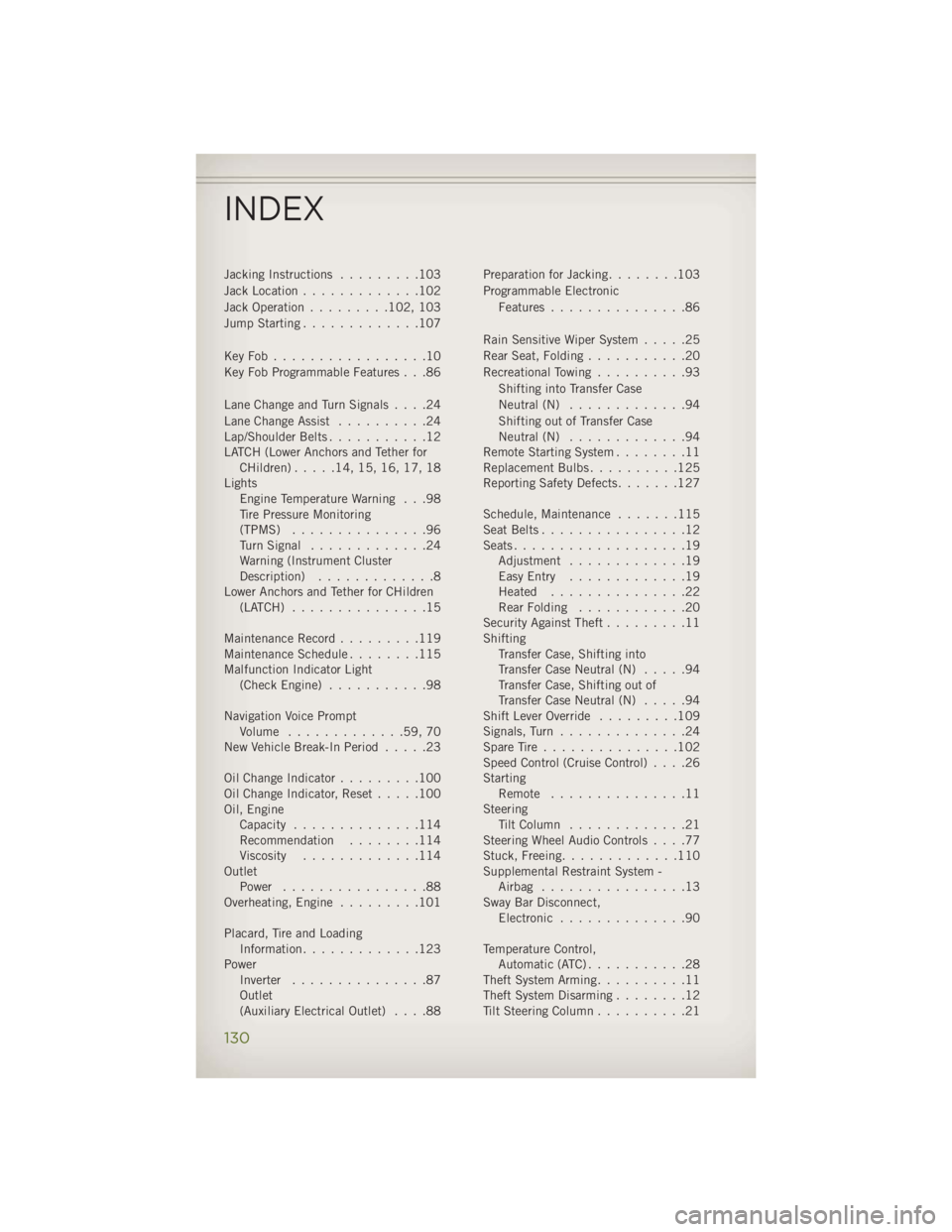
Jacking Instructions .........103
Jack Location .............102
Jack Operation ......... 102, 103
Jump Starting .............107
KeyFob.................10
Key Fob Programmable Features . . .86
LaneChangeandTurnSignals....24
Lane Change Assist ..........24
Lap/Shoulder Belts ...........12
LATCH (Lower Anchors and Tether for
CHildren).....14,15,16,17,18
Lights
Engine Temperature Warning . . .98
Tire Pressure Monitoring
(TPMS) ...............96
TurnSignal .............24
Warning (Instrument Cluster
Description) .............8
Lower Anchors and Tether for CHildren
(LATCH) ...............15
Maintenance Record .........119
MaintenanceSchedule........115
Malfunction Indicator Light
(CheckEngine) ...........98
Navigation Voice Prompt
Volume .............59,70
New Vehicle Break-In Period .....23
Oil Change Indicator .........100
Oil Change Indicator, Reset .....100
Oil, Engine
Capacity ..............114
Recommendation ........114
Viscosity .............114
Outlet
Power ................88
Overheating, Engine .........101
Placard, Tire and Loading
Information .............123
Power
Inverter ...............87
Outlet
(Auxiliary Electrical Outlet) ....88 Preparation for Jacking ........103
Programmable Electronic
Features ...............86
Rain Sensitive Wiper System .....25
RearSeat,Folding...........20
Recreational Towing ..........93
Shifting into Transfer Case
Neutral (N) .............94
Shifting out of Transfer Case
Neutral (N) .............94
Remote Starting System ........11
Replacement Bulbs ..........125
Reporting Safety Defects .......127
Schedule,Maintenance .......115
Seat Belts ................12
Seats ...................19
Adjustment .............19
EasyEntry .............19
Heated ...............22
RearFolding ............20
Security Against Theft .........11
Shifting
Transfer Case, Shifting into
Transfer Case Neutral (N) .....94
Transfer Case, Shifting out of
Transfer Case Neutral (N) .....94
Shift Lever Override .........109
Signals, Turn ..............24
SpareTire...............102
Speed Control (Cruise Control) ....26
Starting
Remote ...............11
Steering
TiltColumn .............21
Steering
Wheel Audio Controls ....
77
Stuck, Freeing .............110
Supplemental Restraint System -
Airbag ................13
Sway Bar Disconnect,
Electronic ..............90
Temperature Control,
Automatic (ATC) ...........28
Theft System Arming ..........11
Theft System Disarming ........12
Tilt Steering Column ..........21INDEX
130