gas type JEEP XJ 1995 Service And Owner's Manual
[x] Cancel search | Manufacturer: JEEP, Model Year: 1995, Model line: XJ, Model: JEEP XJ 1995Pages: 2158, PDF Size: 81.9 MB
Page 1662 of 2158
(c) Vehicle is used for trailer towing or heavy
load hauling.
FLUID/FILTER REPLACEMENT PROCEDURE
(1) Raise vehicle.
(2) Remove oil pan and drain fluid.
(3) Clean oil pan and pan magnet. Then clean re-
maining gasket material from gasket surface of
transmission case.
(4) Remove fluid filter screws and remove filter.
(5) Position new filter on valve body and install fil-
ter screws. Tighten screws to 4 Nzm (35 in. lbs.)
torque.
(6) Adjust rear band at this time if required.
(7) Position new gasket on oil pan and install pan
on transmission. Tighten pan bolts to 150 in. lbs. (17
Nzm) torque.
(8) Adjust front band at this time if required.
(9) Lower vehicle and refill transmission with Mo-
par ATF Plus, type 7176 fluid.
REFILLING AFTER OVERHAUL OR FLUID/FILTER
CHANGE
The most effective way to avoid overfilling after a
fluid change or overhaul is as follows:
(1) Remove dipstick and insert clean funnel in
transmission fill tube.
(2) Add following initial quantity of Mopar ATF
Plus to transmission:
(a) If only fluid and filter were changed, add3
pints (1-1/2 quarts)of ATF Plus to transmission.
(b) If transmission was completely overhauled
and torque converter was replaced or drained, add
10 pints (5 quarts)of ATF Plus to transmission.
(3) Apply parking brakes.
(4) Start and run engine at normal curb idle speed.
(5) Apply service brakes, shift transmission
through all gear ranges then back to Neutral, and
leave engine running at curb idle speed.
(6) Remove funnel, insert dipstick and check fluid
level. Add only enough fluid to bring level toMIN
dot mark on dipstick.
(7) Drive vehicle until transmission fluid is at nor-
mal operating temperature. Then recheck fluid level
as described in next step.
(8) Leave engine running at curb idle speed, shift
into Neutral, and check fluid level again. This time,
add just enough fluid to bring level up toMAX ar-
row mark but do not overfill.
(9) When fluid level is correct, shut engine off, re-
lease park brake, remove funnel, and reseat dipstick
in fill tube.
SHIFT LINKAGE ADJUSTMENT (YJ)
(1) Check linkage adjustment by starting engine in
Park and Neutral.(2) Adjustment is OK if engine starts only in park
and Neutral. Adjustment is incorrect if engine starts
in one but not both positions.
(3) If engine starts in any position other than Park
or Neutral, or if engine will not start at all, park/
neutral position switch may be faulty.
(4) Shift transmission into Park.
(5) Raise vehicle.
(6) Check condition of shift rods, bellcrank,
bellcrank brackets and linkage bushings/grommets
(Fig. 2). Tighten, repair, replace worn, damaged
parts. Do not attempt adjustment if linkage compo-
nents are worn or damaged.
(7) Loosen shift rod trunnion lock bolt or nut. Be
sure upper shift rod slides freely in trunnion (Fig. 2).
Also be sure shift rods and bellcrank rotate freely
and do not bind at any point.
(8) Verify that manual lever is in Park detent (Fig.
2). Move lever all the way rearward to be sure it is in
Park.
(9) Check for positive engagement of park lock by
attempting to rotate propeller shaft. Shaft will not
turn when park pawl is engaged.
(10) Adjust shift rod trunnion to a obtain free pin
fit in bellcrank arm and tighten trunnion lock bolt or
nut. Prevent shift rod from turning while tightening
bolt or nut. Gearshift linkage lash must be elimi-
nated to obtain proper adjustment. Eliminate lash by
pulling downward on shift rod and pressing upward
on bellcrank.
(11) Confirm proper adjustment by starting engine
in Park and Neutral. Engine should start in these
positions only.If engine starts in any position
other than Park or Neutral, adjustment is in-
correct or neutral switch is faulty.
(12) Lower vehicle and verify that steering lock op-
erates correctly.
SHIFT CABLE ADJUSTMENT (XJ)
(1) Shift transmission into Park.
(2) Raise vehicle.
(3) Release cable adjuster clamp to unlock cable
(Figs. 3 and 4). Clamp is at transmission end of ca-
ble.
(4) Unsnap cable from transmission cable bracket.
(5) Move transmission shift lever fully rearward to
Park detent. Lever is on manual valve shaft at driver
side of case.
(6) Verify positive engagement of park lock by at-
tempting to rotate propeller shaft. Shaft will not ro-
tate when park lock is engaged.
(7) Snap cable into cable bracket.
(8) Lock shift cable by pressing cable adjuster
clamp down until it snaps into place.
(9) Check engine starting. Engine should start only
in Park and Neutral.
(10) Lower vehicle.
21 - 100 30RH/32RH IN-VEHICLE SERVICEJ
Page 1667 of 2158
(7) Align valve body and seat it on case. Be sure
manual lever shaft and accumulator spring are prop-
erly seated.
(8) Hold valve body in position and install one or
two attaching bolts to hold valve body in place.
(9) Install remaining valve body bolts. Tighten all
bolts evenly in a diagonal pattern to 12 Nzm (105 in-
lbs) torque.
(10) Install new oil filter and tighten filter screws
to4Nzm (35 in. lbs.) torque.
(11) Connect converter solenoid wire to case con-
nector.
(12) Install manual and throttle levers on throttle
lever shaft. Tighten lever clamp screws and check for
free operation. Shaft and levers must operate freely
without any bind.
(13) Install oil pan and new gasket. Tighten pan
bolts to 17 Nzm (13 ft. lbs.) torque.
(14) Install seal on neutral switch, install switch in
case, and connect switch wires.
(15) Lower vehicle.
(16) Fill transmission with Mopar ATF Plus, Type
7176 fluid.
(17) Adjust gearshift linkage and throttle valve
(kickdown) cable if necessary.
GOVERNOR AND PARK GEAR SERVICE
GOVERNOR/PARK GEAR REMOVAL
(1) Raise vehicle.
(2) Mark both propeller shaft yokes for assembly
reference and disconnect propeller shafts at transfer
case.
(3) Disconnect speed sensor wires and remove
speedometer adapter and sensor.
(4) Position support stand under transmission con-
verter housing.
(5) Remove rear crossmember.
(6) Disconnect parking brake cable at equalizer
and disconnect exhaust components as necessary.
(7) Support transfer case with jack.
(8) Remove bolts attaching transfer case to trans-
mission adapter housing and remove transfer case.
(9) Remove bolts attaching adapter, or extension
housing to transmission and remove adapter/housing.
(10) Loosen but do not remove bolts that attach
governor body to park gear.
(11) Rotate transmission output shaft until gover-
nor weight assembly is accessible. Then remove
E-clip at this end of governor shaft.
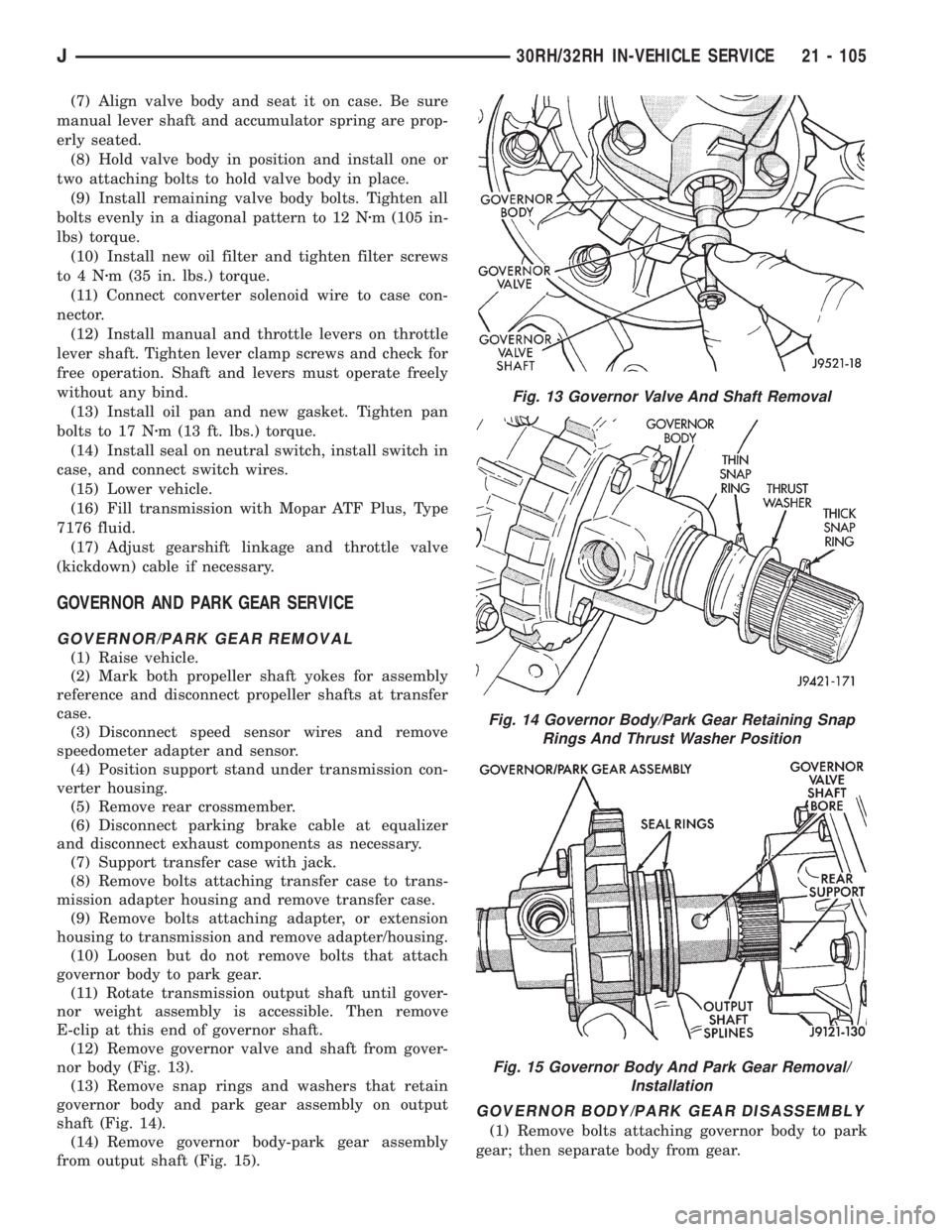
(12) Remove governor valve and shaft from gover-
nor body (Fig. 13).
(13) Remove snap rings and washers that retain
governor body and park gear assembly on output
shaft (Fig. 14).
(14) Remove governor body-park gear assembly
from output shaft (Fig. 15).
GOVERNOR BODY/PARK GEAR DISASSEMBLY
(1) Remove bolts attaching governor body to park
gear; then separate body from gear.
Fig. 13 Governor Valve And Shaft Removal
Fig. 14 Governor Body/Park Gear Retaining Snap
Rings And Thrust Washer Position
Fig. 15 Governor Body And Park Gear Removal/
Installation
J30RH/32RH IN-VEHICLE SERVICE 21 - 105
Page 1687 of 2158
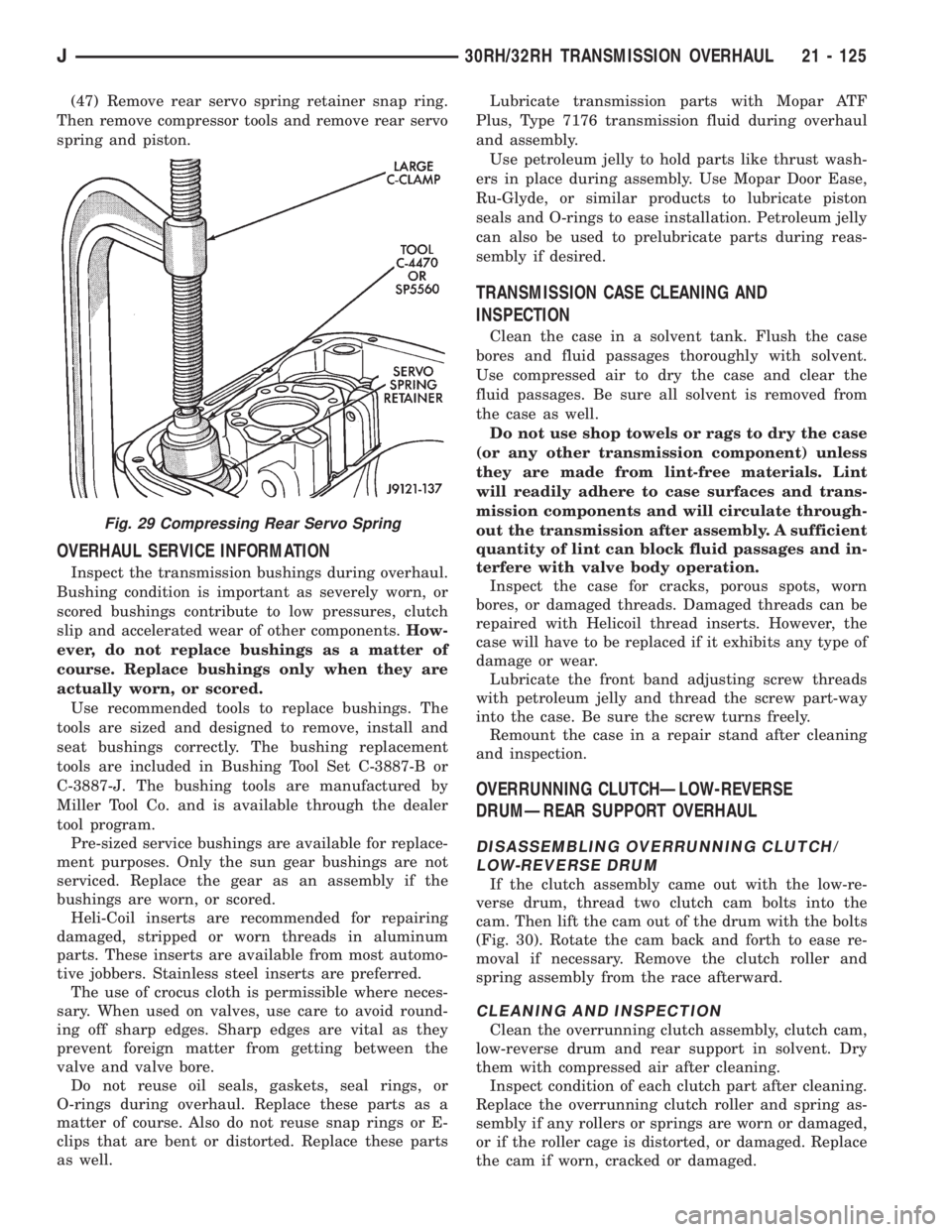
(47) Remove rear servo spring retainer snap ring.
Then remove compressor tools and remove rear servo
spring and piston.
OVERHAUL SERVICE INFORMATION
Inspect the transmission bushings during overhaul.
Bushing condition is important as severely worn, or
scored bushings contribute to low pressures, clutch
slip and accelerated wear of other components.How-
ever, do not replace bushings as a matter of
course. Replace bushings only when they are
actually worn, or scored.
Use recommended tools to replace bushings. The
tools are sized and designed to remove, install and
seat bushings correctly. The bushing replacement
tools are included in Bushing Tool Set C-3887-B or
C-3887-J. The bushing tools are manufactured by
Miller Tool Co. and is available through the dealer
tool program.
Pre-sized service bushings are available for replace-
ment purposes. Only the sun gear bushings are not
serviced. Replace the gear as an assembly if the
bushings are worn, or scored.
Heli-Coil inserts are recommended for repairing
damaged, stripped or worn threads in aluminum
parts. These inserts are available from most automo-
tive jobbers. Stainless steel inserts are preferred.
The use of crocus cloth is permissible where neces-
sary. When used on valves, use care to avoid round-
ing off sharp edges. Sharp edges are vital as they
prevent foreign matter from getting between the
valve and valve bore.
Do not reuse oil seals, gaskets, seal rings, or
O-rings during overhaul. Replace these parts as a
matter of course. Also do not reuse snap rings or E-
clips that are bent or distorted. Replace these parts
as well.Lubricate transmission parts with Mopar ATF
Plus, Type 7176 transmission fluid during overhaul
and assembly.
Use petroleum jelly to hold parts like thrust wash-
ers in place during assembly. Use Mopar Door Ease,
Ru-Glyde, or similar products to lubricate piston
seals and O-rings to ease installation. Petroleum jelly
can also be used to prelubricate parts during reas-
sembly if desired.
TRANSMISSION CASE CLEANING AND
INSPECTION
Clean the case in a solvent tank. Flush the case
bores and fluid passages thoroughly with solvent.
Use compressed air to dry the case and clear the
fluid passages. Be sure all solvent is removed from
the case as well.
Do not use shop towels or rags to dry the case
(or any other transmission component) unless
they are made from lint-free materials. Lint
will readily adhere to case surfaces and trans-
mission components and will circulate through-
out the transmission after assembly. A sufficient
quantity of lint can block fluid passages and in-
terfere with valve body operation.
Inspect the case for cracks, porous spots, worn
bores, or damaged threads. Damaged threads can be
repaired with Helicoil thread inserts. However, the
case will have to be replaced if it exhibits any type of
damage or wear.
Lubricate the front band adjusting screw threads
with petroleum jelly and thread the screw part-way
into the case. Be sure the screw turns freely.
Remount the case in a repair stand after cleaning
and inspection.
OVERRUNNING CLUTCHÐLOW-REVERSE
DRUMÐREAR SUPPORT OVERHAUL
DISASSEMBLING OVERRUNNING CLUTCH/
LOW-REVERSE DRUM
If the clutch assembly came out with the low-re-
verse drum, thread two clutch cam bolts into the
cam. Then lift the cam out of the drum with the bolts
(Fig. 30). Rotate the cam back and forth to ease re-
moval if necessary. Remove the clutch roller and
spring assembly from the race afterward.
CLEANING AND INSPECTION
Clean the overrunning clutch assembly, clutch cam,
low-reverse drum and rear support in solvent. Dry
them with compressed air after cleaning.
Inspect condition of each clutch part after cleaning.
Replace the overrunning clutch roller and spring as-
sembly if any rollers or springs are worn or damaged,
or if the roller cage is distorted, or damaged. Replace
the cam if worn, cracked or damaged.
Fig. 29 Compressing Rear Servo Spring
J30RH/32RH TRANSMISSION OVERHAUL 21 - 125
Page 1712 of 2158
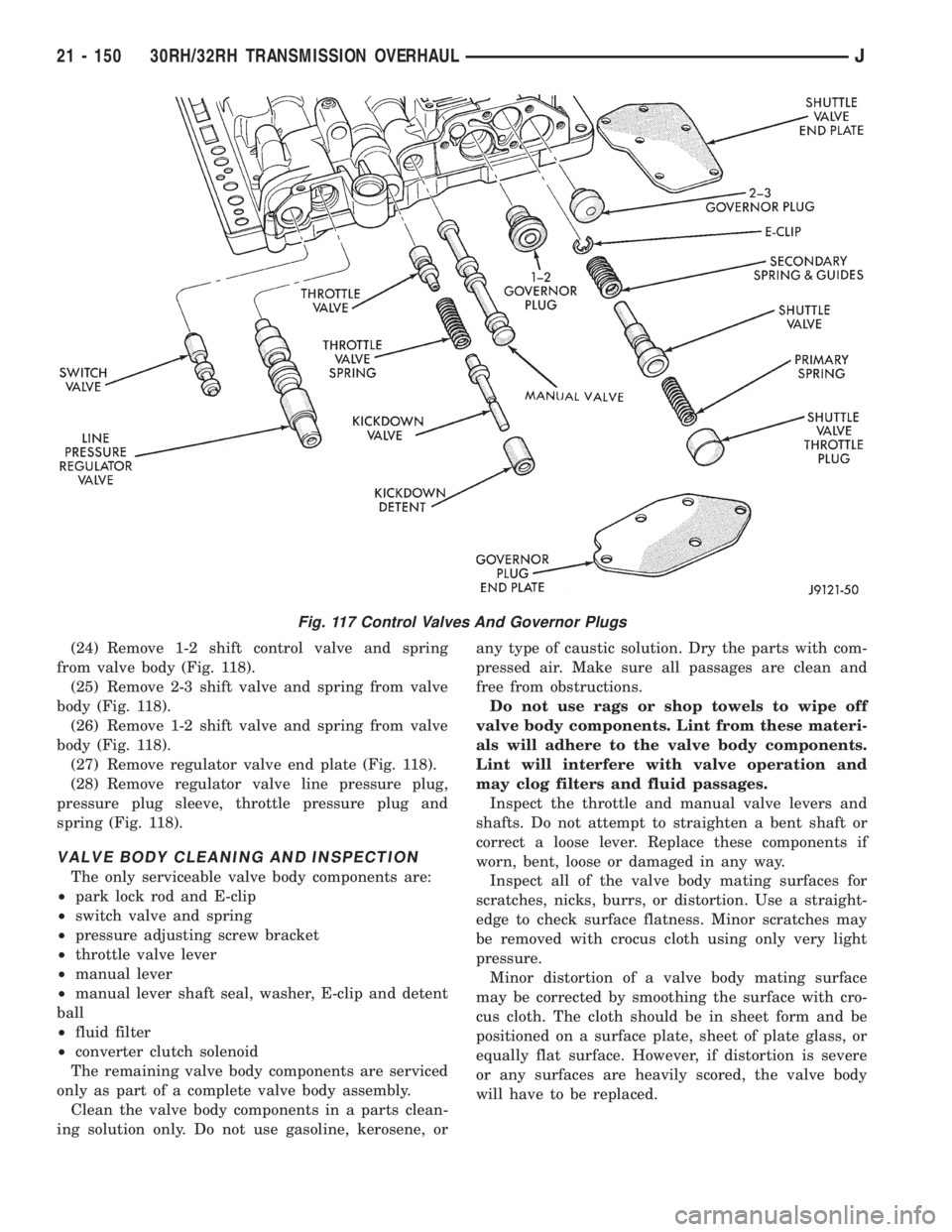
(24) Remove 1-2 shift control valve and spring
from valve body (Fig. 118).
(25) Remove 2-3 shift valve and spring from valve
body (Fig. 118).
(26) Remove 1-2 shift valve and spring from valve
body (Fig. 118).
(27) Remove regulator valve end plate (Fig. 118).
(28) Remove regulator valve line pressure plug,
pressure plug sleeve, throttle pressure plug and
spring (Fig. 118).
VALVE BODY CLEANING AND INSPECTION
The only serviceable valve body components are:
²park lock rod and E-clip
²switch valve and spring
²pressure adjusting screw bracket
²throttle valve lever
²manual lever
²manual lever shaft seal, washer, E-clip and detent
ball
²fluid filter
²converter clutch solenoid
The remaining valve body components are serviced
only as part of a complete valve body assembly.
Clean the valve body components in a parts clean-
ing solution only. Do not use gasoline, kerosene, orany type of caustic solution. Dry the parts with com-
pressed air. Make sure all passages are clean and
free from obstructions.
Do not use rags or shop towels to wipe off
valve body components. Lint from these materi-
als will adhere to the valve body components.
Lint will interfere with valve operation and
may clog filters and fluid passages.
Inspect the throttle and manual valve levers and
shafts. Do not attempt to straighten a bent shaft or
correct a loose lever. Replace these components if
worn, bent, loose or damaged in any way.
Inspect all of the valve body mating surfaces for
scratches, nicks, burrs, or distortion. Use a straight-
edge to check surface flatness. Minor scratches may
be removed with crocus cloth using only very light
pressure.
Minor distortion of a valve body mating surface
may be corrected by smoothing the surface with cro-
cus cloth. The cloth should be in sheet form and be
positioned on a surface plate, sheet of plate glass, or
equally flat surface. However, if distortion is severe
or any surfaces are heavily scored, the valve body
will have to be replaced.
Fig. 117 Control Valves And Governor Plugs
21 - 150 30RH/32RH TRANSMISSION OVERHAULJ
Page 1731 of 2158
The rear planetary ring gear is splined to the out-
put shaft. The front planetary carrier and rear car-
rier ring gear are meshed and rotate as a unit with
the output shaft.
GEARTRAIN OPERATION AND APPLICATION
CHARTS
Operation and application of the first through
fourth and reverse gear elements are outlined in the
function and application charts.
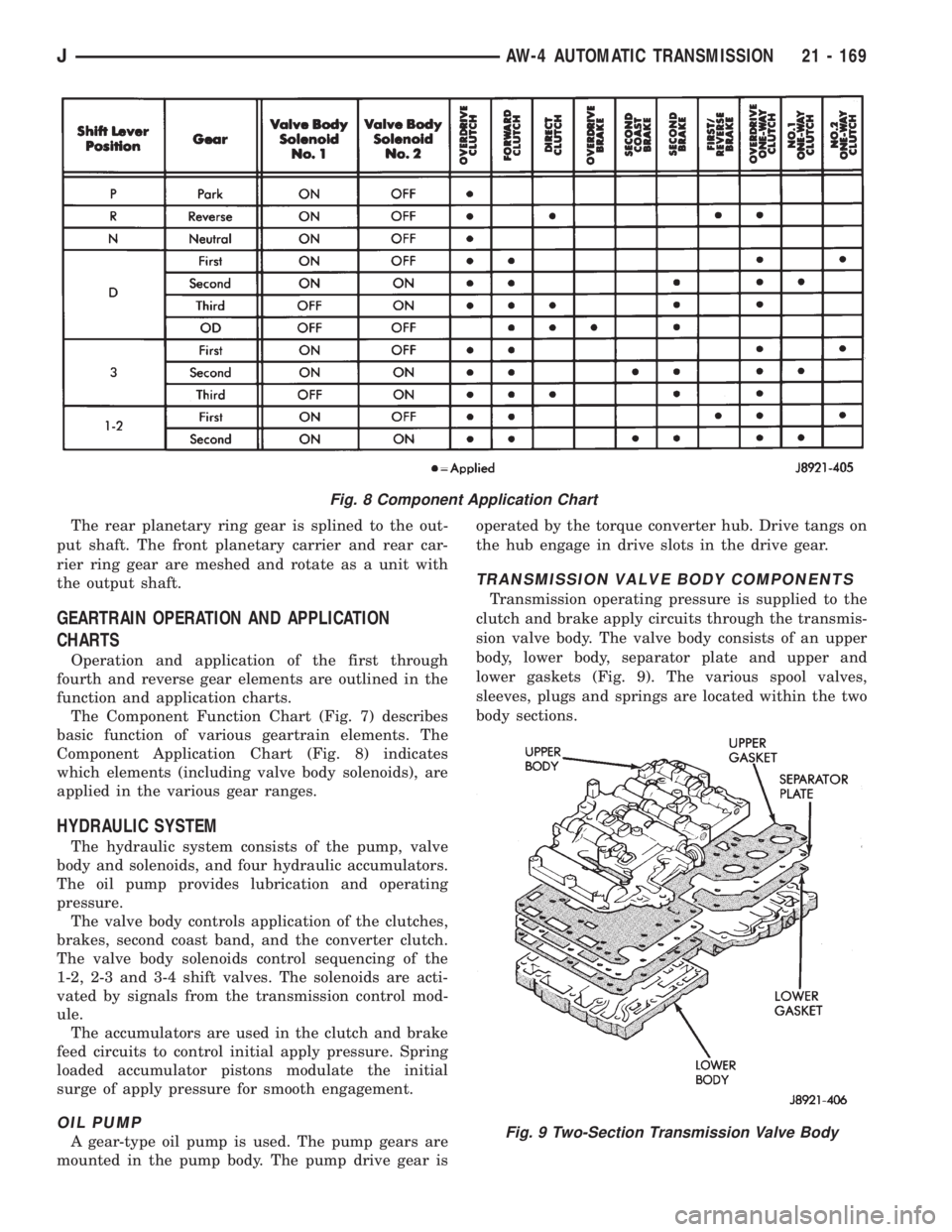
The Component Function Chart (Fig. 7) describes
basic function of various geartrain elements. The
Component Application Chart (Fig. 8) indicates
which elements (including valve body solenoids), are
applied in the various gear ranges.
HYDRAULIC SYSTEM
The hydraulic system consists of the pump, valve
body and solenoids, and four hydraulic accumulators.
The oil pump provides lubrication and operating
pressure.
The valve body controls application of the clutches,
brakes, second coast band, and the converter clutch.
The valve body solenoids control sequencing of the
1-2, 2-3 and 3-4 shift valves. The solenoids are acti-
vated by signals from the transmission control mod-
ule.
The accumulators are used in the clutch and brake
feed circuits to control initial apply pressure. Spring
loaded accumulator pistons modulate the initial
surge of apply pressure for smooth engagement.
OIL PUMP
A gear-type oil pump is used. The pump gears are
mounted in the pump body. The pump drive gear isoperated by the torque converter hub. Drive tangs on
the hub engage in drive slots in the drive gear.
TRANSMISSION VALVE BODY COMPONENTS
Transmission operating pressure is supplied to the
clutch and brake apply circuits through the transmis-
sion valve body. The valve body consists of an upper
body, lower body, separator plate and upper and
lower gaskets (Fig. 9). The various spool valves,
sleeves, plugs and springs are located within the two
body sections.
Fig. 8 Component Application Chart
Fig. 9 Two-Section Transmission Valve Body
JAW-4 AUTOMATIC TRANSMISSION 21 - 169
Page 1908 of 2158
TIRE CHAINS
Tire snow chains may be used on certain models.
Refer to Owner's Manual for more information.
CLEANING OF TIRES
Steam cleaning may be used for cleaning.
DO NOT use gasoline or wire brush for cleaning.
DO NOT use mineral oil or an oil-based solvent.
PRESSURE GAUGES
High-quality, dial-type, air-pressure gauges are rec-
ommended. After checking with the gauge, replace
valve cap and finger tight.
TIRE INFLATION PRESSURES
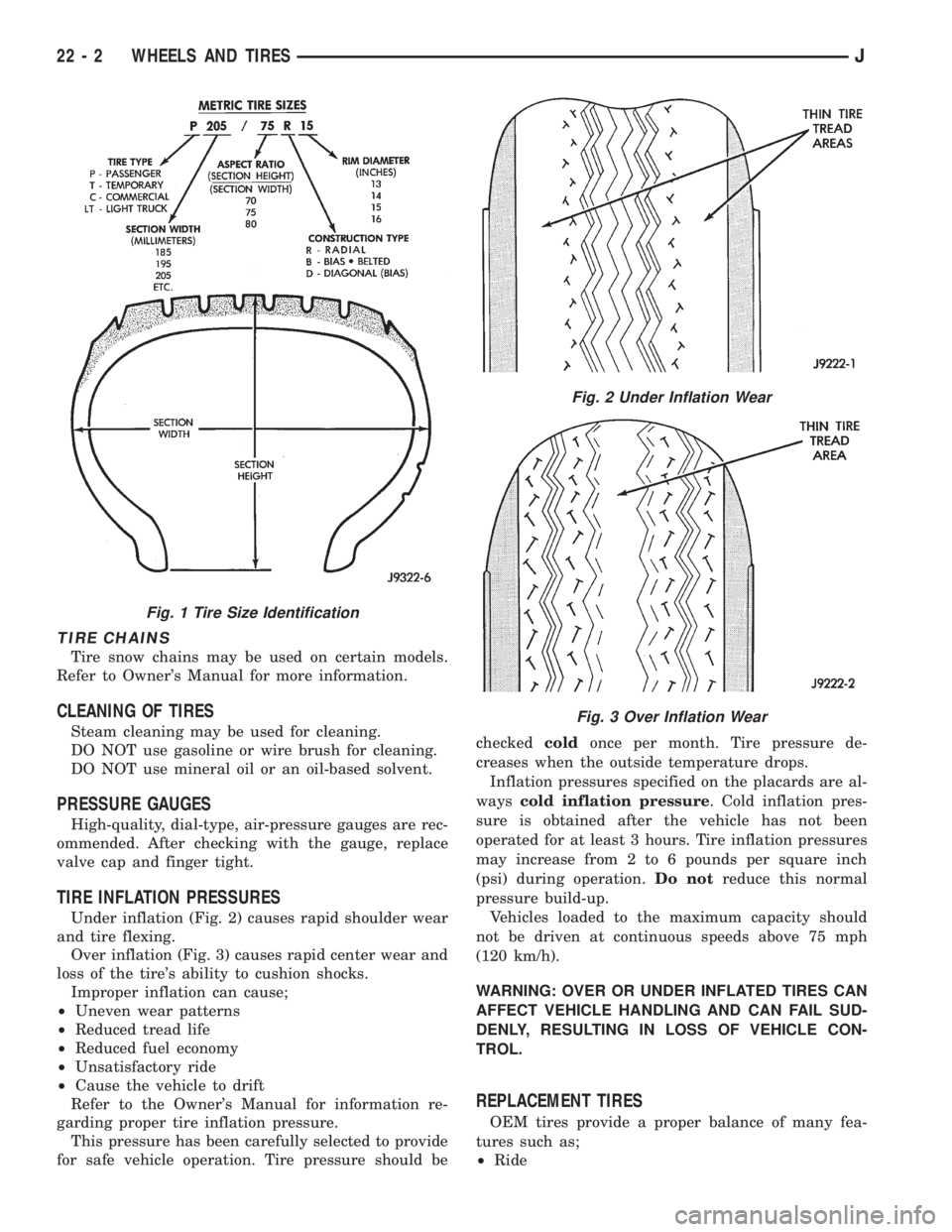
Under inflation (Fig. 2) causes rapid shoulder wear
and tire flexing.
Over inflation (Fig. 3) causes rapid center wear and
loss of the tire's ability to cushion shocks.
Improper inflation can cause;
²Uneven wear patterns
²Reduced tread life
²Reduced fuel economy
²Unsatisfactory ride
²Cause the vehicle to drift
Refer to the Owner's Manual for information re-
garding proper tire inflation pressure.
This pressure has been carefully selected to provide
for safe vehicle operation. Tire pressure should becheckedcoldonce per month. Tire pressure de-
creases when the outside temperature drops.
Inflation pressures specified on the placards are al-
wayscold inflation pressure. Cold inflation pres-
sure is obtained after the vehicle has not been
operated for at least 3 hours. Tire inflation pressures
may increase from 2 to 6 pounds per square inch
(psi) during operation.Do notreduce this normal
pressure build-up.
Vehicles loaded to the maximum capacity should
not be driven at continuous speeds above 75 mph
(120 km/h).
WARNING: OVER OR UNDER INFLATED TIRES CAN
AFFECT VEHICLE HANDLING AND CAN FAIL SUD-
DENLY, RESULTING IN LOSS OF VEHICLE CON-
TROL.
REPLACEMENT TIRES
OEM tires provide a proper balance of many fea-
tures such as;
²Ride
Fig. 1 Tire Size Identification
Fig. 2 Under Inflation Wear
Fig. 3 Over Inflation Wear
22 - 2 WHEELS AND TIRESJ
Page 2087 of 2158
EVAPORATOR COIL:The coil is located in the
A/C housing. Its function is to remove heat and de-
humidify the air before it enters the vehicle.
FIN SENSING CYCLING CLUTCH SWITCH:
The switch is attached to the evaporator coil with the
temperature sensing probe inserted into the coil fins.
This switch controls evaporator temperature and pre-
vents condensate water on the evaporator coil from
freezing. It does this by sending signals to the Pow-
ertrain Control Module (PCM) to cycling the com-
pressor clutch on and off. This switch is used onXJ
only.
FILTER-DRIER:The drier is used to remove any
traces of moisture from the refrigerant system. A
sight glass is located on top of the filter drier. It is
used as a diagnostic tool to observe refrigerant flow.
HIGH PRESSURE RELIEF VALVE:The valve is
located on the filter drier. The valve is used to pre-
vent excessive high pressure build of 3445 to 4135
kPa (500 to 600 psi) and above. This prevents dam-
age to the compressor and other system components.
LOW-PRESSURE HIGH-PRESSURE CUT-OFF
SWITCH:The switch is located on the filter drier
and is wired in series with compressor clutch. When
the pressure drops down to 193 kPa (28 psi) the
switch interrupts the power to the compressor clutch.
When the pressure increases above 3100 to 3375 kPa
(450 to 490 psi) the switch interrupts the power to
the compressor clutch.
THERMOSTAT:The thermostat is located in the
evaporator housing. The thermostat temperature
sensing probe is inserted into the evaporator coil. Its
function is to cycles the compressor clutch on and off.
This switch controls temperature and prevents con-
densate water on the evaporator coil from freezing.
The thermostat is used on theYJonly.
REFRIGERANT LINES:The lines are used to
carry the refrigerant between the various system
components.
SERVICE PORTS:The high pressure service port
is located on the discharge line near the compressor.
The low pressure service port is located on the suc-
tion line near the compressor. These ports are used
to attach A/C gauges. After servicing the refrigerant
system, always install service port caps.
REFRIGERANT
XJ and YJ vehicles use a new type of refrigerant
called R-134a. It is a non-toxic, non-flammable, clear
color-less liquified gas.
R-134a refrigerant is not compatible with R-12 re-
frigerant. A small amount of R-12 in a R-134a system
will cause compressor failure, oil sludge or poor air
conditioning performance.R-134a refrigerant requires a special type of com-
pressor oil (SP20 PAG). When adding oil, make sure
that it is designed to be used in a R-134a system and
the SD7H15 compressor.
Service ports have been designed to ensure that
the system is not accidentally filled with R-12 refrig-
erant.
REFRIGERANT EQUIPMENT
WARNING: EYE PROTECTION MUST BE USED
WHEN SERVICING AN AIR CONDITIONING REFRIG-
ERANT SYSTEM. TURN OFF (ROTATE CLOCKWISE)
ALL VALVES ON THE EQUIPMENT BEING USED
BEFORE PROCEEDING WITH THIS OPERATION.
PERSONNEL INJURY CAN RESULT.
Chrysler Corporation recommends a (R-134a) recy-
cling device that meets SAE standard J2210 be used
when servicing the refrigerant system. Contact an
automotive service equipment supplier for refrigerant
recycling equipment that is available in your area.
Refer to the operating instructions provided with the
recycling equipment for proper operation.
MANIFOLD GAUGE SET
CAUTION: DO NOT use an R-12 manifold gauge set
on an R-134a system. The refrigerants are not com-
patible and system damage will result.
A manifold gauge set (Fig. 1) may be needed in
conjunction with the charging and or recovery/recy-
cling device. The service hoses on the gauge set being
used should have manual (turn wheel) or automatic
back flow valves at the service port connector ends.
This will prevent refrigerant from being release into
the atmosphere.
LOW PRESSURE GAUGE HOSE
The low pressure hose (BLUE with BLACK STRIP)
should be attached to the charging/service port. This
port is located at the right front of the engine com-
partment in the condenser-to-evaporator line.
HIGH PRESSURE GAUGE HOSE
The high pressure hose (RED with BLACK STRIP)
should be attached to the discharge/service port. This
port is located on the compressor plumbing or mani-
fold.
RECOVERY/RECYCLING/EVACUATION/
CHARGING HOSE
The center manifold hose (YELLOW or WHITE
with BLACK STRIP) is used to recover, evacuate and
charge the refrigerant system. When the low or high
pressure valves on the manifold gauge set are
opened, the refrigerant in the system will escape
through this hose.
JHEATING AND AIR CONDITIONING 24 - 7
Page 2089 of 2158
WARNINGS, CAUTIONS AND SERVICE PRECAUTIONS
WARNINGS
WARNING: THE AIR CONDITIONING SYSTEM CON-
TAINS REFRIGERANT UNDER HIGH PRESSURE.
SEVERE PERSONAL INJURY MAY RESULT FROM
IMPROPER SERVICE PROCEDURES. REPAIRS
SHOULD ONLY BE PERFORMED BY QUALIFIED
SERVICE PERSONNEL.
WARNING: AVOID BREATHING A/C REFRIGERANT
AND LUBRICANT VAPOR OR MIST. EXPOSURE MAY
IRRITATE EYES, NOSE AND/OR THROAT. WEAR
EYE PROTECTION WHEN SERVICING THE AIR
CONDITIONING REFRIGERANT SYSTEM. SERIOUS
EYE INJURY CAN RESULT FROM EYE CONTACT
WITH REFRIGERANT. IF EYE CONTACT IS MADE,
SEEK MEDICAL ATTENTION IMMEDIATELY.
WARNING: DO NOT EXPOSE REFRIGERANT TO
OPEN FLAME. POISONOUS GAS IS CREATED
WHEN REFRIGERANT IS BURNED. AN ELEC-
TRONIC TYPE LEAK DETECTOR IS RECOM-
MENDED.
WARNING: IF ACCIDENTAL SYSTEM DISCHARGE
OCCURS, VENTILATE THE WORK AREA BEFORE
RESUMING SERVICE. LARGE AMOUNTS OF RE-
FRIGERANT RELEASED IN A CLOSED WORK AREA
WILL DISPLACE THE OXYGEN AND CAUSE SUFFO-
CATION.
WARNING: THE EVAPORATION RATE OF (R-134A)
REFRIGERANT AT AVERAGE TEMPERATURE AND
ALTITUDE IS EXTREMELY HIGH. AS A RESULT,
ANYTHING THAT COMES IN CONTACT WITH THE
REFRIGERANT WILL FREEZE. ALWAYS PROTECT
SKIN OR DELICATE OBJECTS FROM DIRECT CON-
TACT WITH REFRIGERANT.
WARNING: R-134A SERVICE EQUIPMENT OR VEHI-
CLE A/C SYSTEM SHOULD NOT BE PRESSURE
TESTED OR LEAK TESTED WITH COMPRESSED
AIR. SOME MIXTURES OF AIR AND R-134A HAVE
BEEN SHOWN TO BE COMBUSTIBLE AT ELEVATED
PRESSURES. THESE MIXTURES ARE POTENTIALLY
DANGEROUS AND MAY RESULT IN FIRE OR EX-
PLOSION CAUSING INJURY OR PROPERTY DAM-
AGE.
CAUTIONS
CAUTION: Liquid refrigerant is corrosive to metal
surfaces. Follow the operating instructions supplied
with equipment being used.
CAUTION: DO NOT use R-12 equipment or parts on
the R-134a system. Damage to the system will re-
sult.
CAUTION: Never add R-12 to a system designed to
use R-134a. Damage to the system will result.
CAUTION: R-12 compressor oil can not be mixed
with the R-134a compressor oil. They ARE NOT
compatible.
CAUTION: Do not over charge refrigerant system.
This will cause excessive compressor head pres-
sure and can cause noise and system failure.
SERVICE PRECAUTIONS
Recover the refrigerant before opening any fitting
or connection. Open fittings with caution even after
the system has been discharged. Never open or
loosen a connection before recovering the refrigerant.
The A/C system must always be evacuated before
charging.
DO NOT open the refrigerant system or uncap a
replacement component until you are ready to service
the system. This will prevent contamination in the
system.
Before disconnecting a component clean the outside
of the fittings thoroughly to prevent contamination
entering the system.
Immediately after disconnecting a component from
the system, seal the open fittings with a cap or plug.
Before connecting an open fitting always install a
new seal/gasket. Coat the fitting and seal with clean
refrigerant oil before connecting.
When installing a refrigerant line avoid sharp
bends. Position the lines away from the exhaust or
any sharp edges which may chafe the line.
Tighten fittings only to the specified torque. The
aluminum fittings used in the A/C system will not
tolerate over tightening.
When disconnecting a fitting use a wrench on both
halves of the fitting. This will prevent twisting of the
refrigerant lines or tubes.
Refrigerant oil absorbs moisture from the atmo-
sphere if left uncapped. DO NOT open a container of
JHEATING AND AIR CONDITIONING 24 - 9
Page 2155 of 2158
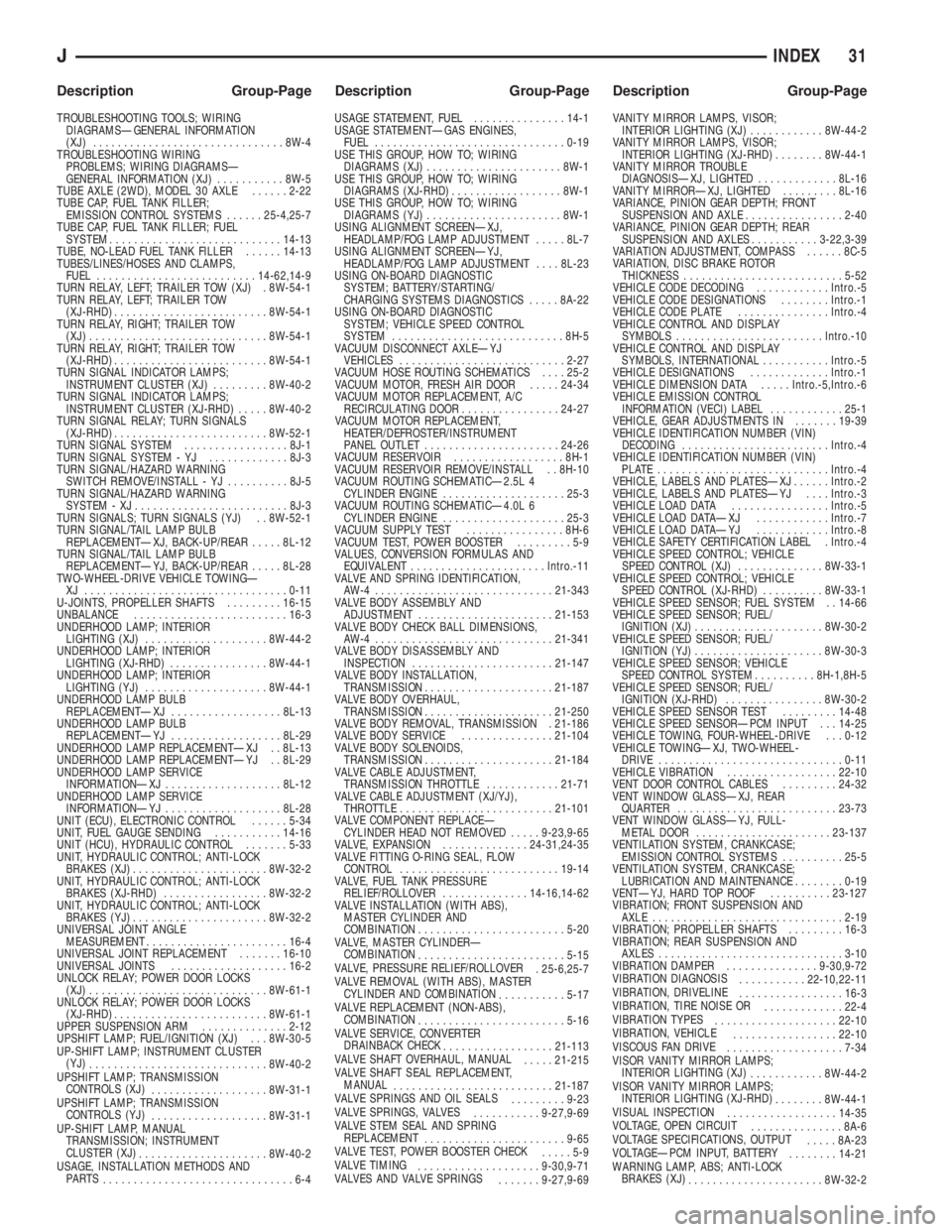
TROUBLESHOOTING TOOLS; WIRING
DIAGRAMSÐGENERAL INFORMATION
(XJ)...............................8W-4
TROUBLESHOOTING WIRING
PROBLEMS; WIRING DIAGRAMSÐ
GENERAL INFORMATION (XJ)...........8W-5
TUBE AXLE (2WD), MODEL 30 AXLE......2-22
TUBE CAP, FUEL TANK FILLER;
EMISSION CONTROL SYSTEMS......25-4,25-7
TUBE CAP, FUEL TANK FILLER; FUEL
SYSTEM............................14-13
TUBE, NO-LEAD FUEL TANK FILLER......14-13
TUBES/LINES/HOSES AND CLAMPS,
FUEL..........................14-62,14-9
TURN RELAY, LEFT; TRAILER TOW (XJ) . 8W-54-1
TURN RELAY, LEFT; TRAILER TOW
(XJ-RHD).........................8W-54-1
TURN RELAY, RIGHT; TRAILER TOW
(XJ).............................8W-54-1
TURN RELAY, RIGHT; TRAILER TOW
(XJ-RHD).........................8W-54-1
TURN SIGNAL INDICATOR LAMPS;
INSTRUMENT CLUSTER (XJ).........8W-40-2
TURN SIGNAL INDICATOR LAMPS;
INSTRUMENT CLUSTER (XJ-RHD).....8W-40-2
TURN SIGNAL RELAY; TURN SIGNALS
(XJ-RHD).........................8W-52-1
TURN SIGNAL SYSTEM.................8J-1
TURN SIGNAL SYSTEM - YJ.............8J-3
TURN SIGNAL/HAZARD WARNING
SWITCH REMOVE/INSTALL - YJ..........8J-5
TURN SIGNAL/HAZARD WARNING
SYSTEM - XJ..........................8J-3
TURN SIGNALS; TURN SIGNALS (YJ) . . 8W-52-1
TURN SIGNAL/TAIL LAMP BULB
REPLACEMENTÐXJ, BACK-UP/REAR.....8L-12
TURN SIGNAL/TAIL LAMP BULB
REPLACEMENTÐYJ, BACK-UP/REAR.....8L-28
TWO-WHEEL-DRIVE VEHICLE TOWINGÐ
XJ .................................0-11
U-JOINTS, PROPELLER SHAFTS.........16-15
UNBALANCE.........................16-3
UNDERHOOD LAMP; INTERIOR
LIGHTING (XJ)....................8W-44-2
UNDERHOOD LAMP; INTERIOR
LIGHTING (XJ-RHD)................8W-44-1
UNDERHOOD LAMP; INTERIOR
LIGHTING (YJ)....................8W-44-1
UNDERHOOD LAMP BULB
REPLACEMENTÐXJ..................8L-13
UNDERHOOD LAMP BULB
REPLACEMENTÐYJ..................8L-29
UNDERHOOD LAMP REPLACEMENTÐXJ . . 8L-13
UNDERHOOD LAMP REPLACEMENTÐYJ . . 8L-29
UNDERHOOD LAMP SERVICE
INFORMATIONÐXJ...................8L-12
UNDERHOOD LAMP SERVICE
INFORMATIONÐYJ...................8L-28
UNIT (ECU), ELECTRONIC CONTROL......5-34
UNIT, FUEL GAUGE SENDING...........14-16
UNIT (HCU), HYDRAULIC CONTROL.......5-33
UNIT, HYDRAULIC CONTROL; ANTI-LOCK
BRAKES (XJ)......................8W-32-2
UNIT, HYDRAULIC CONTROL; ANTI-LOCK
BRAKES (XJ-RHD).................8W-32-2
UNIT, HYDRAULIC CONTROL; ANTI-LOCK
BRAKES (YJ)......................8W-32-2
UNIVERSAL JOINT ANGLE
MEASUREMENT.......................16-4
UNIVERSAL JOINT REPLACEMENT.......16-10
UNIVERSAL JOINTS...................16-2
UNLOCK RELAY; POWER DOOR LOCKS
(XJ).............................8W-61-1
UNLOCK RELAY; POWER DOOR LOCKS
(XJ-RHD).........................8W-61-1
UPPER SUSPENSION ARM..............2-12
UPSHIFT LAMP; FUEL/IGNITION (XJ) . . . 8W-30-5
UP-SHIFT LAMP; INSTRUMENT CLUSTER
(YJ)
.............................8W-40-2
UPSHIFT LAMP; TRANSMISSION
CONTROLS (XJ)
...................8W-31-1
UPSHIFT LAMP; TRANSMISSION
CONTROLS (YJ)
...................8W-31-1
UP-SHIFT LAMP, MANUAL
TRANSMISSION; INSTRUMENT
CLUSTER (XJ)
.....................8W-40-2
USAGE, INSTALLATION METHODS AND
PARTS
...............................6-4USAGE STATEMENT, FUEL...............14-1
USAGE STATEMENTÐGAS ENGINES,
FUEL...............................0-19
USE THIS GROUP, HOW TO; WIRING
DIAGRAMS (XJ)......................8W-1
USE THIS GROUP, HOW TO; WIRING
DIAGRAMS (XJ-RHD)..................8W-1
USE THIS GROUP, HOW TO; WIRING
DIAGRAMS (YJ)......................8W-1
USING ALIGNMENT SCREENÐXJ,
HEADLAMP/FOG LAMP ADJUSTMENT.....8L-7
USING ALIGNMENT SCREENÐYJ,
HEADLAMP/FOG LAMP ADJUSTMENT....8L-23
USING ON-BOARD DIAGNOSTIC
SYSTEM; BATTERY/STARTING/
CHARGING SYSTEMS DIAGNOSTICS.....8A-22
USING ON-BOARD DIAGNOSTIC
SYSTEM; VEHICLE SPEED CONTROL
SYSTEM............................8H-5
VACUUM DISCONNECT AXLEÐYJ
VEHICLES...........................2-27
VACUUM HOSE ROUTING SCHEMATICS....25-2
VACUUM MOTOR, FRESH AIR DOOR.....24-34
VACUUM MOTOR REPLACEMENT, A/C
RECIRCULATING DOOR................24-27
VACUUM MOTOR REPLACEMENT,
HEATER/DEFROSTER/INSTRUMENT
PANEL OUTLET......................24-26
VACUUM RESERVOIR..................8H-1
VACUUM RESERVOIR REMOVE/INSTALL . . 8H-10
VACUUM ROUTING SCHEMATICÐ2.5L 4
CYLINDER ENGINE....................25-3
VACUUM ROUTING SCHEMATICÐ4.0L 6
CYLINDER ENGINE....................25-3
VACUUM SUPPLY TEST................8H-6
VACUUM TEST, POWER BOOSTER.........5-9
VALUES, CONVERSION FORMULAS AND
EQUIVALENT......................Intro.-11
VALVE AND SPRING IDENTIFICATION,
AW-4 .............................21-343
VALVE BODY ASSEMBLY AND
ADJUSTMENT......................21-153
VALVE BODY CHECK BALL DIMENSIONS,
AW-4 .............................21-341
VALVE BODY DISASSEMBLY AND
INSPECTION.......................21-147
VALVE BODY INSTALLATION,
TRANSMISSION.....................21-187
VALVE BODY OVERHAUL,
TRANSMISSION.....................21-250
VALVE BODY REMOVAL, TRANSMISSION . 21-186
VALVE BODY SERVICE...............21-104
VALVE BODY SOLENOIDS,
TRANSMISSION.....................21-184
VALVE CABLE ADJUSTMENT,
TRANSMISSION THROTTLE............21-71
VALVE CABLE ADJUSTMENT (XJ/YJ),
THROTTLE.........................21-101
VALVE COMPONENT REPLACEÐ
CYLINDER HEAD NOT REMOVED.....9-23,9-65
VALVE, EXPANSION..............24-31,24-35
VALVE FITTING O-RING SEAL, FLOW
CONTROL..........................19-14
VALVE, FUEL TANK PRESSURE
RELIEF/ROLLOVER..............14-16,14-62
VALVE INSTALLATION (WITH ABS),
MASTER CYLINDER AND
COMBINATION........................5-20
VALVE, MASTER CYLINDERÐ
COMBINATION
........................5-15
VALVE, PRESSURE RELIEF/ROLLOVER
. 25-6,25-7
VALVE REMOVAL (WITH ABS), MASTER
CYLINDER AND COMBINATION
...........5-17
VALVE REPLACEMENT (NON-ABS),
COMBINATION
........................5-16
VALVE SERVICE, CONVERTER
DRAINBACK CHECK
..................21-113
VALVE SHAFT OVERHAUL, MANUAL
.....21-215
VALVE SHAFT SEAL REPLACEMENT,
MANUAL
..........................21-187
VALVE SPRINGS AND OIL SEALS
.........9-23
VALVE SPRINGS, VALVES
...........9-27,9-69
VALVE STEM SEAL AND SPRING
REPLACEMENT
.......................9-65
VALVE TEST, POWER BOOSTER CHECK
.....5-9
VALVE TIMING
....................9-30,9-71
VALVES AND VALVE SPRINGS
.......9-27,9-69VANITY MIRROR LAMPS, VISOR;
INTERIOR LIGHTING (XJ)............8W-44-2
VANITY MIRROR LAMPS, VISOR;
INTERIOR LIGHTING (XJ-RHD)........8W-44-1
VANITY MIRROR TROUBLE
DIAGNOSISÐXJ, LIGHTED.............8L-16
VANITY MIRRORÐXJ, LIGHTED.........8L-16
VARIANCE, PINION GEAR DEPTH; FRONT
SUSPENSION AND AXLE................2-40
VARIANCE, PINION GEAR DEPTH; REAR
SUSPENSION AND AXLES...........3-22,3-39
VARIATION ADJUSTMENT, COMPASS......8C-5
VARIATION, DISC BRAKE ROTOR
THICKNESS..........................5-52
VEHICLE CODE DECODING............Intro.-5
VEHICLE CODE DESIGNATIONS........Intro.-1
VEHICLE CODE PLATE...............Intro.-4
VEHICLE CONTROL AND DISPLAY
SYMBOLS........................Intro.-10
VEHICLE CONTROL AND DISPLAY
SYMBOLS, INTERNATIONAL...........Intro.-5
VEHICLE DESIGNATIONS.............Intro.-1
VEHICLE DIMENSION DATA.....Intro.-5,Intro.-6
VEHICLE EMISSION CONTROL
INFORMATION (VECI) LABEL............25-1
VEHICLE, GEAR ADJUSTMENTS IN.......19-39
VEHICLE IDENTIFICATION NUMBER (VIN)
DECODING........................Intro.-4
VEHICLE IDENTIFICATION NUMBER (VIN)
PLATE ............................Intro.-4
VEHICLE, LABELS AND PLATESÐXJ......Intro.-2
VEHICLE, LABELS AND PLATESÐYJ....Intro.-3
VEHICLE LOAD DATA................Intro.-5
VEHICLE LOAD DATAÐXJ............Intro.-7
VEHICLE LOAD DATAÐYJ............Intro.-8
VEHICLE SAFETY CERTIFICATION LABEL . Intro.-4
VEHICLE SPEED CONTROL; VEHICLE
SPEED CONTROL (XJ)..............8W-33-1
VEHICLE SPEED CONTROL; VEHICLE
SPEED CONTROL (XJ-RHD)..........8W-33-1
VEHICLE SPEED SENSOR; FUEL SYSTEM . . 14-66
VEHICLE SPEED SENSOR; FUEL/
IGNITION (XJ).....................8W-30-2
VEHICLE SPEED SENSOR; FUEL/
IGNITION (YJ).....................8W-30-3
VEHICLE SPEED SENSOR; VEHICLE
SPEED CONTROL SYSTEM..........8H-1,8H-5
VEHICLE SPEED SENSOR; FUEL/
IGNITION (XJ-RHD)................8W-30-2
VEHICLE SPEED SENSOR TEST.........14-48
VEHICLE SPEED SENSORÐPCM INPUT . . . 14-25
VEHICLE TOWING, FOUR-WHEEL-DRIVE . . . 0-12
VEHICLE TOWINGÐXJ, TWO-WHEEL-
DRIVE..............................0-11
VEHICLE VIBRATION..................22-10
VENT DOOR CONTROL CABLES.........24-32
VENT WINDOW GLASSÐXJ, REAR
QUARTER..........................23-73
VENT WINDOW GLASSÐYJ, FULL-
METAL DOOR......................23-137
VENTILATION SYSTEM, CRANKCASE;
EMISSION CONTROL SYSTEMS..........25-5
VENTILATION SYSTEM, CRANKCASE;
LUBRICATION AND MAINTENANCE........0-19
VENTÐYJ, HARD TOP ROOF..........23-127
VIBRATION; FRONT SUSPENSION AND
AXLE...............................2-19
VIBRATION; PROPELLER SHAFTS.........16-3
VIBRATION; REAR SUSPENSION AND
AXLES..............................3-10
VIBRATION DAMPER...............9-30,9-72
VIBRATION DIAGNOSIS
...........22-10,22-11
VIBRATION, DRIVELINE
.................16-3
VIBRATION, TIRE NOISE OR
.............22-4
VIBRATION TYPES
....................22-10
VIBRATION, VEHICLE
.................22-10
VISCOUS FAN DRIVE
...................7-34
VISOR VANITY MIRROR LAMPS;
INTERIOR LIGHTING (XJ)
............8W-44-2
VISOR VANITY MIRROR LAMPS;
INTERIOR LIGHTING (XJ-RHD)
........8W-44-1
VISUAL INSPECTION
..................14-35
VOLTAGE, OPEN CIRCUIT
...............8A-6
VOLTAGE SPECIFICATIONS, OUTPUT
.....8A-23
VOLTAGEÐPCM INPUT, BATTERY
........14-21
WARNING LAMP, ABS; ANTI-LOCK
BRAKES (XJ)
......................8W-32-2
JINDEX 31
Description Group-Page Description Group-Page Description Group-Page