light KIA Amanti 2004 1.G User Guide
[x] Cancel search | Manufacturer: KIA, Model Year: 2004, Model line: Amanti, Model: KIA Amanti 2004 1.GPages: 296, PDF Size: 29.34 MB
Page 53 of 296
Knowing your vehicle42
3
1
2
3
4
5
6
7
8
9
WARNING
- Safety belt
care
A damaged belt may not give
you the protection you need in
an accident.
Inspect your safety belts peri-
odically for excessive wear or
damage. Pull out each belt
fully and look for fraying, cuts,
burns or other damage. Pull
the safety belt out and let it
retract a number of times.
Make sure that the lap/shoul-
der belts return smoothly and
easily into the retractor.
Check the latches to make
sure they latch and release
without interference or delay.
Never close the doors on any
part of the lap or shoulder
belt.
Any belt not in good condition
or in good working order
should be promptly replaced.
CAUTION
Never close the doors on any
part of the lap or shoulder belt.It can damage the safety belt orbuckle which could increase therisk of injury in case of an acci-dent.
Safety belt warning light and
chimeAs a reminder to the driver and pas-
senger, safety belt warning light will
blink for approximately 6 seconds
each time you turn the ignition switch
ON.
If the driver’s lap/shoulder belt is not
fastened when the key is turned ON,
the safety belt warning chime sounds
and the safety belt warning light
blinks for approximately 6 seconds.
1GQA2083
Opirus-ENG (CAN) 3.qxd 7/8/03 1:56 PM Page 42
Page 60 of 296
349
1
2
3
4
5
6
7
8
9
Knowing your vehicle
Restraint of larger children As children grow, they may need to
use new child-restraint systems,
including larger child seats or boost-
er seats, which are appropriate for
their increased size.
A child who has outgrown available
child-restraint systems should use
the belts provided in the vehicle.
When seated in the rear outboard
seats, the child should be restrained
by the lap/shoulder belt.
If the shoulder belt portion slightly
touches the child’s neck or face, try
placing the child closer to the center
of the vehicle. If the shoulder belt still
touches their face or neck they may
need to be returned to a child
restraint system. In addition, after-
market devices are available from
independent manufacturers which
help pull the shoulder belt down and
away from the child’s face or neck.
Larger children should use one of
the seat belts provided.
WARNING
- Shoulder
belts on small children
Never allow a shoulder belt to
be in contact with a child’ s
neck or face while the vehicle
is in motion.
A child too large for a child
restraint but too small for the
vehicle safety belts should
use an approved belt-position-
ing booster seat. This is safer
than allowing a child to ride
with a shoulder belt that
touches their face or neck.
If safety belts are not properly
worn and adjusted, there is a
risk of death or serious injury
to such a child.
CAUTION
- Hot metal
parts
Safety belts and seats canbecome hot in a vehicle that hasbeen closed during warm/hotweather; they could burn achild. Check seat covers andbuckles before you place a childanywhere near them.
Opirus-ENG (CAN) 3.qxd 7/8/03 1:56 PM Page 49
Page 72 of 296

361
1
2
3
4
5
6
7
8
9
Knowing your vehicle
➀
Driver’s airbag
(see page 3- 63)
➁
Front passenger’ s airbag
(see page 3- 64)
➂
Side airbag (see page 3- 66)
➃
Curtain Airbag(see page 3- 66)
➄ Front impact sensor
(see page 3- 68)
\b
Side impact sensor(see page 3- 68)
➆
SRS Control Module(see page 3- 68)
Airbag inflation condition(see page 3- 69)
Airbag non-inflation condition(see page 3- 71)
Airbag warning light(see page 3- 76)
Airbag service(see page 3- 76)
Airbag warning label(see page 3- 78)
What your airbag system doesDriver’s airbag and front passenger’ s
airbag are designed to supplement
the protection offered by the safety
belt in certain frontal collisions.
Likewise, side airbag and curtain
airbags are designed to supplement
the protection offered by the safety
belt in side collisions. Safety belts
are designed to reduce the injury of
the driver or passengers in case of
light impact or collision. However, to
help reduce impact on driver or pas-
sengers in a serious collision, seat
belts must also be correctly worn.
What your airbag system does
not doThe air bag system is designed to
supplement the protection offered by
the safety belt system. IT IS NOT A
SUBSTITUTE FOR THE SAFETY
BELT.
Opirus-ENG (CAN) 3.qxd 7/8/03 1:56 PM Page 61
Page 74 of 296
363
1
2
3
4
5
6
7
8
9
Knowing your vehicle
Airbag system components The main components of your SRS
are:
To indicate that your vehicle is
equipped with airbags, the corre-
sponding airbag covers are
marked with “SRS AIRBAG”.
- Driver’ s airbag (see page 3- 63)
- Passenger’ s airbag(see page 3- 64)
- Side airbag (see page 3- 66)
- Curtain airbag (see page 3- 66)
A diagnostic system that continual-
ly monitors the system operation.
An indicator light to warn you of a
possible problem with the system.
Emergency power backup in case
your car’ s electrical system is dis-
connected in a crash.
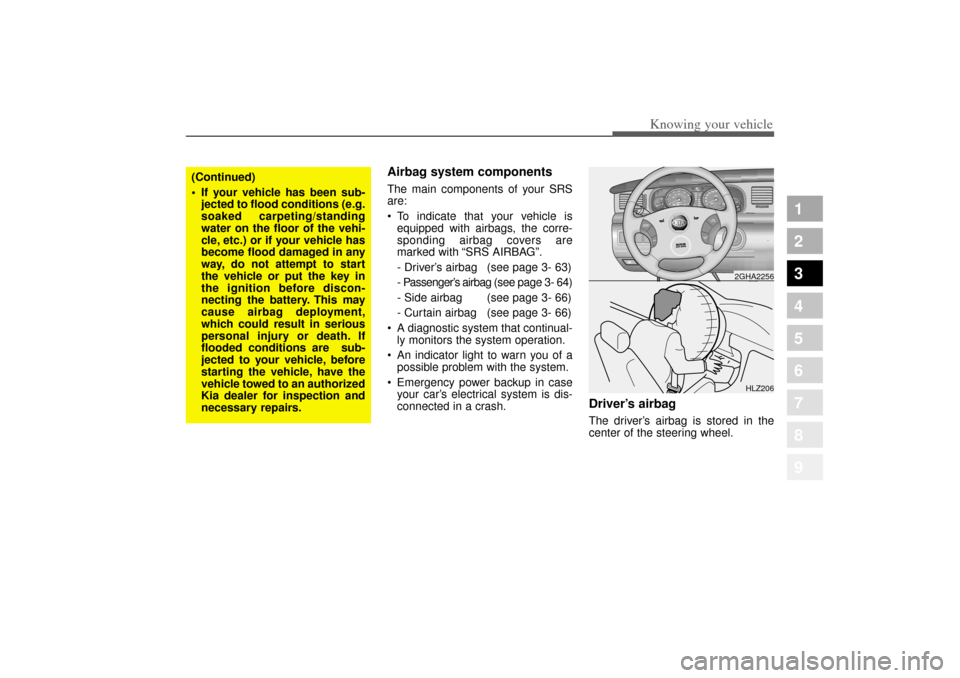
Driver’ s airbagThe driver’ s airbag is stored in the
center of the steering wheel.
CRUISE
ON/OFFCAN CE
L
COAST
SETRES
ACCEL
HLZ206
(Continued)
If your vehicle has been sub-
jected to flood conditions (e.g.
soaked carpeting/standing
water on the floor of the vehi-
cle, etc.) or if your vehicle has
become flood damaged in any
way, do not attempt to start
the vehicle or put the key in
the ignition before discon-
necting the battery. This may
cause airbag deployment,
which could result in serious
personal injury or death. If
flooded conditions are sub-
jected to your vehicle, before
starting the vehicle, have the
vehicle towed to an authorized
Kia dealer for inspection and
necessary repairs.
2GHA2256
Opirus-ENG (CAN) 3.qxd 7/8/03 1:56 PM Page 63
Page 82 of 296
371
1
2
3
4
5
6
7
8
9
Knowing your vehicle
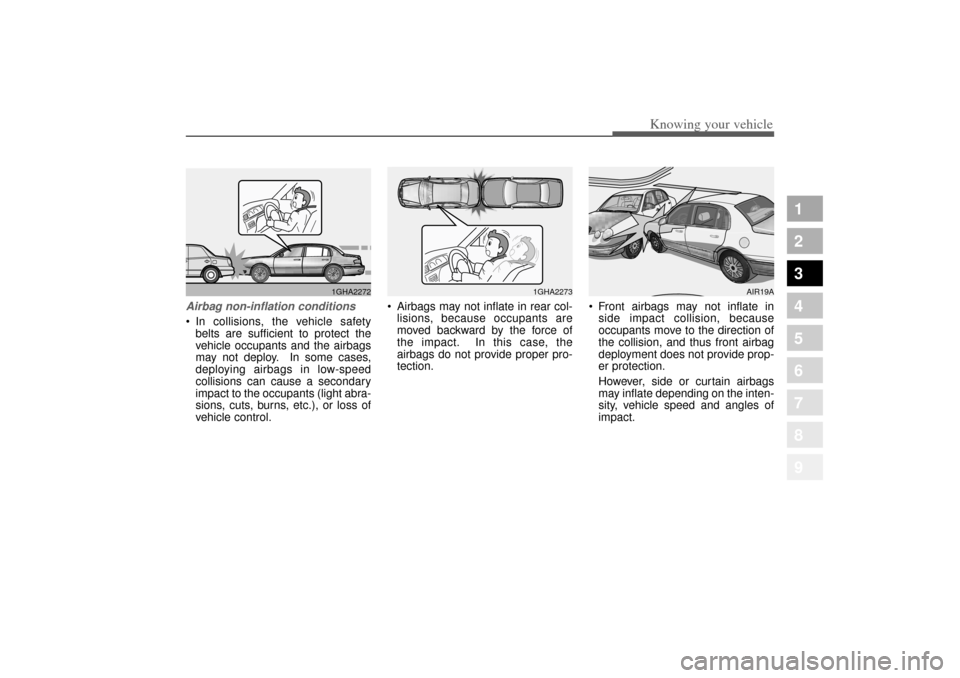
Airbag non-inflation conditionsIn collisions, the vehicle safety
belts are sufficient to protect the
vehicle occupants and the airbags
may not deploy. In some cases,
deploying airbags in low-speed
collisions can cause a secondary
impact to the occupants (light abra-
sions, cuts, burns, etc.), or loss of
vehicle control.
Airbags may not inflate in rear col-
lisions, because occupants are
moved backward by the force of
the impact. In this case, the
airbags do not provide proper pro-
tection.
Front airbags may not inflate in
side impact collision, because
occupants move to the direction of
the collision, and thus front airbag
deployment does not provide prop-
er protection.
However, side or curtain airbags
may inflate depending on the inten-
sity, vehicle speed and angles of
impact.
1GHA2273
1GHA2272
AIR19A
Opirus-ENG (CAN) 3.qxd 7/8/03 1:56 PM Page 71
Page 87 of 296
Knowing your vehicle76
3
1
2
3
4
5
6
7
8
9
Airbag warning lightThe purpose of airbag warning light
in your instrument panel is to alert
you of a potential problem with your
airbag - Supplemental Restraint
System (SRS). When the ignition switch is turned
ON, the indicator light should blink or
illuminate for approximately 6 sec-
onds, then go off.
Have the system checked if:
The light does not turn on briefly
when you turn the ignition ON.
The light stays on after the engine
starts.
The light comes on while the vehi-
cle is in motion.
Airbag (Supplemental
Restraint System) service Your Supplemental Restraint System
is virtually maintenance-free. There
are no parts which you can service.
You must have the system serviced
under the following circumstances:
If an airbag ever inflates, the airbag
must be replaced. Do not try to
remove or discard the airbag by
yourself. This must be done by an
authorized Kia dealer or service
representative
If the airbag warning indicator light
alerts you to a problem, have the
airbag system checked as soon as
possible. Otherwise, your airbag
system may be ineffective.
The entire SRS system must be
inspected by an authorized Kia deal-
er in 10 years after the vehicle man-
ufacture date.
AIR
BAG
Opirus-ENG (CAN) 3.qxd 7/8/03 1:56 PM Page 76
Page 94 of 296
383
1
2
3
4
5
6
7
8
9
Knowing your vehicle
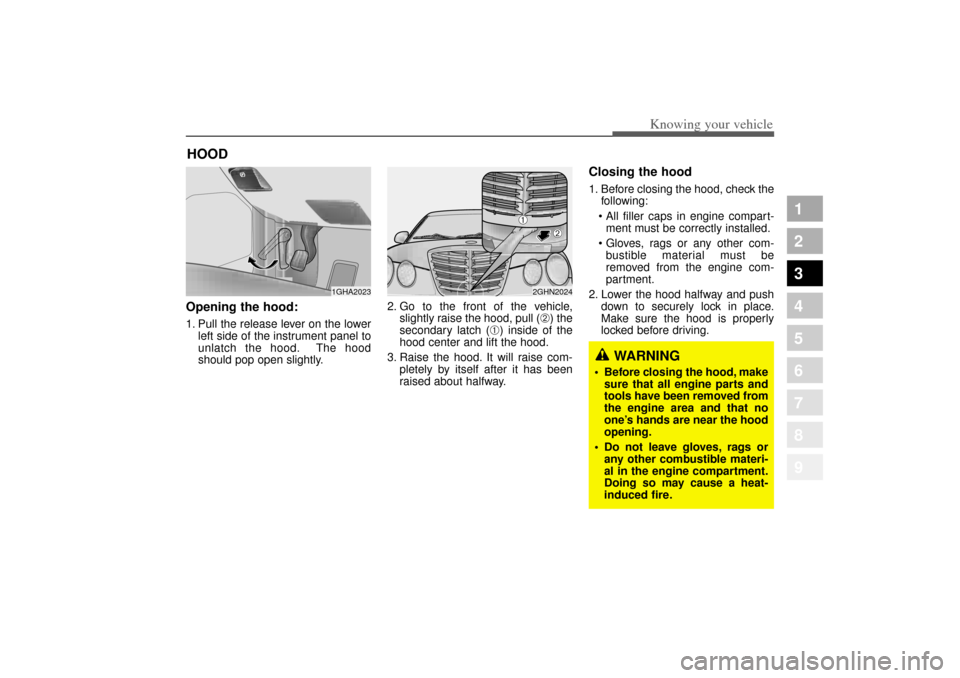
Opening the hood:1. Pull the release lever on the lowerleft side of the instrument panel to
unlatch the hood. The hood
should pop open slightly. 2. Go to the front of the vehicle,
slightly raise the hood, pull (
➁) the
secondary latch (
➀) inside of the
hood center and lift the hood.
3. Raise the hood. It will raise com- pletely by itself after it has been
raised about halfway.
Closing the hood1. Before closing the hood, check thefollowing:
All filler caps in engine compart- ment must be correctly installed.
Gloves, rags or any other com- bustible material must be
removed from the engine com-
partment.
2. Lower the hood halfway and push down to securely lock in place.
Make sure the hood is properly
locked before driving.
HOOD
1GHA2023
2GHN2024
➀
➁
WARNING
Before closing the hood, make
sure that all engine parts and
tools have been removed from
the engine area and that no
one’ s hands are near the hood
opening.
Do not leave gloves, rags or
any other combustible materi-
al in the engine compartment.
Doing so may cause a heat-
induced fire.
Opirus-ENG (CAN) 3.qxd 7/8/03 1:56 PM Page 83
Page 95 of 296
Knowing your vehicle84
3
1
2
3
4
5
6
7
8
9
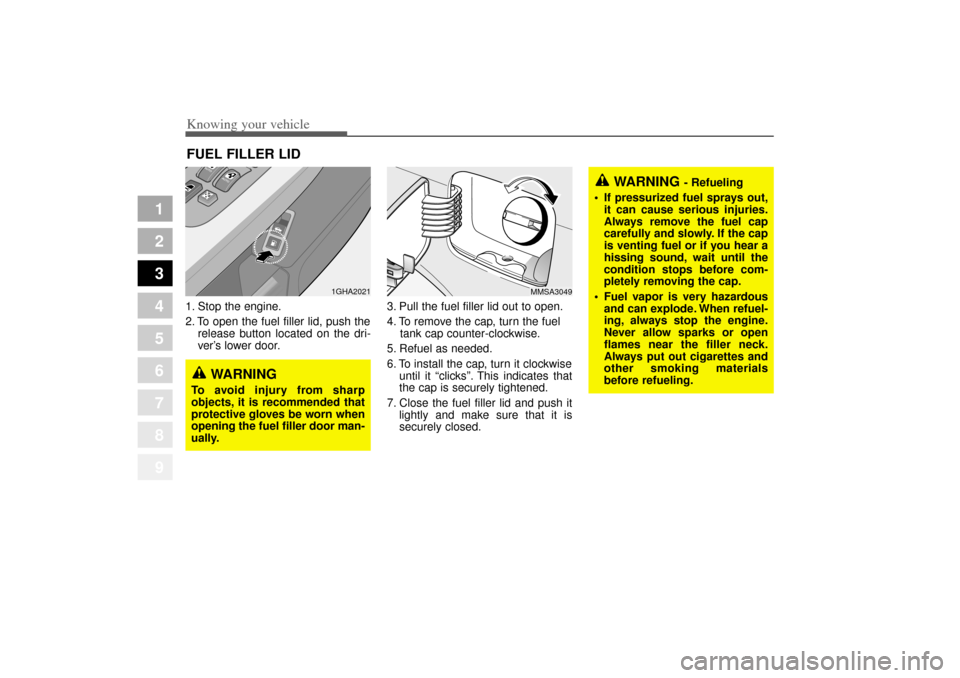
1. Stop the engine.
2. To open the fuel filler lid, push the
release button located on the dri-
ver ’s lower door. 3. Pull the fuel filler lid out to open.
4. To remove the cap, turn the fuel
tank cap counter-clockwise.
5. Refuel as needed.
6. To install the cap, turn it clockwise until it “clicks”. This indicates that
the cap is securely tightened.
7. Close the fuel filler lid and push it lightly and make sure that it is
securely closed.FUEL FILLER LID
1GHA2021
MMSA3049
WARNING
To avoid injury from sharp
objects, it is recommended that
protective gloves be worn when
opening the fuel filler door man-
ually.
WARNING
- Refueling
If pressurized fuel sprays out,
it can cause serious injuries.
Always remove the fuel cap
carefully and slowly. If the cap
is venting fuel or if you hear a
hissing sound, wait until the
condition stops before com-
pletely removing the cap.
Fuel vapor is very hazardous
and can explode. When refuel-
ing, always stop the engine.
Never allow sparks or open
flames near the filler neck.
Always put out cigarettes and
other smoking materials
before refueling.
Opirus-ENG (CAN) 3.qxd 7/8/03 1:56 PM Page 84
Page 96 of 296
385
1
2
3
4
5
6
7
8
9
Knowing your vehicle
✽ ✽NOTICE• Make sure to refuel with gasoline
(unleaded fuel) only for the gaso-
line engine vehicles.
• Check to make sure the fuel filler cap is securely closed after refuel-
ing.
• If the fuel filler cap requires replacement, use only a genuine
Kia cap or the equivalent specified
for your vehicle. An incorrect fuel
filler cap can result in a serious
malfunction of the fuel system or
emission control system. Correct
replacement caps are available at
authorized Kia dealers.
• Do not spill fuel on the exterior surfaces of the vehicle. Any type of
fuel spilled on painted surfaces
may damage the paint. (Continued)(Continued)
• A loose fuel filler cap may cause
the “Check Engine” (Malfunction
Indicator) light in the instrument
panel to illuminate unnecessarily.
• If the fuel filler lid will not open in cold weather because the area
around it is frozen, push or lightly
tap the lid.
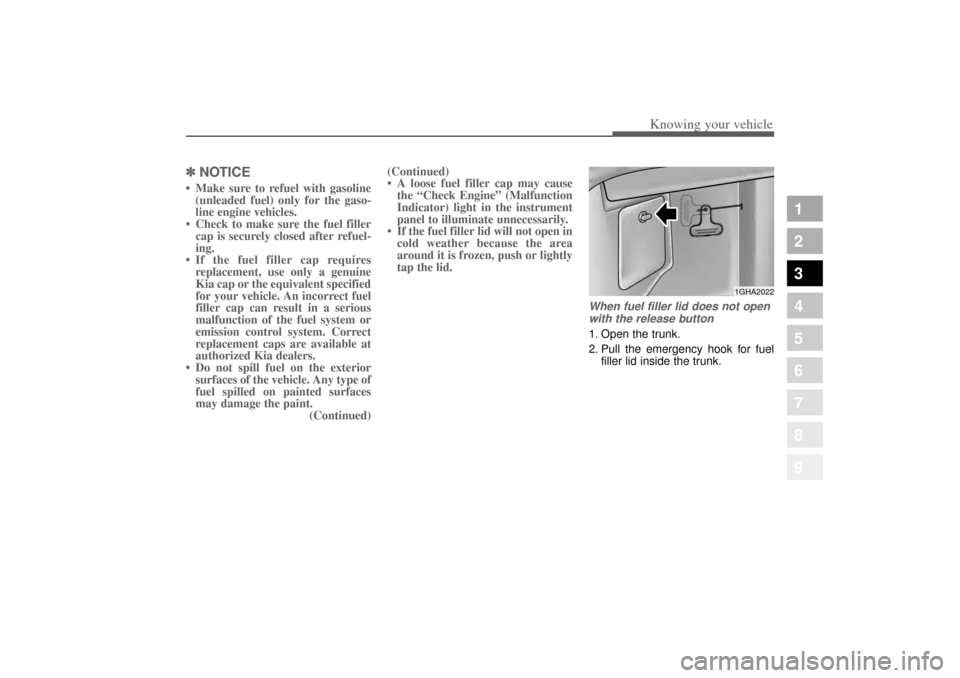
When fuel filler lid does not open
with the release button1. Open the trunk.
2. Pull the emergency hook for fuel filler lid inside the trunk.
1GHA2022
Opirus-ENG (CAN) 3.qxd 7/8/03 1:56 PM Page 85
Page 100 of 296
389
1
2
3
4
5
6
7
8
9
Knowing your vehicle
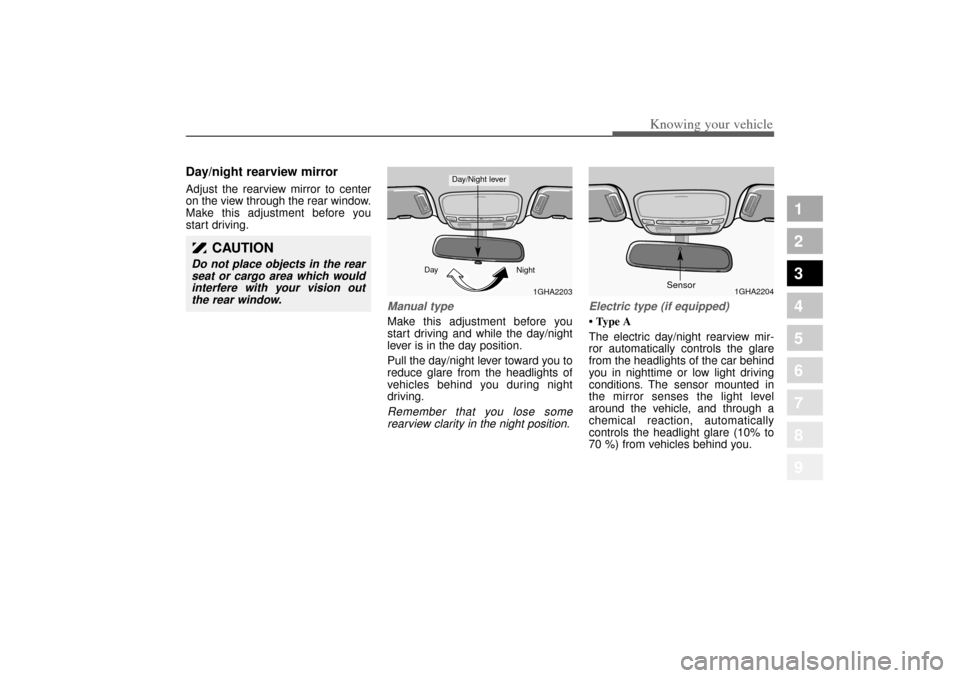
Day/night rearview mirror Adjust the rearview mirror to center
on the view through the rear window.
Make this adjustment before you
start driving.
Manual type Make this adjustment before you
start driving and while the day/night
lever is in the day position.
Pull the day/night lever toward you to
reduce glare from the headlights of
vehicles behind you during night
driving.Remember that you lose somerearview clarity in the night position. Electric type (if equipped)
• Type A
The electric day/night rearview mir-
ror automatically controls the glare
from the headlights of the car behind
you in nighttime or low light driving
conditions. The sensor mounted in
the mirror senses the light level
around the vehicle, and through a
chemical reaction, automatically
controls the headlight glare (10% to
70 %) from vehicles behind you.
1GHA2203
Day
Night
Day/Night lever
1GHA2204
Sensor
CAUTION
Do not place objects in the rear
seat or cargo area which wouldinterfere with your vision outthe rear window.
Opirus-ENG (CAN) 3.qxd 7/8/03 1:56 PM Page 89