light KIA Amanti 2004 1.G Owner's Manual
[x] Cancel search | Manufacturer: KIA, Model Year: 2004, Model line: Amanti, Model: KIA Amanti 2004 1.GPages: 296, PDF Size: 29.34 MB
Page 282 of 296
745
Maintenance
1
2
3
4
5
6
7
8
9
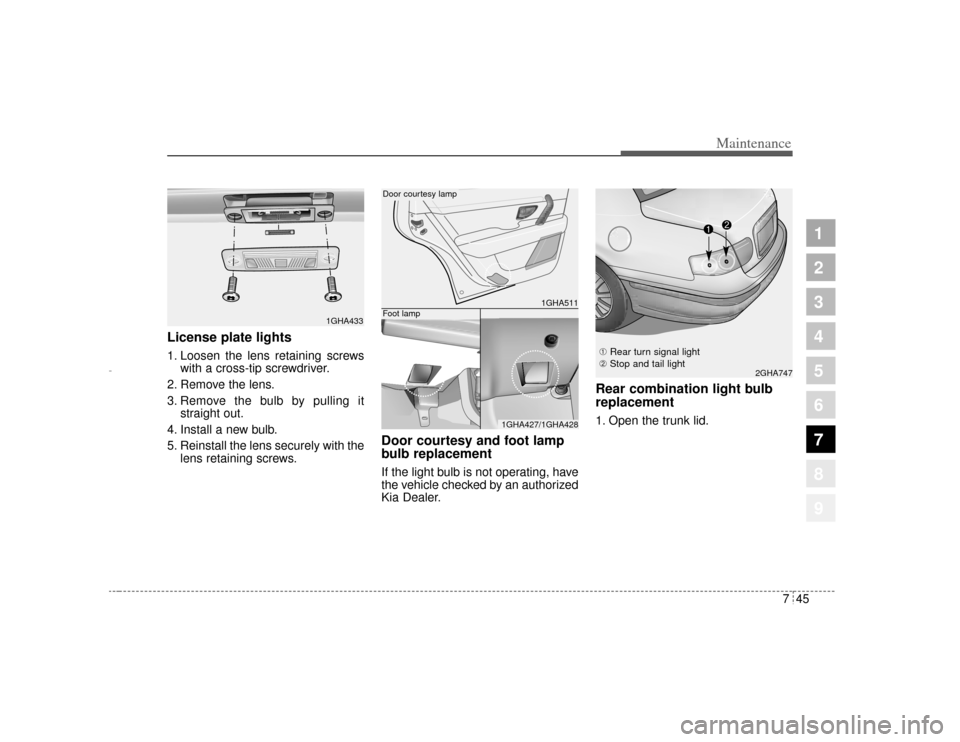
License plate lights 1. Loosen the lens retaining screwswith a cross-tip screwdriver.
2. Remove the lens.
3. Remove the bulb by pulling it straight out.
4. Install a new bulb.
5. Reinstall the lens securely with the lens retaining screws.
Door courtesy and foot lamp
bulb replacementIf the light bulb is not operating, have
the vehicle checked by an authorized
Kia Dealer.
Rear combination light bulb
replacement1. Open the trunk lid.
2GHA747
1GHA433
1GHA511
1GHA427/1GHA428
Door courtesy lampFoot lamp
➀ Rear turn signal light
➁ Stop and tail light
Opirus CAN 7-1.qxd 7/8/03 2:26 PM Page 45
Page 284 of 296
747
Maintenance
1
2
3
4
5
6
7
8
9
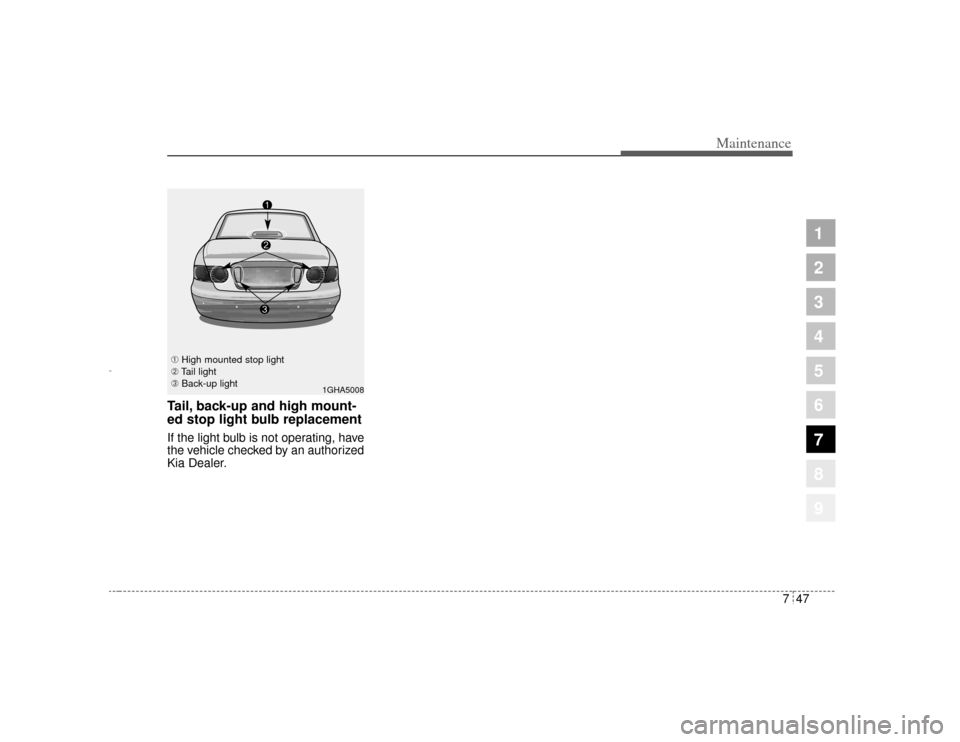
Tail, back-up and high mount-
ed stop light bulb replacementIf the light bulb is not operating, have
the vehicle checked by an authorized
Kia Dealer.➀High mounted stop light
➁ Tail light
➂ Back-up light
1GHA5008
Opirus CAN 7-1.qxd 7/8/03 2:26 PM Page 47
Page 287 of 296
Maintenance50
7
1
2
3
4
5
6
7
8
9
EXTERIOR CARE Exterior general caution It is very important to follow the label
directions when using any chemical
cleaner or polish. Read all warning
and caution statements that appear
on the label.Finish maintenanceWashing To help protect your vehicle’ s finish
from rust and deterioration, wash it
thoroughly and frequently at least
once a month with lukewarm or cold
water.
If you use your vehicle for off-road
driving, you should wash it after each
off-road trip. Pay special attention to
the removal of any accumulation of
salt, dirt, mud, and other foreign
materials. Make sure the drain holes
in the lower edges of the doors and
rocker panels are kept clear and
clean. Insects, tar, tree sap, bird droppings,
industrial pollution and similar
deposits can damage your vehicle’
s
finish if not removed immediately.
Even prompt washing with plain
water may not completely remove all
these deposits. A mild soap, safe for
use on painted surfaces, may be
used.
After washing, rinse the vehicle thor-
oughly with lukewarm or cold water.
Do not allow soap to dry on the fin-
ish.
✽ ✽ NOTICEDo not use strong soap, chemical
detergents or hot water, and do not
wash the vehicle in direct sunlight or
when the body of the vehicle is
warm.
CAUTION
Water washing in the engine
compartment may cause thefailure of electrical circuitslocated in the engine compart-ment.
Pay extreme attention to wash
the engine compartment byusing water.
WARNING
After washing the vehicle, test
the brakes while driving slowly
to see if they have been affected
by water. If braking performance
is impaired, dry the brakes by
applying them lightly while
maintaining a slow forward
speed.
Opirus CAN 7-1.qxd 7/8/03 2:26 PM Page 50
Page 289 of 296
Maintenance52
7
1
2
3
4
5
6
7
8
9
Bright-metal maintenance To remove road tar and insects,
use a tar remover, not a scraper or
other sharp object.
To protect the surfaces of bright-
metal parts from corrosion, apply a
coating of wax or chrome preser-
vative and rub to a high luster.
During winter weather or in coastal
areas, cover the bright metal parts
with a heavier coating of wax or
preservative. If necessary, coat the
parts with non-corrosive petroleum
jelly or other protective compound.
Underbody maintenanceCorrosive materials used for ice and
snow removal and dust control may
collect on the underbody. If these
materials are not removed, acceler-
ated rusting can occur on underbody
parts such as the fuel lines, frame,
floor pan and exhaust system, even
though they have been treated with
rust protection.
Thoroughly flush the vehicle under-
body and wheel openings with luke-
warm or cold water once a month,
after off-road driving and at the end
of each winter. Pay special attention
to these areas because it is difficult
to see all the mud and dirt. It will do
more harm than good to wet down
the road grime without removing it.
The lower edges of doors, rocker
panels, and frame members have
drain holes that should not be
allowed to clog with dirt; trapped
water in these areas can cause rust-
ing.
WARNING
After washing the vehicle, test
the brakes while driving slowly
to see if they have been affected
by water. If braking performance
is impaired, dry the brakes by
applying them lightly while
maintaining a slow forward
speed.
Opirus CAN 7-1.qxd 7/8/03 2:26 PM Page 52
Page 296 of 296
85
1
2
3
4
5
6
7
8
9
Specifications
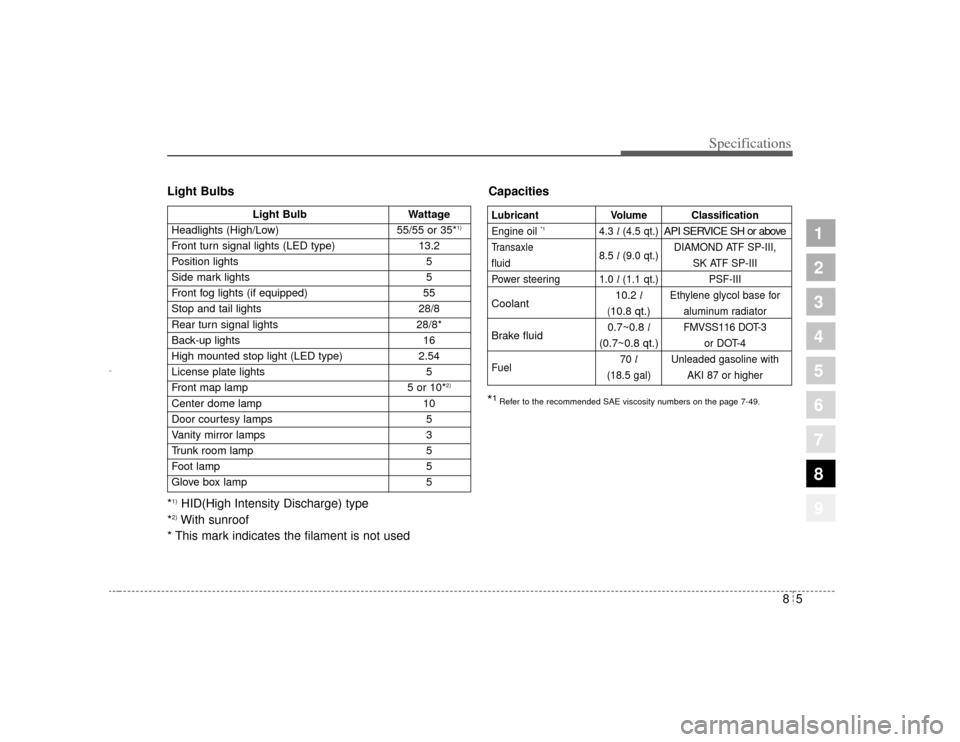
Light Bulbs
*1)HID(High Intensity Discharge) type
*2)With sunroof
* This mark indicates the filament is not used Capacities
Light Bulb
Wattage
Headlights (High/Low) 55/55 or 35*
1)
Front turn signal lights (LED type) 13.2
Position lights 5
Side mark lights 5
Front fog lights (if equipped) 55
Stop and tail lights 28/8
Rear turn signal lights 28/8*
Back-up lights 16
High mounted stop light (LED type) 2.54
License plate lights 5
Front map lamp 5 or 10*
2)
Center dome lamp 10
Door courtesy lamps 5
Vanity mirror lamps 3
Trunk room lamp 5
Foot lamp 5
Glove box lamp 5
LubricantVolume Classification
Engine oil
*1
4.3 l(4.5 qt.)
API SERVICE SH or above
Transaxle
8.5 l(9.0 qt.) DIAMOND ATF SP-III,
fluid SK ATF SP-III
Power steering 1.0 l(1.1 qt.) PSF-III
Coolant 10.2
l
Ethylene glycol base for
(10.8 qt.
) aluminum radiator
Brake fluid 0.7~0.8
l
FMVSS116 DOT-3
(
0.7~0.8 qt.
) or DOT-4
Fuel 70
l Unleaded gasoline with
(18.5 gal) AKI 87 or higher
*¹Refer to the recommended SAE viscosity numbers on the page 7-49.
Opirus CAN 8-1.qxd 7/8/03 2:31 PM Page 5