heating KIA AMANTI 2006 User Guide
[x] Cancel search | Manufacturer: KIA, Model Year: 2006, Model line: AMANTI, Model: KIA AMANTI 2006Pages: 322, PDF Size: 44.16 MB
Page 185 of 322
463
1
2
3
4
5
6
7
8
910
Driving your vehicle
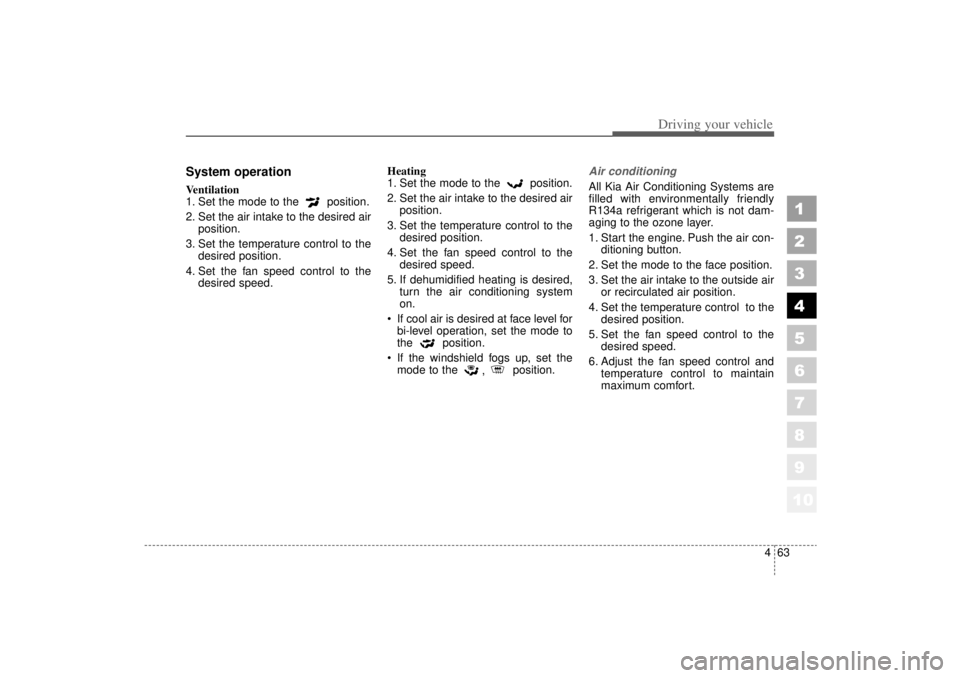
System operationVentilation
1. Set the mode to the position.
2. Set the air intake to the desired airposition.
3. Set the temperature control to the desired position.
4. Set the fan speed control to the desired speed. Heating
1. Set the mode to the position.
2. Set the air intake to the desired air
position.
3. Set the temperature control to the desired position.
4. Set the fan speed control to the desired speed.
5. If dehumidified heating is desired, turn the air conditioning system
on.
If cool air is desired at face level for bi-level operation, set the mode to
the position.
If the windshield fogs up, set the mode to the , position.
Air conditioning All Kia Air Conditioning Systems are
filled with environmentally friendly
R134a refrigerant which is not dam-
aging to the ozone layer.
1. Start the engine. Push the air con-
ditioning button.
2. Set the mode to the face position.
3. Set the air intake to the outside air or recirculated air position.
4. Set the temperature control to the desired position.
5. Set the fan speed control to the desired speed.
6. Adjust the fan speed control and temperature control to maintain
maximum comfort.
Page 186 of 322
Driving your vehicle64
4
1
2
3
4
5
6
7
8
910
If warmer air is desired at floor
level for bi-level operation, set the
mode to the position and
adjust the temperature control to
maintain maximum comfort.
When maximum cooling is desired, set the temperature con-
trol to the Lo (62°F/17°C) and set
the air intake to the recirculated
air position, then set the fan
speed to the highest speed.
✽ ✽NOTICEWhen using the air conditioning sys-
tem, monitor the temperature gauge
closely while driving up hills or in
heavy traffic when outside tempera-
tures are high. Air conditioning sys-
tem operation may cause engine
overheating. Continue to use the
blower fan but turn the air condi-
tioning system off if the temperature
gauge indicates engine overheating.
Air conditioning system oper-
ation tips If the vehicle has been parked in
direct sunlight during hot weather,
open the windows for a short time
to let the hot air inside the vehicle
escape.
To help reduce moisture inside of windows on rainy humid days,
decrease the humidity inside the
vehicle by operating the air condi-
tioning system.
During air conditioning system operation, you may occasionally
notice a slight change in engine
speed at idle as the air condition-
ing compressor cycles on. This is
a normal system operation charac-
teristics.
Page 187 of 322

465
1
2
3
4
5
6
7
8
910
Driving your vehicle
Use the air conditioning systemevery month if only for a few min-
utes to ensure maximum system
performance.
When using the air conditioning system, you may notice clear water
dripping (or even pudding) on the
ground under the passenger side
of the vehicle. This is a normal sys-
tem operation characteristics.
The air conditioning system includes a function that automati-
cally turns the air conditioning
compressor off if engine coolant
temperature approaches an over
heating level. The air conditioning
compressor operation will resume
once engine coolant temperature
returns to the normal range. Also,
the air conditioning compressor is
automatically turned off for a few
seconds when the accelerator is
fully depressed (wide open throt-
tle). When operating the air condition-
ing system use the outside (fresh)
air position.
Operating the air conditioning sys- tem in the recirculated air position
does provide maximum cooling,
however, continual operation in this
mode may cause the air inside the
vehicle to become stale.
Checking the amount of air
conditioner refrigerant and
compressor lubricantWhen the amount of refrigerant is
low, the performance of the air con-
ditioning is reduced. Overfilling also
has a bad influence on the air condi-
tioning system.
Therefore, if abnormal operation is
found, have the system inspected by
an authorized Kia dealer.
Page 199 of 322
57
Driving tips
SPECIAL DRIVING CONDITIONS Hazardous driving conditions When hazardous driving conditions
are encountered such as water,
snow, ice, mud, sand, or similar haz-
ards, follow these suggestions:
Drive cautiously and allow extradistance for braking.
Avoid sudden movements in brak- ing or steering.
When braking, pump the brake pedal with a light up-and-down
motion until the vehicle is stopped.✽ ✽ NOTICEDo not pump the brake pedal on a
vehicle equipped with ABS.
If stalled in snow, mud, or sand,
use second gear. Accelerate slow-
ly to avoid spinning the drive
wheels.
Use sand, rock salt, tire chains, or other non-slip material under the
drive wheels to provide traction
when stalled in ice, snow, or mud.
Rocking the vehicle If it is necessary to rock the vehicle
to free it from snow, sand, or mud,
first turn the steering wheel right and
left to clear the area around your
front wheels. Then, shift back and
forth between R (Reverse) and any
forward gear in vehicles equipped
with an automatic transaxle. Do not
race the engine, and spin the wheels
as little as possible. If you are still
stuck after a few tries, have the vehi-
cle pulled out by a tow vehicle to
avoid engine overheating and possi-
ble damage to the transaxle.
1
2
3
4
5
6
7
8
910
WARNING
- Downshifting
Downshifting with an automatic
transaxle, while driving on slip-
pery surfaces can cause an
accident. The sudden change in
tire speed could cause the tires
to skid. Be careful when down-
shifting on slippery surfaces.
Page 200 of 322
Driving tips85✽
✽NOTICEProlonged rocking may cause engine
over-heating, transaxle damage or
failure, and tire damage.
Driving at night Because night driving presents more
hazards than driving in the daylight,
here are some important tips to
remember:
Slow down and keep more dis-
tance between you and other vehi-
cles, as it may be more difficult to
see at night, especially in areas
where there may not be any street
lights.
Adjust your mirrors to reduce the glare from other driver's head-
lights.
Keep your headlights clean and properly aimed on vehicles not
equipped with the automatic head-
light aiming feature. Dirty or
improperly aimed headlights will
make it much more difficult to see
at night.
Avoid staring directly at the head- lights of oncoming vehicles. You
could be temporarily blinded, and it
will take several seconds for your
eyes to readjust to the darkness.
Driving in the rain Rain and wet roads can make driving
dangerous, especially if you’re not
prepared for the slick pavement.
Here are a few things to consider
when driving in the rain:
A heavy rainfall will make it harderto see and will increase the dis-
tance needed to stop your vehicle,
so slow down.
Keep your windshield wiping equipment in good shape. Replace
your windshield wiper blades when
they show signs of streaking or
missing areas on the windshield.
If your tires are not in good condi- tion, making a quick stop on wet
pavement can cause a skid and
possibly lead to an accident. Be
sure your tires are in good shape.
Turn on your headlights to make it easier for others to see you.
1
2
3
4
5
6
7
8
910
WARNING
- Spinning tires
Do not spin the wheels, espe-
cially at speeds more than 35
mph (56 km/h). Spinning the
wheels at high speeds when the
vehicle is stationary could
cause a tire to overheat, explode
and injure bystanders.
Page 210 of 322
Driving tips18
5
1
2
3
4
5
6
7
8
910
Do not connect a trailer lighting sys-
tem directly to your vehicle’s lighting
system. Use only an approved trailer
wiring harness.
Your Authorized Kia Dealer can
assist you in installing the wiring har-
ness.
Driving on grades Reduce speed and shift to a lower
gear before you start down a long or
steep downgrade. If you don’t shift
down, you might have to use your
brakes so much that they would get
hot and no longer operate efficiently.
On a long uphill grade, shift down
and reduce your speed to around 45
mph (70 km/h) to reduce the possi-
bility of engine and transaxle over-
heating.
If your trailer weighs more than 1000
lbs. (453 kg) and you have an auto-
matic transaxle, you should drive in
D (Drive) when towing a trailer.
Operating your vehicle in D (Drive)
when towing a trailer will minimize
heat buildup and extend the life of
your transaxle.
✽ ✽
NOTICE• When towing a trailer on steep
grades (in excess of 12%) pay close
attention to the engine coolant
temperature gauge to ensure the
engine does not overheat. If the
needle of the coolant temperature
gauge moves across the dial
towards “H” (HOT), pull over and
stop as soon as it is safe to do so,
and allow the engine to idle until it
cools down. You may proceed once
the engine has cooled sufficiently.
• You must decide driving speed depending on trailer weight and
uphill grade to reduce the possibil-
ity of engine and transaxle over-
heating.
CAUTION
Failure to use an approved trail-
er wiring harness could result indamage to the vehicle electricalsystem and/or personal injury.
Page 212 of 322
Driving tips20
5
1
2
3
4
5
6
7
8
910
Maintenance when trailer tow-
ing Your vehicle will need service more
often when you regularly pull a trail-
er. Important items to pay particular
attention include engine oil, automat-
ic transaxle fluid, axle lubricant and
cooling system fluid. Brake condition
is another important item to frequent-
ly check. Each item is covered in this
manual, and the Index will help you
find them quickly. If you’re trailering,
it’s a good idea to review these sec-
tions before you start your trip.
Don’t forget to also maintain your
trailer and hitch. Follow the mainte-
nance schedule that accompanied
your trailer and check it periodically.
Preferably, conduct the check at the
start of each day’s driving. Most
importantly, all hitch nuts and bolts
should be tight.
✽ ✽
NOTICEDue to higher load during trailer
usage, overheating might occur in
hot days or during uphill driving. If
the coolant gauge indicates over-
heating, switch off the A/C and stop
the vehicle in a safe area to cool
down the engine.
OVERLOADING
CAUTION
The gross axle weight rating
(GAWR) and the gross vehicleweight rating (GVWR) for yourvehicle are on the manufactur-er's label attached to the dri-ver's door. Exceeding these rat-ings can cause an accident orvehicle damage. You can calcu-late the weight of your load byweighing the items (or people)before putting them in the vehi-cle. Be careful not to overloadyour vehicle.
Page 221 of 322
1
2
3
4
5
6
7
8
9101
2
3
4
5
6
7
8
910
Road warning / 6-2
Overheating / 6-3
Emergency starting / 6-4
Electrical circuit protection / 6-7
Towing / 6-15
If you have a flat tire / 6-20
In case of an emergency
Page 223 of 322
63
In case of an emergency
OVERHEATING If your temperature gauge indicates
overheating, if you experience a loss
of power, or if you hear a loud knock-
ing or pinging noise, the engine has
probably overheated. Should any of
these symptoms occur, use the fol-
lowing procedure:
1. Turn on the hazard warning flash-er, then drive to the nearest safe
location and stop your vehicle; set
the automatic transaxle in P (Park)
and apply the parking brake.
2. Make sure the air conditioner is off.
3. If coolant or steam is boiling out of the radiator, stop the engine and
call an Authorized Kia Dealer for
assistance. If coolant is not boiling out, allow
the engine to idle and open the
hood to permit the engine to cool
gradually.
If the temperature does not go
down with the engine idling, stop
the engine and allow sufficient
time for it to cool.
4. The coolant level should then be checked. If the level in the reser-
voir is low, look for leaks at the
radiator hoses and connections,
heater hoses and connections,
radiator, and water pump. If you
find a major leak or another prob-
lem that may have caused the
engine to overheat, do not operate
the engine until it has been cor-
rected. Call an Authorized Kia
Dealer for assistance. If you do not
find a leak or other problem, care-
fully add coolant to the reservoir.
If the engine frequently overheats,have the cooling system checkedand repaired by an Authorized KiaDealer.
1
2
3
4
5
6
7
8
910
WARNING
- Removing
radiator cap
Do not remove the radiator cap
when the engine and radiator
are hot. Scalding hot coolant
and steam may blow out under
pressure. This could cause seri-
ous injury.
Page 319 of 322
10 7
Index
Oil And Filter, Changing the Engine . . . . . . . . . . . . . . 7-15
Capacity . . . . . . . . . . . . . . . . . . . . . . . . . . . . . . . . 7-17
Engine and Oil Filter . . . . . . . . . . . . . . . . . . . . . . . 7-15
Filter, Engine Oil and . . . . . . . . . . . . . . . . . . . . . . . 7-15
Level, Checking the Engine . . . . . . . . . . . . . . . . . . 7-15
Pressure Warning, Engine . . . . . . . . . . . . . . . . . . . 4-37
One-Touch Wipers . . . . . . . . . . . . . . . . . . . . . . . . . . 4-50
Outside Rearview Mirrors . . . . . . . . . . . . . . . . . . . . . 3-92
Overheating . . . . . . . . . . . . . . . . . . . . . . . . . . . . . . . . 6-3
Overloading . . . . . . . . . . . . . . . . . . . . . . . . . . . . . . . 5-20
Owner Maintenance . . . . . . . . . . . . . . . . . . . . . . . . . 7-11 Precautions . . . . . . . . . . . . . . . . . . . . . . . . . . . . . . 7-13
Parking Brake . . . . . . . . . . . . . . . . . . . . . . . . . . . . . . 4-13, 7-22
Brake and Brake Fluid Warning . . . . . . . . . . . . . . . 4-38
Power Brakes . . . . . . . . . . . . . . . . . . . . . . . . . . . . . . . . . . 4-11
Socket . . . . . . . . . . . . . . . . . . . . . . . . . . . . . . . . . 3-105
Steering . . . . . . . . . . . . . . . . . . . . . . . . . . . . 4-18, 7-24
Steering Fluid Level, Checking the . . . . . . . . . . . . 7-24
Windows . . . . . . . . . . . . . . . . . . . . . . . . . . . . . . . . 3-15
Pregnant Women, Restraint of . . . . . . . . . . . . . . . . . . 3-47
Proper Use and Care of the Safety Belt System . . . . . 3-47
Push-starting . . . . . . . . . . . . . . . . . . . . . . . . . . . . . . . . 6-6 Rain, Driving in the . . . . . . . . . . . . . . . . . . . . . . . . . . 5-8
Rear
Climate Control . . . . . . . . . . . . . . . . . . . . . . . . . . . 4-67
Door Child Safety Lock . . . . . . . . . . . . . . . . . . . . . 3-12
Lap/Shoulder Belt . . . . . . . . . . . . . . . . . . . . . . . . . 3-45
Seat . . . . . . . . . . . . . . . . . . . . . . . . . . . . . . . . . . . .\
3-30
Window Defroster . . . . . . . . . . . . . . . . . . . . . . . . . 4-52
Rearview Mirrors Day/Night . . . . . . . . . . . . . . . . . . . . . . . . . . . . . . . 3-94
Outside . . . . . . . . . . . . . . . . . . . . . . . . . . . . . . . . . 3-92
Recharging, Battery . . . . . . . . . . . . . . . . . . . . . . . . . 7-35
Recliner, Adjusting the Driver’s seatback . . . . . . . . . . . . . . . 3-22
Adjusting seatback (Front Passenger Seat) . . . . . . . 3-26
Recommended Lubricants . . . . . . . . . . . . . . . . . . . . . . . . . . . . . . . 7-51
SAE Viscosity Number . . . . . . . . . . . . . . . . . . . . . 7-52
Registering Your Vehicle in a Foreign Country . . . . . . 9-3
Relay panel description . . . . . . . . . . . . . . . . . . . . . . . 6-10
Reminder Warning Chime, Key . . . . . . . . . . . . . . . . . 4-43
Remote Keyless entry . . . . . . . . . . . . . . . . . . . . . . . . . 3-4
Reporting Safety Defects . . . . . . . . . . . . . . . . . . . . . . 9-4
Restraint Of Infants and Small Children . . . . . . . . . . . . . . . . 3-48
Of Large Children . . . . . . . . . . . . . . . . . . . . . . . . . 3-49
Of Pregnant Women . . . . . . . . . . . . . . . . . . . . . . . . 3-47
System, Child . . . . . . . . . . . . . . . . . . . . . . . . . . . . 3-50
System, Safety Belt . . . . . . . . . . . . . . . . . . . . . . . . 3-39
1
2
3
4
5
6
7
8
910
P
R