air condition KIA AMANTI 2006 Owners Manual
[x] Cancel search | Manufacturer: KIA, Model Year: 2006, Model line: AMANTI, Model: KIA AMANTI 2006Pages: 322, PDF Size: 44.16 MB
Page 16 of 322
35
1
2
3
4
5
6
7
8
910
Knowing your vehicle
✽ ✽NOTICEThe transmitter will not work if any
of following occur:
- The ignition key is in ignition
switch.
- You exceed the operating distance limit (393.7 inches [10 m]).
- The battery in the transmitter is weak.
- Other vehicles or objects may be blocking the signal.
- The weather is extremely cold.
- The transmitter is close to a radio transmitter such as a radio station
or an airport which can interfere
with normal operation of the
transmitter.
When the transmitter does not work
correctly, open and close the door
with the ignition key. If you have a
problem with the transmitter, con-
tact an authorized Kia Dealer.
✽ ✽ NOTICEKeep the transmitter away from
water or any liquid. If the keyless
entry system is inoperative due to
exposure to water or liquids, it will
not be covered by your manufactur-
er vehicle warranty. Operational distance may vary
depending upon the area the trans-
mitter is used in. For example, if the
vehicle is parked near police sta-
tions, government and public offices,
broadcasting stations, military instal-
lations, airports, or transmitting tow-
ers, etc. This device complies with Part 15
of the FCC rules.
Operation is subject to the following
two conditions:
1. This device may not cause harm-
ful interference, and
2. This device must accept any inter- ference received, including inter-
ference that may cause undesired
operation.
WARNING
Changes or modifications not
expressly approved by the party
responsible for compliance
could void the user's authority
to operate the equipment.
Page 63 of 322
Knowing your vehicle52
3
1
2
3
4
5
6
7
8
910
Installing a child restraint system For safety reasons, we recommend
that the child restraint system be
used in the rear seats. Never place
a rear-facing child restraint in the
front passenger seat, because of
the danger that an inflating pas-
senger side air bag could impact
the rear-facing child restraint and
kill the child.
Since all passenger’s (except dri-
ver’s) safety belts move freely under
normal conditions and only lock
under extreme or emergency condi-
tions (emergency lock mode), you
must manually change these safety
belts to the auto lock mode to secure
a child restraint.✽ ✽ NOTICEThe driver’s safety belt incorporates
the emergency lock mode only.
WARNING
Do not install any child
restraint system in the front
passenger seat. Should an
accident occur and cause the
passenger air bag to deploy, it
could severely injure or kill an
infant or child seated in an
infant or child seat. Therefore,
only use a child restraint sys-
tem in the rear seat of your
vehicle.
If the child restraint seat is not
anchored properly, the risk of
a child being seriously injured
or killed in a collision greatly
increases.
WARNING
Before installing the child
restraint system, read the
instructions supplied by the
child restraint system manu-
facturer.
If the seat belt does not oper-
ate as described, have the
system checked immediately
by your authorized Kia dealer.
Failure to observe this manual
instructions regarding child
restraint system and the
instructions provided with the
child restraint system could
increase the chance and/or
severity of injury in an acci-
dent.
Page 72 of 322

361
1
2
3
4
5
6
7
8
910
Knowing your vehicle
➀
Driver’s air bag
(see page 3- 65)
➁
Front passenger’ s air bag
(see page 3- 66)
➂
Side air bag (see page 3- 72)
➃
Curtain Air bag(see page 3- 73)
➄ Front impact sensor
(see page 3- 74)
\b
Side impact sensor(see page 3- 74)
➆
SRS Control Module(see page 3- 74)
➇
Front seat position sensor
\f
Occupant classification system(see page 3- 66)
Air bag inflation condition(see page 3- 75)
Air bag non-inflation condition(see page 3- 76)
Air bag warning light(see page 3- 81)
Air bag service(see page 3- 82)
Air bag warning label(see page 3- 83)
What your air bag system
doesDriver’s air bag and front passen-
ger’ s air bag are designed to supple-
ment the protection offered by the
safety belt in certain frontal colli-
sions. Likewise, side air bag and cur-
tain air bags are designed to supple-
ment the protection offered by the
safety belt in side collisions. Safety
belts are designed to reduce the
injury of the driver or passengers in
case of impact or collision. No safety
belt or air bag system can complete-
ly eliminate injuries that may cause
in collisions or impacts. To help
reduce impact on driver or passen-
gers in any collision, safety belts
must be correctly worn.
What your air bag system
does not doThe air bag system is designed to
supplement the protection offered by
the safety belt system. IT IS NOT A
SUBSTITUTE FOR THE SAFETY
BELT.
Page 74 of 322
363
1
2
3
4
5
6
7
8
910
Knowing your vehicle
Air bag system components The main components of your SRS
are:
To indicate that your vehicle is
equipped with air bags, the corre-
sponding air bag covers are
marked with “SRS AIR BAG”.
- Driver’ s air bag (see page 3- 65)
- Passenger’ s air bag(see page 3-
66)
- Side air bag (see page 3- 72)
- Curtain air bag (see page 3- 73)
A diagnostic system that continual-
ly monitors the system operation.
An indicator light to warn you of a
possible problem with the system.
Emergency power backup in case
your car’ s electrical system is dis-
connected in a crash. The SRS uses a collection of sen-
sors to gather information about the
driver’
s and front passenger’ s seat
position, the driver’ s and front pas-
senger’ s safety belt usage and
impact severity.
The driver’ s and front passenger’ s
seat position sensors, which are
installed on the seat track, determine
if the seats are fore or aft of a refer-
ence position. Similarly, the safety
belt usage sensors determine if the
driver and front passenger’ s safety
belts are fastened. These sensors
provide the ability to control the SRS
deployment based on how close the
driver’ s seat is to the steering wheel,
how close the passenger’ s seat is to
the instrument panel, whether or not
the safety belts are fastened, and the
severity of the impact.
(Continued)
If your vehicle has been sub-
jected to flood conditions (e.g.
soaked carpeting/standing
water on the floor of the vehi-
cle, etc.) or if your vehicle has
become flood damaged in any
way, do not attempt to start
the vehicle or put the key in
the ignition before discon-
necting the battery.
Disregarding this precaution
may cause air bag deploy-
ment, which could result in
serious personal injury or
death. If your vehicle is sub-
jected to flooded conditions,
before starting the vehicle,
have the vehicle towed to an
authorized Kia dealer for
inspection and necessary
repairs.
Page 75 of 322
Knowing your vehicle64
3
1
2
3
4
5
6
7
8
910
The advanced SRS offers the ability
to control the air bag inflation with
two levels. A first stage level is pro-
vided for moderate-severity impacts.
A second stage level is provided for
more severe impacts.
According to the impact severity,
seating position and safety belt
usage, the SRSCM (SRS Control
Module) controls the air bag inflation.
Failure to properly wear safety
belts can increase the risk or
severity of injury in an accident.
Additionally, your SRS is equipped
with an occupant classification sys-
tem in the front passenger’ s seat.
The occupant classification system
detects the presence of a passenger
in the front passenger’ s seat and will
turn off the front passenger ’s air bag
under certain conditions. For more
detail, see “Occupant Classification
System” later in this section.
CAUTION
If the seat position sensor is not
working properly, the SRS airbag warning light ( ) on theinstrument panel will illuminateeven if there is no malfunctionof the SRS air bag system,because the SRS air bag warn-ing light is connected with theseat position sensor. If the SRSair bag warning light does notilluminate when the ignition keyis turned to the "ON" position, ifit remains illuminated afterblinking for approximately 6seconds, or if it illuminateswhile the vehicle is being driv-en, have an authorized Kia deal-er inspect the seat position sen-sor and the advanced SRS airbag system as soon as possi-ble.
AIR
BAG
WARNING
Modification to the seat struc-
ture can adversely affect the
seat position sensor and
cause the air bag to deploy at
a different level than should
be provided.
Failure to properly wear safety
belts can increase the risk or
severity of injury by causing
the air bags to deploy at a dif-
ferent level than should be
provided.
Do not place any objects
underneath the front seats
which could damage the seat
position sensor or interfere
with the occupant classifica-
tion system.
Do not place any objects that
may cause magnetic fields
near the front seat. These may
cause a malfunction of the
seat position sensor.
(Continued)
Page 77 of 322
Knowing your vehicle66
3
1
2
3
4
5
6
7
8
910
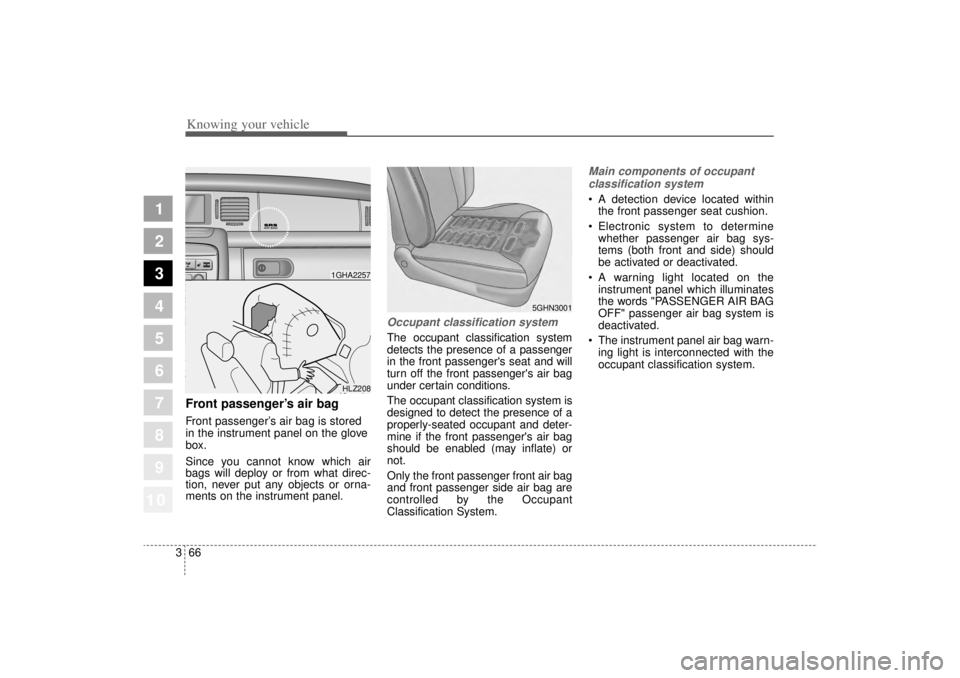
Front passenger’ s air bagFront passenger’s air bag is stored
in the instrument panel on the glove
box.
Since you cannot know which air
bags will deploy or from what direc-
tion, never put any objects or orna-
ments on the instrument panel.
Occupant classification systemThe occupant classification system
detects the presence of a passenger
in the front passenger's seat and will
turn off the front passenger's air bag
under certain conditions.
The occupant classification system is
designed to detect the presence of a
properly-seated occupant and deter-
mine if the front passenger's air bag
should be enabled (may inflate) or
not.
Only the front passenger front air bag
and front passenger side air bag are
controlled by the Occupant
Classification System.
Main components of occupant
classification system A detection device located within
the front passenger seat cushion.
Electronic system to determine
whether passenger air bag sys-
tems (both front and side) should
be activated or deactivated.
A warning light located on the
instrument panel which illuminates
the words "PASSENGER AIR BAG
OFF" passenger air bag system is
deactivated.
The instrument panel air bag warn-
ing light is interconnected with the
occupant classification system.
5GHN3001
1GHA2257HLZ208
Page 79 of 322
Knowing your vehicle68
3
1
2
3
4
5
6
7
8
910
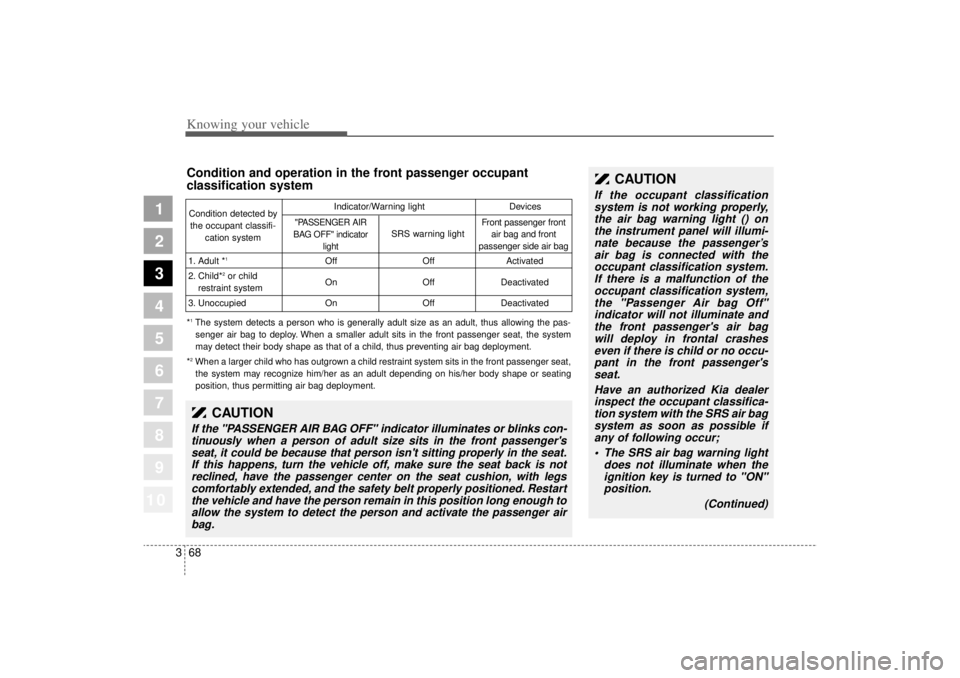
Condition and operation in the front passenger occupant
classification systemCondition detected by
the occupant classifi- cation system
1. Adult *
1
2. Child*
2or child
restraint system
3. Unoccupied Off
On
OnOff
Off
OffActivated
Deactivated
Deactivated
"PASSENGER AIR
BAG OFF" indicator light
SRS warning light Front passenger front
air bag and front
passenger side air bag
Indicator/Warning light
Devices
*1The system detects a person who is generally adult size as an adult, thus allowing the pas-
senger air bag to deploy. When a smaller adult sits in the front passenger seat, the system
may detect their body shape as that of a child, thus preventing air bag deployment.
*2When a larger child who has outgrown a child restraint system sits in the front passenger seat, the system may recognize him/her as an adult depending on his/her body shape or seating
position, thus permitting air bag deployment.
CAUTION
If the "PASSENGER AIR BAG OFF" indicator illuminates or blinks con- tinuously when a person of adult size sits in the front passenger'sseat, it could be because that person isn't sitting properly in the seat.If this happens, turn the vehicle off, make sure the seat back is notreclined, have the passenger center on the seat cushion, with legscomfortably extended, and the safety belt properly positioned. Restartthe vehicle and have the person remain in this position long enough toallow the system to detect the person and activate the passenger airbag.
CAUTION
If the occupant classificationsystem is not working properly,the air bag warning light () onthe instrument panel will illumi-nate because the passenger’ s
air bag is connected with the occupant classification system.If there is a malfunction of theoccupant classification system,the "Passenger Air bag Off"indicator will not illuminate andthe front passenger's air bagwill deploy in frontal crasheseven if there is child or no occu-pant in the front passenger'sseat.
Have an authorized Kia dealerinspect the occupant classifica-tion system with the SRS air bagsystem as soon as possible ifany of following occur;
The SRS air bag warning light
does not illuminate when theignition key is turned to "ON"position.
(Continued)
Page 82 of 322
371
1
2
3
4
5
6
7
8
910
Knowing your vehicle
✽ ✽NOTICE• If luggage or other objects are
placed on the front passenger's
seat or if the temperature of the
seat changes while the seat is unoc-
cupied, the "PASSENGER AIR
BAG OFF" indicator may blink.
These conditions do not indicate a
problem.
•Do not put heavy objects on the front
passenger's seat. This may cause
front passenger air bag deployment
in the event of an accident, thus
increasing your repair costs.
WARNING
The front seat passenger air
bag is much larger than the
steering wheel air bag and
inflates with considerably
more force. It can seriously
hurt or kill a passenger who is
not in the proper position and
wearing the safety belt proper-
ly. The front passengers
should always move their seat
as far back as practical and sit
back in their seat.
It is essential that the front pas-
senger always wears their safe-
ty belts, even when the vehicle
is moving in a parking lot or up
a driveway into garage. If the driver brakes the vehicle
heavily prior to an impact,
unbelted occupants will be
thrown forward. If the front
passenger is not wearing the
safety belts, they will be direct-
ly in front of the storage com-
partment when deployment
occurs. In that situation, seri-
ous injury or death is possible.
(Continued)
(Continued)
Manufacturers are required by
government regulations to
provide a contact point con-
cerning modifications to the
vehicle for persons with dis-
abilities, which modifications
may affect the vehicle’ s
advanced air bag system.
That contact is Kia ’s toll-free
Customer Assistance center
at 1-800-333-4KIA. However,
Kia does not endorse nor will
it support any changes to any
part or structure of the vehicle
that could affect the advanced
air bag system, including the
occupant classification sys-
tem. Specifically, the front
passenger seat, dashboard or
door should not be replaced
except by an authorized Kia
dealer using original Kia parts
designed for this vehicle and
model. Any other such
replacement or modification
could adversely affect the
operation of the occupant
classification system and your
advanced air bags.
(Continued)
(Continued) For the same reason, do not
attach anything to the seat,
dashboard or door, even tem-
porarily. If the system is
adversely affected, it could
cause severe personal
injuries or death in a collision.
Do not place sharp objects on
the front passenger seat. These
can damage the occupant clas-
sification system, if they punc-
ture the seat cushion. Do not install accessory seat
covers on the front seats,
since these will interfere with
proper sensor operation.
Page 83 of 322
Knowing your vehicle72
3
1
2
3
4
5
6
7
8
910
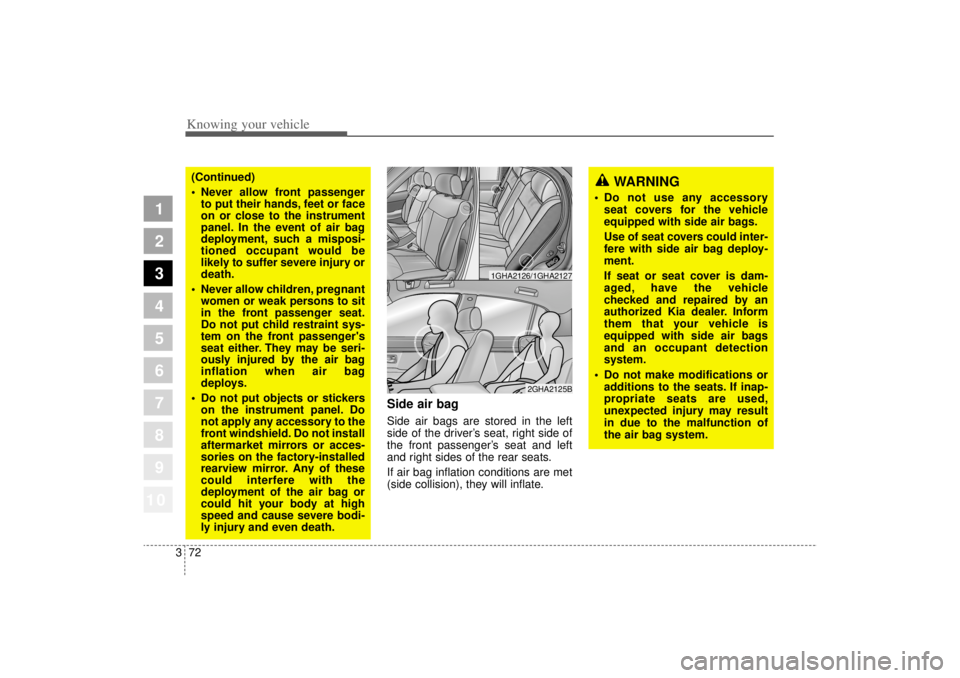
Side air bagSide air bags are stored in the left
side of the driver’ s seat, right side of
the front passenger’ s seat and left
and right sides of the rear seats.
If air bag inflation conditions are met
(side collision), they will inflate.
WARNING
Do not use any accessory
seat covers for the vehicle
equipped with side air bags.
Use of seat covers could inter-
fere with side air bag deploy-
ment.
If seat or seat cover is dam-
aged, have the vehicle
checked and repaired by an
authorized Kia dealer. Inform
them that your vehicle is
equipped with side air bags
and an occupant detection
system.
Do not make modifications or
additions to the seats. If inap-
propriate seats are used,
unexpected injury may result
in due to the malfunction of
the air bag system.
2GHA2125B
1GHA2126/1GHA2127
(Continued)
Never allow front passenger
to put their hands, feet or face
on or close to the instrument
panel. In the event of air bag
deployment, such a misposi-
tioned occupant would be
likely to suffer severe injury or
death.
Never allow children, pregnant
women or weak persons to sit
in the front passenger seat.
Do not put child restraint sys-
tem on the front passenger's
seat either. They may be seri-
ously injured by the air bag
inflation when air bag
deploys.
Do not put objects or stickers
on the instrument panel. Do
not apply any accessory to the
front windshield. Do not install
aftermarket mirrors or acces-
sories on the factory-installed
rearview mirror. Any of these
could interfere with the
deployment of the air bag or
could hit your body at high
speed and cause severe bodi-
ly injury and even death.
Page 86 of 322
375
1
2
3
4
5
6
7
8
910
Knowing your vehicle
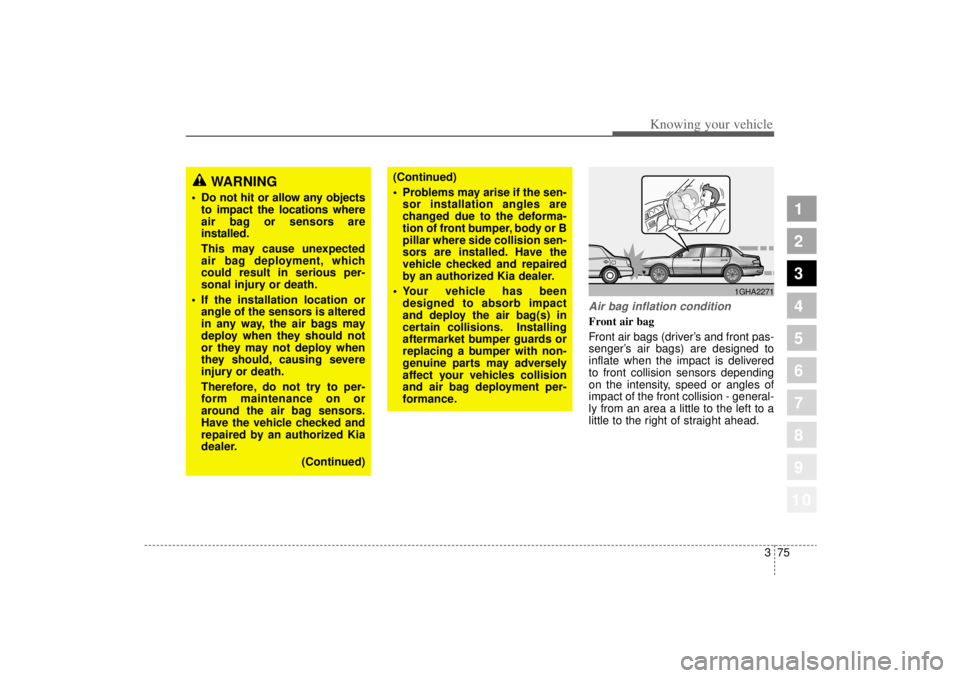
Air bag inflation conditionFront air bag
Front air bags (driver’s and front pas-
senger’ s air bags) are designed to
inflate when the impact is delivered
to front collision sensors depending
on the intensity, speed or angles of
impact of the front collision - general-
ly from an area a little to the left to a
little to the right of straight ahead.
WARNING
Do not hit or allow any objects
to impact the locations where
air bag or sensors are
installed.
This may cause unexpected
air bag deployment, which
could result in serious per-
sonal injury or death.
If the installation location or
angle of the sensors is altered
in any way, the air bags may
deploy when they should not
or they may not deploy when
they should, causing severe
injury or death.
Therefore, do not try to per-
form maintenance on or
around the air bag sensors.
Have the vehicle checked and
repaired by an authorized Kia
dealer.
(Continued)
(Continued)
Problems may arise if the sen-
sor installation angles are
changed due to the deforma-
tion of front bumper, body or B
pillar where side collision sen-
sors are installed. Have the
vehicle checked and repaired
by an authorized Kia dealer.
Your vehicle has been
designed to absorb impact
and deploy the air bag(s) in
certain collisions. Installing
aftermarket bumper guards or
replacing a bumper with non-
genuine parts may adversely
affect your vehicles collision
and air bag deployment per-
formance.
1GHA2271