ignition KIA AMANTI 2006 Repair Manual
[x] Cancel search | Manufacturer: KIA, Model Year: 2006, Model line: AMANTI, Model: KIA AMANTI 2006Pages: 322, PDF Size: 44.16 MB
Page 222 of 322
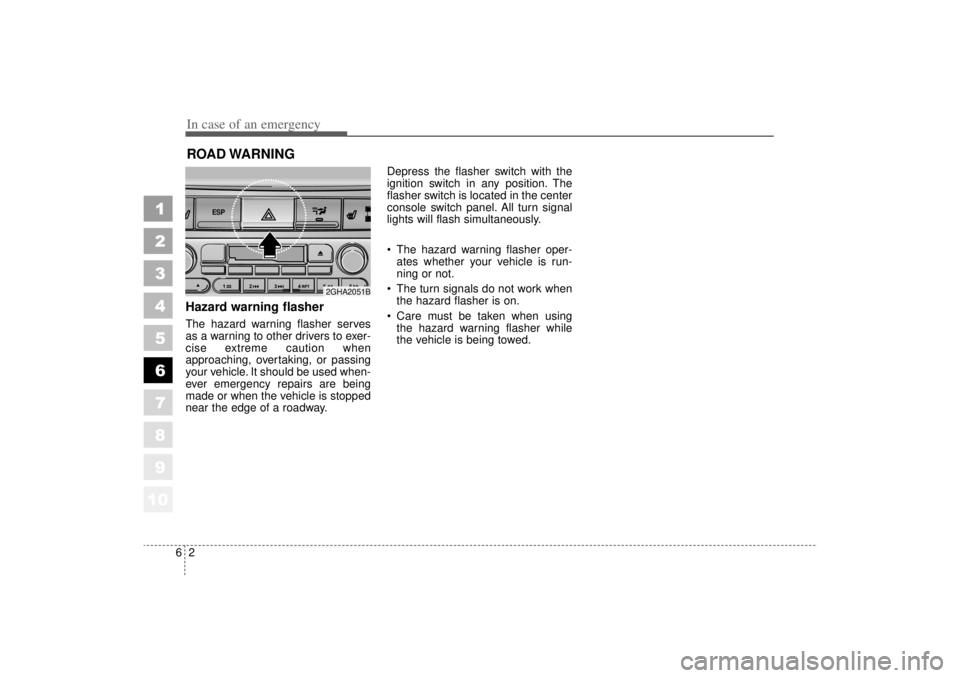
In case of an emergency26ROAD WARNING Hazard warning flasher The hazard warning flasher serves
as a warning to other drivers to exer-
cise extreme caution when
approaching, overtaking, or passing
your vehicle. It should be used when-
ever emergency repairs are being
made or when the vehicle is stopped
near the edge of a roadway.Depress the flasher switch with the
ignition switch in any position. The
flasher switch is located in the center
console switch panel. All turn signal
lights will flash simultaneously.
• The hazard warning flasher oper-
ates whether your vehicle is run-
ning or not.
The turn signals do not work when the hazard flasher is on.
Care must be taken when using the hazard warning flasher while
the vehicle is being towed.
1
2
3
4
5
6
7
8
910
ESP
2GHA2051B
Page 224 of 322
In case of an emergency46EMERGENCY STARTING Jump starting Jump starting can be dangerous if
done incorrectly. Therefore, to avoid
harm to yourself or damage to your
vehicle or battery, follow the jump
starting procedures listed on page
6-6. If in doubt, we strongly recom-
mend that you have a competent
technician or towing service jump
start your vehicle.
✽ ✽NOTICEUse only a 12-volt jumper system.
You can damage a 12-volt starting
motor, ignition system, and other
electrical parts beyond repair by use
of a 24-volt power supply (either two
12-volt batteries in series or a 24-
volt motor generator set).
1
2
3
4
5
6
7
8
910
WARNING
- Battery
• Keep all flames or sparks away from the battery. The bat-
tery produces hydrogen gas
which may explode if exposed
to flame or sparks.
Do not attempt to jump start the vehicle if the discharged
battery is frozen or if the elec-
trolyte level is low; the battery
may rupture or explode.
WARNING
- Battery
Never attempt to check the elec-
trolyte level of the battery as
this may cause the battery to
rupture or explode causing seri-
ous injury.
Page 228 of 322
In case of an emergency86Fuse replacement
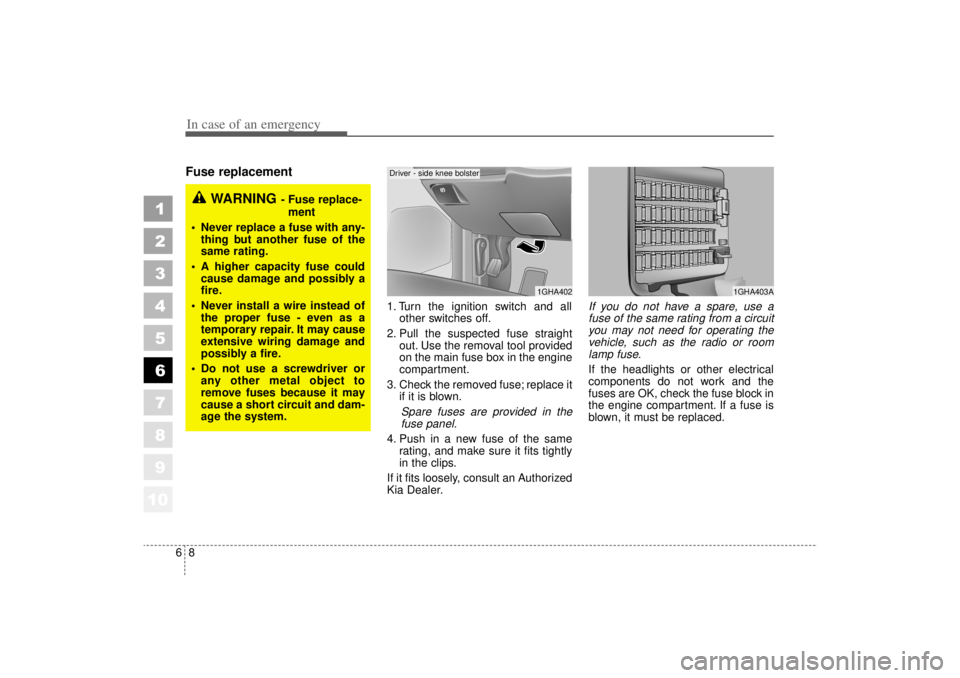
1. Turn the ignition switch and allother switches off.
2. Pull the suspected fuse straight out. Use the removal tool provided
on the main fuse box in the engine
compartment.
3. Check the removed fuse; replace it if it is blown.
Spare fuses are provided in thefuse panel.
4. Push in a new fuse of the same rating, and make sure it fits tightly
in the clips.
If it fits loosely, consult an Authorized
Kia Dealer.
If you do not have a spare, use a fuse of the same rating from a circuityou may not need for operating thevehicle, such as the radio or roomlamp fuse.If the headlights or other electrical
components do not work and the
fuses are OK, check the fuse block in
the engine compartment. If a fuse is
blown, it must be replaced.
1
2
3
4
5
6
7
8
910
1GHA402
1GHA403A
WARNING
- Fuse replace-
ment
Never replace a fuse with any- thing but another fuse of the
same rating.
A higher capacity fuse could cause damage and possibly a
fire.
Never install a wire instead of the proper fuse - even as a
temporary repair. It may cause
extensive wiring damage and
possibly a fire.
Do not use a screwdriver or any other metal object to
remove fuses because it may
cause a short circuit and dam-
age the system.
Driver - side knee bolster
Page 229 of 322
69
In case of an emergency
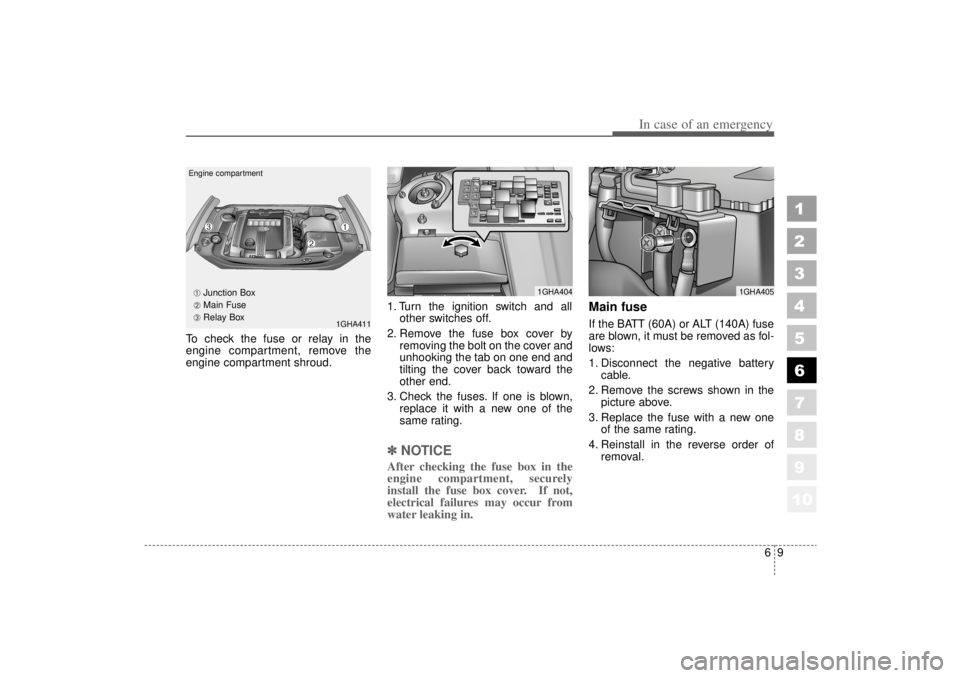
To check the fuse or relay in the
engine compartment, remove the
engine compartment shroud.1. Turn the ignition switch and all
other switches off.
2. Remove the fuse box cover by removing the bolt on the cover and
unhooking the tab on one end and
tilting the cover back toward the
other end.
3. Check the fuses. If one is blown, replace it with a new one of the
same rating.
✽ ✽NOTICEAfter checking the fuse box in the
engine compartment, securely
install the fuse box cover. If not,
electrical failures may occur from
water leaking in.
Main fuseIf the BATT (60A) or ALT (140A) fuse
are blown, it must be removed as fol-
lows:
1. Disconnect the negative battery
cable.
2. Remove the screws shown in the picture above.
3. Replace the fuse with a new one of the same rating.
4. Reinstall in the reverse order of removal.
1
2
3
4
5
6
7
8
910
1GHA404
1GHA411
1GHA405
Engine compartment
➀
➁
➂➀
Junction Box
➁ Main Fuse
➂ Relay Box
Page 232 of 322
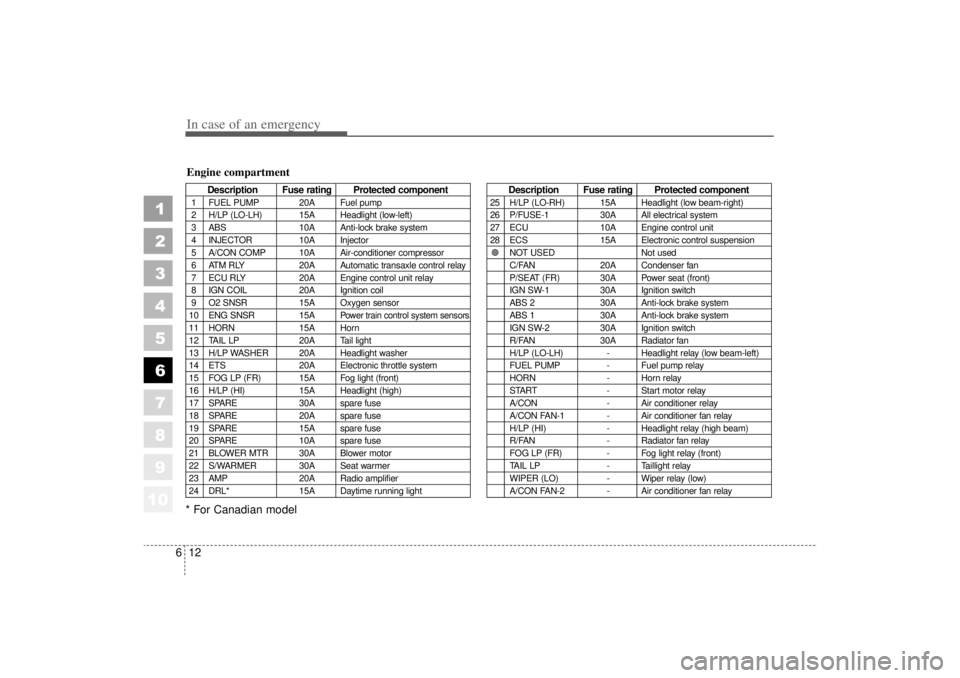
In case of an emergency12
6
1
2
3
4
5
6
7
8
910
* For Canadian model
Description Fuse rating Protected component
1 FUEL PUMP 20A Fuel pump
2 H/LP (LO-LH) 15A Headlight (low-left)
3 ABS 10A Anti-lock brake system
4 INJECTOR 10A Injector
5 A/CON COMP 10A Air-conditioner compressor
6 ATM RLY 20A Automatic transaxle control relay
7 ECU RLY 20A Engine control unit relay
8 IGN COIL 20A Ignition coil
9 O2 SNSR 15A Oxygen sensor
10 ENG SNSR 15A
Power train control system sensors
11 HORN 15A Horn
12 TAIL LP 20A Tail light
13 H/LP WASHER 20A Headlight washer
14 ETS 20A Electronic throttle system
15 FOG LP (FR) 15A Fog light (front)
16 H/LP (HI) 15A Headlight (high)
17 SPARE 30A spare fuse
18 SPARE 20A spare fuse
19 SPARE 15A spare fuse
20 SPARE 10A spare fuse
21 BLOWER MTR 30A Blower motor
22 S/WARMER 30A Seat warmer
23 AMP 20A Radio amplifier
24 DRL* 15A Daytime running light
Description Fuse rating Protected component
25 H/LP (LO-RH) 15A Headlight (low beam-right)
26 P/FUSE-1 30A All electrical system
27 ECU 10A Engine control unit
28 ECS 15A Electronic control suspension
NOT USED Not used
C/FAN 20A Condenser fan
P/SEAT (FR) 30A Power seat (front)
IGN SW-1 30A Ignition switch
ABS 2 30A Anti-lock brake system
ABS 1 30A Anti-lock brake system
IGN SW-2 30A Ignition switch
R/FAN 30A Radiator fan
H/LP (LO-LH) - Headlight relay (low beam-left)
FUEL PUMP - Fuel pump relay
HORN - Horn relay
START - Start motor relay
A/CON - Air conditioner relay
A/CON FAN-1 - Air conditioner fan relay
H/LP (HI) - Headlight relay (high beam)
R/FAN - Radiator fan relay
FOG LP (FR) - Fog light relay (front)
TAIL LP - Taillight relay
WIPER (LO) - Wiper relay (low)
A/CON FAN-2 - Air conditioner fan relay
Engine compartment
Page 236 of 322
In case of an emergency16
6
1
2
3
4
5
6
7
8
910
When towing your vehicle in an
emergency without wheel dollies :
1. Set the ignition switch in the ACC
position.
2. Place the transaxle shift lever in N (Neutral).
3. Release the parking brake.✽ ✽ NOTICEFailure to place the transaxle shift
lever in N (Neutral) may cause inter-
nal damage to the transaxle.
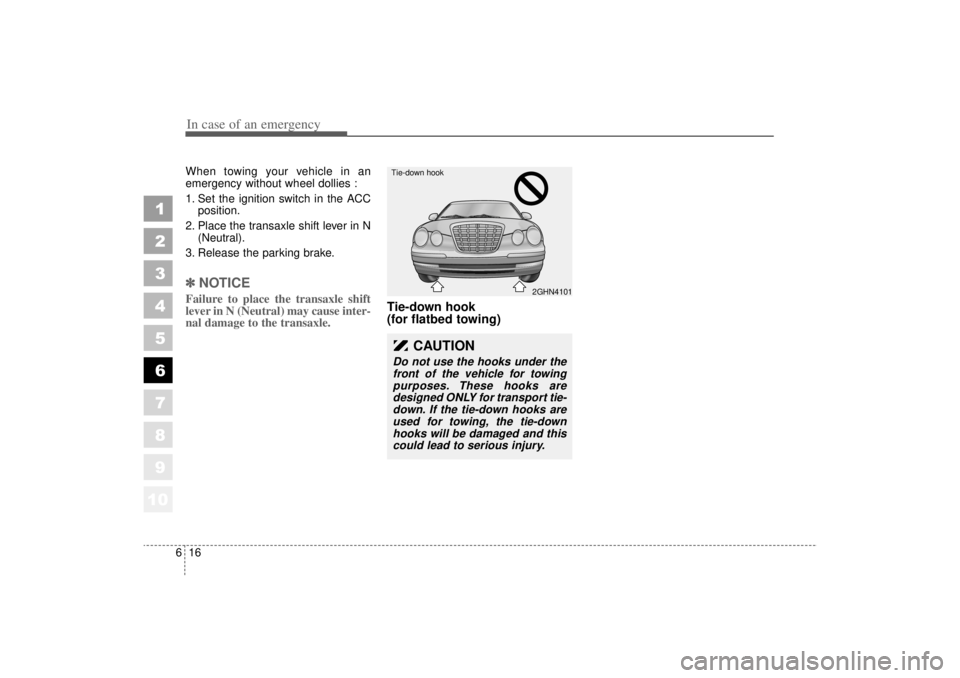
Tie-down hook
(for flatbed towing)
2GHN4101
Tie-down hook
CAUTION
Do not use the hooks under the
front of the vehicle for towingpurposes. These hooks aredesigned ONLY for transport tie-down. If the tie-down hooks areused for towing, the tie-downhooks will be damaged and thiscould lead to serious injury.
Page 239 of 322
619
In case of an emergency
1
2
3
4
5
6
7
8
910
When your vehicle is being
towed by another vehicle
other than a tow truck (In case
of an emergency) Turn the ignition switch to ACC so
the steering wheel isn’t locked.
Place the transaxle shift lever in N
(Neutral).
Release the parking bake.
Vehicle equipped with automatic
transaxles should not exceed 28
mph (45 km/h) and should not be
towed more than 50 miles (80 km).
Press the brake pedal with more
force than normal since you will
have reduced brake performance.
More steering effort will be
required because the power steer-
ing system will be disabled.
If you are driving down a long hill,
the brakes may overheat and brake
performance will be reduced. Stop
often and let the brakes cool off.
✽ ✽
NOTICETo prevent internal damage to the
transaxle, never tow your vehicle
from the rear (backwards) with all
four tires in contact with the sur-
face.
Tips for towing a stuck vehicleThe following methods are effective
when your vehicle is stuck in mud,
sand or similar substances that pre-
vent the vehicle from being driven
out under its own power.
Remove the soil and sand, etc.
from the front and the back of the
tires.
Place a stone or wood under the
tires.
Page 279 of 322
735
Maintenance
1
2
3
4
5
6
7
8
910
For best battery service :Keep the battery securely mount-
ed.
Keep the battery top clean and dry.
Keep the terminals and connec-
tions clean, tight, and coated with
petroleum jelly or terminal grease.
Rinse any spilled electrolyte from
the battery immediately with a
solution of water and baking soda.
If the vehicle is not going to be
used for an extended time, discon-
nect the battery cables.
Battery recharging Your vehicle has a maintenance-free,
calcium-based battery.
If the battery becomes discharged
in a short time (because, for exam-
ple, the headlights or interior lights
were left on while the vehicle was
not in use), recharge it by slow
charging (trickle) for 10 hours.
If the battery gradually discharges
because of high electric load while
the vehicle is being used, recharge
it at 20-30A for two hours.
CBGQ0705
(Continued)
When lifting a plastic-cased
battery, excessive pressure on
the case may cause battery
acid to leak, resulting in per-
sonal injury. Lift with a battery
carrier or with your hands on
opposite corners.
Never attempt to charge the
battery when the battery
cables are connected.
The electrical ignition system
works with high voltage.
Never touch these compo-
nents with the engine running
or the ignition switched on.
Page 288 of 322
Maintenance44
7
1
2
3
4
5
6
7
8
910
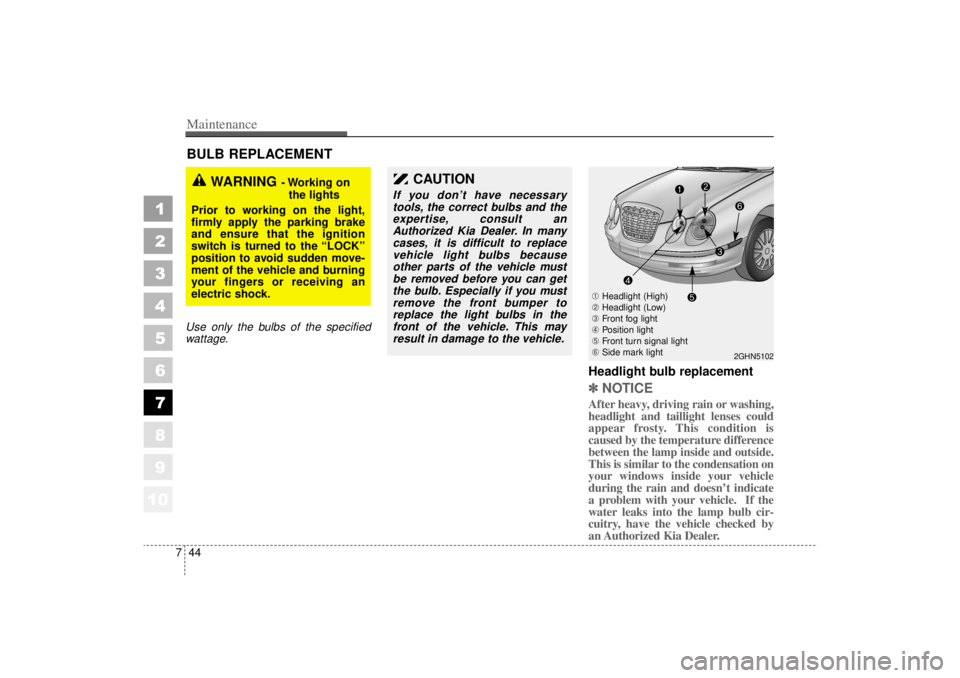
BULB REPLACEMENT Use only the bulbs of the specified
wattage.
Headlight bulb replacement ✽ ✽ NOTICEAfter heavy, driving rain or washing,
headlight and taillight lenses could
appear frosty. This condition is
caused by the temperature difference
between the lamp inside and outside.
This is similar to the condensation on
your windows inside your vehicle
during the rain and doesn’t indicate
a problem with your vehicle. If the
water leaks into the lamp bulb cir-
cuitry, have the vehicle checked by
an Authorized Kia Dealer.
WARNING
- Working on
the lights
Prior to working on the light,
firmly apply the parking brake
and ensure that the ignition
switch is turned to the “LOCK”
position to avoid sudden move-
ment of the vehicle and burning
your fingers or receiving an
electric shock.
CAUTION
If you don’ t have necessary
tools, the correct bulbs and the expertise, consult anAuthorized Kia Dealer. In manycases, it is difficult to replacevehicle light bulbs becauseother parts of the vehicle mustbe removed before you can getthe bulb. Especially if you mustremove the front bumper toreplace the light bulbs in thefront of the vehicle. This mayresult in damage to the vehicle.
2GHN5102
➀ Headlight (High)
➁ Headlight (Low)
➂ Front fog light
➃ Position light
➄ Front turn signal light
➅ Side mark light
Page 314 of 322
Index2
10Air Bag - Advanced Supplemental Restraint System . 3-60
Air Bag Warning Light . . . . . . . . . . . . . . . . . . . . . . . 3-81
Air Cleaner . . . . . . . . . . . . . . . . . . . . . . . . . . . . . . . . 7-29
Air Conditioner (Specifications) . . . . . . . . . . . . . . . . 4-66
Air Filter . . . . . . . . . . . . . . . . . . . . . . . . . . . . . . . . 7-30
Air Conditioning . . . . . . . . . . . . . . . . . . . . . . . . . . . . 4-63 Button . . . . . . . . . . . . . . . . . . . . . . . . . . . . . . . . . . 4-62
System Operation Tips . . . . . . . . . . . . . . . . . . . . . . 4-64
Air Intake Control Button . . . . . . . . . . . . . . . . . . . . . 4-58
Alignment, Tire Balance and Wheel . . . . . . . . . . . . . 7-39
Aluminum Wheel Maintenance . . . . . . . . . . . . . . . . . 7-56
Antenna . . . . . . . . . . . . . . . . . . . . . . . . . . . . . . . . . . 3-111
Anti-Lock Brake System . . . . . . . . . . . . . . . . . . . . . . 4-15 Warning Light . . . . . . . . . . . . . . . . . . . . . . . . . . . . 4-36
Anti-Theft Steering Column Lock, Ignition Switch and . . . . . . . . . . . . . . . . . . . . . . . . . 4-2
Ashtray . . . . . . . . . . . . . . . . . . . . . . . . . . . . . . . . . 3-102
Automatic Climate Control System . . . . . . . . . . . . . . . . . . . . . 4-54
Headlight Aiming . . . . . . . . . . . . . . . . . . . . . . . . . 4-47
Power Window . . . . . . . . . . . . . . . . . . . . . . . . . . . 3-16
Transaxle . . . . . . . . . . . . . . . . . . . . . . . . . . . . 4-5, 7-25
Transaxle (Specifications) . . . . . . . . . . . . . . . . . . . . 8-5
Transaxle Fluid Level, Checking the . . . . . . . . . . . 7-25
Window Reversal . . . . . . . . . . . . . . . . . . . . . . . . . . 3-16
Balance, Wheel Alignment and Tire . . . . . . . . . . . . . 7-39 Battery . . . . . . . . . . . . . . . . . . . . . . . . . . . . . . . . . . . 7-34
Recharging . . . . . . . . . . . . . . . . . . . . . . . . . . . . . . 7-35
Service, for Best . . . . . . . . . . . . . . . . . . . . . . . . . . 7-35
Before Driving . . . . . . . . . . . . . . . . . . . . . . . . . . . . . . 5-5
Belts, Safety . . . . . . . . . . . . . . . . . . . . . . . . . . . . . . . . . . 3-36
Pre-tensioner, seat . . . . . . . . . . . . . . . . . . . . . . . . . 3-36
Blade Replacement, Windshield Wiper . . . . . . . . . . . 7-32
Blades, Wiper . . . . . . . . . . . . . . . . . . . . . . . . . . . . . . 7-32
Body Lubrication . . . . . . . . . . . . . . . . . . . . . . . . . . . 7-28
Brake Fluid Level, Checking . . . . . . . . . . . . . . . . . . . . . . 7-21
Parking . . . . . . . . . . . . . . . . . . . . . . . . . . . . . 4-13, 7-22
System . . . . . . . . . . . . . . . . . . . . . . . . . . . . . . . . . . 4-11
System, Anti-Lock . . . . . . . . . . . . . . . . . . . . . . . . . 4-15
Wear Indicators, Disc . . . . . . . . . . . . . . . . . . . . . . . 4-12
Brakes . . . . . . . . . . . . . . . . . . . . . . . . . . . . . . . . . . . .\
7-21 Power . . . . . . . . . . . . . . . . . . . . . . . . . . . . . . . . . . 4-11
Break-In Process, Vehicle . . . . . . . . . . . . . . . . . . . . . . 1-2
Bulb Replacement . . . . . . . . . . . . . . . . . . . . . . . . . . . 7-44
Bulbs, Light . . . . . . . . . . . . . . . . . . . . . . . . . . . . . . . . 8-5
Capacities (Specifications) . . . . . . . . . . . . . . . . . . . . . 8-5
Capacity, Oil . . . . . . . . . . . . . . . . . . . . . . . . . . . . . . . 7-17
Care of the Safety Belt System, Proper Use and . . . . . . . 3-47
Exterior . . . . . . . . . . . . . . . . . . . . . . . . . . . . . . . . . 7-53
Interior . . . . . . . . . . . . . . . . . . . . . . . . . . . . . . . .\
. . 7-57
1
2
3
4
5
6
7
8
910
AB
C