ignition KIA AMANTI 2006 Owner's Manual
[x] Cancel search | Manufacturer: KIA, Model Year: 2006, Model line: AMANTI, Model: KIA AMANTI 2006Pages: 322, PDF Size: 44.16 MB
Page 49 of 322
Knowing your vehicle38
3
1
2
3
4
5
6
7
8
910
WARNING
Do not strike the pre-tensioner
seat belt assemblies.
Do not attempt to service or
repair the pre-tensioner seat
belt system in any manner.
Improper handling of the pre-
tensioner seat belt assem-
blies, and failure to heed the
warnings not to strike, modify,
inspect, place, service or
repair the pre-tensioner seat
belt assemblies may lead to
improper operation or inad-
vertent activation causing
serious injury.
Always wear the seat belts
when driving or riding in a
motor vehicle.
CAUTION
Because the sensor that acti-
vates the SRS air bag is con-nected with pre-tensioner seatbelt, the SRS air bag warninglight on the instrument panelwill blink or illuminate forapproximately 6 seconds afterthe ignition key has beenturned to the “ON”position,
then the light should go off.
If the pre-tensioner seat belt is
not working properly, thiswarning light will illuminateeven if there is no malfunctionof SRS air bag system. If theSRS air bag warning lightdoes not illuminate when theignition key is turned to “ON”,
or if it remains illuminated after blinking or illuminatingfor approximately 6 seconds,or if it illuminates while thevehicle is being driven, pleasehave an authorized Kia dealerinspect the pre-tensioner seatbelt or SRS air bag system assoon as possible.
WARNING
Pre-tensioners are designed
to operate once. After activa-
tion, pre-tensioner seat belts
must be replaced. All seat
belts, of any type, should
always be replaced after they
have been worn during a colli-
sion.
Do not attempt to inspect or
replace the pre-tensioner seat
belts yourself. This must be
done by an authorized Kia
dealer.
CAUTION
The pre-tensioner seat belt
assembly mechanisms becomehot during activation. Do nottouch the pre-tensioner seatbelt assembly for several min-utes after they have been acti-vated.
Page 74 of 322
363
1
2
3
4
5
6
7
8
910
Knowing your vehicle
Air bag system components The main components of your SRS
are:
To indicate that your vehicle is
equipped with air bags, the corre-
sponding air bag covers are
marked with “SRS AIR BAG”.
- Driver’ s air bag (see page 3- 65)
- Passenger’ s air bag(see page 3-
66)
- Side air bag (see page 3- 72)
- Curtain air bag (see page 3- 73)
A diagnostic system that continual-
ly monitors the system operation.
An indicator light to warn you of a
possible problem with the system.
Emergency power backup in case
your car’ s electrical system is dis-
connected in a crash. The SRS uses a collection of sen-
sors to gather information about the
driver’
s and front passenger’ s seat
position, the driver’ s and front pas-
senger’ s safety belt usage and
impact severity.
The driver’ s and front passenger’ s
seat position sensors, which are
installed on the seat track, determine
if the seats are fore or aft of a refer-
ence position. Similarly, the safety
belt usage sensors determine if the
driver and front passenger’ s safety
belts are fastened. These sensors
provide the ability to control the SRS
deployment based on how close the
driver’ s seat is to the steering wheel,
how close the passenger’ s seat is to
the instrument panel, whether or not
the safety belts are fastened, and the
severity of the impact.
(Continued)
If your vehicle has been sub-
jected to flood conditions (e.g.
soaked carpeting/standing
water on the floor of the vehi-
cle, etc.) or if your vehicle has
become flood damaged in any
way, do not attempt to start
the vehicle or put the key in
the ignition before discon-
necting the battery.
Disregarding this precaution
may cause air bag deploy-
ment, which could result in
serious personal injury or
death. If your vehicle is sub-
jected to flooded conditions,
before starting the vehicle,
have the vehicle towed to an
authorized Kia dealer for
inspection and necessary
repairs.
Page 75 of 322
Knowing your vehicle64
3
1
2
3
4
5
6
7
8
910
The advanced SRS offers the ability
to control the air bag inflation with
two levels. A first stage level is pro-
vided for moderate-severity impacts.
A second stage level is provided for
more severe impacts.
According to the impact severity,
seating position and safety belt
usage, the SRSCM (SRS Control
Module) controls the air bag inflation.
Failure to properly wear safety
belts can increase the risk or
severity of injury in an accident.
Additionally, your SRS is equipped
with an occupant classification sys-
tem in the front passenger’ s seat.
The occupant classification system
detects the presence of a passenger
in the front passenger’ s seat and will
turn off the front passenger ’s air bag
under certain conditions. For more
detail, see “Occupant Classification
System” later in this section.
CAUTION
If the seat position sensor is not
working properly, the SRS airbag warning light ( ) on theinstrument panel will illuminateeven if there is no malfunctionof the SRS air bag system,because the SRS air bag warn-ing light is connected with theseat position sensor. If the SRSair bag warning light does notilluminate when the ignition keyis turned to the "ON" position, ifit remains illuminated afterblinking for approximately 6seconds, or if it illuminateswhile the vehicle is being driv-en, have an authorized Kia deal-er inspect the seat position sen-sor and the advanced SRS airbag system as soon as possi-ble.
AIR
BAG
WARNING
Modification to the seat struc-
ture can adversely affect the
seat position sensor and
cause the air bag to deploy at
a different level than should
be provided.
Failure to properly wear safety
belts can increase the risk or
severity of injury by causing
the air bags to deploy at a dif-
ferent level than should be
provided.
Do not place any objects
underneath the front seats
which could damage the seat
position sensor or interfere
with the occupant classifica-
tion system.
Do not place any objects that
may cause magnetic fields
near the front seat. These may
cause a malfunction of the
seat position sensor.
(Continued)
Page 76 of 322
365
1
2
3
4
5
6
7
8
910
Knowing your vehicle
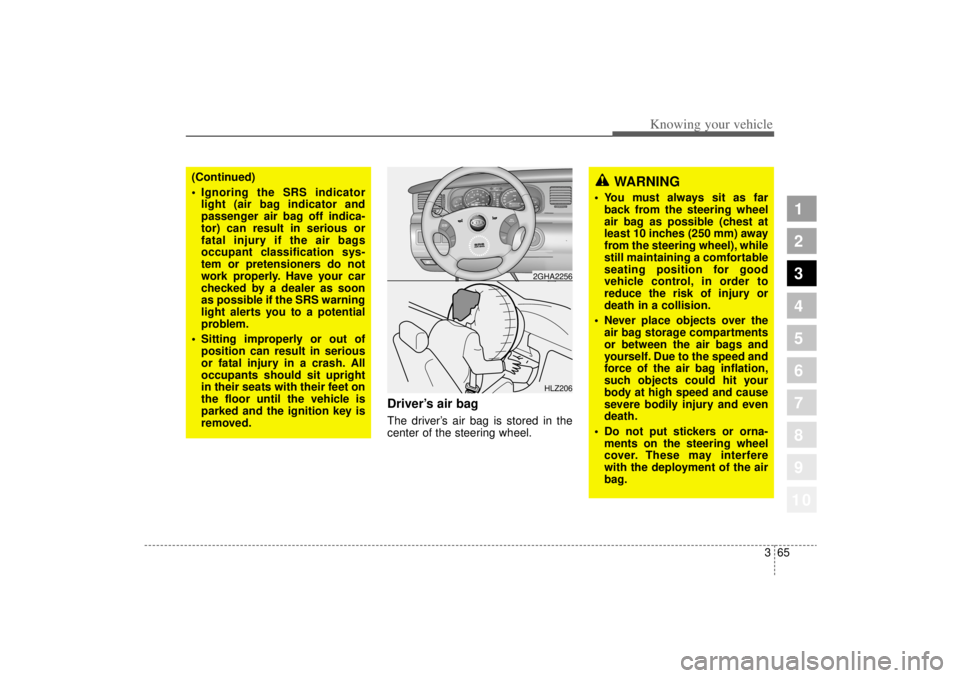
Driver’s air bagThe driver’ s air bag is stored in the
center of the steering wheel.
CRUISE
ON/OFFCAN CE
L
COAST
SETRES
ACCEL
HLZ2062GHA2256
(Continued)
Ignoring the SRS indicator
light (air bag indicator and
passenger air bag off indica-
tor) can result in serious or
fatal injury if the air bags
occupant classification sys-
tem or pretensioners do not
work properly. Have your car
checked by a dealer as soon
as possible if the SRS warning
light alerts you to a potential
problem.
Sitting improperly or out of
position can result in serious
or fatal injury in a crash. All
occupants should sit upright
in their seats with their feet on
the floor until the vehicle is
parked and the ignition key is
removed.
WARNING
You must always sit as far
back from the steering wheel
air bag as possible (chest at
least 10 inches (250 mm) away
from the steering wheel), while
still maintaining a comfortable
seating position for good
vehicle control, in order to
reduce the risk of injury or
death in a collision.
Never place objects over the
air bag storage compartments
or between the air bags and
yourself. Due to the speed and
force of the air bag inflation,
such objects could hit your
body at high speed and cause
severe bodily injury and even
death.
Do not put stickers or orna-
ments on the steering wheel
cover. These may interfere
with the deployment of the air
bag.
Page 79 of 322
Knowing your vehicle68
3
1
2
3
4
5
6
7
8
910
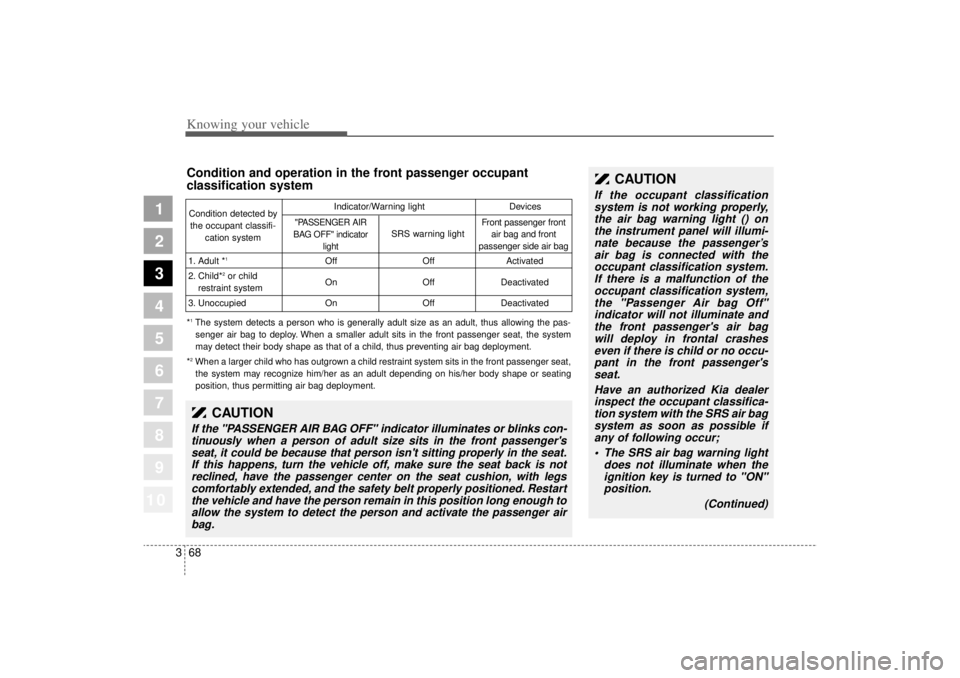
Condition and operation in the front passenger occupant
classification systemCondition detected by
the occupant classifi- cation system
1. Adult *
1
2. Child*
2or child
restraint system
3. Unoccupied Off
On
OnOff
Off
OffActivated
Deactivated
Deactivated
"PASSENGER AIR
BAG OFF" indicator light
SRS warning light Front passenger front
air bag and front
passenger side air bag
Indicator/Warning light
Devices
*1The system detects a person who is generally adult size as an adult, thus allowing the pas-
senger air bag to deploy. When a smaller adult sits in the front passenger seat, the system
may detect their body shape as that of a child, thus preventing air bag deployment.
*2When a larger child who has outgrown a child restraint system sits in the front passenger seat, the system may recognize him/her as an adult depending on his/her body shape or seating
position, thus permitting air bag deployment.
CAUTION
If the "PASSENGER AIR BAG OFF" indicator illuminates or blinks con- tinuously when a person of adult size sits in the front passenger'sseat, it could be because that person isn't sitting properly in the seat.If this happens, turn the vehicle off, make sure the seat back is notreclined, have the passenger center on the seat cushion, with legscomfortably extended, and the safety belt properly positioned. Restartthe vehicle and have the person remain in this position long enough toallow the system to detect the person and activate the passenger airbag.
CAUTION
If the occupant classificationsystem is not working properly,the air bag warning light () onthe instrument panel will illumi-nate because the passenger’ s
air bag is connected with the occupant classification system.If there is a malfunction of theoccupant classification system,the "Passenger Air bag Off"indicator will not illuminate andthe front passenger's air bagwill deploy in frontal crasheseven if there is child or no occu-pant in the front passenger'sseat.
Have an authorized Kia dealerinspect the occupant classifica-tion system with the SRS air bagsystem as soon as possible ifany of following occur;
The SRS air bag warning light
does not illuminate when theignition key is turned to "ON"position.
(Continued)
Page 90 of 322

379
1
2
3
4
5
6
7
8
910
Knowing your vehicle
How does the air bag system
operate Air bag only operates when the
ignition switch is turned to the ON
or START positions.
Air bags inflate instantly in the
event of serious frontal or side col-
lision (if equipped with side air bag
or curtain air bag) in order to help
protect the occupants from serious
physical injury.
There is no single speed at which
the air bags will inflate.
Generally, air bags are designed to
inflate by the severity of a collision
and its direction. These two factors
determine whether the sensors
send out an electronic deploy-
ment/inflation signal.
Air bag deployment depends on a
number of factors including vehicle
speed, angles of impact and the
density and stiffness of the vehi-
cles or objects which your vehicle
hits in the collision. However, fac-
tors are not limited to those men-
tioned above.
The front air bags will completely
inflate and deflate in an instant.
It is virtually impossible for you to
see the air bags inflate during an
accident. It is much more likely that
you will simply see the deflated air
bags hanging out of their storage
compartments after the collision.
In order to help provide protection
in a severe collision, the air bags
must inflate rapidly. The speed of
air bag inflation is a consequence
of the extremely short time in which
a collision occurs and the need to
get the air bag between the occu-
pant and the vehicle structures
before the occupant impacts those
structures. This speed of inflation
reduces the risk of serious or life-
threatening injuries in a severe col-
lision and is thus a necessary part
of air bag design.
However, air bag inflation can also
cause injuries which normally can
include facial abrasions, bruises
and broken bones, and sometimes
more serious injuries because that
inflation speed also causes the air
bags to expand with a great deal
force.
There are even circumstances
under which contact with the
steering wheel air bag can cause
fatal injuries, especially if the
occupant is positioned exces-
sively close to the steering
wheel.
Page 91 of 322
Knowing your vehicle80
3
1
2
3
4
5
6
7
8
910
Noise and smokeWhen the air bags inflate, they make
a loud noise and they leave smoke
and powder in the air inside of the
vehicle. This is normal and is a result
of the ignition of the air bag inflator.
After the air bag inflates, you may
feel substantial discomfort in breath-
ing due to the contact of your chest
to both the safety belt and the air
bag, as well as from breathing the
smoke and powder. We strongly
urge you to open your doors
and/or windows as soon as possi-
ble after impact in order to reduce
discomfort and prevent prolonged
exposure to the smoke and pow-
der.
Though smoke and powder are non-
toxic, it may cause irritation to the
skin (eyes, nose and throat etc). If
this is the case, wash and rinse with
the cold water immediately and con-
sult the doctor if the symptom per-
sists.
WARNING -
Seated
positioning
Driver should sit as far back
(at least 10 inches (250 mm)
away) from the steering wheel
air bag as possible to reduce
the risk of injury or death in a
collision. The front passenger
should always move their seat
as far back as possible and sit
back in their seat.
Air bag inflates instantly in an
event of collision, passengers
may be injured by the air bag
expansion force if they are not
in proper position.
Air bag inflation may cause
injuries which normally include
facial or bodily abrasions,
injuries by the broken glasses
or burns by the explosives.
WARNING
When the air bags deploy, the
air bag related parts in steering
wheel and/or instrument panel
and/or in both sides of the roof
rails above the front and rear
doors are very hot. To prevent
injury, do not touch the air bag
storage areas internal compo-
nents immediately after an air
bag has inflated.
Page 92 of 322
381
1
2
3
4
5
6
7
8
910
Knowing your vehicle
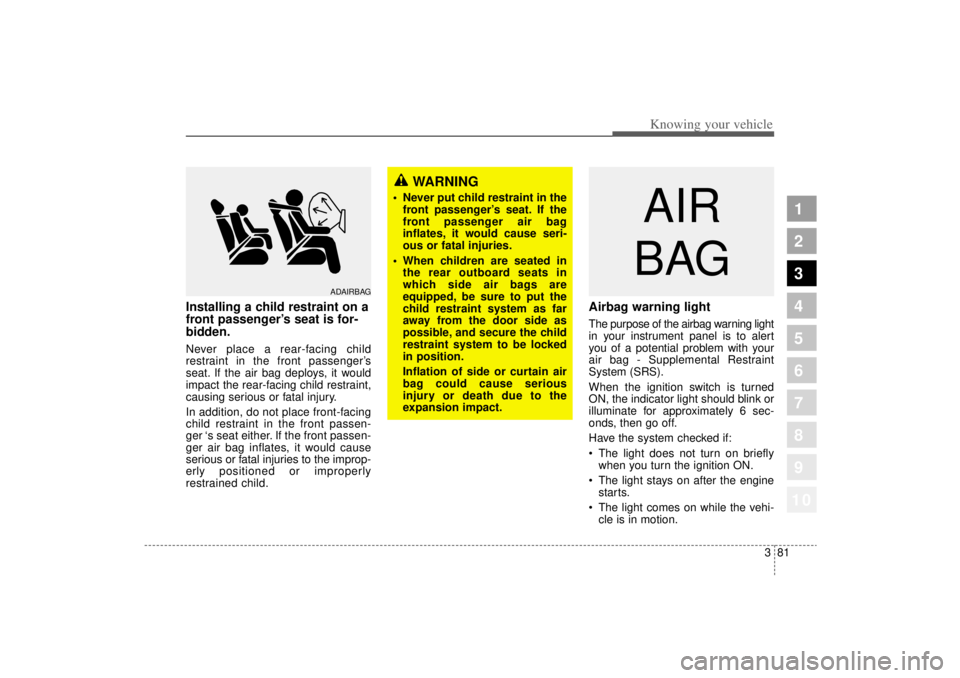
Installing a child restraint on a
front passenger’s seat is for-
bidden.Never place a rear-facing child
restraint in the front passenger ’s
seat. If the air bag deploys, it would
impact the rear-facing child restraint,
causing serious or fatal injury.
In addition, do not place front-facing
child restraint in the front passen-
ger ‘s seat either. If the front passen-
ger air bag inflates, it would cause
serious or fatal injuries to the improp-
erly positioned or improperly
restrained child.
Airbag warning lightThe purpose of the airbag warning light
in your instrument panel is to alert
you of a potential problem with your
air bag - Supplemental Restraint
System (SRS).
When the ignition switch is turned
ON, the indicator light should blink or
illuminate for approximately 6 sec-
onds, then go off.
Have the system checked if:
The light does not turn on briefly
when you turn the ignition ON.
The light stays on after the engine
starts.
The light comes on while the vehi-
cle is in motion.
ADAIRBAG
AIR
BAG
WARNING
Never put child restraint in the
front passenger’ s seat. If the
front passenger air bag
inflates, it would cause seri-
ous or fatal injuries.
When children are seated in
the rear outboard seats in
which side air bags are
equipped, be sure to put the
child restraint system as far
away from the door side as
possible, and secure the child
restraint system to be locked
in position.
Inflation of side or curtain air
bag could cause serious
injury or death due to the
expansion impact.
Page 117 of 322

Knowing your vehicle106
3
1
2
3
4
5
6
7
8
910
✽ ✽
NOTICE• Use when the engine is running
and remove a plug from the power
outlet after using the electric
appliance. Using when the engine
stops or remaining the electric
appliance with plugged in for
many hours may cause the battery
to be discharged.
• Only use the electric appliances which are less than 12V and 10A
in electric capacity.
• Adjust the air-conditioner or heater to the lowest operation level
when you have to use the power
socket while using air-conditioner
or heater.
• Close the cover when not in use.
• Some electronic devices can cause electronic interference and when
plugged into a vehicle's power out-
let. These devices may cause
excessive audio static and mal-
functions in other electronic sys-
tems or devices used in your vehi-
cle.
ClockAnalog (if equipped)Whenever the battery terminals, A/V
CLOCK fuse, or Power Connect are
disconnected, you must reset the
time.
When the ignition switch is in the
ACC or ON position, the clock but-
tons operate as follows:
➀
(+) : time increases one minute
each time the button is
pressed. It increases continu-
ously if pressed longer than 3
seconds.
➁
(-) : time decreases one minuteeach time the button is
pressed. It decreases continu-
ously if pressed longer than 3
seconds.
5GHA2232
➀
➁
Page 119 of 322
Knowing your vehicle108
3
1
2
3
4
5
6
7
8
910
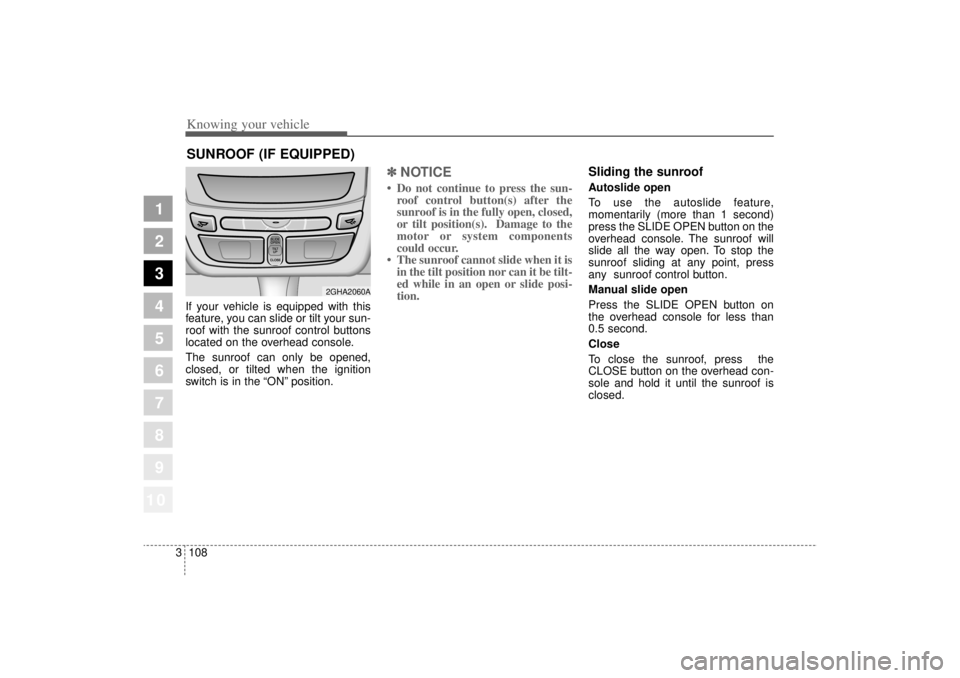
If your vehicle is equipped with this
feature, you can slide or tilt your sun-
roof with the sunroof control buttons
located on the overhead console.
The sunroof can only be opened,
closed, or tilted when the ignition
switch is in the “ON”position.
✽ ✽
NOTICE• Do not continue to press the sun-
roof control button(s) after the
sunroof is in the fully open, closed,
or tilt position(s). Damage to the
motor or system components
could occur.
• The sunroof cannot slide when it is in the tilt position nor can it be tilt-
ed while in an open or slide posi-
tion.
Sliding the sunroof Autoslide open
To use the autoslide feature,
momentarily (more than 1 second)
press the SLIDE OPEN button on the
overhead console. The sunroof will
slide all the way open. To stop the
sunroof sliding at any point, press
any sunroof control button.
Manual slide open
Press the SLIDE OPEN button on
the overhead console for less than
0.5 second.
Close
To close the sunroof, press the
CLOSE button on the overhead con-
sole and hold it until the sunroof is
closed.
SUNROOF (IF EQUIPPED)
SLIDESLIDEOPENOPENTILTTILT UP UPCLOSECLOSESLIDESLIDEOPENOPENTILTTILT UP UPCLOSECLOSE
2GHA2060A