spare wheel KIA AMANTI 2006 Owners Manual
[x] Cancel search | Manufacturer: KIA, Model Year: 2006, Model line: AMANTI, Model: KIA AMANTI 2006Pages: 322, PDF Size: 44.16 MB
Page 240 of 322
In case of an emergency20
6
1
2
3
4
5
6
7
8
910
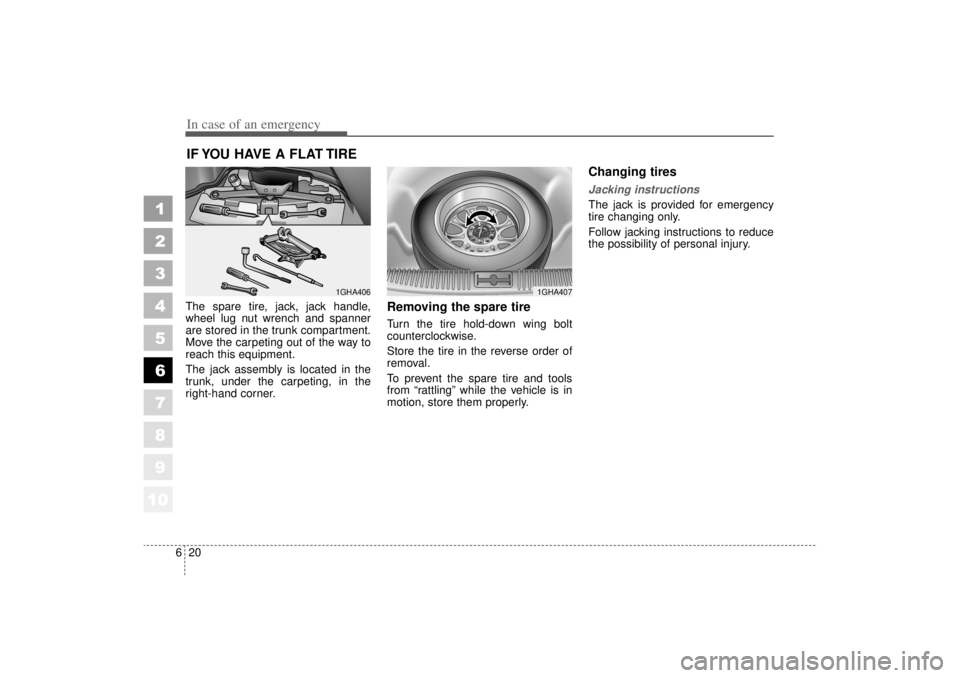
IF YOU HAVE A FLAT TIRE The spare tire, jack, jack handle,
wheel lug nut wrench and spanner
are stored in the trunk compartment.
Move the carpeting out of the way to
reach this equipment.
The jack assembly is located in the
trunk, under the carpeting, in the
right-hand corner.
Removing the spare tire Turn the tire hold-down wing bolt
counterclockwise.
Store the tire in the reverse order of
removal.
To prevent the spare tire and tools
from “rattling” while the vehicle is in
motion, store them properly.
Changing tires Jacking instructions The jack is provided for emergency
tire changing only.
Follow jacking instructions to reduce
the possibility of personal injury.
1GHA406
1GHA407
Page 242 of 322
In case of an emergency22
6
1
2
3
4
5
6
7
8
910
4. Remove the wheel lug nut wrench,
jack, jack handle, and spare tire
from the vehicle.
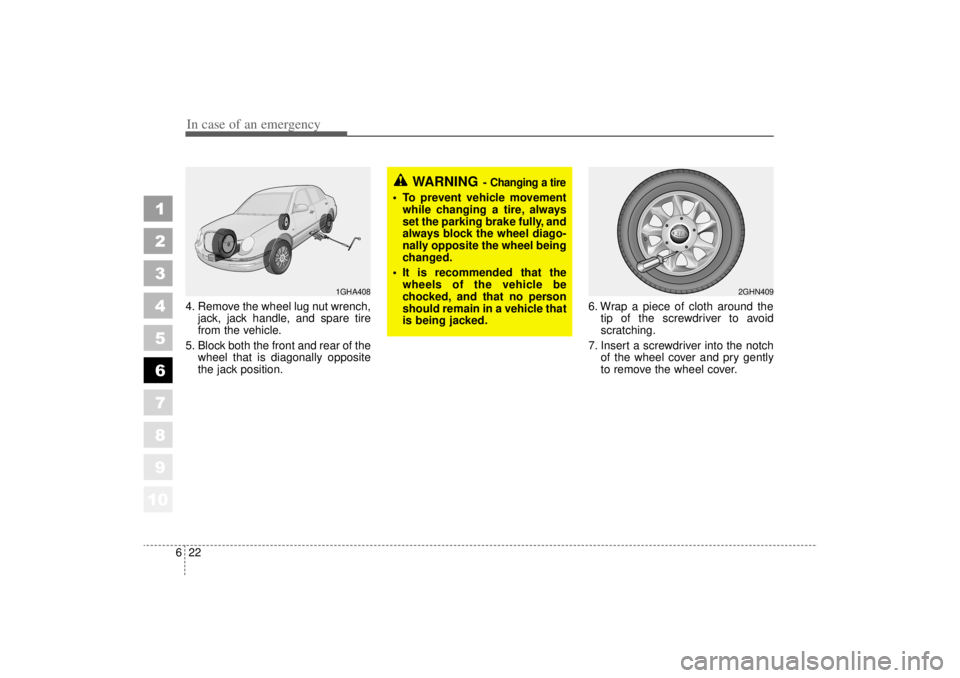
5. Block both the front and rear of the wheel that is diagonally opposite
the jack position. 6. Wrap a piece of cloth around the
tip of the screwdriver to avoid
scratching.
7. Insert a screwdriver into the notch of the wheel cover and pry gently
to remove the wheel cover.
WARNING
- Changing a tire
To prevent vehicle movementwhile changing a tire, always
set the parking brake fully, and
always block the wheel diago-
nally opposite the wheel being
changed.
It is recommended that the wheels of the vehicle be
chocked, and that no person
should remain in a vehicle that
is being jacked.
1GHA408
2GHN409
Page 243 of 322

623
In case of an emergency
1
2
3
4
5
6
7
8
910
8. Loosen the wheel lug nuts coun-terclockwise one turn each, but do
not remove any nut until the tire
has been raised off the ground. 9. Place the jack at the front or rear
jacking position closest to the tire
you are changing. Place the jack
at the designated locations under
the frame. The jacking positions
are plates welded to the frame
with two tabs and a raised dot to
index with the jack. 10. Insert the jack handle into the
jack and turn it clockwise, raising
the vehicle until the tire just
clears the ground. This measure-
ment is approximately 1.2 in (30
mm). Before removing the wheel
lug nuts, make sure the vehicle is
stable and that there is no
chance for movement or slip-
page.
11. Remove the wheel lug nuts by turning them counterclockwise,
then remove the wheel.
12. Mount the spare tire into position and install the wheel lug nuts
with the beveled edge inward.
WARNING
- Jack location
To reduce the possibility of
injury, be sure to use only the
jack provided with the vehicle
and in the correct jack position;
never use any other part of the
vehicle for jack support.
1GHA4104
1GHA4103
2GHN409B
Page 244 of 322
In case of an emergency24
6
1
2
3
4
5
6
7
8
910
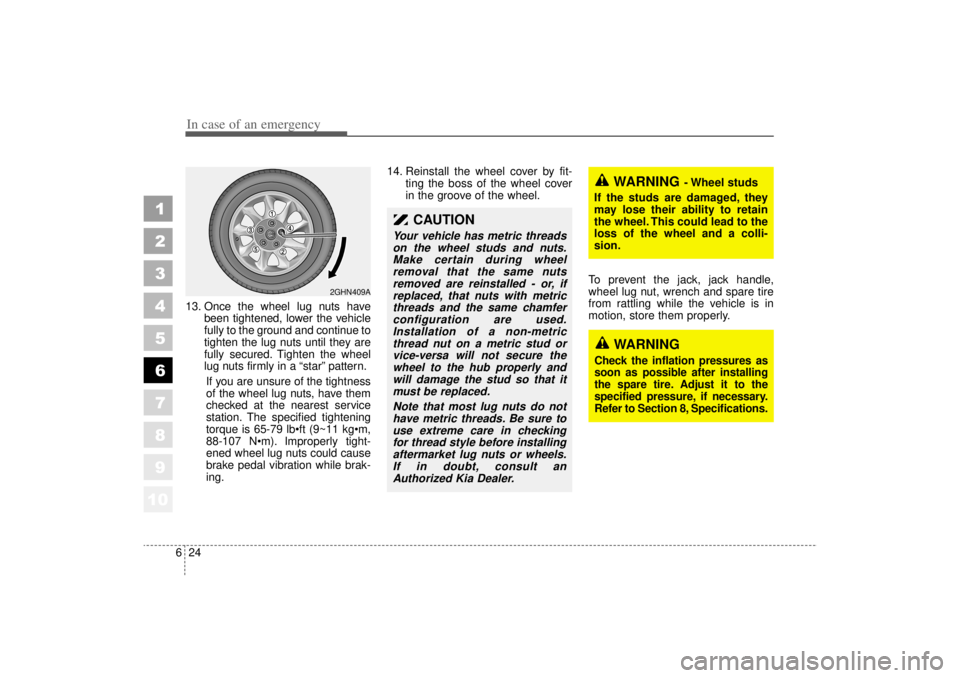
13. Once the wheel lug nuts have
been tightened, lower the vehicle
fully to the ground and continue to
tighten the lug nuts until they are
fully secured. Tighten the wheel
lug nuts firmly in a “star” pattern.
If you are unsure of the tightness
of the wheel lug nuts, have them
checked at the nearest service
station. The specified tightening
torque is 65-79 lb ft (9~11 kgm,
88-107 N m). Improperly tight-
ened wheel lug nuts could cause
brake pedal vibration while brak-
ing. 14. Reinstall the wheel cover by fit-
ting the boss of the wheel cover
in the groove of the wheel.
To prevent the jack, jack handle,
wheel lug nut, wrench and spare tire
from rattling while the vehicle is in
motion, store them properly.
2GHN409A
CAUTION
Your vehicle has metric threadson the wheel studs and nuts.Make certain during wheelremoval that the same nutsremoved are reinstalled - or, ifreplaced, that nuts with metricthreads and the same chamferconfiguration are used.Installation of a non-metricthread nut on a metric stud orvice-versa will not secure thewheel to the hub properly andwill damage the stud so that itmust be replaced.
Note that most lug nuts do nothave metric threads. Be sure touse extreme care in checkingfor thread style before installingaftermarket lug nuts or wheels.If in doubt, consult anAuthorized Kia Dealer.
WARNING
- Wheel studs
If the studs are damaged, they
may lose their ability to retain
the wheel. This could lead to the
loss of the wheel and a colli-
sion.
WARNING
Check the inflation pressures as
soon as possible after installing
the spare tire. Adjust it to the
specified pressure, if necessary.
Refer to Section 8, Specifications.
Page 256 of 322
Maintenance12
7At least monthly: Check coolant level in the coolant
recovery reservoir.
Check the operation of all exterior lights, including the stoplights, turn
signals and hazard warning flash-
ers.
Check the inflation pressures of all tires including the spare.
At least twice a year
(i.e., every Spring and Fall) : Check radiator, heater and air con- ditioning hoses for leaks or da-
mage.
Check windshield washer spray and wiper operation. Clean wiper
blades with clean cloth dampened
with washer fluid.
Check headlight alignment.
Check muffler, exhaust pipes, shields and clamps.
Check the lap/shoulder belts for wear and function.
Check for worn tires and loose wheel lug nuts.
At least once a year : Clean body and door drain holes.
Lubricate door hinges and checks,and hood hinges.
Lubricate door and hood locks and latches.
Lubricate door rubber weather- strips.
Check the air conditioning system before the warm weather season.
Check the power steering fluid level.
Inspect and lubricate automatic transaxle linkage and controls.
Clean battery and terminals.
Check the brake fluid level.
1
2
3
4
5
6
7
8
910
Page 281 of 322
737
Maintenance
1
2
3
4
5
6
7
8
910
TIRES AND WHEELS Tires care For proper maintenance, safety, and
maximum fuel economy, you must
always maintain recommended tire
inflation pressures and stay within
the load limits and weight distribution
recommended for your vehicle.Inflation pressures All tire pressures (including the
spare) should be checked every day
when the tires are cold.“Cold Tires”
means the vehicle has not been driv-
en for at least three hours or driven
less than one mile (1.6 km).
Recommended pressures must be
maintained for the best ride, top vehi-
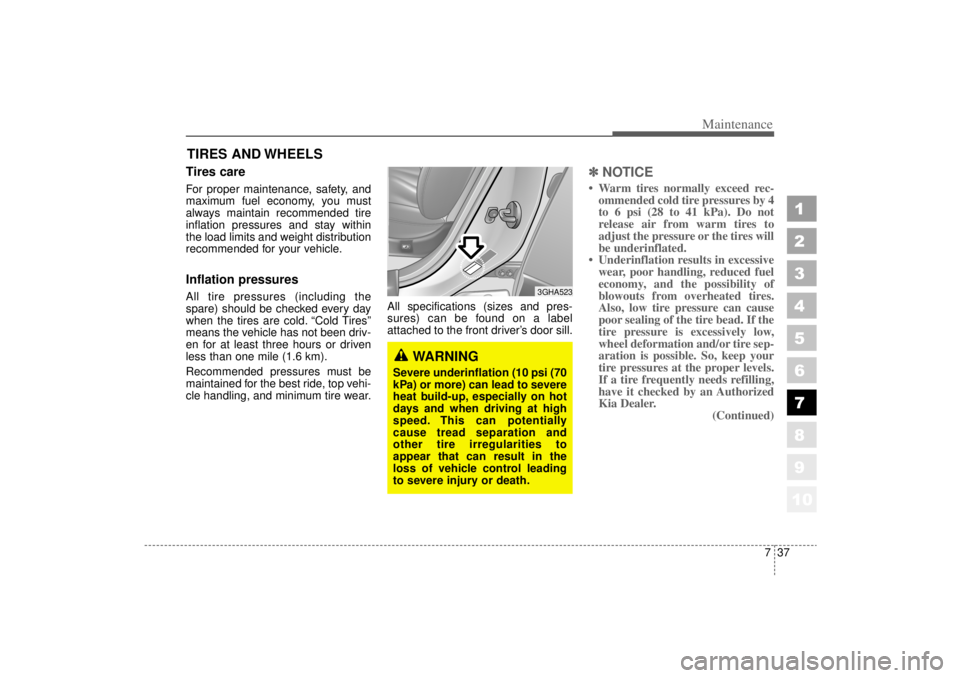
cle handling, and minimum tire wear. All specifications (sizes and pres-
sures) can be found on a label
attached to the front driver’
s door sill.
✽ ✽
NOTICE• Warm tires normally exceed rec-
ommended cold tire pressures by 4
to 6 psi (28 to 41 kPa). Do not
release air from warm tires to
adjust the pressure or the tires will
be underinflated.
• Underinflation results in excessive wear, poor handling, reduced fuel
economy, and the possibility of
blowouts from overheated tires.
Also, low tire pressure can cause
poor sealing of the tire bead. If the
tire pressure is excessively low,
wheel deformation and/or tire sep-
aration is possible. So, keep your
tire pressures at the proper levels.
If a tire frequently needs refilling,
have it checked by an Authorized
Kia Dealer. (Continued)
3GHA523
WARNING
Severe underinflation (10 psi (70
kPa) or more) can lead to severe
heat build-up, especially on hot
days and when driving at high
speed. This can potentially
cause tread separation and
other tire irregularities to
appear that can result in the
loss of vehicle control leading
to severe injury or death.
Page 282 of 322
Maintenance38
7
1
2
3
4
5
6
7
8
910
(Continued)
• Overinflation produces a harsh
ride, handling problems, excessive
wear at the center of the tire tread,
and a greater possibility of dam-
age from road hazards.
• Be sure to reinstall the tire infla- tion valve caps. Without the valve
cap, dirt or moisture could get into
the valve core and cause air leak-
age. If the cap have been lost,
install new one as soon as possible.
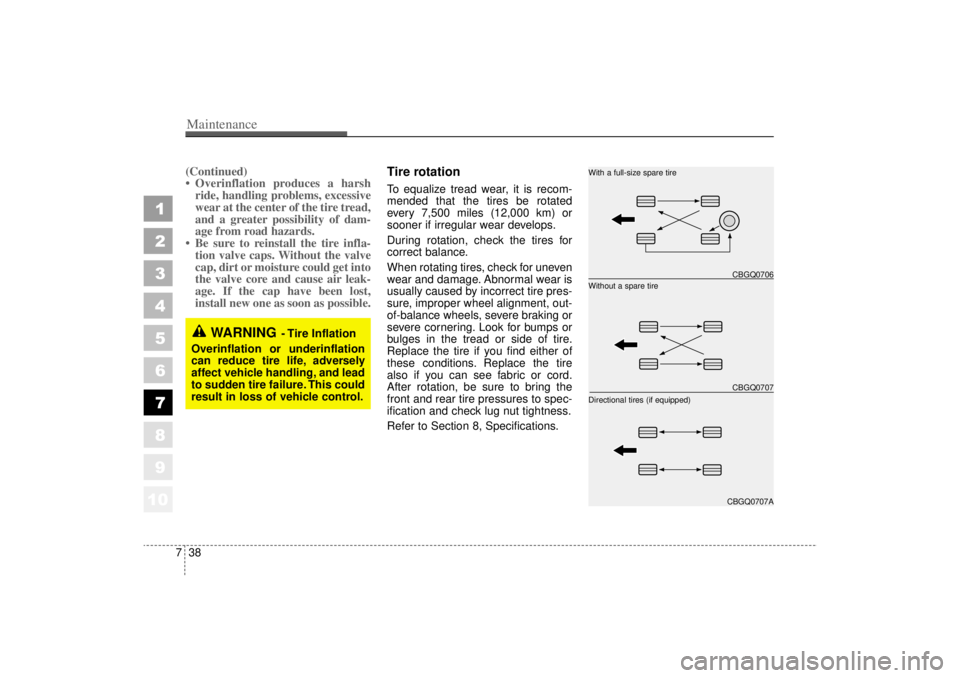
Tire rotation To equalize tread wear, it is recom-
mended that the tires be rotated
every 7,500 miles (12,000 km) or
sooner if irregular wear develops.
During rotation, check the tires for
correct balance.
When rotating tires, check for uneven
wear and damage. Abnormal wear is
usually caused by incorrect tire pres-
sure, improper wheel alignment, out-
of-balance wheels, severe braking or
severe cornering. Look for bumps or
bulges in the tread or side of tire.
Replace the tire if you find either of
these conditions. Replace the tire
also if you can see fabric or cord.
After rotation, be sure to bring the
front and rear tire pressures to spec-
ification and check lug nut tightness.
Refer to Section 8, Specifications.
WARNING
- Tire Inflation
Overinflation or underinflation
can reduce tire life, adversely
affect vehicle handling, and lead
to sudden tire failure. This could
result in loss of vehicle control.
CBGQ0706CBGQ0707CBGQ0707A
Without a spare tire With a full-size spare tire
Directional tires (if equipped)
Page 287 of 322
743
Maintenance
1
2
3
4
5
6
7
8
910
Checking a tire lifeIf any tires that are over 6 years
based on the manufacturing date,
tire strength and performance
decline with age naturally (even if the
tires are not used like a spare tire).
Therefore, the tires should be
replaced by new ones including the
spare tire. You can find the manufac-
turing date on the tire sidewall (pos-
sibly only on the inside of the wheel),
which has DOT marking. DOT is seri-
al numbers on tires, which consist of
a combination of numbers and
English letters. You can check the
manufacturing date to the last four
position of the DOT.
DOT : XXXX XXXX OOOO
The front part of the DOT means a
plant code number, tire size and
tread pattern and the last four num-
bers indicate week and year manu-
factured.
For example:
DOT XXXX XXXX 1602 represents
that the tire was produced in the 16th
week of 2002.
WARNING
A tire more than 6 years old may
cause separation of the cord
layers inside the tire leading to
loss of vehicle or a serious
injury. Therefore, make sure to
check the manufacturing date
and replace the old tire in 6
years after the tire manufactur-
ing date.
WARNING
- Tire temperature
The temperature grade for this
tire is established for a tire that
is properly inflated and not
overloaded. Excessive speed,
underinflation, or excessive
loading, either separately or in
combination, can cause heat
build-up and possible sudden
tires failure. This can cause loss
of vehicle control and serious
injury or death.
Page 320 of 322
Index8
10Roadside Assistance, Emergency . . . . . . . . . . . . . . . . 9-2
Road Warning . . . . . . . . . . . . . . . . . . . . . . . . . . . . . . . 6-2
Rocking the Vehicle . . . . . . . . . . . . . . . . . . . . . . . . . . 5-7
Rotation, Tire . . . . . . . . . . . . . . . . . . . . . . . . . . . . . . 7-38
Safety Belt . . . . . . . . . . . . . . . . . . . . . . . . . . . . . . . . 3-36
Into the auto lock mode . . . . . . . . . . . . . . . . . . . . . 3-53
Restraint System . . . . . . . . . . . . . . . . . . . . . . . . . . 3-39
System, Proper Use and Care of . . . . . . . . . . . . . . . 3-47
Warning Light and Chime . . . . . . . . . . . . . . . . . . . 3-42
Into the Auto Lock mode, placing a passenger . . . . 3-53
Safety Chains . . . . . . . . . . . . . . . . . . . . . . . . . . . . . . 5-16
Schedule 1- Normal Maintenance . . . . . . . . . . . . . . . . 7-5
Schedule 2- Service Maintenance . . . . . . . . . . . . . . . . 7-8
Scheduled Maintenance Service . . . . . . . . . . . . . . . . . 7-4
Seat . . . . . . . . . . . . . . . . . . . . . . . . . . . . . . . . . . . .\
. . 3-18 Adjustment, Driver’s . . . . . . . . . . . . . . . . . . . . . . . 3-20
Adjusting the front passenger seat . . . . . . . . . . . . . 3-25
Rear . . . . . . . . . . . . . . . . . . . . . . . . . . . . . . . . . . . .\
3-30
Severe maintenance schedule . . . . . . . . . . . . . . . . . . . 7-8
Snow Tires . . . . . . . . . . . . . . . . . . . . . . . . . . . . . . . . 5-10
Spare Tire Removing the . . . . . . . . . . . . . . . . . . . . . . . . . . . . 6-20
Special Driving Conditions . . . . . . . . . . . . . . . . . . . . . 5-7
Specifications . . . . . . . . . . . . . . . . . . . . . . . . . . . . . . . 8-2 Lubricant . . . . . . . . . . . . . . . . . . . . . . . . . . . . . . . . 7-51
Speedometer . . . . . . . . . . . . . . . . . . . . . . . . . . . . . . . 4-34 Starting
Emergency . . . . . . . . . . . . . . . . . . . . . . . . . . . . . . . . 6-4
Jump . . . . . . . . . . . . . . . . . . . . . . . . . . . . . . . . . . . .\
6-4
The Engine . . . . . . . . . . . . . . . . . . . . . . . . . . . . . . . 4-4
Steering Column Lock, Ignition Switch and Anti-Theft . . . . . 4-2
Power . . . . . . . . . . . . . . . . . . . . . . . . . . . . . . 4-18, 7-24
Wheel . . . . . . . . . . . . . . . . . . . . . . . . . . . . . . 4-18, 7-25
Tilt . . . . . . . . . . . . . . . . . . . . . . . . . . . . . . . . . . . .\
. 4-19
Storage Compartment . . . . . . . . . . . . . . . . . . . . . . . . 3-99
Suggestions for Economical Operation . . . . . . . . . . . . 5-6
Sunglass Holder . . . . . . . . . . . . . . . . . . . . . . . . . . . 3-101
Sunroof . . . . . . . . . . . . . . . . . . . . . . . . . . . . . . . . . . 3-108
Sunvisor . . . . . . . . . . . . . . . . . . . . . . . . . . . . . . . . . 3-104
Switch, Ignition . . . . . . . . . . . . . . . . . . . . . . . . . . . . . 4-2
Tachometer . . . . . . . . . . . . . . . . . . . . . . . . . . . . . . . . 4-34
Temperature Control Button . . . . . . . . . . . . . . . . . . . . . . . . . . . . 4-56
Gauge, Engine . . . . . . . . . . . . . . . . . . . . . . . . . . . . 4-35
Tie-down Hook . . . . . . . . . . . . . . . . . . . . . . . . . . . . . 6-16
Tilt Steering . . . . . . . . . . . . . . . . . . . . . . . . . . . . . . . 4-19
Tips On Driving Your Vehicle . . . . . . . . . . . . . . . . . . . . . 5-4
For Towing a Stuck Vehicle . . . . . . . . . . . . . . . . . . 6-19
Tire Balance, Wheel Alignment and . . . . . . . . . . . . . . . 7-39
Care . . . . . . . . . . . . . . . . . . . . . . . . . . . . . . . . . . . .\
7-37
Chains . . . . . . . . . . . . . . . . . . . . . . . . . . . . . . . . . . 5-10
1
2
3
4
5
6
7
8
910
S
T