engine KIA AMANTI 2009 Owners Manual
[x] Cancel search | Manufacturer: KIA, Model Year: 2009, Model line: AMANTI, Model: KIA AMANTI 2009Pages: 321, PDF Size: 23.77 MB
Page 271 of 321
721
Maintenance
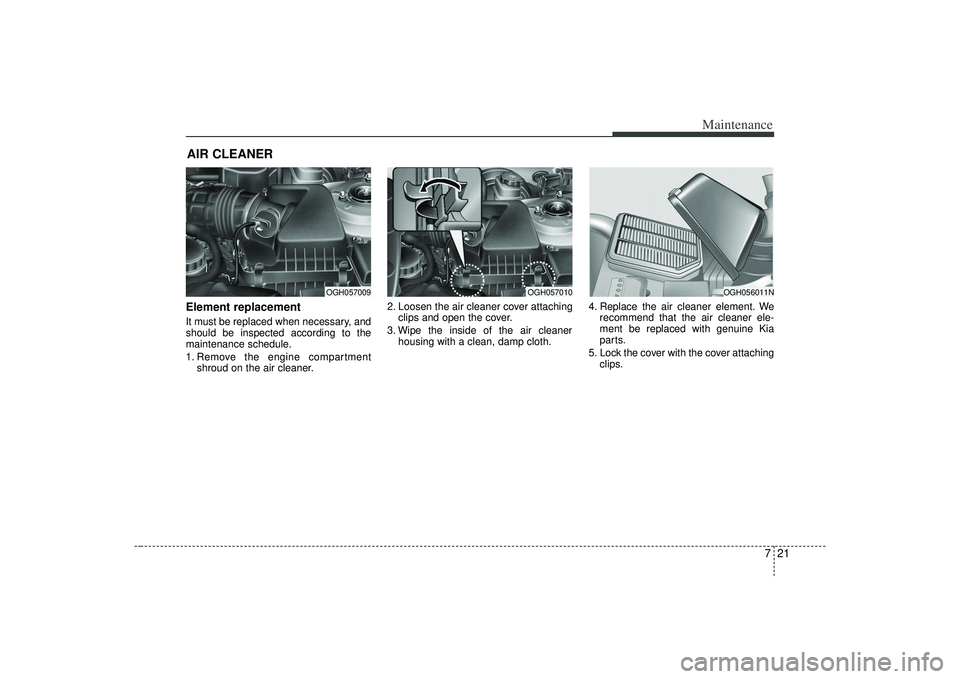
AIR CLEANER Element replacement It must be replaced when necessary, and
should be inspected according to the
maintenance schedule.
1. Remove the engine compartmentshroud on the air cleaner. 2. Loosen the air cleaner cover attaching
clips and open the cover.
3. Wipe the inside of the air cleaner housing with a clean, damp cloth. 4. Replace the air cleaner element. We
recommend that the air cleaner ele-
ment be replaced with genuine Kia
parts.
5. Lock the cover with the cover attaching clips.
OGH057009
OGH057010
OGH056011N
Page 272 of 321
Maintenance22
7Replace the element according to the
Scheduled Maintenance Section.If the vehicle is operated in extremely
dusty or sandy areas, replace the ele-ment more often than the usual recom-mended intervals. (Refer to SevereMaintenance Schedule in this section.)
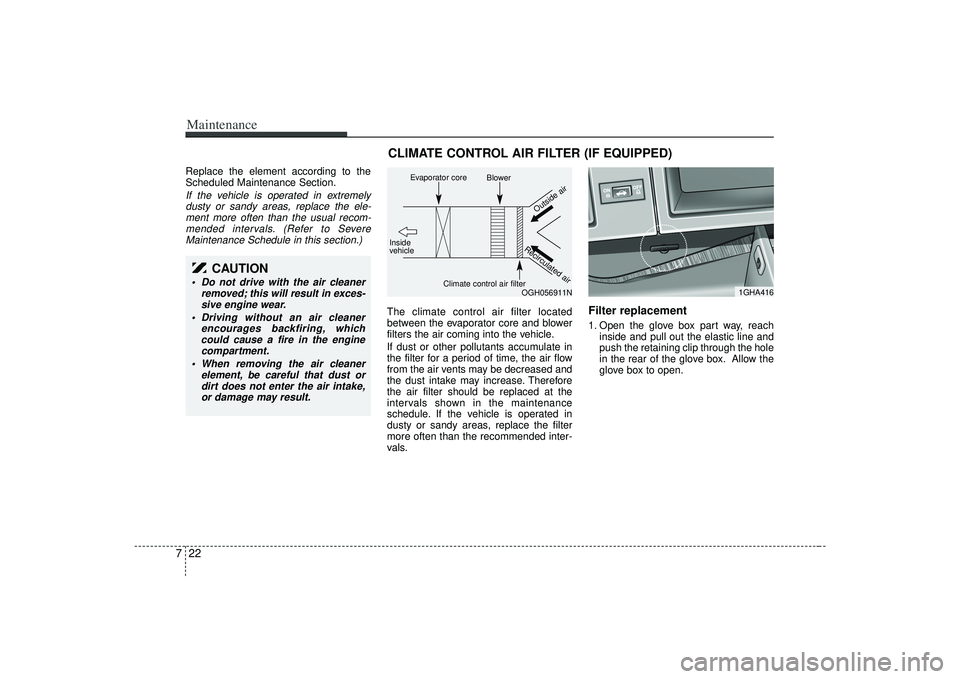
The climate control air filter located
between the evaporator core and blower
filters the air coming into the vehicle.
If dust or other pollutants accumulate in
the filter for a period of time, the air flow
from the air vents may be decreased and
the dust intake may increase. Therefore
the air filter should be replaced at the
intervals shown in the maintenance
schedule. If the vehicle is operated in
dusty or sandy areas, replace the filter
more often than the recommended inter-
vals.
Filter replacement1. Open the glove box part way, reach inside and pull out the elastic line and
push the retaining clip through the hole
in the rear of the glove box. Allow the
glove box to open.
CAUTION
Do not drive with the air cleaner removed; this will result in exces-sive engine wear.
Driving without an air cleaner encourages backfiring, whichcould cause a fire in the engine compartment.
When removing the air cleaner element, be careful that dust ordirt does not enter the air intake,or damage may result.
1GHA416
OGH056911N
Evaporator core
Blower
Outside air
Recirculated air
Climate control air filter
Inside
vehicle
CLIMATE CONTROL AIR FILTER (IF EQUIPPED)
Page 276 of 321
Maintenance26
7
(Continued)
When lifting a plastic-cased bat-
tery, excessive pressure on the
case may cause battery acid to
leak, resulting in personal injury.
Lift with a battery carrier or with
your hands on opposite corners.
Never attempt to charge the bat- tery when the battery cables are
connected.
The electrical ignition system works with high voltage. Never
touch these components with the
engine running or the ignition
switched on.
BATTERY
WARNING
- Battery dangers
Always read the following
instructions carefully when
handling a battery.
Keep lighted cigarettes and all other flames or sparks
away from the battery.
Hydrogen, which is a highly combustible gas, is always
present in battery cells and
may explode if ignited.
Keep batteries out of the reach of children because
batteries contain highly
corrosive SULFURIC ACID.
Do not allow battery acid to
contact your skin, eyes,
clothing or paint finish.
(Continued)
(Continued)If any electrolyte gets intoyour eyes, flush your eyes
with clean water for at least
15 minutes and get immedi-
ate medical attention. If
possible, continue to apply
water with a sponge or
cloth until medical attention
is received.
If electrolyte gets on your
skin, thoroughly wash the
contacted area. If you feel a
pain or a burning sensation,
get medical attention imme-
diately.
Wear eye protection whencharging or working near a
battery. Always provide
ventilation when working in
an enclosed space.
(Continued)
PROPOSITION 65 WARN-
ING
Battery posts, terminals, and relat-
ed accessories contain lead and
lead compounds, chemicals known
to the State of California to cause
cancer and reproductive harm.
Batteries also contain other chemi-
cals known to the State of California
to cause cancer. Wash hands after
handling.
Page 278 of 321
Maintenance28
7✽
✽
NOTICE• Before performing maintenance or
recharging the battery, turn off all
accessories and stop the engine.
• The negative battery cable must be removed first and installed last when
the battery is disconnected.
WARNING
- Recharging
battery
When recharging the battery,
observe the following precautions:
The battery must be removed
from the vehicle and placed in an
area with good ventilation.
Do not allow cigarettes, sparks, or flame near the battery.
Watch the battery during charg- ing, and stop or reduce the charg-
ing rate if the battery cells begin
gassing (boiling) violently or if
the temperature of the electrolyte
of any cell exceeds 120°F (49°C).
Wear eye protection when check- ing the battery during charging.
(Continued)
(Continued)
Disconnect the battery charger inthe following order.
1. Turn off the battery charger main switch.
2. Unhook the negative clamp from the negative battery terminal.
3. Unhook the positive clamp from the positive battery terminal.
Page 292 of 321
Maintenance42
7
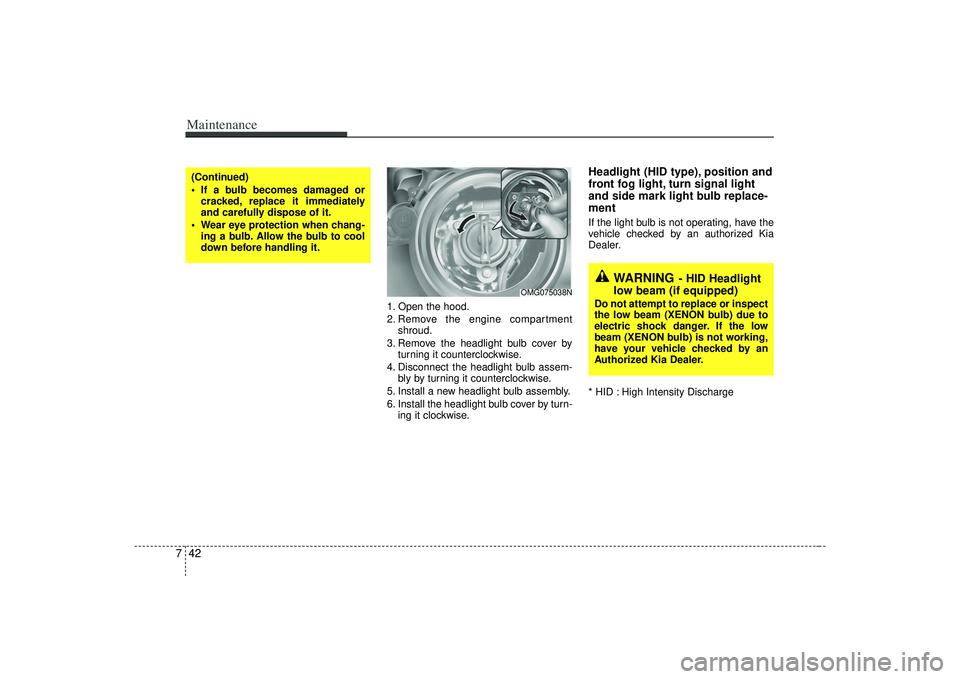
1. Open the hood.
2. Remove the engine compartment
shroud.
3. Remove the headlight bulb cover by turning it counterclockwise.
4. Disconnect the headlight bulb assem- bly by turning it counterclockwise.
5. Install a new headlight bulb assembly.
6. Install the headlight bulb cover by turn- ing it clockwise.
Headlight (HID type), position and
front fog light, turn signal light
and side mark light bulb replace-
mentIf the light bulb is not operating, have the
vehicle checked by an authorized Kia
Dealer.
* HID : High Intensity Discharge
(Continued)
If a bulb becomes damaged orcracked, replace it immediately
and carefully dispose of it.
Wear eye protection when chang- ing a bulb. Allow the bulb to cool
down before handling it.
OMG075038N
WARNING
- HID Headlight
low beam (if equipped)
Do not attempt to replace or inspect
the low beam (XENON bulb) due to
electric shock danger. If the low
beam (XENON bulb) is not working,
have your vehicle checked by an
Authorized Kia Dealer.
Page 296 of 321
Maintenance46
7LUBRICANT SPECIFICATIONS Recommended lubricants To help achieve proper engine and pow-
ertrain performance and durability, use
only lubricants of the proper quality. The
correct lubricants also help promote
engine efficiency that results in improved
fuel economy.
Engine oils labeled Energy Conserving
Oil are now available. Along with other
additional benefits, they contribute to fuel
economy by reducing the amount of fuel
necessary to overcome engine friction.
Often, these improvements are difficult to
measure in everyday driving, but in a
year’s time, they can offer significant cost
and energy savings.
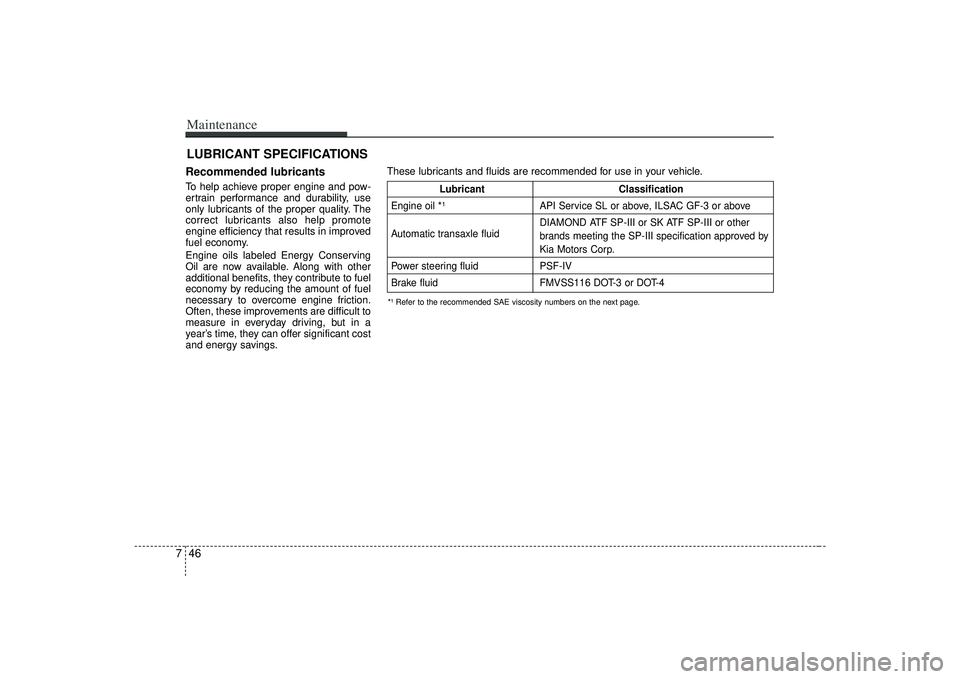
*¹ Refer to the recommended SAE viscosity numbers on the next page.These lubricants and fluids are recommended for use in your vehicle.
Lubricant Classification
Engine oil *¹
API Service SL or above, ILSAC GF-3 or above
Automatic transaxle fluid DIAMOND ATF SP-III or SK ATF SP-III or other
brands meeting the SP-III specification approved by
Kia Motors Corp.
Power steering fluid PSF-IV
Brake fluid FMVSS116 DOT-3 or DOT-4
Page 297 of 321
747
Maintenance
Recommended SAE viscosity
number Engine oil viscosity (thickness) has an
effect on fuel economy and cold weather
operating (starting and oil flow). Lower
viscosity engine oils can provide better
fuel economy and cold weather perform-
ance, however, higher viscosity engine
oils are required for satisfactory lubrica-
tion in hot weather. Using oils of any vis-
cosity other than those recommended
could result in engine damage.
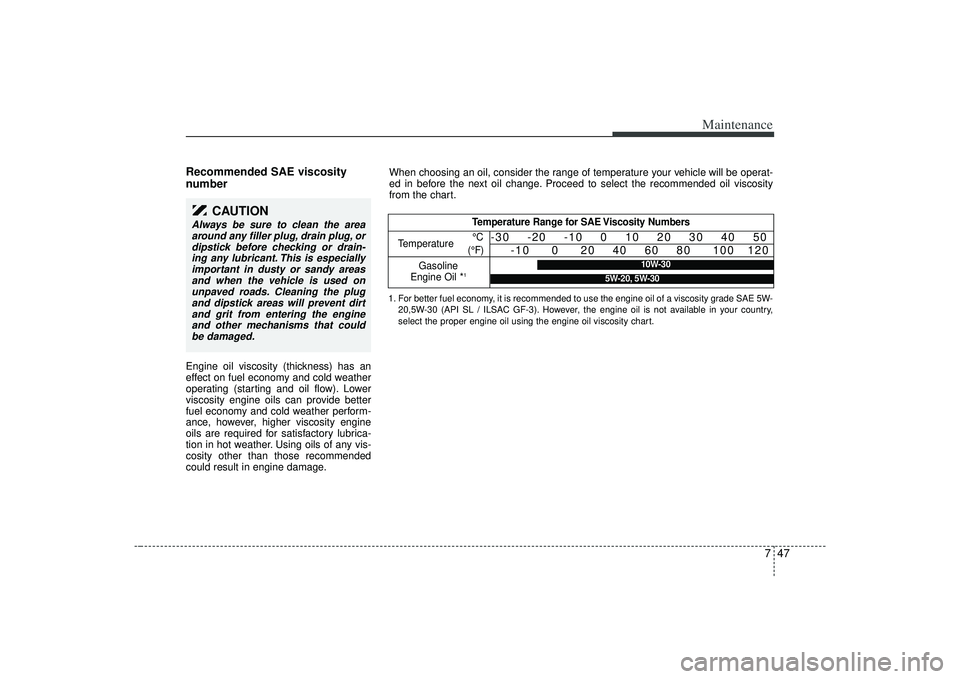
When choosing an oil, consider the range of temperature your vehicle will be operat-
ed in before the next oil change. Proceed to select the recommended oil viscosity
from the chart.
Temperature Range for SAE Viscosity Numbers
TemperatureGasoline
Engine Oil *
1°C
(°F)
-30 -20 -10 0 10 20 30 40 50 -10 0 20 40 60 80 100 120
1. For better fuel economy, it is recommended to use the engine oil of a viscosity grade SAE 5W-
20,5W-30 (API SL / ILSAC GF-3). However, the engine oil is not available in your country,
select the proper engine oil using the engine oil viscosity chart.
10W-30
5W-20, 5W-30
CAUTION
Always be sure to clean the areaaround any filler plug, drain plug, or dipstick before checking or drain-ing any lubricant. This is especiallyimportant in dusty or sandy areasand when the vehicle is used on unpaved roads. Cleaning the plugand dipstick areas will prevent dirt and grit from entering the engineand other mechanisms that couldbe damaged.
Page 298 of 321
Maintenance48
7EXTERIOR CARE Exterior general caution It is very important to follow the label
directions when using any chemical
cleaner or polish. Read all warning and
caution statements that appear on the
label.Finish maintenanceWashing To help protect your vehicle’s finish from
rust and deterioration, wash it thoroughly
and frequently at least once a month with
lukewarm or cold water.
If you use your vehicle for off-road driv-
ing, you should wash it after each off-
road trip. Pay special attention to the
removal of any accumulation of salt, dirt,
mud, and other foreign materials. Make
sure the drain holes in the lower edges of
the doors and rocker panels are kept
clear and clean. Insects, tar, tree sap, bird droppings,
industrial pollution and similar deposits
can damage your vehicle’s finish if not
removed immediately.
Even prompt washing with plain water
may not completely remove all these
deposits. A mild soap, safe for use on
painted surfaces, may be used.
After washing, rinse the vehicle thor-
oughly with lukewarm or cold water. Do
not allow soap to dry on the finish.
CAUTION
Do not use strong soap, chemical
detergents or hot water, and do not wash the vehicle in direct sunlightor when the body of the vehicle is warm.
WARNING
After washing the vehicle, test the
brakes while driving slowly to see if
they have been affected by water. If
braking performance is impaired,
dry the brakes by applying them
lightly while maintaining a slow for-
ward speed.
CAUTION
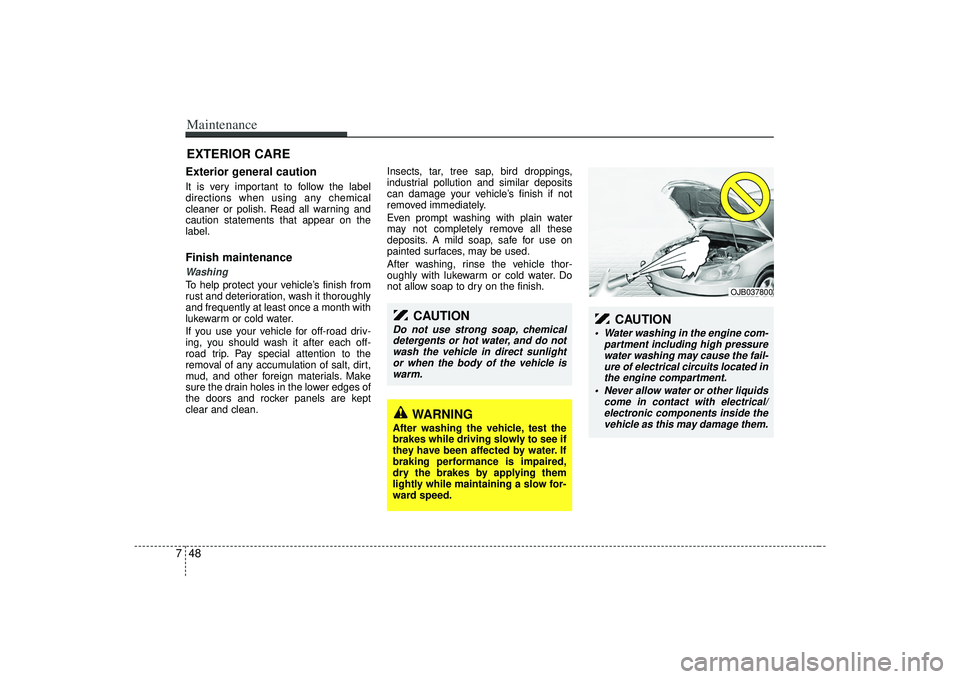
Water washing in the engine com- partment including high pressurewater washing may cause the fail-ure of electrical circuits located in the engine compartment.
Never allow water or other liquids come in contact with electrical/electronic components inside thevehicle as this may damage them.
OJB037800
Page 305 of 321
83
Specifications
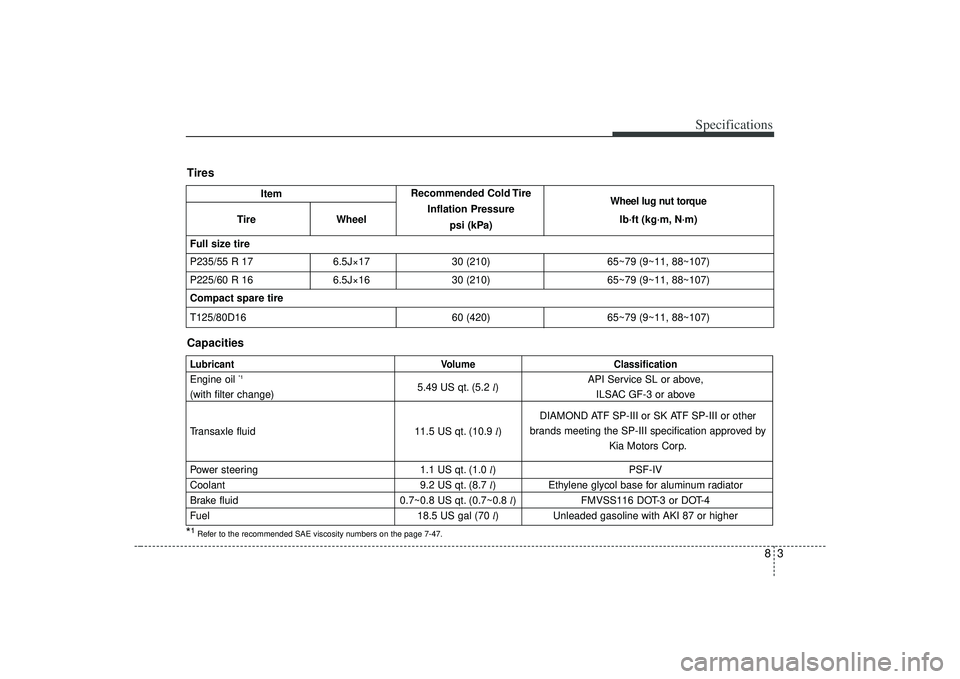
LubricantVolume ClassificationEngine oil
*1
5.49 US qt. (5.2 l) API Service SL or above,
(with filter change) ILSAC GF-3 or above
Transaxle fluid 11.5 US qt. (10.9 l)
Power steering 1.1 US qt. (1.0 l) PSF-IV
Coolant 9.2 US qt. (8.7 l)Ethylene glycol base for aluminum radiator
Brake fluid 0.7~0.8 US qt. (0.7~0.8 l)FMVSS116 DOT-3 or DOT-4
Fuel 18.5 US gal (70 l)Unleaded gasoline with AKI 87 or higher
*¹Refer to the recommended SAE viscosity numbers on the page 7-47.
DIAMOND ATF SP-III or SK ATF SP-III or other
brands meeting the SP-III specification approved by Kia Motors Corp.
Tires
Item Recommended Cold Tire
Wheel lug nut torque
Tire Wheel Inflation Pressure
psi (kPa) lb·ft (kg·m, N·m)
Full size tire
P235/55 R 17 6.5J×1730 (210) 65~79 (9~11, 88~107)
P225/60 R 16 6.5J×1630 (210) 65~79 (9~11, 88~107)
Compact spare tire
T125/80D16 60 (420)65~79 (9~11, 88~107)
Capacities
Page 308 of 321
93
Consumer assistance, Reporting safety defects
Trip InterruptionTrip interruption expense benefits are provided in the event that
a warranty-related disablement occurs more than 150 miles
from your home, and the repairs require more than 24 hours to
complete. Reasonable reimbursement is included for meals,
lodging, or rental car expenses. Trip interruption coverage is lim-
ited to $100 per day subject to a three day maximum limit per
incident. You must contact the Kia Roadside Assistance Center
to obtain pre-authorization of expenses. Once the Kia Roadside
Assistance Center gives authorization for trip interruption bene-
fits, they will assist you in making the necessary arrangements.
Insurance deductibles, expenses, and claims paid by your
insurance company or other providers are not eligible for reim-
bursement.
Fleet vehicles are excluded from reimbursement under Kia’s
Trip Interruption Policy.
Registering Your Vehicle in a Foreign CountryIf you plan to register your vehicle in a foreign country, you
should confirm that it conforms to the regulations in that coun-
try. Even if you successfully register the vehicle in a foreign
country, you may experience the following problems and should
therefore consider the possibility of having to deal with them:
1. The fuel specified for your vehicle may be unavailable. If otherthan the specified fuel is used, it could cause damage to the
engine, the fuel injection system, and other fuel-related parts
which may not be covered under your New Vehicle Emissions
Limited Warranty.
2. We must, therefore, clearly state that when you leave the country in which you purchased your Kia as a new and reg-
ister it in another country, problems arising from the use of
fuel other than the specified fuel are not subject to manufac-
turer’s warranty. Because vehicles like yours may not be mar-
keted in the new country of registration, parts, servicing tech-
niques and tools necessary to maintain and repair your vehi-
cle may be unavailable.
Even if vehicles like yours are sold there, mechanical speci-
fications required by the government may vary enough from
the country of purchase to cause additional problems.
3. There may not be an Authorized Kia Dealer in the area in which you plan to register your vehicle. You may additionally
experience difficulty in obtaining services in a foreign country
for any number of reasons.
Further, we cannot assume any responsibility for problems that
result from unsatisfactory service or lack of service outside of
the United States.