belt KIA AMANTI 2009 Service Manual
[x] Cancel search | Manufacturer: KIA, Model Year: 2009, Model line: AMANTI, Model: KIA AMANTI 2009Pages: 321, PDF Size: 23.77 MB
Page 172 of 321
Driving your vehicle36
4ESC indicator
(Electronic Stability
Control) (if equipped) The ESC indicator will illuminate when
the ignition switch is turned ON, but
should go off after approximately 3 sec-
onds. When the ESC is on, it monitors
the driving conditions and under normal
driving conditions, the ESC light will
remain off. When a slippery or low trac-
tion condition is encountered, the ESC
will operate, and the ESC indicator will
blink to indicate the ESC is operating.
ESC OFF indicator
(if equipped)The ESC OFF indicator will illuminate
when the ignition switch is turned ON,
but should go off after approximately 3
seconds. To switch to ESC OFF mode,
press the ESC OFF button. The ESC
OFF indicator will illuminate indicating
the ESC is deactivated. If this indicator
stays on in the ESC ON mode, the ESC
may have a malfunction. Take your car to
an authorized Kia dealer and have the
system checked.
Safety belt warning chime If the driver's seat belt is not fastened
when the ignition key is turned “ON” or if
it is disconnected after the key is ON, the
safety belt warning chime will sound for
approximately 6 seconds.Key reminder warning chimeIf the driver’s door is opened and the igni-
tion key is left in the ignition switch in the
LOCK or ACC position, the key reminder
warning chime will sound. This is to pre-
vent you from locking your keys in the
vehicle.
ESC
ESC
OFF
Page 235 of 321

In case of an emergency12
6
Power connectorYour vehicle is equipped with a power connector to prevent bat-
tery discharge if your vehicle is parked without being operated
for prolonged periods. Use the following procedures before
parking the vehicle for prolonged period.
1. Turn off the engine.
2. Turn off the headlights and tail lights.
3. Open the driver-side knee bolster cover and pull up the
“POWER/CONN”.✽ ✽NOTICE• If the power connector is pulled up from the fuse panel, the
warning chime, AV system, clock and intetrior lamps, etc.,
will not operate. Some items must be reset after replace-
ment.
• Even though the power connector is pulled up, the battery can still be discharged by operation of the headlights or
other electrical devices.
Description Fuse rating Protected component
A/CON 10A Air-conditioning system
P/WDW(LH) 20A Power window (left)
TAIL LP(RH) 10A Taillight (right)
BACK WARN’G 10A Back warning
DR LP 10A Door courtesy lamp
MIRROR HTD 15A Outside review mirror defroster
ENG SNSR 10A
Power train control system sensors
T/REDUCER10A Seat belt tension reducer
CLOCK 10A Clock
WIPER(FR) 25A Wiper (front)
EPS 10A Electronic power steering
TAIL LP(LH) 10A Tail light (left)
ROOM LP 10A Room lamp
AV, CLOCK 15A Audio, Clock
LAN UNIT 10A Lan unit
TPMS 15A Tire pressure monitoring system
H/LP WASHER 20A Headlight washer
SHUNT CONN - Switch illumination
POWER/CONN - Power connector
1GHA403
Power
connector
Page 253 of 321
73
Maintenance
MAINTENANCEINTERVALS
MAINTENANCE
ITEM
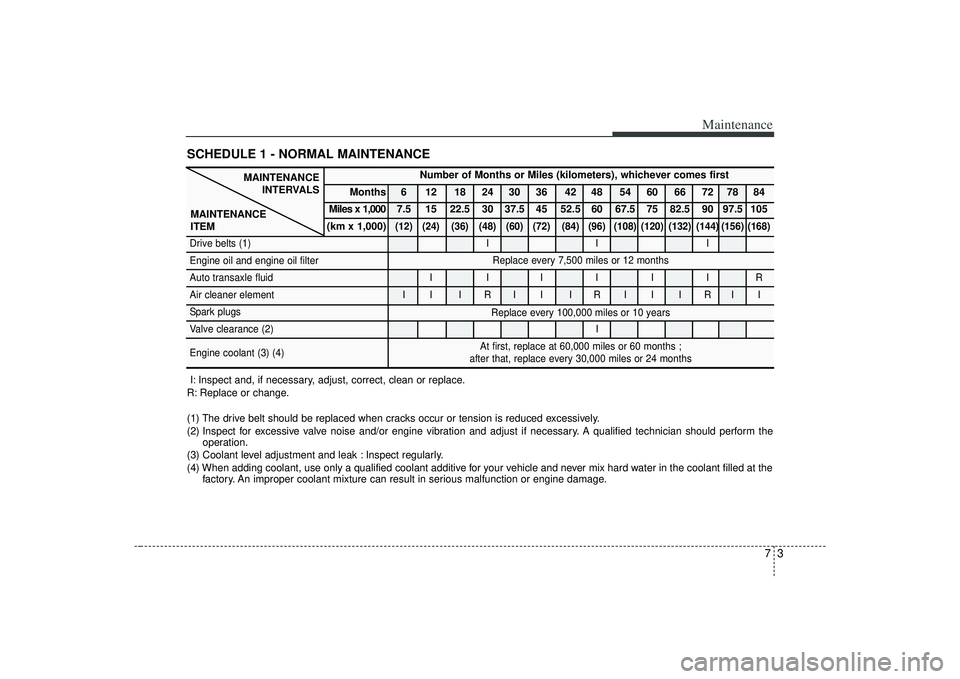
SCHEDULE 1 - NORMAL MAINTENANCE
Number of Months or Miles (kilometers), whichever comes first
Months 6 12 18 24 30 36 42 48 54 60 66 72 78 84
Miles x 1,000 7.5 15 22.5 30 37.5 45 52.5 60 67.5 75 82.5 90 97.5 105
(km x 1,000)
(12) (24) (36) (48) (60) (72) (84) (96) (108) (120) (132) (144) (156) (168)
Drive belts (1) I I I
Engine oil and engine oil filter
Auto transaxle fluid I I I I I I R
Air cleaner element I I I R I I I R I I I R I I
Spark plugs
Valve clearance (2) I
Engine coolant (3) (4)
I: Inspect and, if necessary, adjust, correct, clean or replace.
R: Replace or change.
(1) The drive belt should be replaced when cracks occur or tension is reduced excessively.
(2) Inspect for excessive valve noise and/or engine vibration and adjust if necessary. A qualified technician should perform the operation.
(3) Coolant level adjustment and leak : Inspect regularly.
(4) When adding coolant, use only a qualified coolant additive for your vehicle and never mix hard water in the coolant filled at the factory. An improper coolant mixture can result in serious malfunction or engine damage.
At first, replace at 60,000 miles or 60 months ;
after that, replace every 30,000 miles or 24 months Replace every 100,000 miles or 10 yearsReplace every 7,500 miles or 12 months
Page 256 of 321
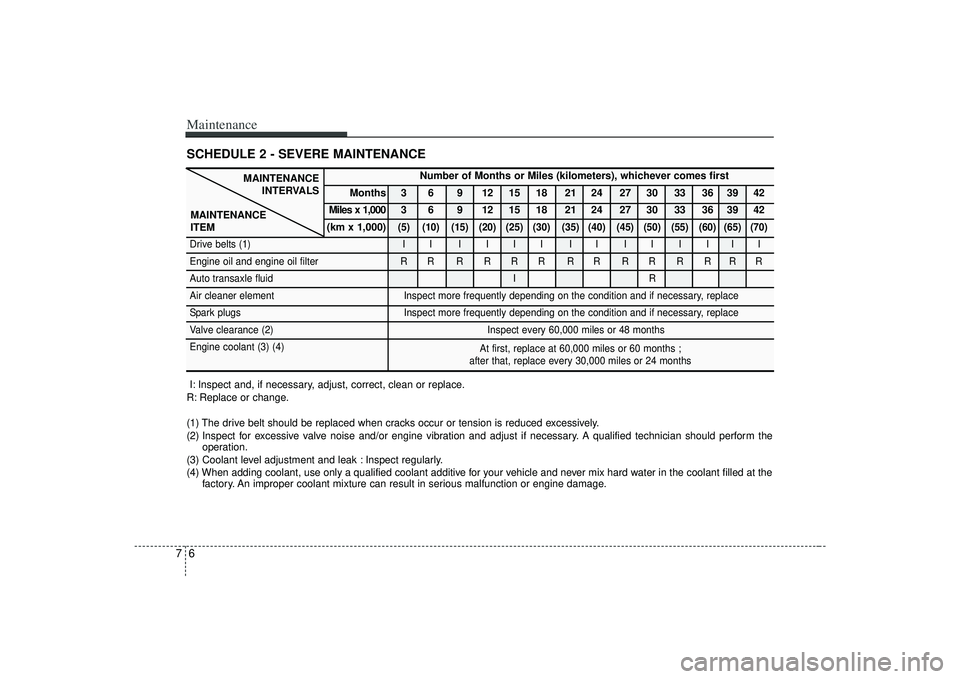
Maintenance67SCHEDULE 2 - SEVERE MAINTENANCE
MAINTENANCEINTERVALS
MAINTENANCE
ITEM
Number of Months or Miles (kilometers), whichever comes first
Months 3 6 9 12 15 18 21 24 27 30 33 36 39 42
Miles x 1,000 3 6 9 12 15 18 21 24 27 30 33 36 39 42
(km x 1,000)
(5) (10) (15) (20) (25) (30) (35) (40) (45) (50) (55) (60) (65) (70)
Drive belts (1) I I I I I I I I I I I I I I
Engine oil and engine oil filter R R R R R R R R R R R R R R
Auto transaxle fluid I R
Air cleaner element Inspect more frequently depending on the condition and if necessary, replace
Spark plugs Inspect more frequently depending on the condition and if necessary, replace
Valve clearance (2) Inspect every 60,000 miles or 48 months
Engine coolant (3) (4)
I: Inspect and, if necessary, adjust, correct, clean or replace.
R: Replace or change.
(1) The drive belt should be replaced when cracks occur or tension is reduced excessively.
(2) Inspect for excessive valve noise and/or engine vibration and adjust if necessary. A qualified technician should perform the operation.
(3) Coolant level adjustment and leak : Inspect regularly.
(4) When adding coolant, use only a qualified coolant additive for your vehicle and never mix hard water in the coolant filled at the factory. An improper coolant mixture can result in serious malfunction or engine damage.
At first, replace at 60,000 miles or 60 months ;
after that, replace every 30,000 miles or 24 months
Page 260 of 321
Maintenance10
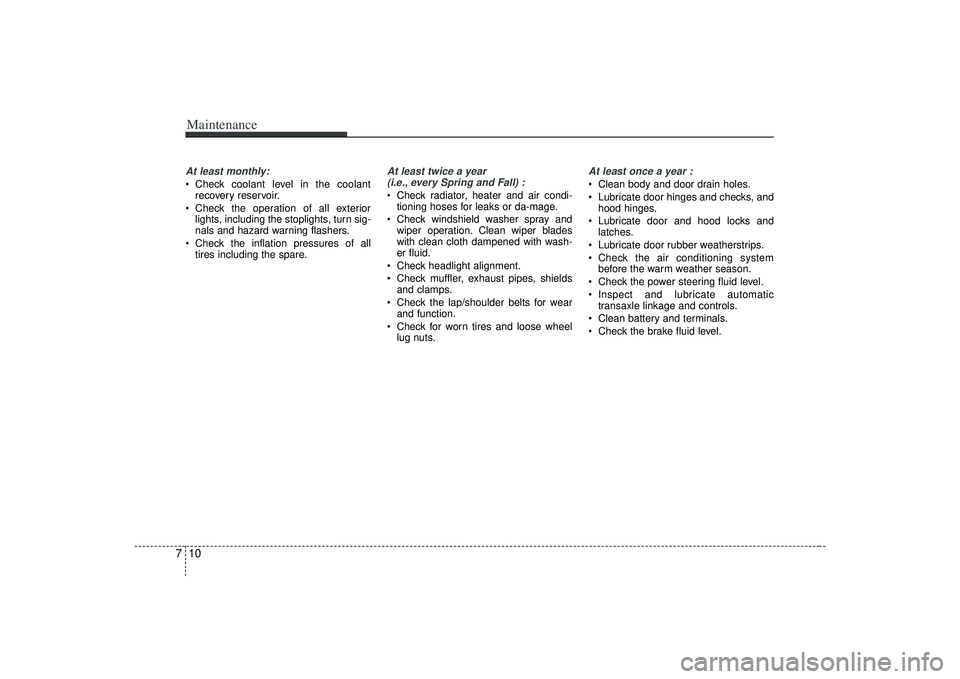
7At least monthly: Check coolant level in the coolant
recovery reservoir.
Check the operation of all exterior lights, including the stoplights, turn sig-
nals and hazard warning flashers.
Check the inflation pressures of all tires including the spare.
At least twice a year (i.e., every Spring and Fall) : Check radiator, heater and air condi- tioning hoses for leaks or da-mage.
Check windshield washer spray and wiper operation. Clean wiper blades
with clean cloth dampened with wash-
er fluid.
Check headlight alignment.
Check muffler, exhaust pipes, shields and clamps.
Check the lap/shoulder belts for wear and function.
Check for worn tires and loose wheel lug nuts.
At least once a year : Clean body and door drain holes.
Lubricate door hinges and checks, andhood hinges.
Lubricate door and hood locks and latches.
Lubricate door rubber weatherstrips.
Check the air conditioning system before the warm weather season.
Check the power steering fluid level.
Inspect and lubricate automatic transaxle linkage and controls.
Clean battery and terminals.
Check the brake fluid level.
Page 286 of 321
Maintenance36
74. Tire ply composition and materialThe number of layers or plies of rub-
ber-coated fabric in the tire. Tire
manufacturers also must indicate the
materials in the tire, which include
steel, nylon, polyester, and others.
The letter "R" means radial ply con-
struction; the letter "D" means diago-
nal or bias ply construction; and the
letter "B" means belted-bias ply con-
struction.
5. Maximum permissible inflation
pressureThis number is the greatest amount
of air pressure that should be put in
the tire. Do not exceed the maximum
permissible inflation pressure. Refer
to the Tire and Loading Information
label for recommended inflation
pressure.6. Maximum load ratingThis number indicates the maximum
load in kilograms and pounds that
can be carried by the tire. When
replacing the tires on the vehicle,
always use a tire that has the same
load rating as the factory installed
tire.7. Uniform tire quality grading The following information relates to
the tire grading system developed by
the National Highway Traffic Safety
Administration (NHTSA) for grading
tires by tread wear, traction and tem-
perature performance. Tread wear
The tread wear grade is a compara-
tive rating based on the wear rate of
the tire when tested under controlled
conditions on a specified govern-
ment test course. For example, a tire
graded 150 would wear one-and-a-
half times as well on the government
course as a tire graded 100.
The relative performance of tires
depends upon the actual conditions
of their use. However, performance
may differ from the norm because of
variations in driving habits, service
practices and differences in road
characteristics and climate.
These grades are molded on the
side-walls of passenger vehicle tires.
The tires available as standard or
optional equipment on Kia vehicles
may vary with respect to grade.
WARNING
Tires degrade over time, even
when they are not being used.
Regardless of the remaining
tread, it is recommended that
tires generally be replaced after
six (6) years of normal service.
Heat caused by hot climates or
frequent high loading condi-
tions can accelerate the aging
process. Failure to follow this
warning can result in sudden
tire failure, which could lead to a
loss of control and an accident
involving serious injury or
death.
Page 287 of 321
737
Maintenance
Traction - AA, A, B & C
The traction grades, from highest to
lowest, are AA, A, B and C. The
grades represent the tires ability to
stop on wet pavement as measured
under controlled conditions on spec-
ified government test surfaces of
asphalt and concrete. A tire marked
C may have poor traction perform-
ance.
Temperature -A, B & C
The temperature grades are A (the
highest), B and C. The grades repre-
sent the tire’s resistance to the gen-
eration of heat and its ability to dissi-
pate heat when tested under con-
trolled conditions on a specified
indoor laboratory test wheel.
Sustained high temperature can
cause the material of the tires to
degenerate and reduce tires life, and
excessive temperature can lead to
sudden tires failure. Grade C corre-
sponds to a level of performance
which all passenger vehicle tires must
meet under the Federal Motor Vehicle
Safety Standard No. 109. Grades A
and B represent higher levels of per-
formance on the laboratory test wheel
than the minimum required by the law.Tire terminology and definitions
Air Pressure: The amount of air
inside the tire pressing outward on
the tire. Air pressure is expressed in
pounds per square inch (psi) or kilo-
pascal (kPa).
Accessory Weight
: This means the
combined weight of optional acces-
sories. Some examples of optional
accessories are, automatic transmis-
sion, power seats, and air condition-
ing.
Aspect Ratio : The relationship of a
tire's height to its width.
Belt: A rubber coated layer of cords
that is located between the plies and
the tread. Cords may be made from
steel or other reinforcing materials.
Bead: The tire bead contains steel
wires wrapped by steel cords that
hold the tire onto the rim.
Bias Ply Tire : A pneumatic tire in
which the plies are laid at alternate
angles less than 90 degrees to the
centerline of the tread.
WARNING
- Tire temperature
The temperature grade for this
tire is established for a tire that
is properly inflated and not
overloaded. Excessive speed,
underinflation, or excessive
loading, either separately or in
combination, can cause heat
build-up and possible sudden
tire failure. This can cause loss
of vehicle control and serious
injury or death.
Page 301 of 321
751
Maintenance
INTERIOR CARE Interior general precautions Prevent caustic solutions such as per-
fume and cosmetic oil from contacting
the dashboard because they may cause
damage or discoloration. If they do con-
tact the dashboard, wipe them off imme-
diately. See the instructions that follow for
the proper way to clean vinyl.Cleaning the upholstery and inte-
rior trim Vinyl Remove dust and loose dirt from vinyl
with a whisk broom or vacuum cleaner.
Clean vinyl surfaces with a vinyl cleaner.
Fabric Remove dust and loose dirt from fabric
with a whisk broom or vacuum cleaner.
Clean with a mild soap solution recom-
mended for upholstery or carpets.
Remove fresh spots immediately with a
fabric spot cleaner. If fresh spots do not
receive immediate attention, the fabric
can be stained and its color can be
affected. Also, its fire-resistant properties
can be reduced if the material is not
properly maintained.
Cleaning the lap/shoulder belt
webbing Clean the belt webbing with any mild
soap solution recommended for cleaning
upholstery or carpet. Follow the instruc-
tions provided with the soap. Do not
bleach or re-dye the webbing because
this may weaken it.Cleaning the interior window
glass If the interior glass surfaces of the vehi-
cle become fogged (that is, covered with
an oily, greasy or waxy film), they should
be cleaned with glass cleaner. Follow the
directions on the glass cleaner container.✽ ✽NOTICEDo not scrape or scratch the inside of
the rear window. This may result in
damage to the rear window defroster
grid.
CAUTION
Using anything but recommended
cleaners and procedures may affectthe fabric’s appearance and fire-resistant properties.
Page 302 of 321
Maintenance52
7CALIFORNIA PERCHLORATE NOTICE Perchlorate Material-special handling
may apply, See www.dtsc.ca.gov/haz-
ardouswaste/perchlorate.
Notice to California Vehicle Dismantlers:
Perchlorate containing materials, such as
airbag inflators, seatbelt pretensioners
and keyless remote entry batteries, must
be disposed of according to Title 22
California Code of Regulations Section
67384.10 (a).
Page 313 of 321

Index2
10
Air Bags - Advanced Supplemental Restraint System ··3-52
Air Bag Curtain ··················\
··················\
··················\
··················\
·3-65
Driver's ··················\
··················\
··················\
··················\
3-57
Front Passenger's ··················\
··················\
··················\
···3-58
Side ··················\
··················\
··················\
··················\
······3-64
Warning Light ··················\
··················\
················3-73, 4-\
35
Air Cleaner··················\
··················\
··················\
···············7-21
Air Conditioning Button ··················\
··················\
··················\
··················\
··4-53
System Operation Tips ··················\
··················\
············4-54
Air Intake Control Button··················\
··················\
··········4-49
Alignment, Tire Balance and Wheel ··················\
···········7-32
Aluminum Wheel Maintenance ··················\
··················\
·7-50
Antenna ················\
··················\
··················\
··················\
···3-98
Anti-Lock Brake System ··················\
··················\
···········4-15 Warning Light ··················\
··················\
··················\
········4-31
Anti-Theft Steering Column Lock, Ignition Switch and ··················\
··················\
··················\
·4-2
Ashtray ··················\
··················\
··················\
··················\
···3-91
Audio Remote Control ··················\
··················\
··················\
·····3-99
Systems ··················\
··················\
··················\
················3-100
Automatic Climate Control System ··················\
··················\
··········4-46
Transaxle ··················\
··················\
··················\
········4-5, 7-18
Transaxle Fluid Level, Checking the ··················\
········7-18 Balance, Wheel Alignment and Tire··················\
············7-32
Battery··················\
··················\
··················\
··················\
····7-26
Recharging ··················\
··················\
··················\
·············7-27
Service, For Best ··················\
··················\
··················\
···7-27
Before Driving ··················\
··················\
··················\
···········5-5
Belts, Safety ··················\
··················\
··················\
··················\
···3-30
Pre-tensioner, seat··················\
··················\
··················\
··3-30
Blade Replacement, Windshield Wiper ··················\
·······7-24
Blades, Wiper··················\
··················\
··················\
···········7-24
Body Lubrication ··················\
··················\
··················\
·····7-20
Brake Fluid Level, Checking ··················\
··················\
·············7-16
Parking··················\
··················\
··················\
··················\
·4-13
System ··················\
··················\
··················\
··················\
·4-10
System, Anti-Lock ··················\
··················\
··················\
·4-15
Wear Indicators, Disc ··················\
··················\
··············4-11
Brakes ··················\
··················\
··················\
··················\
····7-16 Power ··················\
··················\
··················\
··················\
···4-10
Trailer ··················\
··················\
··················\
··················\
··5-21
Break-In Process, Vehicle ··················\
··················\
············1-3
Bulb Replacement··················\
··················\
··················\
····7-41
Bulbs, Light ··················\
··················\
··················\
···············8-2A
B