belt KIA AMANTI 2009 Owner's Guide
[x] Cancel search | Manufacturer: KIA, Model Year: 2009, Model line: AMANTI, Model: KIA AMANTI 2009Pages: 321, PDF Size: 23.77 MB
Page 68 of 321
Knowing your vehicle56
3The advanced SRS offers the ability to
control the air bag inflation with two lev-
els. A first stage level is provided for
moderate-severity impacts. A second
stage level is provided for more severe
impacts.
According to the impact severity, seating
position (only driver) and safety belt
usage, the SRSCM (SRS Control
Module) controls the air bag inflation.
Failure to properly wear safety belts
can increase the risk or severity of
injury in an accident.
Additionally, your SRS is equipped with
an occupant classification system in the
front passenger’s seat. The occupant
classification system detects the pres-
ence of a passenger in the front passen-
ger’s seat and will turn off the front pas-
senger’s air bag under certain conditions.
For more detail, see “Occupant
Classification System” later in this sec-
tion.
CAUTION
If the seat position sensor is not
working properly, the SRS air bag warning light ( ) on the instru-ment panel will illuminate even ifthere is no malfunction of the SRSair bag system, because the SRS airbag warning light is connected with the seat position sensor. If the SRSair bag warning light does not illu- minate when the ignition key isturned to the "ON" position, if it remains illuminated after blinkingfor approximately 6 seconds, or if it illuminates while the vehicle isbeing driven, have an authorizedKia dealer inspect the seat positionsensor and the advanced SRS air bag system as soon as possible.
AIR
BAG
WARNING
Modification to the seat structure
can adversely affect the seat
position sensor and cause the air
bag to deploy at a different level
than should be provided.
Failure to properly wear safety belts can increase the risk or
severity of injury by causing the
air bags to deploy at a different
level than should be provided.
Do not place any objects under- neath the driver’s seats which
could damage the seat position
sensor.
Do not place any objects that may cause magnetic fields near the
front seat. These may cause a
malfunction of the seat position
sensor.
Page 71 of 321
359
Knowing your vehicle
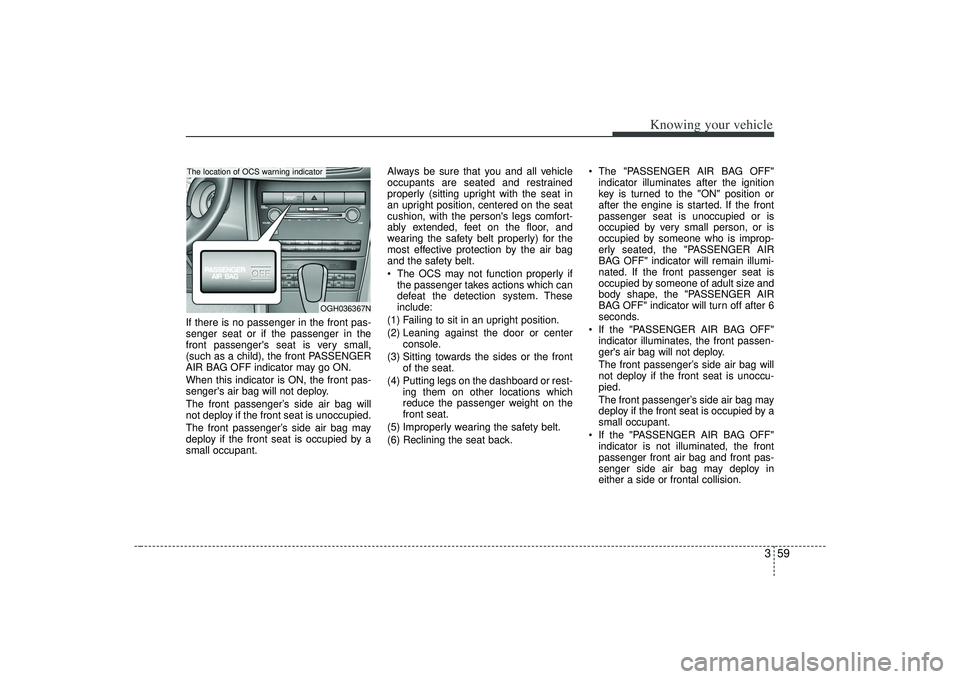
If there is no passenger in the front pas-
senger seat or if the passenger in the
front passenger's seat is very small,
(such as a child), the front PASSENGER
AIR BAG OFF indicator may go ON.
When this indicator is ON, the front pas-
senger's air bag will not deploy.
The front passenger’s side air bag will
not deploy if the front seat is unoccupied.
The front passenger’s side air bag may
deploy if the front seat is occupied by a
small occupant.Always be sure that you and all vehicle
occupants are seated and restrained
properly (sitting upright with the seat in
an upright position, centered on the seat
cushion, with the person's legs comfort-
ably extended, feet on the floor, and
wearing the safety belt properly) for the
most effective protection by the air bag
and the safety belt.
The OCS may not function properly if
the passenger takes actions which can
defeat the detection system. These
include:
(1) Failing to sit in an upright position.
(2) Leaning against the door or center console.
(3) Sitting towards the sides or the front of the seat.
(4) Putting legs on the dashboard or rest- ing them on other locations which
reduce the passenger weight on the
front seat.
(5) Improperly wearing the safety belt.
(6) Reclining the seat back. The "PASSENGER AIR BAG OFF"
indicator illuminates after the ignition
key is turned to the "ON" position or
after the engine is started. If the front
passenger seat is unoccupied or is
occupied by very small person, or is
occupied by someone who is improp-
erly seated, the "PASSENGER AIR
BAG OFF" indicator will remain illumi-
nated. If the front passenger seat is
occupied by someone of adult size and
body shape, the "PASSENGER AIR
BAG OFF" indicator will turn off after 6
seconds.
If the "PASSENGER AIR BAG OFF" indicator illuminates, the front passen-
ger's air bag will not deploy.
The front passenger’s side air bag will
not deploy if the front seat is unoccu-
pied.
The front passenger’s side air bag may
deploy if the front seat is occupied by a
small occupant.
If the "PASSENGER AIR BAG OFF" indicator is not illuminated, the front
passenger front air bag and front pas-
senger side air bag may deploy in
either a side or frontal collision.
OGH036367N
The location of OCS warning indicator
Page 72 of 321
Knowing your vehicle60
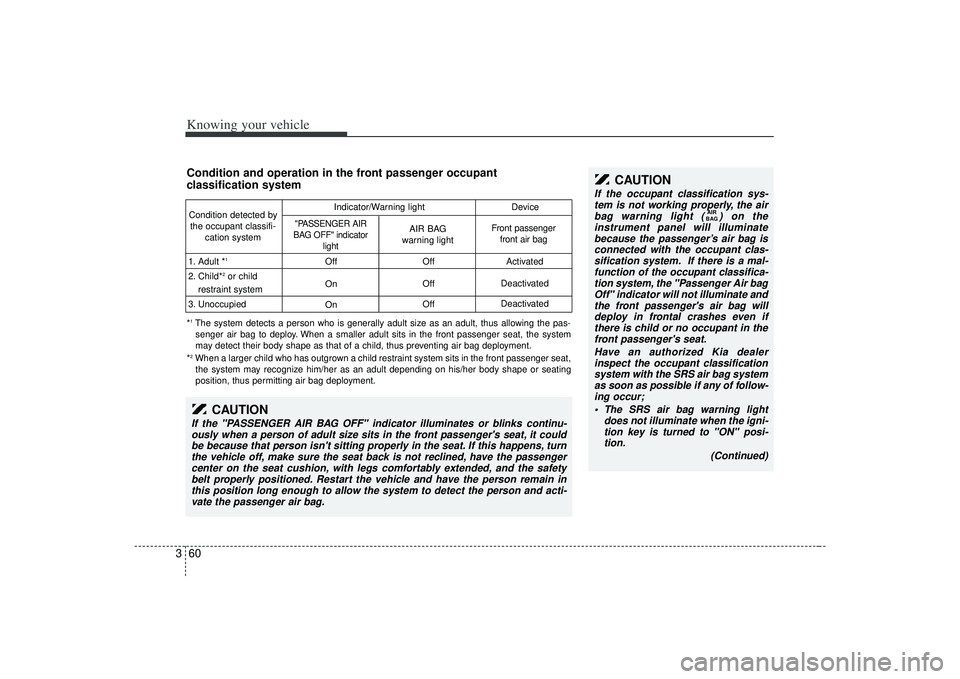
3Condition and operation in the front passenger occupant
classification systemCondition detected by
the occupant classifi- cation system
1. Adult *
1
2. Child*
2or child
restraint system
3. Unoccupied Off
On
On Off
Off
Off
Activated
Deactivated
Deactivated
"PASSENGER AIR
BAG OFF" indicator light
AIR BAG
warning light Front passenger
front air bag
Indicator/Warning light
Device
*1The system detects a person who is generally adult size as an adult, thus allowing the pas-
senger air bag to deploy. When a smaller adult sits in the front passenger seat, the system
may detect their body shape as that of a child, thus preventing air bag deployment.
*2When a larger child who has outgrown a child restraint system sits in the front passenger seat, the system may recognize him/her as an adult depending on his/her body shape or seating
position, thus permitting air bag deployment.
CAUTION
If the "PASSENGER AIR BAG OFF" indicator illuminates or blinks continu- ously when a person of adult size sits in the front passenger's seat, it could be because that person isn't sitting properly in the seat. If this happens, turnthe vehicle off, make sure the seat back is not reclined, have the passengercenter on the seat cushion, with legs comfortably extended, and the safetybelt properly positioned. Restart the vehicle and have the person remain in this position long enough to allow the system to detect the person and acti-vate the passenger air bag.
CAUTION
If the occupant classification sys- tem is not working properly, the airbag warning light ( ) on theinstrument panel will illuminate because the passenger’s air bag isconnected with the occupant clas-sification system. If there is a mal- function of the occupant classifica-tion system, the "Passenger Air bag Off" indicator will not illuminate andthe front passenger's air bag will deploy in frontal crashes even ifthere is child or no occupant in the front passenger's seat.
Have an authorized Kia dealerinspect the occupant classification system with the SRS air bag systemas soon as possible if any of follow-ing occur;
The SRS air bag warning light does not illuminate when the igni-tion key is turned to "ON" posi-tion.
(Continued)
AIR
BAG
Page 73 of 321
361
Knowing your vehicle
WARNING
Even though your vehicle isequipped with the occupant clas-
sification system, do not install a
child restraint system in the front
passenger seat. The child could
be severely injured or killed if the
air bag deploys. Children are
afforded the most protection in
the event of an accident when
they are restrained by the proper
restraint system in the rear seat.
(Continued)
(Continued)
If the "PASSENGER AIR BAGOFF" indicator is illuminated
when the front passenger's seat
is occupied by a person of adult
size who is seated properly, or if
the "PASSENGER AIR BAG OFF"
indicator" is not illuminated when
the front passenger's seat is
unoccupied or occupied by a very
small person, the occupant clas-
sification system is not working
properly. Have your vehicle imme-
diately inspected by your Kia
dealer if the occupant classifica-
tion system is not working prop-
erly.
(Continued)
(Continued)
If a low weight adult is seated inthe front passenger seat, the
occupant classification system
may or may not turn off the right
front passenger air bag, depend-
ing upon the person's seating
position and body type. Everyone
in your vehicle should wear a
safety belt properly -- whether or
not there is an air bag for that per-
son.
If the front seat passenger changes their seating position
(for example, by not sitting
upright, by sitting on the edge of
the seat, or by otherwise being
out of position), the "PASSEN-
GER AIR BAG OFF" indicator may
be turned on, and the passenger
air bag may not deploy in a colli-
sion. Always be sure to sit prop-
erly in the front passenger seat
and wear the safety belt properly
and do not do any of the follow-
ing.
(Continued)
(Continued) The SRS air bag warning light remains illuminated after illumi-nating or blinking for approxi-mately 6 seconds.
The SRS air bag warning light illu- minates while the vehicle is beingdriven.
Page 75 of 321
363
Knowing your vehicle
✽
✽NOTICE• If luggage or other objects are placed
on the front passenger's seat or if the
temperature of the seat changes while
the seat is unoccupied, the "PASSEN-
GER AIR BAG OFF" indicator may
blink. These conditions do not indi-
cate a problem.
• Do not put heavy objects on the front passenger's seat. This may cause front
passenger air bag deployment in the
event of an accident, thus increasing
your repair costs.
WARNING
The front seat passenger air bag
is much larger than the steering
wheel air bag and inflates with
considerably more force. It can
seriously hurt or kill a passenger
who is not in the proper position
and wearing the safety belt prop-
erly. The front passengers should
always move their seats as far
back as practical and sit back in
their seats.
It is essential that the front pas- senger always wears their safety
belts, even when the vehicle is
moving in a parking lot or up a
driveway into garage.
If the driver brakes the vehicle heavily prior to an impact, unbelt-
ed occupants will be thrown for-
ward. If the front passenger is not
wearing a safety belt, he/she will
be directly in front of the storage
compartment when deployment
occurs. In that situation, serious
injury or death is possible.
(Continued)
(Continued)
Manufacturers are required bygovernment regulations to pro-
vide a contact point concerning
modifications to the vehicle for
persons with disabilities, which
modifications may affect the vehi-
cle’s advanced air bag system.
That contact is Kia’s toll-free
Consumer Assistance center at 1-
800-333-4KIA. However, Kia does
not endorse nor will it support
any changes to any part or struc-
ture of the vehicle that could
affect the advanced air bag sys-
tem, including the occupant clas-
sification system. Specifically, the
front passenger seat, dashboard
or door should not be replaced
except by an authorized Kia deal-
er using original Kia parts
designed for this vehicle and
model. Any other such replace-
ment or modification could
adversely affect the operation of
the occupant classification sys-
tem and your advanced air bags.
(Continued)
(Continued) For the same reason, do not
attach anything to the seat, dash-
board or door, even temporarily. If
the system is adversely affected,
it could cause severe personal
injuries or death in a collision.
Do not place sharp objects on the front passenger seat. These can
damage the occupant classifica-
tion system, if they puncture the
seat cushion.
Do not install accessory seat cov- ers on the front seats, since these
will interfere with proper sensor
operation.
Page 77 of 321
365
Knowing your vehicle
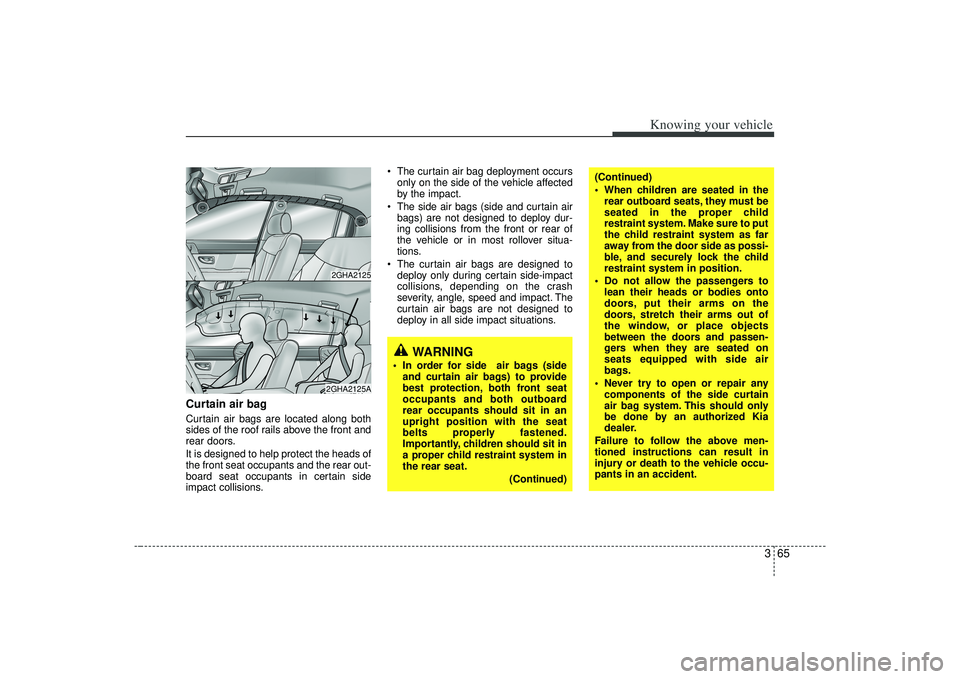
Curtain air bagCurtain air bags are located along both
sides of the roof rails above the front and
rear doors.
It is designed to help protect the heads of
the front seat occupants and the rear out-
board seat occupants in certain side
impact collisions. The curtain air bag deployment occurs
only on the side of the vehicle affected
by the impact.
The side air bags (side and curtain air bags) are not designed to deploy dur-
ing collisions from the front or rear of
the vehicle or in most rollover situa-
tions.
The curtain air bags are designed to deploy only during certain side-impact
collisions, depending on the crash
severity, angle, speed and impact. The
curtain air bags are not designed to
deploy in all side impact situations.
WARNING
In order for side air bags (sideand curtain air bags) to provide
best protection, both front seat
occupants and both outboard
rear occupants should sit in an
upright position with the seat
belts properly fastened.
Importantly, children should sit in
a proper child restraint system in
the rear seat.
(Continued)
(Continued)
When children are seated in therear outboard seats, they must be
seated in the proper child
restraint system. Make sure to put
the child restraint system as far
away from the door side as possi-
ble, and securely lock the child
restraint system in position.
Do not allow the passengers to lean their heads or bodies onto
doors, put their arms on the
doors, stretch their arms out of
the window, or place objects
between the doors and passen-
gers when they are seated on
seats equipped with side air
bags.
Never try to open or repair any components of the side curtain
air bag system. This should only
be done by an authorized Kia
dealer.
Failure to follow the above men-
tioned instructions can result in
injury or death to the vehicle occu-
pants in an accident.
2GHA21252GHA2125A
Page 80 of 321
Knowing your vehicle68
3Side air bag (if equipped)
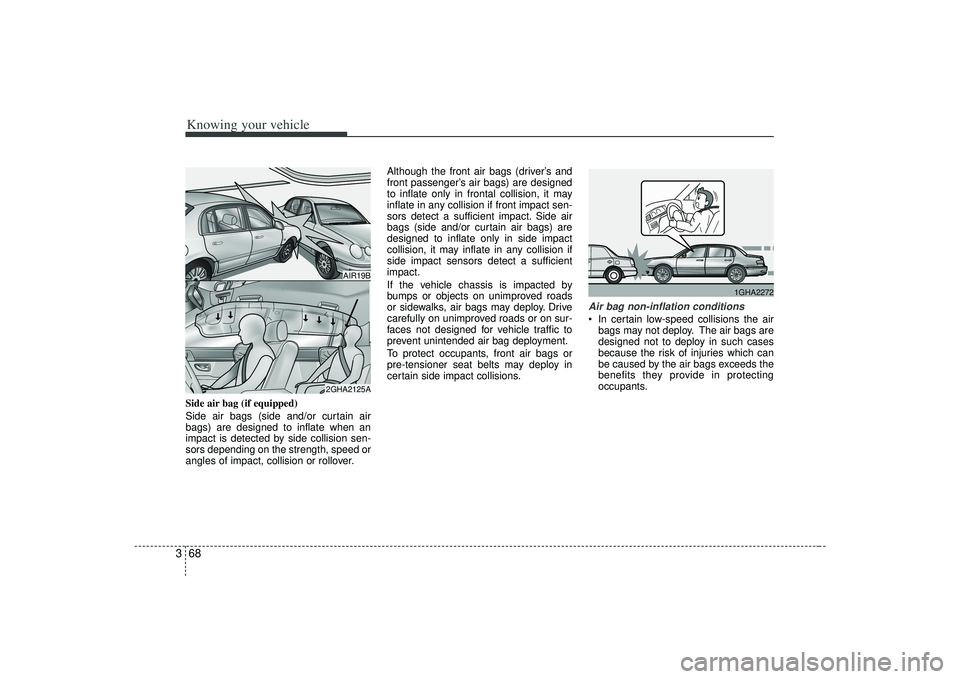
Side air bags (side and/or curtain air
bags) are designed to inflate when an
impact is detected by side collision sen-
sors depending on the strength, speed or
angles of impact, collision or rollover. Although the front air bags (driver’s and
front passenger’s air bags) are designed
to inflate only in frontal collision, it may
inflate in any collision if front impact sen-
sors detect a sufficient impact. Side air
bags (side and/or curtain air bags) are
designed to inflate only in side impact
collision, it may inflate in any collision if
side impact sensors detect a sufficient
impact.
If the vehicle chassis is impacted by
bumps or objects on unimproved roads
or sidewalks, air bags may deploy. Drive
carefully on unimproved roads or on sur-
faces not designed for vehicle traffic to
prevent unintended air bag deployment.
To protect occupants, front air bags or
pre-tensioner seat belts may deploy in
certain side impact collisions.
Air bag non-inflation conditions In certain low-speed collisions the air
bags may not deploy. The air bags are
designed not to deploy in such cases
because the risk of injuries which can
be caused by the air bags exceeds the
benefits they provide in protecting
occupants.
AIR19B
2GHA2125A
1GHA2272
Page 84 of 321
Knowing your vehicle72
3
Noise and smokeWhen the air bags inflate, they make a
loud noise and they leave smoke and
powder in the air inside of the vehicle.
This is normal and is a result of the igni-
tion of the air bag inflator. After the air
bag inflates, you may feel substantial dis-
comfort in breathing due to the contact of
your chest to both the safety belt and the
air bag, as well as from breathing the
smoke and powder. We strongly urge
you to open your doors and/or win-
dows as soon as possible after impact
in order to reduce discomfort and pre-
vent prolonged exposure to the
smoke and powder.
Though smoke and powder are non-
toxic, it may cause irritation to the skin
(eyes, nose and throat, etc). If this is the
case, wash and rinse with the cold water
immediately and consult the doctor if the
symptom persists.
WARNING -
Seated
positioning
Driver should sit as far back (at least 10 inches (250 mm) away
from the steering wheel air bag as
possible to reduce the risk of
injury or death in a collision. The
front passenger should always
move their seat as far back as
possible and sit back in their
seat.
In the event of a collision the air bags inflate instantly. Passengers
may be injured by the air bag
expansion force if they are not in
proper position.
Air bag inflation may cause injuries which normally include
facial or bodily abrasions, injuries
by the broken glasses or burns by
the explosives.
WARNING
When the air bags deploy, the air
bag related parts in steering wheel
and/or instrument panel and/or in
both sides of the roof rails above
the front and rear doors are very
hot. To prevent injury, do not touch
the air bag storage areas internal
components immediately after an
air bag has inflated.
Page 153 of 321
417
Driving your vehicle
Power steeringPower Steering uses energy from the
engine to assist you in steering the vehi-
cle. If the engine is off or if the power
steering system becomes inoperative,
the vehicle may still be steered, but it will
require increased steering effort.
Should you notice any change in the
effort required to steer during normal
vehicle operation, have the power steer-
ing checked by an Authorized Kia Dealer.
✽ ✽NOTICE• Never hold the steering wheel against
a stop (extreme right or left turn) for
more than 5 seconds with the engine
running. Holding the steering wheel
for more than 5 seconds in either posi-
tion may cause damage to the power
steering pump.
• If the power steering drive belt breaks or if the power steering pump mal-
functions, the steering effort will
greatly increase.
✽ ✽ NOTICEIf the vehicle is parked for extended
periods outside in cold weather (below -
10 °C/14 °F), the power steering may
require increased effort when the engine
is first started. This is caused by
increased fluid viscosity due to the cold
weather and does not indicate a mal-
function.
When this happens, increase the engine
RPM by depressing the accelerator until
the RPM reaches 1,500 rpm then release
or let the engine idle for two or three
minutes to warm up the fluid.
STEERING WHEEL
Page 168 of 321
Driving your vehicle32
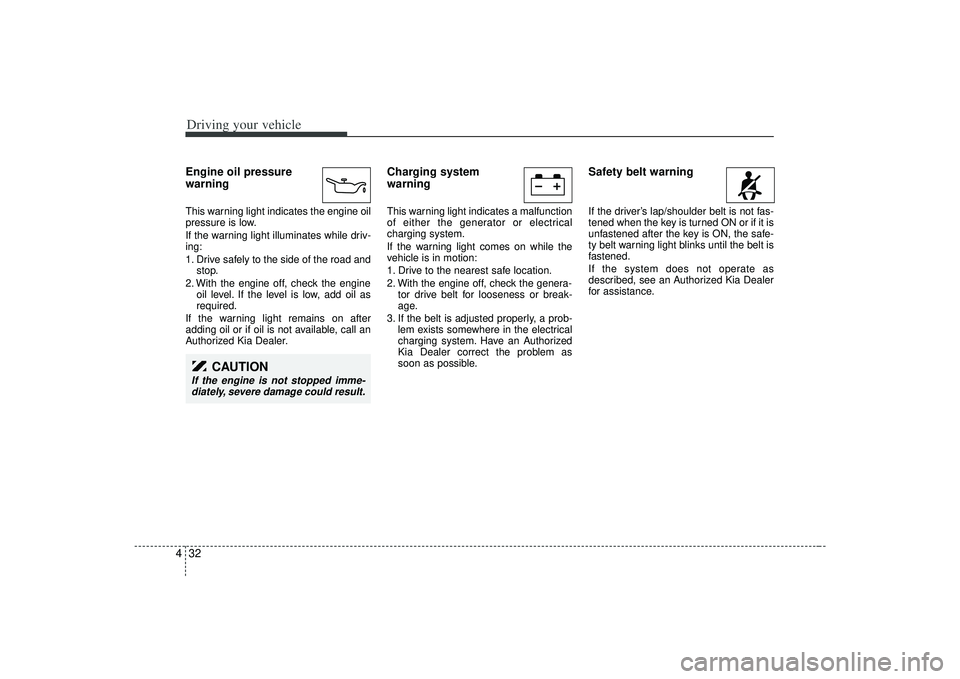
4Engine oil pressure
warning This warning light indicates the engine oil
pressure is low.
If the warning light illuminates while driv-
ing:
1. Drive safely to the side of the road and
stop.
2. With the engine off, check the engine oil level. If the level is low, add oil as
required.
If the warning light remains on after
adding oil or if oil is not available, call an
Authorized Kia Dealer.
Charging system
warning This warning light indicates a malfunction
of either the generator or electrical
charging system.
If the warning light comes on while the
vehicle is in motion:
1. Drive to the nearest safe location.
2. With the engine off, check the genera- tor drive belt for looseness or break-
age.
3. If the belt is adjusted properly, a prob- lem exists somewhere in the electrical
charging system. Have an Authorized
Kia Dealer correct the problem as
soon as possible.
Safety belt warning If the driver’s lap/shoulder belt is not fas-
tened when the key is turned ON or if it is
unfastened after the key is ON, the safe-
ty belt warning light blinks until the belt is
fastened.
If the system does not operate as
described, see an Authorized Kia Dealer
for assistance.
CAUTION
If the engine is not stopped imme-diately, severe damage could result.