tow KIA BORREGO 2015 Owners Manual
[x] Cancel search | Manufacturer: KIA, Model Year: 2015, Model line: BORREGO, Model: KIA BORREGO 2015Pages: 420, PDF Size: 41.56 MB
Page 9 of 420
Introduction
6
1
Biodiesel (for New Zealand)
Commercially supplied Diesel blends of no more than 7% biodiesel, commonly
known as "B7 Diesel" may be used in
your vehicle if Biodiesel meets EN 14214
or equivalent specifications. (EN stands
for "European Norm"). The use of biofu-
els exceeding 7%, made from rapeseed
methyl ester (RME), vegetable oil methyl
ester (VME) etc. or mixing diesel exceed-ing 7% with biodiesel will cause
increased wear or damage to the engine
and fuel system. Repair or replacement
of worn or damaged components due to
the use of non approved fuels will not be
covered by the manufactures warranty. A090000AEN
As with other vehicles of this type, failure
to operate this vehicle correctly mayresult in loss of control, an accident or
vehicle rollover.
Specific design characteristics (higher
ground clearance, track, etc.) give this
vehicle a higher center of gravity than
other types of vehicles. In other words
they are not designed for cornering at the
same speeds as conventional 2-wheel
drive vehicles. Avoid sharp turns or
abrupt maneuvers. Again, failure to oper-
ate this vehicle correctly may result in
loss of control, an accident or vehicle
rollover.
Be sure to read the “Reducing
the risk of a rollover” driving guide-
lines, in section 5 of this manual. A030000AUN
No special break-in period is needed. By
following a few simple precautions for the
first 1,000 km (600 miles) you may add to
the performance, economy and life of
your vehicle.
Do not race the engine.
While driving, keep your engine speed
(rpm, or revolutions per minute)
between 2,000 rpm and 4,000 rpm.
Do not maintain a single speed for long
periods of time, either fast or slow.
Varying engine speed is needed to
properly break-in the engine.
Avoid hard stops, except in emergen- cies, to allow the brakes to seat prop-
erly.
Don't tow a trailer during the first 2,000 km (1,200 miles) of operation.
CAUTION
Never use any fuel, whether
diesel, B7 biodiesel or otherwise,
that fails to meet the latest petro-leum industry specification.
Never use any fuel additives or treatments that are not recom-mended or approved by the vehi-
cle manufacturer.
VEHICLE HANDLING
INSTRUCTIONS VEHICLE BREAK-IN PROCESS
Page 21 of 420
37
Safety features of your vehicle
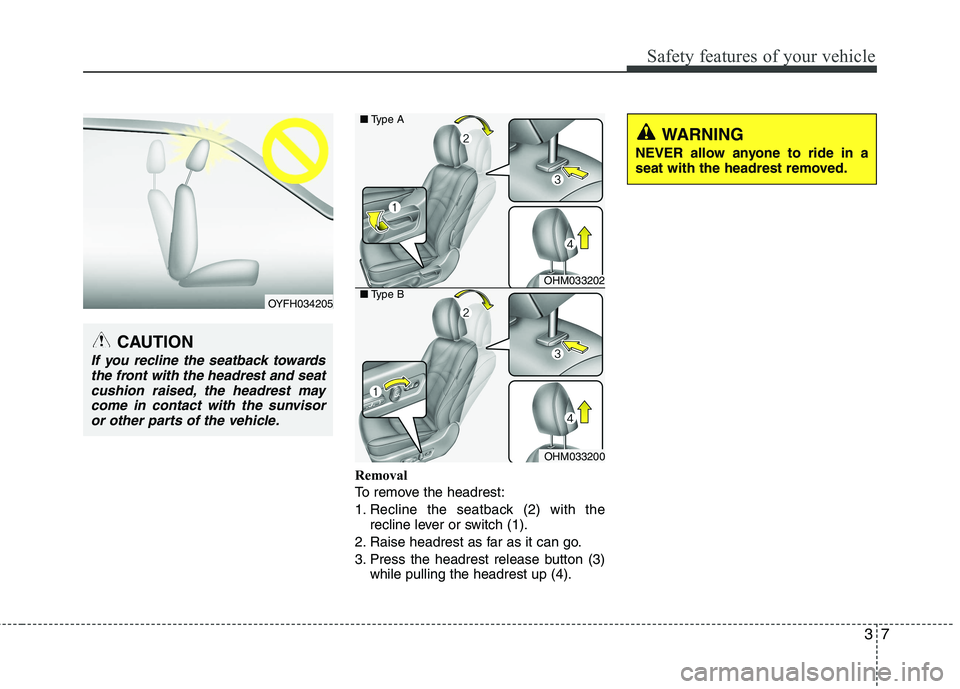
Removal
To remove the headrest:
1. Recline the seatback (2) with therecline lever or switch (1).
2. Raise headrest as far as it can go.
3. Press the headrest release button (3) while pulling the headrest up (4).
WARNING
NEVER allow anyone to ride in a
seat with the headrest removed.
OHM033202
OHM033200
■
Type A
■ Type B
CAUTION
If you recline the seatback towards
the front with the headrest and seat cushion raised, the headrest maycome in contact with the sunvisoror other parts of the vehicle.
OYFH034205
Page 24 of 420
Safety features of your vehicle
10
3
✽✽
NOTICE
With the seat warmer switch in the ON
position, the heating system in the seat
turns off or on automatically depending
on the seat temperature.
C010109BHM
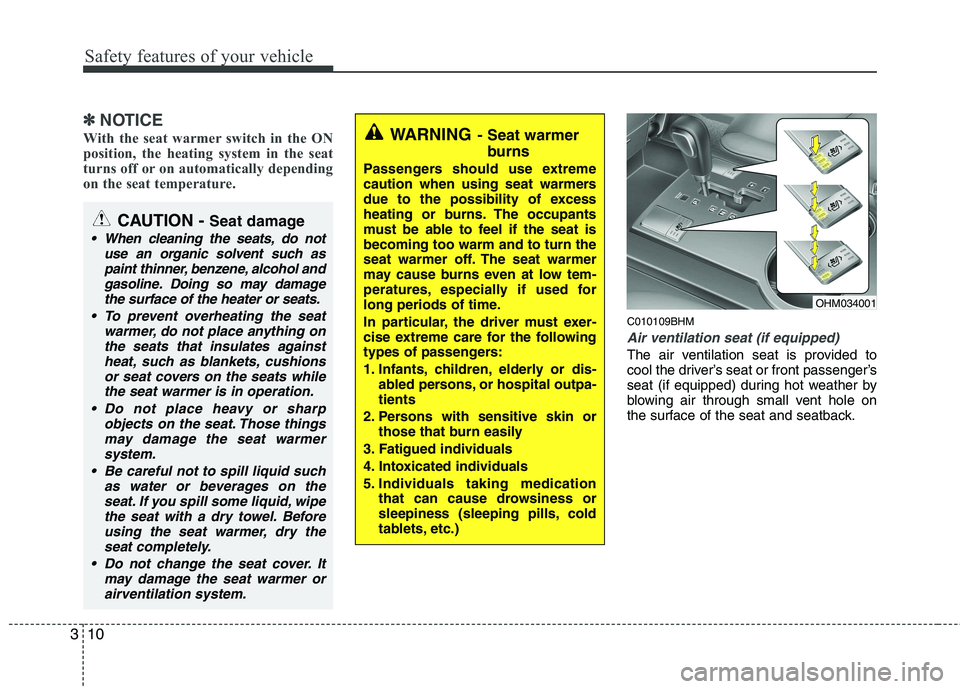
Air ventilation seat (if equipped)
The air ventilation seat is provided to
cool the driver’s seat or front passenger’s
seat (if equipped) during hot weather by
blowing air through small vent hole on
the surface of the seat and seatback.
WARNING - Seat warmer
burns
Passengers should use extreme
caution when using seat warmers
due to the possibility of excess
heating or burns. The occupants
must be able to feel if the seat isbecoming too warm and to turn the
seat warmer off. The seat warmer
may cause burns even at low tem-
peratures, especially if used for
long periods of time.
In particular, the driver must exer-
cise extreme care for the following
types of passengers:
1. Infants, children, elderly or dis- abled persons, or hospital outpa- tients
2. Persons with sensitive skin or those that burn easily
3. Fatigued individuals
4. Intoxicated individuals
5. Individuals taking medication that can cause drowsiness or
sleepiness (sleeping pills, cold
tablets, etc.)
OHM034001
CAUTION - Seat damage
When cleaning the seats, do not
use an organic solvent such as
paint thinner, benzene, alcohol andgasoline. Doing so may damagethe surface of the heater or seats.
To prevent overheating the seat warmer, do not place anything on
the seats that insulates againstheat, such as blankets, cushions or seat covers on the seats whilethe seat warmer is in operation.
Do not place heavy or sharp objects on the seat. Those thingsmay damage the seat warmersystem.
Be careful not to spill liquid such as water or beverages on theseat. If you spill some liquid, wipethe seat with a dry towel. Beforeusing the seat warmer, dry the
seat completely.
Do not change the seat cover. It may damage the seat warmer orairventilation system.
Page 25 of 420
311
Safety features of your vehicle
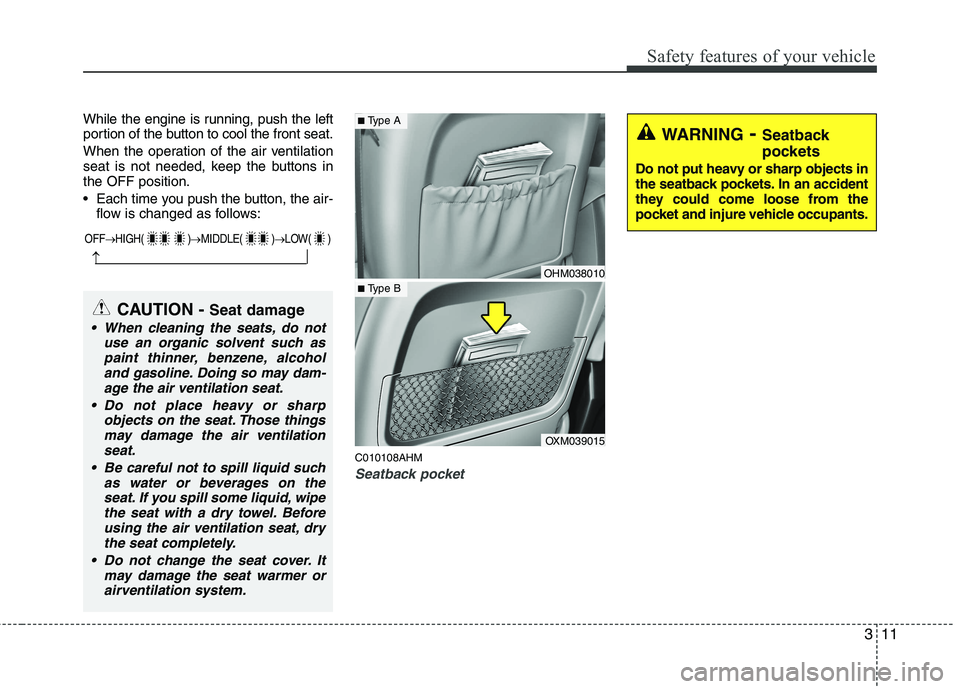
While the engine is running, push the left
portion of the button to cool the front seat.
When the operation of the air ventilation
seat is not needed, keep the buttons inthe OFF position.
Each time you push the button, the air-flow is changed as follows:
C010108AHM
Seatback pocket
WARNING- Seatback
pockets
Do not put heavy or sharp objects in
the seatback pockets. In an accident
they could come loose from the
pocket and injure vehicle occupants.
CAUTION - Seat damage
When cleaning the seats, do not
use an organic solvent such aspaint thinner, benzene, alcoholand gasoline. Doing so may dam-age the air ventilation seat.
Do not place heavy or sharp objects on the seat. Those thingsmay damage the air ventilation seat.
Be careful not to spill liquid such as water or beverages on theseat. If you spill some liquid, wipethe seat with a dry towel. Before using the air ventilation seat, dry
the seat completely.
Do not change the seat cover. It may damage the seat warmer orairventilation system.
OFF HIGH( ) MIDDLE( ) LOW( )
OXM039015
■Type BOHM038010
■Type A
Page 32 of 420
Safety features of your vehicle
18
3
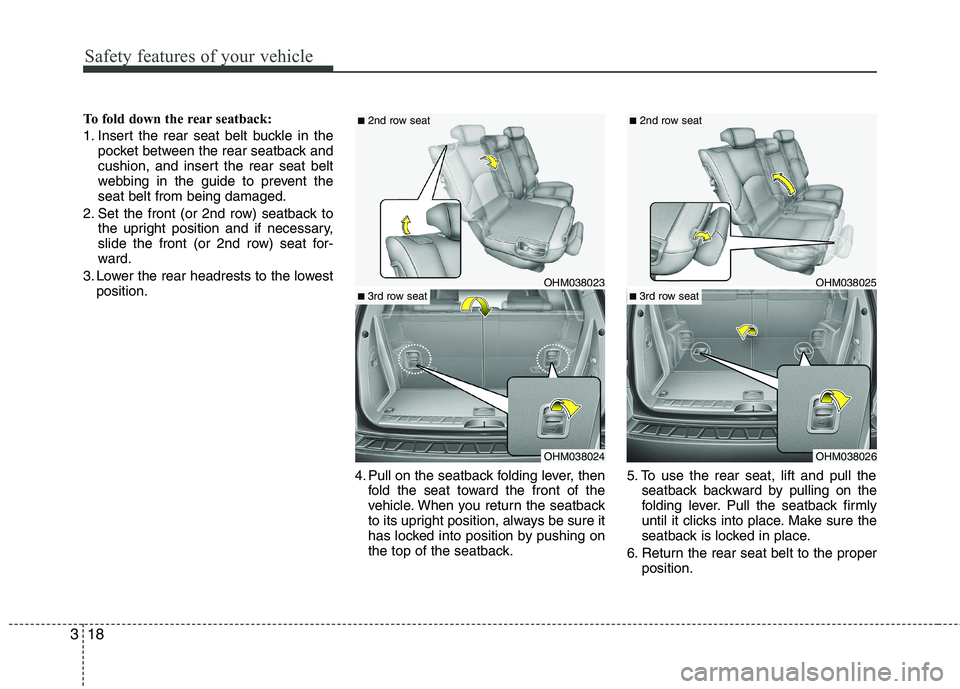
To fold down the rear seatback:
1. Insert the rear seat belt buckle in the
pocket between the rear seatback and
cushion, and insert the rear seat belt
webbing in the guide to prevent theseat belt from being damaged.
2. Set the front (or 2nd row) seatback to the upright position and if necessary,
slide the front (or 2nd row) seat for-
ward.
3. Lower the rear headrests to the lowest position.
4. Pull on the seatback folding lever, thenfold the seat toward the front of the
vehicle. When you return the seatback
to its upright position, always be sure it
has locked into position by pushing on
the top of the seatback. 5. To use the rear seat, lift and pull the
seatback backward by pulling on the
folding lever. Pull the seatback firmly
until it clicks into place. Make sure the
seatback is locked in place.
6. Return the rear seat belt to the proper position.
OHM038026
■ 3rd row seat
OHM038024
■ 3rd row seatOHM038023
■ 2nd row seat■2nd row seat
OHM038025
Page 40 of 420

Safety features of your vehicle
26
3
When using the rear center seat belt, the
buckle with the “CENTER” mark must beused. To release the seat belt:
When you want to release the seat belt,
press the button (1) in the locking buckle.
C020105AHM
Stowing the rear seat belt
The rear seat belt buckles can bestowed in the pocket between the rear
seatback and cushion when not in use.
The center seat belt can be stowed with the plate and webbing rolled in the
pocket between the rear seatback andcushion.
B210A02NF-1
WARNING
The center lap belt latching mecha-
nism is different from those for the
rear seat shoulder belts. When fas-tening the rear seat shoulder belts
or the center lap belt, make sure
they are inserted into the correct
buckles to obtain maximum protec-
tion from the seat belt system and
assure proper operation.
OHM038029L
OHM038030
■ 2nd row seat
■ 3rd row seat
OHM038028L
Page 50 of 420

Safety features of your vehicle
36
3
C030102AHM
Installing a child restraint system
with a lap/shoulder belt
To install a child restraint system on the
outboard seats, do the following:
1. Place the child restraint system in the seat and route the lap/shoulder belt
around or through the restraint, follow-
ing the restraint manufacturer’s
instructions. Be sure the seat belt web-bing is not twisted. 2. Fasten the lap/shoulder belt latch into
the buckle. Listen for the distinct “click”sound.Position the release button so that it is
easy to access in case of an emergency.
3. Buckle the seat belt and allow the seat belt to take up any slack. After installa-
tion of the child restraint system, try to
move it in all directions to be sure the
child restraint system is securelyinstalled.
If you need to tighten the belt, pull the
webbing toward the retractor. When you
unbuckle the seat belt and allow it to
retract, the retractor will automatically
revert back to its normal seated passen-
ger emergency locking usage condition.
OEN036101OEN036104E2MS103005
Page 68 of 420
Safety features of your vehicle
54
3
C040801BHM
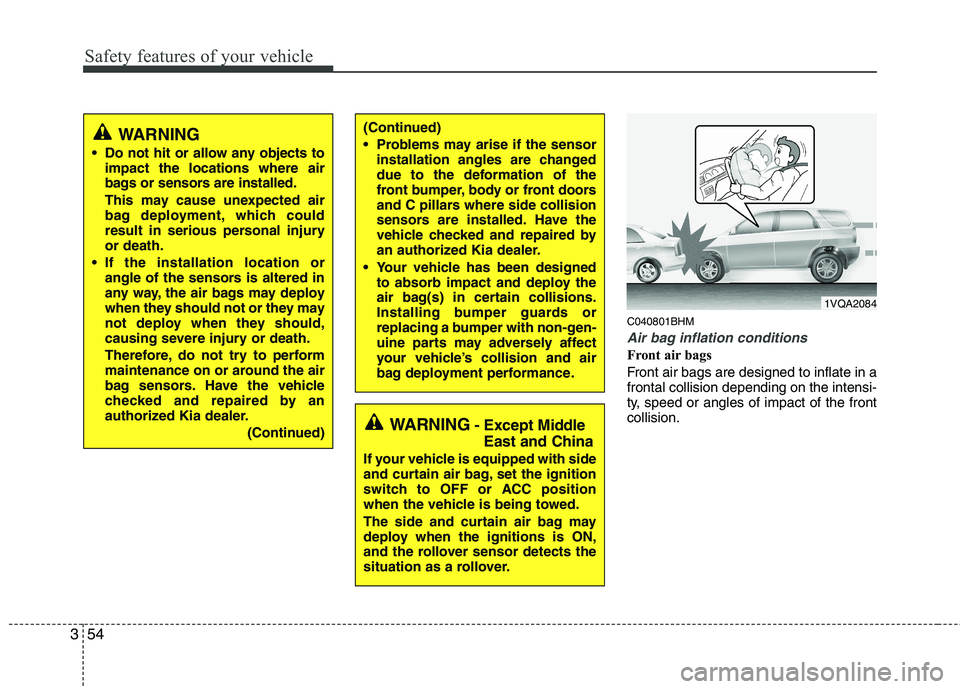
Air bag inflation conditions
Front air bags
Front air bags are designed to inflate in a frontal collision depending on the intensi-
ty, speed or angles of impact of the frontcollision.
1VQA2084
(Continued)
Problems may arise if the sensor
installation angles are changed
due to the deformation of the
front bumper, body or front doors
and C pillars where side collision
sensors are installed. Have the
vehicle checked and repaired by
an authorized Kia dealer.
Your vehicle has been designed to absorb impact and deploy the
air bag(s) in certain collisions.
Installing bumper guards or
replacing a bumper with non-gen-
uine parts may adversely affect
your vehicle’s collision and air
bag deployment performance.WARNING
Do not hit or allow any objects to impact the locations where air
bags or sensors are installed.
This may cause unexpected air
bag deployment, which could
result in serious personal injuryor death.
If the installation location or angle of the sensors is altered in
any way, the air bags may deploy
when they should not or they may
not deploy when they should,
causing severe injury or death.
Therefore, do not try to perform
maintenance on or around the air
bag sensors. Have the vehicle
checked and repaired by an
authorized Kia dealer.
(Continued)
WARNING- Except Middle
East and China
If your vehicle is equipped with side
and curtain air bag, set the ignition
switch to OFF or ACC position
when the vehicle is being towed.
The side and curtain air bag may
deploy when the ignitions is ON,
and the rollover sensor detects the
situation as a rollover.
Page 72 of 420

Safety features of your vehicle
58
3
C041100AHM SRS Care
The SRS is virtually maintenance-free
and so there are no parts you can safely
service by yourself. If the SRS air bag
warning light does not illuminate, or con-
tinuously remains on, have your vehicle
immediately inspected by an authorized
Kia dealer.
Any work on the SRS system, such as
removing, installing, repairing, or any
work on the steering wheel, the frontpassenger's panel, front seats and roof
rails must be performed by an authorized
Kia dealer. Improper handling of the SRS
system may result in serious personal
injury.
WARNING
Modification to SRS components or wiring, including the addition
of any kind of badges to the pad
covers or modifications to the
body structure, can adversely
affect SRS performance and lead
to possible injury.
For cleaning the air bag pad cov- ers, use only a soft, dry cloth or
one which has been moistened
with plain water. Solvents or
cleaners could adversely affect
the air bag covers and proper
deployment of the system.
No objects should be placed over or near the air bag modules on
the steering wheel, instrument
panel, and the front passenger's
panel above the glove box,
because any such object could
cause harm if the vehicle is in a
crash severe enough to cause
the air bags to inflate.
(Continued)(Continued)
If the air bags inflate, they mustbe replaced by an authorized Kia
dealer.
Do not tamper with or disconnect SRS wiring, or other components
of the SRS system. Doing so
could result in injury, due to acci-
dental inflation of the air bags or
by rendering the SRS inopera-
tive.
If components of the air bag sys- tem must be discarded, or if the
vehicle must be scrapped, certain
safety precautions must be
observed. An authorized Kia
dealer knows these precautions
and can give you the necessary
information. Failure to follow
these precautions and proce-dures could increase the risk of
personal injury.
If your vehicle was flooded and has soaked carpeting or water on
the floor, you shouldn't try to
start the engine; have the vehicle
towed to an authorized Kia deal-
er.
Page 82 of 420

Features of your vehicle
8
4
D040300CHM
Smart key precautions
✽✽
NOTICE
If, for some reason, you happen to lose your smart key, you will not be able to
start the engine. Tow the vehicle, if
necessary, and contact an authorized
Kia dealer.
A maximum of 2 smart keys can be
registered to a single vehicle. If you
lose a smart key, you should immedi-
ately take the vehicle and key to your
authorized Kia dealer to protect it
from potential theft.
The smart key will not work if any of
the following occurs:
- The smart key is close to a radiotransmitter such as a radio station or
an airport which can interfere with
normal operation of the smart key.
- The smart key is near a mobile two-
way radio system or a cellular phone.
- Another vehicle’s smart key is being
operated close to your vehicle.
When the smart key does not work
properly, open and close the door with
the mechanical key. If you have a
problem with the smart key, contact
an authorized Kia dealer.
(Continued)(Continued)
If the smart key is in close proximity
to your cell phone or smart phone, the
signal from the smart key could be
blocked by normal operation of your
cell phone or smart phone. This is
especially important when the phone
is active such as making call, receiving
calls, text messaging, and/or send-
ing/receiving emails. Avoid placing the
smart key and your cell phone or
smart phone in the same pants or
jacket pocket and maintain adequate
distance between the two devices.
D040400AHM
Restrictions in handling keys
When leaving keys with parking lot and
valet attendants, the following proce-
dures will ensure that your vehicle’s
glove box compartment can not be
opened in your absence.
1. Press and hold the release button (1) and remove the mechanical key.
2. Close and then lock the glove box using the mechanical key.
3. Leave the smart key with the atten- dant. The glove box can not be opened
without the mechanical key.
OXM041200A
CAUTION
Keep the smart key away from
water or any liquid. If the keyless
entry system is inoperative due to exposure to water or liquids, it willnot be covered by your manufactur-er’s vehicle warranty.
CAUTION
Keep the smart key away from elec-tromagnetic materials that blockselectromagnetic waves to the key
surface.