wheel KIA BORREGO 2017 Owners Manual
[x] Cancel search | Manufacturer: KIA, Model Year: 2017, Model line: BORREGO, Model: KIA BORREGO 2017Pages: 548, PDF Size: 36.78 MB
Page 485 of 548
849
Maintenance
Wheel size designation
Wheels are also marked with impor-
tant information that you need if you
ever have to replace one. The follow-
ing explains what the letters and
numbers in the wheel size designa-tion mean.
Example wheel size designation: 7.5JX19
7.5 - Rim width in inches. J - Rim contour designation.
19 - Rim diameter in inches.Tire speed ratings
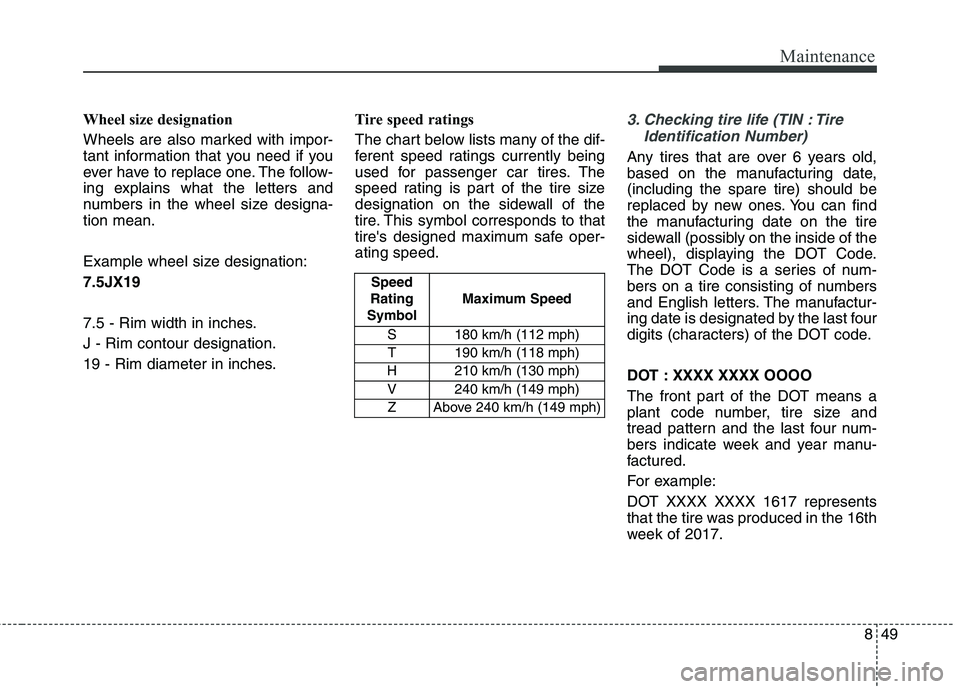
The chart below lists many of the dif-
ferent speed ratings currently being
used for passenger car tires. The
speed rating is part of the tire size
designation on the sidewall of the
tire. This symbol corresponds to that
tire's designed maximum safe oper-ating speed.3. Checking tire life (TIN : Tire
Identification Number)
Any tires that are over 6 years old,
based on the manufacturing date,(including the spare tire) should be
replaced by new ones. You can find
the manufacturing date on the tire
sidewall (possibly on the inside of the
wheel), displaying the DOT Code.
The DOT Code is a series of num-
bers on a tire consisting of numbers
and English letters. The manufactur-
ing date is designated by the last four
digits (characters) of the DOT code.
DOT : XXXX XXXX OOOO
The front part of the DOT means a
plant code number, tire size and
tread pattern and the last four num-
bers indicate week and year manu-
factured.
For example:
DOT XXXX XXXX 1617 represents
that the tire was produced in the 16th
week of 2017.
Speed
Rating
Symbol Maximum Speed
S 180 km/h (112 mph) T 190 km/h (118 mph)
H 210 km/h (130 mph) V 240 km/h (149 mph) Z Above 240 km/h (149 mph)
Page 487 of 548
851
Maintenance
Tread wear
The tread wear grade is a compara-
tive rating based on the wear rate ofthe tire when tested under controlled
conditions on a specified govern-
ment test course. For example, a tire
graded 150 would wear one-and-a-
half times (1½) as well on the gov-
ernment course as a tire graded 100.
The relative performance of tires depends upon the actual conditions
of their use, however, and may
depart significantly from the norm
due to variations in driving habits,
service practices and differences in
road characteristics and climate.
These grades are molded on the
side-walls of passenger vehicle tires.
The tires available as standard or
optional equipment on your vehicle
may vary with respect to grade.Traction - AA, A, B & C
The traction grades, from highest to
lowest, are AA, A, B and C. Those
grades represent the tire’s ability to
stop on wet pavement as measuredunder controlled conditions on speci-
fied government test surfaces of
asphalt and concrete. A tire marked C
may have poor traction performance.
Temperature -A, B & C
The temperature grades are A (the
highest), B, and C, representing the
tire’s resistance to the generation ofheat and its ability to dissipate heatwhen tested under controlled condi-
tions on a specified indoor laboratorytest wheel.
Sustained high temperature can
cause the material of the tire to
degenerate and reduce tire life, and
excessive temperature can lead to
sudden tire failure. Grades B and A
represent higher levels of perform-
ance on the laboratory test wheel
than the minimum required by law.
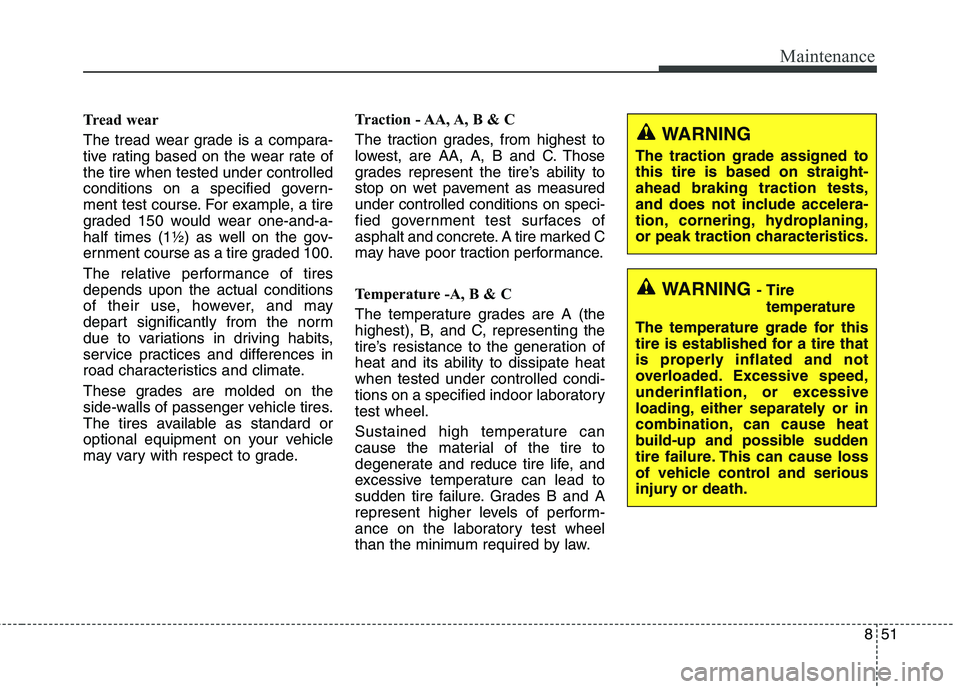
WARNING
- Tire
temperature
The temperature grade for this
tire is established for a tire that
is properly inflated and not
overloaded. Excessive speed,
underinflation, or excessive
loading, either separately or in
combination, can cause heat
build-up and possible sudden
tire failure. This can cause loss
of vehicle control and serious
injury or death.
WARNING
The traction grade assigned to this tire is based on straight-ahead braking traction tests,
and does not include accelera-
tion, cornering, hydroplaning,
or peak traction characteristics.
Page 488 of 548
Maintenance
52
8
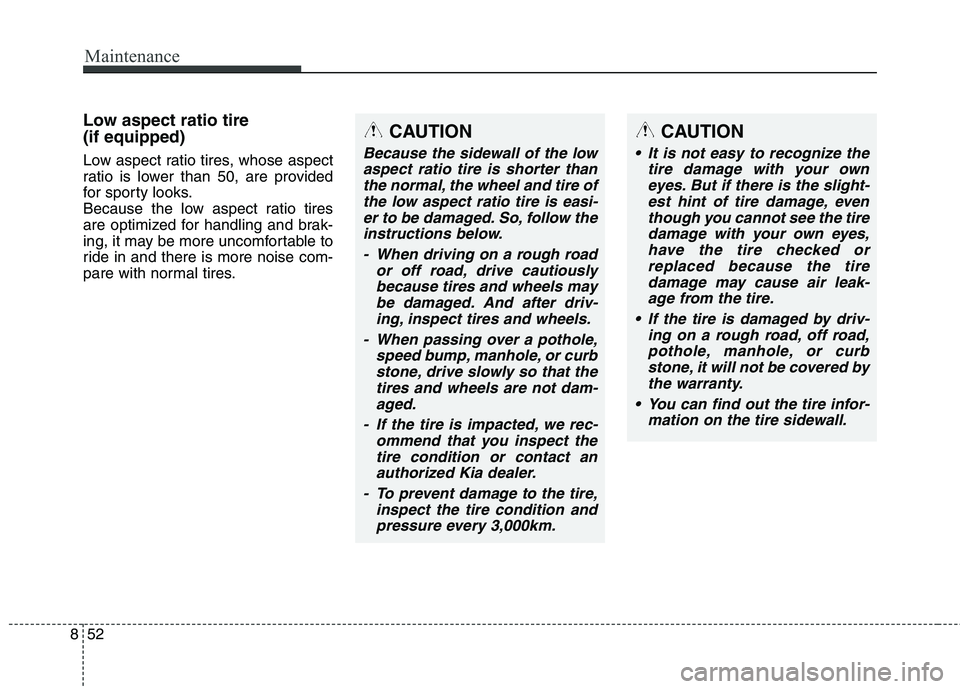
Low aspect ratio tire (if equipped)
Low aspect ratio tires, whose aspect
ratio is lower than 50, are provided
for sporty looks.
Because the low aspect ratio tires
are optimized for handling and brak-
ing, it may be more uncomfortable to
ride in and there is more noise com-
pare with normal tires.CAUTION
Because the sidewall of the low
aspect ratio tire is shorter thanthe normal, the wheel and tire of the low aspect ratio tire is easi-er to be damaged. So, follow theinstructions below.
- When driving on a rough road or off road, drive cautiouslybecause tires and wheels maybe damaged. And after driv-ing, inspect tires and wheels.
- When passing over a pothole, speed bump, manhole, or curbstone, drive slowly so that thetires and wheels are not dam-aged.
- If the tire is impacted, we rec- ommend that you inspect thetire condition or contact anauthorized Kia dealer.
- To prevent damage to the tire, inspect the tire condition andpressure every 3,000km.
CAUTION
It is not easy to recognize the tire damage with your owneyes. But if there is the slight- est hint of tire damage, eventhough you cannot see the tiredamage with your own eyes, have the tire checked orreplaced because the tiredamage may cause air leak- age from the tire.
If the tire is damaged by driv- ing on a rough road, off road,pothole, manhole, or curbstone, it will not be covered by the warranty.
You can find out the tire infor- mation on the tire sidewall.
Page 495 of 548
859
Maintenance
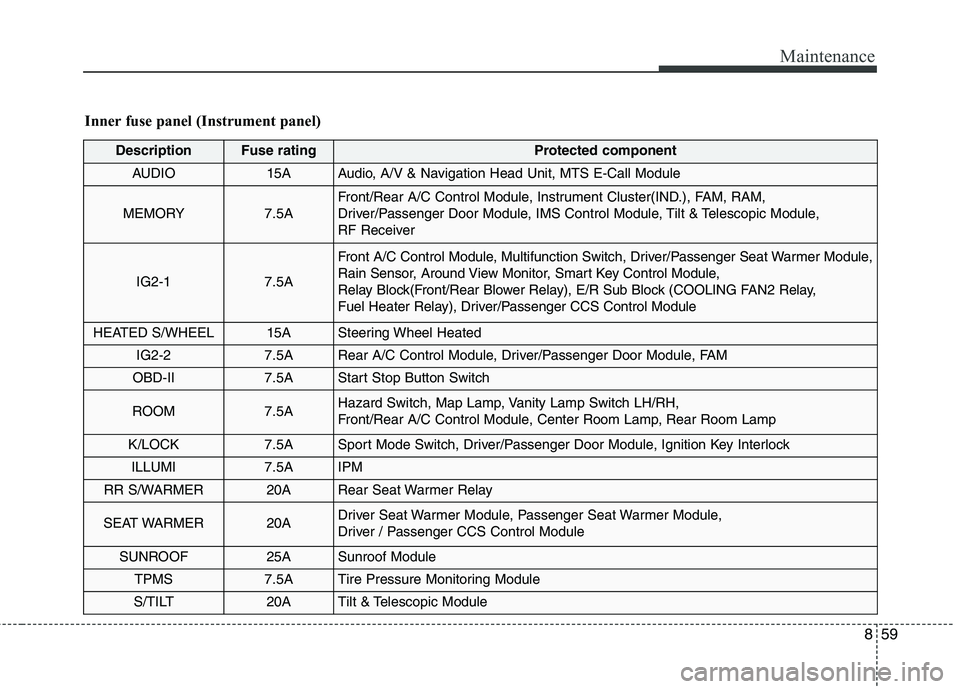
Inner fuse panel (Instrument panel)
DescriptionFuse ratingProtected component
AUDIO15AAudio, A/V & Navigation Head Unit, MTS E-Call Module
MEMORY7.5A
Front/Rear A/C Control Module, Instrument Cluster(IND.), FAM, RAM,
Driver/Passenger Door Module, IMS Control Module, Tilt & Telescopic Module,
RF Receiver
IG2-17.5A
Front A/C Control Module, Multifunction Switch, Driver/Passenger Seat Warmer Module,
Rain Sensor, Around View Monitor, Smart Key Control Module,
Relay Block(Front/Rear Blower Relay), E/R Sub Block (COOLING FAN2 Relay,
Fuel Heater Relay), Driver/Passenger CCS Control Module
HEATED S/WHEEL15ASteering Wheel Heated
IG2-27.5ARear A/C Control Module, Driver/Passenger Door Module, FAM
OBD-II7.5AStart Stop Button Switch
ROOM7.5AHazard Switch, Map Lamp, Vanity Lamp Switch LH/RH,
Front/Rear A/C Control Module, Center Room Lamp, Rear Room Lamp
K/LOCK7.5ASport Mode Switch, Driver/Passenger Door Module, Ignition Key Interlock
ILLUMI7.5AIPM
RR S/WARMER20ARear Seat Warmer Relay
SEAT WARMER20ADriver Seat Warmer Module, Passenger Seat Warmer Module,
Driver / Passenger CCS Control Module
SUNROOF25ASunroof Module
TPMS7.5ATire Pressure Monitoring Module
S/TILT20ATilt & Telescopic Module
Page 516 of 548
Maintenance
80
8
Underbody maintenance
Corrosive materials used for ice and
snow removal and dust control may
collect on the underbody. If these
materials are not removed, acceler-
ated rusting can occur on underbody
parts such as the fuel lines, frame,
floor pan and exhaust system, even
though they have been treated with
rust protection.
Thoroughly flush the vehicle under-
body and wheel openings with luke-
warm or cold water once a month,
after off-road driving and at the end
of each winter. Pay special attentionto these areas because it is difficult
to see all the mud and dirt. It will do
more harm than good to wet down
the road grime without removing it.
The lower edges of the doors, rocker
panels, and frame members have
drain holes that should not clog with
dirt; trapped water in these areas can
cause rusting.
Aluminum wheel maintenance
The aluminum wheels are coated
with a clear protective finish.
Do not use any abrasive cleaner,
polishing compound, solvent, or
wire brushes on aluminum wheels.
They may scratch or damage thefinish.
Clean the wheel when it has cooled.
Use only a mild soap or neutral detergent, and rinse thoroughly
with water. Also, be sure to clean
the wheels after driving on salted
roads. This helps prevent corrosion.
Avoid washing the wheels with high-speed car wash brushes.
Do not use any alkaline or acid detergent. It may damage and cor-
rode the aluminum wheels coated
with a clear protective finish.WARNING
After washing the vehicle, test
the brakes while driving slowly
to see if they have been affected
by water. If braking performance
is impaired, dry the brakes by
applying them lightly while main-
taining a slow forward speed.
Page 519 of 548
883
Maintenance
Interior care
Interior general precautions
Prevent chemicals such as perfume, cosmetic oil, sun cream, hand clean-
er, and air freshener from contacting
the interior parts because they may
cause damage or discoloration. If
they do contact the interior parts,
wipe them off immediately. If neces-
sary, use a vinyle cleaner, see
instructions for correct usage.
Cleaning the upholstery and inte-rior trim
Vinyl
Remove dust and loose dirt from
vinyl with a whisk broom or vacuum
cleaner. Clean vinyl surfaces with a
vinyl cleaner.
Fabric
Remove dust and loose dirt from fab-
ric with a whisk broom or vacuum
cleaner. Clean with a mild soap solu-
tion recommended for upholstery or
carpets. Remove fresh spots imme-
diately with a fabric spot cleaner. If
fresh spots do not receive immediate
attention, the fabric can be stained
and its color can be affected. Also, its
fire-resistant properties can be
reduced if the material is not proper-ly maintained.
CAUTION - Nappa leather
seat cover (If equipped)
Nappa leather retains the hide’s own soft texture with visiblepores, scars or blood vessels, etc. Pressure marks or wrinklesmay be made when used.Prolonged exposure to sunlight or heat may cause discol-oration. These things occur dueto the natural characteristics ofcowhides. If the leather is exposed to rain or gets wet,remove water with a dry clothand dry the leather in the shade to minimize damage. Make sureto keep sharp objects away fromthe leather as these can create scratches on the surface. Forlight-colored leather, be carefulof spots or color transfer, such as from jeans.
CAUTION
Using anything but recommend-ed cleaners and procedures mayaffect the fabric’s appearance and fire-resistant properties.
CAUTION
Never allow water or other liq-uids to come in contact withelectrical/electronic compo- nents inside the vehicle as thismay damage them.
CAUTION
When cleaning leather products(steering wheel, seats etc.), useneutral detergents or low alco- hol content solutions. If you usehigh alcohol content solutionsor acid/alkaline detergents, the color of the leather may fade orthe surface may get stripped off.
Page 525 of 548
Specifications & Consumer information
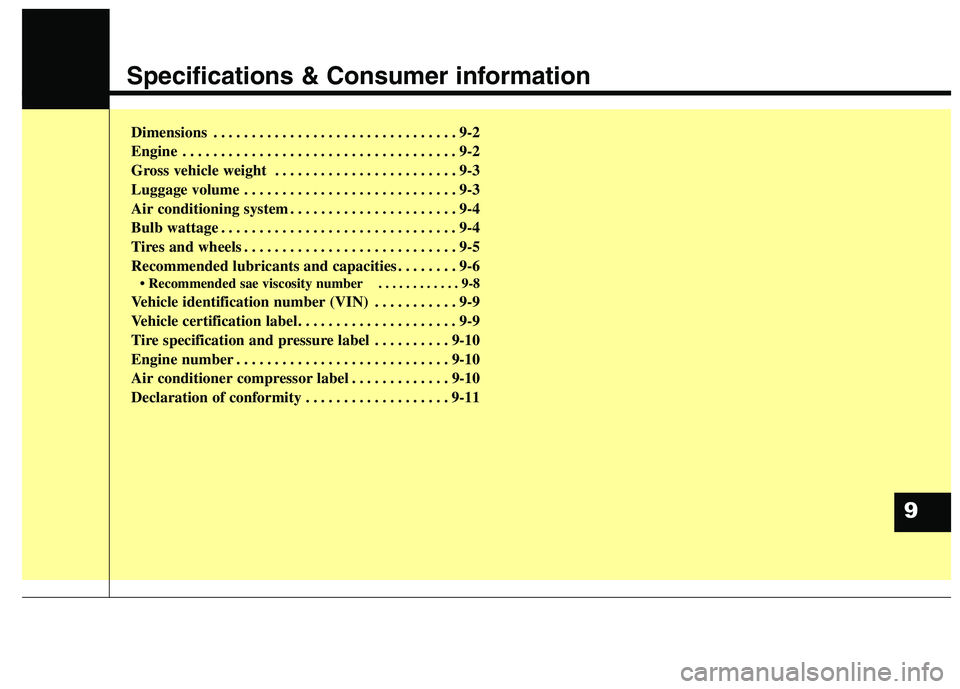
Dimensions . . . . . . . . . . . . . . . . . . . . . . . . . . . . . . . . 9-2
Engine . . . . . . . . . . . . . . . . . . . . . . . . . . . . . . . . . . . . 9-2
Gross vehicle weight . . . . . . . . . . . . . . . . . . . . . . . . 9-3
Luggage volume . . . . . . . . . . . . . . . . . . . . . . . . . . . . 9-3
Air conditioning system . . . . . . . . . . . . . . . . . . . . . . 9-4
Bulb wattage . . . . . . . . . . . . . . . . . . . . . . . . . . . . . . . 9-4
Tires and wheels . . . . . . . . . . . . . . . . . . . . . . . . . . . . 9-5
Recommended lubricants and capacities . . . . . . . . 9-6• Recommended sae viscosity number . . . . . . . . . . . . 9-8
Vehicle identification number (VIN) . . . . . . . . . . . 9-9
Vehicle certification label. . . . . . . . . . . . . . . . . . . . . 9-9
Tire specification and pressure label . . . . . . . . . . 9-10
Engine number . . . . . . . . . . . . . . . . . . . . . . . . . . . . 9-10
Air conditioner compressor label . . . . . . . . . . . . . 9-10
Declaration of conformity . . . . . . . . . . . . . . . . . . . 9-11
9
Page 526 of 548
Specifications & Consumer information
2
9
DIMENSIONS ENGINE
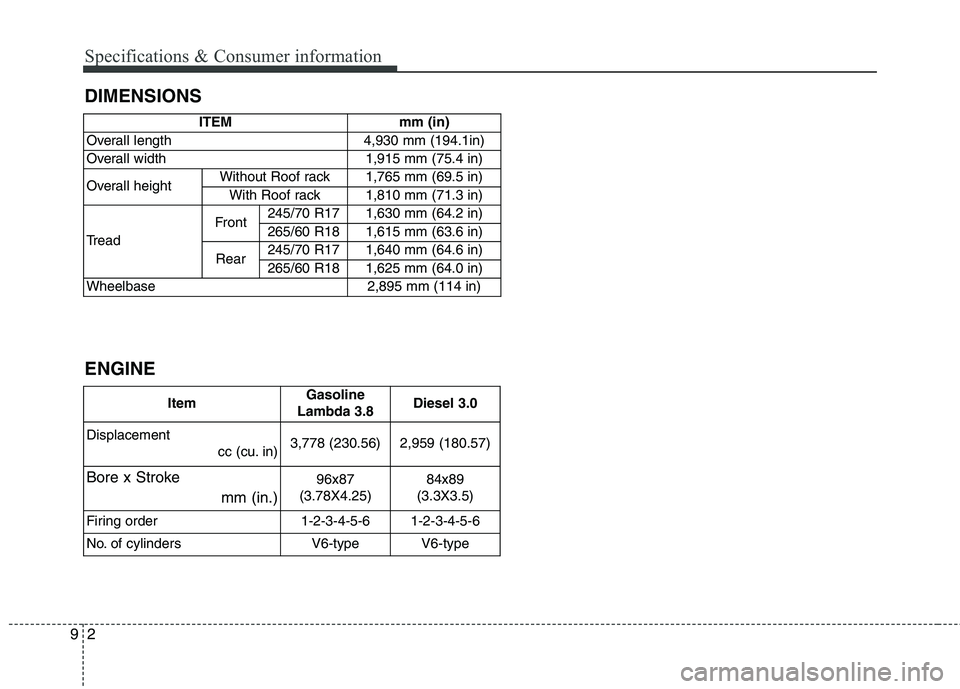
Item Gasoline
Lambda 3.8
Diesel 3.0
Displacement cc (cu. in)3,778 (230.56)
2,959 (180.57)
Bore x Stroke mm (in.)96x87
(3.78X4.25)
84x89
(3.3X3.5)
Firing order 1-2-3-4-5-6
1-2-3-4-5-6
No. of cylinders V6-type
V6-type
ITEMmm (in)
Overall length4,930 mm (194.1in)
Overall width1,915 mm (75.4 in)
Overall heightWithout Roof rack1,765 mm (69.5 in)
With Roof rack1,810 mm (71.3 in)
Tread
Front 245/70 R171,630 mm (64.2 in)
265/60 R181,615 mm (63.6 in)
Rear245/70 R171,640 mm (64.6 in)
265/60 R181,625 mm (64.0 in)
Wheelbase2,895 mm (114 in)
Page 529 of 548
95
Specifications & Consumer information
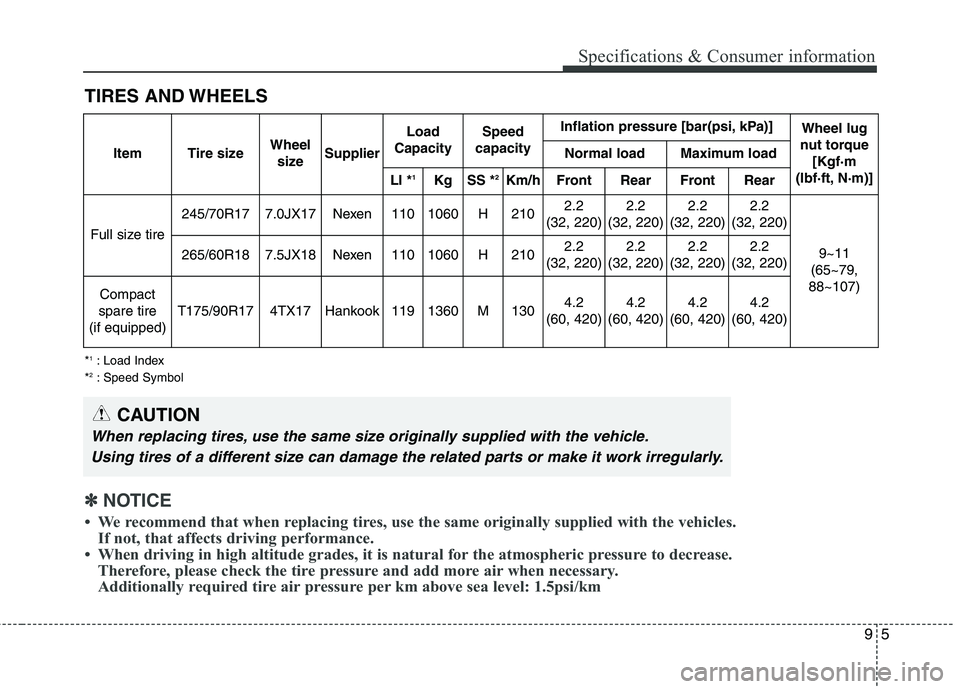
TIRES AND WHEELS *1
: Load Index
* 2
: Speed Symbol
CAUTION
When replacing tires, use the same size originally supplied with the vehicle.
Using tires of a different size can damage the related parts or make it work irregularly.
ItemTire sizeWheel sizeSupplier
Load
CapacitySpeed
capacityInflation pressure [bar(psi, kPa)]Wheel lug
nut torque [Kgf·m
(lbf·ft, N·m)]
Normal loadMaximum load
LI * 1KgSS * 2Km/hFront RearFront Rear
Full size tire
245/70R177.0JX17Nexen1101060H2102.2
(32, 220)2.2
(32, 220)2.2
(32, 220)2.2
(32, 220)
9~11
(65~79,
88~107)265/60R187.5JX18Nexen1101060H2102.2
(32, 220)2.2
(32, 220)2.2
(32, 220)2.2
(32, 220)
Compact
spare tire
(if equipped)
T175/90R174TX17Hankook1191360M1304.2
(60, 420)4.2
(60, 420)4.2
(60, 420)4.2
(60, 420)
✽✽ NOTICE
We recommend that when replacing tires, use the same originally supplied with the vehicles.
If not, that affects driving performance.
When driving in high altitude grades, it is natural for the atmospheric pressure to dec rease.
Therefore, please check the tire pressure and add more air when necessary.
Additionally required tire air pressure per km above sea level: 1.5psi/km
Page 537 of 548
Index
2
I
A/V Mode (cluster)........................................................4-60
Air bag warning label ....................................................3-72
Air bag warning light ....................................................3-55
Air bags..........................................................................3-51
Operation ....................................................................3-52
Air bag warning light ..................................................3-55
SRS components and functions ..................................3-56
Driver's and passenger's front air bag ........................3-59
Side air bag ................................................................3-61
Curtain air bag ............................................................3-63
Inflation conditions ....................................................3-67
Non-inflation conditions ............................................3-68
SRS Care ....................................................................3-70
Air bag warning label ................................................3-72
Air cleaner ....................................................................8-31 Filter replacement ......................................................8-31
Air conditioner compressor label ..................................9-10
Air conditioning system lubricants..................................9-4
Air leveling system (ALS) ............................................6-49 N (Normal) - Ordinary driving mode ........................6-49
HI (High) - Off road driving mode ............................6-49
LO (Low) - Loading mode ........................................6-50
Air ventilation seat ......................................................4-146
Anti-lock brake system (ABS) ......................................6-38
Appearance care ............................................................8-77 Exterior care ................................................................8-77 Interior care ................................................................8-83
Armed stage ..................................................................4-14
AUDIO (With Touch Screen) ........................................5-7 Feature of Your Audio ..................................................5-8
Radio Mode (Type-1)..................................................5-20
Radio Mode (Type-2)..................................................5-23
Media Mode ................................................................5-25
Phone Mode ................................................................5-40 Bluetooth ®
Wireless Technology (Type-1) ................5-41
Bluetooth ®
Wireless Technology (Type-2) ................5-48
Voice Recognition Mode ............................................5-55
Setup Mode (Type-1) ..................................................5-63
Setup Mode (Type-2) ..................................................5-72
Audio system ..................................................................5-2 Antenna ........................................................................5-2
Steering wheel audio controls ......................................5-3
Aux, USB port ..............................................................5-4
How vehicle audio works ............................................5-4
Auto light ....................................................................4-100
Automatic transaxle ......................................................6-16 Manual mode ..............................................................6-19
Shift-lock override ......................................................6-20
Battery............................................................................8-38 For best battery service ..............................................8-38Battery capacity label..................................................8-40
A
B