maintenance KIA BORREGO 2017 User Guide
[x] Cancel search | Manufacturer: KIA, Model Year: 2017, Model line: BORREGO, Model: KIA BORREGO 2017Pages: 548, PDF Size: 36.78 MB
Page 355 of 548
631
Driving your vehicle
✽✽NOTICE
Do not drive in water if the level is higher than the bottom of the vehi-
cle.
Check your brake condition once you are out of mud or water. Press
the brake pedal several times as
you move slowly until you feel nor-
mal braking forces return.
Shorten your scheduled mainte- nance interval if you drive in off-
road conditions such as sand, mud
or water (see “Maintenance under
severe usage conditions” in chapter
8). Always wash your vehicle thor-
oughly after off road use, especially
cleaning the bottom of the vehicle.
Since the driving torque is always applied to the 4 wheels the per-
formance of the 4WD vehicle is
greatly affected by the condition of
the tires. Be sure to equip the vehi-
cle with four tires of the same size
and type.
A full time four wheel drive vehi- cle cannot be towed by an ordi-
nary tow truck. Make sure that
the vehicle is placed on a flat bed
truck for moving.Reducing the risk of a rollover
This multi-purpose passenger vehicle
is defined as a Sports Utility Vehicle
(SUV). SUV’s have higher ground
clearance and a narrower track to
make them capable of performing in a
wide variety of off-road applications.
Specific design characteristics give
them a higher center of gravity than
ordinary vehicles. An advantage of the
higher ground clearance is a better
view of the road, which allows you to
anticipate problems. They are not
designed for cornering at the same
speeds as conventional passenger
vehicles, any more than low-slung
sports vehicles are designed to per-
form satisfactorily in off-road condi-
tions. Due to this risk, driver and pas-sengers are strongly recommended to
buckle their seat belts. In a rollover
crash, an unbelted person is more
likely to die than a person wearing a
seat belt. There are steps that a driver
can make to reduce the risk of a
rollover. If at all possible, avoid sharp
turns or abrupt maneuvers, do not
load your roof rack with heavy cargo,
and never modify your vehicle in any
way.CAUTION - Mud or snow
If one of the front or rear wheels
begins to spin in mud, snow,etc. the vehicle can sometimes be driven out by depressing theaccelerator pedal further; how-ever avoid running the engine continuously at high rpmbecause doing so could dam-age the 4WD system.
Page 373 of 548
649
Driving your vehicle
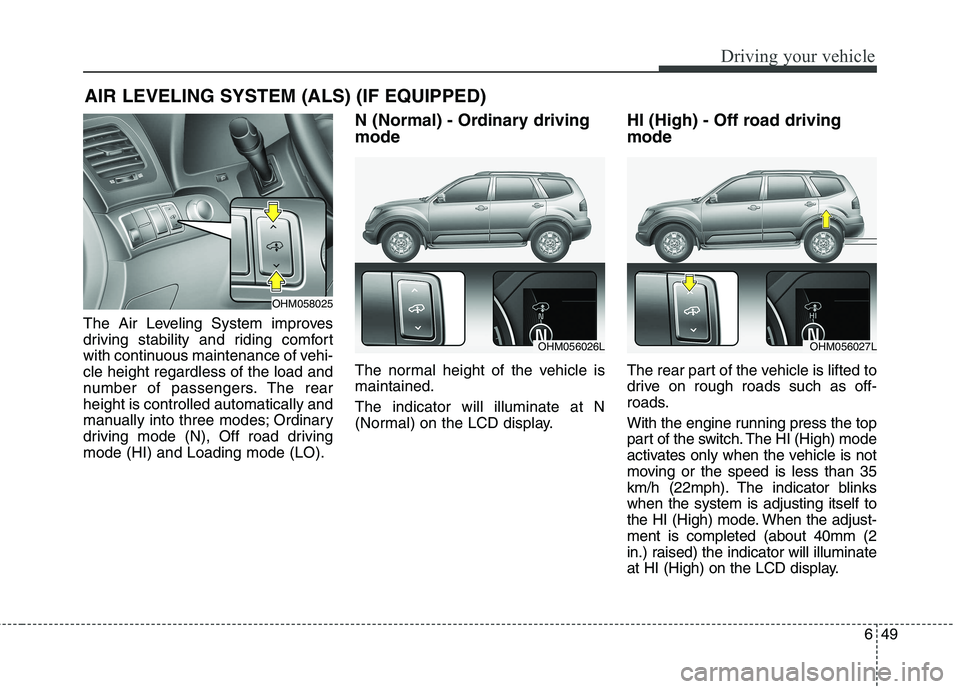
The Air Leveling System improves
driving stability and riding comfort
with continuous maintenance of vehi-cle height regardless of the load and
number of passengers. The rearheight is controlled automatically and
manually into three modes; Ordinary
driving mode (N), Off road drivingmode (HI) and Loading mode (LO).N (Normal) - Ordinary driving mode
The normal height of the vehicle is maintained. The indicator will illuminate at N
(Normal) on the LCD display.
HI (High) - Off road driving mode
The rear part of the vehicle is lifted to
drive on rough roads such as off-
roads.
With the engine running press the top
part of the switch. The HI (High) mode
activates only when the vehicle is not
moving or the speed is less than 35
km/h (22mph). The indicator blinkswhen the system is adjusting itself to
the HI (High) mode. When the adjust-ment is completed (about 40mm (2
in.) raised) the indicator will illuminate
at HI (High) on the LCD display.
AIR LEVELING SYSTEM (ALS) (IF EQUIPPED)
OHM058025
OHM056026LOHM056027L
Page 375 of 548
651
Driving your vehicle
CAUTION
Always check if there is any-thing under the rear part of thevehicle before adjusting theALS.
There may be noise heard while the ALS is adjusting theheight to a mode.
Do not turn off the engine or press the switch to anothermode while the ALS is adjust-ing to the mode selected.
Do not activate the ALS when the air filter of the compressorhas been submerged.
Inspect or replace the ALS air filter and air spring accordingto the maintenance schedule.
Do not drive the vehicle when the air spring is damaged orairless. Have the vehicle towed with all the wheels liftedfrom the ground.
Page 393 of 548
669
Driving your vehicle
Your vehicle's fuel economy depends
mainly on your style of driving, where
you drive and when you drive.
Each of these factors affects how
many kilometers (miles) you can get
from a liter (gallon) of fuel. To operate
your vehicle as economically as pos-
sible, use the following driving sug-
gestions to help save money in bothfuel and repairs:
Drive smoothly. Accelerate at amoderate rate. Do not make "jack-
rabbit" starts or full-throttle shifts
and maintain a steady cruising
speed. Do not race between stop-
lights. Try to adjust your speed to
the traffic so you do not have to
change speeds unnecessarily.
Avoid heavy traffic whenever pos-
sible. Always maintain a safe dis-
tance from other vehicles so you
can avoid unnecessary braking.
This also reduces brake wear.
Drive at a moderate speed. The faster you drive, the more fuel your
vehicle uses. Driving at a moderate
speed, especially on the highway,
is one of the most effective ways toreduce fuel consumption. Do not "ride" the brake pedal. This
can increase fuel consumption and
also increase wear on these com-
ponents. In addition, driving with
your foot resting on the brake pedal
may cause the brakes to overheat,
which reduces their effectiveness
and may lead to more serious con-
sequences.
Take care of your tires. Keep them inflated to the recommended pres-
sure. Incorrect inflation, either too
much or too little, results in unnec-
essary tire wear. Check the tirepressures at least once a month.
Be sure that the wheels are aligned correctly. Improper align-ment can result from hitting curbs
or driving too fast over irregular
surfaces. Poor alignment causes
faster tire wear and may also result
in other problems as well as
greater fuel consumption. Keep your vehicle in good condi-
tion. For better fuel economy and
reduced maintenance costs, main-
tain your vehicle in accordancewith the maintenance schedule in
chapter 8. If you drive your vehicle
in severe conditions, more frequentmaintenance is required (see
chapter 8 for details).
Keep your vehicle clean. For maxi- mum service, your vehicle should
be kept clean and free of corrosive
materials. It is especially important
that mud, dirt, ice, etc. not be
allowed to accumulate on the
underside of the vehicle. This extra
weight can result in increased fuel
consumption and also contribute tocorrosion.
Travel lightly. Do not carry unnec- essary weight in your vehicle.
Weight reduces fuel economy.
Do not let the engine idle longer than necessary. If you are waiting
(and not in traffic), turn off your
engine and restart only when
you're ready to go.
ECONOMICAL OPERATION
Page 402 of 548
Driving your vehicle
78
6
Use high quality ethylene gly- col coolant
Your vehicle is delivered with high
quality ethylene glycol coolant in the
cooling system. It is the only type ofcoolant that should be used because
it helps prevent corrosion in the cool-
ing system, lubricates the water
pump and prevents freezing. Be sure
to replace or replenish your coolantin accordance with the maintenance
schedule in chapter 8. Before winter,
have your coolant tested to assure
that its freezing point is sufficient for
the temperatures anticipated during
the winter.
Check battery and cables
Winter puts additional burdens on
the battery system. Visually inspect
the battery and cables as described
in chapter 8. We recommend that the
level of charge in your battery be
checked by an authorized Kia dealer. Change to "winter weight" oil
if necessary In some climates it is recommended
that a lower viscosity "winter weight"
oil be used during cold weather. See
chapter 9 for recommendations. If
you aren't sure what weight oil you
should use, we recommend that you
consult an authorized Kia dealer.
Check spark plugs and ignition system
Inspect your spark plugs as
described in chapter 8 and replace
them if necessary. Also check all
ignition wiring and components to be
sure they are not cracked, worn or
damaged in any way.
To keep locks from freezing
To keep the locks from freezing,
squirt an approved de-icer fluid or
glycerine into the key opening. If a
lock is covered with ice, squirt it with
an approved de-icing fluid to remove
the ice. If the lock is frozen internally,
you may be able to thaw it out by
using a heated key. Handle the heat-
ed key with care to avoid injury.
Use approved window washer
anti-freeze in system
To keep the water in the window
washer system from freezing, add an
approved window washer anti-freeze
solution in accordance with instruc-
tions on the container. Window wash-
er anti-freeze is available from an
authorized Kia dealer and most auto
parts outlets. Do not use engine
coolant or other types of anti-freeze
as these may damage the paint fin-ish.
Page 414 of 548
What to do in an emergency
10
7
Each tire, including the spare (if pro-
vided), should be checked monthlywhen cold and inflated to the inflation
pressure recommended by the vehi-
cle manufacturer on the vehicle plac-ard or tire inflation pressure label.
(If your vehicle has tires of a different
size than the size indicated on the
vehicle placard or tire inflation pres-
sure label, you should determine the
proper tire inflation pressure for
those tires.)
As an added safety feature, your vehi- cle has been equipped with a tire pres-
sure monitoring system (TPMS) that
illuminates a low tire pressure telltale
when one or more of your tires is sig-
nificantly under-inflated. Accordingly,
when the low tire pressure telltale illu-
minates, you should stop and check
your tires as soon as possible, and
inflate them to the proper pressure.
Driving on a significantly under-inflat-
ed tire causes the tire to overheat and
can lead to tire failure. Under-inflationalso reduces fuel efficiency and tire
tread life, and may affect the vehicle’s
handling and stopping ability. Please note that the TPMS is not a
substitute for proper tire maintenance,
and it is the driver’s responsibility to
maintain correct tire pressure, even ifunder-inflation has not reached the
level to trigger illumination of the
TPMS low tire pressure telltale.
Your vehicle has also been equipped
with a TPMS malfunction indicator toindicate when the system is not oper-
ating properly. The TPMS malfunction
indicator is combined with the low tire
pressure telltale. When the systemdetects a malfunction, the telltale will
flash for approximately 1 minute and
then remain continuously illuminated.
This sequence will continue upon
subsequent vehicle start-ups as long
as the malfunction exists. When theTPMS malfunction indicator remains
illuminated after blinking for approxi-
mately 1 minute, the system may not
be able to detect or signal low tirepressure as intended.
TPMS malfunctions may occur for a
variety of reasons, including theinstallation of replacement or alter-
nate tires or wheels on the vehicle
that prevent the TPMS from function-
ing properly. Always check the TPMSmalfunction telltale after replacing
one or more tires or wheels on your
vehicle to ensure that the replace-
ment or alternate tires and wheels
allow the TPMS to continue to func-
tion properly.
Page 437 of 548
Maintenance
8
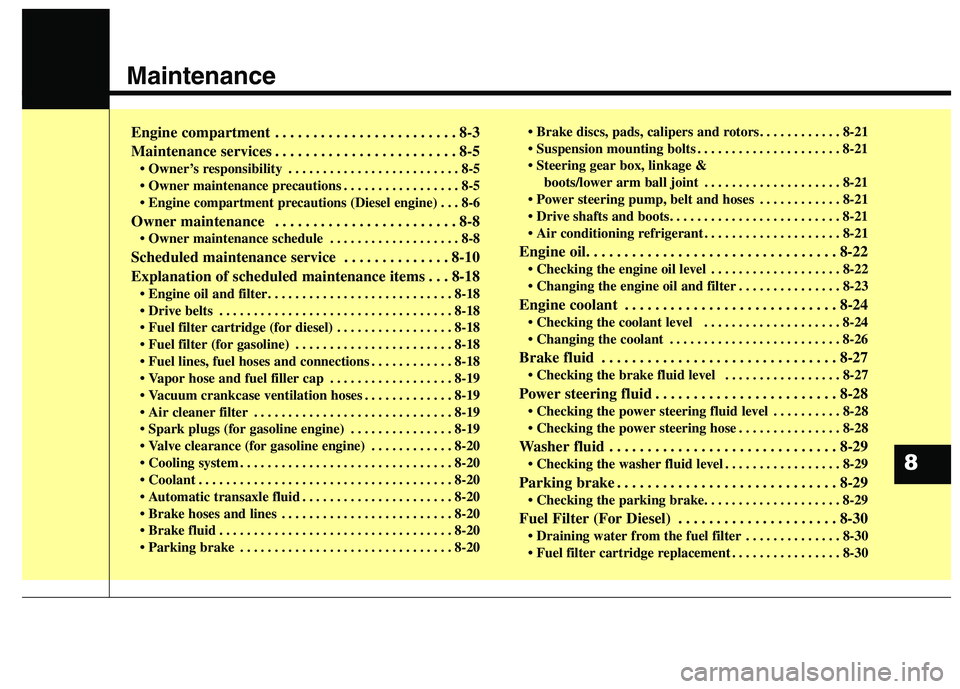
Engine compartment . . . . . . . . . . . . . . . . . . . . . . . . 8-3
Maintenance services . . . . . . . . . . . . . . . . . . . . . . . . 8-5• Owner’s responsibility . . . . . . . . . . . . . . . . . . . . . . . . . 8-5
. . . . . . . . . . . . . . . . . 8-5
. . . 8-6
Owner maintenance . . . . . . . . . . . . . . . . . . . . . . . . 8-8 . . . . . . . . . . . . . . . . . . . 8-8
Scheduled maintenance service . . . . . . . . . . . . . . 8-10
Explanation of scheduled maintenance items . . . 8-18
. . . . . . . . . . . . . . . . . . . . . . . . . . . . . . . . . . 8-18
. . . . . . . . . . . . . . . . . 8-18
. . . . . . . . . . . . . . . . . . . . . . . 8-18
fuel hoses and connections . . . . . . . . . . . . 8-18
. . . . . . . . . . . . . . . . . . 8-19
. . . . . . . . . . . . . 8-19
. . . . . . . . . . . . . . . . . . . . . . . . . . . . . 8-19
. . . . . . . . . . . . . . . 8-19
. . . . . . . . . . . . 8-20
. . . . . . . . . . . . . . . . . . . . . . . . . . . . . . . 8-20
. . . . . . . . . . . . . . . . . . . . . . . . . . . . . . . . . . . . . 8-20
. . . . . . . . . . . . . . . . . . . . . . 8-20
. . . . . . . . . . . . . . . . . . . . . . . . . 8-20
. . . . . . . . . . . . . . . . . . . . . . . . . . . . . . . . . . 8-20
. . . . . . . . . . . . . . . . . . . . . . . . . . . . . . . 8-20 pads, calipers and rotors. . . . . . . . . . . . 8-21
. . . . . . . . . . . . . . . . . . . . . 8-21
linkage &
boots/lower arm ball joint . . . . . . . . . . . . . . . . . . . . 8-21
belt and hoses . . . . . . . . . . . . 8-21
. . . . . . . . . . . . . . . . . . . . 8-21
Engine oil. . . . . . . . . . . . . . . . . . . . . . . . . . . . . . . . . 8-22 . . . . . . . . . . . . . . . . . . . 8-22
. . . . . . . . . . . . . . . 8-23
Engine coolant . . . . . . . . . . . . . . . . . . . . . . . . . . . . 8-24 . . . . . . . . . . . . . . . . . . . . 8-24
. . . . . . . . . . . . . . . . . . . . . . . . . 8-26
Brake fluid . . . . . . . . . . . . . . . . . . . . . . . . . . . . . . . 8-27 . . . . . . . . . . . . . . . . . 8-27
Power steering fluid . . . . . . . . . . . . . . . . . . . . . . . . 8-28 . . . . . . . . . . 8-28
. . . . . . . . . . . . . . . 8-28
Washer fluid . . . . . . . . . . . . . . . . . . . . . . . . . . . . . . 8-29 . . . . . . . . . . . . . . . . . 8-29
Parking brake . . . . . . . . . . . . . . . . . . . . . . . . . . . . . 8-29
Fuel Filter (For Diesel) . . . . . . . . . . . . . . . . . . . . . 8-30 . . . . . . . . . . . . . . 8-30
. . . . . . . . . . . . . . . . 8-30
Page 439 of 548
83
Maintenance
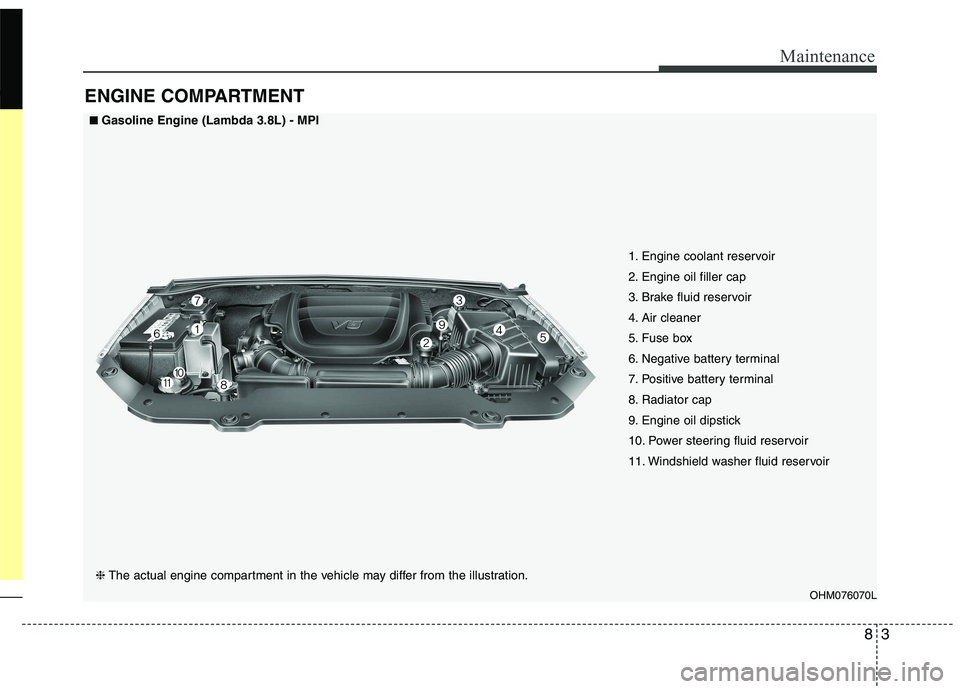
ENGINE COMPARTMENT
OHM076070L
■■Gasoline Engine (Lambda 3.8L) - MPI
❈ The actual engine compartment in the vehicle may differ from the illustration. 1. Engine coolant reservoir
2. Engine oil filler cap
3. Brake fluid reservoir
4. Air cleaner
5. Fuse box
6. Negative battery terminal
7. Positive battery terminal
8. Radiator cap
9. Engine oil dipstick
10. Power steering fluid reservoir
11. Windshield washer fluid reservoir
Page 440 of 548
Maintenance
4
8
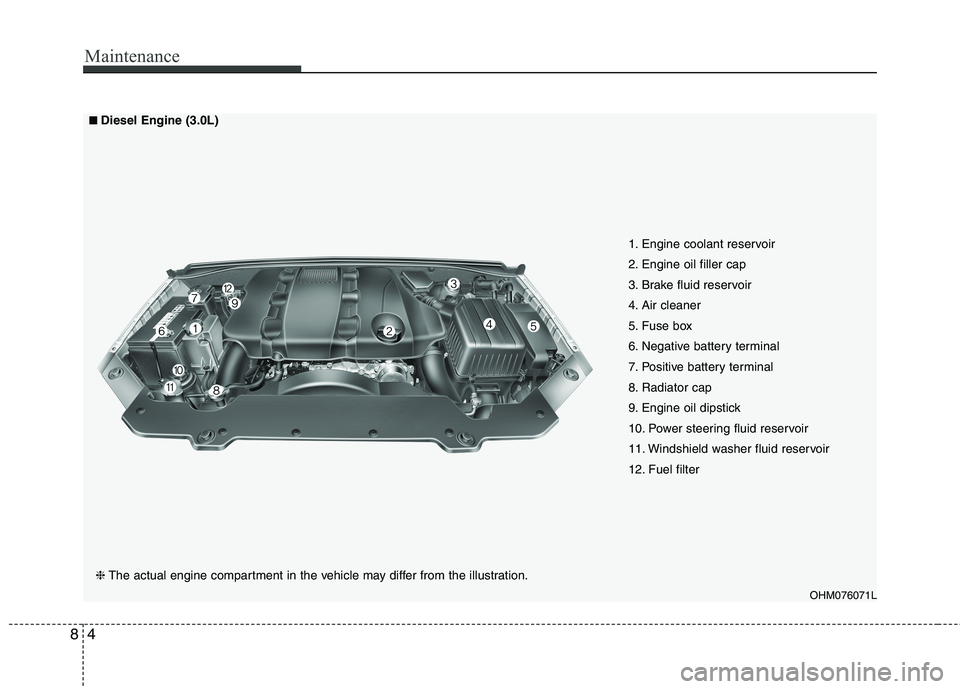
OHM076071L
■■
Diesel Engine (3.0L)
❈ The actual engine compartment in the vehicle may differ from the illustration. 1. Engine coolant reservoir
2. Engine oil filler cap
3. Brake fluid reservoir
4. Air cleaner
5. Fuse box
6. Negative battery terminal
7. Positive battery terminal
8. Radiator cap
9. Engine oil dipstick
10. Power steering fluid reservoir
11. Windshield washer fluid reservoir
12. Fuel filter
Page 441 of 548
MAINTENANCE SERVICES
You should exercise the utmost care
to prevent damage to your vehicle
and injury to yourself whenever per-
forming any maintenance or inspec-
tion procedures.
Inadequate, incomplete or insuffi-
cient servicing may result in opera-
tional problems with your vehicle that
could lead to vehicle damage, an
accident, or personal injury. Owner’s responsibility
✽✽
NOTICE
Maintenance Service and Record
Retention are the owner's responsi-
bility.
We recommend in general that you
have your vehicle serviced by an
authorized Kia dealer.
You should retain documents that
show proper maintenance has been
performed on your vehicle in accor-dance with the scheduled mainte-
nance service charts shown on the
following pages.
You need this information to estab-
lish your compliance with the servic-ing and maintenance requirements
of your vehicle warranties.
Detailed warranty information is pro-
vided in your Warranty & Maintenancebook. Repairs and adjustments required as a result of improper maintenance or
a lack of required maintenance are
not covered when your vehicle is
covered by warranty. Owner maintenance precautions
Improper or incomplete service may
result in problems. This section gives
instructions only for the maintenance
items that are easy to perform.✽✽
NOTICE
Improper owner maintenance dur-
ing the warranty period may affect
warranty coverage. For details, read
the separate Warranty &
Maintenance book provided with
the vehicle. If you're unsure about
any servicing or maintenance proce-
dure, we recommend that the system
be seviced by an authorized Kia
dealer.
85
Maintenance