engine oil KIA BORREGO 2017 Owner's Manual
[x] Cancel search | Manufacturer: KIA, Model Year: 2017, Model line: BORREGO, Model: KIA BORREGO 2017Pages: 548, PDF Size: 36.78 MB
Page 454 of 548
Maintenance
18
8
EXPLANATION OF SCHEDULED MAINTENANCE ITEMS
Engine oil and filter The engine oil and filter should be
changed at the intervals specified in
the maintenance schedule. If the
vehicle is being driven in severe con-
ditions, more frequent oil and filterchanges are required. Drive belts
Inspect all drive belts for evidence of
cuts, cracks, excessive wear or oil
saturation and replace if necessary.
Drive belts should be checked peri-
odically for proper tension and
adjusted as necessary. Fuel filter cartridge (for diesel) A clogged filter can limit the speed at
which the vehicle may be driven,damage the emission system and
cause multiple issues such as hard
starting. If an excessive amount of
foreign matter accumulates in the
fuel tank, the filter may require
replacement more frequently.
After installing a new filter, run the
engine for several minutes, and
check for leaks at the connections.
We recommend that the fuel filter be
replaced by an authorized Kia dealer.
Fuel filter (for gasoline)
Kia gasoline vehicle is equipped a
lifetime fuel filter that integrated with
the fuel tank. Regular maintenance
or replacement is not needed but
depends on fuel quality. If there are
some important safety matters like
fuel flow restriction, surging, loss of
power, hard starting problem etc, fuelfilter inspection or replace is needed.
We recommend that the fuel filter be
Inspected or replaced by an author-
ized Kia dealer.Fuel lines, fuel hoses and con- nections
Check the fuel lines, fuel hoses and
connections for leakage and dam-
age. We recommend that the fuel
lines, fuel hoses and connections be
replaced by an authorized Kia dealer.
WARNING
- Diesel only
Never work on the injection sys- tem with the engine running orwithin 30 seconds after shutting
off the engine. High pressure
pump, rail, injectors and highpressure pipes are subject to
high pressure even after the
engine stops. The fuel jet pro-
duced by fuel leaks may cause
serious injury, if it touches the
body. People using pacemakers
should not more move than 30
cm closer to the ECU or wiring
harness within the engine roomwhile the engine is running,since the high currents in the
Common Rail system produce
considerable magnetic fields.
CAUTION
When you are inspecting the belt, place the ignition switch inthe LOCK/OFF or ACC position.
Page 457 of 548
821
Maintenance
Brake discs, pads, calipers
and rotors
Check the pads for excessive wear,
discs for run out and wear, and
calipers for fluid leakage.
For more information on checking
the pads or lining wear limit, we rec-
ommend to refer to the Kia web site. (https://www
.kia-hotline.com)
Suspension mounting bolts
Check the suspension connections
for looseness or damage. Retighten
to the specified torque. Steering gear box, linkage &
boots/lower arm ball joint
With the vehicle stopped and engine
off, check for excessive free-play in
the steering wheel.
Check the linkage for bends or dam-
age. Check the dust boots and ball
joints for deterioration, cracks, or dam-
age. Replace any damaged parts.
Power steering pump, belt and hoses
Check the power steering pump and
hoses for leakage and damage.
Replace any damaged or leaking
parts immediately. Inspect the power
steering belt (or drive belt) for evi-
dence of cuts, cracks, excessive
wear, oiliness and proper tension.
Replace or adjust it if necessary.Drive shafts and boots
Check the drive shafts, boots and
clamps for cracks, deterioration, or
damage. Replace any damaged
parts and, if necessary, repack the
grease.
Air conditioning refrigerant (if equipped)
Check the air conditioning lines and
connections for leakage and dam-
age.
Page 458 of 548
Maintenance
22
8
ENGINE OIL
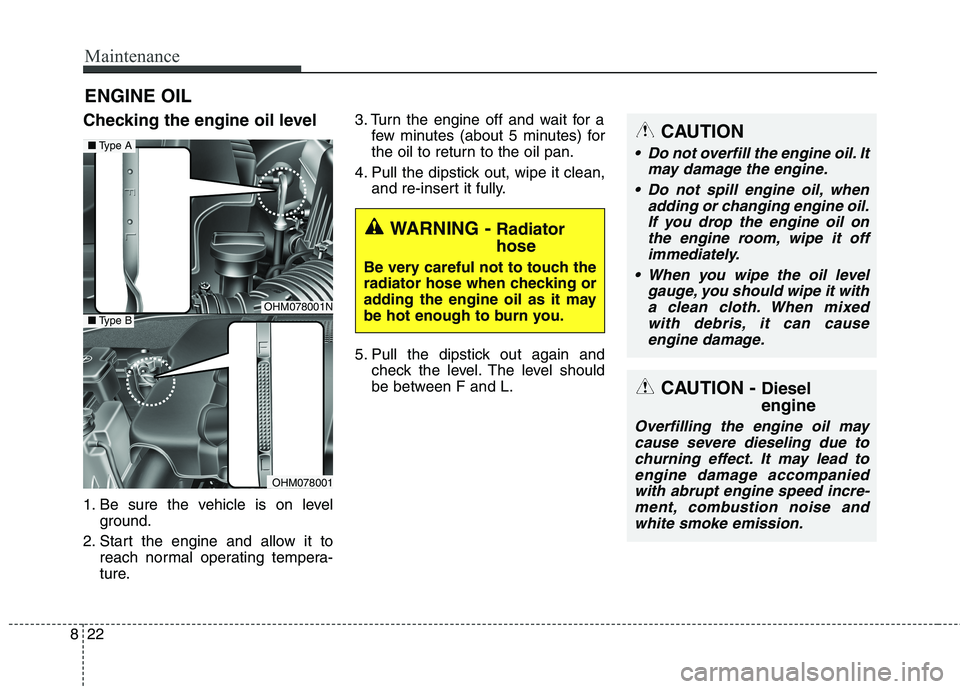
Checking the engine oil level
1. Be sure the vehicle is on level ground.
2. Start the engine and allow it to reach normal operating tempera-
ture. 3. Turn the engine off and wait for a
few minutes (about 5 minutes) for
the oil to return to the oil pan.
4. Pull the dipstick out, wipe it clean, and re-insert it fully.
5. Pull the dipstick out again and check the level. The level should
be between F and L.
WARNING - Radiator hose
Be very careful not to touch the
radiator hose when checking or
adding the engine oil as it may
be hot enough to burn you.
CAUTION
Do not overfill the engine oil. It may damage the engine.
Do not spill engine oil, when adding or changing engine oil.If you drop the engine oil onthe engine room, wipe it offimmediately.
When you wipe the oil level gauge, you should wipe it witha clean cloth. When mixedwith debris, it can causeengine damage.
CAUTION - Diesel engine
Overfilling the engine oil may
cause severe dieseling due tochurning effect. It may lead to engine damage accompaniedwith abrupt engine speed incre-ment, combustion noise andwhite smoke emission.
OHM078001N
OHM078001
■ Type A
■Type B
Page 459 of 548
823
Maintenance
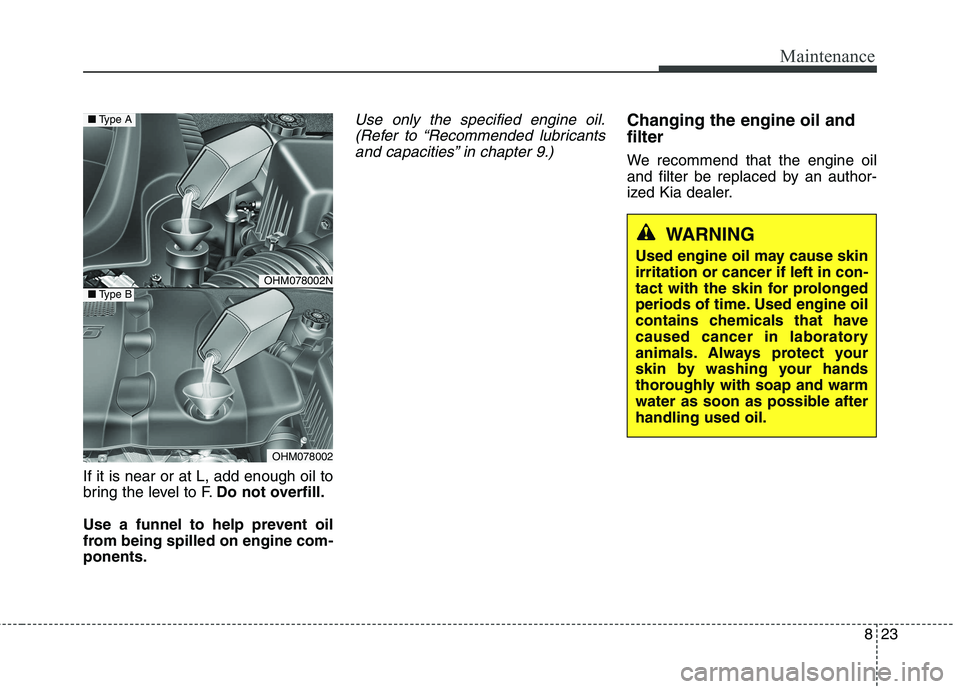
If it is near or at L, add enough oil to
bring the level to F.Do not overfill.
Use a funnel to help prevent oil
from being spilled on engine com-ponents.
Use only the specified engine oil. (Refer to “Recommended lubricantsand capacities” in chapter 9.)Changing the engine oil and filter
We recommend that the engine oil
and filter be replaced by an author-
ized Kia dealer.
WARNING
Used engine oil may cause skin irritation or cancer if left in con-
tact with the skin for prolonged
periods of time. Used engine oil
contains chemicals that have
caused cancer in laboratory
animals. Always protect your
skin by washing your hands
thoroughly with soap and warm
water as soon as possible afterhandling used oil.
OHM078002N
OHM078002
■ Type A
■Type B
Page 463 of 548
827
Maintenance
BRAKE FLUID
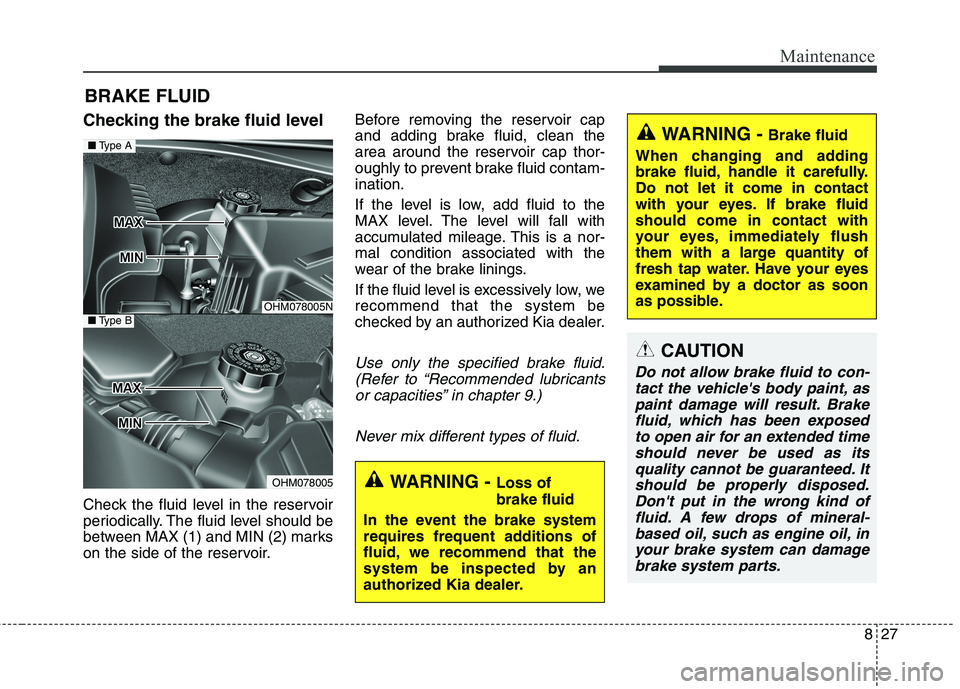
Checking the brake fluid level
Check the fluid level in the reservoir
periodically. The fluid level should be
between MAX (1) and MIN (2) marks
on the side of the reservoir. Before removing the reservoir cap
and adding brake fluid, clean the
area around the reservoir cap thor-
oughly to prevent brake fluid contam-ination.
If the level is low, add fluid to the
MAX level. The level will fall with
accumulated mileage. This is a nor-mal condition associated with the
wear of the brake linings.
If the fluid level is excessively low, we recommend that the system be
checked by an authorized Kia dealer.
Use only the specified brake fluid.
(Refer to “Recommended lubricantsor capacities” in chapter 9.)
Never mix different types of fluid.
WARNING - Brake fluid
When changing and adding
brake fluid, handle it carefully.Do not let it come in contact
with your eyes. If brake fluidshould come in contact with
your eyes, immediately flush
them with a large quantity of
fresh tap water. Have your eyes
examined by a doctor as soon
as possible.
WARNING - Loss of brake fluid
In the event the brake system
requires frequent additions of
fluid, we recommend that the
system be inspected by an
authorized Kia dealer.
CAUTION
Do not allow brake fluid to con- tact the vehicle's body paint, aspaint damage will result. Brakefluid, which has been exposed to open air for an extended timeshould never be used as itsquality cannot be guaranteed. It should be properly disposed.Don't put in the wrong kind offluid. A few drops of mineral- based oil, such as engine oil, inyour brake system can damagebrake system parts.
OHM078005N
OHM078005
■ Type A
■Type B
Page 464 of 548
Maintenance
28
8
POWER STEERING FLUID
Checking the power steering
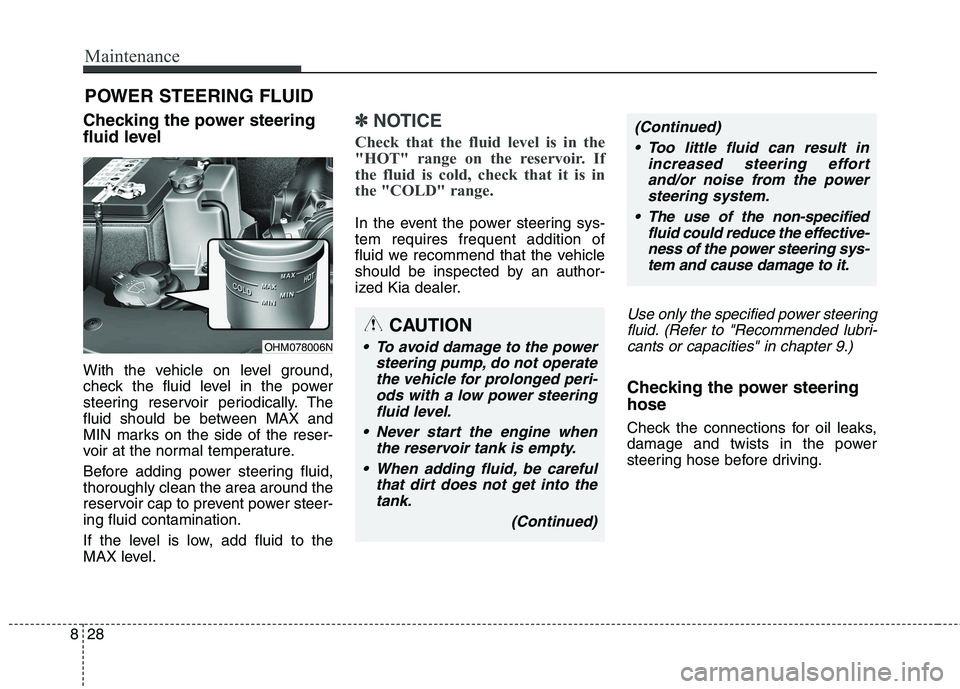
fluid level
With the vehicle on level ground,
check the fluid level in the power
steering reservoir periodically. The
fluid should be between MAX and
MIN marks on the side of the reser-
voir at the normal temperature.
Before adding power steering fluid, thoroughly clean the area around the
reservoir cap to prevent power steer-ing fluid contamination.
If the level is low, add fluid to the
MAX level.
✽✽ NOTICE
Check that the fluid level is in the
"HOT" range on the reservoir. If
the fluid is cold, check that it is in
the "COLD" range.
In the event the power steering sys- tem requires frequent addition of
fluid we recommend that the vehicle
should be inspected by an author-
ized Kia dealer.
Use only the specified power steering fluid. (Refer to "Recommended lubri-cants or capacities" in chapter 9.)
Checking the power steering hose
Check the connections for oil leaks,
damage and twists in the power
steering hose before driving.
CAUTION
To avoid damage to the power steering pump, do not operatethe vehicle for prolonged peri-ods with a low power steeringfluid level.
Never start the engine when the reservoir tank is empty.
When adding fluid, be careful that dirt does not get into thetank.
(Continued)
(Continued) Too little fluid can result in increased steering effortand/or noise from the power steering system.
The use of the non-specified fluid could reduce the effective-ness of the power steering sys-tem and cause damage to it.
OHM078006N
Page 489 of 548
853
Maintenance
FUSES
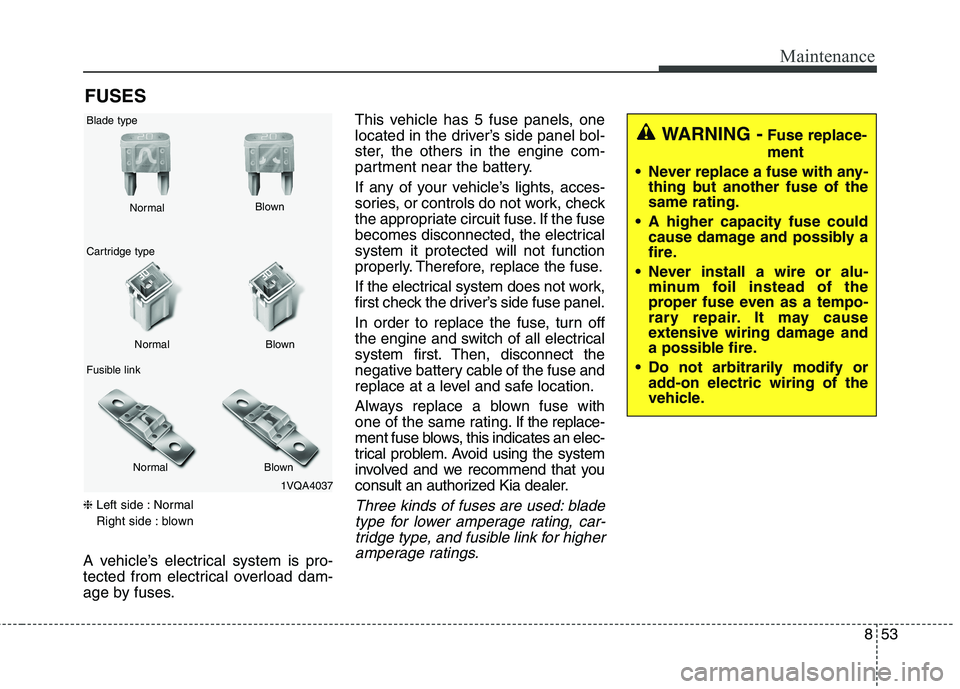
❈ Left side : Normal
Right side : blown
A vehicle’s electrical system is pro-
tected from electrical overload dam-
age by fuses. This vehicle has 5 fuse panels, one
located in the driver’s side panel bol-
ster, the others in the engine com-
partment near the battery.
If any of your vehicle’s lights, acces-
sories, or controls do not work, check
the appropriate circuit fuse. If the fuse
becomes disconnected, the electricalsystem it protected will not function
properly. Therefore, replace the fuse.
If the electrical system does not work,
first check the driver’s side fuse panel.
In order to replace the fuse, turn off
the engine and switch of all electrical
system first. Then, disconnect the
negative battery cable of the fuse and
replace at a level and safe location.
Always replace a blown fuse with
one of the same rating. If
the replace-
ment fuse blows, this indicates an elec-
trical problem. Avoid using the system
involved and we recommend that you
consult an authorized Kia dealer.
Three kinds of fuses are used: blade
type for lower amperage rating, car-tridge type, and fusible link for higheramperage ratings.
WARNING - Fuse replace- ment
Never replace a fuse with any- thing but another fuse of the same rating.
A higher capacity fuse could cause damage and possibly a
fire.
Never install a wire or alu- minum foil instead of the
proper fuse even as a tempo-
rary repair. It may cause
extensive wiring damage and
a possible fire.
Do not arbitrarily modify or add-on electric wiring of the
vehicle.
1VQA4037
Normal
Normal
Blade type
Cartridge type
Fusible link Blown
Blown
Normal Blown
Page 500 of 548
Maintenance
64
8
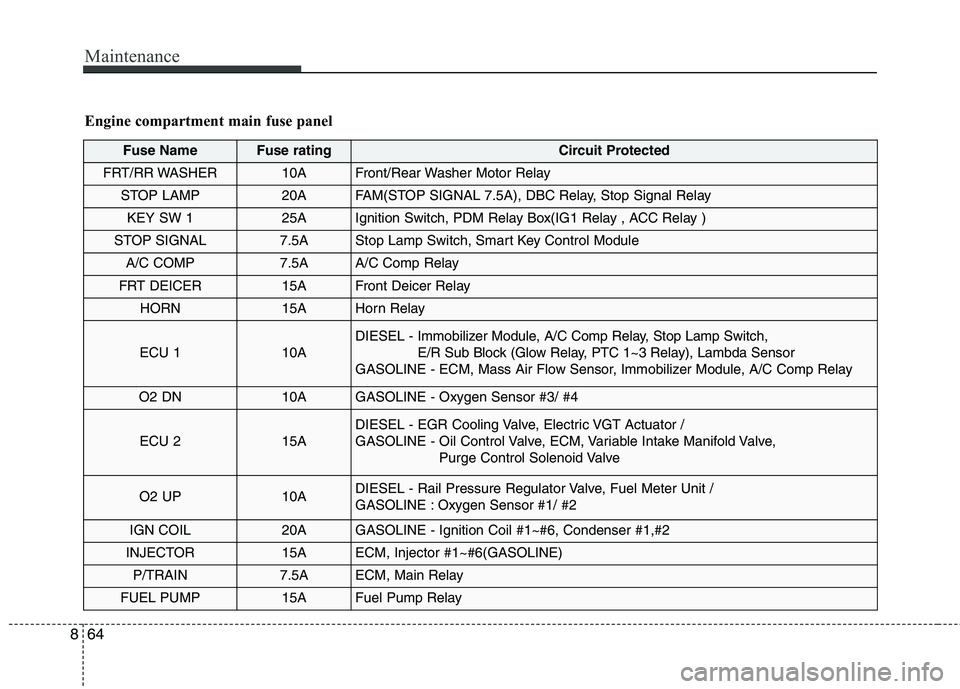
Engine compartment main fuse panel
Fuse NameFuse ratingCircuit Protected
FRT/RR WASHER10AFront/Rear Washer Motor Relay
STOP LAMP20AFAM(STOP SIGNAL 7.5A), DBC Relay, Stop Signal Relay
KEY SW 125AIgnition Switch, PDM Relay Box(IG1 Relay , ACC Relay )
STOP SIGNAL7.5AStop Lamp Switch, Smart Key Control Module
A/C COMP7.5AA/C Comp Relay
FRT DEICER15AFront Deicer Relay
HORN15AHorn Relay
ECU 110A
DIESEL - Immobilizer Module, A/C Comp Relay, Stop Lamp Switch,
E/R Sub Block (Glow Relay, PTC 1~3 Relay), Lambda Sensor
GASOLINE - ECM, Mass Air Flow Sensor, Immobilizer Module, A/C Comp Relay
O2 DN10AGASOLINE - Oxygen Sensor #3/ #4
ECU 215A
DIESEL - EGR Cooling Valve, Electric VGT Actuator /
GASOLINE - Oil Control Valve, ECM, Variable Intake Manifold Valve, Purge Control Solenoid Valve
O2 UP10ADIESEL - Rail Pressure Regulator Valve, Fuel Meter Unit /
GASOLINE : Oxygen Sensor #1/ #2
IGN COIL20AGASOLINE - Ignition Coil #1~#6, Condenser #1,#2
INJECTOR15AECM, Injector #1~#6(GASOLINE)
P/TRAIN7.5AECM, Main Relay
FUEL PUMP15AFuel Pump Relay
Page 514 of 548
Maintenance
78
8
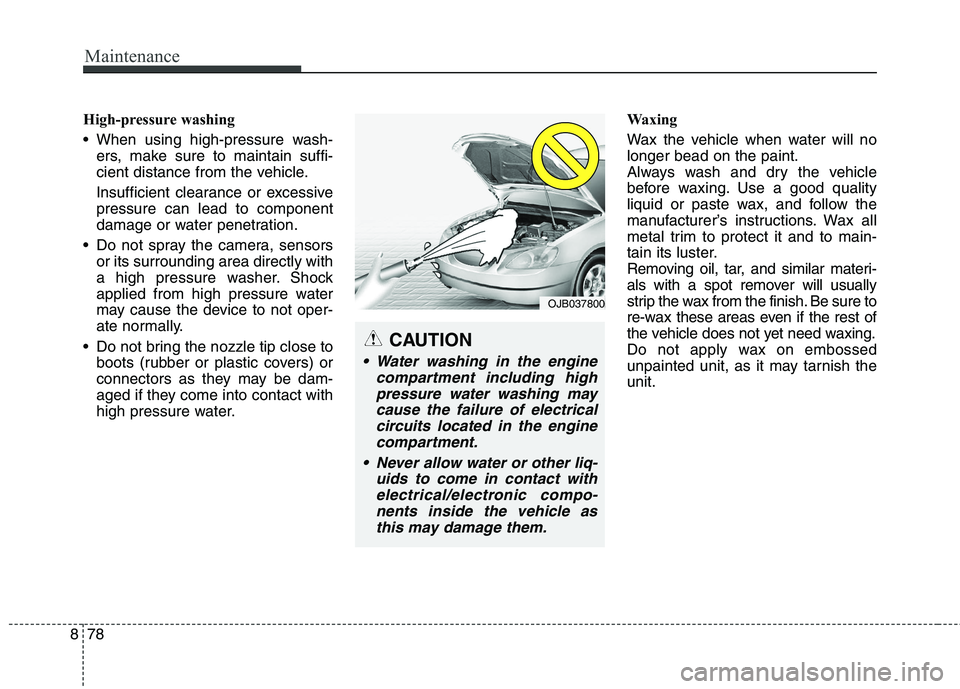
High-pressure washing
When using high-pressure wash-
ers, make sure to maintain suffi-
cient distance from the vehicle.
Insufficient clearance or excessive pressure can lead to component
damage or water penetration.
Do not spray the camera, sensors or its surrounding area directly with
a high pressure washer. Shock
applied from high pressure water
may cause the device to not oper-
ate normally.
Do not bring the nozzle tip close to boots (rubber or plastic covers) or
connectors as they may be dam-
aged if they come into contact with
high pressure water. Waxing
Wax the vehicle when water will no longer bead on the paint.
Always wash and dry the vehicle
before waxing. Use a good quality
liquid or paste wax, and follow the
manufacturer’s instructions. Wax all
metal trim to protect it and to main-
tain its luster.
Removing oil, tar, and similar materi-
als with a spot remover will usually
strip the wax from the finish. Be sure to
re-wax these areas even if the rest of
the vehicle does not yet need waxing.
Do not apply wax on embossed
unpainted unit, as it may tarnish theunit.
CAUTION
Water washing in the engine
compartment including highpressure water washing maycause the failure of electricalcircuits located in the engine compartment.
Never allow water or other liq- uids to come in contact withelectrical/electronic compo-nents inside the vehicle as this may damage them.
OJB037800
Page 530 of 548
Specifications & Consumer information
6
9
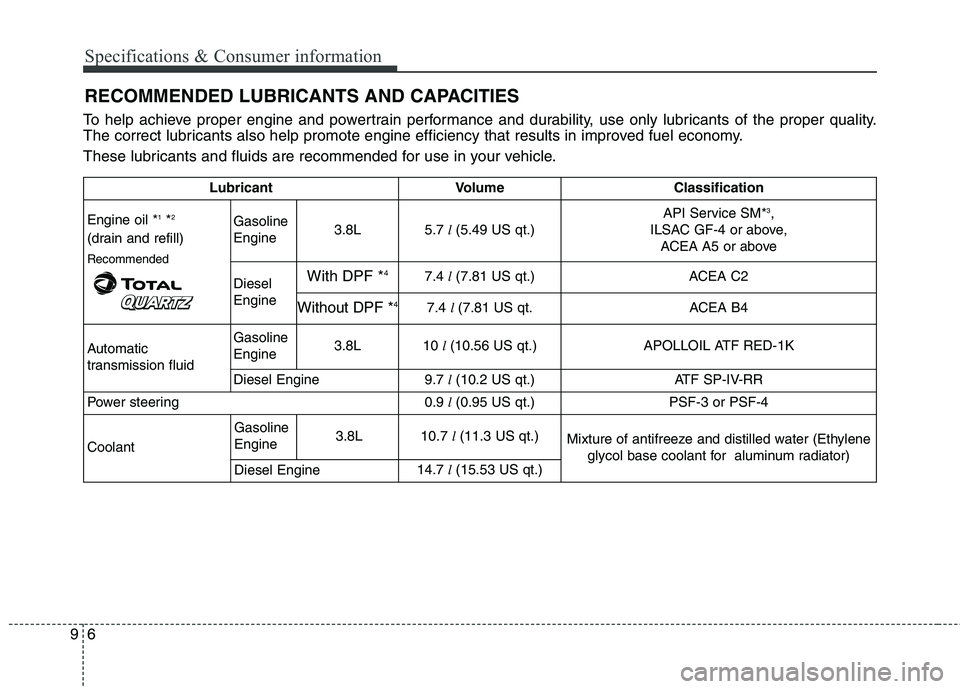
RECOMMENDED LUBRICANTS AND CAPACITIES
To help achieve proper engine and powertrain performance and durability, use only lubricants of the proper quality.
The correct lubricants also help promote engine efficiency that results in improved fuel economy.
These lubricants and fluids are recommended for use in your vehicle.
Lubricant Volume Classification
Engine oil * 1
*2
(drain and refill) Recommended Gasoline Engine
3.8L
5.7
l (5.49 US qt.) API Service SM*
3
,
ILSAC GF-4 or above, ACEA A5 or above
Diesel EngineWith DPF * 47.4
l (7.81 US qt.)ACEA C2
Without DPF * 47.4
l (7.81 US qt.ACEA B4
Automatic
transmission fluid GasolineEngine
3.8L
10
l (10.56 US qt.)
APOLLOIL ATF RED-1K
Diesel Engine 9.7
l (10.2 US qt.)
ATF SP-IV-RR
Power steering 0.9
l (0.95 US qt.)
PSF-3 or PSF-4
Coolant Gasoline Engine
3.8L
10.7
l (11.3 US qt.)
Mixture of antifreeze and distilled water (Ethylene
glycol base coolant for aluminum radiator)
Diesel Engine 14.7
l (15.53 US qt.)