check engine KIA BORREGO 2017 Workshop Manual
[x] Cancel search | Manufacturer: KIA, Model Year: 2017, Model line: BORREGO, Model: KIA BORREGO 2017Pages: 548, PDF Size: 36.78 MB
Page 448 of 548
Maintenance
12
8
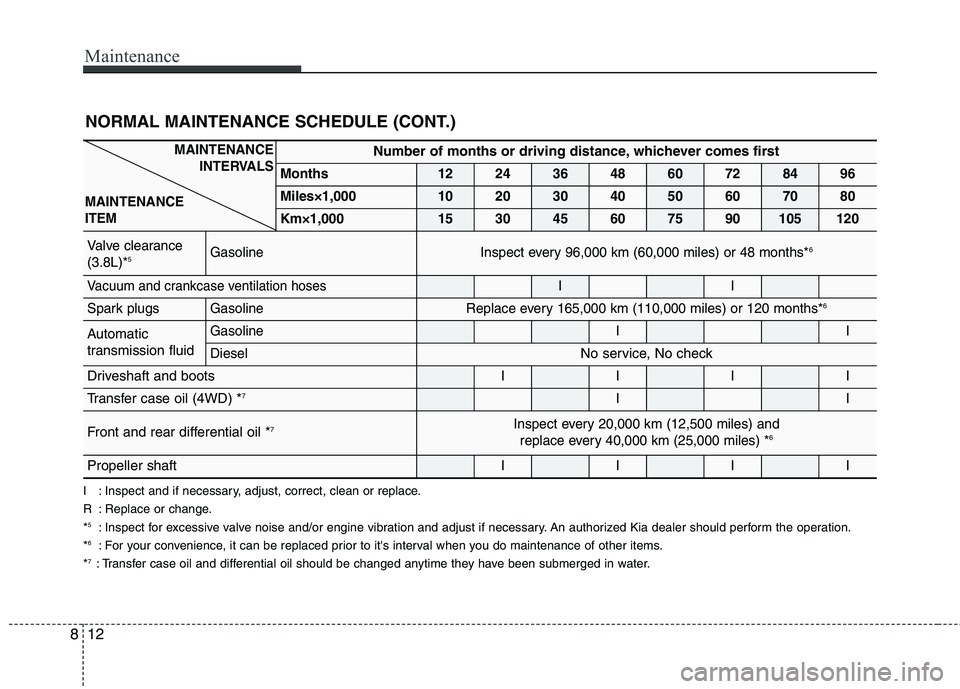
NORMAL MAINTENANCE SCHEDULE (CONT.)
I : Inspect and if necessary, adjust, correct, clean or replace.
R : Replace or change.* 5
: Inspect for excessive valve noise and/or engine vibration and adjust if necessary. An authorized Kia dealer should perform the operation.
* 6
: For your convenience, it can be replaced prior to it's interval when you do maintenance of other items.
* 7
: Transfer case oil and differential oil should be changed anytime they have been submerged in water.
Number of months or driving distance, whichever comes first
Months1224364860728496
Miles×1,0001020304050607080
Km×1,000153045607590105120
Valve clearance (3.8L)* 5GasolineInspect every 96,000 km (60,000 miles) or 48 months* 6
Vacuum and crankcase ventilation hosesII
Spark plugsGasolineReplace every 165,000 km (110,000 miles) or 120 months* 6
Automatic
transmission fluidGasolineII
DieselNo service, No check
Driveshaft and bootsIIII
Transfer case oil (4WD) *7II
Front and rear differential oil * 7Inspect every 20,000 km (12,500 miles) and
replace every 40,000 km (25,000 miles) * 6
Propeller shaftIIII
MAINTENANCE
INTERVALS
MAINTENANCE ITEM
Page 454 of 548
Maintenance
18
8
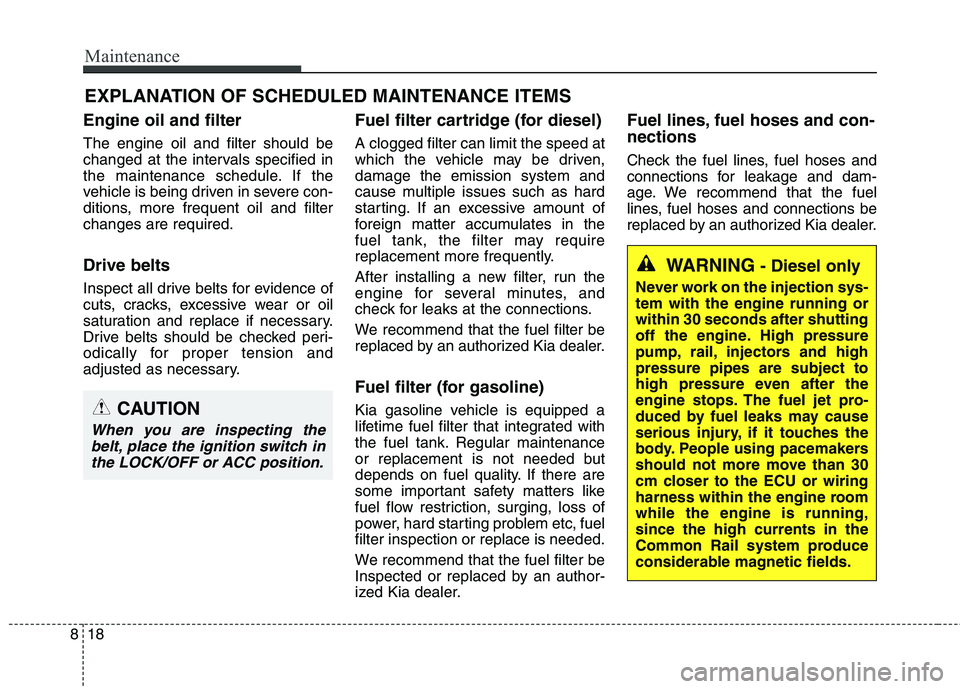
EXPLANATION OF SCHEDULED MAINTENANCE ITEMS
Engine oil and filter The engine oil and filter should be
changed at the intervals specified in
the maintenance schedule. If the
vehicle is being driven in severe con-
ditions, more frequent oil and filterchanges are required. Drive belts
Inspect all drive belts for evidence of
cuts, cracks, excessive wear or oil
saturation and replace if necessary.
Drive belts should be checked peri-
odically for proper tension and
adjusted as necessary. Fuel filter cartridge (for diesel) A clogged filter can limit the speed at
which the vehicle may be driven,damage the emission system and
cause multiple issues such as hard
starting. If an excessive amount of
foreign matter accumulates in the
fuel tank, the filter may require
replacement more frequently.
After installing a new filter, run the
engine for several minutes, and
check for leaks at the connections.
We recommend that the fuel filter be
replaced by an authorized Kia dealer.
Fuel filter (for gasoline)
Kia gasoline vehicle is equipped a
lifetime fuel filter that integrated with
the fuel tank. Regular maintenance
or replacement is not needed but
depends on fuel quality. If there are
some important safety matters like
fuel flow restriction, surging, loss of
power, hard starting problem etc, fuelfilter inspection or replace is needed.
We recommend that the fuel filter be
Inspected or replaced by an author-
ized Kia dealer.Fuel lines, fuel hoses and con- nections
Check the fuel lines, fuel hoses and
connections for leakage and dam-
age. We recommend that the fuel
lines, fuel hoses and connections be
replaced by an authorized Kia dealer.
WARNING
- Diesel only
Never work on the injection sys- tem with the engine running orwithin 30 seconds after shutting
off the engine. High pressure
pump, rail, injectors and highpressure pipes are subject to
high pressure even after the
engine stops. The fuel jet pro-
duced by fuel leaks may cause
serious injury, if it touches the
body. People using pacemakers
should not more move than 30
cm closer to the ECU or wiring
harness within the engine roomwhile the engine is running,since the high currents in the
Common Rail system produce
considerable magnetic fields.
CAUTION
When you are inspecting the belt, place the ignition switch inthe LOCK/OFF or ACC position.
Page 456 of 548
Maintenance
20
8
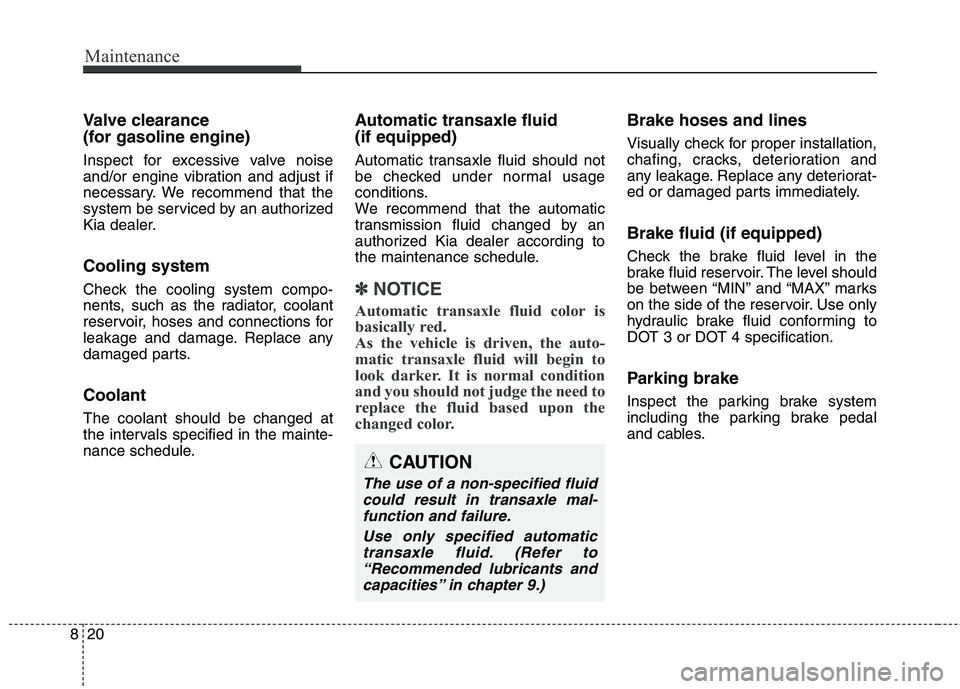
Valve clearance
(for gasoline engine)
Inspect for excessive valve noise
and/or engine vibration and adjust if
necessary. We recommend that the
system be serviced by an authorized
Kia dealer. Cooling system
Check the cooling system compo-
nents, such as the radiator, coolant
reservoir, hoses and connections for
leakage and damage. Replace any
damaged parts. Coolant The coolant should be changed at
the intervals specified in the mainte-
nance schedule. Automatic transaxle fluid (if equipped)
Automatic transaxle fluid should not
be checked under normal usage
conditions.
We recommend that the automatic
transmission fluid changed by an
authorized Kia dealer according to
the maintenance schedule.
✽✽
NOTICE
Automatic transaxle fluid color is
basically red.
As the vehicle is driven, the auto-
matic transaxle fluid will begin to
look darker. It is normal condition
and you should not judge the need to
replace the fluid based upon the
changed color.
Brake hoses and lines
Visually check for proper installation,
chafing, cracks, deterioration and
any leakage. Replace any deteriorat-
ed or damaged parts immediately. Brake fluid (if equipped)
Check the brake fluid level in the
brake fluid reservoir. The level should
be between “MIN” and “MAX” marks
on the side of the reservoir. Use only
hydraulic brake fluid conforming to
DOT 3 or DOT 4 specification.
Parking brake
Inspect the parking brake system
including the parking brake pedal
and cables.
CAUTION
The use of a non-specified fluid could result in transaxle mal-function and failure.
Use only specified automatictransaxle fluid. (Refer to “Recommended lubricants andcapacities” in chapter 9.)
Page 457 of 548
821
Maintenance
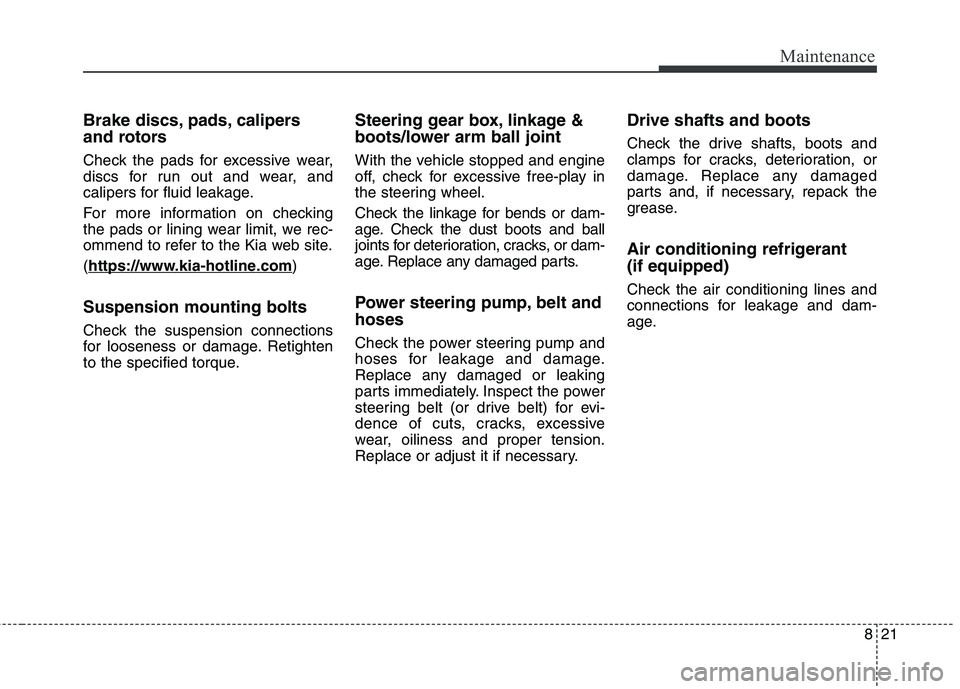
Brake discs, pads, calipers
and rotors
Check the pads for excessive wear,
discs for run out and wear, and
calipers for fluid leakage.
For more information on checking
the pads or lining wear limit, we rec-
ommend to refer to the Kia web site. (https://www
.kia-hotline.com)
Suspension mounting bolts
Check the suspension connections
for looseness or damage. Retighten
to the specified torque. Steering gear box, linkage &
boots/lower arm ball joint
With the vehicle stopped and engine
off, check for excessive free-play in
the steering wheel.
Check the linkage for bends or dam-
age. Check the dust boots and ball
joints for deterioration, cracks, or dam-
age. Replace any damaged parts.
Power steering pump, belt and hoses
Check the power steering pump and
hoses for leakage and damage.
Replace any damaged or leaking
parts immediately. Inspect the power
steering belt (or drive belt) for evi-
dence of cuts, cracks, excessive
wear, oiliness and proper tension.
Replace or adjust it if necessary.Drive shafts and boots
Check the drive shafts, boots and
clamps for cracks, deterioration, or
damage. Replace any damaged
parts and, if necessary, repack the
grease.
Air conditioning refrigerant (if equipped)
Check the air conditioning lines and
connections for leakage and dam-
age.
Page 458 of 548
Maintenance
22
8
ENGINE OIL
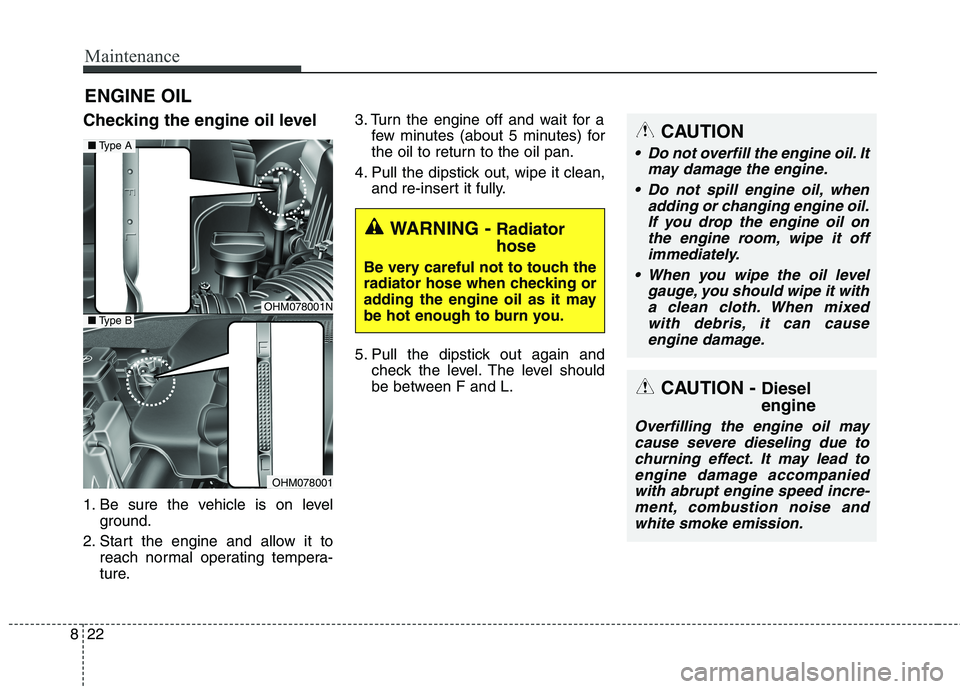
Checking the engine oil level
1. Be sure the vehicle is on level ground.
2. Start the engine and allow it to reach normal operating tempera-
ture. 3. Turn the engine off and wait for a
few minutes (about 5 minutes) for
the oil to return to the oil pan.
4. Pull the dipstick out, wipe it clean, and re-insert it fully.
5. Pull the dipstick out again and check the level. The level should
be between F and L.
WARNING - Radiator hose
Be very careful not to touch the
radiator hose when checking or
adding the engine oil as it may
be hot enough to burn you.
CAUTION
Do not overfill the engine oil. It may damage the engine.
Do not spill engine oil, when adding or changing engine oil.If you drop the engine oil onthe engine room, wipe it offimmediately.
When you wipe the oil level gauge, you should wipe it witha clean cloth. When mixedwith debris, it can causeengine damage.
CAUTION - Diesel engine
Overfilling the engine oil may
cause severe dieseling due tochurning effect. It may lead to engine damage accompaniedwith abrupt engine speed incre-ment, combustion noise andwhite smoke emission.
OHM078001N
OHM078001
■ Type A
■Type B
Page 460 of 548
Maintenance
24
8
ENGINE COOLANT
The high-pressure cooling system
has a reservoir filled with year round
antifreeze coolant. The reservoir is
filled at the factory.
Check the antifreeze protection and
coolant level at least once a year, atthe beginning of the winter season,
and before traveling to a colder cli-
mate. Checking the coolant level
WARNING
Removing radiator cap
Never attempt to remove the radiator cap while the engine
is operating or hot. Doing somight lead to cooling system
and engine damage. Also, hotcoolant or steam could cause
serious personal injury.
Turn the engine off and wait until it cools down. Use
extreme care when removing
the radiator cap. Wrap a thick
towel around it, and turn it
counterclockwise slowly to
the first stop. Step back while
the pressure is released fromthe cooling system.
(Continued)
(Continued)When you are sure all the pressure has been released,
press down on the cap, using
a thick towel, and continue
turning counterclockwise to
remove it.
Even if the engine is not oper- ating, do not remove the radi-ator cap or the drain plugwhile the engine and radiator
are hot. Hot coolant and
steam may still blow out
under pressure, causing seri-
ous injury.
CAUTION
When the engine overheats
from low engine coolant, sud-denly adding engine coolantmay cause cracks in theengine. To prevent damage, add engine coolant slowly insmall quantities.
Do not drive with no engine coolant. It may cause waterpump failure and engine seizure, etc.
Page 461 of 548
825
Maintenance
Check the condition and connections of all cooling system hoses and
heater hoses. Replace any swollen
or deteriorated hoses.
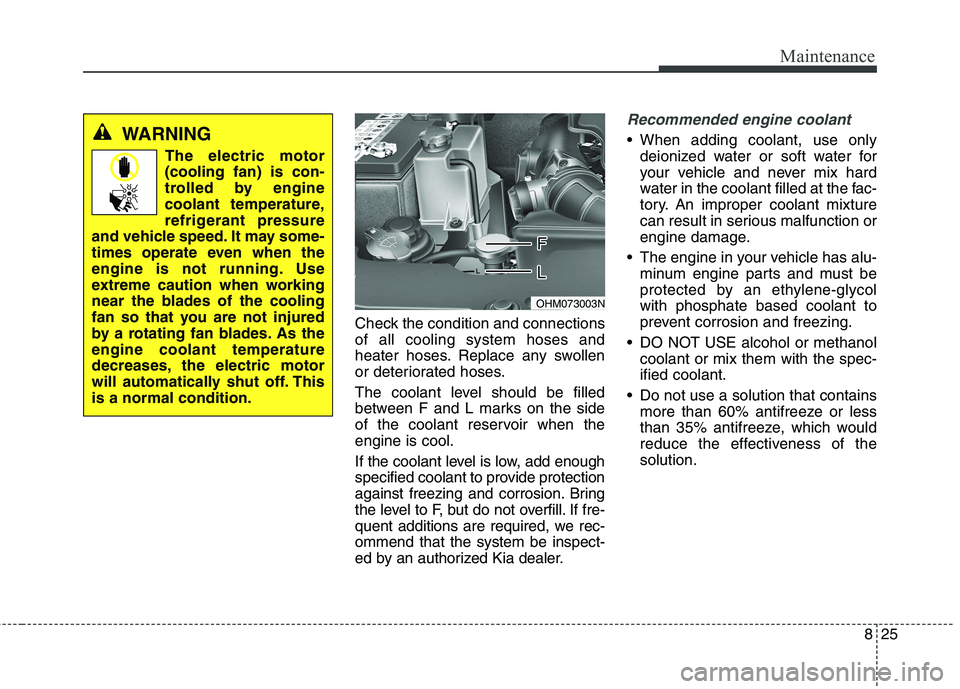
The coolant level should be filled
between F and L marks on the side
of the coolant reservoir when theengine is cool.
If the coolant level is low, add enough
specified coolant to provide protection
against freezing and corrosion. Bring
the level to F, but do not overfill. If fre-
quent additions are required, we rec-ommend that the system be inspect-
ed by an authorized Kia dealer.
Recommended engine coolant
When adding coolant, use onlydeionized water or soft water for
your vehicle and never mix hard
water in the coolant filled at the fac-
tory. An improper coolant mixture
can result in serious malfunction or
engine damage.
The engine in your vehicle has alu- minum engine parts and must be
protected by an ethylene-glycolwith phosphate based coolant to
prevent corrosion and freezing.
DO NOT USE alcohol or methanol coolant or mix them with the spec-ified coolant.
Do not use a solution that contains more than 60% antifreeze or less
than 35% antifreeze, which would
reduce the effectiveness of thesolution.WARNING
The electric motor
(cooling fan) is con-
trolled by engine
coolant temperature,
refrigerant pressure
and vehicle speed. It may some-
times operate even when the
engine is not running. Use
extreme caution when working
near the blades of the cooling
fan so that you are not injured
by a rotating fan blades. As theengine coolant temperature
decreases, the electric motor
will automatically shut off. Thisis a normal condition.
OHM073003N
Page 463 of 548
827
Maintenance
BRAKE FLUID
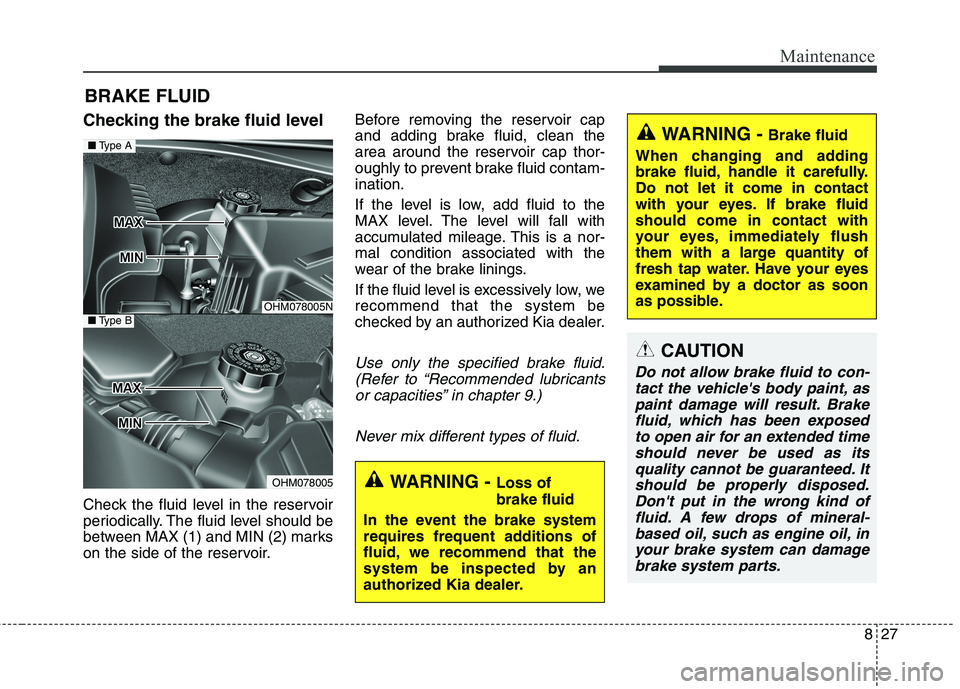
Checking the brake fluid level
Check the fluid level in the reservoir
periodically. The fluid level should be
between MAX (1) and MIN (2) marks
on the side of the reservoir. Before removing the reservoir cap
and adding brake fluid, clean the
area around the reservoir cap thor-
oughly to prevent brake fluid contam-ination.
If the level is low, add fluid to the
MAX level. The level will fall with
accumulated mileage. This is a nor-mal condition associated with the
wear of the brake linings.
If the fluid level is excessively low, we recommend that the system be
checked by an authorized Kia dealer.
Use only the specified brake fluid.
(Refer to “Recommended lubricantsor capacities” in chapter 9.)
Never mix different types of fluid.
WARNING - Brake fluid
When changing and adding
brake fluid, handle it carefully.Do not let it come in contact
with your eyes. If brake fluidshould come in contact with
your eyes, immediately flush
them with a large quantity of
fresh tap water. Have your eyes
examined by a doctor as soon
as possible.
WARNING - Loss of brake fluid
In the event the brake system
requires frequent additions of
fluid, we recommend that the
system be inspected by an
authorized Kia dealer.
CAUTION
Do not allow brake fluid to con- tact the vehicle's body paint, aspaint damage will result. Brakefluid, which has been exposed to open air for an extended timeshould never be used as itsquality cannot be guaranteed. It should be properly disposed.Don't put in the wrong kind offluid. A few drops of mineral- based oil, such as engine oil, inyour brake system can damagebrake system parts.
OHM078005N
OHM078005
■ Type A
■Type B
Page 464 of 548
Maintenance
28
8
POWER STEERING FLUID
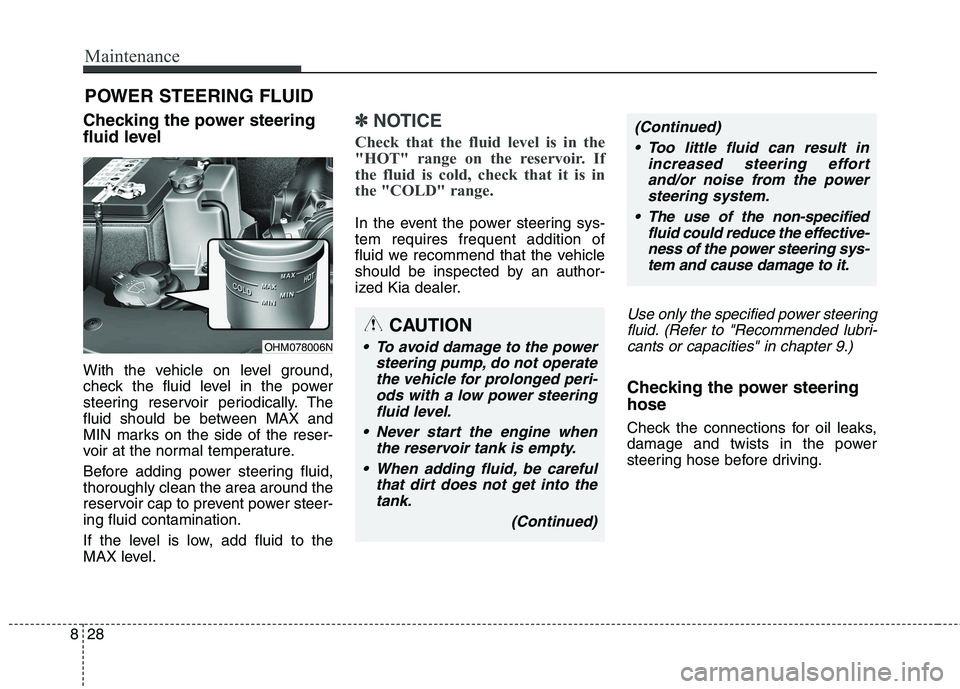
Checking the power steering
fluid level
With the vehicle on level ground,
check the fluid level in the power
steering reservoir periodically. The
fluid should be between MAX and
MIN marks on the side of the reser-
voir at the normal temperature.
Before adding power steering fluid, thoroughly clean the area around the
reservoir cap to prevent power steer-ing fluid contamination.
If the level is low, add fluid to the
MAX level.
✽✽ NOTICE
Check that the fluid level is in the
"HOT" range on the reservoir. If
the fluid is cold, check that it is in
the "COLD" range.
In the event the power steering sys- tem requires frequent addition of
fluid we recommend that the vehicle
should be inspected by an author-
ized Kia dealer.
Use only the specified power steering fluid. (Refer to "Recommended lubri-cants or capacities" in chapter 9.)
Checking the power steering hose
Check the connections for oil leaks,
damage and twists in the power
steering hose before driving.
CAUTION
To avoid damage to the power steering pump, do not operatethe vehicle for prolonged peri-ods with a low power steeringfluid level.
Never start the engine when the reservoir tank is empty.
When adding fluid, be careful that dirt does not get into thetank.
(Continued)
(Continued) Too little fluid can result in increased steering effortand/or noise from the power steering system.
The use of the non-specified fluid could reduce the effective-ness of the power steering sys-tem and cause damage to it.
OHM078006N
Page 466 of 548

Maintenance
30
8
FUEL FILTER (FOR DIESEL)
Draining water from the fuel filter
The fuel filter for diesel engine plays
an important role of separating water
from fuel and accumulating the waterin its bottom.
If water accumulates in the fuel filter,
the warning light comes on when the
ignition switch is in the ON position. Place a water trap under the fuel
filter.
Loosen the drain plug and drain water.
After water is drained, securely tighten the drain plug.
After starting the engine, check to make certain the fuel filter warning
light is off. Fuel filter cartridge replacement
✽✽
NOTICE
When replacing the fuel filter car-
tridge, we recommend that you use
parts for replacement from an
authorized Kia dealer.
CAUTION
If the water accumulated in the fuel filter is not drained at prop-er times, damages to the major parts such as the fuel systemcan be caused by water perme-ation in the fuel filter.OHM078008