child lock KIA BORREGO 2017 Owners Manual
[x] Cancel search | Manufacturer: KIA, Model Year: 2017, Model line: BORREGO, Model: KIA BORREGO 2017Pages: 548, PDF Size: 36.78 MB
Page 57 of 548
Safety features of your vehicle
40
3
WARNING
To reduce the chance of serious or fatal injuries:
Children of all ages are safer when restrained in the rear
seat. A child riding in the front
passenger seat can be force-
fully struck by an inflating air
bag resulting in serious orfatal injuries.
Always follow the child restraint system manufactur-
er’s instructions for installa-
tion and use of the childrestraint.
Always make sure the child seat is secured properly in the
vehicle and your child is
securely restrained in the
child seat.
Never hold a child in your arms or lap when riding in a
vehicle. The violent forces cre-ated during a crash will tear
the child from your arms and
throw the child against the
vehicle’s interior.
(Continued)(Continued)
Never put a seat belt overyourself and a child. During a
crash, the belt could press
deep into the child causingserious internal injuries.
Never leave children unattend- ed in a vehicle – not even for a
short time. The vehicle can
heat up very quickly, resulting
in serious injuries to children
inside. Even very young chil-
dren may inadvertently cause
the vehicle to move, entangle
themselves in the windows, or
lock themselves or others
inside the vehicle.
Never allow two children, or any two persons, to use thesame seat belt.
Children often squirm and reposition themselves improp-
erly. Never let a child ride withthe shoulder belt under their
arm or behind their back.
Always properly position and
secure children in the rear seat.
(Continued)(Continued)
Never allow a child to stand-up or kneel on the seat or floor
of a moving vehicle. During a
collision or sudden stop, the
child can be violently thrown
against the vehicle’s interior,
resulting in serious injury.
Never use an infant carrier or a child safety seat that
"hooks" over a seatback, it
may not provide adequatesecurity in an accident.
Seat belts can become very hot, especially when the vehi-
cle is parked in direct sun-
light. Always check the seat
belt buckles before fastening
them over a child.
After an accident, we recom- mend the system to be
checked by an authorized Kia
dealer.
If there is not enough space to place the child restraint sys- tem because of the driver's
seat, install the child restraintsystem in the rear right seat.
Page 60 of 548
343
Safety features of your vehicle
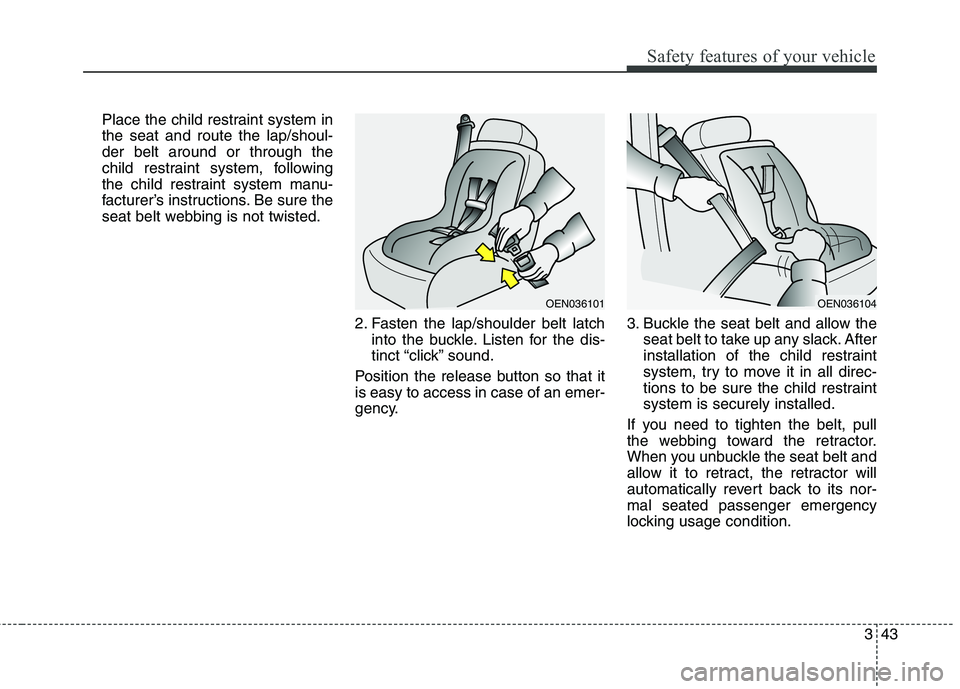
Place the child restraint system in the seat and route the lap/shoul-der belt around or through the
child restraint system, following
the child restraint system manu-
facturer’s instructions. Be sure the
seat belt webbing is not twisted.2. Fasten the lap/shoulder belt latchinto the buckle. Listen for the dis-
tinct “click” sound.
Position the release button so that itis easy to access in case of an emer-
gency. 3. Buckle the seat belt and allow the
seat belt to take up any slack. After
installation of the child restraint
system, try to move it in all direc-
tions to be sure the child restraintsystem is securely installed.
If you need to tighten the belt, pull
the webbing toward the retractor.
When you unbuckle the seat belt and
allow it to retract, the retractor will
automatically revert back to its nor-mal seated passenger emergency
locking usage condition.
OEN036101OEN036104
Page 72 of 548
355
Safety features of your vehicle
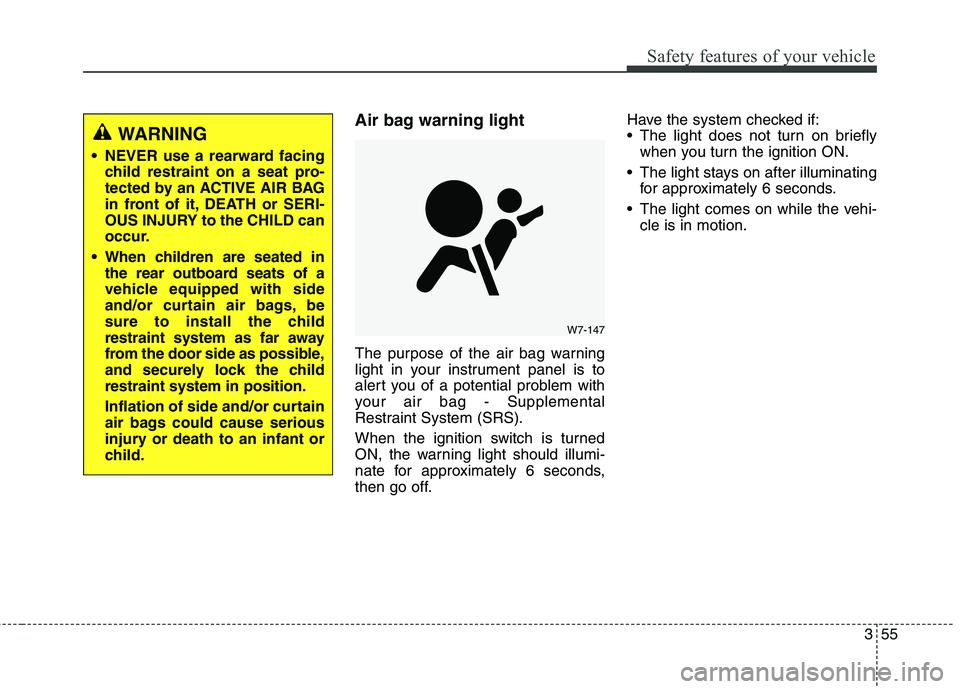
Air bag warning light
The purpose of the air bag warning
light in your instrument panel is to
alert you of a potential problem with
your air bag - Supplemental
Restraint System (SRS).
When the ignition switch is turned
ON, the warning light should illumi-
nate for approximately 6 seconds,
then go off.Have the system checked if:
The light does not turn on briefly
when you turn the ignition ON.
The light stays on after illuminating for approximately 6 seconds.
The light comes on while the vehi- cle is in motion.WARNING
NEVER use a rearward facing child restraint on a seat pro-
tected by an ACTIVE AIR BAG
in front of it, DEATH or SERI-
OUS INJURY to the CHILD can
occur.
When children are seated in the rear outboard seats of a
vehicle equipped with side
and/or curtain air bags, be
sure to install the child
restraint system as far away
from the door side as possible,
and securely lock the childrestraint system in position.
Inflation of side and/or curtain
air bags could cause serious
injury or death to an infant or
child.
W7-147
Page 81 of 548
Safety features of your vehicle
64
3
WARNING
In order for side and curtain air bags to provide the best
protection, front seat occu-
pants and outboard rearoccupants should sit in anupright position with the seat
belts properly fastened.
Importantly, children should
sit in a proper child restraintsystem in the rear seat.
When children are seated in the rear outboard seats, they
must be seated in the proper
child restraint system. Make
sure to position the child
restraint system as far away
from the door side as possible,
and secure the child restraint
system in a locked position.
(Continued)(Continued)
Do not allow the passengers tolean their heads or bodies
against doors, put their arms
on the doors, stretch their
arms out of the window orplace objects between the
doors and passengers when
they are seated on seats
equipped with side and curtain
air bags.
Never try to open or repair any components of the side curtain
air bag system. We recommend
that the system be serviced by
an authorized Kia dealer.
Failure to follow the above
instructions can result in injury
or death to the vehicle occu-pants in an accident.WARNING - No attaching objects
Do not place any objects over the air bag. Also, do not attach
any objects around the area
the air bag inflates such as the
door, side door glass, front
and rear pillar, roof side rail.
Do not hang hard or breakable objects on the coat hook.
Do not hang heavy items on the coat hooks for safely rea-sons.
Page 93 of 548
Features of your vehicle
4
4
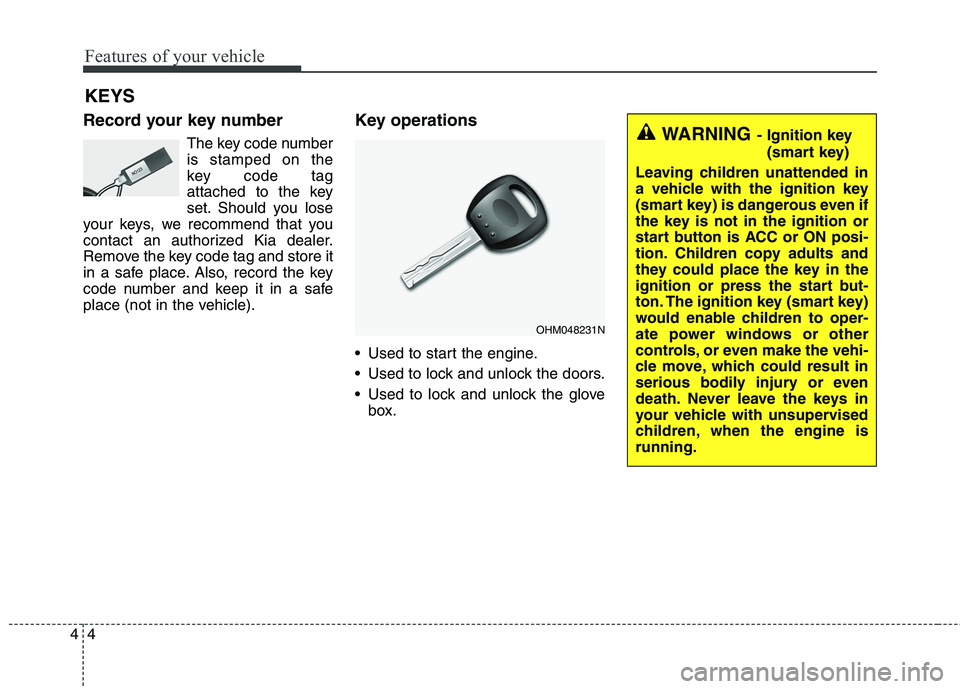
Record your key number
The key code number is stamped on the
key code tag
attached to the key
set. Should you lose
your keys, we recommend that you
contact an authorized Kia dealer.
Remove the key code tag and store it
in a safe place. Also, record the key
code number and keep it in a safe
place (not in the vehicle). Key operations
• Used to start the engine.
Used to lock and unlock the doors.
Used to lock and unlock the glove
box.
KEYS
OHM048231N
WARNING
- Ignition key
(smart key)
Leaving children unattended in
a vehicle with the ignition key
(smart key) is dangerous even if
the key is not in the ignition or
start button is ACC or ON posi-
tion. Children copy adults and
they could place the key in the
ignition or press the start but-
ton. The ignition key (smart key)
would enable children to oper-
ate power windows or other
controls, or even make the vehi-
cle move, which could result in
serious bodily injury or even
death. Never leave the keys in
your vehicle with unsupervised
children, when the engine isrunning.
Page 108 of 548
419
Features of your vehicle
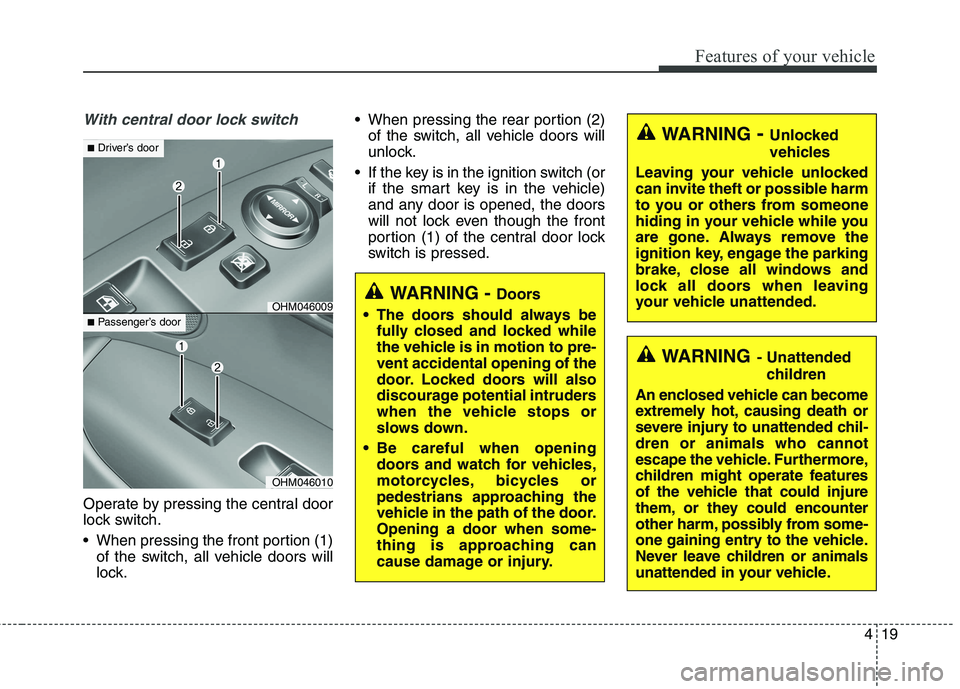
With central door lock switch
Operate by pressing the central door
lock switch.
When pressing the front portion (1)of the switch, all vehicle doors will
lock. When pressing the rear portion (2)
of the switch, all vehicle doors will
unlock.
If the key is in the ignition switch (or if the smart key is in the vehicle)
and any door is opened, the doors
will not lock even though the front
portion (1) of the central door lock
switch is pressed.
WARNING - Unlocked
vehicles
Leaving your vehicle unlocked
can invite theft or possible harm
to you or others from someone
hiding in your vehicle while you
are gone. Always remove the
ignition key, engage the parking
brake, close all windows and
lock all doors when leaving
your vehicle unattended.
WARNING - Unattended
children
An enclosed vehicle can become
extremely hot, causing death or
severe injury to unattended chil-dren or animals who cannot
escape the vehicle. Furthermore,
children might operate features
of the vehicle that could injure
them, or they could encounter
other harm, possibly from some-
one gaining entry to the vehicle.
Never leave children or animals
unattended in your vehicle.
WARNING - Doors
The doors should always be fully closed and locked while
the vehicle is in motion to pre-vent accidental opening of the
door. Locked doors will also
discourage potential intruders
when the vehicle stops or
slows down.
Be careful when opening doors and watch for vehicles,
motorcycles, bicycles or
pedestrians approaching the
vehicle in the path of the door.Opening a door when some-
thing is approaching can
cause damage or injury.OHM046009
■Driver’s door
OHM046010
■Passenger’s door
Page 109 of 548
Features of your vehicle
20
4
Door lock/unlock features
Impact sensing door unlock system
All doors will automatically unlock when an impact causes the air bags
to deploy.
However, automatic door unlock will
not operate if the side airbag is notequipped.
✽✽
NOTICE
An authorized Kia dealer can acti-
vate or deactivate some auto door
lock/unlock features as follows;
Auto door unlock by using the dri- ver's door lock button
Speed sensing auto door lock
Auto door lock/unlock by shifting the transmission shift lever out of
P (Park) or into P (Park
Auto door unlock when the igni- tion key is removed from the igni-
tion switch (for smart key, when
the ENGINE START/STOP button
is changed to the OFF position)
If you want to activate or deactivate
some door lock/unlock feature, we
recommend that you consult an
authorized Kia dealer.
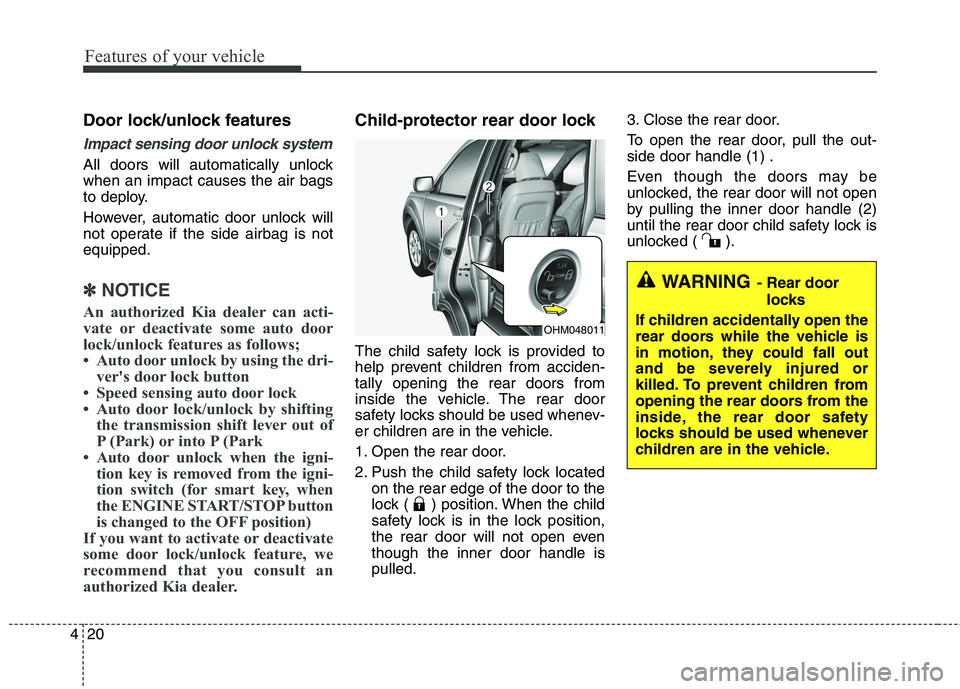
Child-protector rear door lock
The child safety lock is provided to
help prevent children from acciden-tally opening the rear doors from
inside the vehicle. The rear door
safety locks should be used whenev-
er children are in the vehicle.
1. Open the rear door.
2. Push the child safety lock located on the rear edge of the door to the
lock ( ) position. When the child
safety lock is in the lock position,
the rear door will not open eventhough the inner door handle ispulled. 3. Close the rear door.
To open the rear door, pull the out- side door handle (1) .
Even though the doors may be
unlocked, the rear door will not open
by pulling the inner door handle (2)
until the rear door child safety lock is
unlocked ( ).
OHM048011
WARNING
- Rear door
locks
If children accidentally open the
rear doors while the vehicle is
in motion, they could fall out
and be severely injured or
killed. To prevent children from
opening the rear doors from the
inside, the rear door safety
locks should be used whenever
children are in the vehicle.
Page 117 of 548
Features of your vehicle
28
4
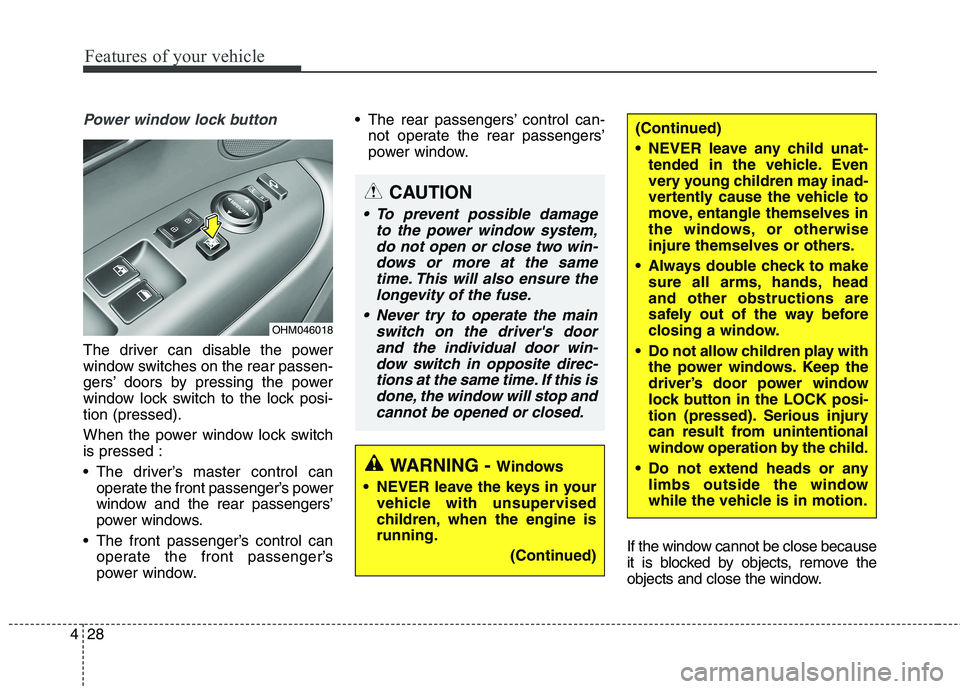
Power window lock button
The driver can disable the power
window switches on the rear passen-
gers’ doors by pressing the power
window lock switch to the lock posi-tion (pressed).
When the power window lock switch is pressed :
The driver’s master control can
operate the front passenger’s power
window and the rear passengers’
power windows.
The front passenger’s control can operate the front passenger’s
power window. The rear passengers’ control can-
not operate the rear passengers’
power window.
If the window cannot be close because
it is blocked by objects, remove the
objects and close the window.
CAUTION
To prevent possible damageto the power window system,do not open or close two win- dows or more at the sametime. This will also ensure thelongevity of the fuse.
Never try to operate the main switch on the driver's doorand the individual door win-dow switch in opposite direc-tions at the same time. If this is done, the window will stop andcannot be opened or closed.
(Continued)
NEVER leave any child unat- tended in the vehicle. Even
very young children may inad-
vertently cause the vehicle to
move, entangle themselves in
the windows, or otherwise
injure themselves or others.
Always double check to make sure all arms, hands, headand other obstructions are
safely out of the way before
closing a window.
Do not allow children play with the power windows. Keep the
driver’s door power window
lock button in the LOCK posi-
tion (pressed). Serious injury
can result from unintentional
window operation by the child.
Do not extend heads or any limbs outside the window
while the vehicle is in motion.
WARNING - Windows
NEVER leave the keys in your vehicle with unsupervised
children, when the engine isrunning.
(Continued)
OHM046018
Page 339 of 548
615
Driving your vehicle
✽✽
NOTICE
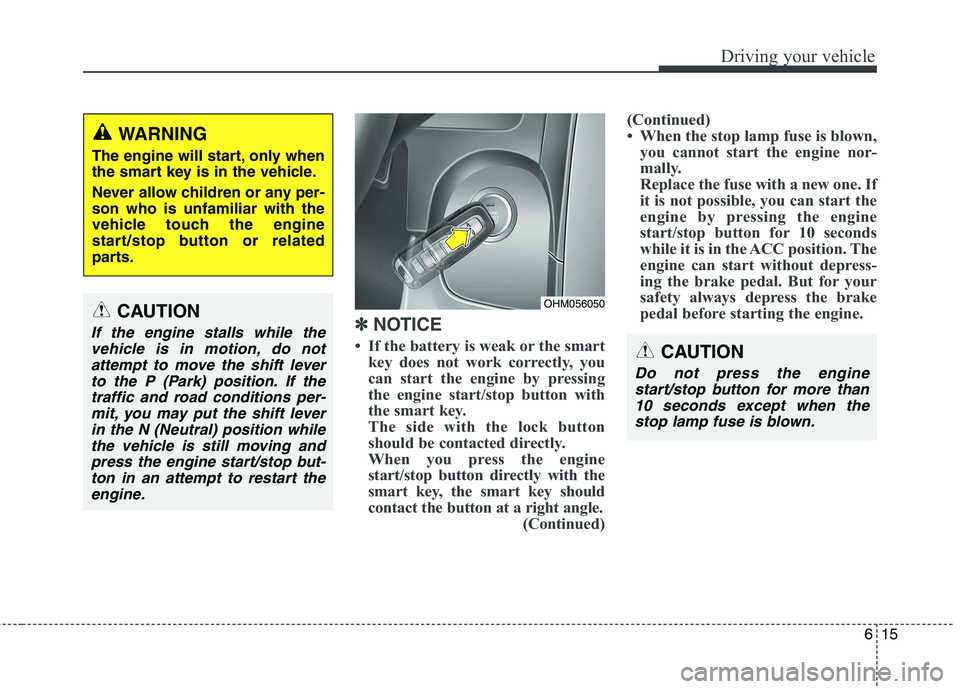
If the battery is weak or the smart key does not work correctly, you
can start the engine by pressing
the engine start/stop button with
the smart key.
The side with the lock button
should be contacted directly.
When you press the engine
start/stop button directly with the
smart key, the smart key should
contact the button at a right angle. (Continued) (Continued)
When the stop lamp fuse is blown,
you cannot start the engine nor-
mally.
Replace the fuse with a new one. If
it is not possible, you can start the
engine by pressing the engine
start/stop button for 10 seconds
while it is in the ACC position. The
engine can start without depress-
ing the brake pedal. But for your
safety always depress the brake
pedal before starting the engine.
WARNING
The engine will start, only when
the smart key is in the vehicle.
Never allow children or any per- son who is unfamiliar with the
vehicle touch the engine
start/stop button or related
parts.
CAUTION
If the engine stalls while the vehicle is in motion, do notattempt to move the shift lever
to the P (Park) position. If thetraffic and road conditions per-mit, you may put the shift lever in the N (Neutral) position whilethe vehicle is still moving andpress the engine start/stop but- ton in an attempt to restart theengine.
OHM056050
CAUTION
Do not press the engine start/stop button for more than10 seconds except when thestop lamp fuse is blown.
Page 341 of 548

617
Driving your vehicle
For smooth operation, depress thebrake pedal when shifting from N(Neutral) to a forward or reverse gear.
Transaxle ranges
The indicator lights in the instrument
cluster displays the shift lever posi-
tion when the ignition switch is in theON position.
P (Park)
Always come to a complete stop
before shifting into P (Park). This
position locks the transaxle and pre-
vents the front wheels from rotating. R (Reverse)
Use this position to drive the vehicle
backward.
WARNING
- Automatic
transaxle
Always check the surrounding areas near your vehicle for
people, especially children,
before shifting a vehicle into
D (Drive) or R (Reverse).
Before leaving the driver’s seat, always make sure the
shift lever is in the P (Park)
position; then set the parking
brake fully and shut the
engine off. Unexpected and
sudden vehicle movementcan occur if these precautions
are not followed in the orderidentified.
Do not use the engine brake (shifting from a high gear to
lower gear) rapidly on slip-
pery roads.
The vehicle may slip causing an accident.
CAUTION
To avoid damage to your
transaxle, do not acceleratethe engine in R (Reverse) orany forward gear position withthe brakes on.
When stopped on an upgrade, do not hold the vehicle sta-tionary with engine power.Use the service brake or theparking brake.
Do not shift from N (Neutral) or P (Park) into D (Drive), or R(Reverse) when the engine isabove idle speed.
WARNING
Shifting into P (Park) while the vehicle is in motion will cause
the drive wheels to lock which
will cause you to lose control
of the vehicle.
Do not use the P (Park) posi- tion in place of the parking
brake. Always make sure the
shift lever is latched in the P
(Park) position and set the
parking brake fully.
Never leave a child unattend- ed in a vehicle.
CAUTION
The transaxle may be damaged
if you shift into P (Park) whilethe vehicle is in motion.