ignition KIA BORREGO 2017 Owners Manual
[x] Cancel search | Manufacturer: KIA, Model Year: 2017, Model line: BORREGO, Model: KIA BORREGO 2017Pages: 548, PDF Size: 36.78 MB
Page 15 of 548
25
Your vehicle at a glance
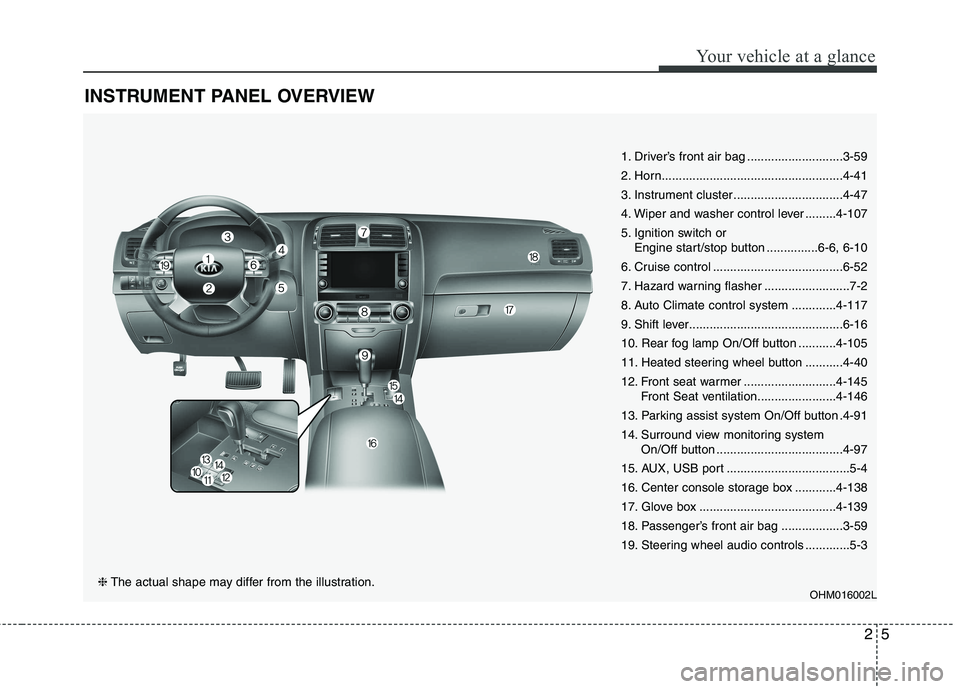
INSTRUMENT PANEL OVERVIEW
1. Driver’s front air bag ............................3-59
2. Horn.....................................................4-41
3. Instrument cluster ................................4-47
4. Wiper and washer control lever .........4-107
5. Ignition switch or Engine start/stop button ...............6-6, 6-10
6. Cruise control ......................................6-52
7. Hazard warning flasher .........................7-2
8. Auto Climate control system .............4-117
9. Shift lever.............................................6-16
10. Rear fog lamp On/Off button ...........4-105
11. Heated steering wheel button ...........4-40
12. Front seat warmer ...........................4-145 Front Seat ventilation.......................4-146
13. Parking assist system On/Off button .4-91
14. Surround view monitoring system On/Off button .....................................4-97
15. AUX, USB port ....................................5-4
16. Center console storage box ............4-138
17. Glove box ........................................4-139
18. Passenger’s front air bag ..................3-59
19. Steering wheel audio controls .............5-3
OHM016002L
❈The actual shape may differ from the illustration.
Page 24 of 548
37
Safety features of your vehicle
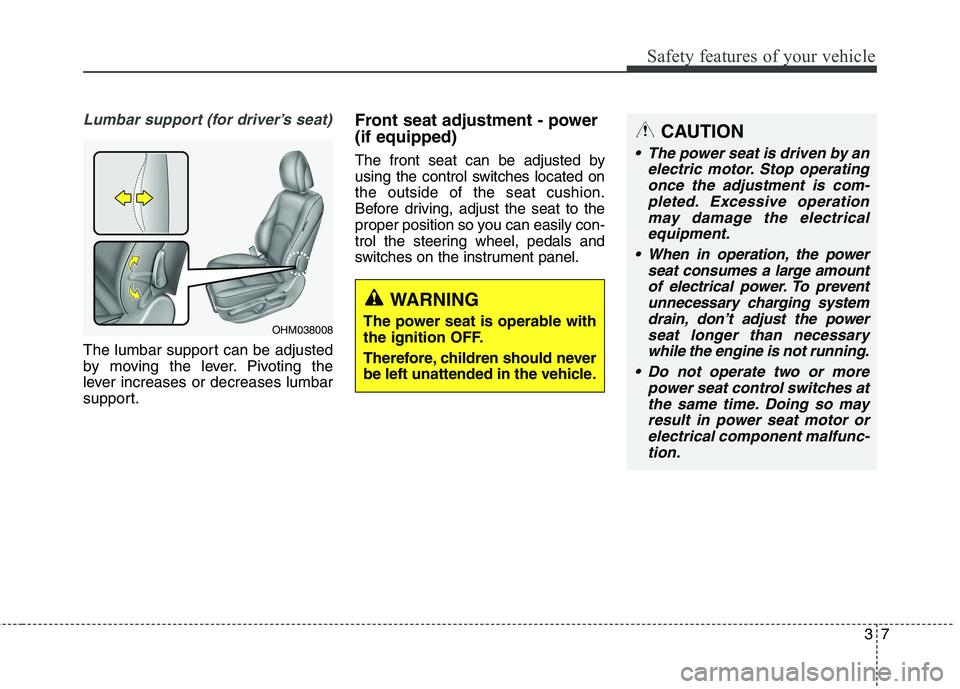
Lumbar support (for driver’s seat)
The lumbar support can be adjusted
by moving the lever. Pivoting the
lever increases or decreases lumbar
support.Front seat adjustment - power (if equipped)
The front seat can be adjusted by
using the control switches located onthe outside of the seat cushion.
Before driving, adjust the seat to the
proper position so you can easily con-
trol the steering wheel, pedals and
switches on the instrument panel.
OHM038008
WARNING
The power seat is operable with
the ignition OFF.
Therefore, children should never
be left unattended in the vehicle.
CAUTION
The power seat is driven by an electric motor. Stop operatingonce the adjustment is com- pleted. Excessive operationmay damage the electricalequipment.
When in operation, the power seat consumes a large amountof electrical power. To preventunnecessary charging systemdrain, don’t adjust the power seat longer than necessarywhile the engine is not running.
Do not operate two or more power seat control switches atthe same time. Doing so may result in power seat motor orelectrical component malfunc-tion.
Page 27 of 548
Safety features of your vehicle
10
3
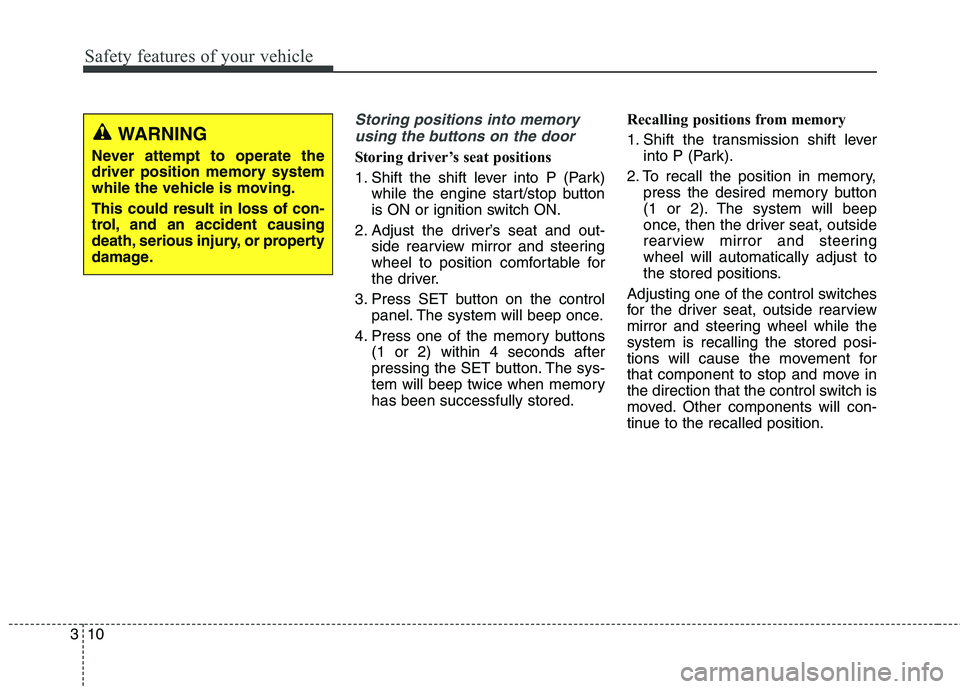
Storing positions into memory
using the buttons on the door
Storing driver’s seat positions
1. Shift the shift lever into P (Park) while the engine start/stop button
is ON or ignition switch ON.
2. Adjust the driver’s seat and out- side rearview mirror and steering
wheel to position comfortable for
the driver.
3. Press SET button on the control panel. The system will beep once.
4. Press one of the memory buttons (1 or 2) within 4 seconds after
pressing the SET button. The sys-
tem will beep twice when memoryhas been successfully stored. Recalling positions from memory
1. Shift the transmission shift lever
into P (Park).
2. To recall the position in memory, press the desired memory button
(1 or 2). The system will beep
once, then the driver seat, outside
rearview mirror and steeringwheel will automatically adjust to
the stored positions.
Adjusting one of the control switches
for the driver seat, outside rearview
mirror and steering wheel while thesystem is recalling the stored posi-
tions will cause the movement for
that component to stop and move in
the direction that the control switch is
moved. Other components will con-
tinue to the recalled position.
WARNING
Never attempt to operate the
driver position memory system
while the vehicle is moving. This could result in loss of con-
trol, and an accident causing
death, serious injury, or property
damage.
Page 28 of 548
311
Safety features of your vehicle
Easy access function (if equipped)
With the shift lever in P (Park) posi-
tion, the system will move the driver’s
seat and the steering wheel forward
or rearward automatically so you can
comfortably enter and exit the vehicle.
Without smart key system- The steering wheel will moveaway from the driver and the seat
will move rearward, when the
ignition key is removed.
- The steering wheel will move toward the driver and the seat will
move forward, when the ignition
key is inserted.
With smart key system
- For driver's comfort when gettingon and off the vehicle, turn off the
engine when the shift lever is in P
(Park). Then, the driver seat will
move rearward when the driver'sdoor is opened.
- The steering wheel will move away from the driver and the seat
will move rearward, when the
ENGINE START/ STOP button isin the OFF position. - The steering wheel will move
toward the driver and the seat will
move forward, when the ENGINE
START/ STOP button is in the
ACC position.
The amount of distance the driver
seat can move rearward can be setthrough the user settings on LCD
mode of instrument cluster.
For more details, please refer to
‘User settings mode’ in chapter 4.WARNING
Use caution when recalling the
adjustment memory while sit-
ting in the vehicle. Push the seat
position control switch to the
desired position immediately if
the seat moves too far in anydirection.
Page 43 of 548

Safety features of your vehicle
26
3
Seat belt warning
As a reminder to the driver, the seat
belt warning light will illuminate for
approximately 6 seconds each time
you turn the ignition switch ON
regardless of belt fastening.
If the driver’s seat belt is not fastened
when the ignition switch is turned ONor if it is disconnected after the igni-
tion switch is turned ON, the seat
belt warning light will illuminate until
the belt is fastened. If you continue not to fasten the seat
belt and you drive over 9km/h, the
illuminated warning light will start to
blink until you drive under 6km/h.
If you continue not to fasten the seat
belt and you drive over 20km/h the
seat belt warning chime will sound
for approximately 100 seconds and
the corresponding warning light will
blink.
Lap/shoulder belt
Height adjustment
You can adjust the height of the shoul- der belt anchor to one of 4 positions
for maximum comfort and safety. The height of the adjusting seat belt
should not be too close to your neck.
You will not be getting the most effec-
tive protection. The shoulder portionshould be adjusted so that it lies
across your chest and midway over
your shoulder near the door and not
your neck.
To adjust the height of the seat belt
anchor, lower or raise the height
adjuster into an appropriate position.
1GQA2083OHM038027
■
Front seat
Page 50 of 548

333
Safety features of your vehicle
The seat belt pre-tensioner system
consists mainly of the following com-
ponents. Their locations are shown in
the illustration:
(1) SRS air bag warning light
(2) Retractor pre-tensioner assembly(3) SRS control module
✽✽NOTICE
When the pre-tensioner seat belts are activated, a loud noise may be
heard and fine dust, which may
appear to be smoke, may be visible
in the passenger compartment.
These are normal operating condi-
tions and are not hazardous.
Although it is harmless, the fine dust may cause skin irritation and
should not be breathed for pro-
longed periods. Wash all exposed
skin areas thoroughly after an
accident in which the pre-tension-
er seat belts were activated.
Because the sensor that activates the SRS air bag is connected with
the pre-tensioner seat belt, the
SRS air bag warning light on the
instrument panel will illuminate
for approximately 6 seconds after
the ignition switch has been
turned to the "ON" position, and
then it should turn off.WARNING
To obtain maximum benefit
from a pre-tensioner seat belt:
1. The seatbelt must be worn correctly and adjusted to the
proper position. Please read
and follow all of the important
information and precautions
about your vehicle’s occupant
safety features – including
seat belts and air bags – that
are provided in this manual.
2. Be sure you and your passen- gers always wear seat belts
properly.
E4BLA300
Page 51 of 548
Safety features of your vehicle
34
3
CAUTION
If the pre-tensioner seat belt is
not working properly, the SRSair bag warning light will illumi- nate even if there is no malfunc-tion of the SRS air bag. If theSRS air bag warning light does not illuminate when the ignitionkey is turned to ON, or if itremains illuminated after illumi- nating for approximately 6 sec-onds, or if it illuminates whilethe vehicle is being driven, werecommend that the system be inspected by an authorized Kiadealer.
CAUTION
Body work on the front area of the vehicle may damage the pre-tensioner seat belt system.Therefore, we recommend that the system be serviced by anauthorized Kia dealer.
WARNING
Pre-tensioners are designed to operate only one time. After
activation, pre-tensioner seat
belts must be replaced. All
seat belts, of any type, should
always be replaced after they
have been worn during a colli-sion.
The pre-tensioner seat belt assembly mechanisms become
hot during activation. Do not
touch the pre-tensioner seat
belt assemblies for several min-
utes after they have been acti-
vated.
Do not attempt to inspect or replace the pre-tensioner seat
belts yourself. We recommendthat the system be inspected
by an authorized Kia dealer.
Do not attempt to service or repair the pre-tensioner seat
belt system in any manner.
(Continued)(Continued)
Improper handling of the pre-tensioner seat belt assem-
blies, and failure to heed the
warnings not to strike, modify,
inspect, replace, service orrepair the pre-tensioner seat
belt assemblies may lead to
improper operation or inadver-
tent activation and serious
injury.
Always wear the seat belts when driving or riding in a
motor vehicle.
If the vehicle or pre-tensioner seat belt must be discarded,
we recommend that you con-
tact an authorized Kia dealer.
Page 69 of 548

Safety features of your vehicle
52
3
How does the air bag system operate
Air bags are activated (able to
inflate if necessary) only when the
ignition switch is turned to the ON
or START position.
Air bags inflate instantly in the event of a serious frontal collisionor side collision (if equipped with a
side air bag or curtain air bag) inorder to help protect the occupants
from serious physical injury.
✽✽ NOTICE - For Europe
Also, the air bags inflate instantly in
the event of a rollover (if equipped
with a side air bag or curtain air bag)
in order to help protect the occu-
pants from serious physical injury.
There is no single speed at which the air bags will inflate.
Generally, air bags are designed to
inflate based upon the severity of a
collision and its direction. These
two factors determine whether thesensors produce an electronic
deployment/ inflation signal.
Air bag deployment depends on a number of factors including vehiclespeed, angles of impact and the
density and stiffness of the vehi-
cles or objects which your vehicle
hits in the collision. The determin-
ing factors are not limited to those
mentioned above.
The front air bags will completely inflate and deflate in an instant.
It is virtually impossible for you to
see the air bags inflate during anaccident.
It is much more likely that you will simply see the deflated air bags
hanging out of their storage com-
partments after the collision.
WARNING
Even in vehicles with air bags, you and your passengers
must always wear the safety
belts provided in order to min-
imize the risk and severity of
injury in the event of a colli-
sion or rollover.
SRS and pretensioners con- tain explosive chemicals.
If scraping a vehicle without
removing SRS and preten-
sioners from a vehicle, it may
cause fire. Before scraping a
vehicle, we recommend that
you contact an authorized Kia
dealer.
Keep the SRS parts and wirings away from water or any
liquid. If the SRS components
are inoperative due to expo-
sure to water or liquids, it may
cause fire or severe injury.
Page 70 of 548
353
Safety features of your vehicle
In order to help provide protectionin a severe collision, the air bags
must inflate rapidly. The speed ofthe air bag inflation is a conse-
quence of extremely short time inwhich a collision occurs and the
need to inflate the air bag between
the occupant and the vehicle struc-
tures before the occupant impacts
those structures. This speed of inflation reduces the
risk of serious or life-threatening
injuries in a severe collision and is
thus a necessary part of the airbag design.
However, air bag inflation can also
cause injuries which can include
facial abrasions, bruises and bro-
ken bones because the inflationspeed also causes the air bags to
expand with a great deal of force.
There are even circumstances under which contact with the
steering wheel air bag can cause
fatal injuries, especially if the
occupant is positioned exces-
sively close to the steeringwheel.Noise and smoke
When the air bags inflate, they make
a loud noise and they leave smoke
and powder in the air inside of the
vehicle. This is normal and is a result
of the ignition of the air bag inflator.
After the air bag inflates, you may
feel substantial discomfort in breath-
ing due to the contact of your chestwith both the seat belt and the air
bag, as well as from breathing the
smoke and powder. Open your
doors and/or windows as soon as
possible after the impact in order
to reduce discomfort and prevent
prolonged exposure to smoke and
powder.
Though the smoke and powder are
non-toxic, they may cause irritation
to the skin (eyes, nose and throat,
etc). If this is the case, wash and
rinse with cold water immediatelyand consult a doctor if the symptom
persists.WARNING
To avoid severe personal injury or death caused by
deploying air bags in a colli-
sion, the driver should sit as
far back from the steering
wheel air bag as possible (at
least 250 mm (10 inches)
away). The front passengers
should always move their
seats as far back as possible
and sit back in their seat.
Air bags inflate instantly in the event of a collision, and pas-
sengers may be injured by the
air bag expansion force if they
are not in a proper position.
Air bag inflation may cause injuries including facial or
bodily abrasions, injuries
from broken glasses or burns.
Page 72 of 548
355
Safety features of your vehicle
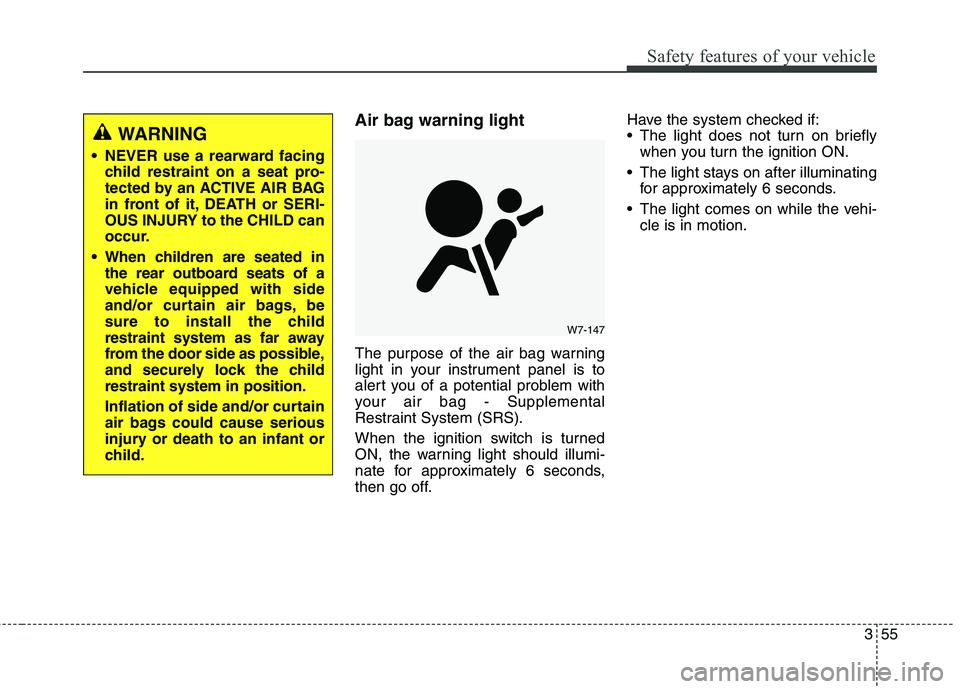
Air bag warning light
The purpose of the air bag warning
light in your instrument panel is to
alert you of a potential problem with
your air bag - Supplemental
Restraint System (SRS).
When the ignition switch is turned
ON, the warning light should illumi-
nate for approximately 6 seconds,
then go off.Have the system checked if:
The light does not turn on briefly
when you turn the ignition ON.
The light stays on after illuminating for approximately 6 seconds.
The light comes on while the vehi- cle is in motion.WARNING
NEVER use a rearward facing child restraint on a seat pro-
tected by an ACTIVE AIR BAG
in front of it, DEATH or SERI-
OUS INJURY to the CHILD can
occur.
When children are seated in the rear outboard seats of a
vehicle equipped with side
and/or curtain air bags, be
sure to install the child
restraint system as far away
from the door side as possible,
and securely lock the childrestraint system in position.
Inflation of side and/or curtain
air bags could cause serious
injury or death to an infant or
child.
W7-147