ESP KIA CADENZA 2011 Service Manual
[x] Cancel search | Manufacturer: KIA, Model Year: 2011, Model line: CADENZA, Model: KIA CADENZA 2011Pages: 352, PDF Size: 28.17 MB
Page 306 of 352
741
Maintenance
4. Tire ply composition and material
The number of layers or plies of rub-
ber-coated fabric in the tire. Tire
manufacturers also must indicate the
materials in the tire, which include
steel, nylon, polyester, and others.
The letter "R" means radial ply con-
struction; the letter "D" means diago-
nal or bias ply construction; and theletter "B" means belted-bias ply con-
struction.
5. Maximum permissible inflationpressure
This number is the greatest amount of air pressure that should be put in
the tire. Do not exceed the maximum
permissible inflation pressure. Refer
to the Tire and Loading Information
label for recommended inflation
pressure.
6. Maximum load rating
This number indicates the maximum
load in kilograms and pounds that
can be carried by the tire. When
replacing the tires on the vehicle,
always use a tire that has the same
load rating as the factory installed
tire.
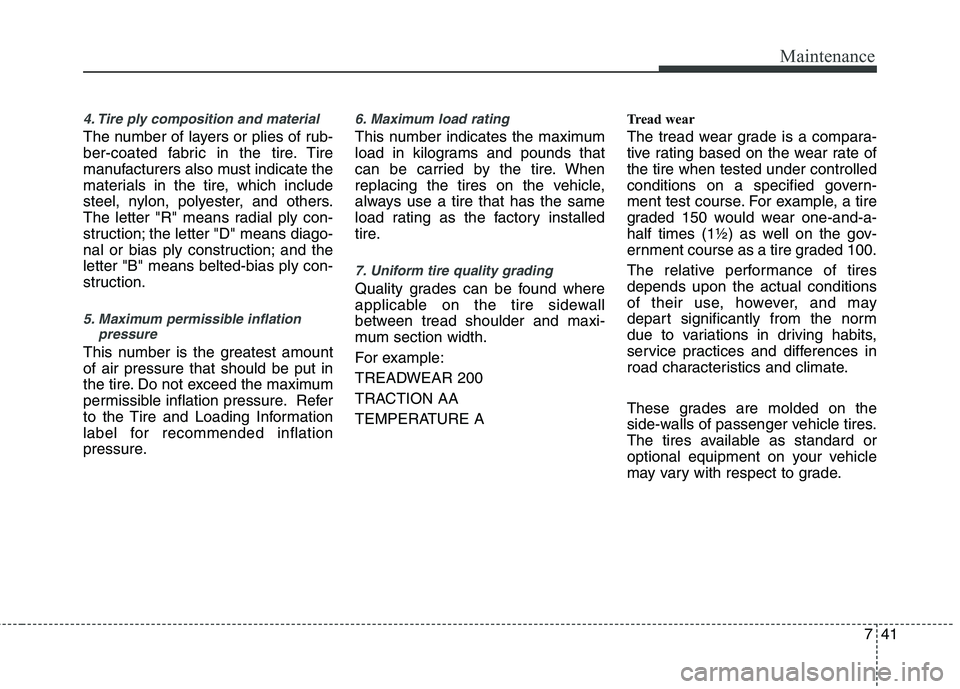
7. Uniform tire quality grading
Quality grades can be found where
applicable on the tire sidewall
between tread shoulder and maxi-
mum section width.
For example:
TREADWEAR 200
TRACTION AA
TEMPERATURE A Tread wear
The tread wear grade is a compara-
tive rating based on the wear rate ofthe tire when tested under controlled
conditions on a specified govern-
ment test course. For example, a tire
graded 150 would wear one-and-a-
half times (1½) as well on the gov-
ernment course as a tire graded 100.
The relative performance of tires depends upon the actual conditions
of their use, however, and may
depart significantly from the norm
due to variations in driving habits,
service practices and differences in
road characteristics and climate.
These grades are molded on the
side-walls of passenger vehicle tires.
The tires available as standard or
optional equipment on your vehicle
may vary with respect to grade.
Page 313 of 352

Maintenance
48
7
Instrument panel (Driver’s side fuse panel)
DescriptionSymbolFuse ratingProtected component
SPARESPARE10A-
ROOM LP10AICM Relay Box (Room Lamp Auto Cut Relay)
WIPER 2210AIPM (Washer Switch), Multifunction Switch (Wiper), Washer Motor
PDM 1125APDM
PDM 3310APDM, Smart Key Control Module
A/BAG15ASRS Control Module
P/WDW LHLH25ADriver Safety Power Window Module, Rear Door Mood Lamp LH, Driver Door Mood Lamp,
Rear Power Window Switch LH
P/WDW RHRH25APassenger Door Module, Passenger Door Mood Lamp, Rear Door Mood Lamp RH,
Rear Power Window Switch RH
CURTAINCURTAIN10ADriver/Passenger Door Module, Rear Curtain Module
S/HEATER
FRTFRT20ADriver/Passenger CCS Control Module, Driver/Passenger Seat Warmer Module
SPARESPARE20A-
PDM 2210AFOB Holder, PDM, Smart Key Control Module, Start Stop Button Switch
Page 314 of 352

749
Maintenance
DescriptionSymbolFuse ratingProtected component
MODULE 22
MODULE10A
ATM Shift Lever Illumination, Instrument Cluster, Multifunction Switch (Remote Control),
Tilt & Telescopic Module, Head Lamp Leveling Device Actuator LH/RH,
Auto Head Lamp Leveling Device Module, IMS Control Module,
Head Lamp Leveling Device Switch, Front CCS Switch, Front Seat Warmer Switch,
Driver/Passenger CCS Control Module, Driver/Passenger Seat Warmer Module
Rear Seat Warmer Module LH/RH, Rear Seat Warmer Switch,
Driver/Passenger Door Module, Electro Chromic Mirror, LDWS Camera Module,
Room Lamp (Deluxe Type)
A/BAG INDIND10AInstrument Cluster (Air Bag IND.)
MODULE 33
MODULE10AABS Control Module, ESP Control Module, ESP Off Switch, Yaw Rate Sensor,
Steering Angle Sensor
IG 1IG120AE/R Fuse & Relay Box (Fuse - F10, F11, F12)
SUNROOF20APanorama Sunroof
DR LOCK20ADriver Door Module
ECSECS15AICM Relay Box (Rear Fog Lamp Relay)
AUDIO 22 AUDIO10AAudio, Audio Monitor, Amp, Overhead Console Lamp Switch, PDM, Smart Key Control Module
POWER
OUTLET 22POWER
OUTLET15AConsole Power Outlet
POWER
OUTLET 11POWER
OUTLET15A(Not Used)
Page 315 of 352

Maintenance
50
7
DescriptionSymbolFuse ratingProtected component
C/LIGHTER15AFront Cigarette Lighter
AMPAMP25AAmp
TRUNK10ATrunk Lid Relay, Trunk Main Switch, Trunk Lid Motor, Fuel Filler Door Switch
S/HEATER
RRRR20ARear Seat Warmer Module LH/RH
MEMORYMEMORY10A
Driver/Passenger Foot Lamp, Data Link Connector, Auto Light & Photo Sensor,
Instrument Cluster (MICOM, IND.), Rear Curtain Module, Door Warning Switch,
Garnish Lamp LH/RH/Center, Tilt & Telescopic Module, A/C Control Module,
Loom Lamp (Deluxe Type), Driver/Passenger Door Scuff Lamp,
IMS Control Module, Driver/Passenger Door Lamp, Driver/Passenger Door Module,
RF Receiver, Trunk Room Lamp
AUDIO 1
1AUDIO15AAudio, Audio Monitor
MODULE 11
MODULE10APDM, Rear Curtain Module, Rain Sensor
Panorama Sunroof, ICM Relay Box (Head Lamp Washer Relay)
SPARESPARE10A-
WIPER 1125AFront Wiper Motor, Multifunction Switch (Wiper)
E/R Fuse & Relay Box (RLY. 11, RLY. 12)
HTD
HANDLEHTD
HANDLE15ASteering Wheel Heated
P/SEAT
PASSPASS20APassenger Manual Switch
POWER
CONNECTOR
POWER
CONNECTOR
Page 317 of 352

Maintenance
52
7
DescriptionSymbolFuse ratingProtected component
MULTI
FUSE
B+260AIPM (Fuse - F7/ F8/ F9/ F19, IPS Control - IPS1/ IPS2/ IPS3/ IPS5/ IPS7)
B+360AIPM (Fuse - F17/ F24/ F25/ F26/ F33/ F34)
IGN140A[W/O Smart Key] Ignition Switch, [With Smart Key] RLY. 1 (ACC Relay), RLY. 9 (IG1 Relay)
40AESP Control Module, ABS Control Module
RR HTD40ARLY. 2 (Rear Defogger Relay)
40ARLY. 14 (Blower Relay)
B+460AIPM (Fuse- F2/ F10, IPS Control - IPS 0/ IPS4/ TURN/ IPS6)
SPARE80A-
FUSE
10AA/C Control Module
B/UP LP10ARLY. 8 (Back-up Lamp Relay), Stop Lamp Switch, Multipurpose Check Connector
IGN10ARLY. 6 (Start2 Relay), Alternator (G6DC)
110APCM, Transaxle Range Switch
Engine compartment main fuse panel
Page 318 of 352
![KIA CADENZA 2011 Service Manual 753
Maintenance
DescriptionSymbolFuse ratingProtected component
FUSE
SPARE30A-
IGN 230A[W/O Smart Key] Ignition Switch, RLY. 3 (Start1 Relay),
[With Smart Key] RLY. 3 (Start1 Relay), RLY. 10 (IG2 Re](/img/2/57935/w960_57935-317.png "KIA CADENZA 2011 Service Manual 753
Maintenance
DescriptionSymbolFuse ratingProtected component
FUSE
SPARE30A-
IGN 230A[W/O Smart Key] Ignition Switch, RLY. 3 (Start1 Relay),
[With Smart Key] RLY. 3 (Start1 Relay), RLY. 10 (IG2 Re")
753
Maintenance
DescriptionSymbolFuse ratingProtected component
FUSE
SPARE30A-
IGN 230A[W/O Smart Key] Ignition Switch, RLY. 3 (Start1 Relay),
[With Smart Key] RLY. 3 (Start1 Relay), RLY. 10 (IG2 Relay)
B+140AIPM (Fuse - F4/ F12/ F18/ F35, Power Connector - F27/ F28)
240AEMS Box (Fuse - F35/ F36/ F37/ F38)
30AESP Control Module, ABS Control Module
10AIPM, RLY. 11 (Wiper Relay), Front Wiper Motor
AMS10A(Not Used)
20AICM Relay Box (Head Lamp Washer Relay)
320APCM (G4KE)
STOP LP15AStop Lamp Switch
20ARLY. 7 (Front Wiper Deicer Relay)
DIAGNOSIS20AMultipurpose Check Connector
40ARLY. 4 (Cooling Fan (Low) Relay), RLY. 5 (Cooling Fan (High) Relay)
Page 320 of 352
755
Maintenance
LIGHT BULBS
Use only the bulbs of the specifiedwattage.
✽✽ NOTICE
After, driving in heavy rain or washing
the vehicle, headlight and taillight lenses
could appear frosty. This condition is
caused by the temperature difference
between the lamp inside and outside.
This is similar to the condensation on
your windows inside your vehicle during
the rain and doesn’t indicate a problem
with your vehicle. If the water leaks into
the lamp bulb circuitry, have the vehicle
checked by an authorized KIA dealer.
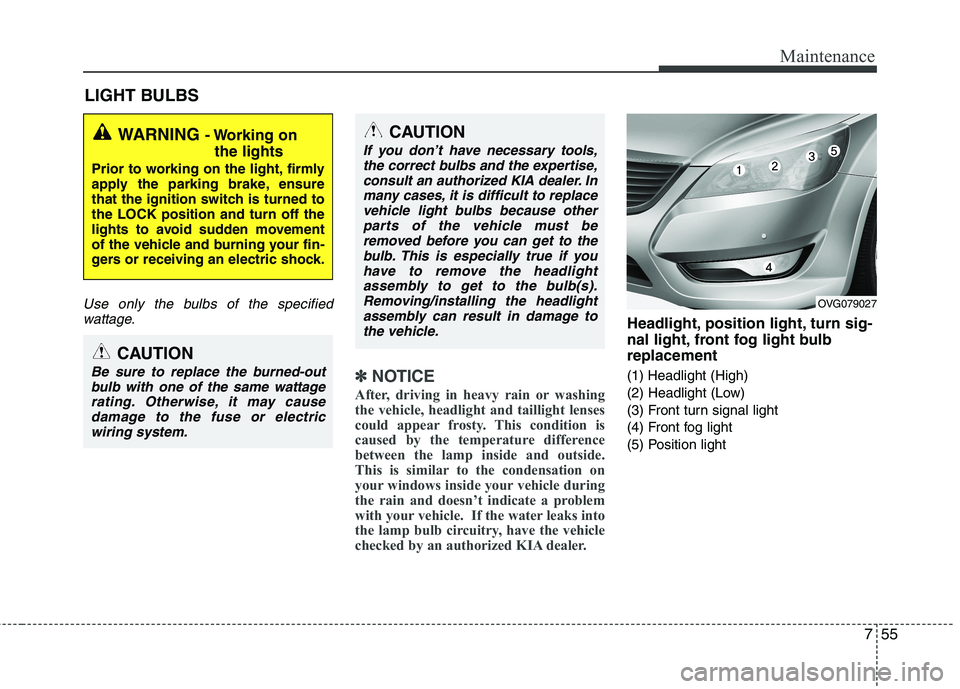
Headlight, position light, turn sig-
nal light, front fog light bulbreplacement
(1) Headlight (High)
(2) Headlight (Low)
(3) Front turn signal light
(4) Front fog light
(5) Position light
WARNING - Working on
the lights
Prior to working on the light, firmly
apply the parking brake, ensure
that the ignition switch is turned tothe LOCK position and turn off the
lights to avoid sudden movement
of the vehicle and burning your fin-
gers or receiving an electric shock.
CAUTION
Be sure to replace the burned-out bulb with one of the same wattagerating. Otherwise, it may causedamage to the fuse or electricwiring system.
CAUTION
If you don’t have necessary tools,the correct bulbs and the expertise,
consult an authorized KIA dealer. Inmany cases, it is difficult to replacevehicle light bulbs because other parts of the vehicle must be
removed before you can get to thebulb. This is especially true if youhave to remove the headlight
assembly to get to the bulb(s).Removing/installing the headlightassembly can result in damage tothe vehicle.
OVG079027
Page 328 of 352
763
Maintenance
Exterior care
Exterior general caution
It is very important to follow the label
directions when using any chemical
cleaner or polish. Read all warning andcaution statements that appear on thelabel.
Finish maintenance
Washing
To help protect your vehicle’s finish from
rust and deterioration, wash it thoroughlyand frequently at least once a month with
lukewarm or cold water.
If you use your vehicle for off-road driv-
ing, you should wash it after each off-
road trip. Pay special attention to the
removal of any accumulation of salt, dirt,
mud, and other foreign materials. Make
sure the drain holes in the lower edges of
the doors and rocker panels are keptclear and clean.
Insects, tar, tree sap, bird droppings,
industrial pollution and similar deposits
can damage your vehicle’s finish if not
removed immediately.
Even prompt washing with plain water
may not completely remove all these
deposits. A mild soap, safe for use on
painted surfaces, may be used.
After washing, rinse the vehicle thor-
oughly with lukewarm or cold water. Do
not allow soap to dry on the finish.
APPEARANCE CARECAUTION
Do not use strong soap, chemical
detergents or hot water, and do
not wash the vehicle in direct sunlight or when the body of thevehicle is warm.
Be careful when washing the side windows of your vehicle.Especially, with high-pressurewater, water may leak through the windows and wet the interior.
To prevent damage to the plastic parts, do not clean with chemicalsolvents or strong detergents.
WARNING - Wet brakes
After washing the vehicle, test the
brakes while driving slowly to see if
they have been affected by water. If
braking performance is impaired,
dry the brakes by applying them
lightly while maintaining a slow for-
ward speed.
Page 334 of 352
769
Maintenance
EMISSION CONTROL SYSTEM (IF EQUIPPED)
The emission control system of your
vehicle is covered by a written limited
warranty. Please see the warranty infor-
mation contained in the Service Passport
in your vehicle.
Your vehicle is equipped with an emis-
sion control system to meet all applicable
emission regulations. There are three emission control sys-
tems, as follows.
(1) Crankcase emission control system
(2) Evaporative emission control system(3) Exhaust emission control system In order to assure the proper function of
the emission control systems, it is rec-
ommended that you have your car
inspected and maintained by an author-
ized KIA dealer in accordance with the
maintenance schedule in this manual. Caution for the Inspection and
Maintenance Test (With Electronic
Stability Program (ESP) system)
To prevent the vehicle from misfir-
ing during dynamometer testing,
turn the Electronic Stability
Program (ESP) system off by press-
ing the ESP switch.
After dynamometer testing is com- pleted, turn the ESP system back on
by pressing the ESP switch again. 1. Crankcase emission control
system
The positive crankcase ventilation sys-
tem is employed to prevent air pollution
caused by blow-by gases being emitted
from the crankcase. This system supplies
fresh filtered air to the crankcase through
the air intake hose. Inside the crankcase,
the fresh air mixes with blow-by gases,
which then pass through the PCV valveinto the induction system.
2. Evaporative emission control system
The Evaporative Emission Control
System is designed to prevent fuel
vapors from escaping into the atmos-
phere.
Page 341 of 352
85
Specifications & Consumer information
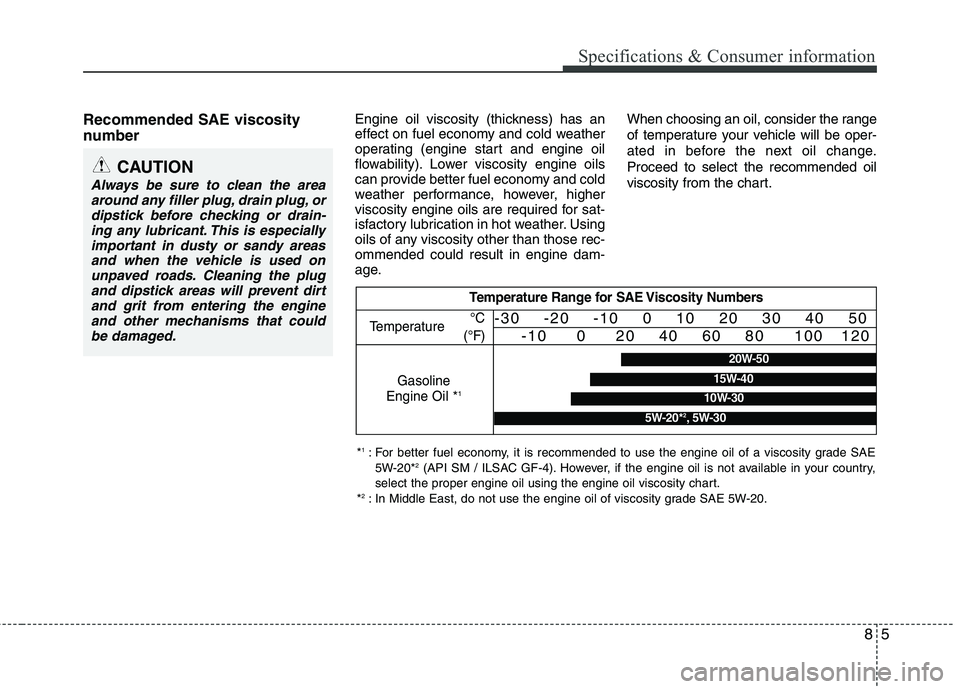
Recommended SAE viscosity
number Engine oil viscosity (thickness) has an
effect on fuel economy and cold weather
operating (engine start and engine oil
flowability). Lower viscosity engine oils
can provide better fuel economy and cold
weather performance, however, higher
viscosity engine oils are required for sat-
isfactory lubrication in hot weather. Using
oils of any viscosity other than those rec-ommended could result in engine dam-
age.When choosing an oil, consider the range
of temperature your vehicle will be oper-
ated in before the next oil change.Proceed to select the recommended oil
viscosity from the chart.
CAUTION
Always be sure to clean the area
around any filler plug, drain plug, ordipstick before checking or drain-ing any lubricant. This is especially
important in dusty or sandy areasand when the vehicle is used onunpaved roads. Cleaning the plugand dipstick areas will prevent dirt
and grit from entering the engine and other mechanisms that couldbe damaged.
Temperature Range for SAE Viscosity Numbers
Temperature
Gasoline
Engine Oil * 1°C
(°F)-30 -20 -10 0 10 20 30 40 50 -10 0 20 40 60 80 100 120
*1
: For better fuel economy, it is recommended to use the engine oil of a viscosity grade SAE
5W-20* 2
(API SM / ILSAC GF-4). However, if the engine oil is not available in your country,
select the proper engine oil using the engine oil viscosity chart.
* 2
: In Middle East, do not use the engine oil of viscosity grade SAE 5W-20.
20W-50
10W-30
15W-40
5W-20* 2
, 5W-30