seats KIA Cadenza 2014 1.G User Guide
[x] Cancel search | Manufacturer: KIA, Model Year: 2014, Model line: Cadenza, Model: KIA Cadenza 2014 1.GPages: 415, PDF Size: 5.09 MB
Page 48 of 415

Safety features of your vehicle
34
3
Air bag warning light
The purpose of the air bag warning
light in your instrument panel is to
alert you of a potential problem with
your air bag - Supplemental
Restraint System (SRS).
When the ignition switch is turned
ON, the indicator light should illumi-
nate for approximately 6 seconds,
then go off.
Have the system checked by an
authorized Kia dealer if:
The light does not turn on briefly
when you turn the ignition ON.
The light stays on after illuminating for approximately 6 seconds. The light comes on while the vehi-
cle is in motion.
W7-147
WARNING - Air bag
deployment
When children are seated in the
rear outboard seats of a vehicle
equipped with side and/or cur-
tain air bags, install the child
restraint system as far away
from the door side as possible.
Inflation of the side and/or cur-
tain air bags could impact the
child.
Page 61 of 415

347
Safety features of your vehicle
They are designed to help protect
the heads of the front seat occupants
and the rear outboard seat occu-
pants in certain side impact colli-
sions.
The curtain air bags are designed to
deploy only during certain side
impact collisions, depending on the
crash severity, angle, speed and
impact. The curtain air bags are not
designed to deploy in all side impact
situations, collisions from the front or
rear of the vehicle or in most rollover
situations.
Do not allow the passengers to lean
their heads or bodies onto doors, put
their arms on the doors, stretch their
arms out of the window, or place
objects between the doors and pas-
sengers when they are seated on
seats equipped with side and/or cur-
tain air bags.✽ ✽NOTICE
Never try to open or repair any com-
ponents of the side curtain air bag
system. This should only be done by
an authorized Kia dealer.
Page 201 of 415
4133
Features of your vehicle
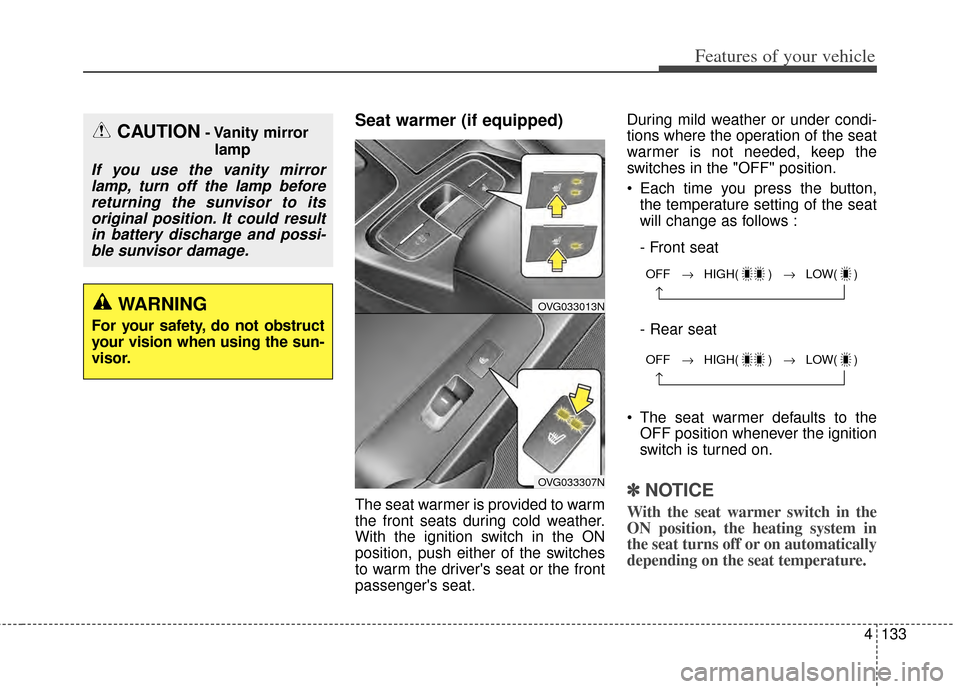
Seat warmer (if equipped)
The seat warmer is provided to warm
the front seats during cold weather.
With the ignition switch in the ON
position, push either of the switches
to warm the driver's seat or the front
passenger's seat.During mild weather or under condi-
tions where the operation of the seat
warmer is not needed, keep the
switches in the "OFF" position.
Each time you press the button,
the temperature setting of the seat
will change as follows :
- Front seat
- Rear seat
The seat warmer defaults to the OFF position whenever the ignition
switch is turned on.✽ ✽ NOTICE
With the seat warmer switch in the
ON position, the heating system in
the seat turns off or on automatically
depending on the seat temperature.
CAUTION- Vanity mirror
lamp
If you use the vanity mirrorlamp, turn off the lamp beforereturning the sunvisor to itsoriginal position. It could resultin battery discharge and possi-ble sunvisor damage.
WARNING
For your safety, do not obstruct
your vision when using the sun-
visor.
OFF → HIGH( ) → LOW( )
→
OFF → HIGH( ) → LOW( )
→
OVG033013N
OVG033307N
Page 202 of 415
Features of your vehicle
134
4
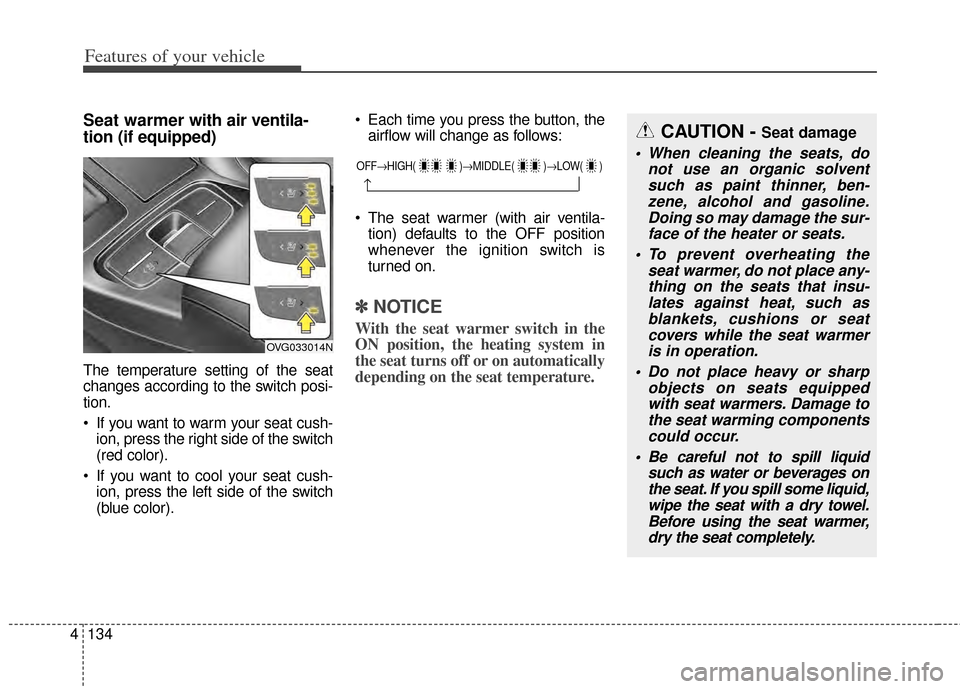
Seat warmer with air ventila-
tion (if equipped)
The temperature setting of the seat
changes according to the switch posi-
tion.
If you want to warm your seat cush-
ion, press the right side of the switch
(red color).
If you want to cool your seat cush- ion, press the left side of the switch
(blue color). Each time you press the button, the
airflow will change as follows:
The seat warmer (with air ventila- tion) defaults to the OFF position
whenever the ignition switch is
turned on.
✽ ✽ NOTICE
With the seat warmer switch in the
ON position, the heating system in
the seat turns off or on automatically
depending on the seat temperature.
OFF→ HIGH( )→ MIDDLE( )→LOW( )
→
CAUTION - Seat damage
When cleaning the seats, do
not use an organic solventsuch as paint thinner, ben-zene, alcohol and gasoline.Doing so may damage the sur-face of the heater or seats.
To prevent overheating the seat warmer, do not place any-thing on the seats that insu-lates against heat, such asblankets, cushions or seatcovers while the seat warmeris in operation.
Do not place heavy or sharp objects on seats equippedwith seat warmers. Damage tothe seat warming componentscould occur.
Be careful not to spill liquid such as water or beverages onthe seat. If you spill some liquid,wipe the seat with a dry towel.Before using the seat warmer,dry the seat completely.
OVG033014N
Page 287 of 415

577
Driving your vehicle
✽
✽NOTICE
Overloading your vehicle may cause
damage. Repairs would not be cov-
ered by your warranty. Do not over-
load your vehicle.
WARNING - Over
loading
Do not overload your vehicle.
Overloading your vehicle can
cause heat buildup in your vehi-
cle's tires and possible tire fail-
ure, increased stopping dis-
tances and poor vehicle han-
dling--all of which may result in
a crash.
WARNING - Loose cargo
Do not travel with unsecured
blunt objects in the passenger
compartment of your vehicle
(e.g. suit cases or unsecured
child seats). These items may
strike occupant during a sud-
den stop or crash.
Page 369 of 415

Maintenance
56
7
Tire terminology and definitions
Air Pressure: The amount of air
inside the tire pressing outward on
the tire. Air pressure is expressed in
pounds per square inch (psi) or kilo-
pascal (kPa).
Accessory Weight : This means the
combined weight of optional acces-
sories. Some examples of optional
accessories are, automatic
transaxle, power seats, and air con-
ditioning.
Aspect Ratio : The relationship of a
tire's height to its width.
Belt: A rubber coated layer of cords
that is located between the plies and
the tread. Cords may be made from
steel or other reinforcing materials.
Bead: The tire bead contains steel
wires wrapped by steel cords that
hold the tire onto the rim.
Bias Ply Tire : A pneumatic tire in
which the plies are laid at alternate
angles less than 90 degrees to the
centerline of the tread. Cold Tire Pressure: The amount of
air pressure in a tire, measured in
pounds per square inch (psi) or kilo-
pascals (kPa) before a tire has built
up heat from driving.
Curb Weight: This means the weight
of a motor vehicle with standard and
optional equipment including the
maximum capacity of fuel, oil and
coolant, but without passengers and
cargo.
DOT Markings: The DOT code
includes the Tire Identification
Number (TIN), an alphanumeric des-
ignator which can also identify the
tire manufacturer, production plant,
brand and date of production.
GVWR: Gross Vehicle Weight Rating
GAWR FRT: Gross Axle Weight
Rating for the Front Axle.
GAWR RR: Gross Axle Weight
Rating for the Rear axle.
Intended Outboard Sidewall
: The
side of an asymmetrical tire, that
must always face outward when
mounted on a vehicle.
Kilopascal (kPa): The metric unit for
air pressure.
Load Index: An assigned number
ranging from 1 to 279 that corre-
sponds to the load carrying capacity
of a tire.
Maximum Inflation Pressure: The
maximum air pressure to which a
cold tire may be inflated. The maxi-
mum air pressure is molded onto the
sidewall.
Maximum Load Rating : The load
rating for a tire at the maximum per-
missible inflation pressure for that
tire.
Maximum Loaded Vehicle Weight:
The sum of curb weight; accessory
weight; vehicle capacity weight; and
production options weight.
Normal Occupant Weight: The
number of occupants a vehicle is
designed to seat multiplied by 68 kg
(150 pounds).
Page 393 of 415

Maintenance
80
7
Cleaning the upholstery and inte-
rior trim
Vinyl
Remove dust and loose dirt from
vinyl with a whisk broom or vacuum
cleaner. Clean vinyl surfaces with a
vinyl cleaner.
Fabric
Remove dust and loose dirt from fab-
ric with a whisk broom or vacuum
cleaner. Clean with a mild soap solu-
tion recommended for upholstery or
carpets. Remove fresh spots imme-
diately with a fabric spot cleaner. If
fresh spots do not receive immediate
attention, the fabric can be stained
and its color can be affected. Also, its
fire-resistant properties can be
reduced if the material is not proper-
ly maintained.
Cleaning the lap/shoulder beltwebbing
Clean the belt webbing with any mild
soap solution recommended for
cleaning upholstery or carpet. Follow
the instructions provided with the
soap. Do not bleach or re-dye the
webbing because this may weaken
it.
Cleaning the interior windowglass
If the interior glass surfaces of the
vehicle become fogged (that is, cov-
ered with an oily, greasy or waxy
film), they should be cleaned with a
glass cleaner. Follow the directions
on the glass cleaner container.
CAUTION
Using anything but recommend-ed cleaners and proceduresmay affect the fabric’s appear-ance and fire-resistant proper-ties.
CAUTION
When cleaning leather products(steering wheel, seats etc.), useneutral detergents or low alco-hol content solutions. If you usehigh alcohol content solutionsor acid/alkaline detergents, thecolor of the leather may fade orthe surface may get stripped off.
CAUTION
Do not scrape or scratch theinside of the rear window. Thismay result in damage of the rearwindow defroster grid.
Page 413 of 415

Index
8I
Rear curtain. . . . . . . . . . . . . . . . . . . . . . . . . . . . . . . . . 4-139
Rear parking assist system . . . . . . . . . . . . . . . . . . . . . . 4-90
Rear seat adjustment . . . . . . . . . . . . . . . . . . . . . . . . . . . 3-11
Rear view camera . . . . . . . . . . . . . . . . . . . . . . . . . . . . . 4-94
Recommended cold tire inflation pressures . . . . . . . . . 7-46
Recommended lubricants and capacities . . . . . . . . . . . . 8-5Recommended SAE viscosity number. . . . . . . . . . . . 8-6
Record your key number . . . . . . . . . . . . . . . . . . . . . . . . 4-4
Remote keyless entry system operations . . . . . . . . . . . . 4-6
Reverse parking aid function . . . . . . . . . . . . . . . . . . . . 4-50
Road warning . . . . . . . . . . . . . . . . . . . . . . . . . . . . . . . . . 6-2
Rocking the vehicle . . . . . . . . . . . . . . . . . . . . . . . . . . . 5-66
Room lamp . . . . . . . . . . . . . . . . . . . . . . . . . . . . . . . . . 4-108
Rotation (Tire) . . . . . . . . . . . . . . . . . . . . . . . . . . . . . . . 7-50
Scheduled maintenance service . . . . . . . . . . . . . . . . . . . 7-8
Seat belt Precautions. . . . . . . . . . . . . . . . . . . . . . . . . . . 3-21
Seat belt restraint system . . . . . . . . . . . . . . . . . . . . . . . 3-13
Seat belt warning . . . . . . . . . . . . . . . . . . . . . . . . . . . . . 3-14
Seat belts . . . . . . . . . . . . . . . . . . . . . . . . . . . . . . . . . . . . \
3-13 3 point system seat belt . . . . . . . . . . . . . . . . . . . . . . 3-15
Height adjustment . . . . . . . . . . . . . . . . . . . . . . . . . . 3-16
Pre-tensioner seat belt . . . . . . . . . . . . . . . . . . . . . . . 3-18
Seat belt Precautions . . . . . . . . . . . . . . . . . . . . . . . . 3-21 Seat belt restraint system . . . . . . . . . . . . . . . . . . . . . 3-13
Seat belt warning . . . . . . . . . . . . . . . . . . . . . . . . . . . 3-14
Seat warmer . . . . . . . . . . . . . . . . . . . . . . . . . . . . . . . . 4-133
Seatback pocket . . . . . . . . . . . . . . . . . . . . . . . . . . . . . . 3-10
Seats . . . . . . . . . . . . . . . . . . . . . . . . . . . . . . . . . . . . \
. . . . 3-2 Armrest (rear) . . . . . . . . . . . . . . . . . . . . . . . . . . . . . . 3-12
Front seat adjustment - power . . . . . . . . . . . . . . . . . . 3-4
Headrest(front) . . . . . . . . . . . . . . . . . . . . . . . . . . . . . . 3-9
Headrest(rear) . . . . . . . . . . . . . . . . . . . . . . . . . . . . . . 3-11
Rear seat adjustment . . . . . . . . . . . . . . . . . . . . . . . . 3-11
Seatback pocket . . . . . . . . . . . . . . . . . . . . . . . . . . . . 3-10
Service Mode . . . . . . . . . . . . . . . . . . . . . . . . . . . . . . . . 4-60
Shift lock system . . . . . . . . . . . . . . . . . . . . . . . . . . . . . 5-14
Side air bag . . . . . . . . . . . . . . . . . . . . . . . . . . . . . . . . . . 3-45\
Smart cruise control system . . . . . . . . . . . . . . . . . . . . . 5-41
Smart key . . . . . . . . . . . . . . . . . . . . . . . . . . . . . . . . . . . . \
4-4 Battery replacement . . . . . . . . . . . . . . . . . . . . . . . . . . 4-8
Immobilizer system . . . . . . . . . . . . . . . . . . . . . . . . . 4-11
Record your key number . . . . . . . . . . . . . . . . . . . . . . 4-4
Remote keyless entry system operations . . . . . . . . . . 4-6
Smart key functions . . . . . . . . . . . . . . . . . . . . . . . . . . 4-4
Smart key precautions . . . . . . . . . . . . . . . . . . . . . . . . 4-5
Transmitter precautions . . . . . . . . . . . . . . . . . . . . . . . 4-7
Smart key functions . . . . . . . . . . . . . . . . . . . . . . . . . . . . 4-4
Smart key precautions. . . . . . . . . . . . . . . . . . . . . . . . . . . 4-5
Smooth cornering . . . . . . . . . . . . . . . . . . . . . . . . . . . . . 5-67
Snow tires . . . . . . . . . . . . . . . . . . . . . . . . . . . . . . . . . . . 5-\
70
R
S