warning KIA Cadenza 2015 1.G User Guide
[x] Cancel search | Manufacturer: KIA, Model Year: 2015, Model line: Cadenza, Model: KIA Cadenza 2015 1.GPages: 429, PDF Size: 5.47 MB
Page 27 of 429
23
Your vehicle at a glance
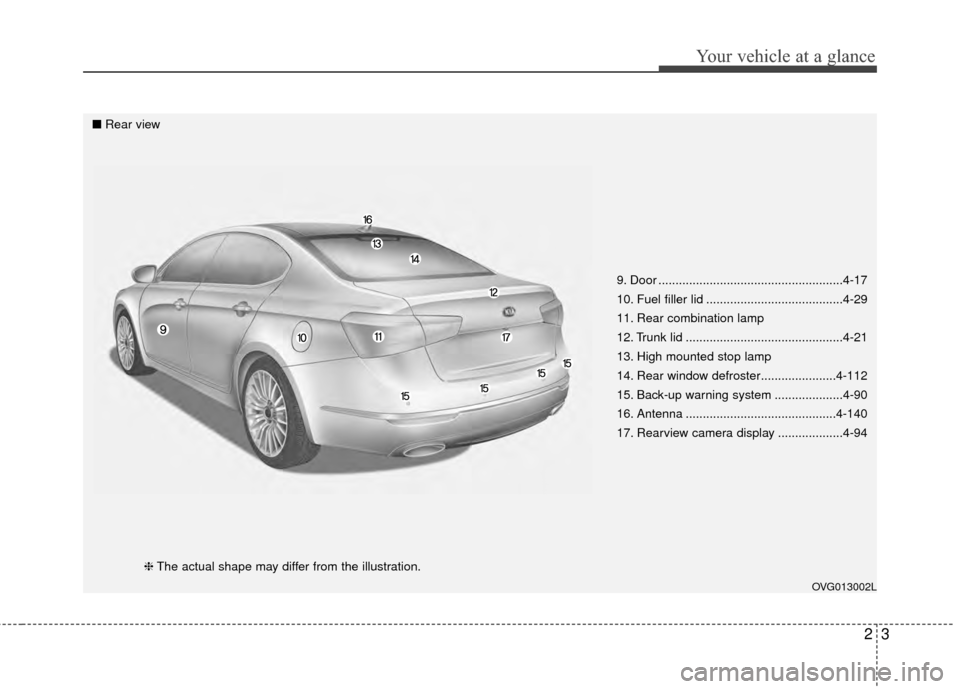
9. Door ......................................................4-17
10. Fuel filler lid ........................................4-29
11. Rear combination lamp
12. Trunk lid ..............................................4-21
13. High mounted stop lamp
14. Rear window defroster......................4-112
15. Back-up warning system ....................4-90
16. Antenna ............................................4-140
17. Rearview camera display ...................4-94
OVG013002L
■Rear view
❈The actual shape may differ from the illustration.
Page 29 of 429
25
Your vehicle at a glance
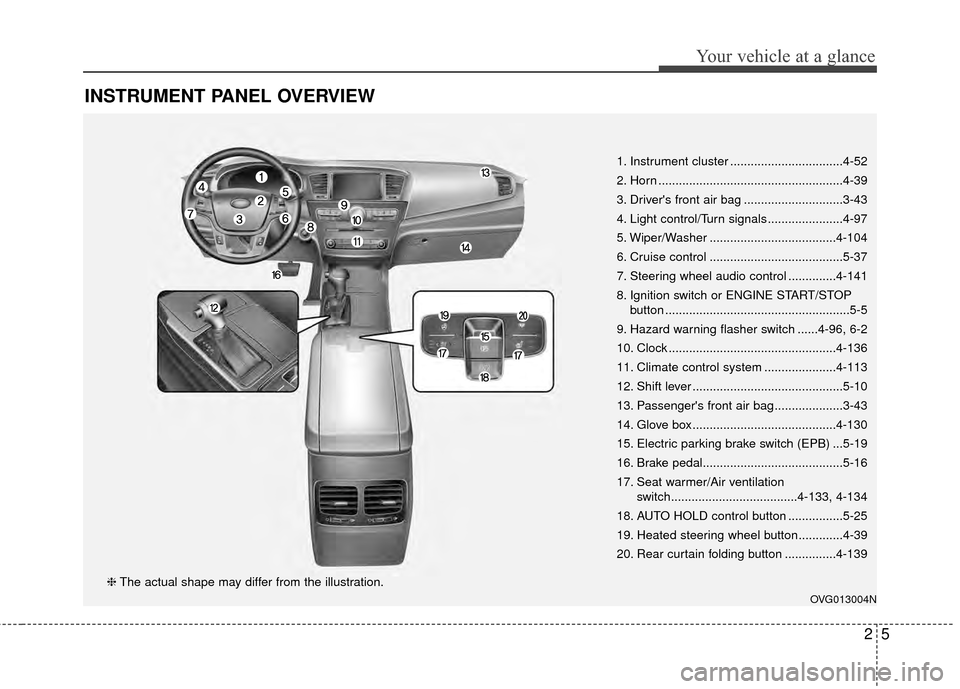
INSTRUMENT PANEL OVERVIEW
1. Instrument cluster .................................4-52
2. Horn ......................................................4-39
3. Driver's front air bag .............................3-43
4. Light control/Turn signals ......................4-97
5. Wiper/Washer .....................................4-104
6. Cruise control .......................................5-37
7. Steering wheel audio control ..............4-141
8. Ignition switch or ENGINE START/STOPbutton ......................................................5-5
9. Hazard warning flasher switch ......4-96, 6-2
10. Clock .................................................4-136
11. Climate control system .....................4-113
12. Shift lever ............................................5-10
13. Passenger's front air bag ....................3-43
14. Glove box ..........................................4-130
15. Electric parking brake switch (EPB) ...5-19
16. Brake pedal.........................................5-16
17. Seat warmer/Air ventilation switch.....................................4-133, 4-134
18. AUTO HOLD control button ................5-25
19. Heated steering wheel button.............4-39
20. Rear curtain folding button ...............4-139
OVG013004N
❈ The actual shape may differ from the illustration.
Page 33 of 429
33
Safety features of your vehicle
WARNING - Uprighting
seat
Do not press the release lever
on a manual seatback without
holding and controlling the
seatback. The seatback will
spring upright possibly impact-
ing you or other passengers.
WARNING- Loose
objects
Do not place anything in the dri-
ver's foot well or under the front
seats. Loose objects in the dri-
ver's foot area could interfere
with the operation of the foot
pedals.WARNING- Driver respon-
sibility for passengers
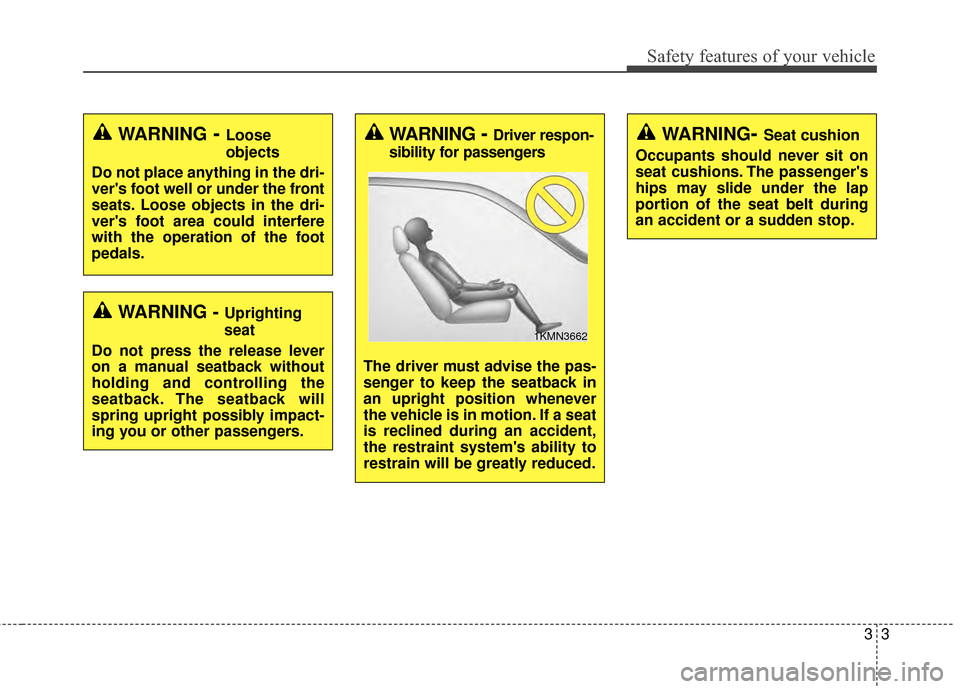
The driver must advise the pas-
senger to keep the seatback in
an upright position whenever
the vehicle is in motion. If a seat
is reclined during an accident,
the restraint system's ability to
restrain will be greatly reduced.WARNING- Seat cushion
Occupants should never sit on
seat cushions. The passenger's
hips may slide under the lap
portion of the seat belt during
an accident or a sudden stop.
1KMN3662
Page 34 of 429
Safety features of your vehicle
43
Front seat adjustment - power
The front seat can be adjusted by
using the control switch located on
the outside of the seat cushion.
Before driving, adjust the seat to the
proper position so as to easily con-
trol the steering wheel, pedals and
switches on the instrument panel.WARNING- Seat adjustment
Do not adjust the seat while wearing seat belts. Moving the
seat forward will cause strong
pressure on the abdomen.
Do not place your hand near the seat bottom or seat track
while adjusting the seat. Your
hand could get caught in the
seat mechanism.
WARNING
The power seat is operable with
the ignition OFF.
Therefore, children should never
be left unattended in the vehicle.
WARNING- Driver’s seat
Never attempt to adjust the seat while the vehicle is mov-
ing. This could result in loss
of control of your vehicle.
Do not allow anything to inter- fere with the normal position
of the seatback. Storing items
against a seatback or in any
other way interfering with
proper locking of a seatback
could result in a serious or
fatal injury in a sudden stop
or collision.
Sit as far back as possible from the steering wheel while
still maintaining comfortable
control of your vehicle. A dis-
tance of at least 10" from your
chest to the steering wheel is
recommended. Failure to do
so could result in air bag infla-
tion injuries to the driver.
Page 37 of 429
37
Safety features of your vehicle
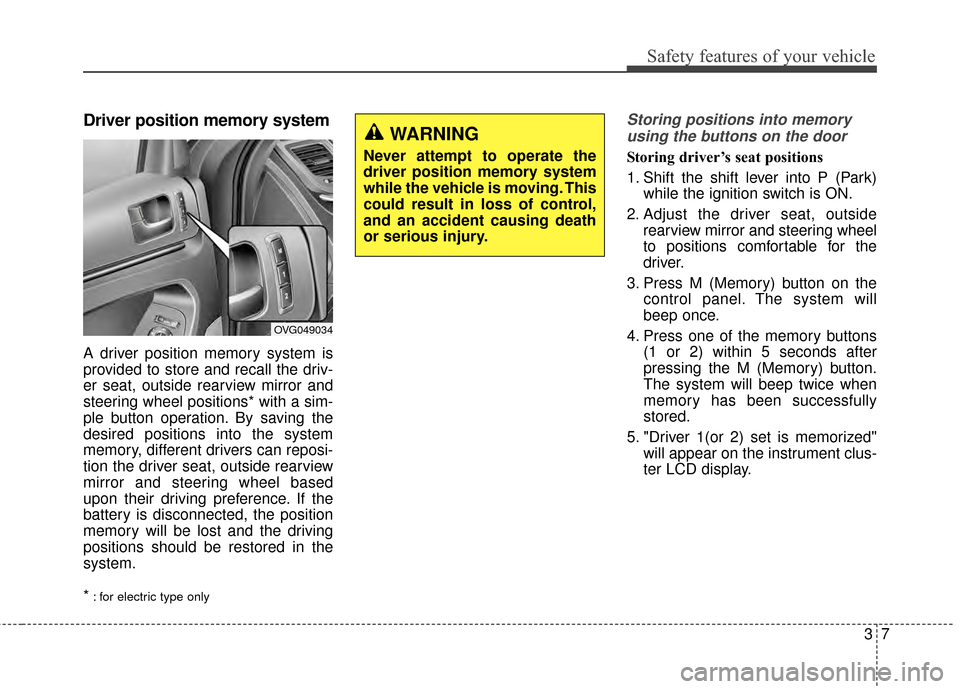
Driver position memory system
A driver position memory system is
provided to store and recall the driv-
er seat, outside rearview mirror and
steering wheel positions* with a sim-
ple button operation. By saving the
desired positions into the system
memory, different drivers can reposi-
tion the driver seat, outside rearview
mirror and steering wheel based
upon their driving preference. If the
battery is disconnected, the position
memory will be lost and the driving
positions should be restored in the
system.
*
: for electric type only
Storing positions into memoryusing the buttons on the door
Storing driver’s seat positions
1. Shift the shift lever into P (Park) while the ignition switch is ON.
2. Adjust the driver seat, outside rearview mirror and steering wheel
to positions comfortable for the
driver.
3. Press M (Memory) button on the control panel. The system will
beep once.
4. Press one of the memory buttons (1 or 2) within 5 seconds after
pressing the M (Memory) button.
The system will beep twice when
memory has been successfully
stored.
5. "Driver 1(or 2) set is memorized" will appear on the instrument clus-
ter LCD display.
OVG049034
WARNING
Never attempt to operate the
driver position memory system
while the vehicle is moving. This
could result in loss of control,
and an accident causing death
or serious injury.
Page 39 of 429
39
Safety features of your vehicle
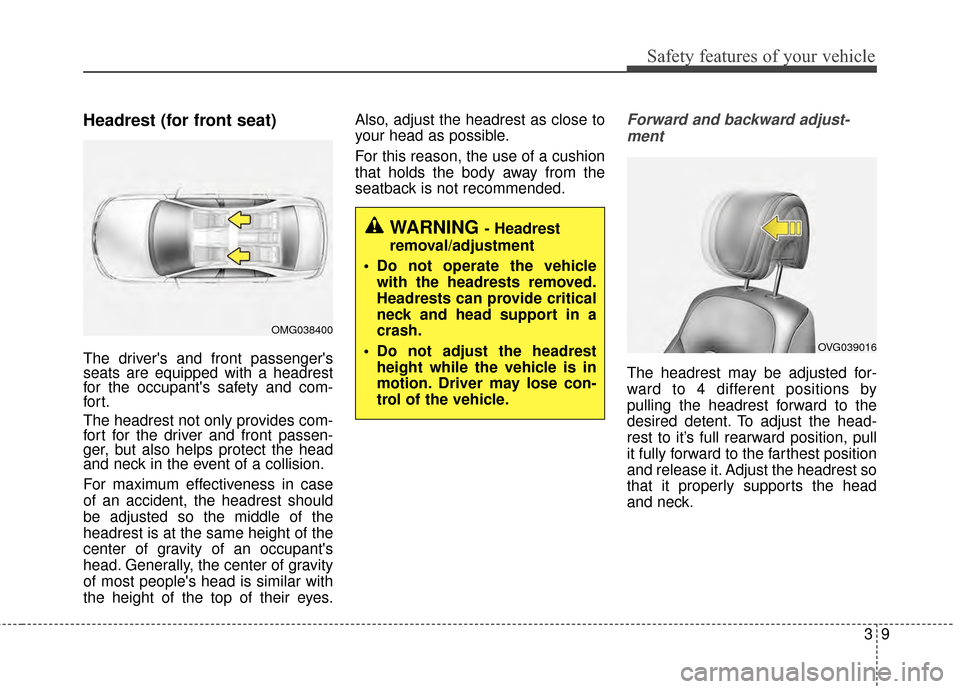
Headrest (for front seat)
The driver's and front passenger's
seats are equipped with a headrest
for the occupant's safety and com-
for t.
The headrest not only provides com-
fort for the driver and front passen-
ger, but also helps protect the head
and neck in the event of a collision.
For maximum effectiveness in case
of an accident, the headrest should
be adjusted so the middle of the
headrest is at the same height of the
center of gravity of an occupant's
head. Generally, the center of gravity
of most people's head is similar with
the height of the top of their eyes.Also, adjust the headrest as close to
your head as possible.
For this reason, the use of a cushion
that holds the body away from the
seatback is not recommended.
Forward and backward adjust-
ment
The headrest may be adjusted for-
ward to 4 different positions by
pulling the headrest forward to the
desired detent. To adjust the head-
rest to it’s full rearward position, pull
it fully forward to the farthest position
and release it. Adjust the headrest so
that it properly supports the head
and neck.
OMG038400
WARNING - Headrest
removal/adjustment
Do not operate the vehicle with the headrests removed.
Headrests can provide critical
neck and head support in a
crash.
Do not adjust the headrest height while the vehicle is in
motion. Driver may lose con-
trol of the vehicle.
OVG039016
Page 40 of 429
Safety features of your vehicle
10
3
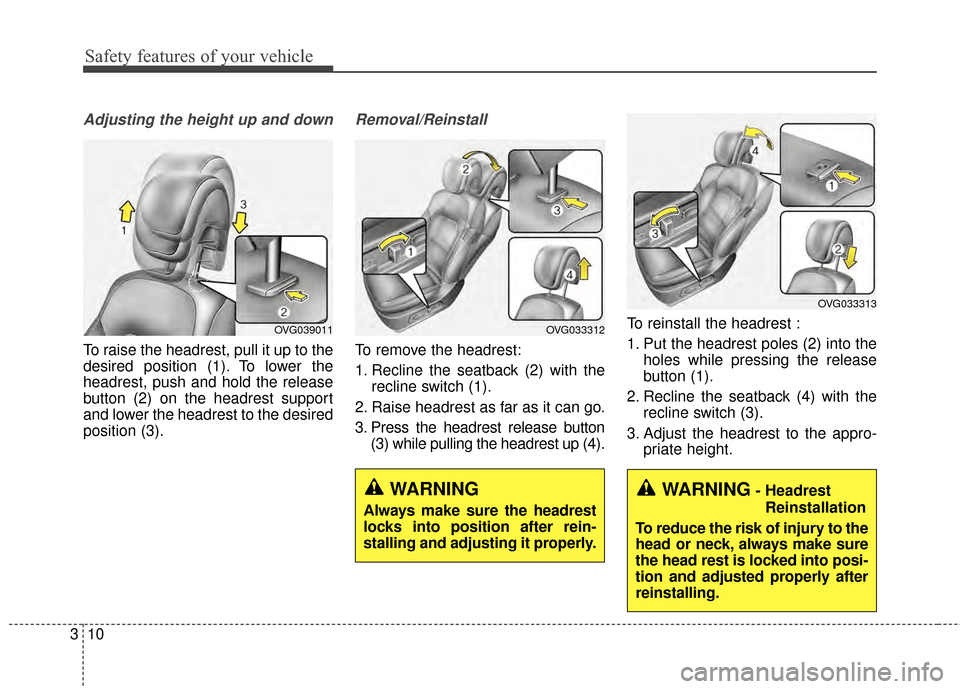
Adjusting the height up and down
To raise the headrest, pull it up to the
desired position (1). To lower the
headrest, push and hold the release
button (2) on the headrest support
and lower the headrest to the desired
position (3).
Removal/Reinstall
To remove the headrest:
1. Recline the seatback (2) with the
recline switch (1).
2. Raise headrest as far as it can go.
3. Press the headrest release button (3) while pulling the headrest up (4). To reinstall the headrest :
1. Put the headrest poles (2) into the
holes while pressing the release
button (1).
2. Recline the seatback (4) with the recline switch (3).
3. Adjust the headrest to the appro- priate height.
OVG039011OVG033312
OVG033313
WARNING
Always make sure the headrest
locks into position after rein-
stalling and adjusting it properly.
WARNING- Headrest
Reinstallation
To reduce the risk of injury to the
head or neck, always make sure
the head rest is locked into posi-
tion and adjusted properly after
reinstalling.
Page 41 of 429
311
Safety features of your vehicle
Seatback pocket
The seatback pocket is provided on
the back of the front seatbacks.
Rear seat adjustment
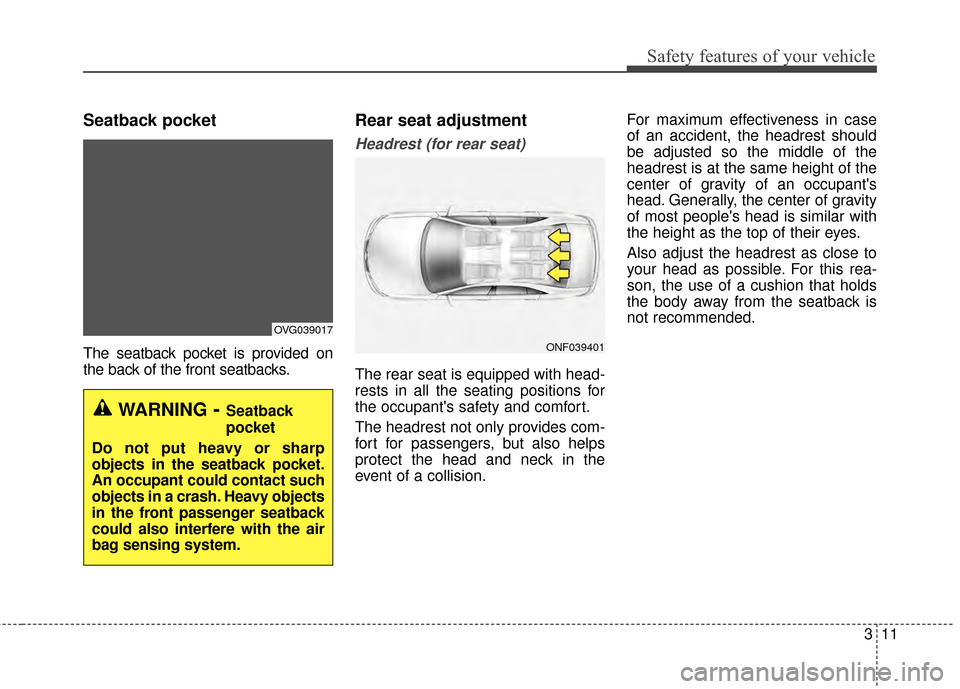
Headrest (for rear seat)
The rear seat is equipped with head-
rests in all the seating positions for
the occupant's safety and comfort.
The headrest not only provides com-
fort for passengers, but also helps
protect the head and neck in the
event of a collision.For maximum effectiveness in case
of an accident, the headrest should
be adjusted so the middle of the
headrest is at the same height of the
center of gravity of an occupant's
head. Generally, the center of gravity
of most people's head is similar with
the height as the top of their eyes.
Also adjust the headrest as close to
your head as possible. For this rea-
son, the use of a cushion that holds
the body away from the seatback is
not recommended.
WARNING- Seatback
pocket
Do not put heavy or sharp
objects in the seatback pocket.
An occupant could contact such
objects in a crash. Heavy objects
in the front passenger seatback
could also interfere with the air
bag sensing system.
OVG039017
ONF039401
Page 43 of 429
313
Safety features of your vehicle
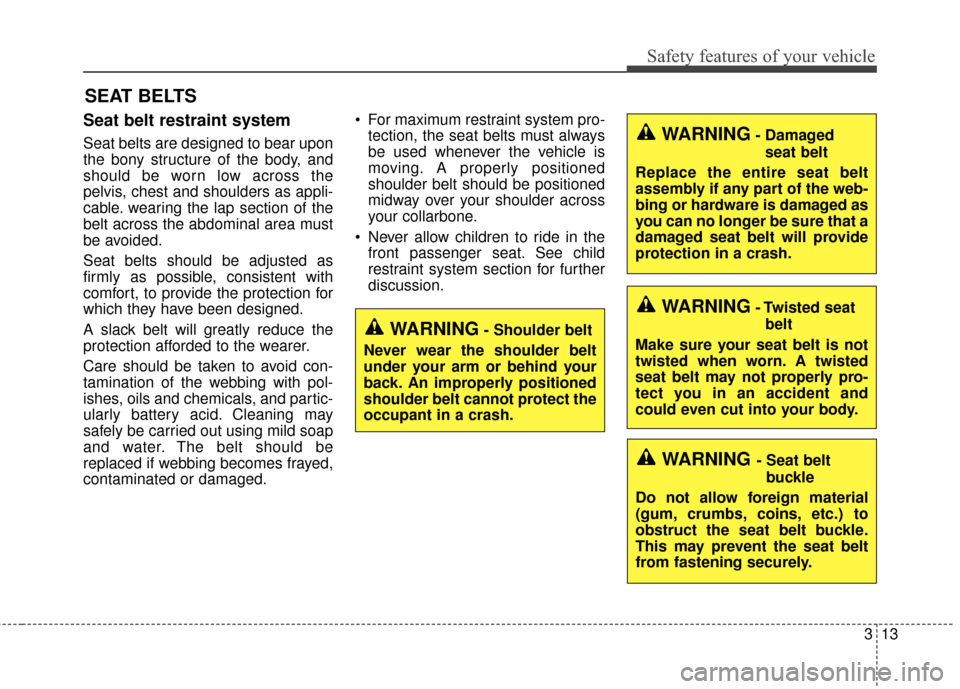
Seat belt restraint system
Seat belts are designed to bear upon
the bony structure of the body, and
should be worn low across the
pelvis, chest and shoulders as appli-
cable. wearing the lap section of the
belt across the abdominal area must
be avoided.
Seat belts should be adjusted as
firmly as possible, consistent with
comfort, to provide the protection for
which they have been designed.
A slack belt will greatly reduce the
protection afforded to the wearer.
Care should be taken to avoid con-
tamination of the webbing with pol-
ishes, oils and chemicals, and partic-
ularly battery acid. Cleaning may
safely be carried out using mild soap
and water. The belt should be
replaced if webbing becomes frayed,
contaminated or damaged. For maximum restraint system pro-
tection, the seat belts must always
be used whenever the vehicle is
moving. A properly positioned
shoulder belt should be positioned
midway over your shoulder across
your collarbone.
Never allow children to ride in the front passenger seat. See child
restraint system section for further
discussion.
SEAT BELTS
WARNING- Shoulder belt
Never wear the shoulder belt
under your arm or behind your
back. An improperly positioned
shoulder belt cannot protect the
occupant in a crash.
WARNING- Damaged seat belt
Replace the entire seat belt
assembly if any part of the web-
bing or hardware is damaged as
you can no longer be sure that a
damaged seat belt will provide
protection in a crash.
WARNING- Twisted seat belt
Make sure your seat belt is not
twisted when worn. A twisted
seat belt may not properly pro-
tect you in an accident and
could even cut into your body.
WARNING - Seat belt buckle
Do not allow foreign material
(gum, crumbs, coins, etc.) to
obstruct the seat belt buckle.
This may prevent the seat belt
from fastening securely.
Page 44 of 429
Safety features of your vehicle
14
3
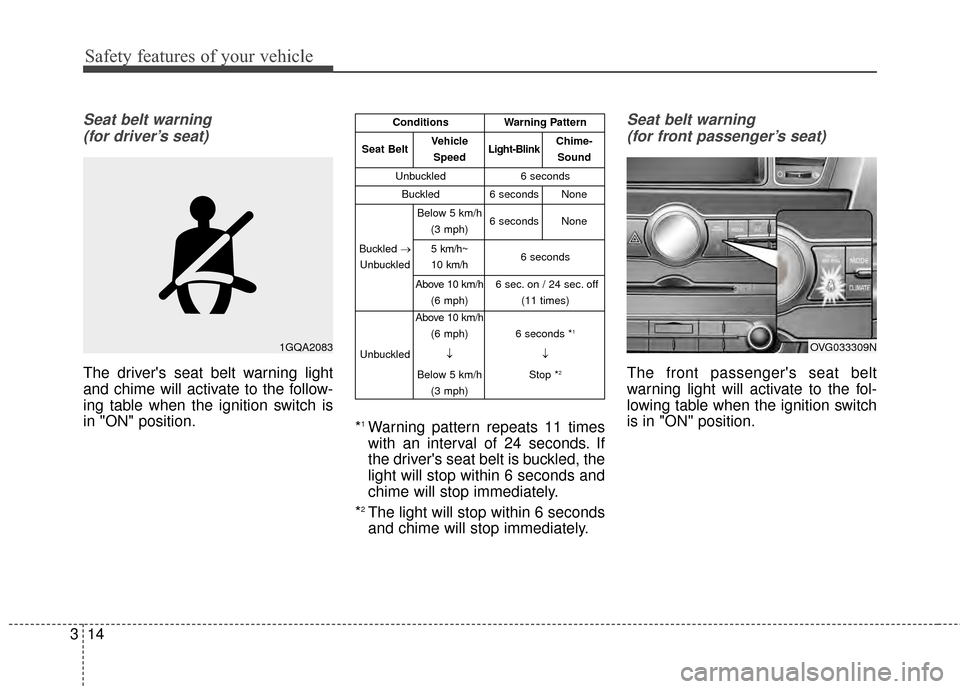
Seat belt warning
(for driver’s seat)
The driver's seat belt warning light
and chime will activate to the follow-
ing table when the ignition switch is
in "ON" position. *
1Warning pattern repeats 11 times
with an interval of 24 seconds. If
the driver's seat belt is buckled, the
light will stop within 6 seconds and
chime will stop immediately.
*
2The light will stop within 6 seconds
and chime will stop immediately.
Seat belt warning (for front passenger’s seat)
The front passenger's seat belt
warning light will activate to the fol-
lowing table when the ignition switch
is in "ON" position.
1GQA2083OVG033309N
ConditionsWarning Pattern
Seat BeltVehicle
SpeedLight-BlinkChime-Sound
Unbuckled6 seconds
Buckled6 secondsNone
Buckled →
Unbuckled
Below 5 km/h (3 mph)6 secondsNone
5 km/h~
10 km/h6 seconds
Above 10 km/h (6 mph)6 sec. on / 24 sec. off (11 times)
Unbuckled
Above 10 km/h(6 mph)
↓
Below 5 km/h (3 mph)
6 seconds *1
↓
Stop *
2