climate control KIA Cadenza 2015 1.G Owner's Guide
[x] Cancel search | Manufacturer: KIA, Model Year: 2015, Model line: Cadenza, Model: KIA Cadenza 2015 1.GPages: 429, PDF Size: 5.47 MB
Page 349 of 429

Maintenance
20
7
204,000 km (127,500 miles) or 102 months
❑ Rotate tire
❑ Inspect battery condition
❑ Inspect air cleaner filter
❑ Inspect vacuum hose
❑ Replace engine oil and filter
(204,000 km (127,500 miles) or 204 months)
❑ Add fuel additive *
1
(204,000 km (127,500 miles) or 204 months)
❑ Inspect cooling system hoses and connections
❑ Inspect brake pedal free play
❈ Inspect : Inspect and if necessary, adjust, correct, clean or
replace.
(Continued)
❑Replace climate control air filter
(for evaporator and blower unit)
❑ Replace air cleaner filter
❑ Replace engine oil and filter
(192,000 km (120,000 miles) or 192 months)
❑ Replace coolant
(First, 192,000 km (120,000 miles) or 120 months
after every 48,000 km (30,000 miles) or 24 months)
❑ Add fuel additive *
1
(192,000 km (120,000 miles) or 192 months)
❑ Inspect cooling system hoses and connections
❑ Inspect brake pedal free play
❑ Inspect all latch, hinges and locks
NORMAL MAINTENANCE SCHEDULE
❈ Inspect : Inspect and if necessary, adjust, correct, clean or
replace.
Page 350 of 429

721
Maintenance
NORMAL MAINTENANCE SCHEDULE
216,000 km (135,000 miles) or 108 months
❑Rotate tire
❑ Inspect battery condition
❑ Inspect air cleaner filter
❑ Inspect vacuum hose
❑ Inspect air conditioning refrigerant
❑ Inspect brake hoses and lines
❑ Inspect drive shafts and boots
❑ Inspect exhaust pipe and muffler
❑ Inspect front brake disc/pads, calipers
❑ Inspect rear brake disc/pads
❑ Inspect steering gear box, linkage & boots/lower arm ball
joint, upper arm ball joint
❑ Inspect suspension mounting bolts
❑ Inspect drive belts *
3
(First, 96,000 km (60,000 miles) or 72 months
after every 24,000 km (15,000 miles) or 24 months)
❑ Replace climate control air filter
(for evaporator and blower unit)
❑ Replace engine oil and filter
(216,000 km (135,000 miles) or 216 months)
❑ Add fuel additive *
1
(216,000 km (135,000 miles) or 216 months)
(Continued)
(Continued)
❑ Inspect cooling system hoses and connections
❑ Inspect brake pedal free play
❑ Inspect all latch, hinges and locks
❈ Inspect : Inspect and if necessary, adjust, correct, clean or
replace.
228,000 km (142,500 miles) or 114 months
❑Rotate tire
❑ Inspect battery condition
❑ Inspect air cleaner filter
❑ Inspect vacuum hose
❑ Replace engine oil and filter
(228,000 km (142,500 miles) or 228 months)
❑ Add fuel additive *
1
(228,000 km (142,500 miles) or 228 months)
❑ Inspect cooling system hoses and connections
❑ Inspect brake pedal free play
❈ Inspect : Inspect and if necessary, adjust, correct, clean or
replace.
Page 351 of 429

Maintenance
22
7
No check, No service required
❑ Automatic transaxle fluid
240,000 km (150,000 miles) or 120 months
❑Rotate tire
❑ Inspect battery condition
❑ Inspect air conditioning refrigerant
❑ Inspect brake hoses and lines
❑ Inspect drive shafts and boots
❑ Inspect exhaust pipe and muffler
❑ Inspect front brake disc/pads, calipers
❑ Inspect rear brake disc/pads
❑ Inspect steering gear box, linkage & boots/lower arm ball
joint, upper arm ball joint
❑ Inspect suspension mounting bolts
❑ Inspect brake fluid
❑ Inspect fuel filter *
2
❑Inspect fuel lines, fuel hoses and connections
❑ Inspect fuel tank air filter *2
❑Inspect vapor hose and fuel filler cap
❑ Inspect drive belts *3
(First, 96,000 km (60,000 miles) or 72 months
after every 24,000 km (15,000 miles) or 24 months)
❑ Replace climate control air filter
(for evaporator and blower unit)
(Continued)
(Continued)
❑ Replace air cleaner filter
❑ Replace engine oil and filter
(240,000 km (150,000 miles) or 240 months)
❑ Replace coolant
(First, 192,000 km (120,000 miles) or 120 months
after every 48,000 km (30,000 miles) or 24 months)
❑ Add fuel additive *
1
(240,000 km (150,000 miles) or 240 months)
❑ Inspect cooling system hoses and connections
❑ Inspect brake pedal free play
❑ Inspect all latch, hinges and locks
❈ Inspect : Inspect and if necessary, adjust, correct, clean or
replace.
NORMAL MAINTENANCE SCHEDULE
Page 353 of 429

Maintenance
24
7
SEVERE DRIVING CONDITIONS
A - Repeatedly driving short distance of less than 8 km (5 miles)
in normal temperature or less than 16 km (10 miles) in freez-
ing temperature
B - Extensive engine idling or low speed driving for long dis- tances
C - Driving on rough, dusty, muddy, unpaved, graveled or salt- spread roads
D - Driving in areas using salt or other corrosive materials or in very cold weather
E - Driving in sandy areas F - Driving in heavy traffic area over 32°C (90°F)
G- Driving on uphill, downhill, or mountain road
H - Towing a Trailer, or using a camper, or roof rack
I - Driving as a patrol car, taxi, other commercial use or vehicle
towing
J - Driving over 170 km/h (106 mph)
K - Frequently driving in stop-and-go conditions
MAINTENANCE ITEMMAINTENANCE OPERATIONMAINTENANCE INTERVALSDRIVING
CONDITION
FRONT DISC BRAKE/PADS, CALIPERSIMORE FREQUENTLYC, D, G, H
REAR DISC BRAKE/PADSIMORE FREQUENTLYC, D, F, G
PARKING BRAKEIMORE FREQUENTLYC, D, G, H
STEERING GEAR BOX, LINKAGE &
BOOTS/LOWER ARM BALL JOINT, UPPER
ARM BALL JOINT
IMORE FREQUENTLYC, D, E, F, G, H, I
DRIVE SHAFTS AND BOOTSIEVERY 120,000 KM (75,000 MILES) OR 6 MONTHSC, D, E, F, G, H, I
CLIMATE CONTROL AIR FILTER (FOR
EVAPORATOR AND BLOWER UNIT)RMORE FREQUENTLYC, E
Page 367 of 429

Maintenance
38
7
CLIMATE CONTROL AIR FILTER (IF EQUIPPED)
Filter inspection
The climate control air filter should
be replaced according to the
Maintenance Schedule. If the vehicle
is operated in severely air-polluted
cities or on dusty rough roads for a
long period, it should be inspected
more frequently and replaced earlier.
When you replace the climate control
air filter, replace it performing the fol-
lowing procedure, and be careful to
avoid damaging other components.
Page 374 of 429
745
Maintenance
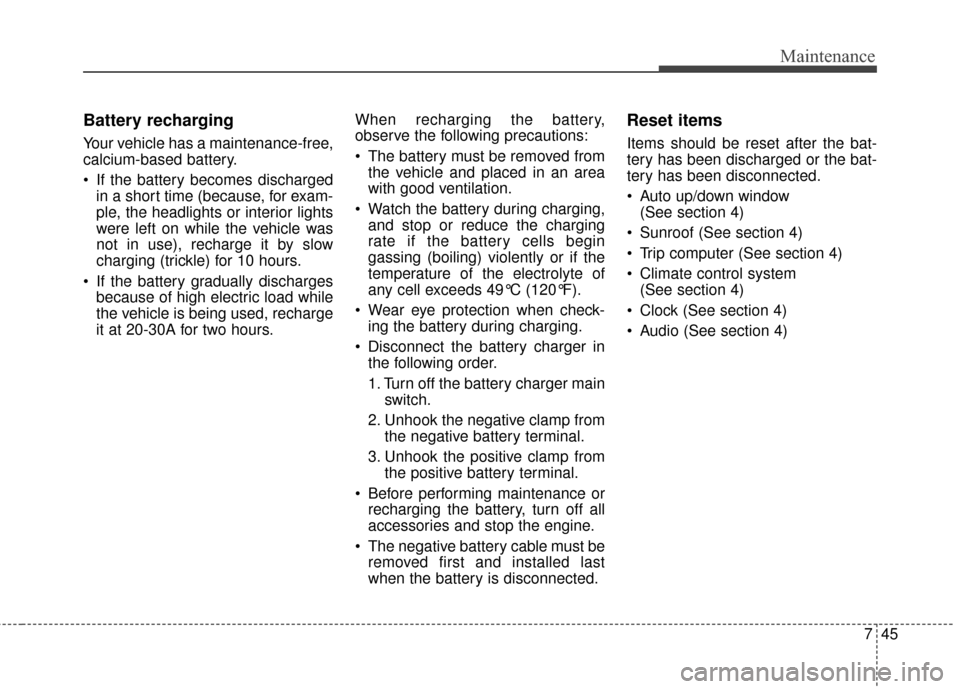
Battery recharging
Your vehicle has a maintenance-free,
calcium-based battery.
If the battery becomes dischargedin a short time (because, for exam-
ple, the headlights or interior lights
were left on while the vehicle was
not in use), recharge it by slow
charging (trickle) for 10 hours.
If the battery gradually discharges because of high electric load while
the vehicle is being used, recharge
it at 20-30A for two hours. When recharging the battery,
observe the following precautions:
The battery must be removed from
the vehicle and placed in an area
with good ventilation.
Watch the battery during charging, and stop or reduce the charging
rate if the battery cells begin
gassing (boiling) violently or if the
temperature of the electrolyte of
any cell exceeds 49°C (120°F).
Wear eye protection when check- ing the battery during charging.
Disconnect the battery charger in the following order.
1. Turn off the battery charger main switch.
2. Unhook the negative clamp from the negative battery terminal.
3. Unhook the positive clamp from the positive battery terminal.
Before performing maintenance or recharging the battery, turn off all
accessories and stop the engine.
The negative battery cable must be removed first and installed last
when the battery is disconnected.
Reset items
Items should be reset after the bat-
tery has been discharged or the bat-
tery has been disconnected.
Auto up/down window (See section 4)
Sunroof (See section 4)
Trip computer (See section 4)
Climate control system (See section 4)
Clock (See section 4)
Audio (See section 4)
Page 383 of 429

Maintenance
54
7
4. Tire ply composition and mate-
rial
The number of layers or plies of rub-
ber-coated fabric in the tire. Tire
manufacturers also must indicate the
materials in the tire, which include
steel, nylon, polyester, and others.
The letter "R" means radial ply con-
struction; the letter "D" means diago-
nal or bias ply construction; and the
letter "B" means belted-bias ply con-
struction.
5. Maximum permissible inflationpressure
This number is the greatest amount
of air pressure that should be put in
the tire. Do not exceed the maximum
permissible inflation pressure. Refer
to the Tire and Loading Information
label for recommended inflation
pressure.
6. Maximum load rating
This number indicates the maximum
load in kilograms and pounds that
can be carried by the tire. When
replacing the tires on the vehicle,
always use a tire that has the same
load rating as the factory installed
tire.
7. Uniform tire quality grading
Quality grades can be found where
applicable on the tire sidewall
between tread shoulder and maxi-
mum section width.
For example:
TREADWEAR 200
TRACTION AA
TEMPERATURE A Tread wear
The tread wear grade is a compara-
tive rating based on the wear rate of
the tire when tested under controlled
conditions on a specified govern-
ment test course. For example, a tire
graded 150 would wear one-and-a-
half times (1½) as well on the gov-
ernment course as a tire graded 100.
The relative performance of tires
depends upon the actual conditions
of their use, however, and may
depart significantly from the norm
due to variations in driving habits,
service practices and differences in
road characteristics and climate.
Regardless of the remaining tread,
we recommend that tires be replaced
after approximately six (6) years of
normal service. Heat caused by hot
climates or frequent high loading
conditions can accelerate the aging
process.
These grades are molded on the
side-walls of passenger vehicle tires.
The tires available as standard or
optional equipment on your vehicles
may vary with respect to grade.
Page 423 of 429
Index
2I
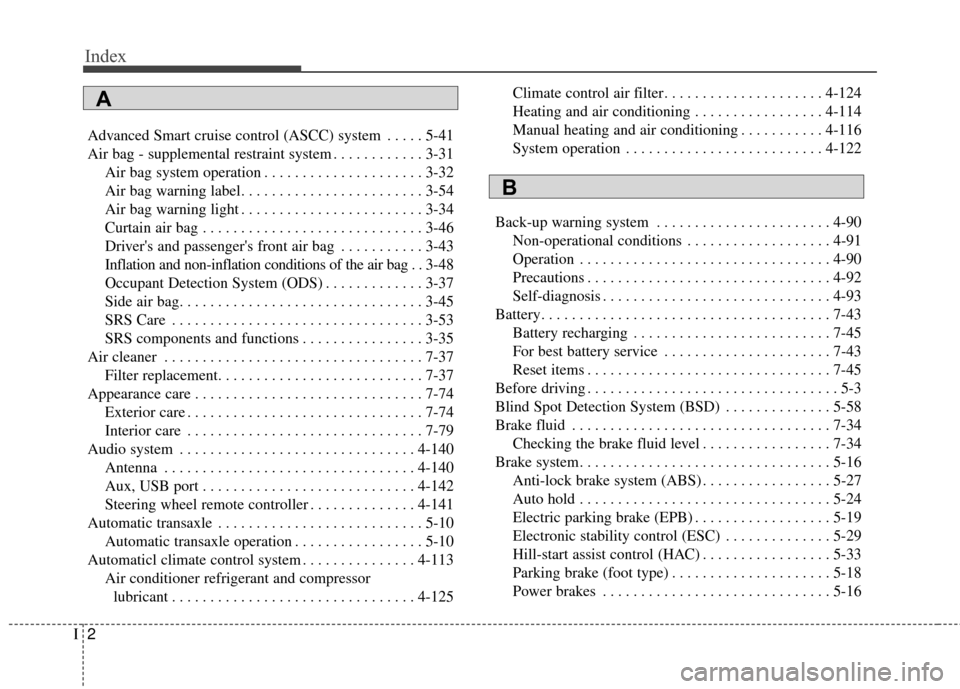
Advanced Smart cruise control (ASCC) system . . . . . 5-41
Air bag - supplemental restraint system . . . . . . . . . . . . 3-31Air bag system operation . . . . . . . . . . . . . . . . . . . . . 3-32
Air bag warning label. . . . . . . . . . . . . . . . . . . . . . . . 3-54
Air bag warning light . . . . . . . . . . . . . . . . . . . . . . . . 3-34
Curtain air bag . . . . . . . . . . . . . . . . . . . . . . . . . . . . . 3-46
Driver's and passenger's front air bag . . . . . . . . . . . 3-43
Inflation and non-inflation conditions of the air bag . . 3-48
Occupant Detection System (ODS) . . . . . . . . . . . . . 3-37
Side air bag. . . . . . . . . . . . . . . . . . . . . . . . . . . . . . . . 3-45
SRS Care . . . . . . . . . . . . . . . . . . . . . . . . . . . . . . . . . 3-53
SRS components and functions . . . . . . . . . . . . . . . . 3-35
Air cleaner . . . . . . . . . . . . . . . . . . . . . . . . . . . . . . . . . . 7-37\
Filter replacement. . . . . . . . . . . . . . . . . . . . . . . . . . . 7-37
Appearance care . . . . . . . . . . . . . . . . . . . . . . . . . . . . . . 7-74 Exterior care . . . . . . . . . . . . . . . . . . . . . . . . . . . . . . . 7-74
Interior care . . . . . . . . . . . . . . . . . . . . . . . . . . . . . . . 7-79
Audio system . . . . . . . . . . . . . . . . . . . . . . . . . . . . . . . 4-140 Antenna . . . . . . . . . . . . . . . . . . . . . . . . . . . . . . . . . 4-140
Aux, USB port . . . . . . . . . . . . . . . . . . . . . . . . . . . . 4-142
Steering wheel remote controller . . . . . . . . . . . . . . 4-141
Automatic transaxle . . . . . . . . . . . . . . . . . . . . . . . . . . . 5-10 Automatic transaxle operation . . . . . . . . . . . . . . . . . 5-10
Automaticl climate control system . . . . . . . . . . . . . . . 4-113 Air conditioner refrigerant and compressorlubricant . . . . . . . . . . . . . . . . . . . . . . . . . . . . . . . . 4-125 Climate control air filter. . . . . . . . . . . . . . . . . . . . . 4-124
Heating and air conditioning . . . . . . . . . . . . . . . . . 4-114
Manual heating and air conditioning . . . . . . . . . . . 4-116
System operation . . . . . . . . . . . . . . . . . . . . . . . . . . 4-122
Back-up warning system . . . . . . . . . . . . . . . . . . . . . . . 4-90 Non-operational conditions . . . . . . . . . . . . . . . . . . . 4-91
Operation . . . . . . . . . . . . . . . . . . . . . . . . . . . . . . . . . 4-90
Precautions . . . . . . . . . . . . . . . . . . . . . . . . . . . . . . . . 4-92
Self-diagnosis . . . . . . . . . . . . . . . . . . . . . . . . . . . . . . 4-93
Battery. . . . . . . . . . . . . . . . . . . . . . . . . . . . . . . . . . . . \
. . 7-43 Battery recharging . . . . . . . . . . . . . . . . . . . . . . . . . . 7-45
For best battery service . . . . . . . . . . . . . . . . . . . . . . 7-43
Reset items . . . . . . . . . . . . . . . . . . . . . . . . . . . . . . . . 7-45
Before driving . . . . . . . . . . . . . . . . . . . . . . . . . . . . . . . . . 5-3
Blind Spot Detection System (BSD) . . . . . . . . . . . . . . 5-58
Brake fluid . . . . . . . . . . . . . . . . . . . . . . . . . . . . . . . . . . 7-34\
Checking the brake fluid level . . . . . . . . . . . . . . . . . 7-34
Brake system. . . . . . . . . . . . . . . . . . . . . . . . . . . . . . . . . 5-16 Anti-lock brake system (ABS) . . . . . . . . . . . . . . . . . 5-27
Auto hold . . . . . . . . . . . . . . . . . . . . . . . . . . . . . . . . . 5-24
Electric parking brake (EPB) . . . . . . . . . . . . . . . . . . 5-19
Electronic stability control (ESC) . . . . . . . . . . . . . . 5-29
Hill-start assist control (HAC) . . . . . . . . . . . . . . . . . 5-33
Parking brake (foot type) . . . . . . . . . . . . . . . . . . . . . 5-18
Power brakes . . . . . . . . . . . . . . . . . . . . . . . . . . . . . . 5-16
A
B
Page 424 of 429
I3
Index
Vehicle stability management (VSM) . . . . . . . . . . . 5-33
Bulb wattage . . . . . . . . . . . . . . . . . . . . . . . . . . . . . . . . . . 8-4
Child restraint system . . . . . . . . . . . . . . . . . . . . . . . . . . 3-24 Lower anchor system . . . . . . . . . . . . . . . . . . . . . . . . 3-29
Tether anchor system . . . . . . . . . . . . . . . . . . . . . . . 3-28
Using a child restraint system . . . . . . . . . . . . . . . . . 3-25
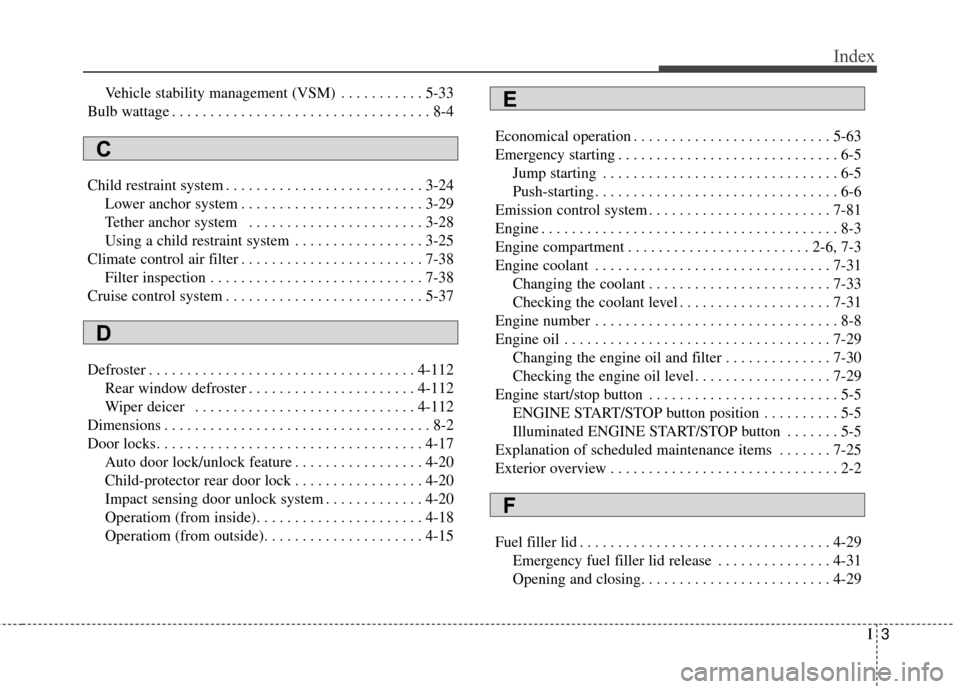
Climate control air filter . . . . . . . . . . . . . . . . . . . . . . . . 7-38 Filter inspection . . . . . . . . . . . . . . . . . . . . . . . . . . . . 7-38
Cruise control system . . . . . . . . . . . . . . . . . . . . . . . . . . 5-37
Defroster . . . . . . . . . . . . . . . . . . . . . . . . . . . . . . . . . . . 4-\
112 Rear window defroster . . . . . . . . . . . . . . . . . . . . . . 4-112
Wiper deicer . . . . . . . . . . . . . . . . . . . . . . . . . . . . . 4-112
Dimensions . . . . . . . . . . . . . . . . . . . . . . . . . . . . . . . . . . . 8-\
2
Door locks. . . . . . . . . . . . . . . . . . . . . . . . . . . . . . . . . . . 4-\
17 Auto door lock/unlock feature . . . . . . . . . . . . . . . . . 4-20
Child-protector rear door lock . . . . . . . . . . . . . . . . . 4-20
Impact sensing door unlock system . . . . . . . . . . . . . 4-20
Operatiom (from inside). . . . . . . . . . . . . . . . . . . . . . 4-18
Operatiom (from outside). . . . . . . . . . . . . . . . . . . . . 4-15 Economical operation . . . . . . . . . . . . . . . . . . . . . . . . . . 5-63
Emergency starting . . . . . . . . . . . . . . . . . . . . . . . . . . . . . 6-5
Jump starting . . . . . . . . . . . . . . . . . . . . . . . . . . . . . . . 6-5
Push-starting . . . . . . . . . . . . . . . . . . . . . . . . . . . . . . . . 6-6
Emission control system . . . . . . . . . . . . . . . . . . . . . . . . 7-81
Engine . . . . . . . . . . . . . . . . . . . . . . . . . . . . . . . . . . . . \
. . . 8-3
Engine compartment . . . . . . . . . . . . . . . . . . . . . . . . 2-6, 7-3
Engine coolant . . . . . . . . . . . . . . . . . . . . . . . . . . . . . . . 7-31 Changing the coolant . . . . . . . . . . . . . . . . . . . . . . . . 7-33
Checking the coolant level . . . . . . . . . . . . . . . . . . . . 7-31
Engine number . . . . . . . . . . . . . . . . . . . . . . . . . . . . . . . . 8-8
Engine oil . . . . . . . . . . . . . . . . . . . . . . . . . . . . . . . . . . . 7-\
29 Changing the engine oil and filter . . . . . . . . . . . . . . 7-30
Checking the engine oil level . . . . . . . . . . . . . . . . . . 7-29
Engine start/stop button . . . . . . . . . . . . . . . . . . . . . . . . . 5-5 ENGINE START/STOP button position . . . . . . . . . . 5-5
Illuminated ENGINE START/STOP button . . . . . . . 5-5
Explanation of scheduled maintenance items . . . . . . . 7-25
Exterior overview . . . . . . . . . . . . . . . . . . . . . . . . . . . . . . 2-2
Fuel filler lid . . . . . . . . . . . . . . . . . . . . . . . . . . . . . . . . . 4-29 Emergency fuel filler lid release . . . . . . . . . . . . . . . 4-31
Opening and closing. . . . . . . . . . . . . . . . . . . . . . . . . 4-29
C
D
E
F