check engine KIA Cadenza 2015 1.G Workshop Manual
[x] Cancel search | Manufacturer: KIA, Model Year: 2015, Model line: Cadenza, Model: KIA Cadenza 2015 1.GPages: 429, PDF Size: 5.47 MB
Page 400 of 429
771
Maintenance
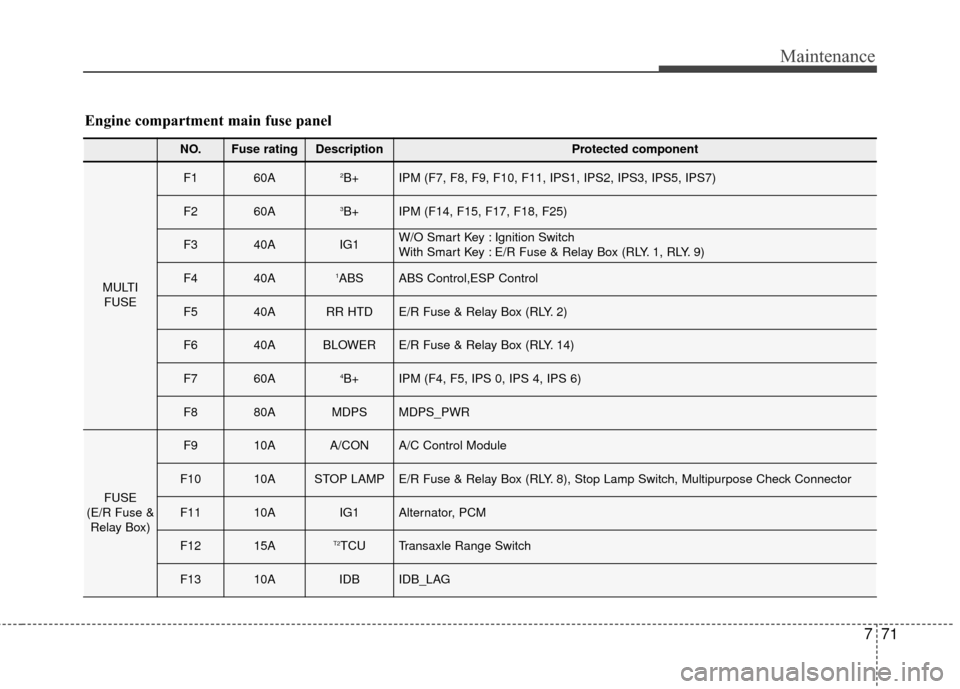
NO.Fuse ratingDescriptionProtected component
MULTIFUSE
F160A2B+IPM (F7, F8, F9, F10, F11, IPS1, IPS2, IPS3, IPS5, IPS7)
F260A3B+IPM (F14, F15, F17, F18, F25)
F340AIG1W/O Smart Key : Ignition Switch
With Smart Key : E/R Fuse & Relay Box (RLY. 1, RLY. 9)
F440A1ABSABS Control,ESP Control
F540ARR HTDE/R Fuse & Relay Box (RLY. 2)
F640ABLOWERE/R Fuse & Relay Box (RLY. 14)
F760A4B+IPM (F4, F5, IPS 0, IPS 4, IPS 6)
F880AMDPSMDPS_PWR
FUSE
(E/R Fuse & Relay Box)
F910AA/CONA/C Control Module
F1010ASTOP LAMPE/R Fuse & Relay Box (RLY. 8), Stop Lamp Switch, Multipurpose Check Connector
F1110AIG1Alternator, PCM
F1215AT2TCUTransaxle Range Switch
F1310AIDBIDB_LAG
Engine compartment main fuse panel
Page 411 of 429
Maintenance
82
7
Canister
Fuel vapors generated inside the fuel
tank are absorbed and stored in the
onboard canister. When the engine is
running, the fuel vapors absorbed in
the canister are drawn into the surge
tank through the purge control sole-
noid valve.
Purge Control Solenoid Valve
(PCSV)
The purge control solenoid valve is
controlled by the Engine Control
Module (ECM); when the engine
coolant temperature is low during
idling, the PCSV closes so that evap-
orated fuel is not taken into the
engine. After the engine warms up
during ordinary driving, the PCSV
opens to introduce evaporated fuel to
the engine.
3. Exhaust emission control
system
The Exhaust Emission Control
System is a highly effective system
which controls exhaust emissions
while maintaining good vehicle per-
formance.
Vehicle modifications
This vehicle should not be modified.
Modification of your vehicle could
affect its performance, safety or
durability and may even violate gov-
ernmental safety and emissions reg-
ulations.
In addition, damage or performance
problems resulting from any modifi-
cation may not be covered under
warranty.
If you use unauthorized electronic
devices, it may cause the vehicle to
operate abnormally, wire damage,
battery discharge and fire. For your
safety, do not use unauthorized
electronic devices.
Engine exhaust gas precautions
(carbon monoxide)
Carbon monoxide can be present with other exhaust fumes.
Therefore, if you smell exhaust
fumes of any kind inside your vehi-
cle, have it inspected and repaired
immediately. If you ever suspect
exhaust fumes are coming into
your vehicle, drive it only with all
the windows fully open. Have your
vehicle checked and repaired
immediately.
Page 419 of 429
Specifications & Consumer information
68
Recommended SAE viscosity
number
Always be sure to clean the area
around any filler plug, drain plug, or
dipstick before checking or draining
any lubricant. This is especially
important in dusty or sandy areas
and when the vehicle is used on
unpaved roads. Cleaning the plug
and dipstick areas will prevent dirt
and grit from entering the engine and
other mechanisms that could be
damaged.Engine oil viscosity (thickness) has
an effect on fuel economy and cold
weather operating (engine start and
engine oil flowability). Lower viscosi-
ty engine oils can provide better fuel
economy and cold weather perform-
ance, however, higher viscosity
engine oils are required for satisfac-
tory lubrication in hot weather. Using
oils of any viscosity other than those
recommended could result in engine
damage.
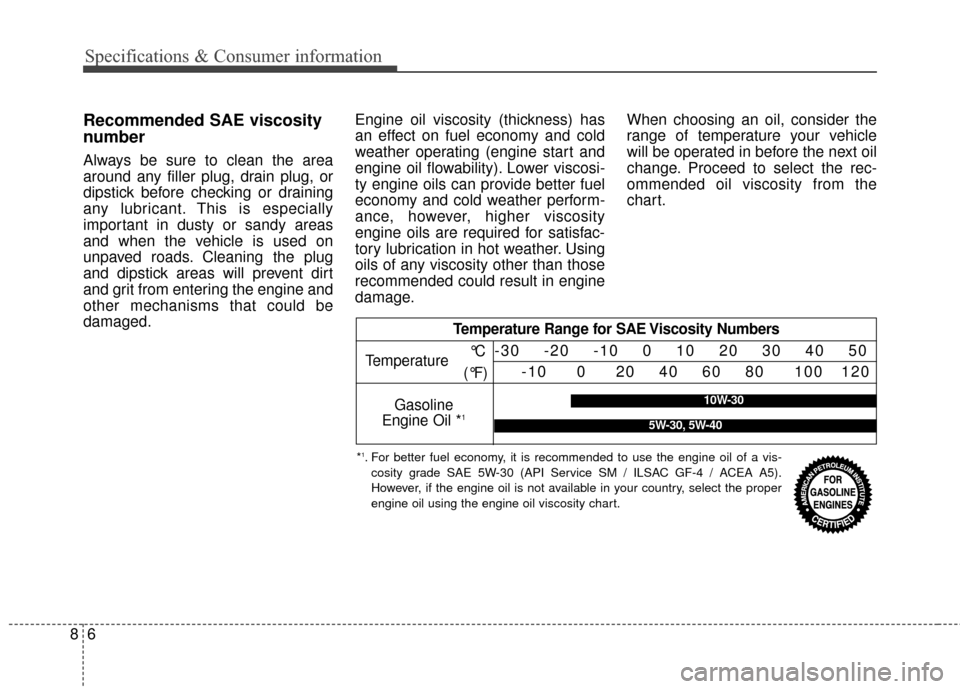
When choosing an oil, consider the
range of temperature your vehicle
will be operated in before the next oil
change. Proceed to select the rec-
ommended oil viscosity from the
chart.
Temperature Range for SAE Viscosity Numbers
Temperature
Gasoline
Engine Oil *
1
°C
(°F)-30 -20 -10 0 10 20 30 40 50 -10 0 20 40 60 80 100 120
*1. For better fuel economy, it is recommended to use the engine oil of a vis-cosity grade SAE 5W-30 (API Service SM / ILSAC GF-4 / ACEA A5).
However, if the engine oil is not available in your country, select the proper
engine oil using the engine oil viscosity chart.
10W-30
5W-30, 5W-40
Page 424 of 429
I3
Index
Vehicle stability management (VSM) . . . . . . . . . . . 5-33
Bulb wattage . . . . . . . . . . . . . . . . . . . . . . . . . . . . . . . . . . 8-4
Child restraint system . . . . . . . . . . . . . . . . . . . . . . . . . . 3-24 Lower anchor system . . . . . . . . . . . . . . . . . . . . . . . . 3-29
Tether anchor system . . . . . . . . . . . . . . . . . . . . . . . 3-28
Using a child restraint system . . . . . . . . . . . . . . . . . 3-25
Climate control air filter . . . . . . . . . . . . . . . . . . . . . . . . 7-38 Filter inspection . . . . . . . . . . . . . . . . . . . . . . . . . . . . 7-38
Cruise control system . . . . . . . . . . . . . . . . . . . . . . . . . . 5-37
Defroster . . . . . . . . . . . . . . . . . . . . . . . . . . . . . . . . . . . 4-\
112 Rear window defroster . . . . . . . . . . . . . . . . . . . . . . 4-112
Wiper deicer . . . . . . . . . . . . . . . . . . . . . . . . . . . . . 4-112
Dimensions . . . . . . . . . . . . . . . . . . . . . . . . . . . . . . . . . . . 8-\
2
Door locks. . . . . . . . . . . . . . . . . . . . . . . . . . . . . . . . . . . 4-\
17 Auto door lock/unlock feature . . . . . . . . . . . . . . . . . 4-20
Child-protector rear door lock . . . . . . . . . . . . . . . . . 4-20
Impact sensing door unlock system . . . . . . . . . . . . . 4-20
Operatiom (from inside). . . . . . . . . . . . . . . . . . . . . . 4-18
Operatiom (from outside). . . . . . . . . . . . . . . . . . . . . 4-15 Economical operation . . . . . . . . . . . . . . . . . . . . . . . . . . 5-63
Emergency starting . . . . . . . . . . . . . . . . . . . . . . . . . . . . . 6-5
Jump starting . . . . . . . . . . . . . . . . . . . . . . . . . . . . . . . 6-5
Push-starting . . . . . . . . . . . . . . . . . . . . . . . . . . . . . . . . 6-6
Emission control system . . . . . . . . . . . . . . . . . . . . . . . . 7-81
Engine . . . . . . . . . . . . . . . . . . . . . . . . . . . . . . . . . . . . \
. . . 8-3
Engine compartment . . . . . . . . . . . . . . . . . . . . . . . . 2-6, 7-3
Engine coolant . . . . . . . . . . . . . . . . . . . . . . . . . . . . . . . 7-31 Changing the coolant . . . . . . . . . . . . . . . . . . . . . . . . 7-33
Checking the coolant level . . . . . . . . . . . . . . . . . . . . 7-31
Engine number . . . . . . . . . . . . . . . . . . . . . . . . . . . . . . . . 8-8
Engine oil . . . . . . . . . . . . . . . . . . . . . . . . . . . . . . . . . . . 7-\
29 Changing the engine oil and filter . . . . . . . . . . . . . . 7-30
Checking the engine oil level . . . . . . . . . . . . . . . . . . 7-29
Engine start/stop button . . . . . . . . . . . . . . . . . . . . . . . . . 5-5 ENGINE START/STOP button position . . . . . . . . . . 5-5
Illuminated ENGINE START/STOP button . . . . . . . 5-5
Explanation of scheduled maintenance items . . . . . . . 7-25
Exterior overview . . . . . . . . . . . . . . . . . . . . . . . . . . . . . . 2-2
Fuel filler lid . . . . . . . . . . . . . . . . . . . . . . . . . . . . . . . . . 4-29 Emergency fuel filler lid release . . . . . . . . . . . . . . . 4-31
Opening and closing. . . . . . . . . . . . . . . . . . . . . . . . . 4-29
C
D
E
F