power steering KIA CADENZA 2018 User Guide
[x] Cancel search | Manufacturer: KIA, Model Year: 2018, Model line: CADENZA, Model: KIA CADENZA 2018Pages: 502, PDF Size: 9.77 MB
Page 281 of 502
Driving your vehicle
42
5
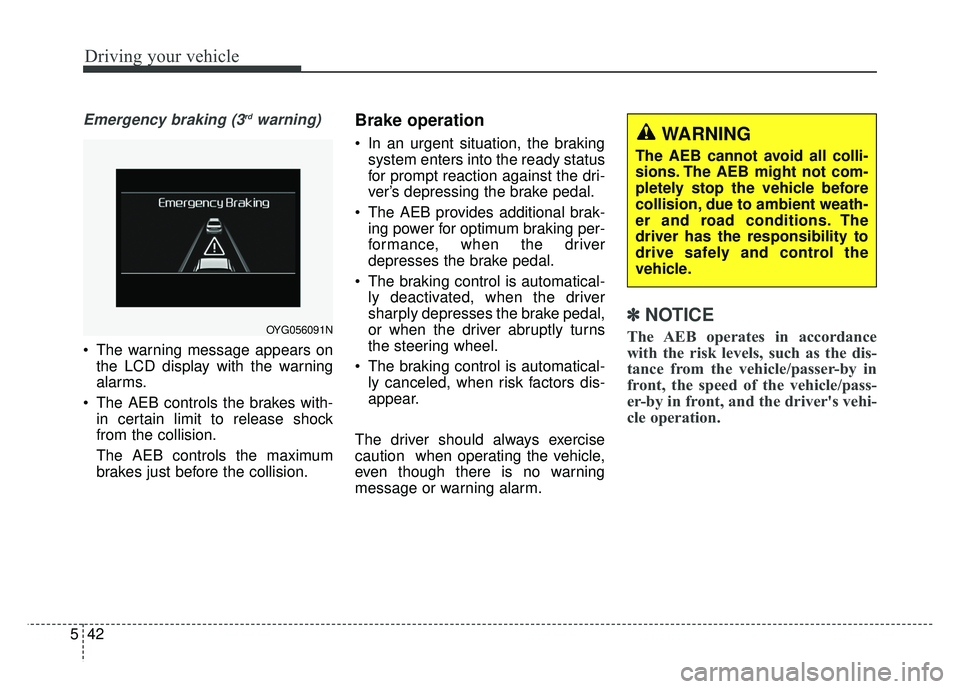
Emergency braking (3rdwarning)
The warning message appears on
the LCD display with the warning
alarms.
The AEB controls the brakes with- in certain limit to release shock
from the collision.
The AEB controls the maximum
brakes just before the collision.
Brake operation
In an urgent situation, the brakingsystem enters into the ready status
for prompt reaction against the dri-
ver’s depressing the brake pedal.
The AEB provides additional brak- ing power for optimum braking per-
formance, when the driver
depresses the brake pedal.
The braking control is automatical- ly deactivated, when the driver
sharply depresses the brake pedal,
or when the driver abruptly turns
the steering wheel.
The braking control is automatical- ly canceled, when risk factors dis-
appear.
The driver should always exercise
caution when operating the vehicle,
even though there is no warning
message or warning alarm.
✽ ✽ NOTICE
The AEB operates in accordance
with the risk levels, such as the dis-
tance from the vehicle/passer-by in
front, the speed of the vehicle/pass-
er-by in front, and the driver's vehi-
cle operation. OYG056091N
WARNING
The AEB cannot avoid all colli-
sions. The AEB might not com-
pletely stop the vehicle before
collision, due to ambient weath-
er and road conditions. The
driver has the responsibility to
drive safely and control the
vehicle.
Page 324 of 502
585
Driving your vehicle
It gently applies braking power on the
tire, which is located in the opposite
side of the possibly-colliding point.
The instrument cluster will inform the
driver of the system activation.
The Smart Blind Spot Detection
System is automatically deactivated,
when the vehicle drives a certain dis-
tance away, when the vehicle direc-
tion is changed against the possible-
colliding point, when the steering
wheel is abruptly moved, or when the
brake pedal is depressed.
When the turn signals operate, the
Smart Blind Spot Detection System
operates only once. However, when
the turn signals are turned off, the sys-
tem re-enters the activation conditions.
The driver should drive the vehicle in
the middle of the vehicle lanes to
keep the system in the ready status.
When the vehicle drives too close to
one side of the vehicle lanes, the
system may not properly operate.
In addition, the system may not prop-
erly control your vehicle in accordance
with driving situations. Thus, always
pay close attention to road situations.Warning message
When there is a malfunction with the
Smart Blind Spot Detection System,
warning message ("Smart BSD brak-
ing system malfunction") appears on
LCD display and deactivates the
Smart Blind Spot Detection System.
In this case, we recommend you to
have your vehicle inspected by an
authorized Kia dealer.
Limitations of the system
The driver must be cautious in the
below situations, because the sys-
tem may not detect other vehicles or
objects in certain circumstances.
The vehicle drives on a curvedroad or through a tollgate.
The sensor is polluted with rain, snow, mud, etc.
The rear bumper where the sensor is located is covered with a foreign
object such as a bumper sticker, a
bumper guard, a bike rack, etc.
The rear bumper is damaged, or the sensor is out of the original
default position.
The vehicle height gets lower or higher due to heavy loading in a
trunk, abnormal tire pressure, etc.
The vehicle drives in inclement weather such as heavy rain or snow.
There is a fixed object near the vehicle, such as a guardrail.
A big vehicle is near such as a bus or truck.
Page 332 of 502
593
Driving your vehicle
Remember, your vehicle does notrequire extended warm-up. After
the engine has started, allow the
engine to run for 10 to 20 seconds
prior to placing the vehicle in gear.
In very cold weather, however, give
your engine a slightly longer warm-
up period.
Don't "lug" or "over-rev" the engine. Lugging is driving too slowly in a
very high gear resulting in engine
bucking. If this happens, shift to a
lower gear. Over-revving is racing
the engine beyond its safe limit.
This can be avoided by shifting at
the recommended speed. Use your air conditioning sparingly.
The air conditioning system is
operated by engine power so your
fuel economy is reduced when you
use it.
Open windows at high speeds can reduce fuel economy.
Fuel economy is less in crosswinds and headwinds. To help offset
some of this loss, slow down when
driving in these conditions.
Keeping a vehicle in good operating
condition is important both for econ-
omy and safety. Therefore, have an
authorized Kia dealer perform
scheduled inspections and mainte-
nance.
WARNING - Engine off
during motion
Never turn the engine off to
coast down hills or anytime the
vehicle is in motion. The power
steering and power brakes will
not function properly without the
engine running. In addition, turn-
ing off the ignition while driving
could lead to out of working
power driven steering wheel and
hard to control steering wheel.
Keep the engine on and down-
shift to an appropriate gear for
an engine braking effect.
Page 371 of 502
What to do in an emergency
26
6
3. Install the towing hook by turning it
clockwise into the hole until it is
fully secured.
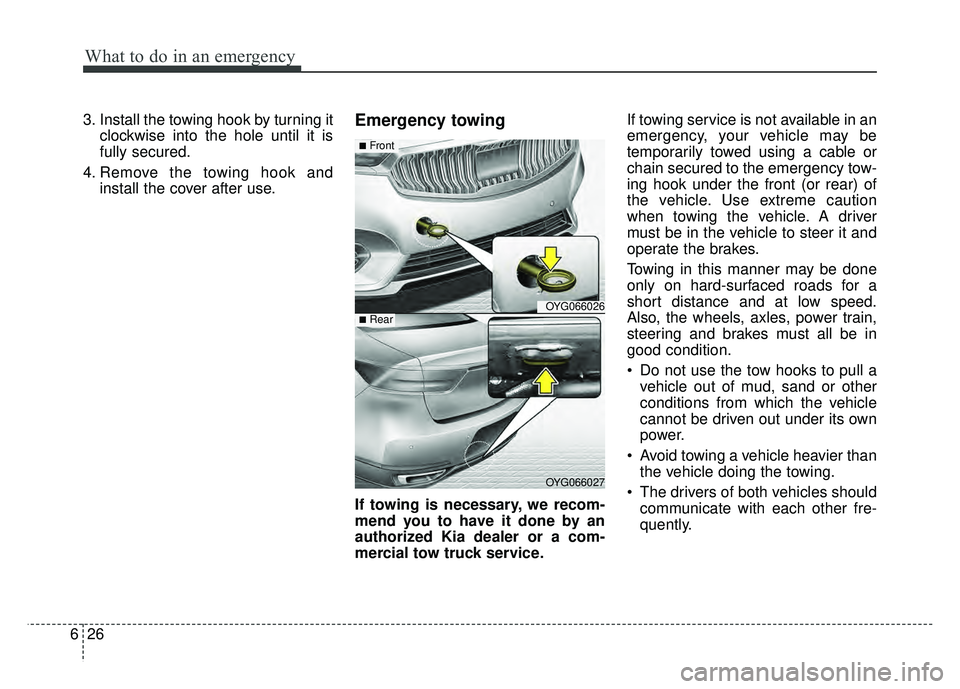
4. Remove the towing hook and install the cover after use.Emergency towing
If towing is necessary, we recom-
mend you to have it done by an
authorized Kia dealer or a com-
mercial tow truck service. If towing service is not available in an
emergency, your vehicle may be
temporarily towed using a cable or
chain secured to the emergency tow-
ing hook under the front (or rear) of
the vehicle. Use extreme caution
when towing the vehicle. A driver
must be in the vehicle to steer it and
operate the brakes.
Towing in this manner may be done
only on hard-surfaced roads for a
short distance and at low speed.
Also, the wheels, axles, power train,
steering and brakes must all be in
good condition.
Do not use the tow hooks to pull a
vehicle out of mud, sand or other
conditions from which the vehicle
cannot be driven out under its own
power.
Avoid towing a vehicle heavier than the vehicle doing the towing.
The drivers of both vehicles should communicate with each other fre-
quently.
OYG066026
OYG066027
■Front
■Rear
Page 373 of 502
What to do in an emergency
28
6
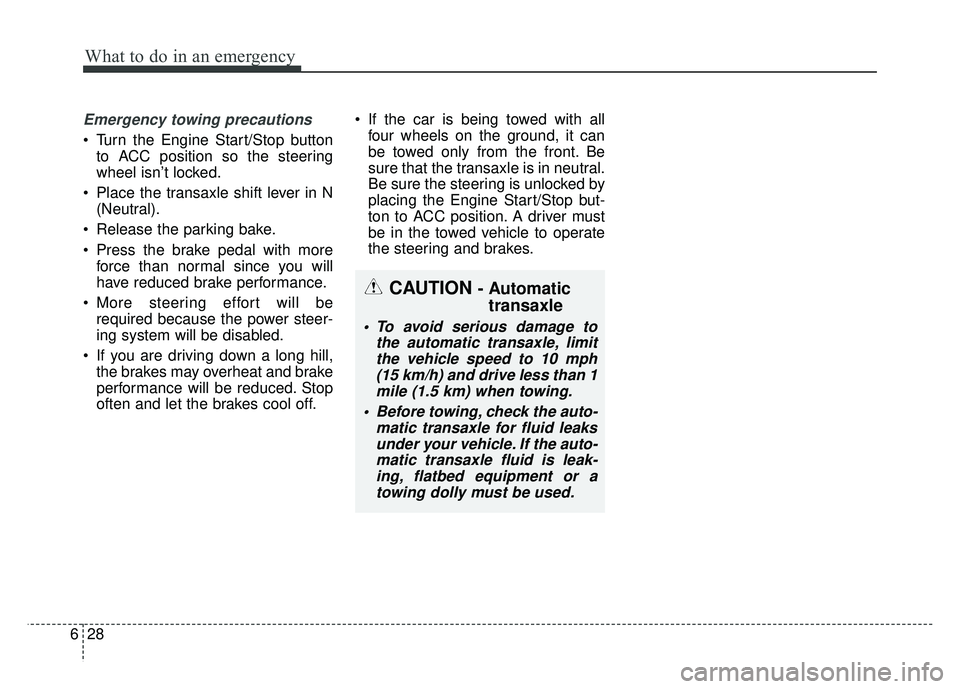
Emergency towing precautions
Turn the Engine Start/Stop button
to ACC position so the steering
wheel isn’t locked.
Place the transaxle shift lever in N (Neutral).
Release the parking bake.
Press the brake pedal with more force than normal since you will
have reduced brake performance.
More steering effort will be required because the power steer-
ing system will be disabled.
If you are driving down a long hill, the brakes may overheat and brake
performance will be reduced. Stop
often and let the brakes cool off. If the car is being towed with all
four wheels on the ground, it can
be towed only from the front. Be
sure that the transaxle is in neutral.
Be sure the steering is unlocked by
placing the Engine Start/Stop but-
ton to ACC position. A driver must
be in the towed vehicle to operate
the steering and brakes.
CAUTION - Automatictransaxle
To avoid serious damage to
the automatic transaxle, limitthe vehicle speed to 10 mph(15 km/h) and drive less than 1mile (1.5 km) when towing.
Before towing, check the auto- matic transaxle for fluid leaksunder your vehicle. If the auto-matic transaxle fluid is leak-ing, flatbed equipment or atowing dolly must be used.
Page 438 of 502
765
Maintenance
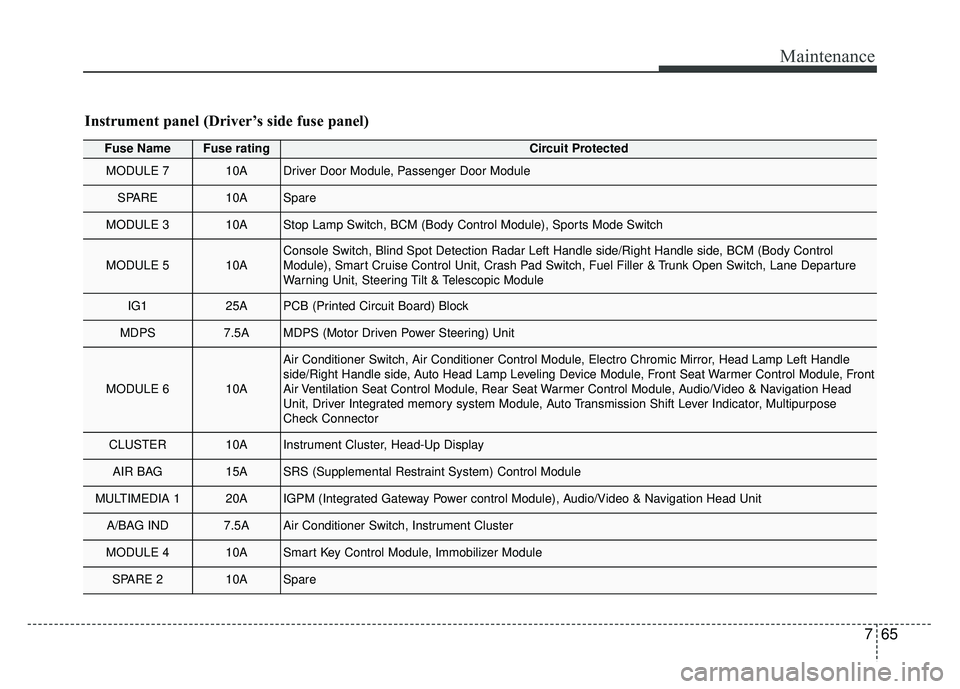
Fuse NameFuse ratingCircuit Protected
MODULE 710ADriver Door Module, Passenger Door Module
SPARE10ASpare
MODULE 310AStop Lamp Switch, BCM (Body Control Module), Sports Mode Switch
MODULE 510AConsole Switch, Blind Spot Detection Radar Left Handle side/Right Handle\
side, BCM (Body Control
Module), Smart Cruise Control Unit, Crash Pad Switch, Fuel Filler & Trunk Open Switch, Lane Departure
Warning Unit, Steering Tilt & Telescopic Module
IG125APCB (Printed Circuit Board) Block
MDPS7.5AMDPS (Motor Driven Power Steering) Unit
MODULE 610A
Air Conditioner Switch, Air Conditioner Control Module, Electro Chromic Mirror, Head Lamp Left Handle
side/Right Handle side, Auto Head Lamp Leveling Device Module, Front Seat Warmer Control Module, Front
Air Ventilation Seat Control Module, Rear Seat Warmer Control Module, Audio/Video & Navigation Head
Unit, Driver Integrated memory system Module, Auto Transmission Shift Lever Indicator, Multipurpose
Check Connector
CLUSTER10AInstrument Cluster, Head-Up Display
AIR BAG15ASRS (Supplemental Restraint System) Control Module
MULTIMEDIA 120AIGPM (Integrated Gateway Power control Module), Audio/Video & Navigation Head Unit
A/BAG IND7.5AAir Conditioner Switch, Instrument Cluster
MODULE 410ASmart Key Control Module, Immobilizer Module
SPARE 210ASpare
Instrument panel (Driver’s side fuse panel)
Page 439 of 502
Maintenance
66
7
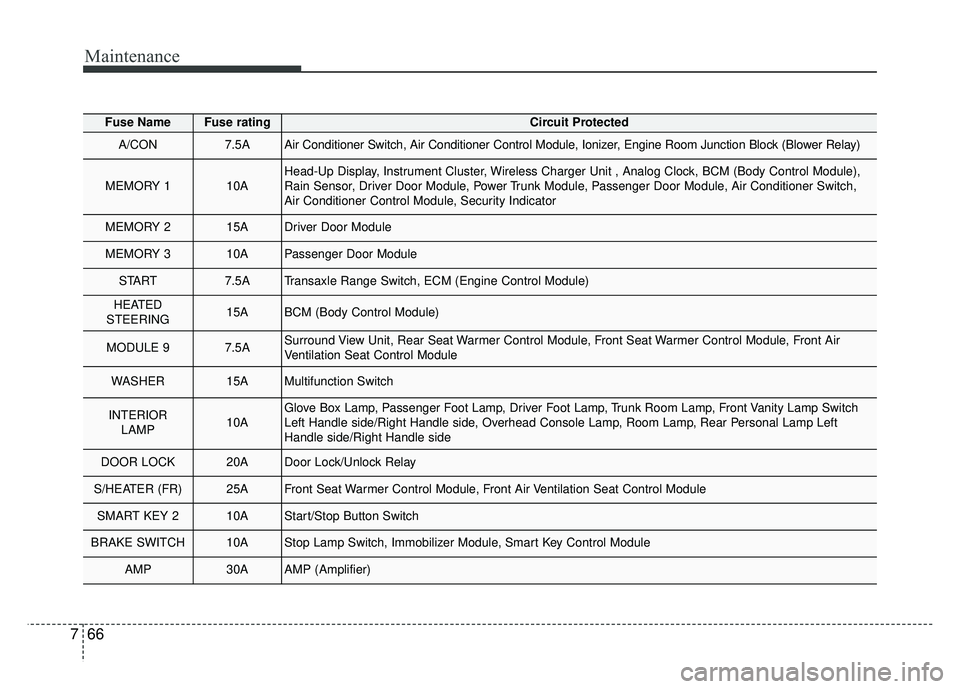
Fuse NameFuse ratingCircuit Protected
A/CON7.5AAir Conditioner Switch, Air Conditioner Control Module, Ionizer, Engine Room Junction Block (Blower Relay)
MEMORY 110AHead-Up Display, Instrument Cluster, Wireless Charger Unit , Analog Clock, BCM (Body Control Module),
Rain Sensor, Driver Door Module, Power Trunk Module, Passenger Door Module, Air Conditioner Switch,
Air Conditioner Control Module, Security Indicator
MEMORY 215ADriver Door Module
MEMORY 310APassenger Door Module
START7.5ATransaxle Range Switch, ECM (Engine Control Module)
HEATED
STEERING15ABCM (Body Control Module)
MODULE 97.5ASurround View Unit, Rear Seat Warmer Control Module, Front Seat Warmer Control Module, Front Air
Ventilation Seat Control Module
WASHER15AMultifunction Switch
INTERIOR LAMP10AGlove Box Lamp, Passenger Foot Lamp, Driver Foot Lamp, Trunk Room Lamp, Front Vanity Lamp Switch
Left Handle side/Right Handle side, Overhead Console Lamp, Room Lamp, Rear Personal Lamp Left
Handle side/Right Handle side
DOOR LOCK20ADoor Lock/Unlock Relay
S/HEATER (FR)25AFront Seat Warmer Control Module, Front Air Ventilation Seat Control Module
SMART KEY 210AStart/Stop Button Switch
BRAKE SWITCH10AStop Lamp Switch, Immobilizer Module, Smart Key Control Module
AMP30AAMP (Amplifier)
Page 440 of 502
767
Maintenance
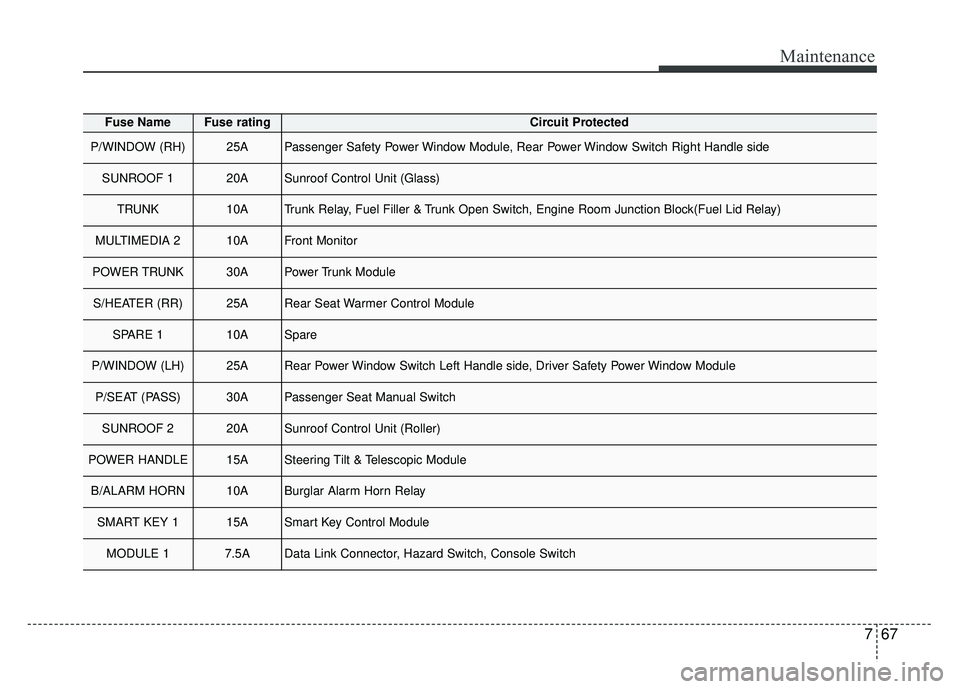
Fuse NameFuse ratingCircuit Protected
P/WINDOW (RH)25APassenger Safety Power Window Module, Rear Power Window Switch Right Handle side
SUNROOF 120ASunroof Control Unit (Glass)
TRUNK10ATrunk Relay, Fuel Filler & Trunk Open Switch, Engine Room Junction Block(Fuel Lid Relay)
MULTIMEDIA 210AFront Monitor
POWER TRUNK30APower Trunk Module
S/HEATER (RR)25ARear Seat Warmer Control Module
SPARE 110ASpare
P/WINDOW (LH)25ARear Power Window Switch Left Handle side, Driver Safety Power Window Module
P/SEAT (PASS)30APassenger Seat Manual Switch
SUNROOF 220ASunroof Control Unit (Roller)
POWER HANDLE15ASteering Tilt & Telescopic Module
B/ALARM HORN10ABurglar Alarm Horn Relay
SMART KEY 115ASmart Key Control Module
MODULE 17.5AData Link Connector, Hazard Switch, Console Switch
Page 443 of 502
Maintenance
70
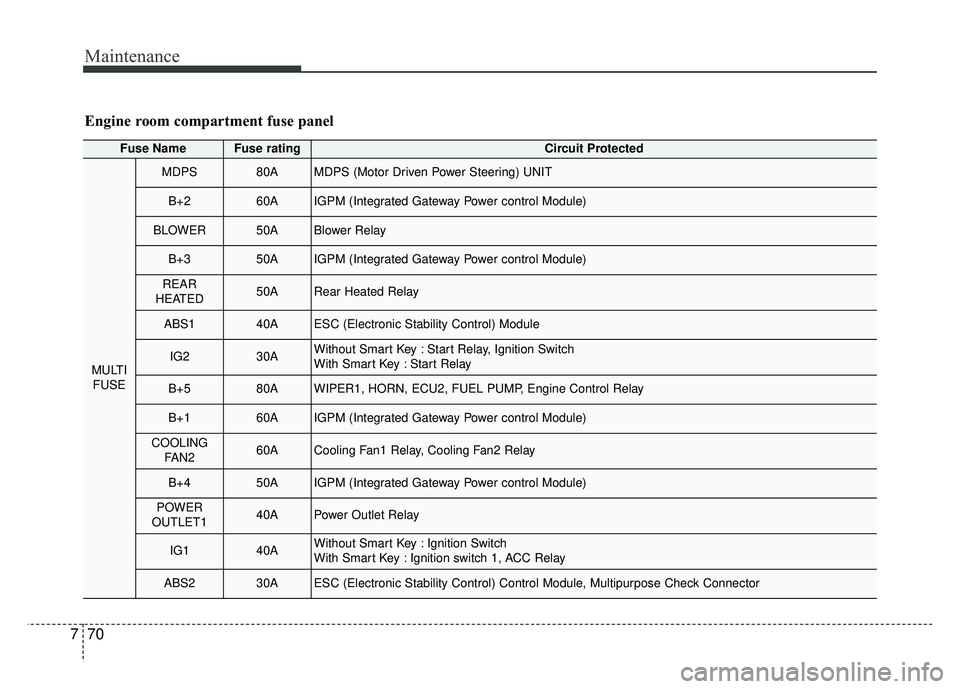
7
Fuse NameFuse ratingCircuit Protected
MULTI
FUSE
MDPS80AMDPS (Motor Driven Power Steering) UNIT
B+260AIGPM (Integrated Gateway Power control Module)
BLOWER50ABlower Relay
B+350AIGPM (Integrated Gateway Power control Module)
REAR
HEATED50ARear Heated Relay
ABS140AESC (Electronic Stability Control) Module
IG230AWithout Smart Key : Start Relay, Ignition Switch
With Smart Key : Start Relay
B+580AWIPER1, HORN, ECU2, FUEL PUMP, Engine Control Relay
B+160AIGPM (Integrated Gateway Power control Module)
COOLING FAN260ACooling Fan1 Relay, Cooling Fan2 Relay
B+450AIGPM (Integrated Gateway Power control Module)
POWER
OUTLET140APower Outlet Relay
IG140AWithout Smart Key : Ignition Switch
With Smart Key : Ignition switch 1, ACC Relay
ABS230AESC (Electronic Stability Control) Control Module, Multipurpose Check Connector
Engine room compartment fuse panel
Page 492 of 502
I5
Index
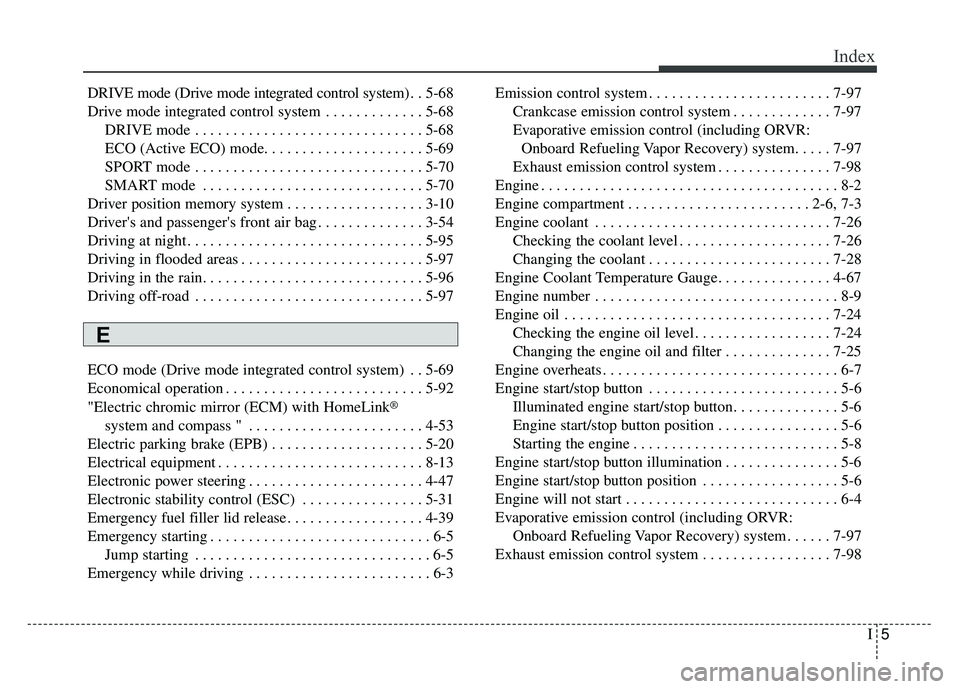
DRIVE mode (Drive mode integrated control system) . . 5-68
Drive mode integrated control system . . . . . . . . . . . . . 5-68 DRIVE mode . . . . . . . . . . . . . . . . . . . . . . . . . . . . . . 5-68
ECO (Active ECO) mode. . . . . . . . . . . . . . . . . . . . . 5-69
SPORT mode . . . . . . . . . . . . . . . . . . . . . . . . . . . . . . 5-70
SMART mode . . . . . . . . . . . . . . . . . . . . . . . . . . . . . 5-70
Driver position memory system . . . . . . . . . . . . . . . . . . 3-10
Driver's and passenger's front air bag . . . . . . . . . . . . . . 3-54
Driving at night . . . . . . . . . . . . . . . . . . . . . . . . . . . . . . . 5-95
Driving in flooded areas . . . . . . . . . . . . . . . . . . . . . . . . 5-97
Driving in the rain. . . . . . . . . . . . . . . . . . . . . . . . . . . . . 5-96
Driving off-road . . . . . . . . . . . . . . . . . . . . . . . . . . . . . . 5-97
ECO mode (Drive mode integrated control system) . . 5-69
Economical operation . . . . . . . . . . . . . . . . . . . . . . . . . . 5-92
"Electric chromic mirror (ECM) with HomeLink
®
system and compass " . . . . . . . . . . . . . . . . . . . . . . . 4-53
Electric parking brake (EPB) . . . . . . . . . . . . . . . . . . . . 5-20
Electrical equipment . . . . . . . . . . . . . . . . . . . . . . . . . . . 8-13
Electronic power steering . . . . . . . . . . . . . . . . . . . . . . . 4-47
Electronic stability control (ESC) . . . . . . . . . . . . . . . . 5-31
Emergency fuel filler lid release. . . . . . . . . . . . . . . . . . 4-39
Emergency starting . . . . . . . . . . . . . . . . . . . . . . . . . . . . . 6-5 Jump starting . . . . . . . . . . . . . . . . . . . . . . . . . . . . . . . 6-5
Emergency while driving . . . . . . . . . . . . . . . . . . . . . . . . 6-3 Emission control system . . . . . . . . . . . . . . . . . . . . . . . . 7-97
Crankcase emission control system . . . . . . . . . . . . . 7-97
Evaporative emission control (including ORVR:Onboard Refueling Vapor Recovery) system. . . . . 7-97
Exhaust emission control system . . . . . . . . . . . . . . . 7-98
Engine . . . . . . . . . . . . . . . . . . . . . . . . . . . . . . . . . . . . \
. . . 8-2
Engine compartment . . . . . . . . . . . . . . . . . . . . . . . . 2-6, 7-3
Engine coolant . . . . . . . . . . . . . . . . . . . . . . . . . . . . . . . 7-26 Checking the coolant level . . . . . . . . . . . . . . . . . . . . 7-26
Changing the coolant . . . . . . . . . . . . . . . . . . . . . . . . 7-28
Engine Coolant Temperature Gauge. . . . . . . . . . . . . . . 4-67
Engine number . . . . . . . . . . . . . . . . . . . . . . . . . . . . . . . . 8-9
Engine oil . . . . . . . . . . . . . . . . . . . . . . . . . . . . . . . . . . . 7-\
24 Checking the engine oil level . . . . . . . . . . . . . . . . . . 7-24
Changing the engine oil and filter . . . . . . . . . . . . . . 7-25
Engine overheats . . . . . . . . . . . . . . . . . . . . . . . . . . . . . . . 6-7
Engine start/stop button . . . . . . . . . . . . . . . . . . . . . . . . . 5-6 Illuminated engine start/stop button. . . . . . . . . . . . . . 5-6
Engine start/stop button position . . . . . . . . . . . . . . . . 5-6
Starting the engine . . . . . . . . . . . . . . . . . . . . . . . . . . . 5-8
Engine start/stop button illumination . . . . . . . . . . . . . . . 5-6
Engine start/stop button position . . . . . . . . . . . . . . . . . . 5-6
Engine will not start . . . . . . . . . . . . . . . . . . . . . . . . . . . . 6-4
Evaporative emission control (including ORVR: Onboard Refueling Vapor Recovery) system . . . . . . 7-97
Exhaust emission control system . . . . . . . . . . . . . . . . . 7-98
E