fuel KIA CADENZA 2019 Workshop Manual
[x] Cancel search | Manufacturer: KIA, Model Year: 2019, Model line: CADENZA, Model: KIA CADENZA 2019Pages: 518, PDF Size: 11.08 MB
Page 491 of 518
791
Maintenance
Canister
Fuel vapors generated inside the fuel
tank are absorbed and stored in the
onboard canister. When the engine is
running, the fuel vapors absorbed in
the canister are drawn into the surge
tank through the purge control sole-
noid valve.
Purge Control Solenoid Valve(PCSV)
The purge control solenoid valve is
controlled by the Engine Control
Module (ECM); when the engine
coolant temperature is low during
idling, the PCSV closes so that evap-
orated fuel is not taken into the
engine. After the engine warms up
during ordinary driving, the PCSV
opens to introduce evaporated fuel to
the engine.
3. Exhaust emission control system
The Exhaust Emission Control
System is a highly effective system
which controls exhaust emissions
while maintaining good vehicle per-
formance.
Vehicle modifications
This vehicle should not be modified.
Modification of your vehicle could
affect its performance, safety or
durability and may even violate gov-
ernmental safety and emissions reg-
ulations.
In addition, damage or performance
problems resulting from any modifi-
cation may not be covered under
warranty.
If you use unauthorized electronic
devices, it may cause the vehicle to
operate abnormally, wire damage,
battery discharge and fire. For your
safety, do not use unauthorized
electronic devices.
Engine exhaust gas precautions
(carbon monoxide)
Carbon monoxide can be present with other exhaust fumes.
Therefore, if you smell exhaust
fumes of any kind inside your vehi-
cle, have it inspected and repaired
immediately. If you ever suspect
exhaust fumes are coming into
your vehicle, drive it only with all
the windows fully open. Have your
vehicle checked and repaired
immediately.
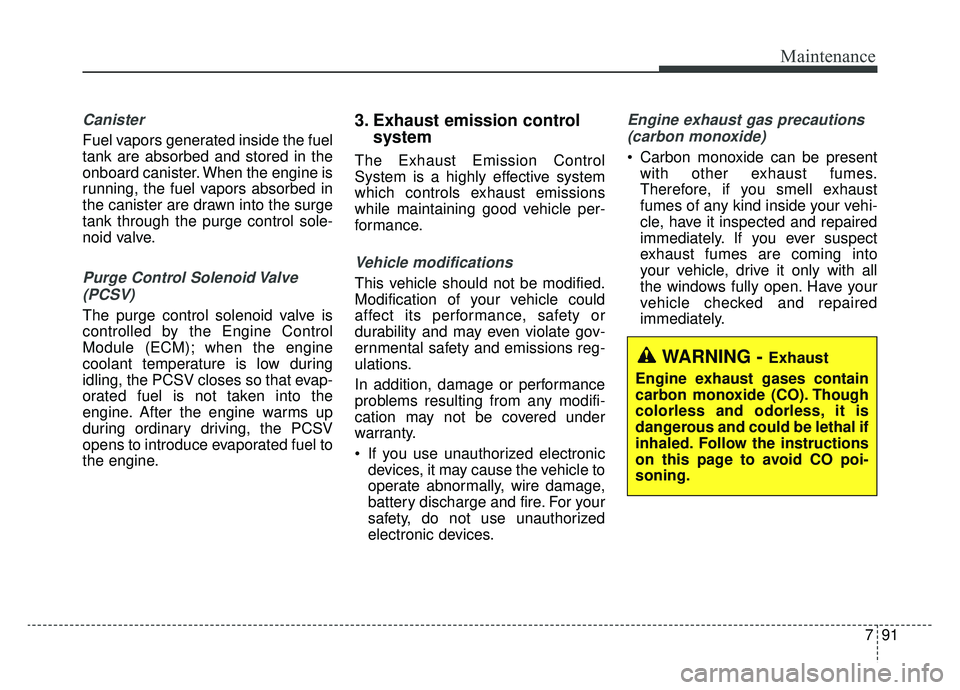
WARNING - Exhaust
Engine exhaust gases contain
carbon monoxide (CO). Though
colorless and odorless, it is
dangerous and could be lethal if
inhaled. Follow the instructions
on this page to avoid CO poi-
soning.
Page 493 of 518
793
Maintenance
Your vehicle is equipped with a cat-
alytic converter emission control
device.
Therefore, the following precautions
must be observed:
Use only UNLEADED FUEL forgasoline engines.
Do not operate the vehicle when there are signs of engine malfunc-
tion, such as misfire or a noticeable
loss of performance.
Do not misuse or abuse the engine. Examples of misuse are
coasting with the ignition off and
descending steep grades in gear
with the ignition off.
Do not operate the engine at high idle speed for extended periods (5
minutes or more).
Do not modify or tamper with any part of the engine or emission con-
trol system. All inspections and
adjustments must be made by an
authorized Kia dealer.
Avoid driving with an extremely low fuel level. Running out of fuel could
cause the engine to misfire, dam-
aging the catalytic converter. Failure to observe these precautions
could result in damage to the catalyt-
ic converter and to your vehicle.
Additionally, such actions could void
your warranties.
Perchlorate Material-special handling
may apply, See www.dtsc.ca.gov/haz-
ardouswaste/ perchlorate.
Notice to California Vehicle Dismantlers:
Perchlorate containing materials,
such as air bag inflators, seatbelt
pretensioners and keyless remote
entry batteries, must be disposed of
according to Title 22 California Code
of Regulations Chapter 67384.10
(a).
CALIFORNIA
PERCHLORATE NOTICE
Page 499 of 518
Specifications, Consumer information, Reporting safety defects
68
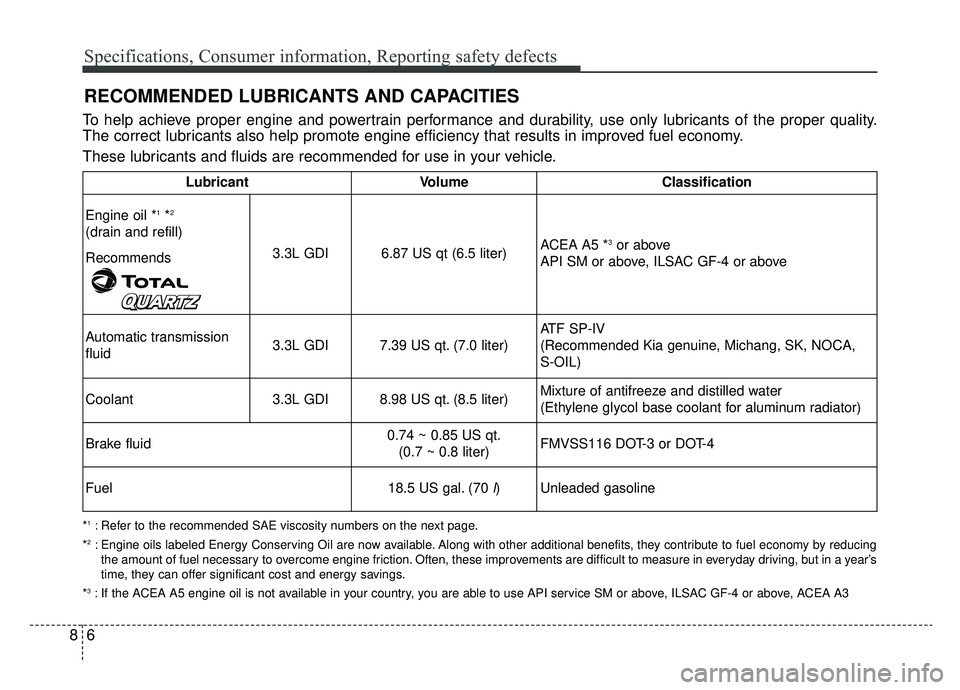
RECOMMENDED LUBRICANTS AND CAPACITIES
To help achieve proper engine and powertrain performance and durability, use only lubricants of the proper quality.
The correct lubricants also help promote engine efficiency that results in improved fuel economy.
These lubricants and fluids are recommended for use in your vehicle.
*1: Refer to the recommended SAE viscosity numbers on the next page.
*2: Engine oils labeled Energy Conserving Oil are now available. Along with other additional benefits, they contribute to fuel economy by reducing the amount of fuel necessary to overcome engine friction. Often, these improvements are difficult to measure in everyday driving, but in a year’s
time, they can offer significant cost and energy savings.
*
3: If the ACEA A5 engine oil is not available in your country, you are able to use API service SM or above, ILSAC GF-4 or above, ACEA A3
LubricantVolume Classification
Engine oil *1*2
(drain and refill)
Recommends
3.3L GDI6.87 US qt (6.5 liter)ACEA A5 *3or above
API SM or above, ILSAC GF-4 or above
Automatic transmission
fluid 3.3L GDI
7.39 US qt. (7.0 liter)ATF SP-IV
(Recommended Kia genuine, Michang, SK, NOCA,
S-OIL)
Coolant 3.3L GDI
8.98 US qt. (8.5 liter) Mixture of antifreeze and distilled water
(Ethylene glycol base coolant for aluminum radiator)
Brake fluid
0.74 ~ 0.85 US qt. (0.7 ~ 0.8 liter) FMVSS116 DOT-3 or DOT-4
Fuel
18.5 US gal. (70l) Unleaded gasoline
Page 500 of 518
87
Specifications, Consumer information, Reporting safety defects
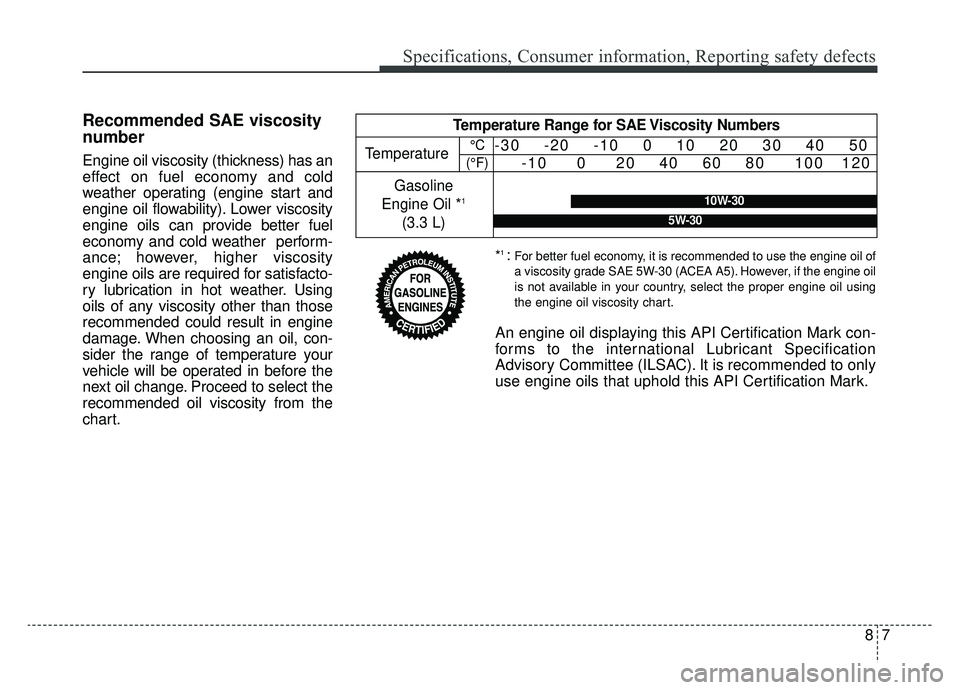
Recommended SAE viscosity
number
Engine oil viscosity (thickness) has an
effect on fuel economy and cold
weather operating (engine start and
engine oil flowability). Lower viscosity
engine oils can provide better fuel
economy and cold weather perform-
ance; however, higher viscosity
engine oils are required for satisfacto-
ry lubrication in hot weather. Using
oils of any viscosity other than those
recommended could result in engine
damage. When choosing an oil, con-
sider the range of temperature your
vehicle will be operated in before the
next oil change. Proceed to select the
recommended oil viscosity from the
chart.
Temperature Range for SAE Viscosity Numbers
TemperatureGasoline
Engine Oil *
1
(3.3 L)
°C
(°F)-30 -20 -10 0 10 20 30 40 50 -10 0 20 40 60 80 100 120
10W-30
5W-30
*1 :For better fuel economy, it is recommended to use the engine oil of
a viscosity grade SAE 5W-30 (ACEA A5). However, if the engine oil
is not available in your country, select the proper engine oil using
the engine oil viscosity chart.
An engine oil displaying this API Certification Mark con-
forms to the international Lubricant Specification
Advisory Committee (ILSAC). It is recommended to only
use engine oils that uphold this API Certification Mark.
Page 503 of 518
Specifications, Consumer information, Reporting safety defects
10
8
Roadside Assistance is provided on all new current
model year Kia Vehicles from the date the vehicle is deliv-
ered to the first retail buyer or otherwise put into use (in-
service date), whichever is earlier, for a period of 60
months or 60,000 miles, whichever is earlier, subject to
the terms, conditions and exclusions set forth in the Kia
Warranty and Consumer Information Manual applicable
to your model year vehicle.
KMA reserves the right to limit or deny services or other
benefits to any owner or driver when, in KMA's judgment,
the claims and/or service requests are excessive in fre-
quency or type of occurrence.
Toll free consumer assistance
Kia's toll-free Consumer Assistance hot line is staffed
from 5:00 AM to 6:00 PM PST, Monday through Friday
and is accessible by dialing 1-800-333-4Kia (4542).
For more information regarding assistance available,
please refer to your Kia Warranty & Consumer
Information Manual.
Emergency roadside assistance
Kia's toll free Roadside Assistance hot line is staffed 24
hours a day, 365 days a year and is accessible by dialing
1-800-333-4Kia (4542).
Please note that you must provide your Vehicle
Identification Number (VIN) to verify coverage at the time
of your call. The VIN can be found on the dash of your
vehicle on the driver’s side, on the door jamb of the dri-
ver’s door, your vehicle’s registration or proof of insur-
ance card.
Kia utilizes a network of over 30,000 roadside assistance
providers. Should you accidentally run out of fuel, require
a battery jump, or need help changing a tire, a Kia
Roadside Assistance Representative will dispatch some-
one to deliver a small quantity of gas, change a flat tire
with your inflated spare, or arrange a battery jump to
allow you to proceed to your destination. We have access
to a network of over 10,000 locksmiths to help you should
you become locked out of your Kia.
In the event that mechanical difficulty renders your vehi-
cle undriveable due to a warranty-related concern, Kia’s
Roadside Assistance Representative will arrange to
transport your vehicle to the nearest Kia dealer or to an
authorized Kia alternative service location.
CONSUMER ASSISTANCE (U.S. ONLY)
Page 505 of 518
Specifications, Consumer information, Reporting safety defects
12
8
Registering your vehicle in a foreign country
If you plan to register your vehicle in a foreign country,
you should confirm that it conforms to the regulations in
that country. Even if you successfully register the vehicle
in a foreign country, you may experience the following
problems and should therefore consider the possibility of
having to deal with them:
1. The fuel specified for your vehicle may be unavailable.
If other than the specified fuel is used, it could cause
damage to the engine, the fuel injection system, and
other fuel-related parts which may not be covered
under your New Vehicle Emissions Limited Warranty.
2. We must, therefore, clearly state that when you leave the country in which you purchased your Kia new and
register it in another country, problems arising from the
use of fuel other than the specified fuel are not subject
to manufacturer’s warranty. Because vehicles like
yours may not be marketed in the new country of reg-
istration, parts, servicing techniques and tools neces-
sary to maintain and repair your vehicle may be
unavailable.
Even if vehicles like yours are sold there, mechanical
specifications required by the government may vary
enough from the country of purchase to cause addi-
tional problems. 3. There may not be an Authorized Kia Dealer in the area
in which you plan to register your vehicle. You may
additionally experience difficulty in obtaining services
in a foreign country for any number of reasons.
Further, we cannot assume any responsibility for prob-
lems that result from unsatisfactory service or lack of
service outside of the United States.
Page 511 of 518
Index
4I
Drive mode indicator screen . . . . . . . . . . . . . . . . . . 5-80
ECO mode driving . . . . . . . . . . . . . . . . . . . . . . . . . . 5-77
Driver Attention Warning (DAW). . . . . . . . . . . . . . . . 5-107 Resetting the system. . . . . . . . . . . . . . . . . . . . . . . . 5-109
System disabled . . . . . . . . . . . . . . . . . . . . . . . . . . . 5-109
System malfunction . . . . . . . . . . . . . . . . . . . . . . . . 5-110
System setting and activation . . . . . . . . . . . . . . . . . 5-107
Economical operation . . . . . . . . . . . . . . . . . . . . . . . . . 5-112
Electrical Equipment (U.S. only) . . . . . . . . . . . . . . . . . 8-13 Installation of a mobile two-way radio system . . . . 8-13
Emergency starting . . . . . . . . . . . . . . . . . . . . . . . . . . . . . 6-5 Jump starting . . . . . . . . . . . . . . . . . . . . . . . . . . . . . . . 6-5
Push-starting . . . . . . . . . . . . . . . . . . . . . . . . . . . . . . . . 6-6
Emission control system . . . . . . . . . . . . . . . . . . . . . . . . 7-90 Crankcase emission control system . . . . . . . . . . . . . 7-90
Evaporative emission control (including ORVR:Onboard Refueling Vapor Recovery) system. . . . . 7-90
Exhaust emission control system . . . . . . . . . . . . . . . 7-91
Engine . . . . . . . . . . . . . . . . . . . . . . . . . . . . . . . . . . . . \
. . . 8-2
Engine compartment . . . . . . . . . . . . . . . . . . . . . . . . 2-6, 7-3
Engine coolant . . . . . . . . . . . . . . . . . . . . . . . . . . . . . . . 7-20 Changing the coolant . . . . . . . . . . . . . . . . . . . . . . . . 7-22
Checking the coolant level . . . . . . . . . . . . . . . . . . . . 7-20
Engine number . . . . . . . . . . . . . . . . . . . . . . . . . . . . . . . . 8-9 Engine oil . . . . . . . . . . . . . . . . . . . . . . . . . . . . . . . . . . . 7-\
18
Changing the engine oil and filter . . . . . . . . . . . . . . 7-19
Checking the engine oil level . . . . . . . . . . . . . . . . . . 7-18
Engine start/stop button . . . . . . . . . . . . . . . . . . . . . . . . . 5-6 Engine start/stop button position . . . . . . . . . . . . . . . . 5-6
Illuminated engine start/stop button. . . . . . . . . . . . . . 5-6
Starting the engine with a smart key . . . . . . . . . . . . . 5-8
Explanation of scheduled maintenance items . . . . . . . 7-14
Exterior overview . . . . . . . . . . . . . . . . . . . . . . . . . . . . . . 2-2
Forward Collision-avoidance Assist (FCA) . . . . . . . . . 5-38 Brake operation . . . . . . . . . . . . . . . . . . . . . . . . . . . . 5-41
FCA front radar . . . . . . . . . . . . . . . . . . . . . . . . . . . . 5-42
FCA warning message and system control . . . . . . . 5-40
Limitation of the system . . . . . . . . . . . . . . . . . . . . . 5-45
System malfunction . . . . . . . . . . . . . . . . . . . . . . . . . 5-44
System setting and activation . . . . . . . . . . . . . . . . . . 5-38
Fuel filler lid . . . . . . . . . . . . . . . . . . . . . . . . . . . . . . . . . 4-39 Closing the fuel filler lid . . . . . . . . . . . . . . . . . . . . . 4-39
Emergency fuel filler lid release . . . . . . . . . . . . . . . 4-40
Opening the fuel filler lid. . . . . . . . . . . . . . . . . . . . . 4-39
Fuel requirements . . . . . . . . . . . . . . . . . . . . . . . . . . . . . . 1-2 Do not use methanol . . . . . . . . . . . . . . . . . . . . . . . . . 1-4
Fuel Additives . . . . . . . . . . . . . . . . . . . . . . . . . . . . . . 1-4
Gasoline containing alcohol and methanol . . . . . . . . 1-3
Operation in foreign countries . . . . . . . . . . . . . . . . . . 1-5
E
F