Transaxle KIA Carens 2008 2.G Owner's Guide
[x] Cancel search | Manufacturer: KIA, Model Year: 2008, Model line: Carens, Model: KIA Carens 2008 2.GPages: 341, PDF Size: 6.23 MB
Page 272 of 341
73
Maintenance
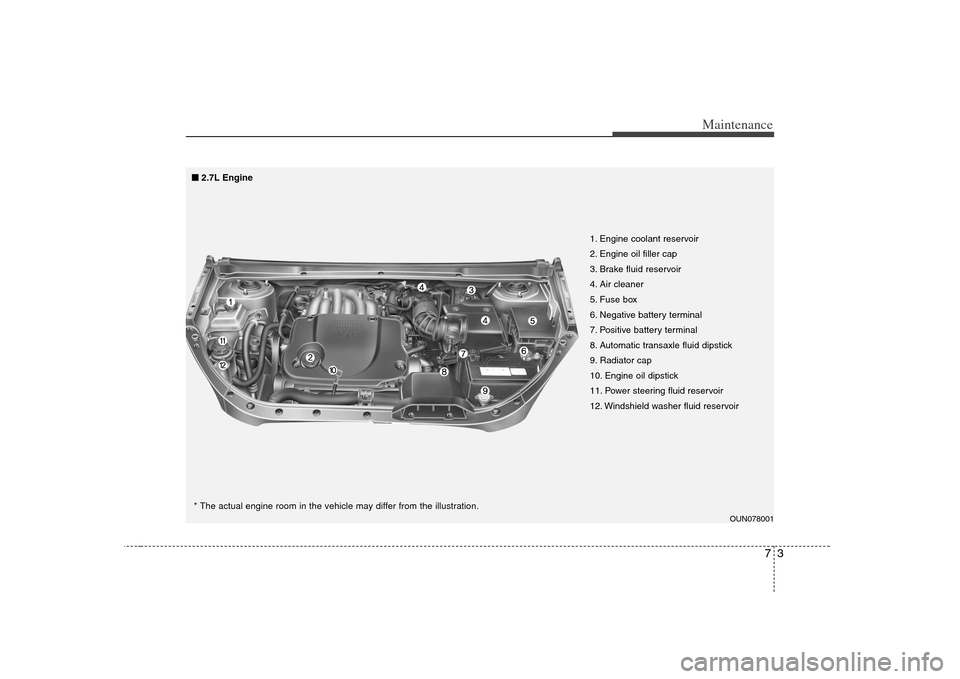
OUN078001
1. Engine coolant reservoir
2. Engine oil filler cap
3. Brake fluid reservoir
4. Air cleaner
5. Fuse box
6. Negative battery terminal
7. Positive battery terminal
8. Automatic transaxle fluid dipstick
9. Radiator cap
10. Engine oil dipstick
11. Power steering fluid reservoir
12. Windshield washer fluid reservoir
■ ■
2.7L Engine* The actual engine room in the vehicle may differ from the illustration.
Page 275 of 341
Maintenance6 7OWNER MAINTENANCE G030000AUNThe following lists are vehicle checks and
inspections that should be performed by
the owner or an authorized KIA dealer at
the frequencies indicated to help ensure
safe, dependable operation of your vehi-
cle.
Any adverse conditions should be
brought to the attention of your dealer as
soon as possible.
These Owner Maintenance Checks are
generally not covered by warranties and
you may be charged for labor, parts and
lubricants used.
Owner maintenance schedule G030101AUNWhen you stop for fuel: Check the engine oil level.
Check coolant level in coolant reser-
voir.
Check the windshield washer fluid
level.
Look for low or under-inflated tires.
G030102AUNWhile operating your vehicle: Note any changes in the sound of the
exhaust or any smell of exhaust fumes
in the vehicle.
Check for vibrations in the steering
wheel. Notice any increased steering
effort or looseness in the steering
wheel, or change in its straight-ahead
position.
Notice if your vehicle constantly turns
slightly or “pulls” to one side when trav-
eling on smooth, level road.
When stopping, listen and check for
unusual sounds, pulling to one side,
increased brake pedal travel or “hard-
to-push” brake pedal.
If any slipping or changes in the oper-
ation of your transaxle occurs, check
the transaxle fluid level.
Check automatic transaxle P (Park)
function.
Check parking brake.
Check for fluid leaks under your vehicle
(water dripping from the air condition-
ing system during or after use is nor-
mal).
WARNING
Be careful when checking your
engine coolant level when the
engine is hot. Scalding hot coolant
and steam may blow out under
pressure. This could cause burns
or other serious injury.
Page 276 of 341
77
Maintenance
G030103AUNAt least monthly: Check coolant level in the engine
coolant reservoir.
Check the operation of all exterior
lights, including the stoplights, turn sig-
nals and hazard warning flashers.
Check the inflation pressures of all
tires including the spare.
G030104AUNAt least twice a year
(i.e., every Spring and Fall): Check radiator, heater and air condi-
tioning hoses for leaks or damage.
Check windshield washer spray and
wiper operation. Clean wiper blades
with clean cloth dampened with wash-
er fluid.
Check headlight alignment.
Check muffler, exhaust pipes, shields
and clamps.
Check the lap/shoulder belts for wear
and function.
Check for worn tires and loose wheel
lug nuts.
G030105AUN-EUAt least once a year: Clean body and door drain holes.
Lubricate door hinges and checks, and
hood hinges.
Lubricate door and hood locks and
latches.
Lubricate door rubber weatherstrips.
Check the air conditioning system.
Check the power steering fluid level.
Inspect and lubricate automatic
transaxle linkage and controls.
Clean battery and terminals.
Check the brake fluid level.
Page 279 of 341
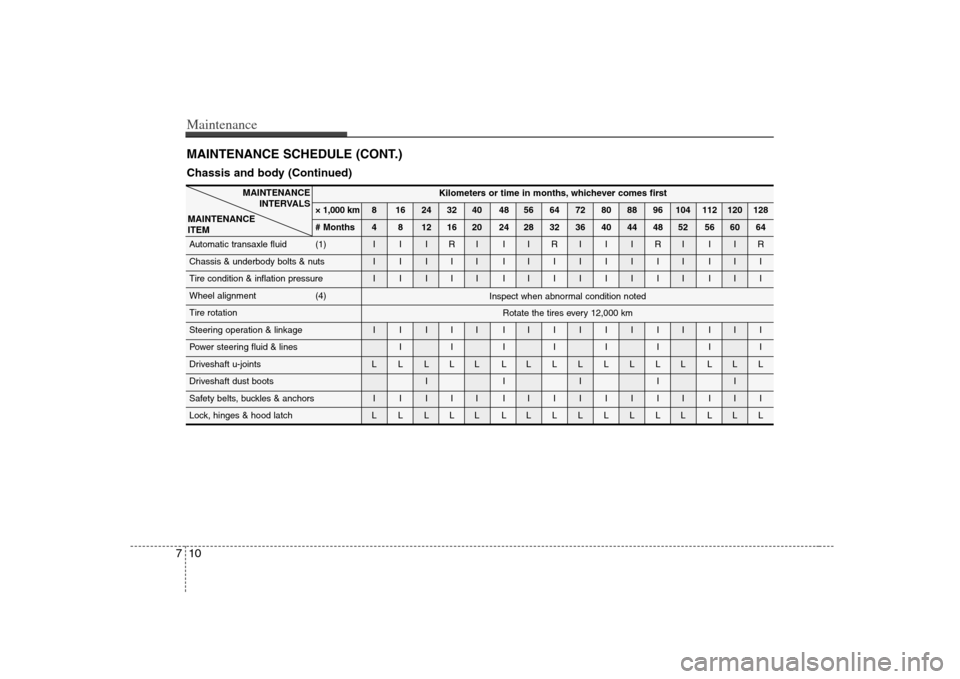
Maintenance10 7MAINTENANCE SCHEDULE (CONT.)
Kilometers or time in months, whichever comes first
× 1,000 km 8 16 24 32 40 48 56 64 72 80 88 96 104 112 120 128
# Months 4 8 12 16 20 24 28 32 36 40 44 48 52 56 60 64
Automatic transaxle fluid (1) I I I R I I I R I I I R I I I R
Chassis & underbody bolts & nuts I I I I I IIIIIIII III
Tire condition & inflation pressure I I I I I IIIIIIII III
Wheel alignment (4)
Tire rotation
Steering operation & linkage I I I I I IIIIIIII III
Power steering fluid & lines I I IIIIII
Driveshaft u-joints L L L L L LLLLLLLL LLL
Driveshaft dust boots I I I I I
Safety belts, buckles & anchors I I I I I IIIIIIII III
Lock, hinges & hood latch L L L L L LLLLLLLL LLL
MAINTENANCE
INTERVALS
MAINTENANCE
ITEM
Inspect when abnormal condition noted
Rotate the tires every 12,000 km
Chassis and body (Continued)
Page 283 of 341
Maintenance14 7G051100AUNCooling systemCheck cooling system components, such
as radiator, coolant reservoir, hoses and
connections for leakage and damage.
Replace any damaged parts.G051200AUNCoolantThe coolant should be changed at the
intervals specified in the maintenance
schedule.G051400AUNAutomatic transaxle fluidThe fluid level should be in the "HOT"
range of the dipstick, after the engine
and transaxle are at normal operating
temperature. Check the automatic
transaxle fluid level with the engine run-
ning and the transaxle in neutral, with the
parking brake properly applied.
G051500AUNBrake hoses and linesVisually check for proper installation,
chafing, cracks, deterioration and any
leakage. Replace any deteriorated or
damaged parts immediately.G051600AUNBrake fluidCheck brake fluid level in the brake fluid
reservoir. The level should be between
“MIN” and “MAX” marks on the side of
the reservoir. Use only hydraulic brake
fluid conforming to DOT 3 or DOT 4
specification.G051700AUNParking brakeInspect the parking brake system includ-
ing the parking brake pedal and cables.
G051900AUNBrake discs, pads, calipers and
rotorsCheck the pads for excessive wear, discs
for run out and wear, and calipers for fluid
leakage.G052000AUNExhaust pipe and mufflerVisually inspect the exhaust pipes, muf-
fler and hangers for cracks, deterioration,
or damage. Start the engine and listen
carefully for any exhaust gas leakage.
Tighten connections or replace parts as
necessary.G052100AUNSuspension mounting boltsCheck the suspension connections for
looseness or damage. Retighten to the
specified torque.
Page 291 of 341
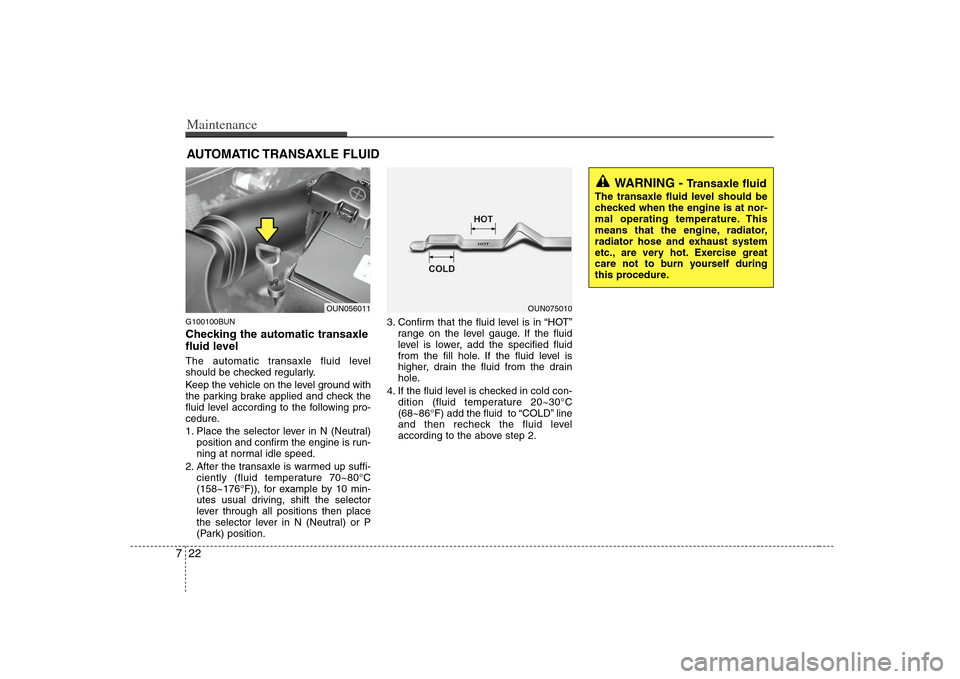
Maintenance22 7AUTOMATIC TRANSAXLE FLUIDG100100BUNChecking the automatic transaxle
fluid level The automatic transaxle fluid level
should be checked regularly.
Keep the vehicle on the level ground with
the parking brake applied and check the
fluid level according to the following pro-
cedure.
1. Place the selector lever in N (Neutral)
position and confirm the engine is run-
ning at normal idle speed.
2. After the transaxle is warmed up suffi-
ciently (fluid temperature 70~80°C
(158~176°F)), for example by 10 min-
utes usual driving, shift the selector
lever through all positions then place
the selector lever in N (Neutral) or P
(Park) position.3. Confirm that the fluid level is in “HOT”
range on the level gauge. If the fluid
level is lower, add the specified fluid
from the fill hole. If the fluid level is
higher, drain the fluid from the drain
hole.
4. If the fluid level is checked in cold con-
dition (fluid temperature 20~30°C
(68~86°F) add the fluid to “COLD” line
and then recheck the fluid level
according to the above step 2.
OUN056011
WARNING -
Transaxle fluid
The transaxle fluid level should be
checked when the engine is at nor-
mal operating temperature. This
means that the engine, radiator,
radiator hose and exhaust system
etc., are very hot. Exercise great
care not to burn yourself during
this procedure.
OUN075010
Page 292 of 341
723
Maintenance
✽ ✽
NOTICE“COLD” range is for reference only and
should NOT be used to determine
transaxle fluid level.
✽ ✽
NOTICENew automatic transaxle fluid should be
red. The red dye is added so the assem-
bly plant can identify it as automatic
transaxle fluid and distinguish it from
engine oil or antifreeze. The red dye,
which is not an indicator of fluid quali-
ty, is not permanent. As the vehicle is
driven, the automatic transaxle fluid
will begin to look darker. The color may
eventually appear light brown.
Therefore, have an authorized KIA
dealer change the automatic transaxle
fluid according to the Scheduled
Maintenance at the beginning of this
section.Use only the specified automatic
transaxle fluid. (Refer to "Recommended
lubricants or capacities" in section 8.)
G100200AUNChanging the automatic transaxle
fluidHave automatic transaxle fluid changed
by an authorized KIA dealer according to
the Maintenance Schedule at the begin-
ning of this section.
WARNING
- Parking brake
To avoid sudden movement of the
vehicle, apply parking brake and
depress the brake pedal before
moving the shift lever.
CAUTION
Low fluid level causes transaxle
slippage. Overfilling can cause
foaming, loss of fluid and transaxle
malfunction.
The use of a non-specified fluid
could result in transaxle malfunc-
tion and failure.
Page 321 of 341
Maintenance52 7
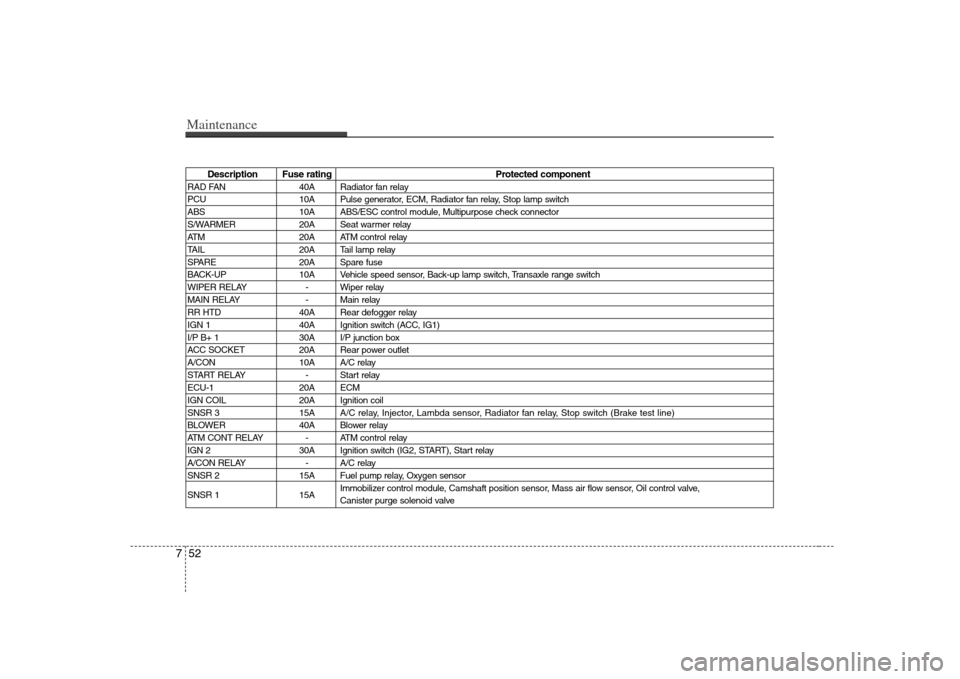
Description Fuse rating Protected component
RAD FAN 40A Radiator fan relay
PCU 10A Pulse generator, ECM, Radiator fan relay, Stop lamp switch
ABS 10A ABS/ESC control module, Multipurpose check connector
S/WARMER 20A Seat warmer relay
ATM 20A ATM control relay
TAIL 20A Tail lamp relay
SPARE 20A Spare fuse
BACK-UP 10A Vehicle speed sensor, Back-up lamp switch, Transaxle range switch
WIPER RELAY - Wiper relay
MAIN RELAY - Main relay
RR HTD 40A Rear defogger relay
IGN 1 40A Ignition switch (ACC, IG1)
I/P B+ 1 30A I/P junction box
ACC SOCKET 20A Rear power outlet
A/CON 10A A/C relay
START RELAY - Start relay
ECU-1 20A ECM
IGN COIL 20A Ignition coil
SNSR 3 15AA/C relay, Injector, Lambda sensor, Radiator fan relay, Stop switch (Brake test line)
BLOWER 40A Blower relay
ATM CONT RELAY - ATM control relay
IGN 2 30A Ignition switch (IG2, START), Start relay
A/CON RELAY - A/C relay
SNSR 2 15A Fuel pump relay, Oxygen sensor
SNSR 1 15AImmobilizer control module, Camshaft position sensor, Mass air flow sensor, Oil control valve,
Canister purge solenoid valve
Page 334 of 341
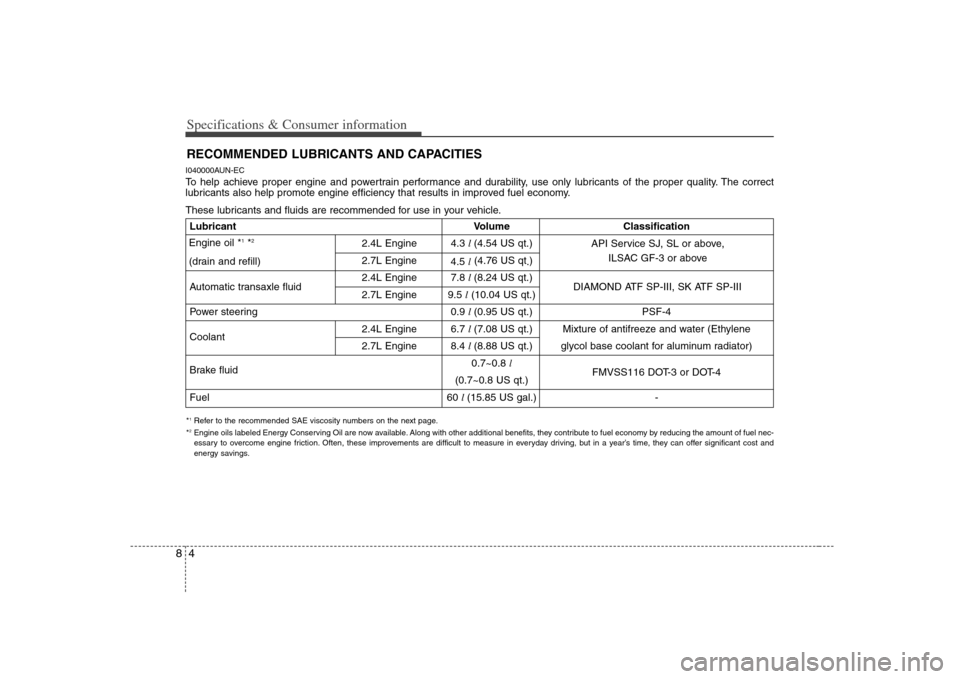
Specifications & Consumer information4 8RECOMMENDED LUBRICANTS AND CAPACITIES I040000AUN-ECTo help achieve proper engine and powertrain performance and durability, use only lubricants of the proper quality. The correct
lubricants also help promote engine efficiency that results in improved fuel economy.These lubricants and fluids are recommended for use in your vehicle.*1Refer to the recommended SAE viscosity numbers on the next page.
*2Engine oils labeled Energy Conserving Oil are now available. Along with other additional benefits, they contribute to fuel economy by reducing the amount of fuel nec-
essary to overcome engine friction. Often, these improvements are difficult to measure in everyday driving, but in a year’s time, they can offer significant cost and
energy savings.Lubricant Volume Classification
2.4L Engine 4.3 l (4.54 US qt.)
2.7L Engine
4.5 l(4.76 US qt
.)
2.4L Engine 7.8 l (8.24 US qt.)
Automatic transaxle fluid
2.7L Engine 9.5 l(10.04 US qt.)
Power steering 0.9 l (0.95 US qt.) PSF-4
Coolant2.4L Engine 6.7 l (7.08 US qt.) Mixture of antifreeze and water (Ethylene
2.7L Engine 8.4 l (8.88 US qt.) glycol base coolant for aluminum radiator)
Brake fluid0.7~0.8 l
(0.7~0.8 US qt.)FMVSS116 DOT-3 or DOT-4
Fuel 60 l (15.85 US gal.) -Engine oil *
1*2
(drain and refill)API Service SJ, SL or above,
ILSAC GF-3 or above
DIAMOND ATF SP-III, SK ATF SP-III
Page 339 of 341
Index2I
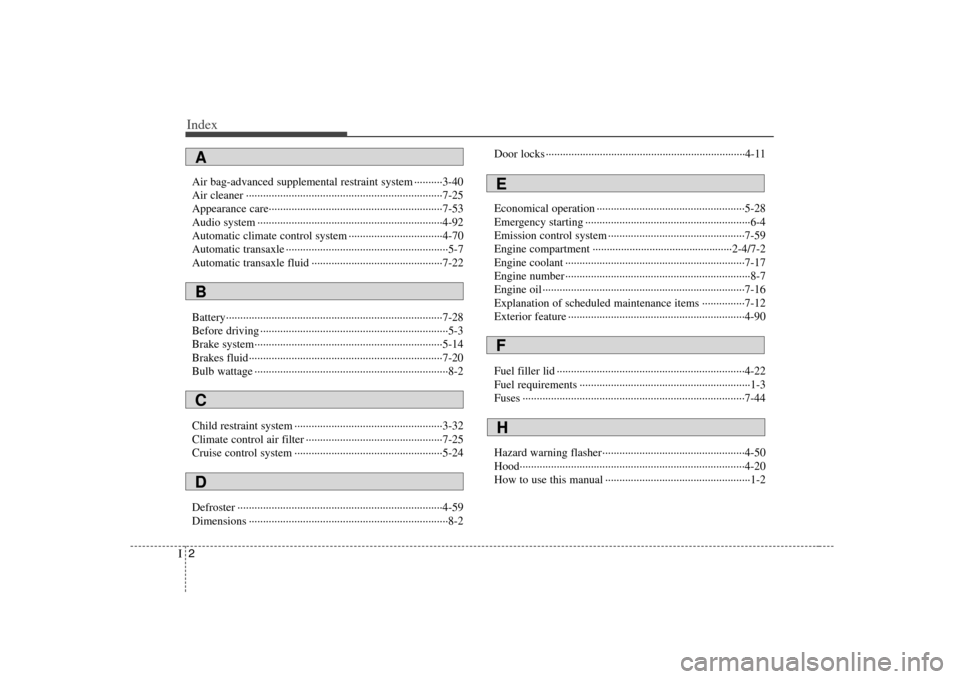
Air bag-advanced supplemental restraint system ··········3-40
Air cleaner ·····································································7-25
Appearance care·····························································7-53
Audio system ·································································4-92
Automatic climate control system ·································4-70
Automatic transaxle ·························································5-7
Automatic transaxle fluid ··············································7-22
Battery············································································7-28
Before driving ··································································5-3
Brake system··································································5-14
Brakes fluid····································································7-20
Bulb wattage ····································································8-2
Child restraint system ····················································3-32
Climate control air filter ················································7-25
Cruise control system ····················································5-24
Defroster ········································································4-59
Dimensions ······································································8-2Door locks ······································································4-11
Economical operation ····················································5-28
Emergency starting ··························································6-4
Emission control system ················································7-59
Engine compartment ·················································2-4/7-2
Engine coolant ·······························································7-17
Engine number ·································································8-7
Engine oil ·······································································7-16
Explanation of scheduled maintenance items ···············7-12
Exterior feature ······························································4-90
Fuel filler lid ··································································4-22
Fuel requirements ····························································1-3
Fuses ··············································································7-44
Hazard warning flasher··················································4-50
Hood···············································································4-20
How to use this manual ···················································1-2ABCD
EFH