Fluid KIA Carens 2014 3.G User Guide
[x] Cancel search | Manufacturer: KIA, Model Year: 2014, Model line: Carens, Model: KIA Carens 2014 3.GPages: 517, PDF Size: 13.98 MB
Page 195 of 517
Features of your vehicle
108
4
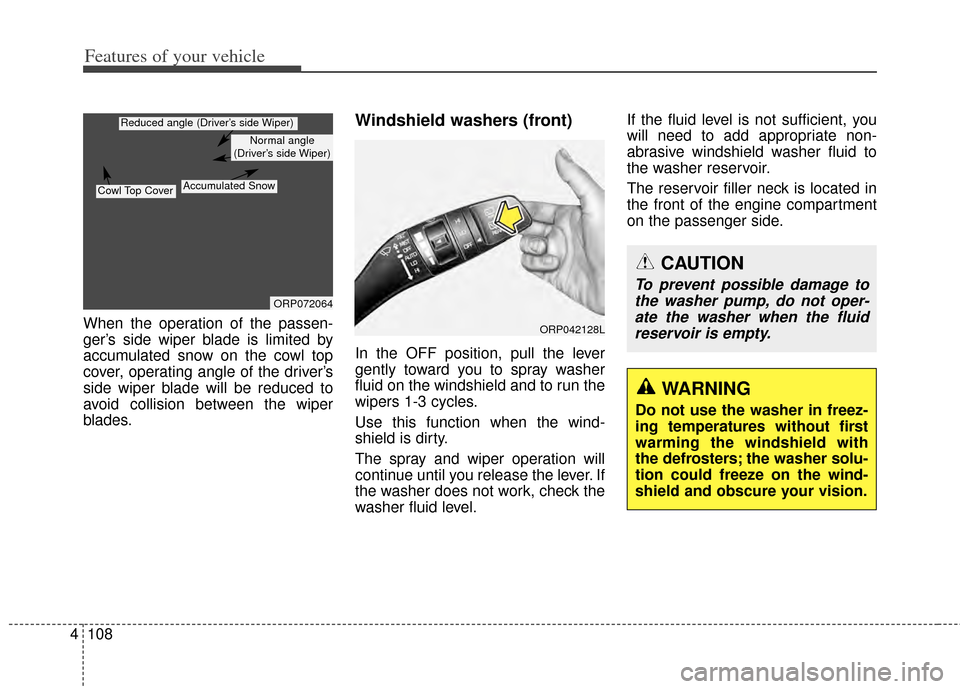
When the operation of the passen-
ger’s side wiper blade is limited by
accumulated snow on the cowl top
cover, operating angle of the driver’s
side wiper blade will be reduced to
avoid collision between the wiper
blades.
Windshield washers (front)
In the OFF position, pull the lever
gently toward you to spray washer
fluid on the windshield and to run the
wipers 1-3 cycles.
Use this function when the wind-
shield is dirty.
The spray and wiper operation will
continue until you release the lever. If
the washer does not work, check the
washer fluid level. If the fluid level is not sufficient, you
will need to add appropriate non-
abrasive windshield washer fluid to
the washer reservoir.
The reservoir filler neck is located in
the front of the engine compartment
on the passenger side.
ORP072064
Reduced angle (Driver’s side Wiper)
Normal angle
(Driver’s side Wiper)
Accumulated SnowCowl Top Cover
ORP042128L
WARNING
Do not use the washer in freez-
ing temperatures without first
warming the windshield with
the defrosters; the washer solu-
tion could freeze on the wind-
shield and obscure your vision.
CAUTION
To prevent possible damage to the washer pump, do not oper-ate the washer when the fluidreservoir is empty.
Page 196 of 517
4109
Features of your vehicle
Headlight washer (if equipped)
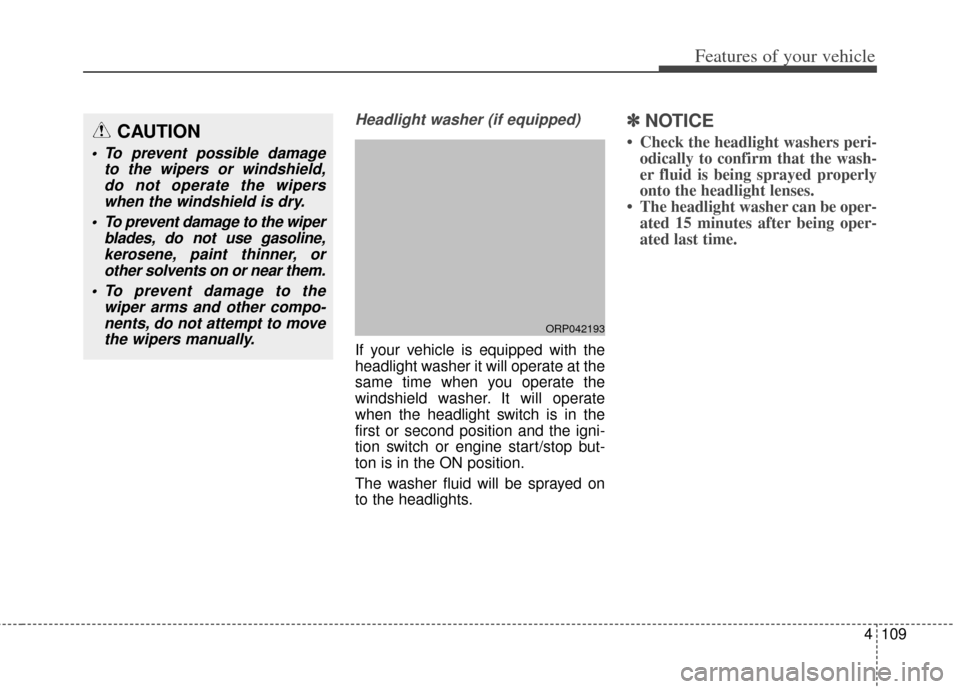
If your vehicle is equipped with the
headlight washer it will operate at the
same time when you operate the
windshield washer. It will operate
when the headlight switch is in the
first or second position and the igni-
tion switch or engine start/stop but-
ton is in the ON position.
The washer fluid will be sprayed on
to the headlights.
✽ ✽NOTICE
• Check the headlight washers peri-
odically to confirm that the wash-
er fluid is being sprayed properly
onto the headlight lenses.
• The headlight washer can be oper- ated 15 minutes after being oper-
ated last time.CAUTION
To prevent possible damage
to the wipers or windshield,do not operate the wiperswhen the windshield is dry.
To prevent damage to the wiper blades, do not use gasoline,kerosene, paint thinner, orother solvents on or near them.
To prevent damage to the wiper arms and other compo-nents, do not attempt to movethe wipers manually.
ORP042193
Page 197 of 517
Features of your vehicle
110
4
Rear window wiper and wash-
er switch
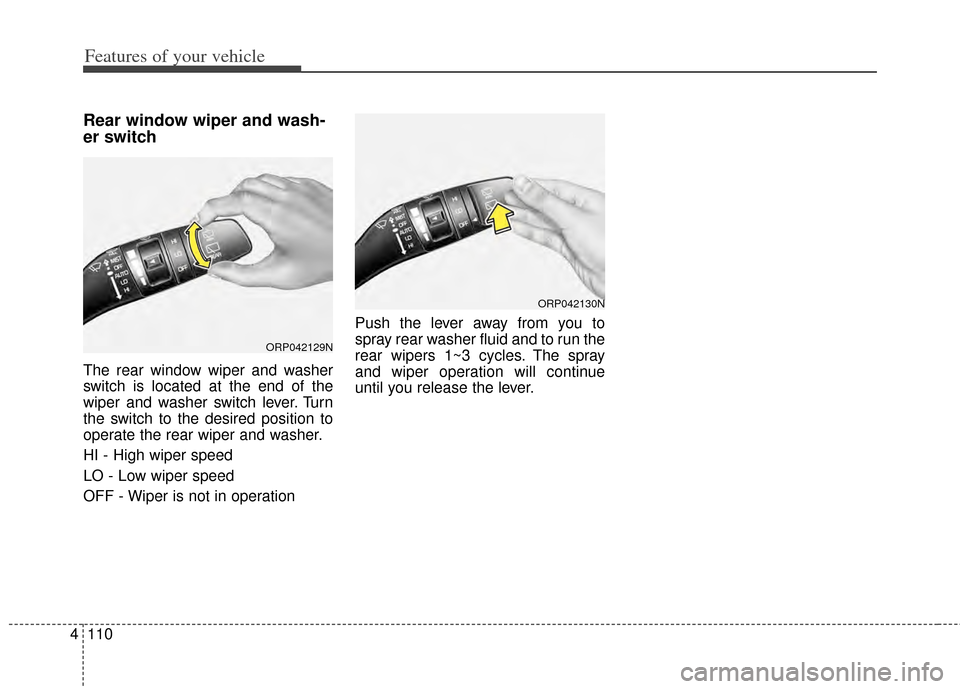
The rear window wiper and washer
switch is located at the end of the
wiper and washer switch lever. Turn
the switch to the desired position to
operate the rear wiper and washer.
HI - High wiper speed
LO - Low wiper speed
OFF - Wiper is not in operation Push the lever away from you to
spray rear washer fluid and to run the
rear wipers 1~3 cycles. The spray
and wiper operation will continue
until you release the lever.
ORP042130N
ORP042129N
Page 310 of 517
53
Driving your vehicle
Before entering vehicle
• Be sure that all windows, outsidemirror(s), and outside lights are
clean.
Check the condition of the tires.
Check under the vehicle for any sign of leaks.
Be sure there are no obstacles behind you if you intend to back up.
Necessary inspections
Fluid levels, such as engine oil,
engine coolant, brake fluid, and
washer fluid should be checked on a
regular basis, at the exact interval
depending on the fluid. Further
details are provided in chapter 7,
“Maintenance”.
Before starting
Close and lock all doors.
Position the seat so that all con-trols are easily reached.
Adjust the inside and outside rearview mirrors.
Be sure that all lights work.
Check all gauges.
Check the operation of warning lights when the ignition switch is
turned to the ON position.
Release the parking brake and make sure the brake warning light
goes out.
For safe operation, be sure you are
familiar with your vehicle and its
equipment.
BEFORE DRIVING
WARNING
Driving while distracted can
result in a loss of vehicle con-
trol, that may lead to an acci-
dent, severe personal injury,
and death. The driver’s primary
responsibility is in the safe and
legal operation of a vehicle, and
use of any handheld devices,
other equipment, or vehicle sys-
tems which take the driver’s
eyes, attention and focus away
from the safe operation of a
vehicle or which are not permis-
sible by law should never be
used during operation of the
vehicle.
Page 366 of 517
559
Driving your vehicle
Use high quality ethylene gly-
col coolant
Your vehicle is delivered with high
quality ethylene glycol coolant in the
cooling system. It is the only type of
coolant that should be used because
it helps prevent corrosion in the cool-
ing system, lubricates the water
pump and prevents freezing. Be sure
to replace or replenish your coolant
in accordance with the maintenance
schedule in section 7. Before winter,
have your coolant tested to assure
that its freezing point is sufficient for
the temperatures anticipated during
the winter.
Check battery and cables
Winter puts additional burdens on
the battery system. Visually inspect
the battery and cables as described
in section 7. The level of charge in
your battery can be checked by an
authorized Kia dealer or a service
station.
Change to "winter weight" oil
if necessary
In some climates it is recommended
that a lower viscosity "winter weight"
oil be used during cold weather. See
section 8 for recommendations. If
you aren't sure what weight oil you
should use, consult an authorized
Kia dealer.
Check spark plugs and igni-
tion system
Inspect your spark plugs as
described in section 7 and replace
them if necessary. Also check all
ignition wiring and components to be
sure they are not cracked, worn or
damaged in any way.
To keep locks from freezing
To keep the locks from freezing,
squirt an approved de-icer fluid or
glycerine into the key opening. If a
lock is covered with ice, squirt it with
an approved de-icing fluid to remove
the ice. If the lock is frozen internally,
you may be able to thaw it out by
using a heated key. Handle the heat-
ed key with care to avoid injury.
Use approved window washer
anti-freeze in system
To keep the water in the window
washer system from freezing, add an
approved window washer anti-freeze
solution in accordance with instruc-
tions on the container. Window wash-
er anti-freeze is available from an
authorized Kia dealer and most auto
parts outlets. Do not use engine
coolant or other types of anti-freeze
as these may damage the paint fin-
ish.
Page 374 of 517
567
Driving your vehicle
When you are ready to leave after
parking on a hill
1. With the manual transaxle inNeutral or automatic transaxle in P
(Park), apply your brakes and hold
the brake pedal down while you:
and
2. Slowly remove your foot from the brake pedal.
3. Drive slowly until the trailer is clear of the chocks.
4. Stop and have someone pick up and store the chocks.
Maintenance when trailer tow-
ing
Your vehicle will need service more
often when you regularly pull a trail-
er. Important items to pay particular
attention to include engine oil, auto-
matic transaxle fluid, axle lubricant
and cooling system fluid. Brake con-
dition is another important item to
frequently check. Each item is cov-
ered in this manual, and the Index
will help you find them quickly. If
you’re trailering, it’s a good idea to
review these sections before you
start your trip.
Don’t forget to also maintain your
trailer and hitch. Follow the mainte-
nance schedule that accompanied
your trailer and check it periodically.
Preferably, conduct the check at the
start of each day’s driving. Most
importantly, all hitch nuts and bolts
should be tight.
CAUTION
Due to higher load duringtrailer usage, overheatingmight occur in hot days orduring uphill driving. If thecoolant gauge indicates over-heating, switch off the A/C andstop the vehicle in a safe areato cool down the engine.
When towing check transaxle fluid more frequently.
WARNING- Parkingbrake
It can be dangerous to get out
of your vehicle if the parking
brake is not firmly set.
If you have left the engine run-
ning, the vehicle can move sud-
denly. You or others could be
seriously or fatally injured.
Page 392 of 517
What to do in an emergency
86
IF THE ENGINE OVERHEATS
If your temperature gauge indicates
overheating, you will experience a
loss of power, or hear loud pinging or
knocking, the engine is probably too
hot. If this happens, you should:
1.Pull off the road and stop as soonas it is safe to do so.
2.Place the shift lever in P (automat- ic transaxle) or neutral (manual
transaxle) and set the parking
brake. If the air conditioning is on,
turn it off.
3.If engine coolant is running out under the vehicle or steam is com-
ing out from underneath the hood,
stop the engine. Do not open the
hood until the coolant has stopped
running or the steaming has
stopped. If there is no visible loss
of engine coolant and no steam,
leave the engine running and
check to be sure the engine cool-
ing fan is operating. If the fan is not
running, turn the engine off. 4.Check to see if the water pump
drive belt is missing. If it is not
missing, check to see that it is
tight. If the drive belt seems to be
satisfactory, check for coolant leak-
ing from the radiator, hoses or
under the vehicle. (If the air condi-
tioning had been in use, it is nor-
mal for cold water to be draining
from it when you stop).
5.If the water pump drive belt is bro- ken or engine coolant leaks, stop
the engine immediately and call
the nearest authorized Kia dealer
for assistance. 6.If you cannot find the cause of the
overheating, wait until the engine
temperature has returned to nor-
mal. Then, if coolant has been lost,
carefully add coolant to the reser-
voir to bring the fluid level in the
reservoir up to the halfway mark.
7.Proceed with caution, keeping alert for further signs of overheat-
ing. If overheating happens again,
call an authorized Kia dealer for
assistance.
WARNING - Under thehood
While the engine is running,
keep hair, hands and clothing
away from moving parts such
as the fan and drive belts to pre-
vent injury.
WARNING
Do not remove the radiator cap
when the engine is hot. This
may result in coolant being
blown out of the opening and
cause serious burns.
CAUTION
Serious loss of coolant indi-
cates there is a leak in the cool-ing system and this should bechecked as soon as possible byan authorized Kia dealer.
Page 412 of 517
What to do in an emergency
28
6
CAUTION - Automatic
transaxle
If the car is being towed with all
four wheels on the ground, itcan be towed only from thefront. Be sure that the transaxleis in neutral. Be sure the steer-ing is unlocked by placing theignition switch in the ACC posi-tion. A driver must be in thetowed vehicle to operate thesteering and brakes.
To avoid serious damage to the automatic transaxle, limitthe vehicle speed to 15 km/h(10 mph) and drive less than1.5 km (1 mile) when towing.
Before towing, check under your vehicle for leaking auto-matic transaxle fluid. If theautomatic transaxle fluid isleaking, a flatbed equipmentor towing dolly must be used.
Page 413 of 517
Maintenance
Engine compartment . . . . . . . . . . . . . . . . . . . . . . . . 7-3
Maintenance services . . . . . . . . . . . . . . . . . . . . . . . . 7-4
Owner’s responsibility . . . . . . . . . . . . . . . . . . . . . . . . . . 7-4
Owner maintenance precautions . . . . . . . . . . . . . . . . . 7-5
Owner maintenance . . . . . . . . . . . . . . . . . . . . . . . . . 7-6
Owner maintenance schedule . . . . . . . . . . . . . . . . . . . . 7-6
Scheduled maintenance service . . . . . . . . . . . . . . 7-8
Normal maintenance schedule . . . . . . . . . . . . . . . . . . . . 7-9
Maintenance under severe usage conditions . . . . . . . . 7-23
Explanation of scheduled maintenance items . . . 7-25
Engine oil. . . . . . . . . . . . . . . . . . . . . . . . . . . . . . . . . 7-29
Checking the engine oil level . . . . . . . . . . . . . . . . . . . 7-29
Changing the engine oil and filter . . . . . . . . . . . . . . . . 7-30
Engine coolant . . . . . . . . . . . . . . . . . . . . . . . . . . . . 7-31
Checking the coolant level . . . . . . . . . . . . . . . . . . . . . . 7-31
Changing the coolant . . . . . . . . . . . . . . . . . . . . . . . . . . . 7-33
Radiator cap . . . . . . . . . . . . . . . . . . . . . . . . . . . . . . 7-33
Brake/clutch fluid . . . . . . . . . . . . . . . . . . . . . . . . . 7-35
Checking the brake/clutch fluid level . . . . . . . . . . . . 7-35
Checking the washer fluid level . . . . . . . . . . . . . . . . . 7-36
Automatic transaxle fluid . . . . . . . . . . . . . . . . . . . 7-36
Washer fluid . . . . . . . . . . . . . . . . . . . . . . . . . . . . . . 7-36
Parking brake . . . . . . . . . . . . . . . . . . . . . . . . . . . . . 7-37
Checking the parking brake . . . . . . . . . . . . . . . . . . . . 7-37
Air cleaner. . . . . . . . . . . . . . . . . . . . . . . . . . . . . . . . 7-38
Filter replacement . . . . . . . . . . . . . . . . . . . . . . . . . . . . 7-38
Climate control air filter . . . . . . . . . . . . . . . . . . . . 7-39
Filter inspection . . . . . . . . . . . . . . . . . . . . . . . . . . . . . . . 7-39
Wiper blades . . . . . . . . . . . . . . . . . . . . . . . . . . . . . . 7-40
Blade inspection . . . . . . . . . . . . . . . . . . . . . . . . . . . . . . . 7-40
Blade replacement . . . . . . . . . . . . . . . . . . . . . . . . . . . . 7-40
Battery . . . . . . . . . . . . . . . . . . . . . . . . . . . . . . . . . . 7-43\
For best battery service . . . . . . . . . . . . . . . . . . . . . . . . . 7-43
Battery recharging . . . . . . . . . . . . . . . . . . . . . . . . . . . . 7-44
Reset items . . . . . . . . . . . . . . . . . . . . . . . . . . . . . . . . . . . 7-\
45
Tires and wheels . . . . . . . . . . . . . . . . . . . . . . . . . . . 7-46
Tire care . . . . . . . . . . . . . . . . . . . . . . . . . . . . . . . . . . . . \
7-46
Recommended cold tire inflation pressures . . . . . . . 7-46
Checking tire inflation pressure . . . . . . . . . . . . . . . . . . 7-48
Tire rotation . . . . . . . . . . . . . . . . . . . . . . . . . . . . . . . . . 7-49
Wheel alignment and tire balance . . . . . . . . . . . . . . . 7-50
Tire replacement . . . . . . . . . . . . . . . . . . . . . . . . . . . . . . 7-50
Wheel replacement . . . . . . . . . . . . . . . . . . . . . . . . . . . . 7-51
Tire traction . . . . . . . . . . . . . . . . . . . . . . . . . . . . . . . . . . 7-52\
Tire maintenance . . . . . . . . . . . . . . . . . . . . . . . . . . . . . 7-52
Tire sidewall labeling . . . . . . . . . . . . . . . . . . . . . . . . . . . 7-52
All season tires . . . . . . . . . . . . . . . . . . . . . . . . . . . . . . . 7-58
Summer tires . . . . . . . . . . . . . . . . . . . . . . . . . . . . . . . . . 7-58
Snow tires . . . . . . . . . . . . . . . . . . . . . . . . . . . . . . . . . . . . \
7-59
7
Page 415 of 517
73
Maintenance
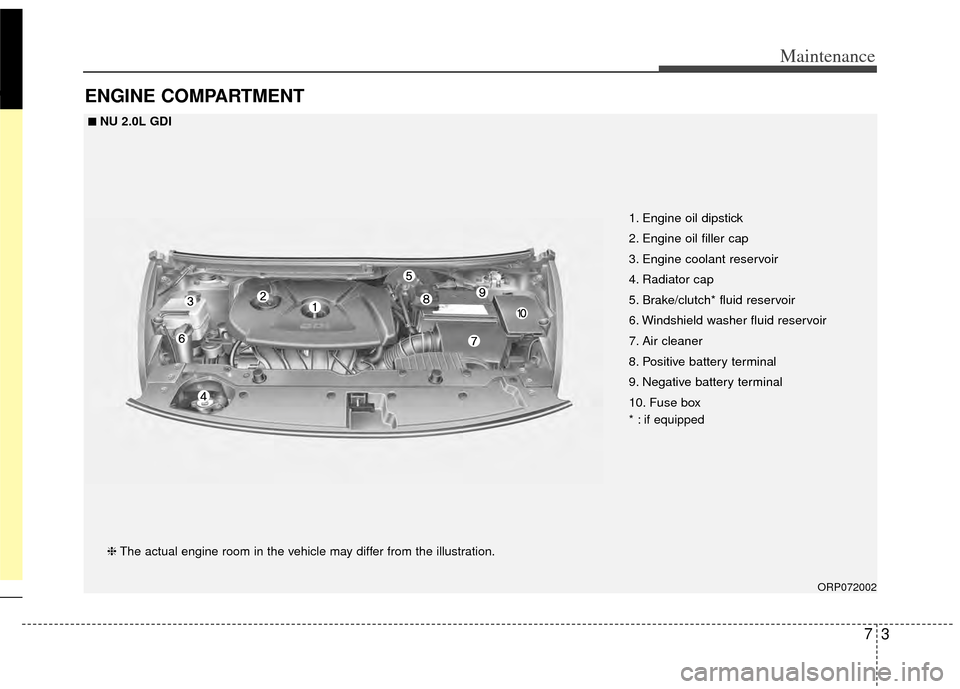
ENGINE COMPARTMENT
ORP072002
1. Engine oil dipstick
2. Engine oil filler cap
3. Engine coolant reservoir
4. Radiator cap
5. Brake/clutch* fluid reservoir
6. Windshield washer fluid reservoir
7. Air cleaner
8. Positive battery terminal
9. Negative battery terminal
10. Fuse box
* : if equipped
■
■NU 2.0L GDI
❈The actual engine room in the vehicle may differ from the illustration.