fuel cap KIA Carens 2014 3.G User Guide
[x] Cancel search | Manufacturer: KIA, Model Year: 2014, Model line: Carens, Model: KIA Carens 2014 3.GPages: 517, PDF Size: 13.98 MB
Page 423 of 517
711
Maintenance
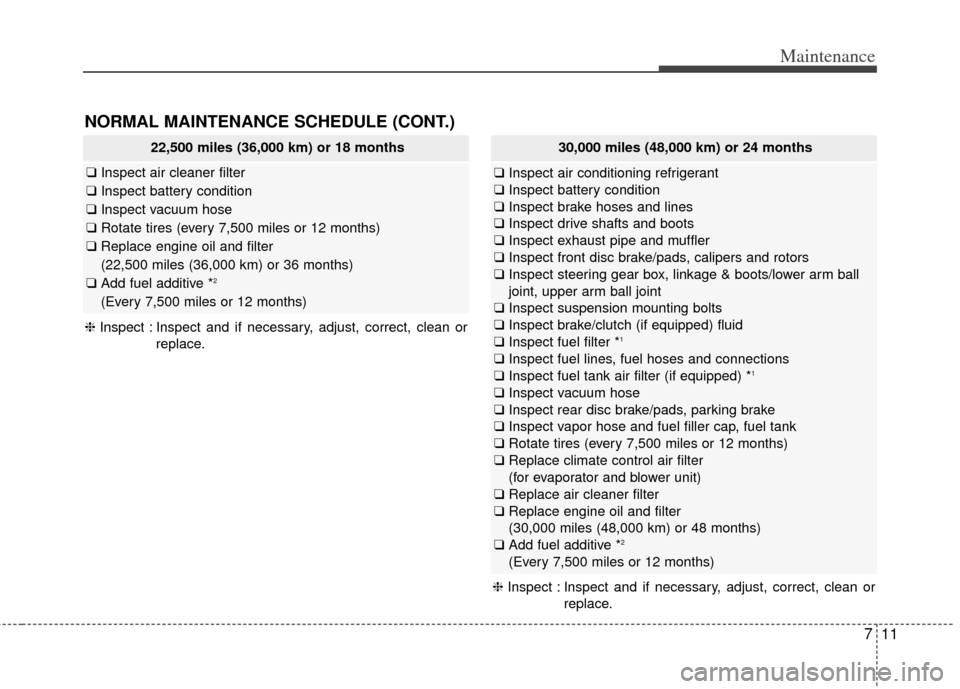
NORMAL MAINTENANCE SCHEDULE (CONT.)
22,500 miles (36,000 km) or 18 months
❑Inspect air cleaner filter
❑ Inspect battery condition
❑ Inspect vacuum hose
❑ Rotate tires (every 7,500 miles or 12 months)
❑ Replace engine oil and filter
(22,500 miles (36,000 km) or 36 months)
❑ Add fuel additive *
2
(Every 7,500 miles or 12 months)
❈ Inspect : Inspect and if necessary, adjust, correct, clean or
replace.
30,000 miles (48,000 km) or 24 months
❑Inspect air conditioning refrigerant
❑ Inspect battery condition
❑ Inspect brake hoses and lines
❑ Inspect drive shafts and boots
❑ Inspect exhaust pipe and muffler
❑ Inspect front disc brake/pads, calipers and rotors
❑ Inspect steering gear box, linkage & boots/lower arm ball
joint, upper arm ball joint
❑ Inspect suspension mounting bolts
❑ Inspect brake/clutch (if equipped) fluid
❑ Inspect fuel filter *
1
❑Inspect fuel lines, fuel hoses and connections
❑ Inspect fuel tank air filter (if equipped) *1
❑ Inspect vacuum hose
❑ Inspect rear disc brake/pads, parking brake
❑ Inspect vapor hose and fuel filler cap, fuel tank
❑ Rotate tires (every 7,500 miles or 12 months)
❑ Replace climate control air filter
(for evaporator and blower unit)
❑ Replace air cleaner filter
❑ Replace engine oil and filter
(30,000 miles (48,000 km) or 48 months)
❑ Add fuel additive *
2
(Every 7,500 miles or 12 months)
❈ Inspect : Inspect and if necessary, adjust, correct, clean or
replace.
Page 425 of 517
713
Maintenance
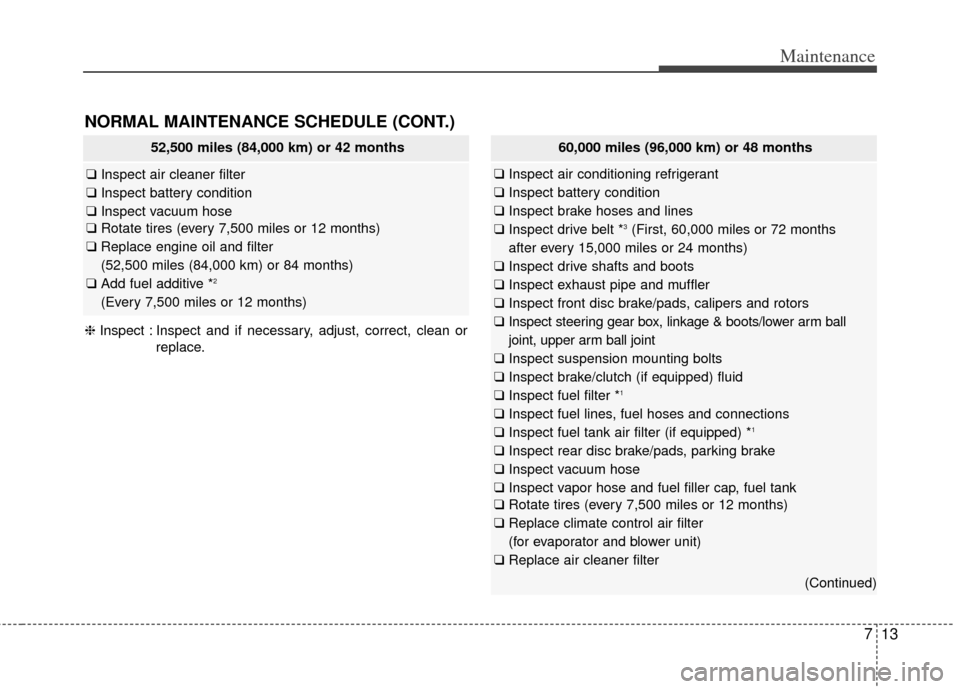
NORMAL MAINTENANCE SCHEDULE (CONT.)
52,500 miles (84,000 km) or 42 months
❑Inspect air cleaner filter
❑ Inspect battery condition
❑ Inspect vacuum hose
❑ Rotate tires (every 7,500 miles or 12 months)
❑ Replace engine oil and filter
(52,500 miles (84,000 km) or 84 months)
❑ Add fuel additive *
2
(Every 7,500 miles or 12 months)
❈ Inspect : Inspect and if necessary, adjust, correct, clean or
replace.
60,000 miles (96,000 km) or 48 months
❑Inspect air conditioning refrigerant
❑ Inspect battery condition
❑ Inspect brake hoses and lines
❑ Inspect drive belt *
3 (First, 60,000 miles or 72 months
after every 15,000 miles or 24 months)
❑ Inspect drive shafts and boots
❑ Inspect exhaust pipe and muffler
❑ Inspect front disc brake/pads, calipers and rotors
❑ Inspect steering gear box, linkage & boots/lower arm ball
joint, upper arm ball joint
❑ Inspect suspension mounting bolts
❑ Inspect brake/clutch (if equipped) fluid
❑ Inspect fuel filter *
1
❑Inspect fuel lines, fuel hoses and connections
❑ Inspect fuel tank air filter (if equipped) *1
❑Inspect rear disc brake/pads, parking brake
❑ Inspect vacuum hose
❑ Inspect vapor hose and fuel filler cap, fuel tank
❑ Rotate tires (every 7,500 miles or 12 months)
❑ Replace climate control air filter
(for evaporator and blower unit)
❑ Replace air cleaner filter
(Continued)
Page 428 of 517
Maintenance
16
7
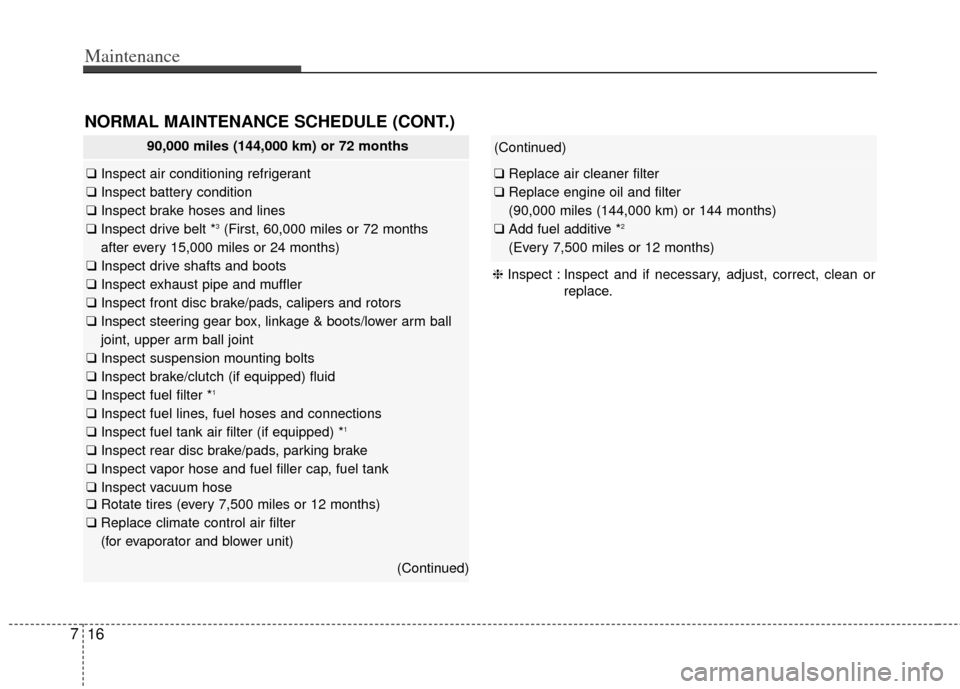
90,000 miles (144,000 km) or 72 months
❑ Inspect air conditioning refrigerant
❑ Inspect battery condition
❑ Inspect brake hoses and lines
❑ Inspect drive belt *
3 (First, 60,000 miles or 72 months
after every 15,000 miles or 24 months)
❑ Inspect drive shafts and boots
❑ Inspect exhaust pipe and muffler
❑ Inspect front disc brake/pads, calipers and rotors
❑ Inspect steering gear box, linkage & boots/lower arm ball
joint, upper arm ball joint
❑ Inspect suspension mounting bolts
❑ Inspect brake/clutch (if equipped) fluid
❑ Inspect fuel filter *
1
❑Inspect fuel lines, fuel hoses and connections
❑ Inspect fuel tank air filter (if equipped) *1
❑Inspect rear disc brake/pads, parking brake
❑ Inspect vapor hose and fuel filler cap, fuel tank
❑ Inspect vacuum hose
❑ Rotate tires (every 7,500 miles or 12 months)
❑ Replace climate control air filter
(for evaporator and blower unit)
(Continued)
(Continued)
❑ Replace air cleaner filter
❑ Replace engine oil and filter
(90,000 miles (144,000 km) or 144 months)
❑ Add fuel additive *
2
(Every 7,500 miles or 12 months)
NORMAL MAINTENANCE SCHEDULE (CONT.)
❈ Inspect : Inspect and if necessary, adjust, correct, clean or
replace.
Page 431 of 517
719
Maintenance
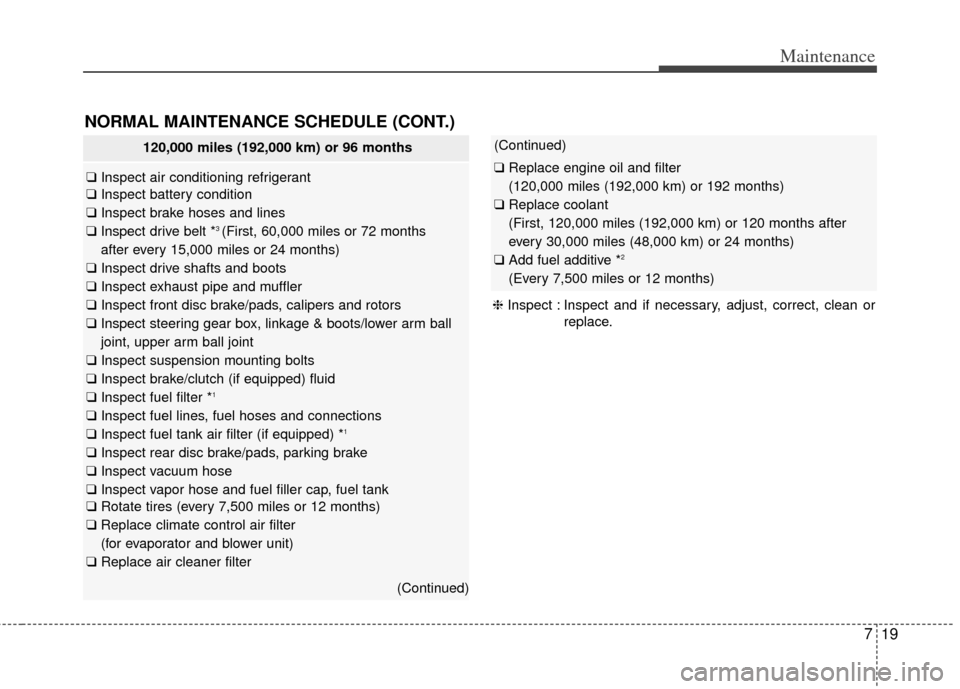
NORMAL MAINTENANCE SCHEDULE (CONT.)
120,000 miles (192,000 km) or 96 months
❑Inspect air conditioning refrigerant
❑ Inspect battery condition
❑ Inspect brake hoses and lines
❑ Inspect drive belt *
3 (First, 60,000 miles or 72 months
after every 15,000 miles or 24 months)
❑ Inspect drive shafts and boots
❑ Inspect exhaust pipe and muffler
❑ Inspect front disc brake/pads, calipers and rotors
❑ Inspect steering gear box, linkage & boots/lower arm ball
joint, upper arm ball joint
❑ Inspect suspension mounting bolts
❑ Inspect brake/clutch (if equipped) fluid
❑ Inspect fuel filter *
1
❑Inspect fuel lines, fuel hoses and connections
❑ Inspect fuel tank air filter (if equipped) *1
❑Inspect rear disc brake/pads, parking brake
❑ Inspect vacuum hose
❑ Inspect vapor hose and fuel filler cap, fuel tank
❑ Rotate tires (every 7,500 miles or 12 months)
❑ Replace climate control air filter
(for evaporator and blower unit)
❑ Replace air cleaner filter
(Continued)
(Continued)
❑Replace engine oil and filter
(120,000 miles (192,000 km) or 192 months)
❑ Replace coolant
(First, 120,000 miles (192,000 km) or 120 months after
every 30,000 miles (48,000 km) or 24 months)
❑ Add fuel additive *
2
(Every 7,500 miles or 12 months)
❈ Inspect : Inspect and if necessary, adjust, correct, clean or
replace.
Page 433 of 517
721
Maintenance
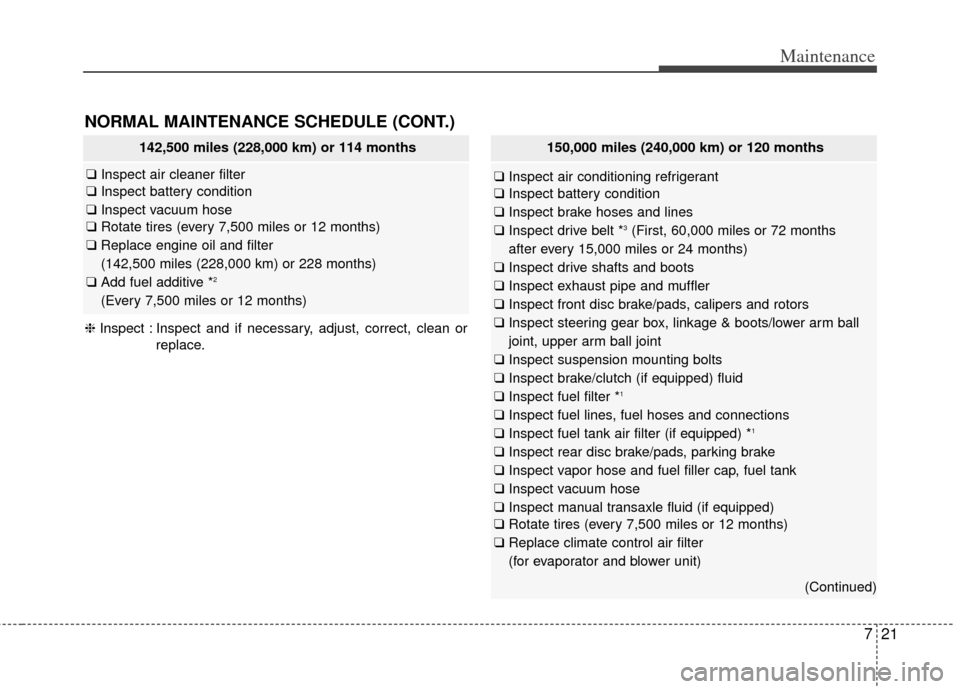
NORMAL MAINTENANCE SCHEDULE (CONT.)
❈Inspect : Inspect and if necessary, adjust, correct, clean or
replace.
142,500 miles (228,000 km) or 114 months
❑Inspect air cleaner filter
❑ Inspect battery condition
❑ Inspect vacuum hose
❑ Rotate tires (every 7,500 miles or 12 months)
❑ Replace engine oil and filter
(142,500 miles (228,000 km) or 228 months)
❑ Add fuel additive *
2
(Every 7,500 miles or 12 months)
150,000 miles (240,000 km) or 120 months
❑ Inspect air conditioning refrigerant
❑ Inspect battery condition
❑ Inspect brake hoses and lines
❑ Inspect drive belt *
3 (First, 60,000 miles or 72 months
after every 15,000 miles or 24 months)
❑ Inspect drive shafts and boots
❑ Inspect exhaust pipe and muffler
❑ Inspect front disc brake/pads, calipers and rotors
❑ Inspect steering gear box, linkage & boots/lower arm ball
joint, upper arm ball joint
❑ Inspect suspension mounting bolts
❑ Inspect brake/clutch (if equipped) fluid
❑ Inspect fuel filter *
1
❑Inspect fuel lines, fuel hoses and connections
❑ Inspect fuel tank air filter (if equipped) *1
❑Inspect rear disc brake/pads, parking brake
❑ Inspect vapor hose and fuel filler cap, fuel tank
❑ Inspect vacuum hose
❑ Inspect manual transaxle fluid (if equipped)
❑ Rotate tires (every 7,500 miles or 12 months)
❑ Replace climate control air filter
(for evaporator and blower unit)
(Continued)
Page 437 of 517
725
Maintenance
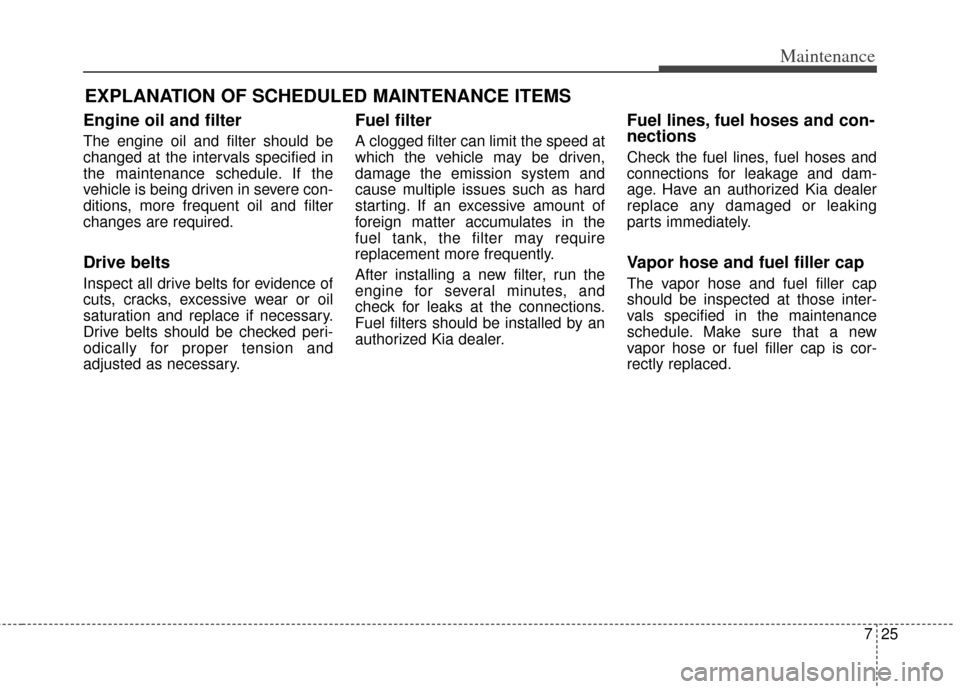
EXPLANATION OF SCHEDULED MAINTENANCE ITEMS
Engine oil and filter
The engine oil and filter should be
changed at the intervals specified in
the maintenance schedule. If the
vehicle is being driven in severe con-
ditions, more frequent oil and filter
changes are required.
Drive belts
Inspect all drive belts for evidence of
cuts, cracks, excessive wear or oil
saturation and replace if necessary.
Drive belts should be checked peri-
odically for proper tension and
adjusted as necessary.
Fuel filter
A clogged filter can limit the speed at
which the vehicle may be driven,
damage the emission system and
cause multiple issues such as hard
starting. If an excessive amount of
foreign matter accumulates in the
fuel tank, the filter may require
replacement more frequently.
After installing a new filter, run the
engine for several minutes, and
check for leaks at the connections.
Fuel filters should be installed by an
authorized Kia dealer.
Fuel lines, fuel hoses and con-
nections
Check the fuel lines, fuel hoses and
connections for leakage and dam-
age. Have an authorized Kia dealer
replace any damaged or leaking
parts immediately.
Vapor hose and fuel filler cap
The vapor hose and fuel filler cap
should be inspected at those inter-
vals specified in the maintenance
schedule. Make sure that a new
vapor hose or fuel filler cap is cor-
rectly replaced.
Page 459 of 517
747
Maintenance
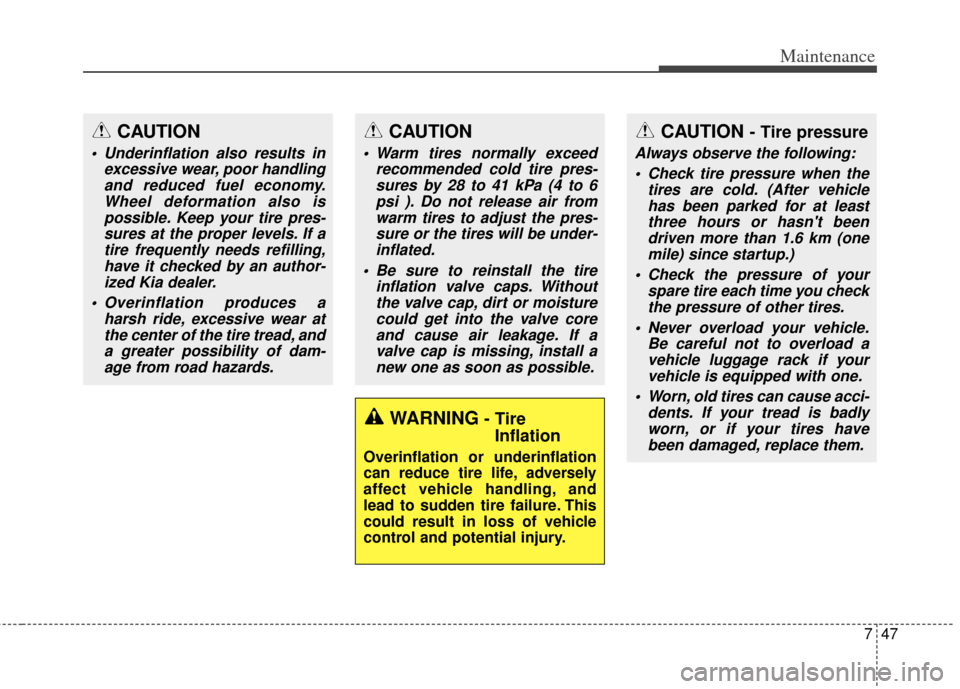
CAUTION
Underinflation also results inexcessive wear, poor handlingand reduced fuel economy.Wheel deformation also ispossible. Keep your tire pres-sures at the proper levels. If atire frequently needs refilling,have it checked by an author-ized Kia dealer.
Overinflation produces a harsh ride, excessive wear atthe center of the tire tread, anda greater possibility of dam-age from road hazards.
WARNING- Tire Inflation
Overinflation or underinflation
can reduce tire life, adversely
affect vehicle handling, and
lead to sudden tire failure. This
could result in loss of vehicle
control and potential injury.
CAUTION - Tire pressure
Always observe the following:
Check tire pressure when the tires are cold. (After vehiclehas been parked for at leastthree hours or hasn't beendriven more than 1.6 km (onemile) since startup.)
Check the pressure of your spare tire each time you checkthe pressure of other tires.
Never overload your vehicle. Be careful not to overload avehicle luggage rack if yourvehicle is equipped with one.
Worn, old tires can cause acci- dents. If your tread is badlyworn, or if your tires havebeen damaged, replace them.
CAUTION
Warm tires normally exceed recommended cold tire pres-sures by 28 to 41 kPa (4 to 6psi ). Do not release air fromwarm tires to adjust the pres-sure or the tires will be under-inflated.
Be sure to reinstall the tire inflation valve caps. Withoutthe valve cap, dirt or moisturecould get into the valve coreand cause air leakage. If avalve cap is missing, install anew one as soon as possible.
Page 469 of 517
757
Maintenance
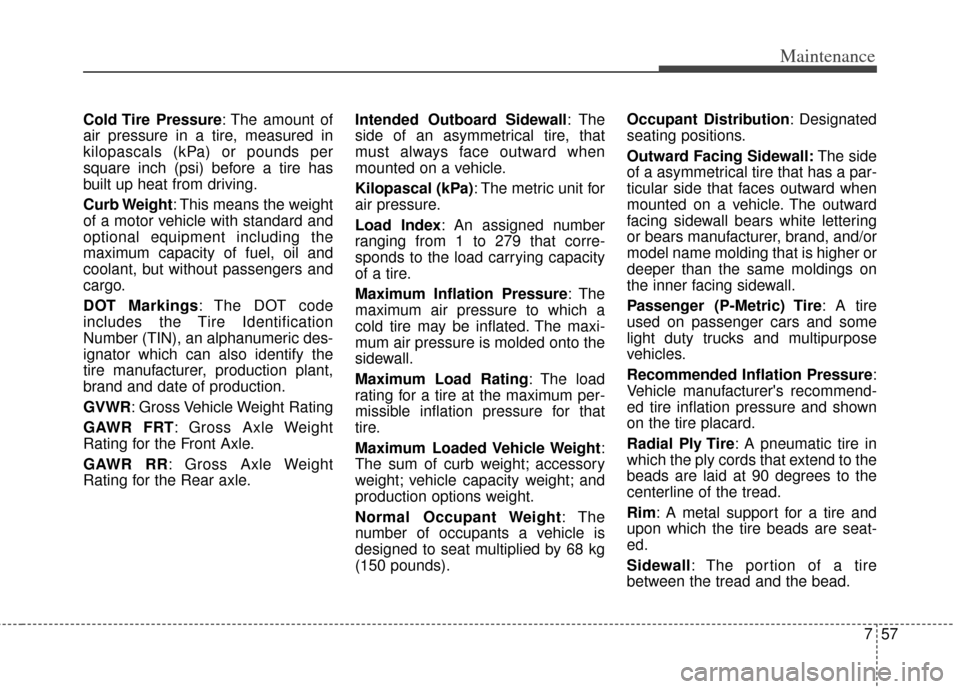
Cold Tire Pressure: The amount of
air pressure in a tire, measured in
kilopascals (kPa) or pounds per
square inch (psi) before a tire has
built up heat from driving.
Curb Weight: This means the weight
of a motor vehicle with standard and
optional equipment including the
maximum capacity of fuel, oil and
coolant, but without passengers and
cargo.
DOT Markings: The DOT code
includes the Tire Identification
Number (TIN), an alphanumeric des-
ignator which can also identify the
tire manufacturer, production plant,
brand and date of production.
GVWR: Gross Vehicle Weight Rating
GAWR FRT: Gross Axle Weight
Rating for the Front Axle.
GAWR RR: Gross Axle Weight
Rating for the Rear axle.Intended Outboard Sidewall
: The
side of an asymmetrical tire, that
must always face outward when
mounted on a vehicle.
Kilopascal (kPa): The metric unit for
air pressure.
Load Index: An assigned number
ranging from 1 to 279 that corre-
sponds to the load carrying capacity
of a tire.
Maximum Inflation Pressure: The
maximum air pressure to which a
cold tire may be inflated. The maxi-
mum air pressure is molded onto the
sidewall.
Maximum Load Rating : The load
rating for a tire at the maximum per-
missible inflation pressure for that
tire.
Maximum Loaded Vehicle Weight:
The sum of curb weight; accessory
weight; vehicle capacity weight; and
production options weight.
Normal Occupant Weight:The
number of occupants a vehicle is
designed to seat multiplied by 68 kg
(150 pounds). Occupant Distribution
: Designated
seating positions.
Outward Facing Sidewall: The side
of a asymmetrical tire that has a par-
ticular side that faces outward when
mounted on a vehicle. The outward
facing sidewall bears white lettering
or bears manufacturer, brand, and/or
model name molding that is higher or
deeper than the same moldings on
the inner facing sidewall.
Passenger (P-Metric) Tire : A tire
used on passenger cars and some
light duty trucks and multipurpose
vehicles.
Recommended Inflation Pressure :
Vehicle manufacturer's recommend-
ed tire inflation pressure and shown
on the tire placard.
Radial Ply Tire : A pneumatic tire in
which the ply cords that extend to the
beads are laid at 90 degrees to the
centerline of the tread.
Rim: A metal support for a tire and
upon which the tire beads are seat-
ed.
Sidewall: The portion of a tire
between the tread and the bead.
Page 494 of 517
Maintenance
82
7
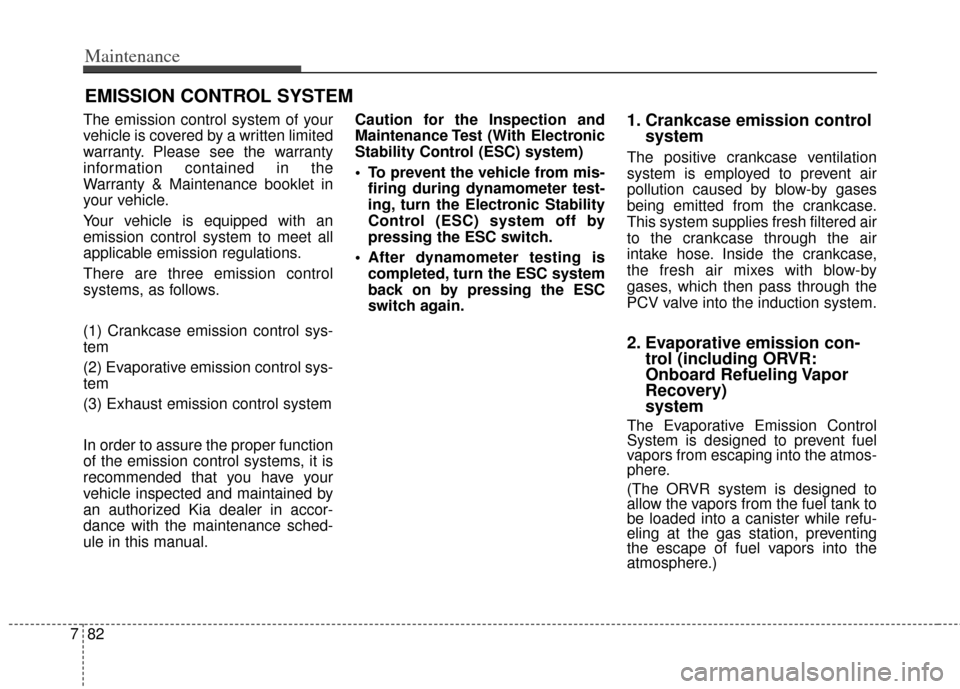
EMISSION CONTROL SYSTEM
The emission control system of your
vehicle is covered by a written limited
warranty. Please see the warranty
information contained in the
Warranty & Maintenance booklet in
your vehicle.
Your vehicle is equipped with an
emission control system to meet all
applicable emission regulations.
There are three emission control
systems, as follows.
(1) Crankcase emission control sys-
tem
(2) Evaporative emission control sys-
tem
(3) Exhaust emission control system
In order to assure the proper function
of the emission control systems, it is
recommended that you have your
vehicle inspected and maintained by
an authorized Kia dealer in accor-
dance with the maintenance sched-
ule in this manual. Caution for the Inspection and
Maintenance Test (With Electronic
Stability Control (ESC) system)
To prevent the vehicle from mis-
firing during dynamometer test-
ing, turn the Electronic Stability
Control (ESC) system off by
pressing the ESC switch.
After dynamometer testing is completed, turn the ESC system
back on by pressing the ESC
switch again.1. Crankcase emission control system
The positive crankcase ventilation
system is employed to prevent air
pollution caused by blow-by gases
being emitted from the crankcase.
This system supplies fresh filtered air
to the crankcase through the air
intake hose. Inside the crankcase,
the fresh air mixes with blow-by
gases, which then pass through the
PCV valve into the induction system.
2. Evaporative emission con-trol (including ORVR:
Onboard Refueling Vapor
Recovery)
system
The Evaporative Emission Control
System is designed to prevent fuel
vapors from escaping into the atmos-
phere.
(The ORVR system is designed to
allow the vapors from the fuel tank to
be loaded into a canister while refu-
eling at the gas station, preventing
the escape of fuel vapors into the
atmosphere.)
Page 503 of 517
Specifications & Consumer information
68
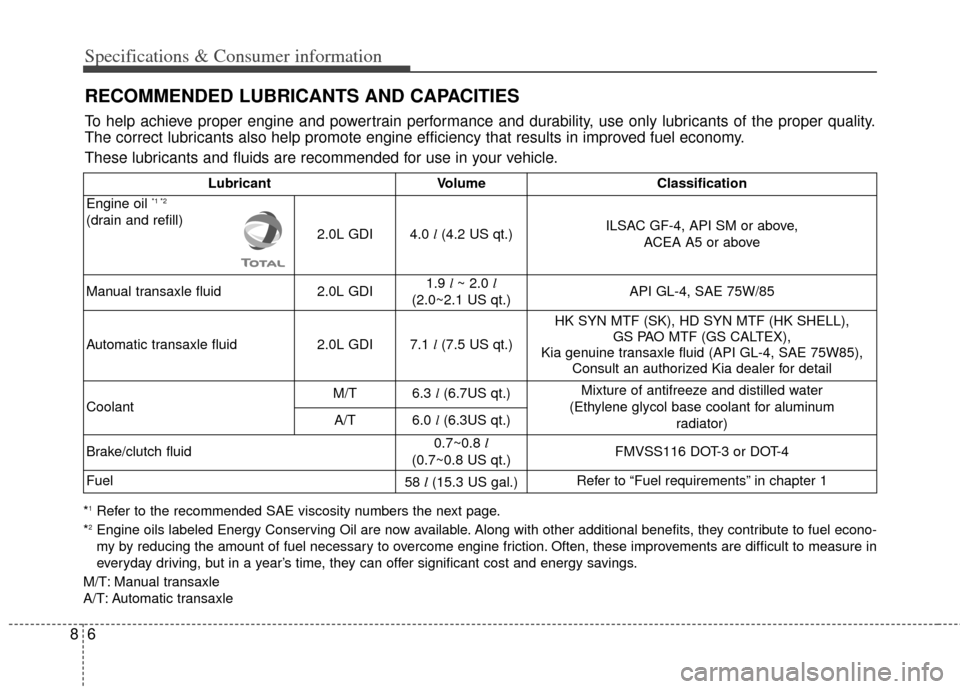
RECOMMENDED LUBRICANTS AND CAPACITIES
To help achieve proper engine and powertrain performance and durability, use only lubricants of the proper quality.
The correct lubricants also help promote engine efficiency that results in improved fuel economy.
These lubricants and fluids are recommended for use in your vehicle.
LubricantVolume Classification
Engine oil
*1 *2
(drain and refill) 2.0L GDI4.0
l(4.2 US qt.) ILSAC GF-4, API SM or above,
ACEA A5 or above
Manual transaxle fluid 2.0L GDI 1.9
l ~ 2.0 l
(2.0~2.1 US qt.) API GL-4, SAE 75W/85
Automatic transaxle fluid 2.0L GDI7.1
l(7.5 US qt.)
HK SYN MTF (SK), HD SYN MTF (HK SHELL),
GS PAO MTF (GS CALTEX),
Kia genuine transaxle fluid (API GL-4, SAE 75W85), Consult an authorized Kia dealer for detail
Coolant M/T
6.3
l(6.7US qt.) Mixture of antifreeze and distilled water
(Ethylene glycol base coolant for aluminum radiator)
A/T6.0l(6.3US qt.)
Brake/clutch fluid 0.7~0.8
l
(0.7~0.8 US qt.) FMVSS116 DOT-3 or DOT-4
Fuel58
l (15.3 US gal.)Refer to “Fuel requirements” in chapter 1
*1Refer to the recommended SAE viscosity numbers the next page.
*2Engine oils labeled Energy Conserving Oil are now available. Along with other additional benefits, they contribute to fuel econo -
my by reducing the amount of fuel necessary to overcome engine friction. Often, these improvements are difficult to measure in
everyday driving, but in a year’s time, they can offer significant cost and energy savings.
M/T: Manual transaxle
A/T: Automatic transaxle