ECU KIA Carens 2017 3.G User Guide
[x] Cancel search | Manufacturer: KIA, Model Year: 2017, Model line: Carens, Model: KIA Carens 2017 3.GPages: 625, PDF Size: 19.69 MB
Page 56 of 625
Safety features of your vehicle
40
3
Do not lie down
To reduce the chance of injuries in
the event of an accident and to
achieve maximum effectiveness of
the restraint system, all passengers
should be sitting up and the front and
rear seats should be in an upright
position when the vehicle is moving.
A seat belt cannot provide proper
protection if the person is lying down
in the rear seat or if the front and rear
seats are in a reclined position.
Care of seat belts
Seat belt systems should never be
disassembled or modified. In addi-
tion, care should be taken to assure
that seat belts and belt hardware are
not damaged by seat hinges, doors
or other abuse.WARNING
Riding with a reclined seatback
increases your chance of seri-
ous or fatal injuries in the event
of a collision or sudden stop.
The protection of your restraint
system (seat belts and air bags)
is greatly reduced by reclining
your seat. Seat belts must be
secured against your hips and
chest to work properly. The
more the seatback is reclined,
the greater the chance an occu-
pant's hips will slide under the
lap belt causing serious internal
injuries. Also, the shoulder belt
may strike the occupant's neck.
Drivers and passengers should
always sit well back in their
seats, properly belted, and with
the seatbacks upright.
Page 58 of 625
Safety features of your vehicle
42
3
CHILD RESTRAINT SYSTEM
Children riding in the car should sit in
the rear seat and must always be
properly restrained to minimize the
risk of injury in an accident, sudden
stop or sudden maneuver. According
to accident statistics, children are
safer when properly restrained in the
rear seats than in the front seat.
Larger children who are not in a child
restraint should use one of the seat
belts provided.
You should be aware of the specific
requirements in your country. Child
and/or infant safety seats must be
properly placed and installed in the
rear seat. You must use a commer-
cially available child restraint system
that meets the requirements of the
safety standards of your country.
Child restraint systems are designed
to be secured in vehicle seats by
seat belt, or by a tether anchor
and/or LATCH anchors (if equipped). Children could be injured or killed in
a crash if their restraints are not
properly secured. For small children
and babies, a child seat or infant seat
must be used. Before buying a par-
ticular child restraint system, make
sure it fits your car seat and seat
belts, and fits your child. Follow all
the instructions provided by the man-
ufacturer when installing the child
restraint system.
When the child restraint system is
not in use, store it in the luggage
area or fasten it with a seat belt so
that it will not be thrown forward in
case of a sudden stop or an acci-
dent.
WARNING- Restraint location
Never install a child or infant
seat on the front passenger's
seat.
A child riding in the front pas-
senger seat can be forcefully
struck by an inflating airbag.
WARNING- Hot child restraint
A child restraint in a closed
vehicle can become very hot.
To prevent burns, check the
seating surface and buckles
before placing your child in the
child restraint.
Page 59 of 625
343
Safety features of your vehicle
Using a child restraint system
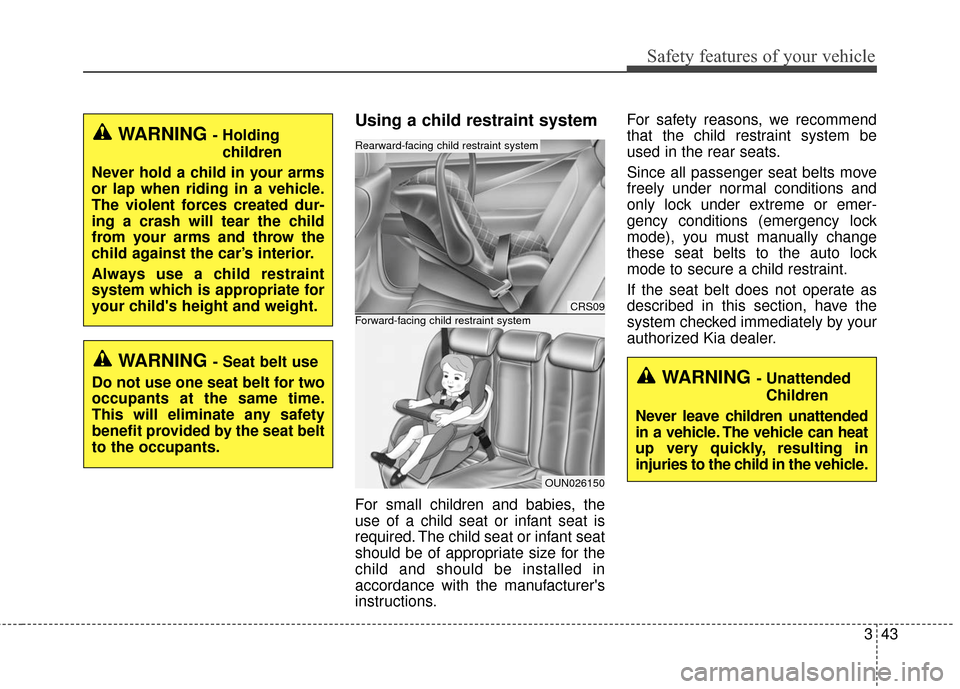
For small children and babies, the
use of a child seat or infant seat is
required. The child seat or infant seat
should be of appropriate size for the
child and should be installed in
accordance with the manufacturer's
instructions.For safety reasons, we recommend
that the child restraint system be
used in the rear seats.
Since all passenger seat belts move
freely under normal conditions and
only lock under extreme or emer-
gency conditions (emergency lock
mode), you must manually change
these seat belts to the auto lock
mode to secure a child restraint.
If the seat belt does not operate as
described in this section, have the
system checked immediately by your
authorized Kia dealer.
CRS09
OUN026150
Forward-facing child restraint system
Rearward-facing child restraint systemWARNING - Holding
children
Never hold a child in your arms
or lap when riding in a vehicle.
The violent forces created dur-
ing a crash will tear the child
from your arms and throw the
child against the car’s interior.
Always use a child restraint
system which is appropriate for
your child's height and weight.
WARNING - Seat belt use
Do not use one seat belt for two
occupants at the same time.
This will eliminate any safety
benefit provided by the seat belt
to the occupants.
WARNING - Unattended Children
Never leave children unattended
in a vehicle. The vehicle can heat
up very quickly, resulting in
injuries to the child in the vehicle.
Page 60 of 625
Safety features of your vehicle
44
3
✽ ✽
NOTICE
If the vehicle headrest prevents
proper installation of a child seat (as
described in the child seat system
manual), the headrest of the respec-
tive seating position shall be read-
justed or entirely removed.
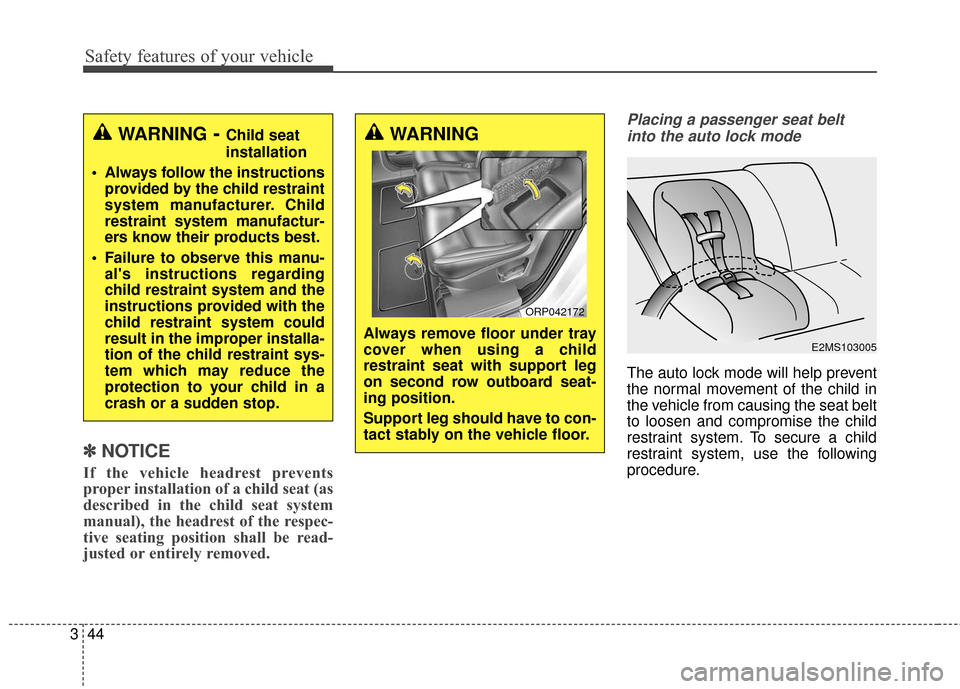
Placing a passenger seat belt
into the auto lock mode
The auto lock mode will help prevent
the normal movement of the child in
the vehicle from causing the seat belt
to loosen and compromise the child
restraint system. To secure a child
restraint system, use the following
procedure.
WARNING- Child seat
installation
Always follow the instructions provided by the child restraint
system manufacturer. Child
restraint system manufactur-
ers know their products best.
Failure to observe this manu- al's instructions regarding
child restraint system and the
instructions provided with the
child restraint system could
result in the improper installa-
tion of the child restraint sys-
tem which may reduce the
protection to your child in a
crash or a sudden stop.
E2MS103005
WARNING
Always remove floor under tray
cover when using a child
restraint seat with support leg
on second row outboard seat-
ing position.
Support leg should have to con-
tact stably on the vehicle floor.
ORP042172
Page 63 of 625
347
Safety features of your vehicle
Securing a child restraint seatwith tether anchor system
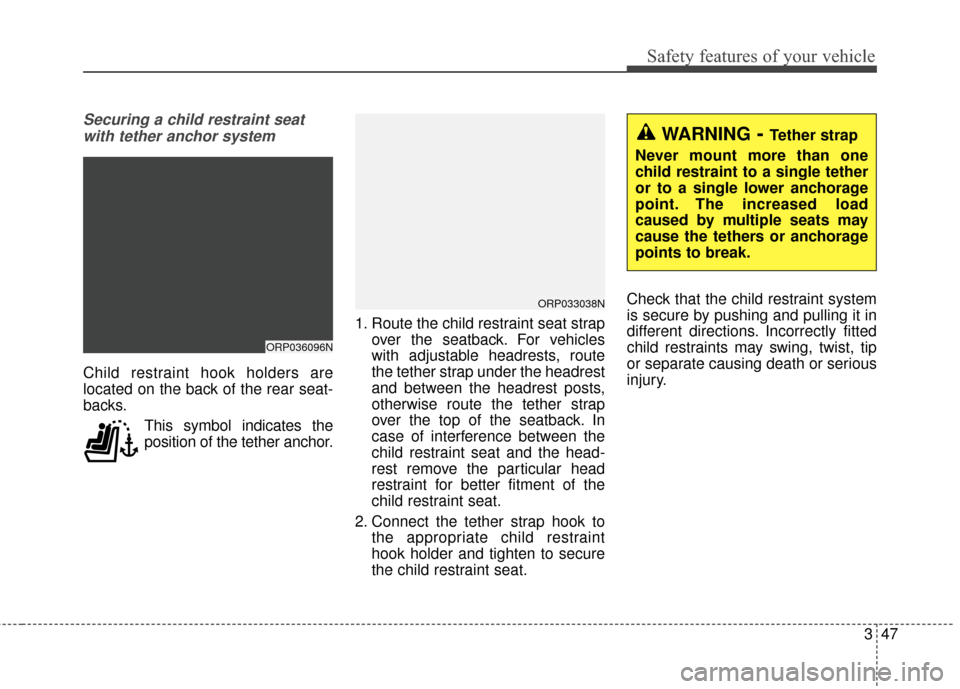
Child restraint hook holders are
located on the back of the rear seat-
backs.
This symbol indicates the
position of the tether anchor. 1. Route the child restraint seat strap
over the seatback. For vehicles
with adjustable headrests, route
the tether strap under the headrest
and between the headrest posts,
otherwise route the tether strap
over the top of the seatback. In
case of interference between the
child restraint seat and the head-
rest remove the particular head
restraint for better fitment of the
child restraint seat.
2. Connect the tether strap hook to the appropriate child restraint
hook holder and tighten to secure
the child restraint seat. Check that the child restraint system
is secure by pushing and pulling it in
different directions. Incorrectly fitted
child restraints may swing, twist, tip
or separate causing death or serious
injury.
ORP036096N
ORP033038N
WARNING- Tether strap
Never mount more than one
child restraint to a single tether
or to a single lower anchorage
point. The increased load
caused by multiple seats may
cause the tethers or anchorage
points to break.
Page 64 of 625
Safety features of your vehicle
48
3
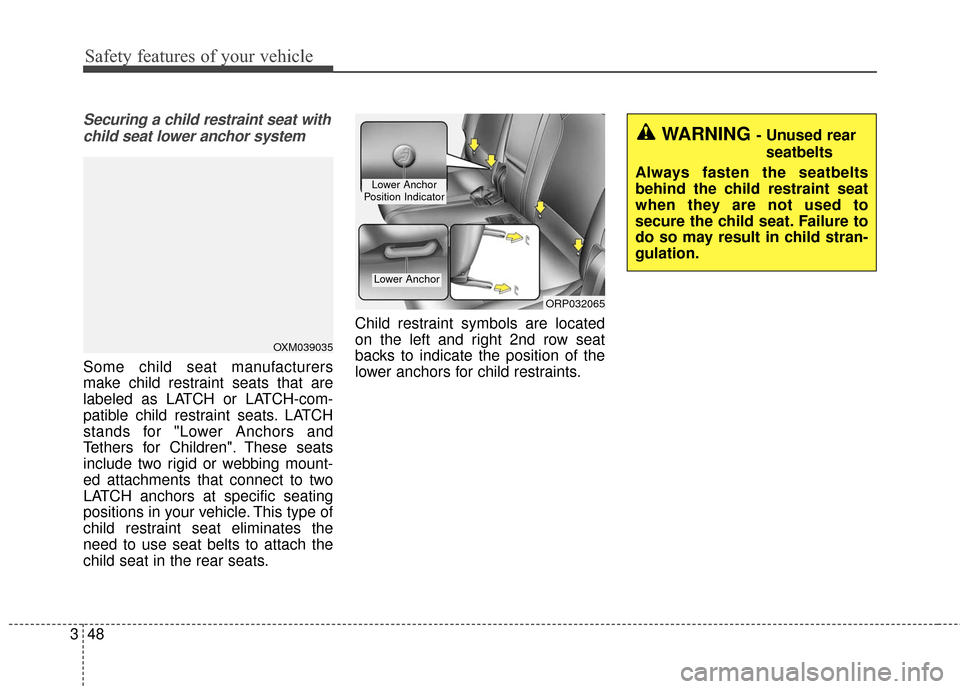
Securing a child restraint seat with
child seat lower anchor system
Some child seat manufacturers
make child restraint seats that are
labeled as LATCH or LATCH-com-
patible child restraint seats. LATCH
stands for "Lower Anchors and
Tethers for Children". These seats
include two rigid or webbing mount-
ed attachments that connect to two
LATCH anchors at specific seating
positions in your vehicle. This type of
child restraint seat eliminates the
need to use seat belts to attach the
child seat in the rear seats. Child restraint symbols are located
on the left and right 2nd row seat
backs to indicate the position of the
lower anchors for child restraints.
ORP032065
Lower Anchor
Lower Anchor
Position Indicator
OXM039035
WARNING - Unused rear seatbelts
Always fasten the seatbelts
behind the child restraint seat
when they are not used to
secure the child seat. Failure to
do so may result in child stran-
gulation.
Page 69 of 625
353
Safety features of your vehicle
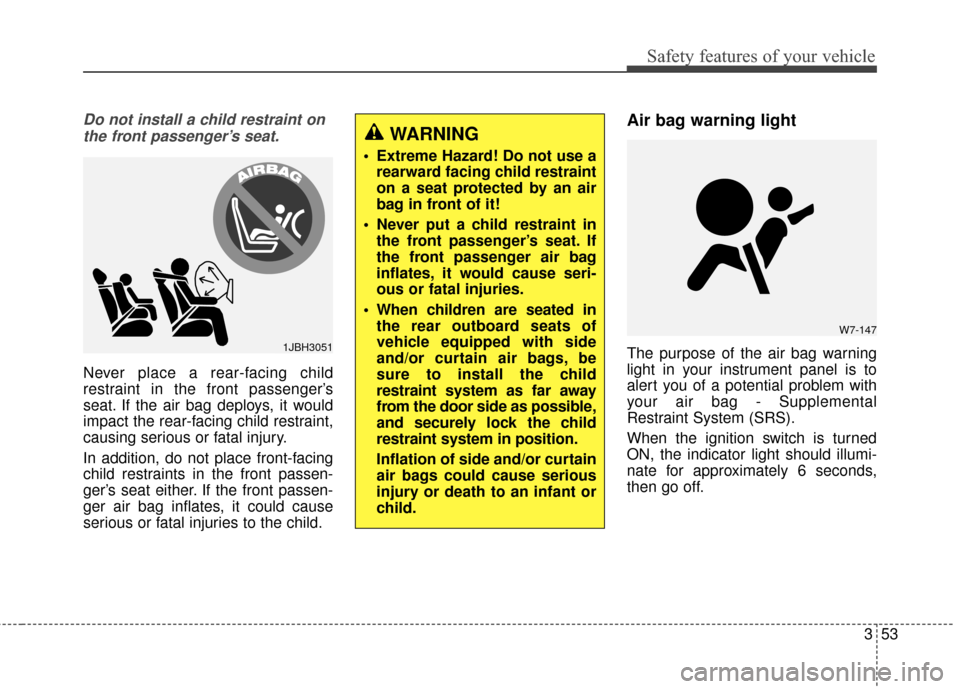
Do not install a child restraint onthe front passenger’s seat.
Never place a rear-facing child
restraint in the front passenger’s
seat. If the air bag deploys, it would
impact the rear-facing child restraint,
causing serious or fatal injury.
In addition, do not place front-facing
child restraints in the front passen-
ger’s seat either. If the front passen-
ger air bag inflates, it could cause
serious or fatal injuries to the child.
Air bag warning light
The purpose of the air bag warning
light in your instrument panel is to
alert you of a potential problem with
your air bag - Supplemental
Restraint System (SRS).
When the ignition switch is turned
ON, the indicator light should illumi-
nate for approximately 6 seconds,
then go off.1JBH3051
WARNING
Extreme Hazard! Do not use a rearward facing child restraint
on a seat protected by an air
bag in front of it!
Never put a child restraint in the front passenger’s seat. If
the front passenger air bag
inflates, it would cause seri-
ous or fatal injuries.
When children are seated in the rear outboard seats of
vehicle equipped with side
and/or curtain air bags, be
sure to install the child
restraint system as far away
from the door side as possible,
and securely lock the child
restraint system in position.
Inflation of side and/or curtain
air bags could cause serious
injury or death to an infant or
child.
W7-147
Page 80 of 625
Safety features of your vehicle
64
3
(Continued)
Do not modify or replace the
front passenger seat. Don't
place anything on or attach any-
thing such as a blanket or seat
heater to the front passenger
seat. This can adversely affect
the occupant detection system.
Do not place sharp objects on the front passenger seat.
These may damage the occu-
pant detection system, if they
puncture the seat cushion.
Do not use accessory seat covers on the front seats.
Accident statistics show that children are safer if they are
restrained in the rear, as
opposed to the front seat. It is
recommended that child
restraints be secured in a rear
seat, including an infant riding
in a rear-facing infant seat, a
child riding in a forward-fac-
ing child seat and an older
child riding in a booster seat.
(Continued)(Continued)
Air bags can only be usedonce - have an authorized Kia
dealer replace the air bag
immediately after deployment.
The occupant detection sys- tem may not work properly if
water, coffee or any other liq-
uid including rain gets on the
seat. Keep the front seat dry
at all times.
Do not place an electronic device (ex. laptop computer,
after market DMB/navigation/
satellite audio, video game
machine, MP3, etc.) on the
front passenger seat. Its elec-
tronic field may cause the
ODS to switch to the "on" con-
dition and thus turn on the air
bag warning light or allow the
passenger air bag to deploy
needlessly in a collision,
increasing your repair costs.WARNING
If the occupant detection sys-
tem is not working properly, the
SRS air bag warning light on
the instrument panel will illumi-
nate because the passenger's
front air bag is connected with
the occupant detection system.
If there is a malfunction of the
occupant detection system, the
PASSENGER AIR BAG “OFF”
indicator will not illuminate and
the passenger's front air bag
will inflate in frontal impact
crashes even if there is no
occupant in the front passen-
ger's seat.
(Continued)
Page 89 of 625
373
Safety features of your vehicle
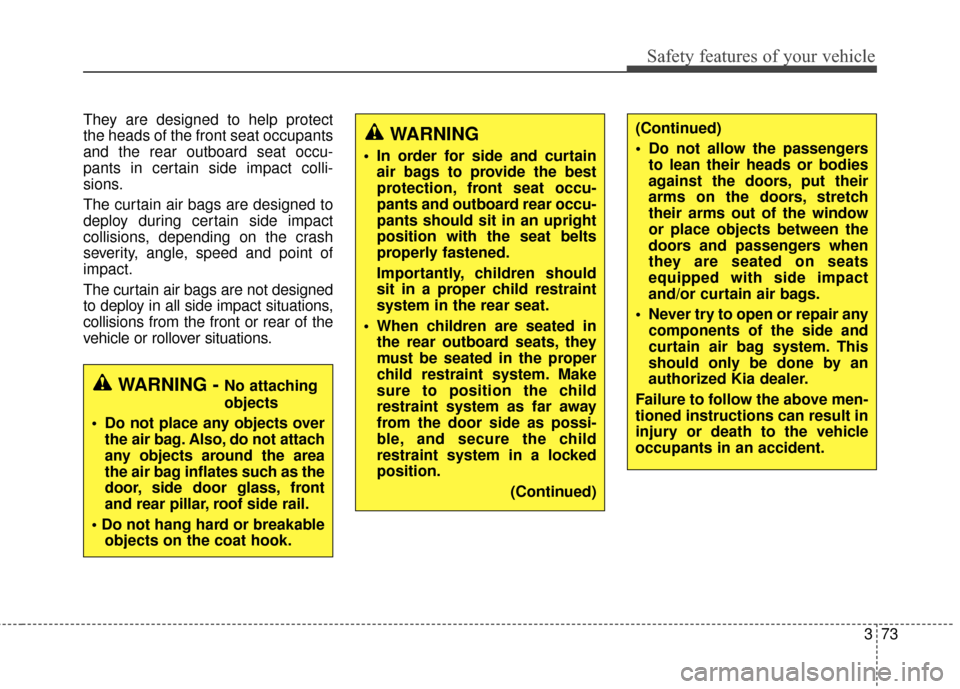
They are designed to help protect
the heads of the front seat occupants
and the rear outboard seat occu-
pants in certain side impact colli-
sions.
The curtain air bags are designed to
deploy during certain side impact
collisions, depending on the crash
severity, angle, speed and point of
impact.
The curtain air bags are not designed
to deploy in all side impact situations,
collisions from the front or rear of the
vehicle or rollover situations.
WARNING
In order for side and curtainair bags to provide the best
protection, front seat occu-
pants and outboard rear occu-
pants should sit in an upright
position with the seat belts
properly fastened.
Importantly, children should
sit in a proper child restraint
system in the rear seat.
When children are seated in the rear outboard seats, they
must be seated in the proper
child restraint system. Make
sure to position the child
restraint system as far away
from the door side as possi-
ble, and secure the child
restraint system in a locked
position.
(Continued)
(Continued)
Do not allow the passengersto lean their heads or bodies
against the doors, put their
arms on the doors, stretch
their arms out of the window
or place objects between the
doors and passengers when
they are seated on seats
equipped with side impact
and/or curtain air bags.
Never try to open or repair any components of the side and
curtain air bag system. This
should only be done by an
authorized Kia dealer.
Failure to follow the above men-
tioned instructions can result in
injury or death to the vehicle
occupants in an accident.
WARNING - No attaching
objects
Do not place any objects over the air bag. Also, do not attach
any objects around the area
the air bag inflates such as the
door, side door glass, front
and rear pillar, roof side rail.
objects on the coat hook.
Page 118 of 625
421
Features of your vehicle
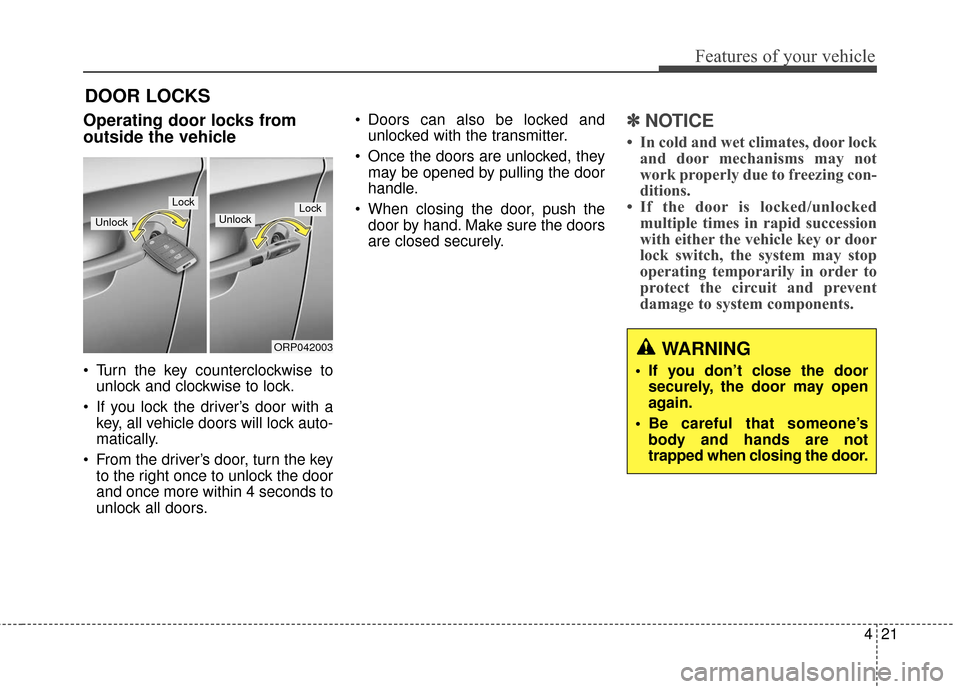
Operating door locks from
outside the vehicle
Turn the key counterclockwise tounlock and clockwise to lock.
If you lock the driver’s door with a key, all vehicle doors will lock auto-
matically.
From the driver’s door, turn the key to the right once to unlock the door
and once more within 4 seconds to
unlock all doors. Doors can also be locked and
unlocked with the transmitter.
Once the doors are unlocked, they may be opened by pulling the door
handle.
When closing the door, push the door by hand. Make sure the doors
are closed securely.
✽ ✽ NOTICE
• In cold and wet climates, door lock
and door mechanisms may not
work properly due to freezing con-
ditions.
• If the door is locked/unlocked multiple times in rapid succession
with either the vehicle key or door
lock switch, the system may stop
operating temporarily in order to
protect the circuit and prevent
damage to system components.
DOOR LOCKS
ORP042003
UnlockUnlock
LockLock
WARNING
If you don’t close the door
securely, the door may open
again.
Be careful that someone’s body and hands are not
trapped when closing the door.